Fungus Gnats on Calathea Roseopicta: Causes, Checks & Fixes
Quick answer
Fungus gnats on Calathea Roseopicta mean the top inch of mix is staying wet too long-not that the plant wants a soggy soil cap. First step: press the top 2 cm of mix; if it feels damp and small black flies hover when you water, pause watering until that layer dries and set a yellow sticky trap at soil level.
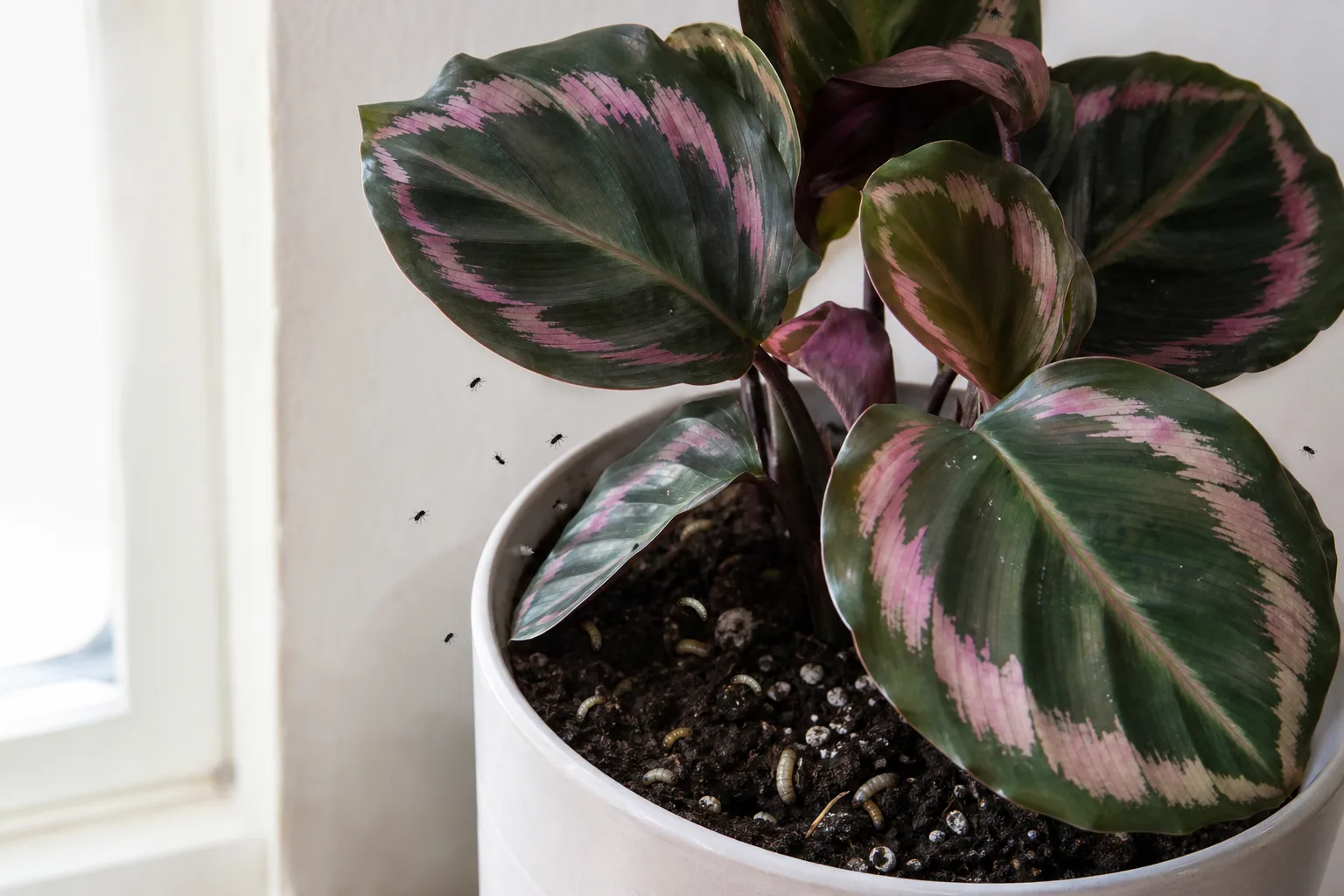
Fungus Gnats on Calathea Roseopicta: Causes, Checks & Fixes
This guide covers fungus gnats on Calathea Roseopicta. See also the general Fungus Gnats guide, watering, and light pages for this plant.
Fungus Gnats on Calathea Roseopicta: Causes, Checks & Fixes
Quick answer
Fungus gnats on Calathea Roseopicta (Goeppertia roseopicta, rose-painted calathea) almost always mean the top layer of your potting mix is staying wet longer than this cultivar can tolerate-even though Roseopicta genuinely needs evenly moist, well-drained soil below. Owners often overwater because the plant is marketed as humidity-loving; gnats are the early warning that you crossed from moist roots to a soggy soil cap.
First step: check the top 2 cm of mix with your finger before you water again. If that layer is still damp and small black flies hover when you move the pot, pause the next drink until the surface feels dry. Set one yellow sticky trap at soil level under the broad painted-leaf rosette to catch egg-laying adults. Do not spray pesticides on thin painted foliage on day one-fix the wet surface first.
For the full Roseopicta watering rhythm, see the Calathea Roseopicta watering guide. If white fuzz appears on the soil at the same time, read mold on soil on Calathea Roseopicta-gnats and surface mold share the same wet-cap cause.
Why Calathea Roseopicta gets fungus gnats
Rose-painted calathea sits in a narrow moisture band. NC State Extension describes it as needing moist, well-drained peaty mix with humidity above 60% and room temperatures around 65–75°F. That profile works when light, warmth, and drainage stay balanced. When any of those slip, the same care setup leaves the surface wet while roots below barely drink-exactly the habitat fungus gnat larvae prefer.
Adult gnats lay eggs in consistently moist organic soil. Larvae feed on fungi, algae, and decaying organic matter in the top 2 to 3 inches of mix and may nibble fine roots when populations are heavy. Roseopicta’s shallow feeder roots and peaty blend hold surface moisture longer than many houseplants, so gnats show up here before owners notice yellow leaves.
These Roseopicta-specific triggers are the usual path from “moist plant” to gnat cloud:
Watering to keep it humid. Misting leaves or running a humidifier does not require wet soil. Calendar watering every five days while the plant sits in a dim winter corner keeps the cap damp even when growth slows.
Dense painted-leaf rosette shading the soil. Cultivars such as Medallion, Dottie, and Rosy form a compact crown whose overlapping broad banded blades slow evaporation at the soil line-especially when the pot lives in a corner with limited airflow.
Peaty mix without enough perlite or bark. Roseopicta wants organic, moisture-holding soil, but compacted peat retains a wet surface cap. See the Calathea Roseopicta soil guide for structure targets.
Cachepots and saucers holding runoff. Decorative outer pots that trap drainage water keep the bottom of the mix saturated and the surface humid. Empty standing water within 30 minutes of every watering.
Winter slowdown with unchanged volume. Colorado State Extension notes that shorter days and cooler rooms slow plant water use; if you keep summer watering volume through fall and winter, the mix stays moist and gnat reproduction accelerates indoors.
Organic debris on the surface. Spent Roseopicta leaves that curl down against the mix decay quickly in a humid room, feeding larvae and surface fungi-the same overlap covered on the mold-on-soil page.
Gnats are a moisture signal, not a random pest invasion from open windows. They tell you the dry-down checkpoint from the watering guide-top 1 to 2 inches beginning to dry between drinks-has been skipped too many times in a row.
What fungus gnats look like on Calathea Roseopicta
On Roseopicta pots, fungus gnats usually announce themselves when you water or shift the container:
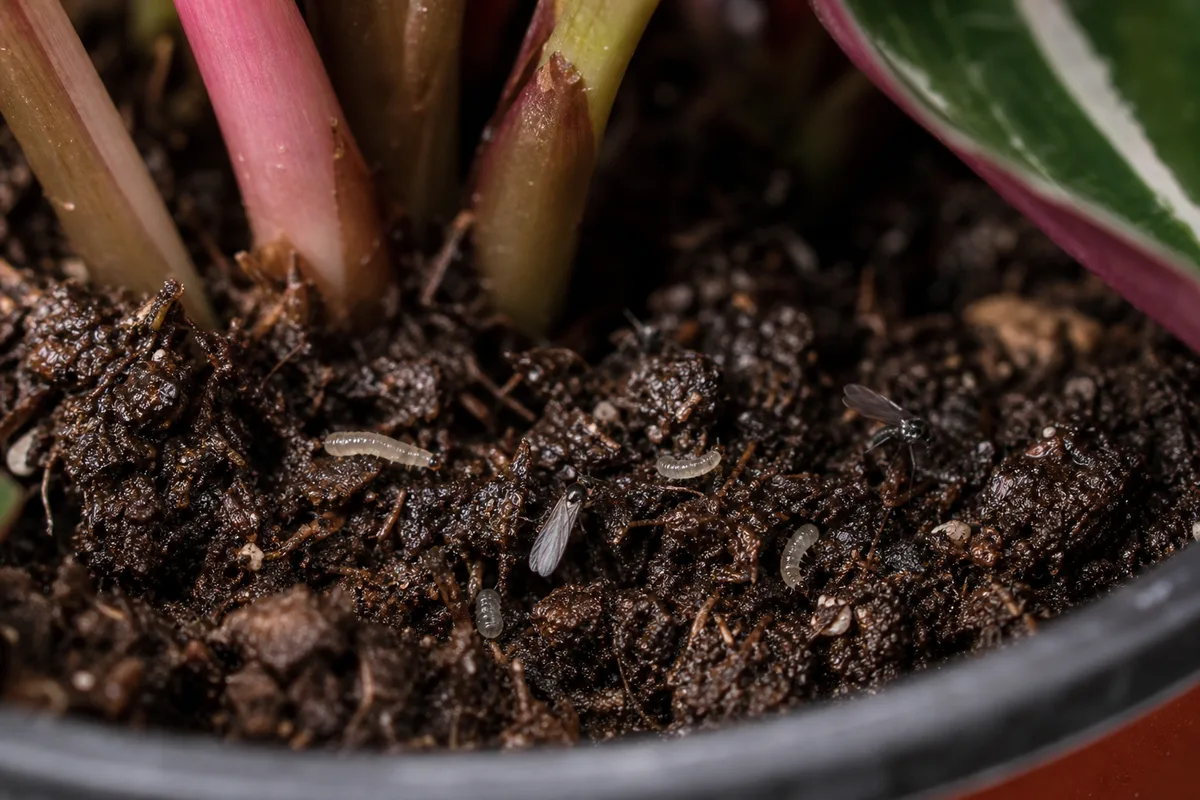
Small black fungus gnats at the damp soil surface under a rose-painted calathea rosette - a sign the top layer is staying wet too long.
- Tiny black flies (about 1/8 inch long) hovering at soil level or rising in a short, erratic cloud when you disturb the mix
- Translucent wormlike larvae with dark head capsules in the top inch of peaty soil-visible if you scrape the surface gently
- Yellow sticky traps at the pot rim catching dozens of adults within a few days
- Musty or damp smell from the soil surface, sometimes alongside white fuzzy mold patches
- Faint stippling or slowed new growth only when larval numbers are high and roots are already stressed
The painted leaves themselves rarely show direct gnat damage. Broad green blades with pink or cream bands and burgundy undersides stay structurally fine unless chronic wetness has already triggered separate problems-yellow lower leaves, black splotches, or crown softness from overwatering. Judge gnat severity by fly counts and soil moisture, not by pattern loss on old foliage.
Adults are weak fliers and tend to stay near the infested pot, though a few may drift to windows. They do not bite. The nuisance is larval feeding in wet mix and the signal that your Roseopicta root zone may be trending too wet for too long.
How to confirm gnats vs other pests
Work through these checks in order before buying sprays or repotting:
- Flight pattern - Gnats hover near damp soil under the rosette. Fruit flies congregate around kitchen fruit or compost bins, not consistently at one houseplant pot.
- Soil tie-in - Flies appear within a day of watering and decrease when the surface has stayed dry for a week. No soil link points away from gnats.
- Larval proof - Insert 1/4-inch potato slices or wedges into the top of the mix. Colorado State Extension recommends checking the underside after a few days for larvae that migrated to feed.
- Surface moisture - Top 2 cm still damp three or more days after watering confirms slow drying-the root cause gnats exploit.
- Pot weight - Heavy pot with a dark wet surface means excess retained water; very light pot with a few gnats may mean old adults on now-appropriate moisture.
- Companion signs - White mold on soil, decaying leaf bits on the surface, or sour smell suggest the same wet-cap problem gnats indicate.
- Stem firmness - Firm crown tissue supports a moisture-and-larval fix. Soft stems at the soil line mean investigate roots before treating gnats alone.
| What you see | Likely cause | Quick check |
|---|---|---|
| Small black flies at soil line only | Fungus gnats | Larvae in top inch; potato slice test |
| Larger tan flies at kitchen fruit | Fruit flies | No larvae in Roseopicta mix |
| Whiteflies on leaf undersides | Whiteflies | Flying when leaves are brushed, not only when soil is disturbed |
| Gnats + yellow limp lower leaves + wet heavy pot | Gnats plus possible root stress | Rhizome firmness; see root rot |
| Gnats + white soil fuzz | Shared wet-cap habitat | Mold-on-soil crossover |
If larvae are present in moist top mix and adults appear after watering, gnats are confirmed. Treat the wet surface and life cycle next-not the painted leaf display.
Check rhizome health before you treat
Roseopicta grows from a compact rhizome at the soil line. Before you stack BTI drenches or repot, confirm the base is still sound:
- Press the crown gently - Firm stems that resist pressure support a dry-down and larval-control path. Mushy or collapsing tissue at the soil line means root-zone trouble beyond gnats alone.
- Lift the pot - Heavy and wet days after the last watering, with limp lower leaves, suggests roots may not be moving water even though gnats are visible.
- Smell the drainage hole - Musty is common with surface organic matter. Sharp sour or swampy odor points toward anaerobic wet mix and possible rot.
- Slide the plant partway out - Only if stems feel soft or yellowing spreads on new leaves. Healthy rhizomes are firm and pale. Mushy brown roots with foul smell mean follow the root rot guide instead of surface fixes alone.
- Watch new growth - A clean rolled leaf emerging with strong pink or cream contrast means the plant still has reserves. Stalled new rolls with persistent gnat clouds and wet soil mean escalate inspection.
Gnat damage to established fine roots is usually minor when caught early. Larvae become a bigger problem when overwatering has already reduced root function-wilting with wet soil is the confusing combo that sends Roseopicta owners in circles.
First fix: dry the surface and break the life cycle
Pause the next watering until the top 1 to 2 inches of mix feel dry, and place a yellow sticky trap at soil level under the leaf rosette.
That single step attacks the problem Roseopicta owners miss: gnats need a continuously moist cap to lay eggs and hatch larvae. UMN Extension lists letting the top layer dry completely before the next drink as the primary cultural control. For Roseopicta, that dry-down is the same checkpoint used in normal care-not a drought stress test for the whole root ball.
After the surface dries:
- Empty cachepots and saucers so no standing water rewets the mix from below.
- Remove decaying leaf bits resting on the soil-they feed larvae.
- Move to brighter filtered light temporarily if the pot has been in deep shade; faster transpiration helps the cap dry without starving the root zone. Avoid direct sun on painted bands.
- Keep room humidity in the air, not in the saucer-humidifiers and pebble trays work when the inner pot sits above water, not in it.
Do not increase watering because leaves look slightly limp while gnats are present-that deepens the wet-cap cycle. Check the top 2 cm first; limp foliage with dry mix means underwatering, which is a separate path on the underwatering page.
When to escalate: BTI, traps, and top-layer refresh
If adult counts stay high after two weeks of corrected dry-down, add larval treatment while keeping the surface discipline:
Yellow sticky traps
Place traps horizontally at the soil surface or vertically on skewers just above the mix. Adults are attracted to yellow and become stuck before laying more eggs. Replace when covered or every few days during heavy outbreaks. Traps alone do not kill larvae-they reduce the next generation.
BTI soil drench
Bacillus thuringiensis israelensis (BTI) kills fungus gnat larvae in moist mix when applied as a drench. Wisconsin Horticulture Extension notes that Bti products do not affect eggs, pupae, or adults-repeat applications every five to seven days until the infestation subsides. UMN Extension recommends BTI from mosquito-dunk products as safe for plants and pets when used as a soil drench.
Mix according to label directions-many growers soak BTI granules in water, strain, and use the infused water to moisten the top layer without returning the pot to a soggy state. Continue weekly drenches for three to four weeks to catch overlapping generations. BTI addresses larvae; you still need dry-down for prevention.
Top-layer refresh
If peat-heavy mix has compacted and the surface stays wet despite correct intervals, scrape off the top 1 to 2 cm of soil, discard it, and replace with fresh well-draining tropical mix. Add perlite or fine bark if the blend is dense. Do not jump to a much larger pot-that holds more unused wet mix.
Bottom-watering temporarily
Set the pot in a tray of water for 15–30 minutes so roots absorb from below while the cap stays drier. UMN Extension notes bottom-watering can keep the surface less hospitable to egg-laying. Empty all runoff afterward. Resume top watering once gnat counts drop if you rely on flushing salts from filtered water.
Skip foliar pesticide sprays on Roseopicta’s thin painted blades unless a separate pest is confirmed-water spots and chemical burns permanently dull the banded pattern. Do not use hydrogen peroxide drenches as a default; extension sources prioritize drying and Bti for gnats.
Recovery timeline and what success looks like
Days 3–7: Adult counts on sticky traps should begin falling once the surface stays dry between checks. You may still see stragglers when you water-watch whether numbers drop with each dry cycle.
Weeks 1–2: With surface drying and traps in place, flying adults should become occasional rather than constant. The pot feels lighter at the dry threshold.
Weeks 3–4: Colorado State Extension notes the gnat life cycle can complete in three to four weeks indoors at room temperature-full control often takes that long because overlapping generations hatch in waves. BTI drenches during this window target larvae you cannot see.
Beyond one month: Persistent clouds after corrected dry-down, traps, and optional BTI mean the mix, pot size, cachepot setup, or light level still holds surface moisture. Repot with better structure or audit winter watering before assuming the plant is doomed.
Judge recovery on Roseopicta by new painted leaves opening cleanly from the crown-not by old leaves that already had brown tips from tap water or low humidity. Gnat control does not reverse prior edge damage. Success means no fly cloud when you shift the pot, top 2 cm drying on schedule, and continuing new rolls with strong pattern contrast.
What not to do on Calathea Roseopicta
- Keep soil constantly moist to “help” a stressed plant - chronic wet caps feed larvae and invite rot
- Spray pesticides on broad painted banded leaves - thin glossy tissue shows permanent spots; fix soil moisture first
- Water on a calendar without checking the top 1 to 2 inches - winter and dim corners need longer gaps
- Leave the pot in a full cachepot - trapped runoff rewets the mix from below
- Repot into a much larger container on day one - more wet unused mix extends gnat habitat
- Confuse air humidity with soil moisture - Roseopicta wants 60%+ humidity in the air, not a soggy surface
- Ignore yellow lower leaves and sour smell while treating gnats only - escalate to root rot checks
How to prevent gnats next time
- Water when the top 1 to 2 inches begin to dry - follow the watering guide rhythm (roughly 5–10 days in active growth, 10–14 days in cool winter rooms, always check first)
- Use filtered or rainwater and well-draining peaty mix with perlite or bark per the soil guide
- Empty saucers and cachepots within 30 minutes of every watering
- Remove fallen leaves from the soil surface weekly
- Give bright filtered light so the plant uses water steadily without scorching painted bands
- Refresh compacted top mix when mold or gnats return every season
- Quarantine new plants for two weeks-gnats hitchhike on moist nursery soil
- Keep a sticky trap in the pot during high-risk months (late fall through winter) when indoor heating and slowed growth combine with unchanged watering
Prevention on Roseopicta is maintaining the moist-root, dry-surface balance the cultivar needs-not sterilizing every speck of soil.
When gnats mean root rot
Treat as urgent when:
- Gnat clouds persist after four weeks of dry-down, traps, and BTI
- Yellow lower leaves spread while the pot stays heavy and wet
- Stems soften or collapse at the soil line
- Mix smells sour, not merely musty
- New growth stops and old leaves droop despite wet soil
- Mushy brown rhizomes appear on partial unpotting
A few gnats on an otherwise firm plant with continuing new painted leaves is a watering course correction, not a death sentence. Gnats plus crown mush and sour wet mix mean stop surface treatment alone and follow the root rot on Calathea Roseopicta rescue path-trim damaged roots, repot into fresh airy mix, and rebuild dry-down discipline after recovery.
Related Calathea Roseopicta guides
- Calathea Roseopicta watering - top 1–2 inch dry-down and seasonal rhythm
- Overwatering on Calathea Roseopicta - when wet soil stresses roots
- Mold on soil on Calathea Roseopicta - shared wet-cap diagnostics
- Root rot on Calathea Roseopicta - rhizome rescue when gnats signal deeper trouble
- Calathea Roseopicta soil - peaty mix structure that dries correctly
Conclusion
Fungus gnats on Calathea Roseopicta expose the gap between “moisture-loving” reputation and what the plant actually needs: evenly moist roots with a dry soil cap between waterings. Check the top 2 cm, dry the surface, trap adults, and drench larvae with BTI only if flies keep returning. Firm rhizomes and clean new painted leaves mean you caught the problem at the warning stage-soft crowns and sour mix mean pivot to root rescue. Fix the wet cap and Roseopicta usually keeps opening the striking banded leaves that make this cultivar worth the extra attention.