Wilting on Alocasia Dragon Scale: Causes, Checks & Fixes
Quick answer
When Alocasia Dragon Scale wilts, press the corm at the soil line before you reach for the watering can. Firm corm with dry top 2–3 cm means underwatering; firm corm with all leaves dropping in fall or winter often means dormancy-not death. Soft corm with wet, sour soil means stop watering immediately and inspect roots.
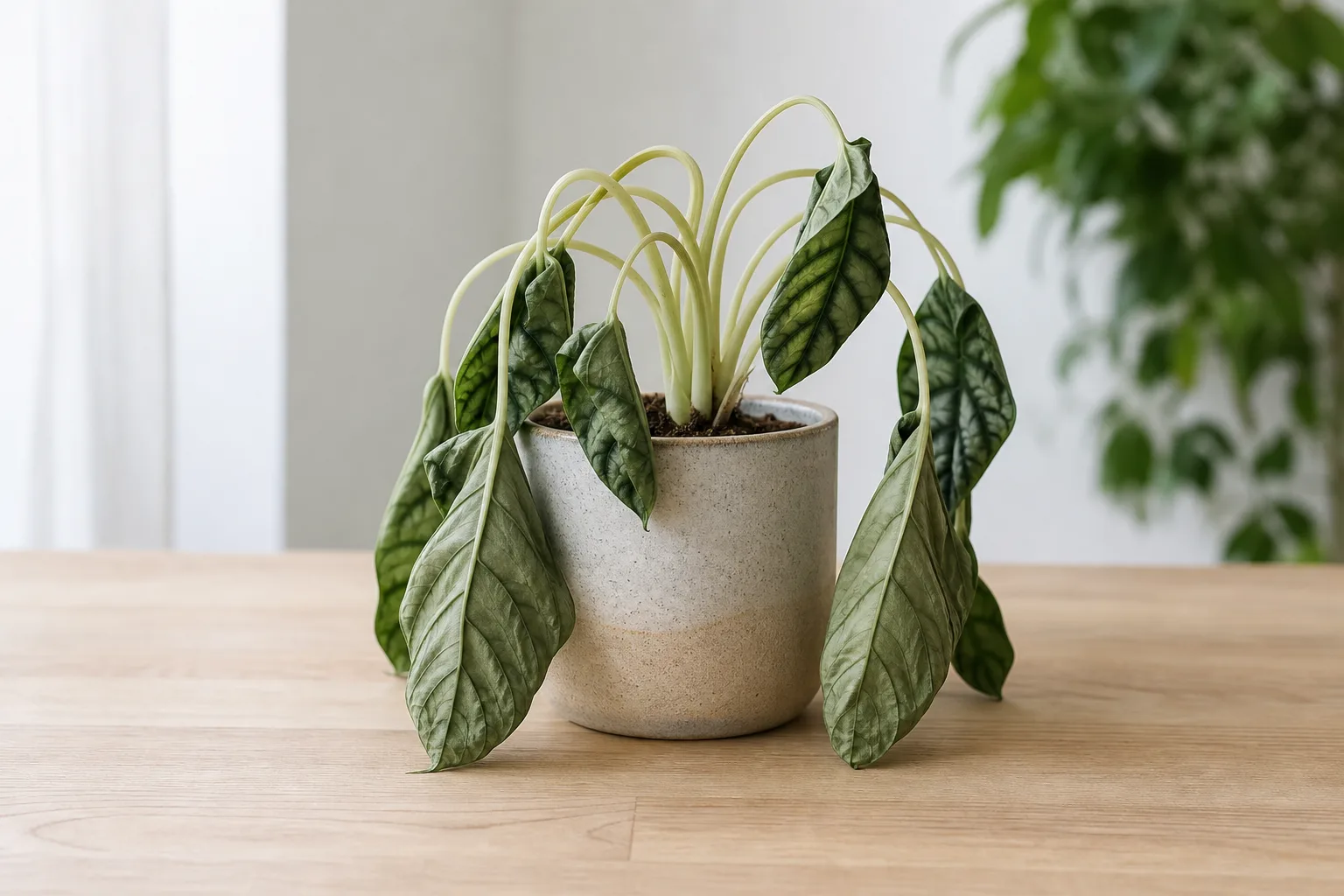
Wilting on Alocasia Dragon Scale: Causes, Checks & Fixes
This guide covers wilting on Alocasia Dragon Scale. See also the general Wilting guide, watering, and light pages for this plant.
Wilting on Alocasia Dragon Scale: Causes, Checks & Fixes
Quick answer
Wilting on Alocasia Dragon Scale (Alocasia baginda ‘Dragon Scale’) is sudden loss of turgor-limp petioles, collapsed blades, or leaves that flop instead of holding their stiff, sculpted shape. Jewel alocasias like this Borneo understory species store energy in a corm and wilt fast when roots cannot keep pace with leaf water loss. On this jewel alocasia, the same visual collapse can mean opposite problems: drowning roots, drought stress, dry winter air, cold shock, repot trauma, or normal seasonal dormancy.
First step: press the corm at the soil line before you water. Gently feel the swollen underground stem where petioles meet the mix. A firm corm with dry top 2–3 cm of substrate points to underwatering on Alocasia Dragon Scale. A firm corm with all foliage dropping in cool, dim fall or winter often means dormancy-not death. A soft corm with wet, sour-smelling soil means stop watering immediately and inspect roots for rot.
For baseline watering rhythm and dormancy cuts, see the Alocasia Dragon Scale watering guide. This page focuses on acute collapse and the wet-vs-dry diagnostic path.
Wilting vs. drooping on Dragon Scale - which page to use
Wilting is acute collapse-leaves that were upright yesterday flop hard, petioles lose stiffness, or the whole crown sags within hours to a few days. It often follows a single care mistake: a heavy winter watering on dormant soil, a missed drink during a heat spell, a cold draft after an open window, or repot shock.
Drooping is gradual limpness that develops over a week or more as culture drifts-slowly increasing watering in a cool room, creeping low humidity, or light that is too dim for active growth. See drooping leaves for the slow-decline pattern.
| Pattern | Soil / pot | Corm feel | Likely cause | Read next |
|---|---|---|---|---|
| Sudden hard flop | Wet, heavy pot | Soft or rubbery | Wet wilt / root rot on Alocasia Dragon Scale | Overwatering, root rot |
| Sudden hard flop | Dry, light pot | Firm | Underwatering | Underwatering |
| Collapse with papery edges | Moist but not soggy | Firm | Low humidity | Low humidity |
| All leaves drop in fall/winter | Dry to lightly moist | Firm | Dormancy | Watering guide - dormancy |
| Flop 3–7 days after repot | Variable | Firm unless rot started | Repot shock | Hold water, raise humidity |
What wilting looks like on Alocasia Dragon Scale
Dragon Scale leaves are thick and textured-when healthy, petioles stand stiff and blades hold a sculpted, upward angle. Wilting removes that architecture. The symptom is not subtle on this species because the rigid “scale” look depends on full turgor.
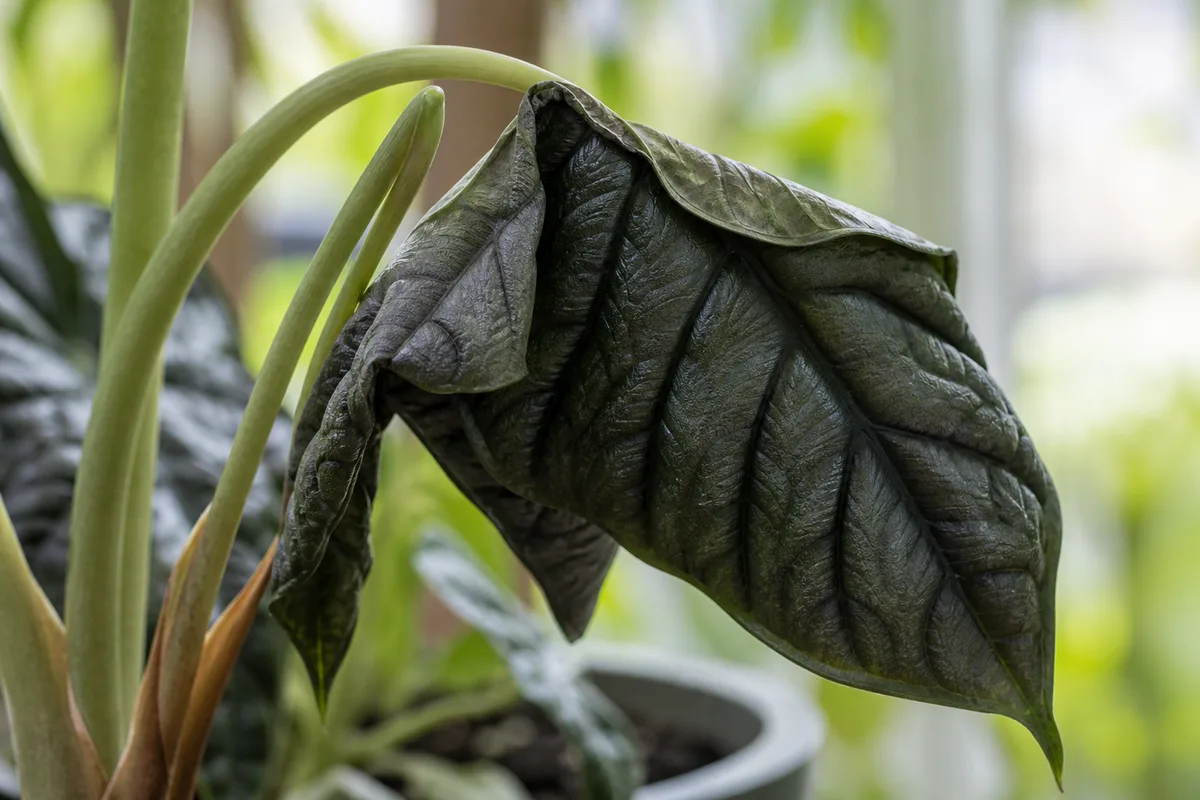
Wilting symptoms on Alocasia Dragon Scale - compare with healthy tissue on the same plant.
Wet wilt (limp leaves, wet chunky mix, possibly soft corm)
The classic trap: leaves look thirsty, but the pot is heavy and the top of the mix stays dark and cool for many days. Petioles may feel rubbery at the base. Lower leaves yellow from the outside in. Soil can smell sour or stagnant. Fungus gnats often hover near the surface-wet top layers sustain their larvae.
This is the wet-wilt paradox: roots in saturated, oxygen-poor mix cannot absorb water, so the plant collapses while standing in moisture. On Dragon Scale, textured leaves can hide early yellowing until the whole blade flops at once.
Dry wilt (collapsed petioles, light pot, dry top 3 cm)
The pot feels dramatically lighter than after a normal watering. Soil pulls slightly from the pot wall. Leaves curl inward or droop along their length. A thorough drink usually perks the plant within hours if roots are still firm and white when you check a drainage hole edge.
Humidity collapse (papery leaves, dry air, soil may be moist)
Margins turn papery brown while the rest of the blade still has some stiffness-then petioles weaken. Soil can be correctly moist at 2–3 cm depth while air at leaf height sits below 50% RH near a heating vent. This is transpiration stress, not thirst. See low humidity for the full humidity path.
Dormancy collapse (all leaves drop, firm corm - not death)
In fall and winter, when light drops and rooms cool, Dragon Scale may shed every leaf and survive on the corm alone-a normal winter dormancy response in alocasias when conditions cool and dry. The corm stays firm. Soil dries slowly because the plant pulls almost no water. Panicked watering on a leafless, firm corm is a common route into rot.
Repot shock and cold-draft acute wilt
Fresh Alocasia Dragon Scale repotting guide disturbs fine feeder roots; wilt 3–7 days later with firm corm usually resolves if you hold extra water, keep humidity at 65–70%, and avoid direct sun. A single cold night below 13 °C (55 °F) or a blast from an AC vent can collapse leaves within hours-move the plant to stable warmth before diagnosing watering.
Why Alocasia Dragon Scale wilts
Overwatering and root rot (wet-wilt paradox)
Overwatering is the most common killer of jewel alocasias. Dragon Scale evolved on Borneo forest floors where rain drains instantly through loose, airy substrate-the corm stores water, but fine roots need oxygen between drinks. Calendar watering through winter dormancy, heavy nursery mix, or pots without drainage keeps roots suffocating. Pathogens like Phytophthora thrive in cold, wet soil.
Underwatering during active growth
Less common but faster to fix. During warm active growth, letting the entire root zone dry out collapses petioles before the thick leaves show obvious curl. Dragon Scale tolerates a short dry spell thanks to the corm, but extended drought kills feeder roots.
Low humidity
Dragon Scale targets 60–80% relative humidity around foliage. Below roughly 50% at leaf height-common in heated winter rooms-the plant loses water through transpiration faster than roots replace it. Petioles weaken and blades flop even when soil moisture is correct.
Repotting and root disturbance
Unpotting, dividing, or moving into a much larger pot damages fine roots. The plant cannot move water efficiently until new roots form-temporary wilt with firm corm is expected for a week or two.
Cold and draft stress
Sustained exposure below about 16 °C (60 °F) during growth or sudden cold drafts slows root function and can trigger dormancy or acute wilt. Cold air plus wet substrate is especially dangerous-the roots stop metabolizing while pathogens multiply.
Seasonal dormancy
When light and temperature drop, the plant may stop growth entirely, drop all leaves, and rest on the corm. This looks like catastrophic wilt but is a normal survival strategy-not rot-when the corm stays firm and soil is not sour.
How to confirm the cause (corm test + checklist)
Work through these checks in order. One clear answer beats stacking fixes.
- Corm press - Brush soil from the base of petioles or press the pot wall at soil line. Firm = corm alive. Soft, squishy, or hollow = possible rot.
- Soil moisture at 2–3 cm - Chopstick or finger: damp at depth with wet-wilt symptoms means stop watering. Dry to the second knuckle with limp leaves means drought.
- Pot weight - Heavy and saturated vs. light and dusty confirms wet vs. dry without guessing from surface color alone.
- Smell - Sour or stagnant odor from drainage holes or soil surface signals anaerobic conditions and likely root damage.
- Season and light - Leafless plant in November with firm corm and cool room? Suspect dormancy before rot.
- Humidity at leaf height - Hygrometer below 50% with papery margins and moist soil points to air moisture, not watering frequency.
- Recent events - Repot, division, open window, or AC blast in the last week explains acute wilt with otherwise sound roots.
Wet wilt vs. dry wilt at a glance
| Check | Wet wilt / rot risk | Dry wilt | Dormancy |
|---|---|---|---|
| Top 2–3 cm soil | Wet, cool, dark | Dry, dusty | Dry to lightly moist |
| Pot weight | Heavy | Light | Light to moderate |
| Corm | Soft or rubbery if advanced | Firm | Firm |
| Leaf pattern | Yellow lower leaves, sour smell | Uniform limpness, may curl | All leaves drop |
| First action | Stop watering; inspect roots | Water thoroughly | Cut water 60–70%; wait |
The first fix to try
Press the corm, then match your action to soil moisture-not leaf appearance alone.
If soil is wet and corm is soft
Stop watering immediately. Move to Alocasia Dragon Scale light guide with good airflow. Do not fertilize. If lower leaves yellow and smell is sour, unpot within 24–48 hours, rinse roots, trim mushy tissue, and follow the root rot recovery path. Watering a wet-wilted plant is the most common fatal mistake on Alocasia.
If soil is dry and pot is light
Water thoroughly until it runs from drainage holes, or bottom-water 15–20 minutes and drain completely. Check again in 12–24 hours-healthy roots should restore stiffness. If leaves stay limp on now-moist soil, previous overwatering may have damaged roots; inspect before the next drink.
If humidity is below 50% at leaf height
Move off heating vents and winter glass. Run a humidifier until readings hold roughly 65–70% RH. Do not compensate by keeping soil wet-that stacks humidity stress with rot risk on the moisture-sensitive corm.
If all leaves drop in fall/winter with firm corm
Treat as dormancy. Cut total irrigation volume by 60–70%, extend intervals to every 3–4 weeks, and let the top 3–4 cm dry between sips-overwatering during dormancy commonly causes root rot. The goal is keeping the corm from desiccating, not pushing growth. Resume light watering only when a new growth tip appears in late winter.
Step-by-step recovery by cause
Underwatering: One thorough watering, then return to the top 2–3 cm dry rule from the watering guide. Expect perk-up within hours if roots are intact.
Low humidity: Humidifier plus vent relocation. Existing wilted leaves may not fully re-stiffen; judge success by the next clean spear.
Wet wilt / early rot: Dry-down for 5–7 days if corm is still mostly firm. If softening spreads or smell worsens, unpot, trim, treat with dilute hydrogen peroxide soak, and repot in fresh chunky aroid mix. Hold water 5–7 days after repot.
Repot shock: Keep warm (22–25 °C / 72–77 °F), humidity at 70%, bright indirect light. Water lightly only when the top 2–3 cm dries-do not soak a recovering root ball daily.
Cold shock: Move to stable warmth above 18 °C (65 °F). Remove fully collapsed leaves. Wait 1–2 weeks before changing watering rhythm.
Dormancy: Minimal water every 3–4 weeks. No fertilizer. No repotting until spring growth returns.
Recovery timeline and success signs
| Cause | First improvement | Full recovery signal |
|---|---|---|
| Underwatering | Hours to 1 day | New spear within 2–4 weeks in active growth |
| Low humidity | 3–7 days after RH stabilizes | Next unfurling leaf with intact margins |
| Wet wilt (caught early) | 1–2 weeks dry-down | Firm corm, no spreading yellow |
| Root rot (moderate) | 3–6 weeks after trim/repot | New root tips, first small leaf |
| Repot shock | 5–10 days | Petioles stiffen on new watering cycle |
| Dormancy | Weeks to months | New growth tip in late winter/spring |
Damaged yellow or collapsed leaf tissue rarely re-firms. Judge success by a firm corm, stable older leaves, and clean new growth-not by repairing old blades.
Lookalike symptoms
- Gradual limpness over weeks - Drooping leaves, not acute wilt
- Yellow only on oldest leaves with wet soil - Overwatering pattern
- Crispy margins on moist soil - Low humidity or fluoride in tap water; see brown tips
- Fine stippling and webbing - Spider mites, often in dry air
- Uniform yellow across plant in bright sun - Possible sun scorch after moving to direct light; not a watering issue
Mistakes to avoid
- Watering limp leaves on wet soil - Fuels rot when roots are already suffocating.
- Discarding a leafless plant with firm corm in winter - Likely dormancy, not death.
- Stacking repot, prune, and fertilize on wilt day one - One correction at a time so you can read the plant’s response.
- Misting instead of fixing humidity - Brief moisture on textured leaves does not replace sustained 65–70% RH and can invite fungal spotting.
- Moving to direct sun to “revive” a wilted plant - Adds stress; use bright indirect light only.
- Resuming summer watering schedule the day a dormancy spear appears - Rebuild roots with half-volume drinks until the first full leaf unfurls.
How to prevent wilting on Alocasia Dragon Scale
Build the connected system from the watering guide: chunky aroid mix, drainage holes, top 2–3 cm dry before watering in active growth, 60–70% humidity at leaf height, and 60–70% irrigation cutback through dormancy. Lift the pot weekly to learn its weight. Inspect new spears and the corm base during routine care so you catch limpness before full collapse.
Keep the plant above 18 °C (65 °F) during growth and away from AC vents and cold winter glass. Quarantine and acclimate after repotting-hold extra water for two weeks while roots settle. For the full Alocasia Dragon Scale overview, see baseline light, soil, and humidity targets.
When to worry - and when to read root rot next
Escalate immediately if the corm softens, soil smells sour, yellow spreads to multiple leaves while the mix stays wet, or wilt worsens 48 hours after you stopped watering wet soil. Those patterns suggest advancing rot-not a simple dry-down case.
A firm corm with dry soil and limp foliage is uncomfortable but manageable with one thorough watering. A firm corm with zero leaves in January is often resting-wait before unpotting.
If more than half the root system is mushy when you inspect, follow the full root rot protocol. Recovery is possible from a healthy corm even when all leaves are gone, but a soft, foul-smelling crown needs fast action-not another week of hope-watering.
When to use this page vs other Alocasia Dragon Scale guides
- Alocasia Dragon Scale watering guide - Use for routine moisture checks before assuming wilting is the main issue.
- Alocasia Dragon Scale problems hub - Browse all 16 common issues on this species.
- Underwatering on Alocasia Dragon Scale - Different entry point when symptoms overlap with wilting.
- Overwatering on Alocasia Dragon Scale - Different entry point when symptoms overlap with wilting.
- Root Rot on Alocasia Dragon Scale - Different entry point when symptoms overlap with wilting.
Related Alocasia Dragon Scale guides
- Alocasia Dragon Scale overview
- Alocasia Dragon Scale watering
- Alocasia Dragon Scale light
- Alocasia Dragon Scale soil
- Underwatering on Alocasia Dragon Scale
- Overwatering on Alocasia Dragon Scale
- Root Rot on Alocasia Dragon Scale
- Drooping Leaves on Alocasia Dragon Scale
- Yellow Leaves on Alocasia Dragon Scale
- Alocasia Dragon Scale problems