Yellow Leaves on Alocasia Dragon Scale: Causes, Checks &
Quick answer
Yellow leaves on Alocasia Dragon Scale usually trace to overwatering, low humidity, or winter dormancy-not one diagnosis. First step: press the corm at the soil line for firmness, check moisture 2–3 cm down, and note whether one old bottom leaf is fading or many leaves are yellowing at once.
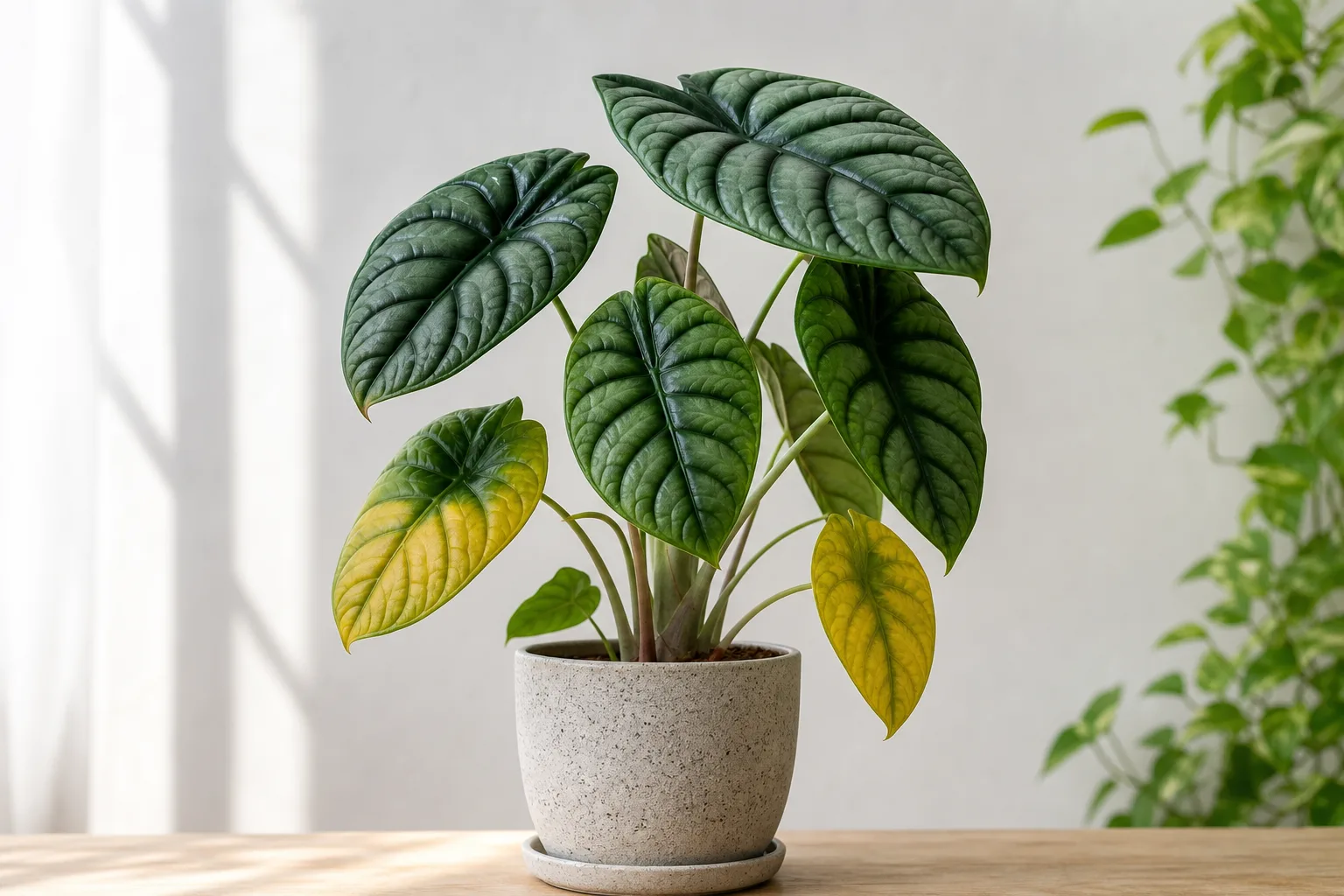
Yellow Leaves on Alocasia Dragon Scale: Causes, Checks & Fixes
This guide covers yellow leaves on Alocasia Dragon Scale. See also the general Yellow Leaves guide, watering, and light pages for this plant.
Yellow Leaves on Alocasia Dragon Scale: Causes, Checks & Fixes
Quick answer
Yellow leaves on Alocasia Dragon Scale (Alocasia baginda ‘Dragon Scale’) are a stress signal, not one disease. On this jewel alocasia with thick, silvery-scaled foliage, the pattern usually separates into three buckets: normal lower-leaf aging, wet-root stress from overwatering on Alocasia Dragon Scale, or dry-air and dormancy stress in cool months.
First step: press the corm at the soil line for firmness, check moisture 2–3 cm down, and note which leaves are yellowing before you water, fertilize, or repot. If the mix is still damp and multiple leaves are fading, pause watering until the top 2–3 cm dries. If only one old bottom leaf is yellow while new center growth stays green, you may not need any fix beyond removing the spent leaf.
For baseline watering rhythm and dormancy cuts, see the Alocasia Dragon Scale watering guide.
What yellow leaves look like on Dragon Scale
Dragon Scale holds each thick, textured leaf on a sturdy petiole from a central crown above an underground corm. Yellowing rarely looks random-it follows a pattern that hints at the cause on this species’ distinctive foliage.
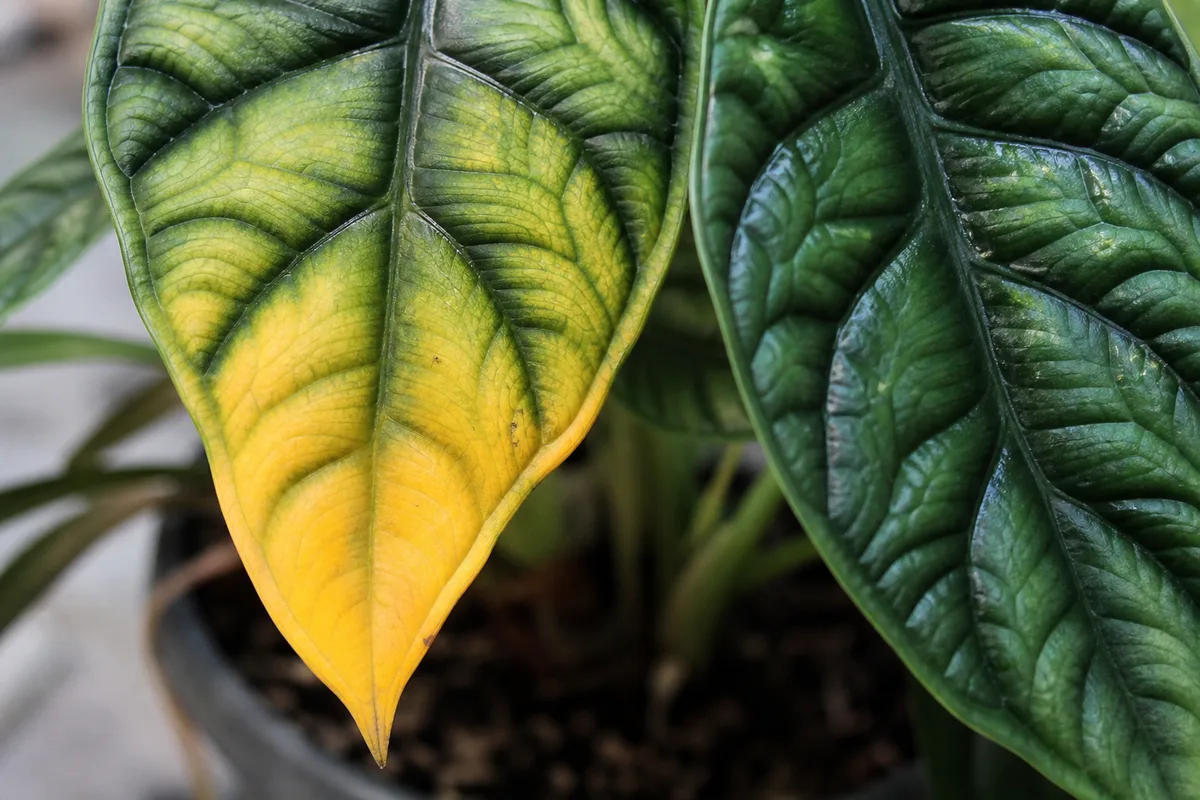
Yellow Leaves symptoms on Alocasia Dragon Scale - compare with healthy tissue on the same plant.
Normal aging shows as one or two oldest lower leaves turning evenly yellow, then brown, over several weeks. The petiole may feel slightly limp as the leaf dies back, but the corm and newer spears stay firm and dark green with intact silvery scaling.
Overwatering often yellows several leaves at once, starting from the bottom upward. Leaves may look pale green-yellow before going fully yellow. Soil stays dark and cool at the surface for many days after watering. Petioles can feel soft where they meet the soil, and the pot may smell sour. This overlaps with the overwatering guide wet-wilt pattern.
Low humidity (common in heated winter rooms) produces yellowing with crispy brown tips or margins on otherwise green leaves. The damage often spreads leaf by leaf rather than hitting every leaf overnight. See the low humidity guide when papery edges appear without constantly wet soil.
Dormancy in autumn or winter can yellow and drop most or all leaves while the underground corm stays firm. Growth stops, and the plant may look dead above soil even though the corm is alive-a scenario that panics many Dragon Scale owners.
Insufficient light slows photosynthesis and water uptake. Soil that would dry in four days in Alocasia Dragon Scale light guide may stay wet for ten in a dim corner-turning a reasonable watering habit into chronic root stress. Pale, yellowing upper leaves on long weak petioles often point here.
underwatering on Alocasia Dragon Scale yellows fewer leaves at first but pairs with drooping, dry edges, and a lightweight pot. Mix pulls away from the pot sides.
Pest stress (especially spider mites in dry air) shows speckled or patchy yellow between veins, often with fine webbing on leaf undersides-not uniform whole-leaf yellowing.
Why Alocasia Dragon Scale gets yellow leaves
Dragon Scale evolved for tropical humidity and bright filtered light on Borneo’s fast-draining forest floor, not constantly wet peat in a dim corner. Most indoor yellowing traces to culture mismatch, not mystery illness.
Overwatering and wet-root stress
Overwatering is the leading cause. Alocasias want evenly moist-not soggy-mix. When soil stays saturated, roots lose oxygen and stop taking up water and nutrients. Stunted growth with yellowing leaves is a classic overwatering symptom. Calendar watering, blocked drainage holes, heavy bagged mix, oversized pots, and low light (which slows water use) all keep the root zone wet too long around the corm.
Cool dim rooms compound the problem: evaporation slows, so a summer watering rhythm leaves the corm sitting in unused moisture for weeks.
Low humidity and dry winter air
Low humidity stresses Dragon Scale more than many common houseplants. RHS guidance for alocasias recommends medium to high humidity through the growing season. Ideal indoor humidity sits around 60–80% for this jewel alocasia. Winter heating drops room air to 25–35%, which dries the thick scaled leaves and can yellow whole foliage over time-especially when paired with inconsistent watering.
Winter dormancy (normal leaf drop)
Winter dormancy is normal for many alocasias, and Dragon Scale is among the more dormancy-prone jewel varieties. Shorter days, cooler rooms below about 15°C (59°F), and reduced growth trigger leaf yellowing and drop. During dormancy the plant drinks far less; continuing a summer watering schedule leaves roots sitting in unused moisture. Alocasias may lose foliage in winter but resprout in spring when you keep winter watering to a minimum and maintain temperatures above 10°C (50°F).
Natural lower-leaf senescence
Natural senescence happens because Dragon Scale constantly pushes new spears from the crown. Each new leaf costs energy, so the plant sheds its oldest lower leaf periodically. One yellow bottom leaf on an otherwise vigorous plant with firm corm is often harmless turnover.
Insufficient light
Insufficient light slows photosynthesis and water uptake. Soil that would dry in four days in bright indirect light may stay wet for ten in a dark hallway-turning a reasonable watering habit into chronic root stress. Pale, yellowing upper leaves on long weak petioles often point here. See the not enough light guide when new growth looks leggy and pale.
Underwatering and nutrient stress (less common)
Underwatering is less common but real during hot active growth or after the mix has gone hydrophobic. A damaged root system cannot feed foliage efficiently, and older leaves yellow as the plant conserves moisture.
Lookalike symptoms to rule out
| Pattern | Likely cause | Key check | First action |
|---|---|---|---|
| One old bottom leaf, firm corm | Normal aging | New spears green and firm | Remove spent leaf only |
| Multiple lower leaves, wet heavy pot, sour smell | Overwatering / root stress | Corm soft? Roots mushy? | Pause water; see overwatering |
| Crispy brown tips, dry air, appropriate soil moisture | Low humidity | Hygrometer below 50% | Humidifier; see low humidity |
| All leaves drop in cool fall/winter, firm corm, no sour smell | Dormancy | Season + growth stopped | Cut watering 60–70%; see watering dormancy section |
| Stippled yellow patches, fine webbing | Spider mites | Inspect leaf undersides | Isolate, rinse, raise humidity |
| Light dry pot, inward-curling leaves | Underwatering | Top 3 cm bone dry | Deep soak once; resume dry-down schedule |
| Soft corm, mushy roots, foul odor | Advanced root rot on Alocasia Dragon Scale | Unpot inspection | See root rot guide |
How to confirm the cause
Work through these checks in order. You are looking for one dominant pattern, not every possible problem at once.
- Which leaves? Single old bottom leaf only → likely aging. Multiple leaves, bottom-up → suspect water or roots. Patchy yellow with webbing → inspect for mites.
- Corm firmness - Press gently at the soil line where petioles meet the mix. A firm corm with leaf drop in cool months points to dormancy or mild stress. A soft corm with wet mix suggests rot, not simple aging.
- Soil moisture at depth - Stick your finger or a chopstick 2–3 cm into the mix. Wet and cold days after watering confirms overwatering. Bone dry throughout with a light pot suggests drought.
- Pot weight and drainage - Lift before and after watering. Does water sit in the saucer? Are drainage holes open? Sour smell means anaerobic soil.
- Season and room conditions - Is it late autumn with shorter days and the heat on? Has growth stopped? Firm corm with leaf drop may be dormancy.
- Light exposure - Count hours of bright indirect light. Leggy pale new growth in a dark spot compounds watering mistakes.
- Humidity clues - Brown crispy tips with yellow margins in a dry room point to air moisture, not root rot.
- Root inspection (if wet soil + widespread yellowing) - Gently tip the plant out. Healthy roots are firm and pale; rotted roots are brown, slimy, or smell bad.
If the pot is dry, the corm is firm, and only one lower leaf is fading slowly, aging or mild drought fits better than rot-do not soak a plant you have not inspected.
First fix for Alocasia Dragon Scale
Press the corm and pause watering until the top 2–3 cm of mix dries if soil is currently wet and multiple leaves are yellowing.
That single change stops the most dangerous cycle on Dragon Scale: adding water to already saturated roots around the corm. Empty any standing water from the saucer. Move the plant to bright indirect light if it sits in shade-better light helps the mix dry and supports recovery without forcing you to repot on day one.
If inspection confirms only normal aging (one yellow bottom leaf, firm corm, appropriate soil moisture), remove that fully yellow leaf with clean scissors and change nothing else.
If dormancy fits-cool season, growth stopped, firm corm, no sour smell-cut total irrigation volume by 60–70% and extend intervals to every 3–4 weeks. Do not repot or fertilize a leafless dormant corm. Full protocol lives in the watering guide dormancy section.
If humidity is clearly the issue-crispy margins, dry air, no wet-soil smell-raise moisture around the plant with a humidifier targeting 60–80%, but still fix watering rhythm first. Do not fertilize a yellowing stressed plant until new growth looks stable for two weeks.
Repot only when roots are mushy, mix is compacted and never dries, or drainage has failed. Fixing care first is enough for mild overwatering without visible rot.
Step-by-step recovery by cause
Once you know the cause, work in this order:
- Adjust watering - Water when the top 2–3 cm feels dry during active growth; stretch intervals to every two to four weeks in winter dormancy. Never let the pot sit in runoff.
- Improve light - Place in bright indirect light, out of direct hot sun that scorches Dragon Scale’s thick leaves.
- Raise humidity - Target 60–80% with a humidifier near the plant, especially when heating runs. Grouping plants helps slightly; misting alone is a weak fix.
- Remove spent leaves - Cut fully yellow leaves at the petiole base. Keep partially green leaves-they still photosynthesize. Wear gloves when handling; Dragon Scale contains calcium oxalate crystals toxic to cats and dogs if chewed-keep trimmings away from pets.
- Inspect roots if yellowing continues on wet soil - Trim mushy roots, let cuts air-dry a few hours, repot into fresh chunky aroid mix with perlite and bark in a pot with drainage holes sized to the corm. See the root rot guide for full protocol.
- Treat pests if confirmed - Rinse leaf undersides and isolate if spider mites are present; fix dry air alongside any spray.
- Hold fertilizer - Skip feed until new center spears emerge healthy. Salt on stressed roots worsens yellowing.
For dormancy, keep the corm warm (above 15°C), barely moist-not wet-and wait. New growth often resumes in spring without heroic intervention.
Recovery timeline
Stabilization usually appears within one to two weeks after watering and light corrections-yellowing should stop spreading, and the corm should stay firm.
New green spears from the crown are the real success marker. Expect them in two to four weeks during active growth; dormant plants may stay leafless until spring.
Fully yellow leaves will not green up again-they drop or you remove them. Judge recovery by new foliage, not old color.
Worsening signs: more leaves yellow daily on wet soil, soft corm, sour pot smell, or collapse without new buds by mid-spring after dormancy-those warrant root inspection or accepting the corm may not recover.
What not to do
Do not water more because leaves look limp when soil is already wet-rotting roots cannot absorb water, and extra moisture makes decay worse.
Do not fertilize heavily to “green up” yellow leaves. Overfeeding stressed alocasias causes salt burn and more chlorosis.
Do not repot into a larger pot hoping it helps drying-extra wet soil volume usually makes overwatering worse.
Do not panic during winter dormancy if the corm is firm and you have reduced water-Dragon Scale often drops all leaves and restarts in spring.
Do not repot or fertilize a dormant leafless corm-wait until a new growth tip appears in late winter or early spring.
Do not remove every partially yellow leaf at once-keep green tissue until the plant pushes replacements.
When pruning, wear gloves if sap irritates your skin. Keep removed leaves away from pets and children because of calcium oxalate content.
How to prevent yellow leaves next time
Match watering to how fast your pot actually dries in your light and season, not a fixed calendar. Water when the top 2–3 cm is dry in summer; cut back sharply in winter per the watering guide.
Keep bright indirect light so the plant uses water predictably. Maintain 60–80% humidity when possible-especially with heating on.
Use well-draining chunky aroid mix, pots with open drainage, and empty saucers within thirty minutes of watering.
Quarantine new Dragon Scale plants for two weeks and inspect leaf undersides weekly. Remove old lower leaves before they become pest harborages.
For a full care baseline, see the Alocasia Dragon Scale overview.
When to worry
Escalate immediately if many leaves yellow within days on soggy soil, the corm softens, or roots are mostly mushy on inspection-follow the root rot guide before the corm tissue is gone.
A single yellow bottom leaf on a firm plant with appropriate moisture can wait-you are likely seeing normal turnover or mild stress.
If the corm stays hard but all leaves drop in winter, wait until spring before declaring the plant dead-dormant Dragon Scale often resprouts when warmth and light return.
Contact your local cooperative extension office if chronic decline continues after correcting water, light, and humidity-the corm may need professional assessment once home fixes fail.
Conclusion
Yellow leaves on Alocasia Dragon Scale reward careful reading more than quick fixes. Check corm firmness, soil moisture, and leaf pattern first, pause water if the mix is wet, and separate normal aging and dormancy from root stress. Recovery shows in firm new center growth, not in old leaves turning green again-give the plant stable light, humidity, and a drying rhythm matched to the season, and Dragon Scale usually bounces back from everything short of advanced rot.
When to use this page vs other Alocasia Dragon Scale guides
- Alocasia Dragon Scale watering guide - Use for routine moisture checks before assuming yellow leaves is the main issue.
- Alocasia Dragon Scale problems hub - Browse all 16 common issues on this species.
- Overwatering on Alocasia Dragon Scale - Different entry point when symptoms overlap with yellow leaves.
- Underwatering on Alocasia Dragon Scale - Different entry point when symptoms overlap with yellow leaves.
- Not Enough Light on Alocasia Dragon Scale - Different entry point when symptoms overlap with yellow leaves.
Related Alocasia Dragon Scale guides
- Alocasia Dragon Scale overview
- Alocasia Dragon Scale watering
- Alocasia Dragon Scale light
- Alocasia Dragon Scale soil
- Overwatering on Alocasia Dragon Scale
- Underwatering on Alocasia Dragon Scale
- Not Enough Light on Alocasia Dragon Scale
- Root Rot on Alocasia Dragon Scale
- Alocasia Dragon Scale problems