Overwatering on Alocasia Dragon Scale: Causes, Checks &
Quick answer
Overwatering on Alocasia Dragon Scale means the corm and root zone stay wet too long-limp leaves on damp chunky mix are the signature wet-wilt trap. First step: stop watering, press the corm at the soil line for firmness, and let the top 2–3 cm of substrate dry before the next drink.
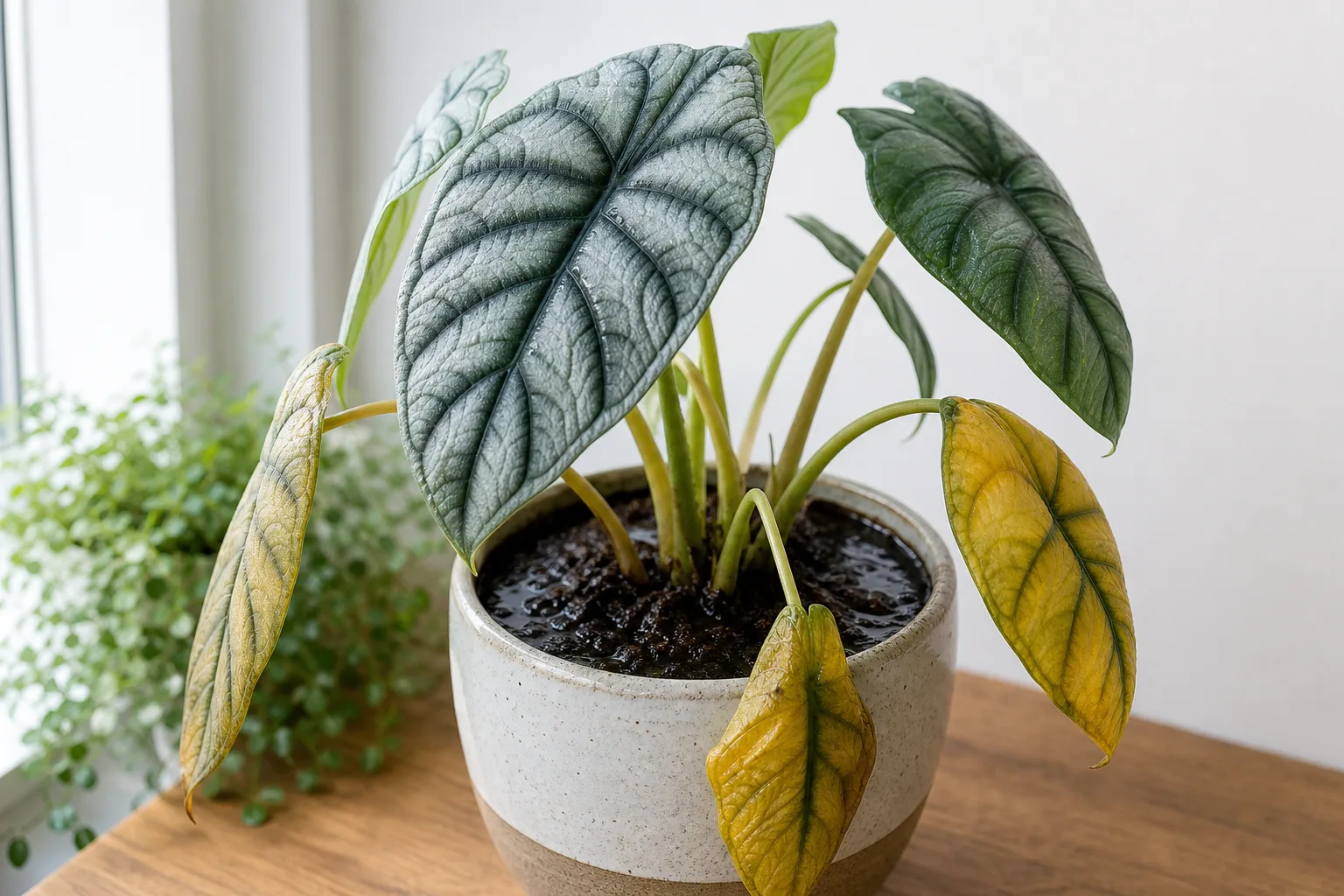
Overwatering on Alocasia Dragon Scale: Causes, Checks & Fixes
This guide covers overwatering on Alocasia Dragon Scale. See also the general Overwatering guide, watering, and light pages for this plant.
Overwatering on Alocasia Dragon Scale: Causes, Checks & Fixes
Quick answer
Overwatering on Alocasia Dragon Scale (Alocasia baginda ‘Dragon Scale’) is not one extra drink-it is a corm and root zone that stay wet too long. The signature trap is wet wilt: limp, collapsed petioles while the chunky mix is still damp, because roots in saturated soil cannot move water upward even though the plant looks thirsty.
First step: stop watering and press the corm at the soil line. Gently feel the swollen underground stem where petioles meet the mix. A firm corm with wet soil means dry-down and drainage correction may be enough. A soft corm with sour-smelling mix means inspect roots immediately-see the root rot guide before you water again.
For baseline rhythm, water quality, and dormancy cuts, see the Alocasia Dragon Scale watering guide. This page focuses on diagnosing and fixing chronic wet soil before the corm is gone.
What overwatering looks like on Dragon Scale
Jewel alocasias store energy in a corm below the soil line. Fine feeder roots branch off it and need both moisture and oxygen. When the mix stays logged, roots suffocate first as overwatering decreases oxygen in the root zone; the corm follows if saturation continues.
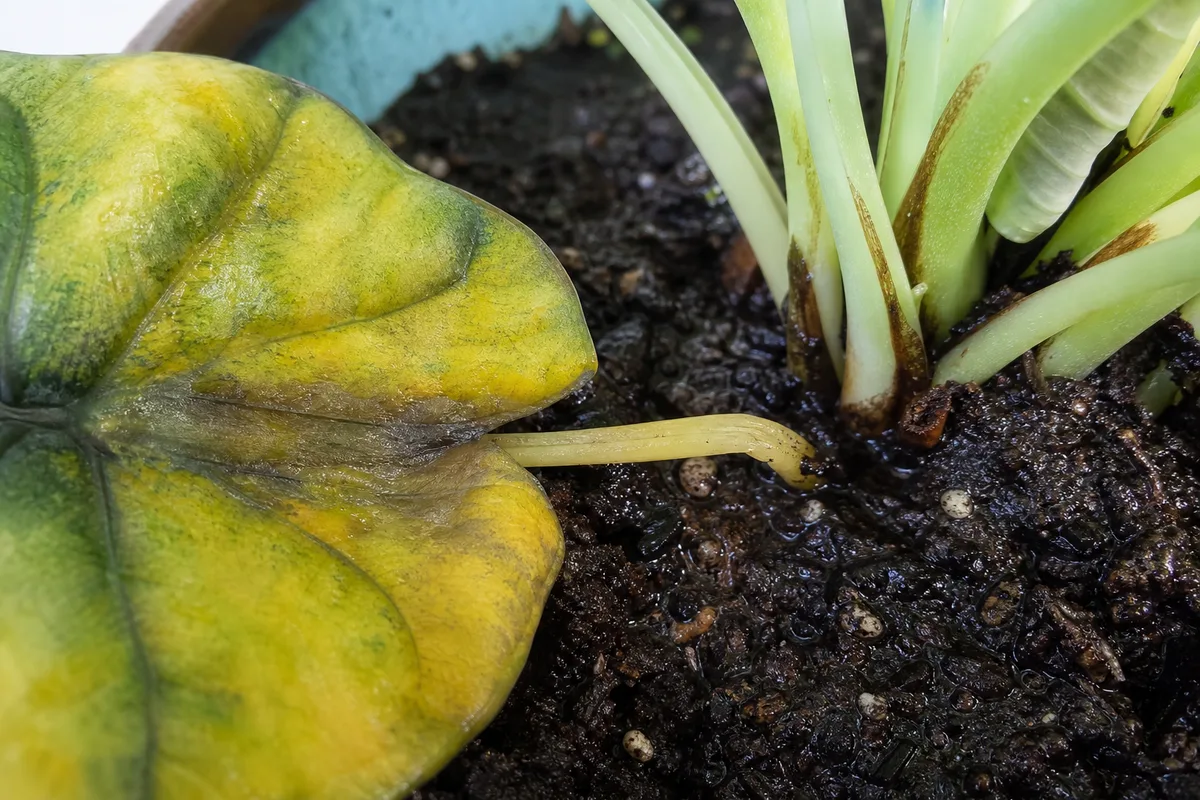
Overwatering symptoms on Alocasia Dragon Scale - compare with healthy tissue on the same plant.
Early signs
- Limp petioles and collapsed blades while the pot feels heavy and the top 2–3 cm of mix stay damp
- Yellow lower leaves from the outside in-often more than one at a time, not a single aging leaf
- Rubbery or soft petiole bases where stalks meet wet soil
- Sour or stagnant smell from the drainage hole or when you brush soil aside at the crown
- Fungus gnats hovering near the surface when the top centimeter never dries
- Edema or small watery blisters on thick baginda foliage-an early stress signal before full yellowing
- White mold fuzz on the soil surface in persistently damp pots
Advanced signs
- Soft or squishy corm when you press gently at the soil line
- Widespread yellowing including newer leaves while mix stays wet
- Stalled or rotting new spears that brown before unfurling
- Roots that slip apart when touched-healthy houseplant roots are firm and white to light tan
What it does not look like: A light, dry pot with firm corm and inward-curling leaves usually means underwatering. All leaves dropping in cool fall or winter with a firm corm and no sour smell often means dormancy-not rot. Papery brown edges on firm petioles with appropriate dry-down may be low humidity or water chemistry, not overwatering.
Why Dragon Scale gets overwatered
Dragon Scale evolved on Borneo’s forest floor, where rain is frequent but substrate drains almost immediately. Indoors, growers often read “likes moisture” as “keep it wet”-but this plant wants consistent access to moist, airy mix, not standing water around the corm.
The wet-wilt paradox
The most dangerous pattern: you see limp leaves, assume thirst, and water again. Each cycle keeps the root zone anaerobic. Leaves stay collapsed because the soil is wet, not despite it. On Dragon Scale, textured dark foliage can hide early yellowing until the whole rosette flops at once-by then root damage may already be significant.
Dormancy is the hidden overwatering season
RHS guidance for alocasias recommends reducing watering in winter when plants go dormant and may lose foliage. Dragon Scale often slows or stops growth when light and temperature drop. Continuing a summer watering schedule on cool, dim soil is the most reliable path to rot-dormant alocasias may lose foliage but survive to resprout in spring when you keep winter watering to a minimum. See the watering guide dormancy section for volume cuts.
Setup mistakes that keep pots wet
- Calendar watering without a chopstick or pot-weight check
- Oversized plastic or glazed pots holding excess wet mix around a small corm
- Dense peat-heavy mix instead of the chunky aroid blend this species needs
- Bottom-watering with full saucers left standing for hours or days
- Decorative cachepots trapping runoff after every drink
- Cool rooms and dim corners where evaporation slows but the weekly schedule does not change
- Surface-dry trap: chunky bark mix can feel dry on top while the corm zone stays saturated in a deep pot
How to confirm the cause
Work through these checks in order. Each step narrows the diagnosis without stacking unnecessary treatments.
Five-step inspection checklist
- Pot weight - Lift the pot. Heavy and cool several days after the last watering strongly suggests chronic saturation. Learn what “ready to water” feels like after a proper dry-down cycle.
- Moisture at 2–3 cm depth - Push a clean chopstick to the second knuckle. Dark damp particles clinging to the tip mean wait. Surface color alone lies on chunky mixes.
- Corm firmness - Brush soil aside at the base of petioles and press the swollen stem. Firm, like a potato, is the baseline. Soft, squishy, or hollow means escalate.
- Smell and drainage - Sour odor from the hole, or water that does not exit within seconds when you test-pour, confirms poor aeration.
- Leaf and spear pattern - Multiple lower yellows on wet soil plus limp petioles fit overwatering. One old yellow on firm corm with appropriate dry-down may be normal senescence.
Symptom lookalike comparison
| Pattern | Pot weight | Mix at 2–3 cm | Corm feel | What it usually means |
|---|---|---|---|---|
| Overwatering / wet wilt | Heavy | Wet, cool, clings | Firm to soft | Saturated root zone; rot risk |
| Underwatering | Light | Dry throughout | Firm | Turgor loss from drought |
| Dormancy (fall/winter) | Light to medium | Dry to lightly moist | Firm | Seasonal rest-not rot |
| Low humidity | Normal | On schedule | Firm | Papery edges, not sour soil |
| Advanced root rot | Heavy | Wet, sour | Soft, mushy | Pathogens in corm tissue-see root rot |
For acute collapse and the wet-vs-dry first decision, the wilting guide walks the same corm-press workflow in more detail.
First fix for Alocasia Dragon Scale
Make one clear first move: stop watering and place the plant in bright indirect light with good airflow-not a dark corner. Do not fertilize. Do not repot on day one unless the corm is already soft and you need to trim rot immediately.
Once watering is paused:
- Let the top 2–3 cm of substrate dry before any further moisture-the same band used in the watering guide.
- Empty saucers and cachepots within 30 minutes of every watering session. Standing water forces roots to stay saturated.
- Press the corm daily while the mix dries. If it stays firm and leaves stabilize within a week, you may have caught the problem early.
- If leaves keep declining, the corm softens, or soil smells sour after dry-down begins-unpot and inspect roots using the recovery steps below or the full protocol on the root rot page.
Do not move a waterlogged plant into direct sun to “dry it faster”-that adds leaf stress on top of failing roots.
Step-by-step recovery when the corm or roots are soft
If inspection reveals mushy roots or partial corm softness, dry-down alone is not enough. Work through these steps in order:
- Unpot carefully - Tip the pot sideways and support the corm with your hand. Do not yank by the petioles.
- Rinse all old substrate away under lukewarm room-temperature water until roots are visible.
- Trim rot - Cut dark, mushy, or smelly roots back to firm white tissue with sterilized shears. If the corm has soft spots, cut back to firm white material inside-the corm can be trimmed like a potato if healthy tissue remains.
- Hydrogen peroxide soak - Dip trimmed roots and corm in 1 part 3% hydrogen peroxide to 3–4 parts water for 5–10 minutes. Do not use undiluted peroxide or soak longer than 10 minutes.
- Air-dry - Let cut surfaces sit on a paper towel in shade for one to two hours.
- Repot in fresh, dry, chunky mix - Use the soil ratios from the Dragon Scale soil guide. Choose a clean pot with drainage holes sized to the remaining root mass, not the former leaf volume.
- Hold water 5–7 days - Let cut tissue callus. Then water lightly and resume the top 2–3 cm dry-down rule. No fertilizer for at least four to six weeks.
Cold air plus wet substrate favors water-mold pathogens such as Pythium and Phytophthora-keep recovery temperatures around 22–25 °C (72–77 °F) and humidity near 70% in bright indirect light.
Recovery timeline and what to watch
Recovery is judged by corm firmness and new spear emergence, not by old yellow leaves re-greening. Damaged blades rarely recover their sculpted stiffness; they may drop while the plant stabilizes.
- Mild saturation, firm corm, mostly white roots - Stabilization within one to two weeks after dry-down; first new spear in two to four weeks
- Moderate rot with heavy root trim - Four to eight weeks before a new leaf unfurls; expect remaining foliage to drop
- Leafless but firm corm - Normal after severe stress; the plant may resprout from the corm alone over several weeks
- Advanced corm mush throughout - Recovery unlikely; set expectations honestly
Signs of improvement: corm feels solid under daily checks, soil dries on a predictable cycle, no sour smell, new spear pushing from the center.
Signs the problem is worsening: spreading softness up petioles, wilt on wet soil after repot, sour smell returning within days, or no new growth after six to eight weeks in good light with a firm corm.
What not to do
- Do not water because leaves look wilted when soil is already wet-that deepens the wet-wilt cycle.
- Do not fertilize a waterlogged plant; stressed roots cannot use nutrients safely.
- Do not repot into a larger pot hoping extra soil will absorb moisture-it usually keeps the corm wetter longer.
- Do not leave the plant in sour, dense mix without trimming damaged roots-the anaerobic conditions remain.
- Do not seal a rotting plant in a closed bag for humidity without airflow-that can worsen secondary decay.
- Do not assume death when all leaves drop in winter-check corm firmness before discarding a dormant plant.
How to prevent overwatering next time
Prevention on Dragon Scale is a connected system-mix, pot, light, season, and check method all feed the same decision:
- Water when the top 2–3 cm of substrate dries-not on a calendar. In active growth that may mean every 5–10 days in a 10–15 cm pot; in dormancy, extend to every 2–4 weeks with 60–70% less volume.
- Use chunky, fast-draining aroid mix and a pot matched to the corm size. See the soil and repotting guides.
- Empty saucers within 30 minutes after bottom-watering. Lift cachepots to confirm no standing water.
- Match watering to light and season-reduce watering when the plant is dormant in winter; dim corners need longer dry-down than bright windows.
- Default to chopstick plus pot-weight checks rather than surface color alone on bark-heavy mixes.
- Watch for fungus gnats as an early moisture alarm-see the fungus gnats guide if adults persist after you fix the rhythm.
When to worry
Treat as urgent when:
- The corm feels soft, hollow, or collapses under gentle pressure
- Petioles are rubbery or mushy at the base with wet, sour soil
- Multiple leaves yellow in 48–72 hours while the mix stays damp
- New spears brown and rot before unfurling
You can usually wait and dry down when:
- The corm is firm, smell is neutral, and only one older lower leaf is yellowing
- Soil is damp but roots were mostly white and firm on a recent casual check
- The plant is entering dormancy with firm corm and slowing growth in fall-adjust volume, do not flood
If more than half the root system is mushy or the corm is soft throughout, recovery odds drop sharply. Honest next steps live on the root rot guide-do not keep cycling water on a failing corm.
Related Alocasia Dragon Scale guides
- Watering - top 2–3 cm dry-down, dormancy cuts, and emergency recovery depth
- Wilting - wet-wilt vs. dry-wilt corm-press workflow
- Root rot - escalation when mushy roots or soft corm appear
- Underwatering - light pot and firm corm pattern
- Drooping leaves - slow decline vs. acute wet wilt
- Soil and repotting - chunky mix and pot sizing for oxygen at the corm
- Fungus gnats and mold on soil - wet-surface co-symptoms
- Yellow leaves - lower-leaf yellowing patterns beyond overwatering