Alocasia Dragon Scale Watering: How Often, How Much
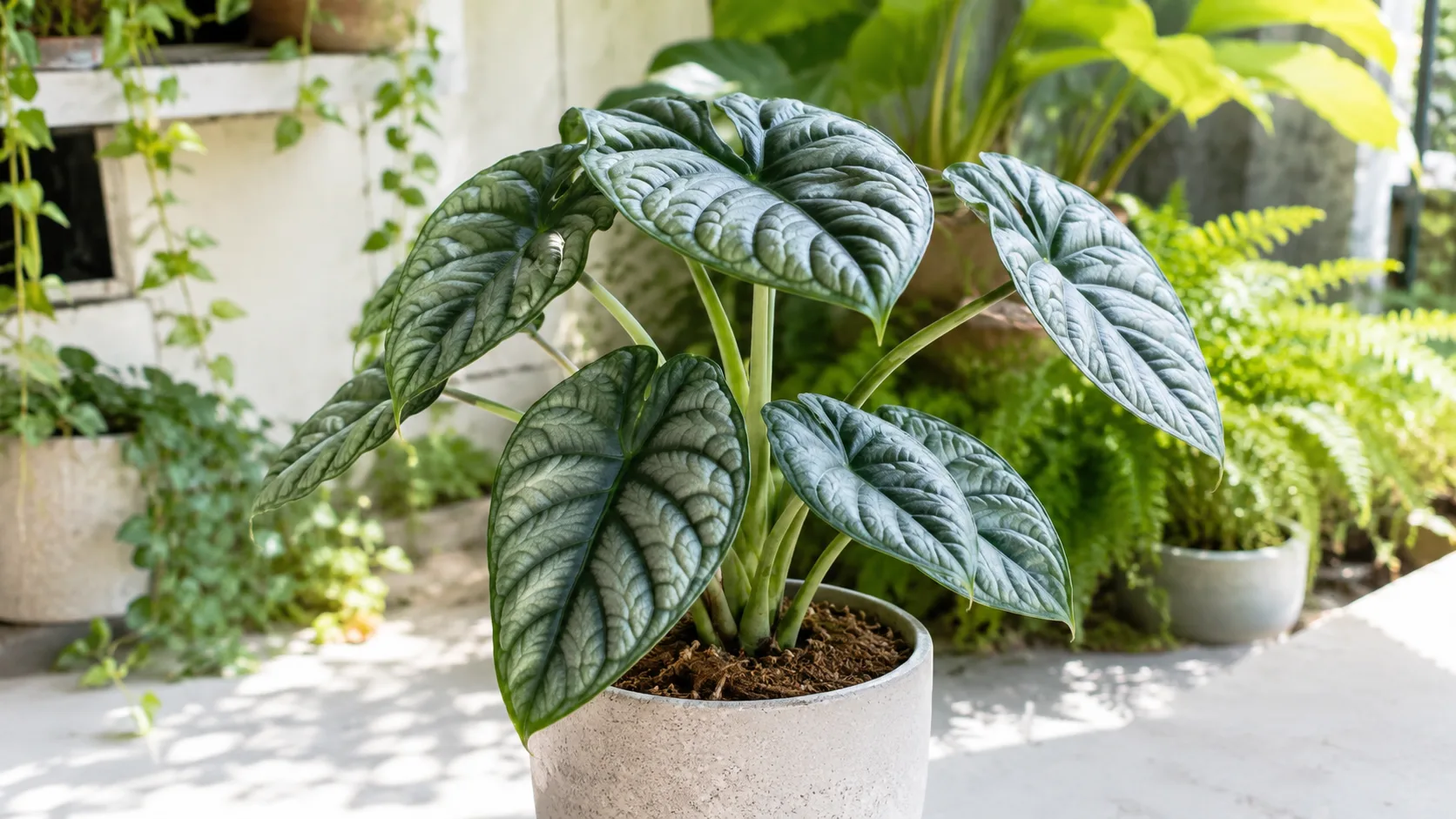
Alocasia Dragon Scale Watering: How Often, How Much, and How to Fix Mistakes
Alocasia Dragon Scale Watering: How Often, How Much, and How to Fix Mistakes
Alocasia Dragon Scale is one of those plants that looks like a piece of carved metal until you water it wrong twice and the whole thing collapses. The dark, sculpted leaves are not decoration - they are a sign of a plant that is biologically wired for a very specific kind of moisture. Get the rhythm right and the corm stays firm, the leaves stay thick, and the plant pushes out a new, perfectly veined spear every few weeks. Get it wrong and you get yellow leaves, mushy stems, root rot on Alocasia Dragon Scale, and a grower wondering what they did.
This guide is built around one question: how do you water an Alocasia Dragon Scale so it actually thrives, and what do you do when something is already going wrong? Every recommendation below is grounded in horticultural guidance from the Missouri Botanical Garden, the Royal Horticultural Society, university extension services including the University of Florida IFAS Extension and the University of Wisconsin Extension, and the practical experience of aroid growers. Use it as a working system, not a one-time checklist.
Why Watering Alocasia Dragon Scale Is Harder Than It Looks
Most generic houseplant advice - “water when the top inch is dry” - is too coarse for Alocasia Dragon Scale overview. Alocasia Dragon Scale is a Jewel Alocasia in the Alocasia baginda group, native to the island of Borneo, where rain is frequent and the forest floor drains almost immediately after each downpour (Kew Plants of the World Online). The substrate is consistently moist but never logged. That is the only environment in which the plant evolved, and it is the only environment in which the corm - the swollen underground stem the plant uses to store energy and survive stress - stays healthy. Replicate it indoors and the plant rewards you. Miss it, and the corm is the first thing to suffer.
The corm, the roots, and the balance most people miss
The corm is the part most beginners never see. It sits below the soil, stores starch and water, and is the only part of the plant that reliably survives a bad month. The fine feeder roots that branch off it are the part that pulls moisture and oxygen in, and they are extremely sensitive to two conditions: too much water for too long, and not enough oxygen. The corm can take a short dry spell; the fine roots cannot take a long wet one. That is the entire puzzle, and it is also why the watering advice in this article emphasizes dry-down intervals, substrate choice, and pot drainage as much as volume.
How Often to Water Alocasia Dragon Scale
The honest answer is: it depends on your pot, your mix, your light, and your season. But there is a useful default to start from. The Missouri Botanical Garden’s general Alocasia guidance and the Royal Horticultural Society both recommend watering when the top of the substrate has started to dry. For Dragon Scale specifically, most experienced growers target a narrow band: the top 2–3 cm of substrate dry, the lower half still slightly moist. That band is where the corm gets what it needs and the roots get the oxygen they need.
The “top 2–3 cm dry” rule and seasonal rhythm
In a 10–15 cm pot in a typical indoor environment, that translates to watering roughly every 5–10 days during active growth, and every 2–4 weeks during dormancy. Larger pots hold more water and dry more slowly; terracotta pots dry faster than plastic or glazed ceramic. Plants in brighter, warmer rooms drink faster than plants in cool, dim corners. The number that matters is not “every X days” but “the top 2–3 cm has dried.” Calendar schedules are a reminder, not a rule. Spring and summer are active growth seasons - expect to water more often, often twice a week in a chunky mix in a warm, bright room. Fall and winter are the opposite. Light drops, temperatures fall, and the plant either slows growth or enters full dormancy, depending on conditions. The substrate stays wet for much longer, and continuing a summer schedule is the most reliable way to cause rot. Cut frequency roughly in half from October onward, then again in mid-winter if growth has fully stopped.
The Three Moisture Checks That Actually Work
If you only learn one skill for this plant, learn how to check moisture. Every other piece of advice on the internet assumes you already know how to do this well.
Chopstick, pot weight, and moisture meter
The first check is the chopstick or finger test. Push a clean chopstick, wooden skewer, or your finger into the substrate down to the second knuckle. Pull it out and look at it. If the tip comes up dark and damp, wait. If it comes up mostly dry with just a hint of moisture, water. This works because it samples below the surface crust, where the actual root zone lives. Surface color lies; a chopstick does not. The second check is pot weight. Lift the pot right after a thorough watering and remember how heavy it feels. Lift it again 24 hours later, then a few days later. The difference between “soaking wet” and “ready to water” is a clear weight drop that you can feel after a few cycles. The Spruce and several university extensions use this as the primary check for moisture-sensitive aroids, and for good reason - it works. The third check is a moisture meter, which is a useful second opinion for beginners or for very chunky mixes where a chopstick slides past dry pockets. Insert the probe into the middle of the pot, not the edge, and read at root depth. A reading of 3–4 on a 1–10 scale (depending on the meter) usually corresponds to “top dry, lower half slightly moist.” Meters are not perfect in bark-heavy mixes, so use the reading as a guide, not a verdict.
What Kind of Water to Use on Alocasia Dragon Scale
Water quality is the second most common killer of this plant, right after overwatering on Alocasia Dragon Scale, and the two are often linked. The University of Florida IFAS Extension has documented that chlorine in tap water damages the delicate root hairs of sensitive houseplants, and aroid growers have long reported the same for fluoride and dissolved mineral salts. Alocasia Dragon Scale, with its thin, textured leaves, shows the damage before the roots do: brown, crispy leaf margins that get blamed on humidity but are actually chemistry.
Why tap water can slowly damage the plant
Rainwater is the gold standard. It is naturally soft, free of chlorine and fluoride, and sits in the slightly acidic pH range (about 5.5–6.5) that aroids prefer. Distilled water is the cleanest option and a safe default if you only have a few plants. Filtered water works if your filter is designed to remove fluoride, not just chlorine. Standard activated carbon pitchers improve taste but often leave fluoride behind; reverse osmosis and filters labeled for fluoride removal are the only pitcher-style options that consistently work. If rainwater or distilled water is not practical, you can use tap water with two adjustments. First, let it sit uncovered for 24 hours so chlorine can off-gas - note that this does not remove fluoride, but it reduces the more reactive chlorine. Second, bring it to room temperature before pouring. Cold tap water in winter can shock the roots and trigger dormancy or leaf drop. The University of Maryland Extension specifically advises that sensitive plants can develop brown leaf tips from fluoride in tap water, and the same principle applies to Dragon Scale. If you see persistent brown leaf margins and humidity is already above 60%, the water itself is the most likely culprit.
Bottom vs Top Watering: Which One Wins
Both methods work for Alocasia Dragon Scale if the substrate is well-draining, but they do different jobs. Choosing one and using it forever is a missed opportunity.
Bottom watering as default, top watering as a periodic flush
Bottom watering - setting the pot in a tray of water and letting the substrate wick moisture up through the drainage holes - encourages the roots to grow downward, saturates the entire root zone evenly, and keeps the surface of the substrate drier. That last point matters more than people realize. A dry surface discourages fungus gnats, which lay eggs in the top centimeter of persistently damp soil and are one of the most reliable early signs of overwatering. Set the pot in 2–3 cm of room-temperature water for 15–20 minutes, then remove and let the excess drain. The Spruce specifically recommends bottom watering for Dragon Scale in soilless mixes, and most aroid growers use it as their default method. The problem with bottom watering is that it does not flush the substrate. Over time, salts from fertilizer, mineral content in the water you do use, and other soluble residues accumulate in the top of the pot. Every 4–6 weeks, water thoroughly from the top until water runs freely from the drainage holes, then empty the saucer. This is your reset. The combination - bottom watering as the default, top watering as a periodic flush - gives you the best of both methods: even moisture for the roots and clean substrate for the long run.
Humidity, Temperature, and Transpiration
Watering does not exist in isolation. Humidity and temperature decide how fast the plant loses water through its leaves, and that sets the pace for how fast the substrate dries. The Royal Horticultural Society and the University of Arkansas Extension both put Alocasia in the 60–80% relative humidity range, with the practical indoor target sitting around 65–70%. Below 50%, the plant starts losing moisture faster than the roots can replace it, and the first sign is the same papery, brown, crispy edge that people confuse with watering problems.
60–80% humidity and the temperature range that supports healthy water use
“60 to 80 percent” is not a number you have to hit exactly. It is a band. In a bathroom with a shower running, you might briefly hit 80%. In a living room with central heating running in winter, you are probably sitting at 25–35%, which is far too dry. A cool-mist humidifier with a hygrometer is the most reliable way to keep the plant in range. Grouping plants together, using a pebble tray, and placing the plant in a naturally humid room (kitchen, bathroom, well-lit laundry) all help. Misting is the least effective option and can leave the leaves vulnerable to fungal spotting, so use it as a temporary boost, not a strategy. Alocasia Dragon Scale is comfortable between 18 and 27 °C (65–80 °F). It tolerates short dips to 16 °C (60 °F) but reacts badly below 13 °C (55 °F). Cold air plus wet substrate is the worst combination - the roots slow down, oxygen demand drops, and pathogens like Pythium and Phytophthora thrive. Keep the plant away from cold windows in winter, away from heating vents that dry the air, and away from air conditioners that drop temperature suddenly.
Overwatering Symptoms in Detail
Overwatering is the single most common cause of decline in Alocasia Dragon Scale, and the symptoms are not always what you would expect. The plant does not always look “too wet.” Sometimes it wilts. Sometimes it goes yellow. Sometimes it drops leaves one at a time. Knowing the full pattern helps you catch it before the corm is gone.
Yellow leaves, mushy stems, and the “wet wilt” trap
The classic pattern starts with the oldest leaves yellowing from the outside in, often more than one at a time. The petioles may feel soft or rubbery at the base. The substrate smells sour or stagnant. The plant may wilt even though the soil is wet - that is the “wet wilt” trap, and it is the most diagnostic sign. The roots are suffocating; they cannot move water upward; the plant looks thirsty but cannot drink. If you see wilting paired with wet substrate, stop watering immediately and inspect the roots. Healthy roots are firm and white to light tan. Rotted roots are dark, mushy, and may smell bad. University of Wisconsin Extension and multiple aroid-care resources confirm that this is the most reliable early warning. Fungus gnats are a related warning sign that is often mistaken for a pest problem. The larvae live in the top centimeter of substrate and only sustain a population when that layer stays wet for days at a time. A few gnats flying around the pot means the substrate is staying wet too long. The fix is to extend the dry-down interval, switch to bottom watering to keep the surface drier, and - if the population is established - use yellow sticky traps for adults and BTi (Bacillus thuringiensis israelensis) or beneficial nematodes (Steinernema feltiae) for the larvae in the substrate. The gnats are the symptom; the watering is the cause.
underwatering on Alocasia Dragon Scale Symptoms in Detail
Underwatering is less common but more forgiving. The plant has ways to signal distress, and recovery is usually straightforward.
Curling leaves, especially inward into a taco or canoe shape, is the most common early sign. Brown, crispy edges may follow, but they look different from fluoride damage: the browning from underwatering is usually more uniform and accompanied by a slightly papery texture across the whole leaf. Drooping that resolves within hours of a thorough watering is another strong signal. The substrate will feel dry, sometimes pulling slightly away from the sides of the pot. If you see these signs, water thoroughly - top water until it drains - and the plant should perk up within a day. If it does not, the roots have likely been damaged by the previous overwatering cycle and you have a more serious problem that the recovery section below can help with.
Dormancy and Winter Watering
Alocasia Dragon Scale can stay evergreen year-round if it is kept consistently warm (above 21 °C / 70 °F), in Alocasia Dragon Scale light guide, and with humidity above 60%. In most homes, those conditions are hard to maintain through winter, and the plant will respond by slowing growth or going fully dormant - losing all of its leaves and surviving on the corm alone. This is not death. It is the plant doing exactly what it would do in a dry season in Borneo (PDA Exotic Plants).
Cutting volume by 60–70% and coming out safely
The biggest mistake in dormancy care is keeping the summer watering schedule. The plant is pulling almost no water, the substrate dries slowly because of cooler temperatures and lower light, and the roots sit in moisture for weeks. That is the perfect storm for Pythium and Phytophthora, the two pathogens responsible for most Alocasia root rot. Cut total irrigation volume by 60–70% and extend the interval to every 3–4 weeks. The goal is not to grow the plant; it is to keep the corm from desiccating. If the top 3–4 cm of substrate dries and the corm still feels firm when you press the side of the pot gently, you are doing it right. When you see a new growth tip emerge in late winter or early spring, do not jump straight back to the summer schedule. The root system is rebuilding and cannot move water as efficiently as it did before. Water lightly, about half the normal volume, and wait until the top 2–3 cm of substrate is dry before the next session. Do not resume a full watering schedule until the first full leaf has unfurled. This is a four- to six-week transition, and rushing it is one of the most common ways a recovering plant gets pushed straight back into rot.
Emergency Recovery: How to Save a Soggy Alocasia Dragon Scale
If you have caught the problem early - yellowing leaves, soft petioles, sour substrate, but the plant is still standing - the recovery path is the same one experienced growers use. Work through these steps in order, and do not skip ahead.
- Unpot the plant. Tip the pot on its side, support the corm with your hand, and slide the root ball out. Do not yank by the stem.
- Rinse the roots. Wash away all the old substrate under lukewarm room-temperature water. You need to see the roots clearly to assess the damage.
- Inspect and trim. Healthy roots are firm and white to light tan. Rotted roots are dark, mushy, and may slip apart when you touch them. Trim every soft, dark, or smelly root back to firm white tissue with sterilized shears. If the corm itself is mushy, trim back to firm white tissue inside the corm - you can safely cut into healthy corm material.
- Treat with dilute hydrogen peroxide. Mix 1 part 3% hydrogen peroxide with 3–4 parts water. Soak the trimmed root system and corm for 5–10 minutes. This kills most anaerobic bacteria and fungi on contact and adds oxygen back to the tissue. Do not use undiluted hydrogen peroxide, and do not soak for longer than 10 minutes.
- Repot in a fresh, dry, chunky mix. Use a mix of roughly 40% quality potting compost, 30% perlite or pumice, 20% orchid bark, and 10% horticultural charcoal. The substrate should drain from the pot in under 30 seconds when watered. Choose a clean pot with multiple drainage holes - terracotta is ideal because it wicks moisture away from the root zone. Do not reuse the old pot without scrubbing and drying it first.
- Hold off on watering for 5–7 days. Let the trimmed roots callus and the substrate dry back. After that, water lightly with a dilute root stimulant if you have one, and resume the normal “top 2–3 cm dry” schedule. Do not fertilize for at least 4–6 weeks.
- Increase humidity and keep warm. While the plant recovers, push humidity to 70% and keep temperatures around 22–25 °C (72–77 °F). Bright indirect light helps the plant push new roots. Do not move the plant into direct sun to “help it recover” - that adds stress.
If more than 50% of the root system is gone, recovery is possible but slow. Expect a month or more before new growth appears, and accept that the plant may drop its remaining leaves and resprout from the corm. That is normal. New growth from a healthy corm, even a leafless one, is the best sign that the plant has turned the corner.
A Simple 7-Day Watering Routine You Can Follow
If you want a starting routine and then adjust from there, this is a sensible default for an Alocasia Dragon Scale in a 10–15 cm terracotta pot with a chunky aroid mix, in a bright, warm room during active growth.
- Day 1 (after a thorough watering): Check the pot weight. Note the heavy, saturated feel.
- Day 3: Check the top 2 cm with a chopstick. If still damp, do nothing.
- Day 5: Recheck the chopstick and the pot weight. If the top 2–3 cm is dry and the pot feels noticeably lighter, water.
- Day 6: If the chopstick is still picking up moisture on day 5, wait one more day and recheck.
- Day 7: Water thoroughly from the top until it drains, or bottom water for 15–20 minutes. Let the pot drain completely. Empty the saucer.
- Every 4–6 weeks: Use a top-water flush to rinse out any accumulated salts, then return to the routine.
- Every 6 months or so: Refresh the top 2–3 cm of substrate with new chunky mix to keep the surface aerated and prevent compaction.
In winter, multiply every interval by 2 to 3, and reduce volume. If the plant drops all its leaves, stop watering entirely for 2–3 weeks, then resume a tiny sip every 3–4 weeks until new growth appears.
Conclusion
Watering an Alocasia Dragon Scale is less about a fixed schedule and more about a connected system: substrate, pot, water quality, humidity, temperature, and season all feed into the same decision. The default rule - top 2–3 cm of substrate dry, then water thoroughly - covers most of the year, but the rhythm changes with the seasons, the water you use changes the long-term health of the plant, and the difference between “moist” and “soggy” is the difference between a thriving aroid and a dying one. If you build the habit of checking the substrate with a chopstick, lifting the pot to feel the weight, and watching the leaves for early signals, you will catch problems long before they become emergencies. And if you do end up with a soggy plant, the recovery path is well understood: unpot, rinse, trim, treat, repot in a chunky mix, and let the corm rebuild. The corm is the plant’s insurance policy. Protect it, and the plant will come back.
When to use this page vs other Alocasia Dragon Scale guides
- Alocasia Dragon Scale overview - Start here for whole-plant context before deep-diving this topic.
- Alocasia Dragon Scale problems hub - Jump to symptom-specific fix guides when this care topic does not resolve the issue.
- Overwatering on Alocasia Dragon Scale - Escalate here when watering adjustments are not enough.
- Underwatering on Alocasia Dragon Scale - Escalate here when watering adjustments are not enough.
- Root Rot on Alocasia Dragon Scale - Escalate here when watering adjustments are not enough.
Related Alocasia Dragon Scale guides
- Alocasia Dragon Scale overview
- Alocasia Dragon Scale light
- Alocasia Dragon Scale soil
- Alocasia Dragon Scale propagation
- Alocasia Dragon Scale fertilizer
- Alocasia Dragon Scale repotting
- Overwatering on Alocasia Dragon Scale
- Underwatering on Alocasia Dragon Scale
- Root Rot on Alocasia Dragon Scale
- Wilting on Alocasia Dragon Scale
- Drooping Leaves on Alocasia Dragon Scale
- Mold on Soil on Alocasia Dragon Scale
Related tool
Try the Plant Watering Calculator with alocasia-dragon-scale pre-selected to estimate needs for your setup.