Water Plants Before First Frost: The Task to Prioritize
Water plants before first frost with the right timing, root-zone method, and moisture check. Learn what to water, what to cover, and when to stop.
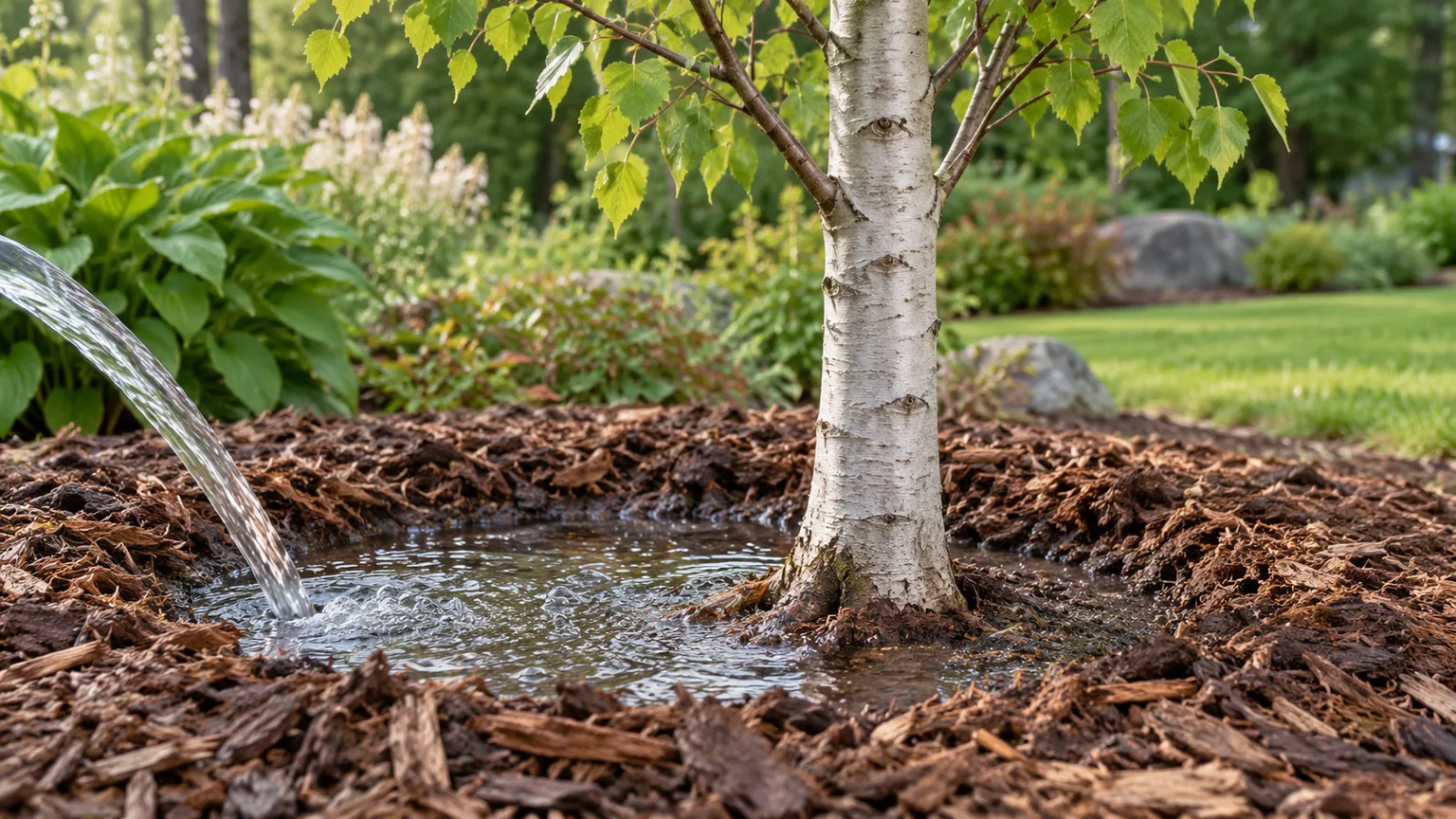
If the forecast says your first frost is approaching and you can complete only one garden job, check the soil and water the root zone if it is dry and still unfrozen. That is the useful version of the advice—not a last-minute flood of every bed. A slow, thorough soak gives roots access to moisture before cold locks the soil, while a rushed splash across the surface does very little.
This matters most for new trees and shrubs, evergreens, late-planted perennials, raised beds, new lawns, and plants in windy or sun-baked locations. Established, drought-adapted plants in naturally wet soil may need nothing. The decision comes down to three observations: what the plant is, whether the soil is actually dry below the surface, and whether water can infiltrate before temperatures fall below freezing.
The best sequence is simple: inspect, water on a mild day, soak slowly across the root zone, confirm the depth, then add correctly placed mulch or a frost cover where those protections are appropriate. Water supports the plant’s winter resilience; it does not turn a tomato into a frost-hardy crop or rescue roots sitting in saturated clay.
Why Deep Watering Comes First
Cold weather damages more than leaves. A long, dry fall can leave roots short of the moisture they need to remain functional, and frozen soil can prevent those roots from replacing water lost by evergreen foliage or drying wind. Colorado State University Extension notes that root injury from prolonged dry fall and winter conditions may not be obvious until the following spring or summer, when a weakened plant shows dieback, reduced growth, or greater pest and disease pressure. Colorado State University Extension’s fall and winter watering guidance is the reason I treat a dry root zone as a higher priority than cosmetic fall cleanup. Davey Tree’s fall-watering guidance also puts young trees high on the priority list and warns that light, frequent applications can run off before reaching roots.

What moisture does for roots
Roots do not shut off the instant the first leaf freezes. In fall, soil can remain warm enough for roots to function even as top growth slows, and a healthy root system stores resources and anchors the plant through wind and freeze-thaw movement. Moist soil also has more heat capacity than dry soil, so it cools more slowly during a cold night. That is a limited buffer, not a force field: a wet root zone cannot prevent a hard freeze from killing tender stems or flowers.
Evergreens deserve particular attention because they keep their foliage or needles and can continue losing water during sunny, windy winter weather. Their roots may be unable to replace that loss when the ground is frozen. Deciduous trees and dormant perennials usually lose less water after leaf drop, but recently planted specimens still have a smaller, less distributed root system and are less forgiving of a dry start.
Which plants need priority
Start with plants that combine high water demand, shallow or incomplete roots, and exposure. That means trees and shrubs planted within the last year or two, evergreens, broadleaf evergreens, late-planted perennials, newly seeded or sodded lawns, and plants in raised beds or containers. Give extra attention to south- and west-facing sites, berms, windy corners, areas beside heat-reflecting walls, and spots beneath roof overhangs that receive little rain.
An established native or drought-tolerant plant in a well-drained bed may not need supplemental water at all if autumn rain has kept the soil moist. “Water everything before frost” is as imprecise as “stop watering everything in fall.” Match the effort to the plant and the evidence in the soil.
Frost, Freeze, and Hard Freeze Are Not the Same
Garden forecasts use frost, freeze, and hard freeze in ways that can sound interchangeable, but the practical response differs. Frost is often a surface event: ice crystals form on exposed plant tissue during a calm, clear night. A freeze describes air or plant tissue reaching 32°F (0°C) or lower, and a hard freeze is a longer or colder event that can freeze soil and kill tender annuals outright.
The labels are not perfectly standardized across weather services, and a forecast low is not the temperature at every leaf or low pocket in your yard. A sheltered bed beside a wall can stay warmer than an open lawn; a low hollow can be colder than the official station. Use the forecast as a trigger to inspect, not as a promise that every plant will experience the same conditions.
For a light frost, a cover may be the most important intervention for tomatoes, peppers, basil, tender flowers, and other cold-sensitive tops. For a dry stretch followed by a freeze, root-zone watering helps plants enter that event hydrated. For a hard freeze, water alone will not save a tender plant; harvest it, move the container, or cover it with a proper barrier before nightfall.
Check the Forecast and Soil Before You Water
Do not begin with the hose. First look at the next 24 to 48 hours, recent rain, soil drainage, and the plant’s history. If the ground is saturated, the bed drains poorly, or substantial rain is on the way, adding water can displace air from the root zone and create the exact cold, wet conditions that encourage root problems.
Probe below the mulch with a finger, trowel, or soil probe. Check several spots: near the plant, halfway to the canopy edge, and farther out for a tree. The surface may feel damp after dew while the soil below is dry, or it may look dry while the root zone is still moist. A screwdriver that enters easily through moist soil but stops at a dry layer gives a better answer than a calendar reminder.
Colorado State Extension recommends watering when air temperatures are above 40°F and there is no snow cover, then applying water around midday so it has time to soak in before a possible night freeze. K-State’s winter-watering guidance uses a less conservative threshold: water when the temperature is above freezing and the soil is not frozen. Both sources agree on the practical test—water must be able to infiltrate before the soil freezes. K-State Research and Extension’s winter watering tips also recommends checking the soil rather than relying on a fixed interval and soaking general landscape areas to roughly 6 to 8 inches, with trees needing deeper moisture. Choose the warmer window when you can, particularly if your local forecast or extension service gives a more specific cutoff.
Use the average first frost date as a planning tool
An average first frost date helps you schedule the inspection, mulch materials, frost cloth, and final harvest. It is not a deadline and it is not a guarantee. The Old Farmer’s Almanac frost-date calculator can give you a local starting point, but the short-range forecast should control the day you water or cover.
Count backward from the forecasted cold spell, not just from the average date. If you see a dry week and a mild afternoon before the first likely frost, that is a good watering window. If the first cold night is tonight and the soil is already frozen, skip the ineffective deep soak and shift to covers, relocation, or harvest. If the air is mild but the soil is waterlogged, wait for drainage.
A Practical Deep-Watering Method
Deep watering means wetting the soil where roots can use it, slowly enough that the water infiltrates instead of running downhill. You are aiming for a moist root zone, not a pond. A reliable sequence is: check the soil and forecast; identify the root zone; choose a low-flow method; water in slow passes; then verify the depth and drain exposed equipment. Epic Gardening’s fall-watering guide makes the same useful distinction between a fixed summer timer and an autumn routine adjusted for rainfall, temperature, and local conditions.
Water at the root zone, not the leaves
Set a hose on a low flow, use a soaker hose, or choose a soft spray wand. Direct the water at the soil and distribute it across the root zone. Overhead watering is not automatically disastrous—natural rain wets foliage—but it is inefficient for a deliberate pre-freeze soak and leaves cold, wet leaves that can stay damp longer than necessary. Epic Gardening’s fall-watering guidance also recommends watering at soil level and reducing irrigation as cooler weather and rainfall change how quickly beds dry.
For a shrub, circle the plant broadly rather than pouring every gallon at the crown. For a perennial, water the surrounding soil until the root ball and the adjacent soil are both moist. For a tree, begin at the trunk only if the original root ball is still dry, then work outward to the dripline and beyond. The roots that absorb water are not concentrated in a narrow ring against the bark.
Soak slowly and verify depth
Pause when water begins to run off, especially on clay, compacted ground, or a slope. Let that water soak in, then continue. Several slow passes are more effective than one fast blast. A rain gauge or straight-sided container placed under a sprinkler can help you learn how quickly your system applies water, but the soil probe is the final check because the same number of gallons behaves differently in sand, loam, and clay.
After watering, push a metal rod or screwdriver into the soil in multiple locations. For general beds and lawns, aim for moisture around 6 to 8 inches deep. For trees, Colorado State guidance uses about 12 inches as the target depth. Stop when the soil is adequately moist through the active root zone; deeper is not automatically better, and water below the roots is mostly wasted.
The soil should feel moist and crumbly, not soupy. If a hole fills with water, the soil remains shiny and slick, or your foot sinks into the bed, you have crossed from useful irrigation into saturation. Improve drainage or wait rather than trying to “protect” roots with more water.
Finish by protecting your equipment
Once the root zone is watered, disconnect the hose from the outdoor spigot and drain the hose, wand, sprinkler, or other above-ground equipment. Water trapped in fittings can freeze and damage the equipment. Do not assume a brief frost will destroy every buried irrigation line, but do follow the manufacturer’s winterizing instructions before an extended freeze.
Do not leave an automatic irrigation system running through a freezing night as a substitute for a deep soak. A timed system can create runoff, ice, and saturated soil when the water is needed below ground. Hand-watering during a mild window gives you better control and lets you confirm where the water went.
How Much Water to Give Trees, Shrubs, Perennials, and Lawns
There is no single pre-frost volume for an entire yard. Plant size, root spread, soil texture, recent precipitation, and exposure all change the amount. Use published numbers as starting points, then reduce them for rain and stop when the target depth is reached.
Start with the dripline for trees
The dripline is the outer edge of a tree’s canopy—the place where rain would fall from the widest branches. Most fine, absorbing roots are in the upper soil and spread far beyond the trunk. Watering only at the trunk leaves much of the active root zone dry and can keep the trunk base unnecessarily wet.
For a newly planted or young tree, Colorado State Extension gives a general survival guideline of 10 gallons of water per inch of trunk diameter, applied slowly across the root zone. Measure trunk diameter about 6 inches above the ground; a 2-inch trunk would therefore start at about 20 gallons, divided across multiple points rather than dumped in one place. The guidance also stresses watering to about 12 inches deep and accounting for precipitation. CSU estimates that a tree may need roughly one year of establishment for each inch of trunk diameter, so a larger transplant can remain vulnerable longer than a simple “new this year” label suggests.
Large established trees need a wider approach. Place a soaker hose or move a soft sprinkler around the dripline and just beyond it so different sections receive water. Do not use the 10-gallon-per-inch number as a license to flood a mature tree in one session; soil infiltration and the tree’s actual moisture level are the controlling factors.
For shrubs, Colorado State Extension’s dry-winter schedule gives newly planted shrubs 5 gallons twice a month, small established shrubs (under 3 feet) 5 gallons monthly, and large established shrubs over 6 feet 18 gallons monthly; it also says to reduce those amounts when precipitation contributes moisture. Treat those figures as regional starting points, not a universal schedule, and check the soil before each application. Newly planted shrubs may need closer monitoring than established shrubs. Perennials usually need a normal thorough watering, not a saturated crown, especially if they are dormant or naturally adapted to dry soil.
Lawns are a separate case. Newly seeded or sodded areas are vulnerable because their roots are shallow, while established turf in a moist, shaded site may not need a special soak. South- or west-facing turf and windy sites dry faster. Water normally enough to moisten the active root zone, but avoid leaving a thick, persistent sheet of ice on the lawn.
When Watering Before Frost Can Backfire
Do not water outdoor soil that is frozen solid. Water cannot infiltrate frozen ground; it may run off, pool, or freeze at the surface while the roots remain dry. Wait for a thaw and a mild period when the soil can absorb the water.
Skip supplemental water when the bed is already saturated, when drainage is poor, or when a heavy rain is imminent. Cold, airless soil can damage roots as surely as dry soil, and a pre-frost soak does not cancel the need for oxygen around the roots. Plants in naturally wet swales, rain gardens, or heavy clay should be judged by their actual moisture rather than by a generic winter-watering schedule.
Also avoid applying a late nitrogen fertilizer in the same rush. Fertilizer does not replace water, and nitrogen can encourage soft new growth that has not hardened before cold arrives. This is the moment to protect established tissues and roots, not to force a final flush of leaves.
Finally, do not treat watering as a cure for a tender plant that is visibly vulnerable to the forecast. A well-watered tomato can still be killed by a hard freeze. Water the soil, then cover the plant, harvest the crop, or move it if it is in a container.
Mulch After Watering, Not Instead of It
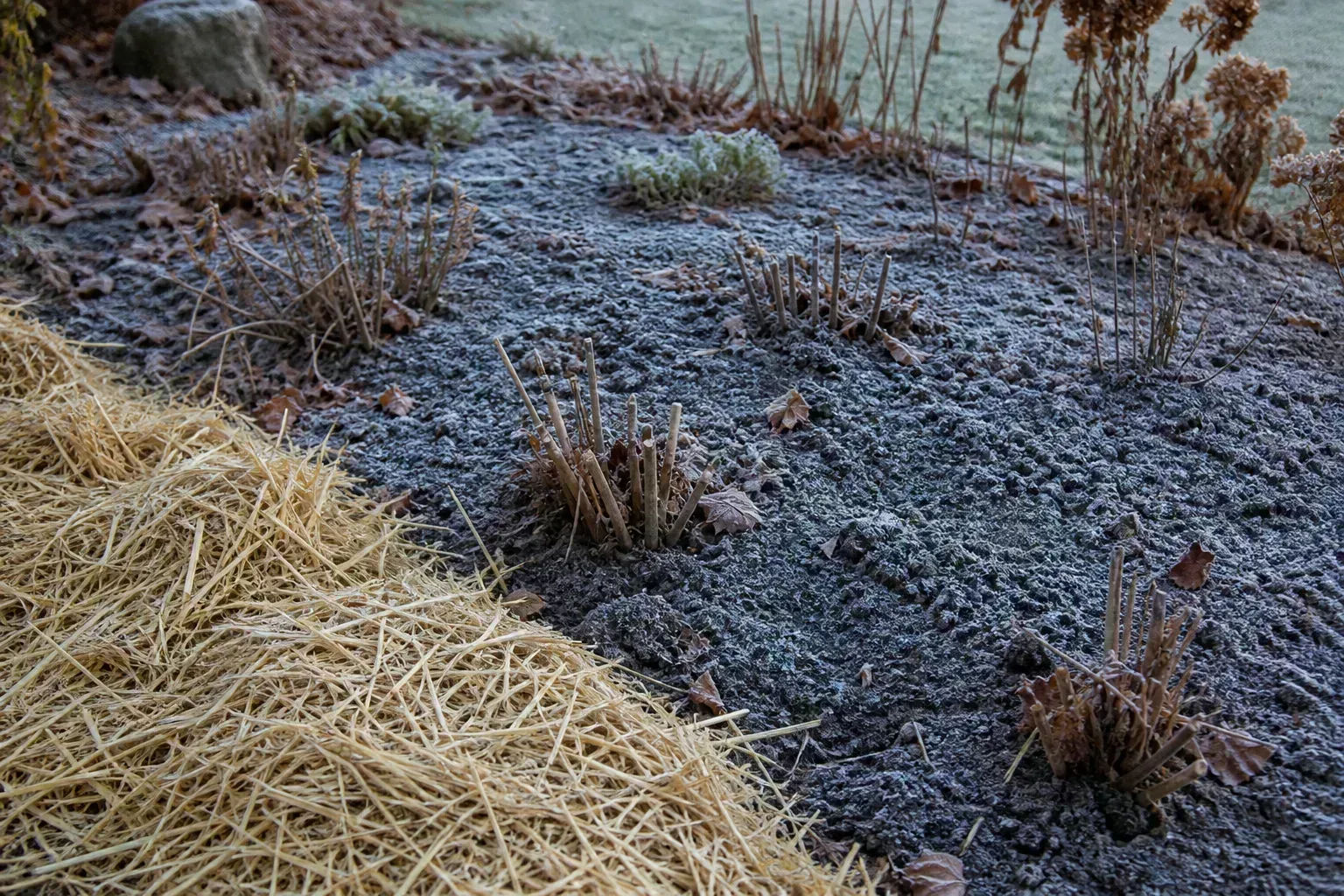
Mulch is a moisture-conservation and temperature-buffering layer, not a replacement for a dry root-zone soak. After the soil has drained and the plant has received the water it needs, add a few inches of organic mulch around trees, shrubs, and perennials. Keep the material several inches away from trunks, stems, and crowns so the base stays ventilated and does not remain wet.
The exact timing depends on the plant and climate. A thin, correctly placed layer can be useful before winter, while a very thick layer applied against a stem can invite rot, rodents, or unstable moisture. In beds where freeze-thaw cycles lift shallow-rooted perennials, mulch helps keep soil temperatures more even. In a wet climate, an airy layer is better than a dense, water-holding mound.
Do not rake every leaf automatically. Shredded leaves can contribute organic matter and protect soil, but whole wet leaves can mat over low plants and turf. Remove diseased material and thick layers that block light, air, or water. The goal is a breathable blanket over moist soil—not a sealed lid.
Protect Tender Plants, Containers, and New Transplants
Watering is the priority for dry roots, but covers are the priority for tender foliage. Check tomatoes, peppers, cucumbers, basil, begonias, tropicals, late flowers, and young transplants before a frost. Cool-season crops such as kale and spinach may tolerate a light frost, while warm-season crops can be damaged by one cold night. Plant hardiness, stage of growth, wind, and duration all matter.
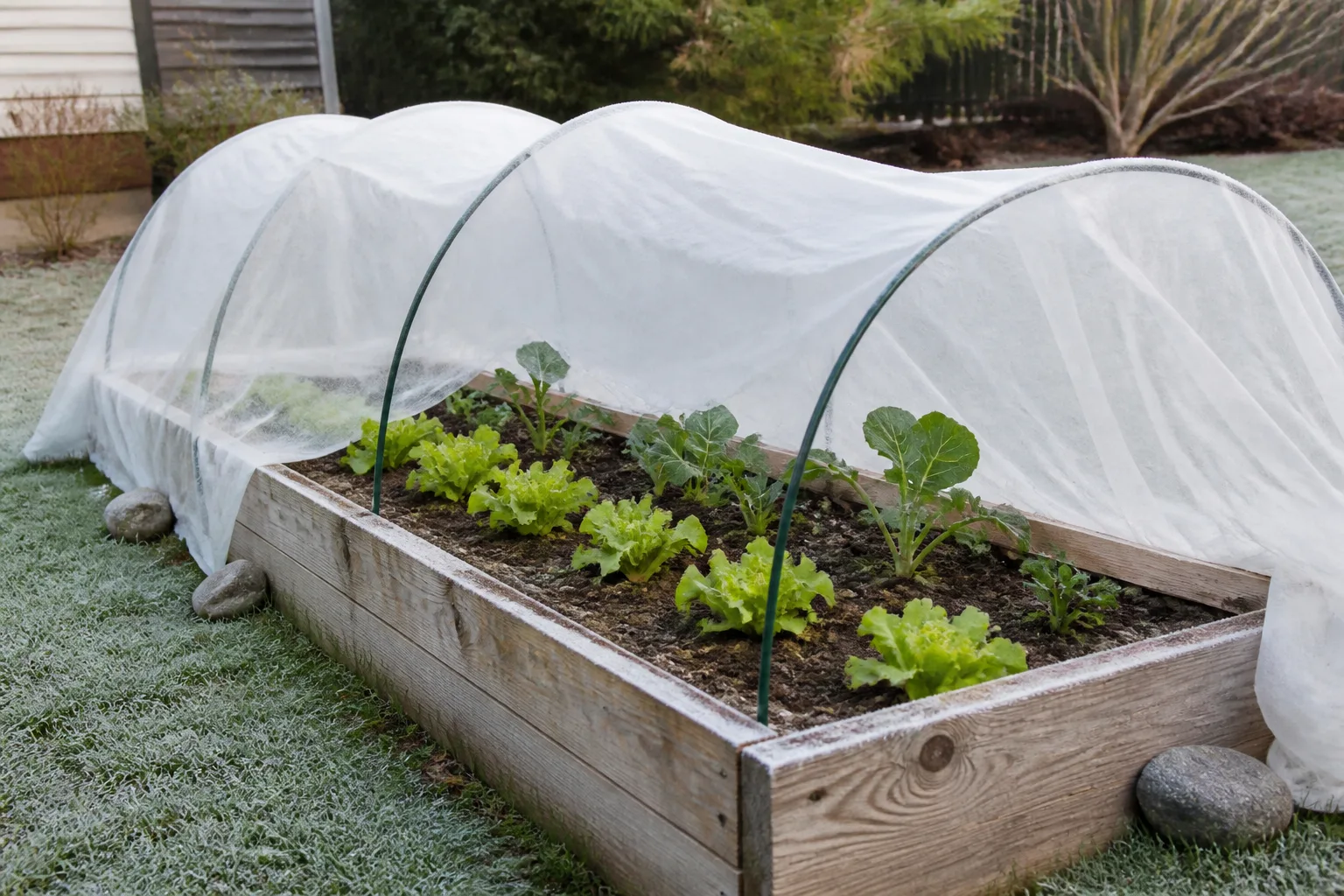
Use frost cloth or another breathable cover that reaches the ground and secure the edges so cold air cannot flow underneath. Put it on around sunset, after the soil and bed have released some daytime heat, and remove it after sunrise so the plant does not overheat. A lightweight fabric can rest on some plants, but heavier sheets and blankets should be supported by hoops or stakes so they do not crush foliage.
Plastic should not touch leaves. It can conduct cold directly to the tissue where it makes contact, and it can overheat the plant when the sun rises. If plastic is the only emergency material, build a frame, leave space between it and the plant, and remove it promptly in the morning.
New transplants deserve both moisture and protection because their roots have not explored the surrounding soil. Water the root ball and nearby soil if dry, then use mulch around—not over—the crown. A newly planted shrub beside a warm wall may need a wind barrier more than another gallon of water; a new perennial in a raised bed may need a check after every thaw.
Containers Need a Separate Winter Plan
A pot is not a small version of an in-ground bed. Above-ground soil loses heat from every side and can freeze faster, while the restricted root system has less room to find moisture. Containers also sit beneath eaves, where rain may never reach them. That makes potted evergreens, shrubs, window boxes, hanging baskets, and late-season planters easy to overlook.
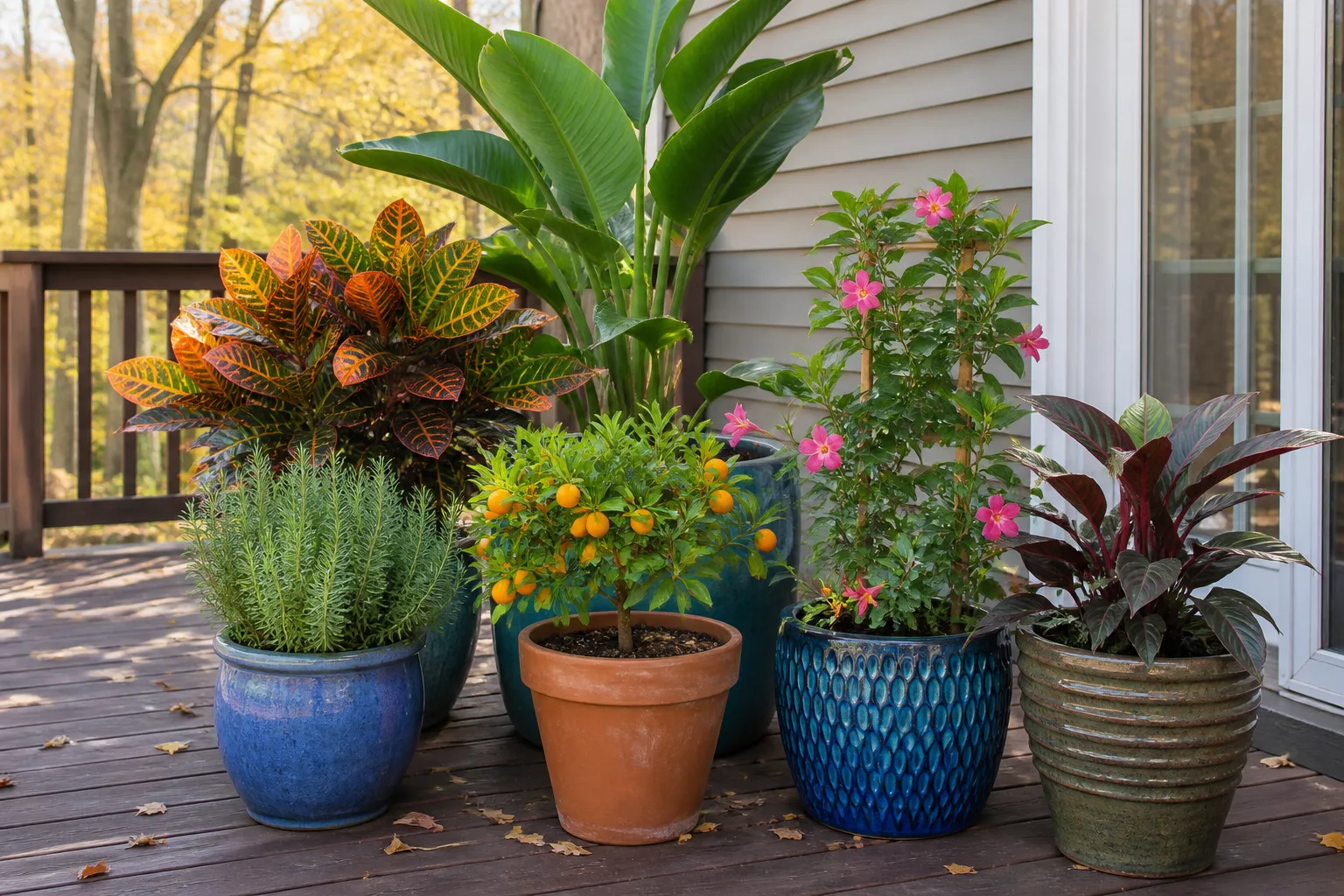
Check a container on a mild day by feeling the mix below the surface and lifting the pot if it is small enough. If it is dry and drainage is good, water thoroughly until excess drains from the bottom, then empty the saucer. Do not water a frozen pot simply because the calendar says it is winter; wait for a thaw when the roots can use the moisture.
Move tender containers to a protected location before frost, not after leaves have collapsed. Cluster hardy pots together, insulate the outside of large containers with an appropriate wrap, or sink a pot into the ground when the plant and container allow it. Protect terracotta from repeated freeze-and-thaw stress, and never leave a container standing in a full saucer of water.
Houseplants that spent summer outdoors need their own inspection before the first frost. Bring them in before temperatures fall into their cold-injury range, check leaf undersides and pot rims for pests, and transition them gradually to indoor light when possible. Do not let the outdoor pre-frost watering rule turn into an indoor winter overwatering routine.
What to Do After a Frost or Freeze
If you missed the pre-frost watering window, do not try to correct it with a midnight flood. Check the soil once temperatures rise and the ground thaws. If the root zone is dry, water slowly during the next suitable mild period. If it is already wet, leave it alone and focus on wind protection, covers, or removing a heavy load of snow when appropriate.
After a light frost, wait before cutting off every limp or blackened leaf. Damaged tissue will not become healthy again, but it can help reveal which stems and buds are still alive. A plant may look worse before it shows recovery. Major pruning immediately after cold damage can remove living tissue or trigger tender regrowth at the wrong time.
After a hard freeze, assess the plant in stages. Check whether stems are firm or mushy, whether the crown is anchored, and whether the soil remains frozen. Do not scrape ice aggressively from branches or bend frozen stems. When the soil thaws, restore moisture only if it is dry and the plant can drain; then wait for new growth before deciding what is truly dead.
The next season’s symptoms may appear late. Brown evergreen needles, dead tips, weak spring growth, and dieback can follow winter drought even when the plant looked fine in December. Record the date, weather, soil condition, and what you did. That small garden log will help you improve the timing next year more than a rigid universal schedule can.
Conclusion
Before the first frost, finish the job that cold weather makes impossible: give dry, unfrozen soil a slow, deep drink at the plant’s root zone. Prioritize new plantings, evergreens, exposed sites, raised beds, new lawns, and containers, then confirm that the water reached the depth roots can use.
Stop when the soil is saturated or frozen. Follow the soak with a correctly placed mulch layer, a properly installed frost cover for tender tops, or a move indoors for vulnerable pots. That order matters because water protects roots, while covers and relocation protect tissues that are not winter-hardy.
The strongest pre-winter garden is not the one that received the most water. It is the one where each plant got the right response to its soil, exposure, root system, and forecast—and where the gardener knew when to put the hose away.