12 Best English Garden Plants for a Cottage Border
Choose 12 classic English garden plants by light, soil, height, and bloom season, then combine them into a border with color from spring through fall.

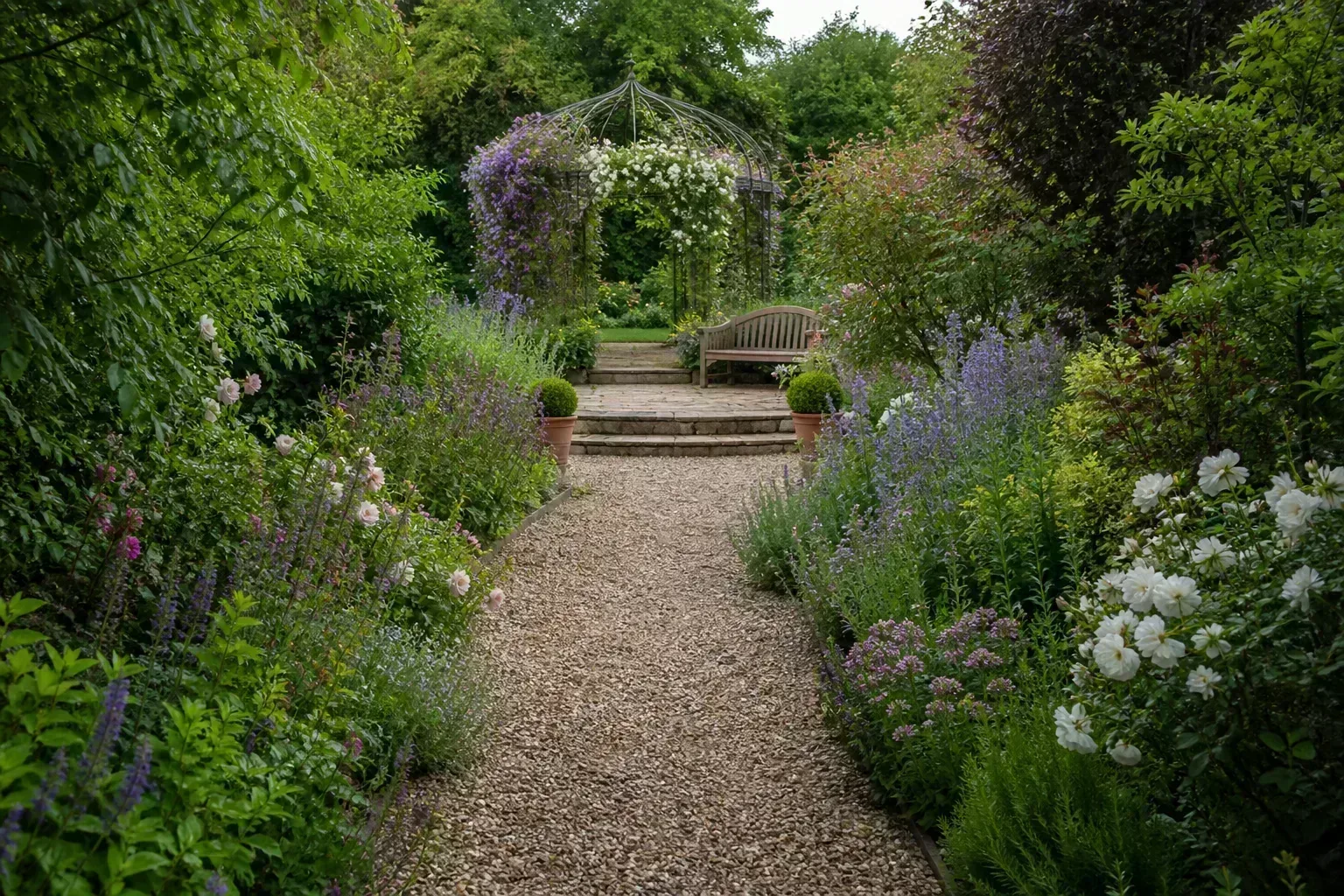
The English-garden look most home gardeners picture is a full, informal flower border: roses and tall spires rising behind mounds of foliage, with lower flowers softening the path. That style looks spontaneous, but the plants still need to suit the site. A delphinium in a windy, shady corner or lavender in winter-wet clay will struggle no matter how charming the planting plan looks on paper.
The 12 plants below cover different jobs, from the first primroses of spring to Japanese anemones that carry color into fall. Use them as a menu, not a checklist. Start with the light and drainage you have, repeat a few plants in groups, and leave enough room for each one to reach its natural spread. For a broader comparison of formal and cottage-influenced English layouts, see our English garden design guide.
Start with the conditions your border can offer
Before choosing flowers, watch the site for a day and note where direct sun falls, where water collects after rain, and which areas dry first. Full sun generally means at least six hours of direct light; morning sun with afternoon shade is a different condition from a deeply shaded bed. Do not try to make one border serve every plant equally. A better plan separates a sunny, sharply drained edge for lavender and pinks from a cooler, more moisture-retentive area for primroses and Japanese anemones.
Then sketch the mature height and spread, not the size of the nursery pot. Put tall, upright plants like delphiniums and hollyhocks toward the back of a border or the center of an island bed. Let mid-height peonies, phlox, and hardy geraniums overlap visually, then use compact plants at the front. The Royal Horticultural Society’s cottage-garden planting guide describes the useful mix of upright spires, lower “foam” plants, and self-seeders; the same principle works in a North American border when you adjust for local climate.
| Plant | Best role | Light and soil starting point | Main planning note |
|---|---|---|---|
| Peach-leaved bellflower | Airy middle or back | Sun to part shade; well-drained soil | Allow modest self-seeding or remove spent stems |
| Cottage pinks | Sunny front edge | Full sun; sharp drainage | Do not site in persistently wet soil |
| Delphinium | Tall back layer | Sun; fertile, well-drained soil | Stake early and shelter from wind |
| Hardy geranium | Low to mid border | Sun to part shade; average drainage | Cultivar determines spread and bloom length |
| Hollyhock | Vertical accent | Sun; fertile, drained soil | Give airflow and plan for rust or replacement |
| Japanese anemone | Late-season middle layer | Part shade to sun; evenly moist soil | Check spread and mature height |
| Lady’s mantle | Front or transition | Sun to part shade; average moisture | Remove seed heads if seedlings are unwanted |
| English lavender | Sunny edging or low hedge | Full sun; very free-draining soil | Winter wet is often a bigger risk than summer dryness |
| Peony | Long-lived focal clump | Sun; well-drained soil | Needs space; avoid moving it casually |
| Garden phlox | Mid-to-back layer | Sun to light shade; moisture without sogginess | Airflow helps reduce mildew pressure |
| Primrose | Spring front or shaded edge | Light shade; soil that does not dry out | It may disappear or flower poorly in summer heat |
| Rose | Shrub, climber, or anchor | Sun; moist but well-drained soil | Match growth habit and disease resistance to the site |
A short soil test can keep the list honest. Feel the soil after watering: gritty soil drains quickly; sticky clay stays wet longer; loam usually holds some moisture without remaining saturated. If you have heavy clay, select plants for the damp conditions or improve the bed’s structure over time with organic matter rather than adding a little sand to an entire clay bed. If you have dry sandy soil, prioritize drought-tolerant choices and water new plants while they establish.
12 plants that bring the English garden look to life
1. Peach-leaved bellflower for airy blue spires
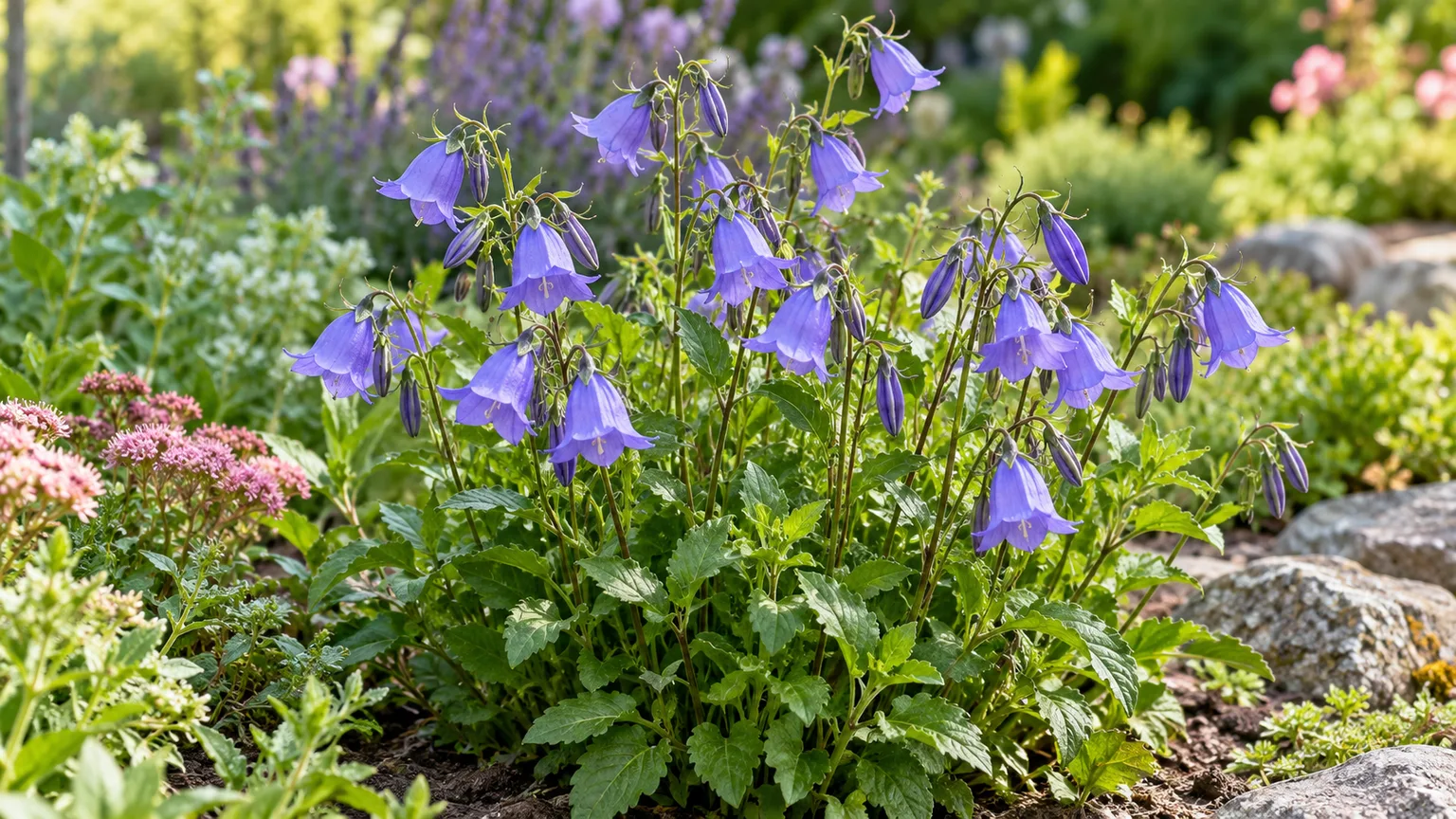
Peach-leaved bellflower (Campanula persicifolia) gives a border an upright but not heavy accent. Its open stems and bell-shaped flowers can rise through lower foliage, so it works well between a solid mound such as peony and a softer front-edge plant. It can also make useful cut flowers. The blue or white forms fit naturally into a cool palette, while a repeated group of three or five looks more intentional than a single plant stranded among unrelated colors.
Give it sun or light shade and soil that drains reasonably well. A mature clump can send up new stems in different spots over time; let a few seedlings remain if you want the border to loosen, or remove the flower stems before seeds scatter. Do not confuse a tall, clumping bellflower with creeping bellflower, a different species with a different growth habit. Check the botanical name and regional guidance before planting.
2. Cottage pinks for scent at the edge
Cottage pinks are compact Dianthus with fringed, often fragrant flowers and blue-green foliage. They are most useful along a sunny path or at the front of a border, where you can brush past the flowers and smell their clove-like scent. Their low cushions also create a visual transition between taller flowering stems and paving or lawn. Choose a cultivar based on mature width and repeat flowering, since dianthus varieties differ in both.
The important condition is drainage. Pinks can cope with dry spells once established more easily than with soil that stays wet around their crowns, especially through cold weather. Set them in sun, avoid burying the crown under mulch, and do not crowd them with thirsty plants. Sweet William is another Dianthus and makes a similar cottage-style accent, but it is not the same species as perennial cottage pinks.
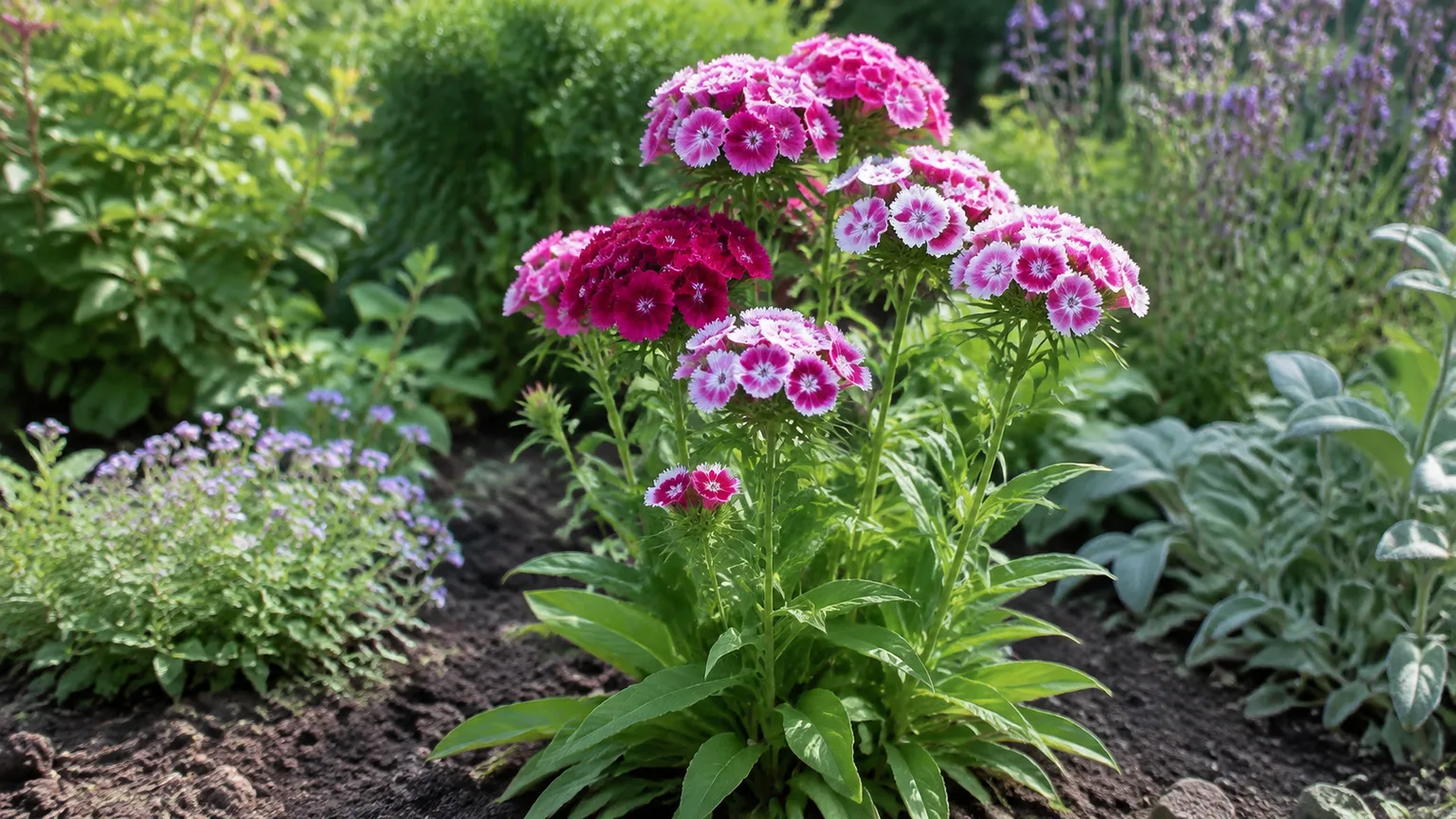
3. Delphinium for height and early-summer color
Few plants create a more unmistakable vertical accent than delphinium. Blue, violet, white, and pink flower spikes can anchor the back of a sunny border, where they rise above peonies and lower geraniums. The Royal Horticultural Society’s delphinium growing guide notes that tall forms need a sheltered spot and support, and that cutting spent flower stems can encourage another flush. That second flowering is not guaranteed in every climate or cultivar, so treat it as a possible bonus rather than the whole season’s plan.
Delphiniums are worth choosing selectively. If your site is windy, choose a shorter cultivar, plant behind a sturdy neighboring plant, or use discreet supports before stems elongate. Keep young shoots on your slug patrol list, and make sure the crown is not sitting in waterlogged winter soil. Missouri Botanical Garden’s Plant Finder lists Pacific hybrid delphiniums in a specific hardiness range, but that range should not be generalized to every delphinium; check the cultivar’s profile and your regional guidance before buying.
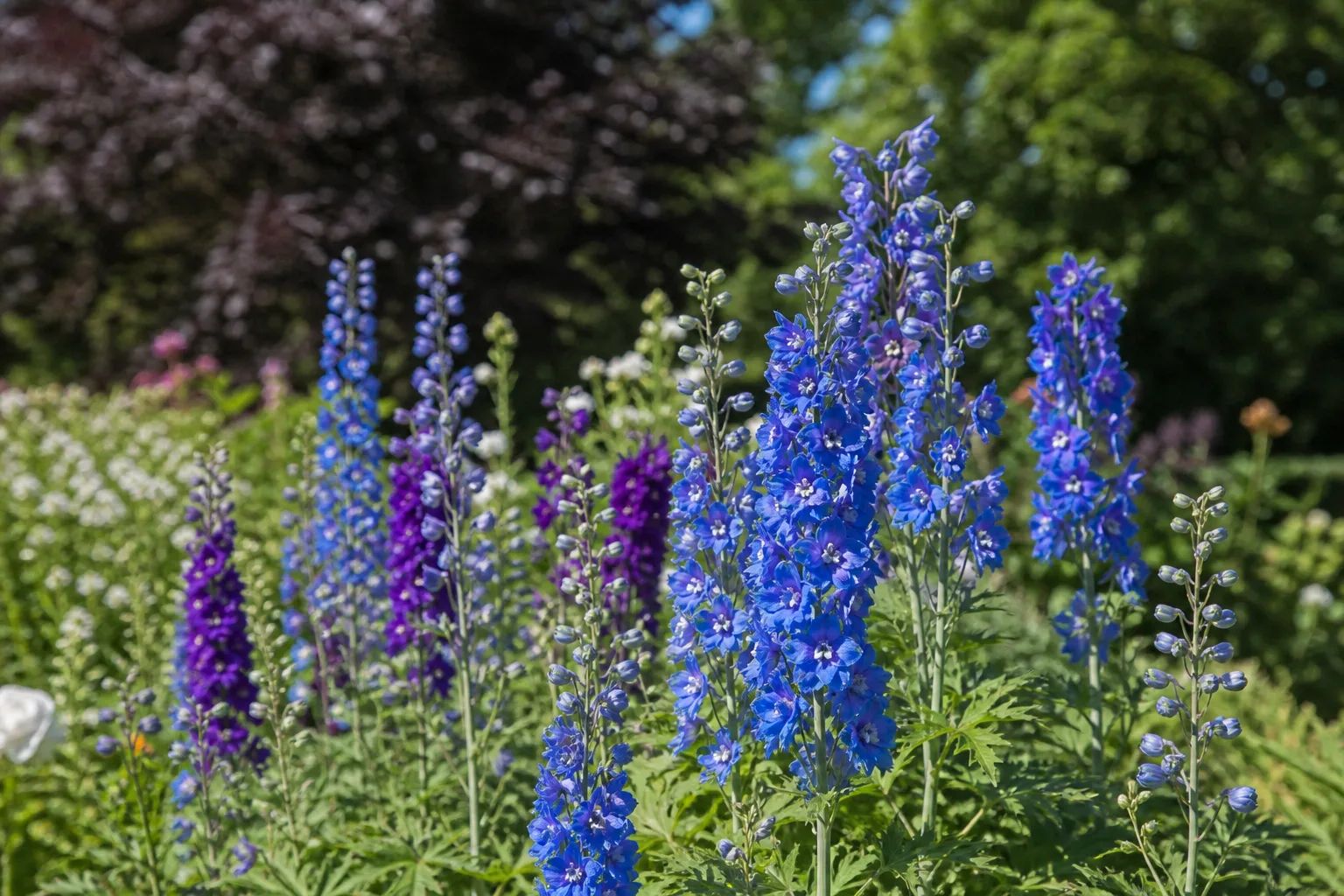
4. Hardy geranium for a long-flowering middle layer
Hardy geraniums, also called cranesbills, are perennial Geranium species and cultivars. They are not the tender bedding plants often sold as “geraniums,” which are Pelargonium. Hardy forms weave between taller plants, cover bare soil, and soften the base of roses or delphiniums. Some cultivars bloom for a long stretch; others give a shorter show and earn their place with attractive foliage and a tidy mound.
Use the label to check spread before planting. A vigorous cultivar can become a useful living groundcover, while a compact one fits a narrow border. If the foliage looks ragged after its main flush, shear it back and water if the soil is dry; fresh growth may follow, though rebloom varies. Plant it where it can mingle without swallowing slower neighbors, and repeat it in several clumps to make the mixed border feel connected.
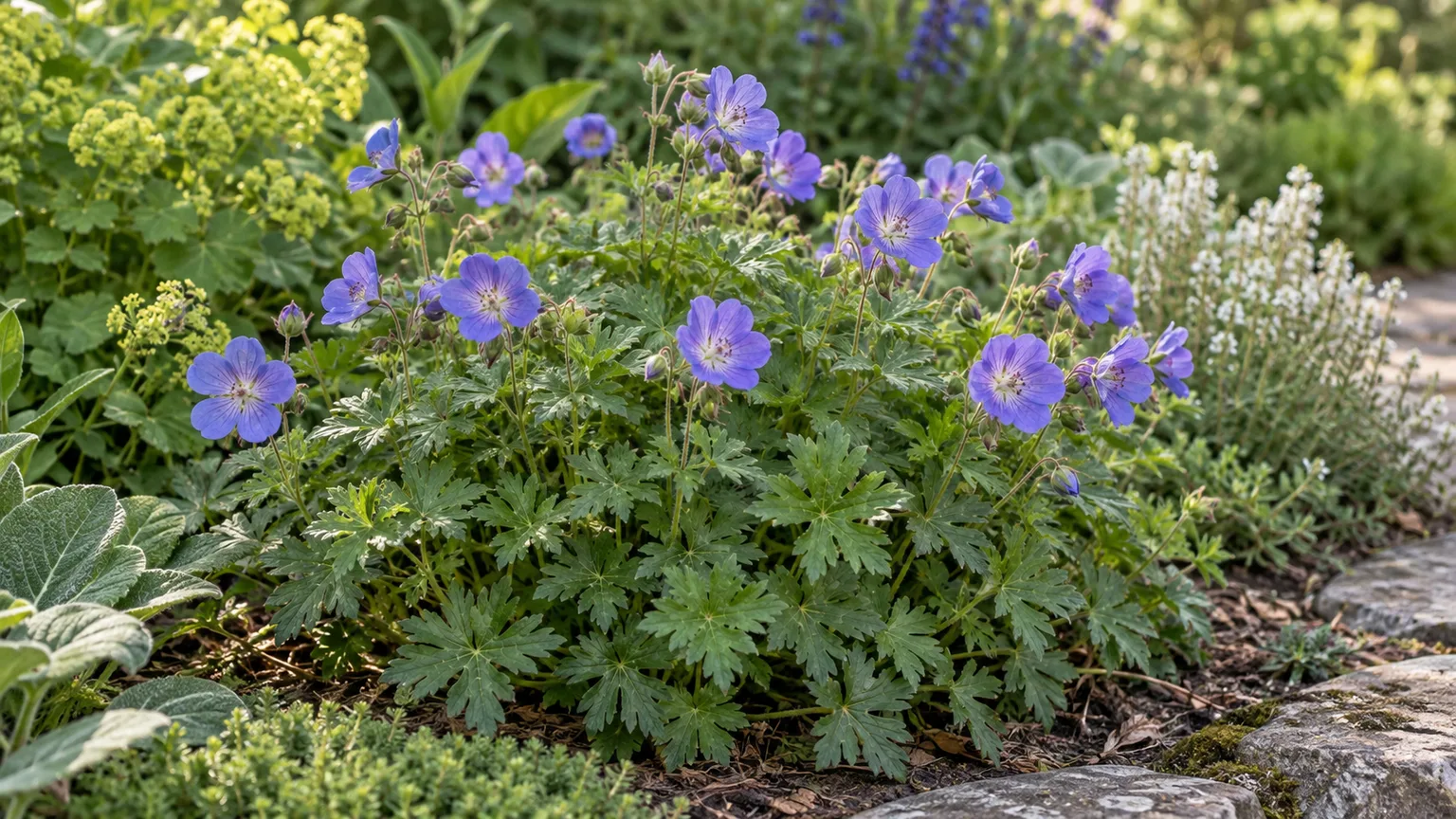
5. Hollyhock for a cottage-style vertical accent
Hollyhocks (Alcea rosea) bring tall flower columns to fences, walls, and the back of a bed. Their height can make a small border feel taller, but the flower stalks are visually dense, so place them where they will not block shorter plants. They are often biennial or short-lived perennials, which means the display may depend on seedlings or replacement plants rather than one permanent clump that flowers reliably every year.
Air movement matters. Hollyhock rust is common in many gardens; avoid packing leaves tightly against a wall, water at the soil rather than over the foliage, and remove badly affected leaves without stripping the plant bare. If you like a slightly self-sown look, let a few healthy plants set seed near the wall. If you want a deliberate color scheme, remove seedlings that appear in the wrong spot and save seed only from plants whose color and form you want to repeat.
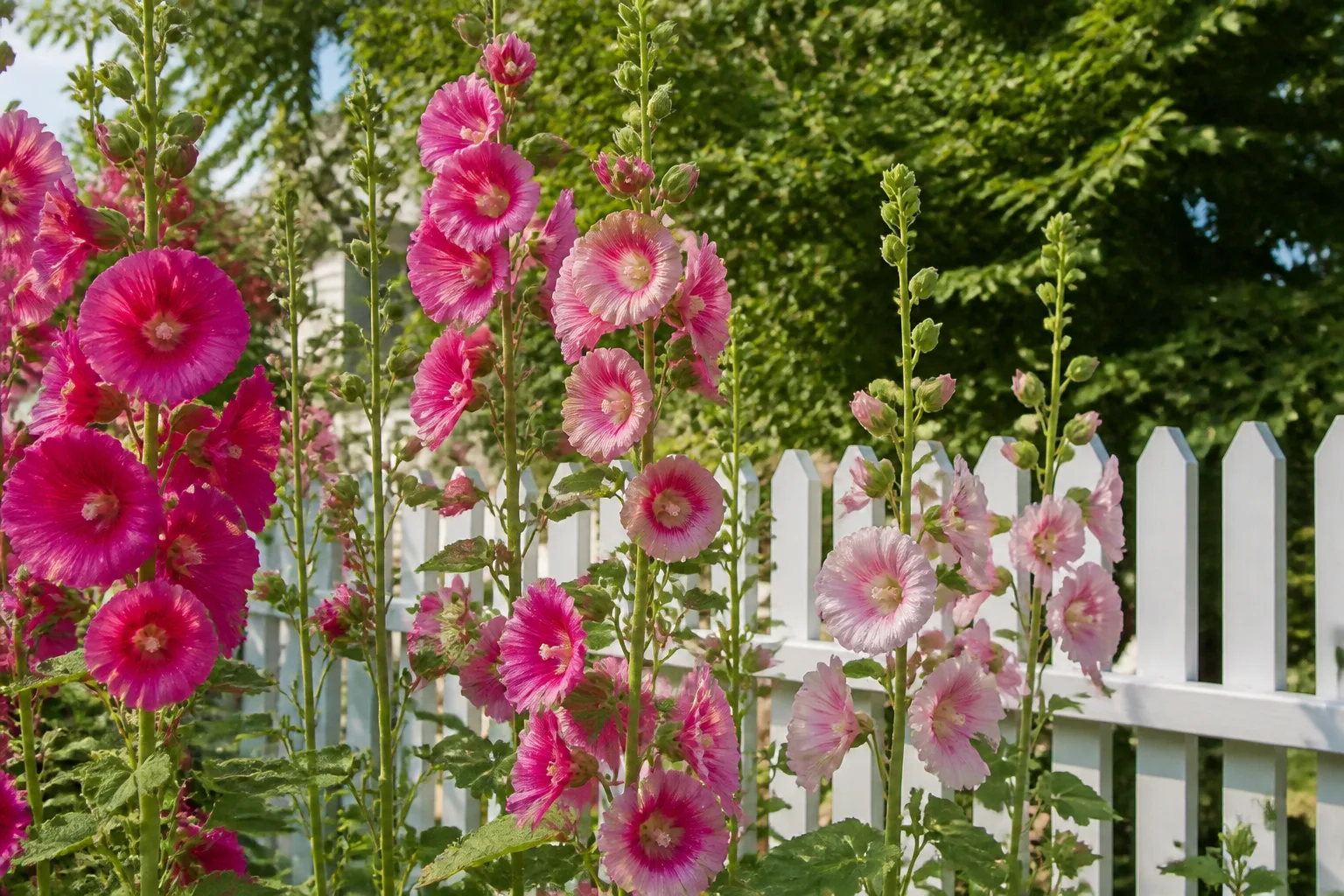
6. Japanese anemone for late-season color
Japanese anemones (Anemone × hybrida and related hybrids) open airy pink or white flowers when many early perennials are fading. Their branching stems suit the middle or back of a border, and the loose flowers keep a dense planting from looking like a wall. They are especially useful beside shrubs or in a bright woodland edge where the soil stays evenly moist rather than baking dry.
Give them room and check the cultivar’s height. Some form a manageable clump; others spread over time, especially in favorable soil. If a plant begins surfacing where you do not want it, remove unwanted shoots while they are small and keep the boundary clear. New plantings may need water through dry spells, but a wet, stagnant site is not a substitute for good drainage. Late flowers are most valuable when they bridge the gap between summer roses and fall foliage, so place them where their blooms can be seen from a path or window.

7. Lady’s mantle for soft foliage and chartreuse flowers
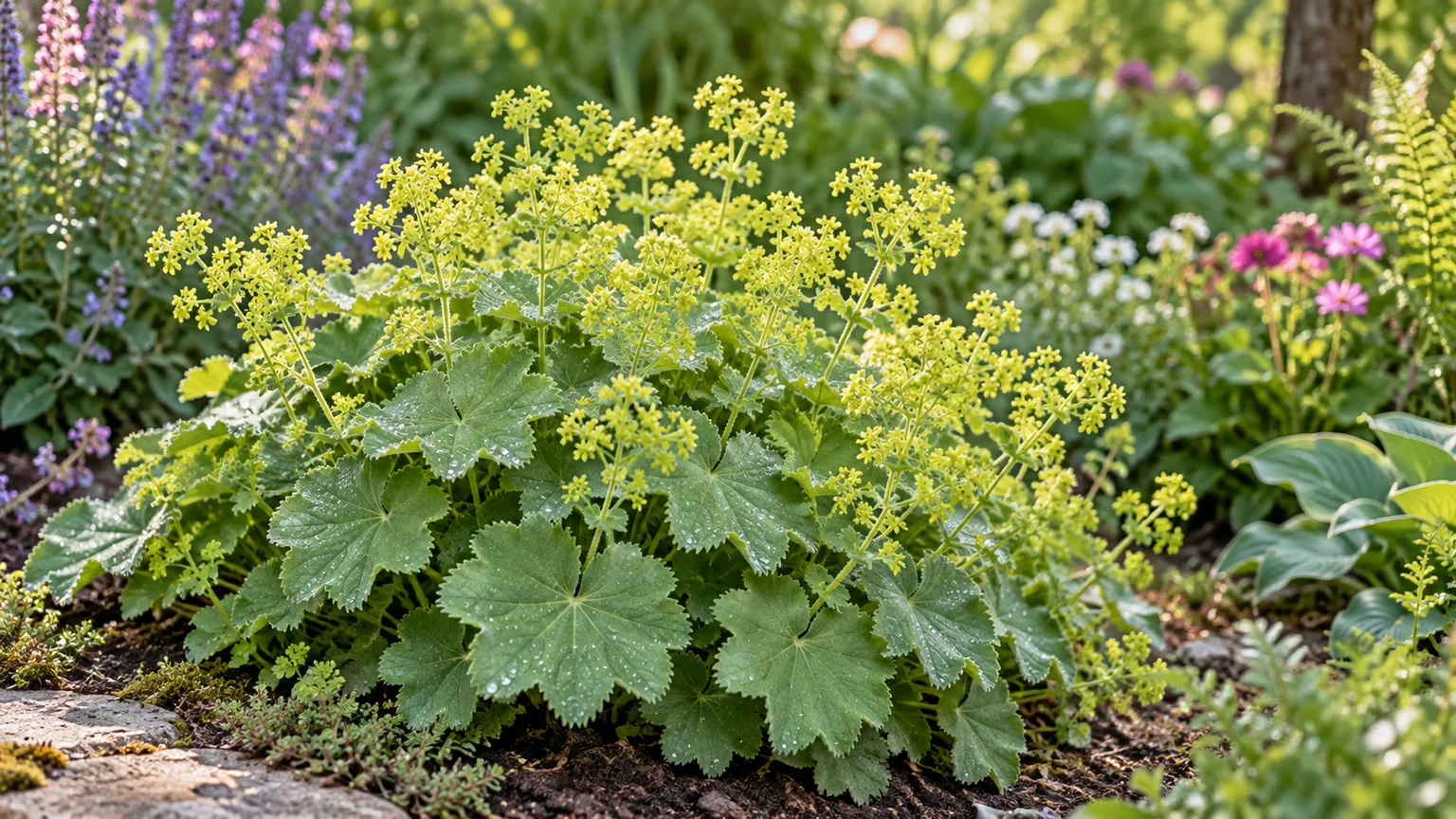
Lady’s mantle (Alchemilla mollis) is a strong edging and transition plant. Its rounded leaves catch droplets after rain, while sprays of small chartreuse flowers soften the gap between bold blooms and the path. It is not a focal flower; it is the quiet connector that makes roses, peonies, and blue flowers look as if they belong in the same border. Plant it in a front or middle position where the foliage can spread without covering delicate neighbors.
It tolerates a range of light, though afternoon shade can be welcome in hot climates. After flowering, cut back the stems if you prefer a neat mound or want to limit self-seeding. Keep some leaves in place until new growth is ready, and do not overwater simply because the foliage looks lush. Lady’s mantle pairs particularly well with blue delphinium or hardy geranium, whose stronger colors stand out against its soft green texture.
8. English lavender for sunny, dry edges
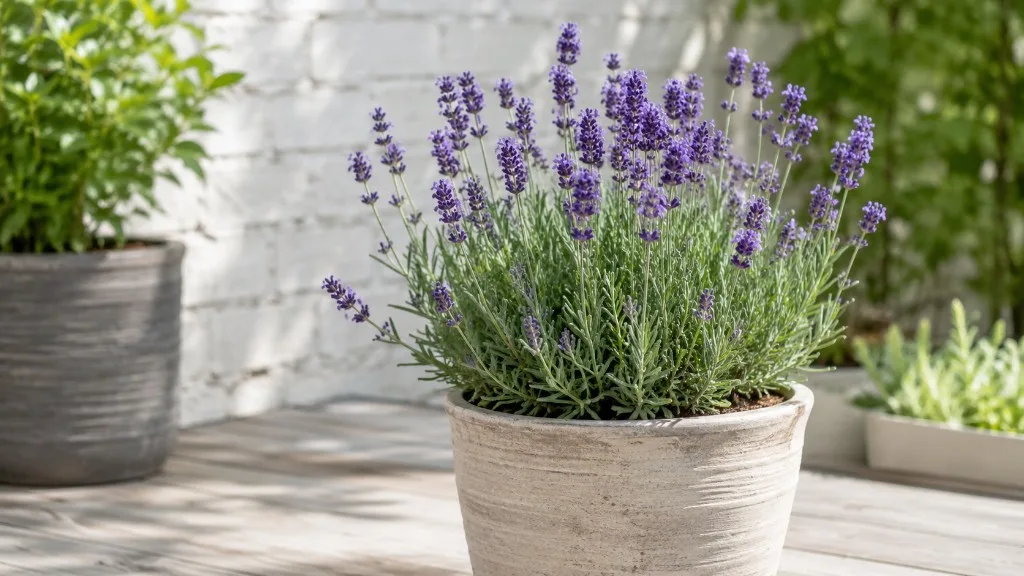
English lavender (Lavandula angustifolia) provides fragrance, gray-green foliage, and a compact evergreen-like shape through much of the year. Use it as a low line beside a sunny walk or repeat it in short drifts at the front of the border. The RHS recommends full sun and free-draining soil for lavender; it can be a poor choice for a damp, shaded bed even if the same variety thrives in a drier part of the yard. Compact cultivars such as ‘Hidcote’ are useful where the edging must stay modest.
Plant lavender where air can move around it and avoid cutting into old, leafless wood when pruning. In humid or wet-winter regions, the growing environment may be the limiting factor, not the gardener’s watering schedule. A raised or sloped bed can improve drainage, but only if water actually has somewhere to move. Do not place lavender between plants that need frequent irrigation; create a separate dry pocket and let the border’s other species carry the wetter zones.
9. Peony for a long-lived spring focal point
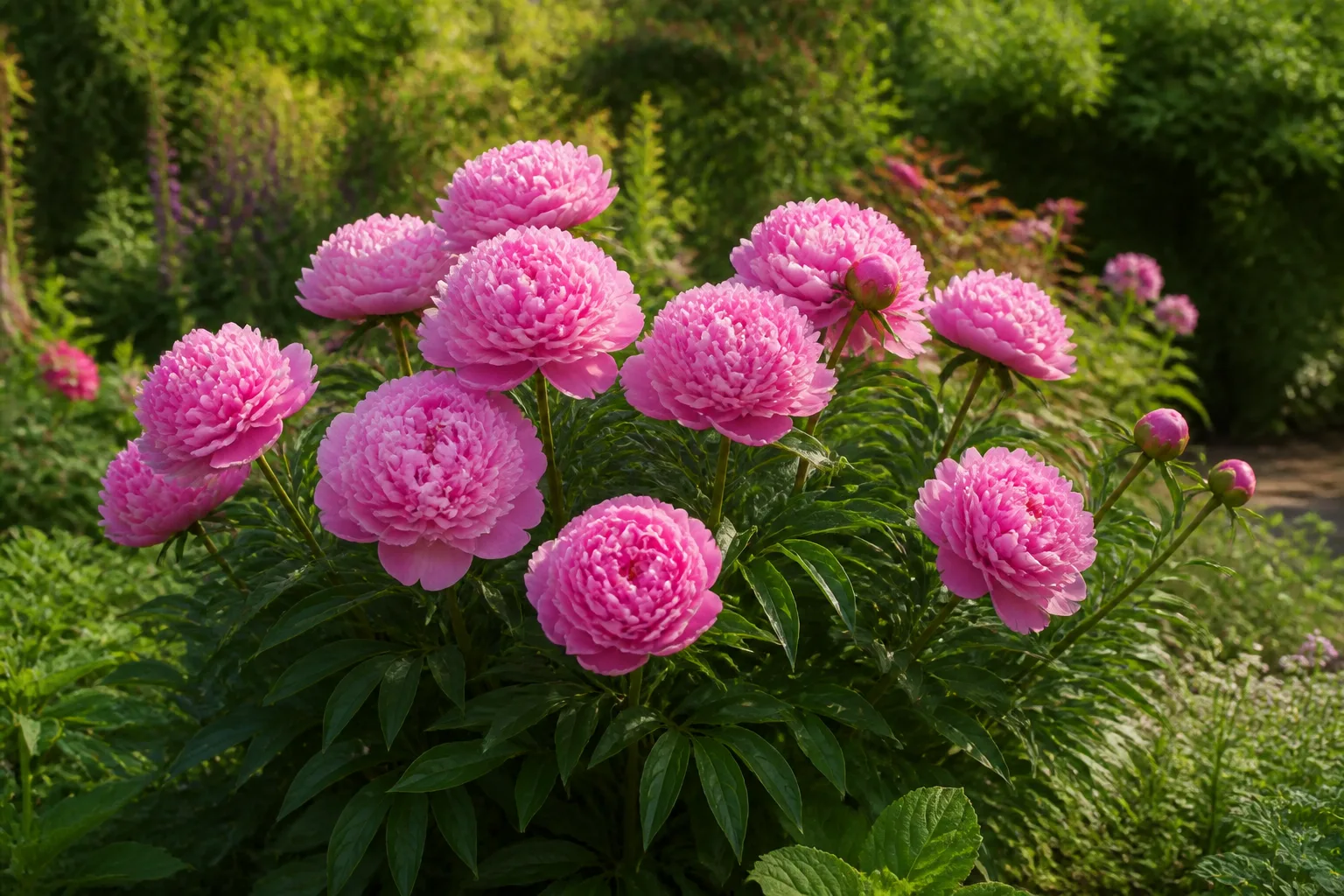
Herbaceous peonies (Paeonia hybrids) produce large flowers in late spring or early summer, depending on cultivar and climate. Their substantial blooms are a natural focal point, so use one clump as an anchor rather than scattering single plants through a small bed. The foliage remains useful after flowering, helping fill the middle layer, and an established peony can return for years if it is planted in a suitable position.
Give it sun and room for its mature width. Heavy flowers may need a ring or discreet support before the buds open, not after a storm has flattened the stems. Peonies dislike being moved repeatedly, and planting depth can affect flowering, so follow the nursery’s instructions for the exact type you buy. Pair the clump with plants that can cover the ground nearby without shading it out, such as a moderate hardy geranium set beyond the crown rather than directly on top of it.
10. Garden phlox for midsummer fragrance
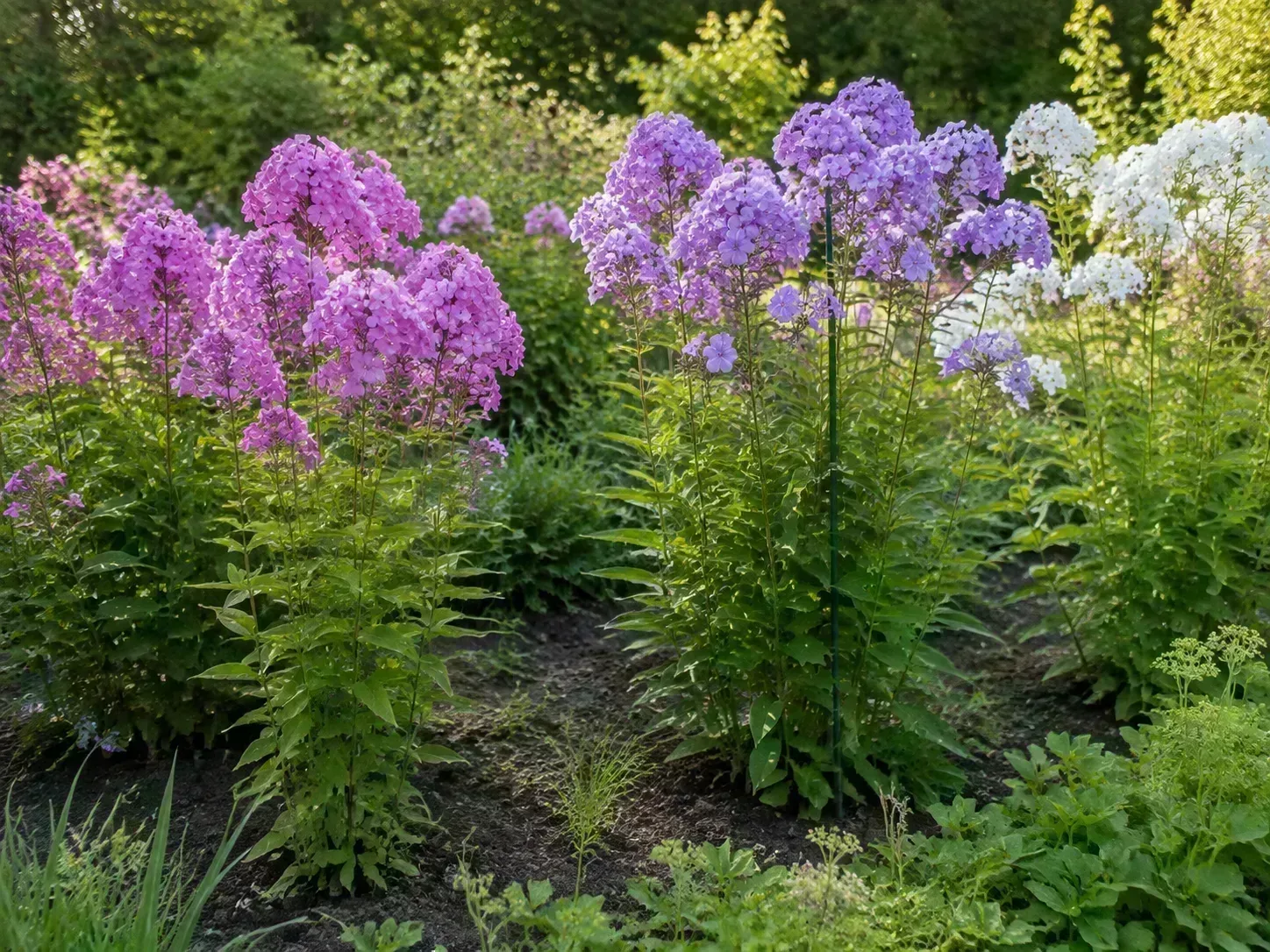
Tall garden phlox (Phlox paniculata) fills the midsummer lull with broad clusters of flowers and a noticeable sweet scent. It is a good middle-to-back border plant, especially where you want pink, lavender, white, or purple color to overlap with roses and later Japanese anemones. Unlike creeping phlox, which is a low spring groundcover, garden phlox grows upright; confirm the species when purchasing so you get the height and season you expect.
Give plants enough room for air to move through the foliage. Powdery mildew can mark leaves, particularly in crowded, shaded, or humid conditions, so choose a location with sun or light shade and avoid overhead watering late in the day. If mildew appears, remove fallen diseased foliage during cleanup and consider a more resistant cultivar when replacing the plant. Do not treat a single mildew-prone season as proof that the whole border needs a spray routine; first correct crowding and select a plant suited to the site.
11. Primrose for the first flowers of spring
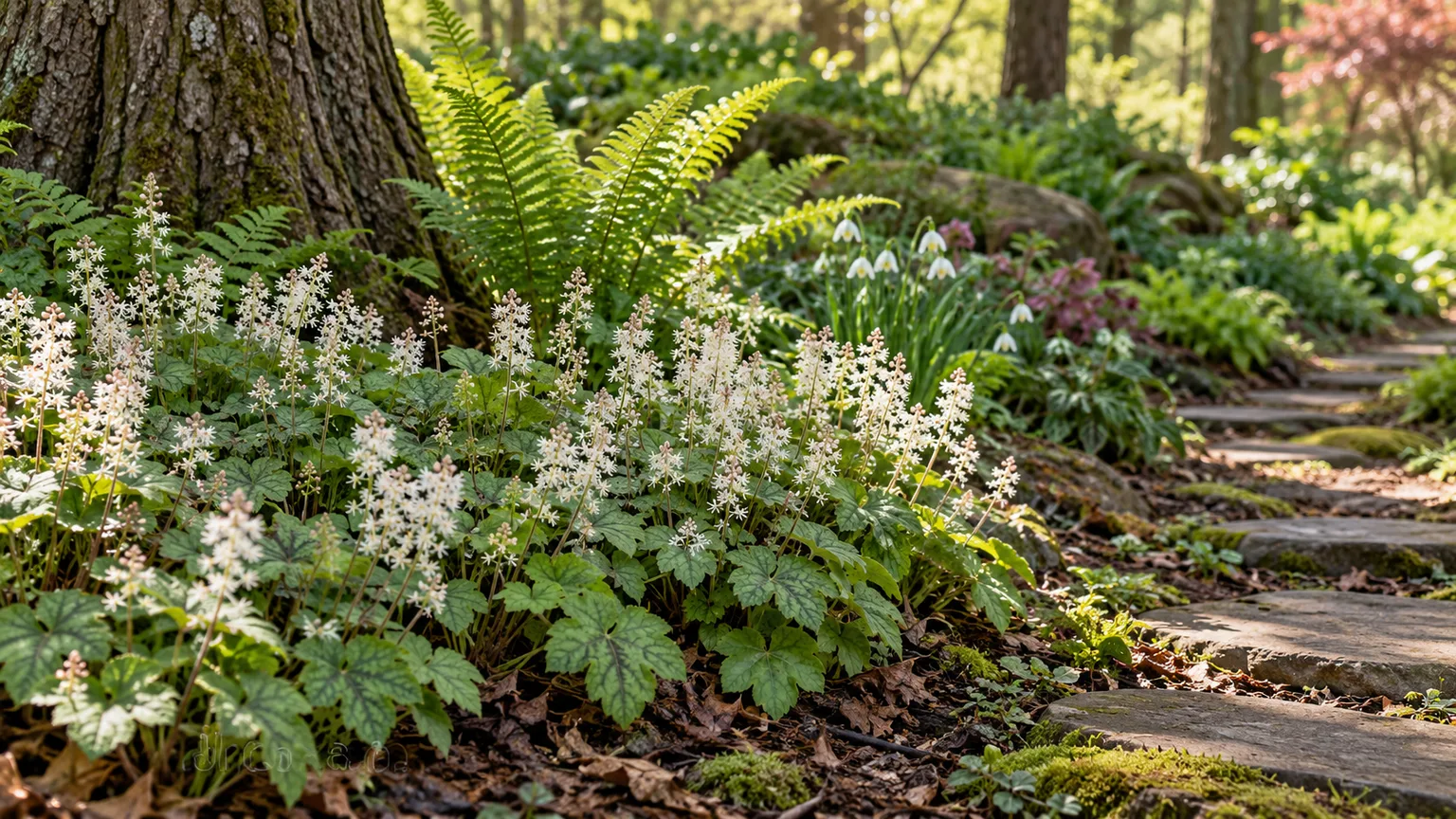
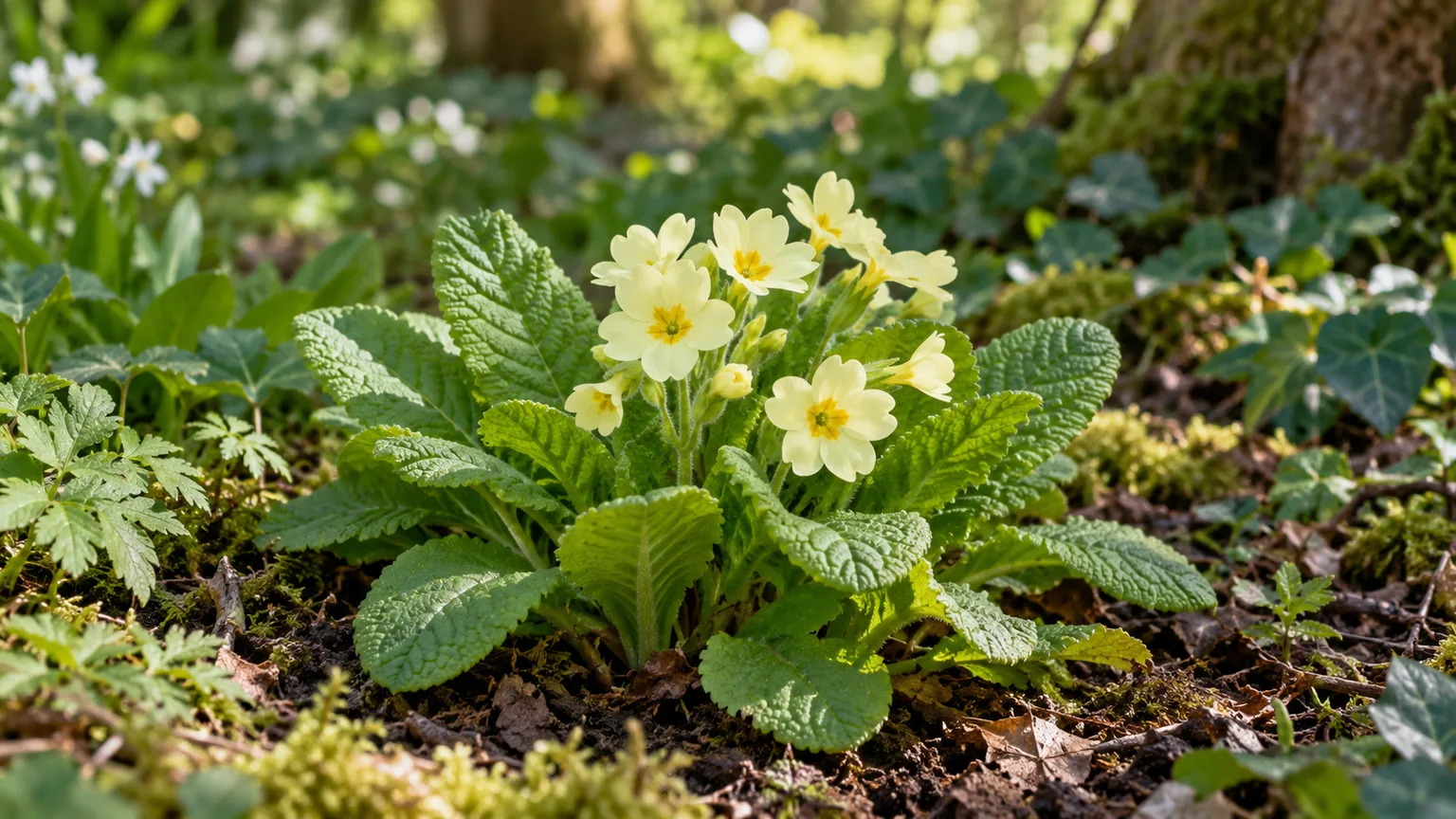
Primroses (Primula vulgaris) bring bright color to a shaded edge before the summer border wakes up. They are useful near a path, beneath deciduous trees, or in a cool pocket that stays lightly moist in spring. The RHS primrose and polyanthus guide describes them as plants for sun or light shade in soil that is neither very wet nor very dry; they do not flower well in deep shade and can struggle where the soil dries out.
Think of primrose as a seasonal layer, not a plant that must carry the border all summer. In hot regions, it may slow down or disappear from view after spring, so surround it with later-emerging foliage rather than leaving a bare gap. A few clumps near a woodland edge or beneath shrubs can mark the start of the bloom sequence while the rest of the border is still mostly leaves. Replace plants only if they fail to return or lose vigor; first check whether the spot is too dry or shaded.
12. Roses for scent, structure, and repeat bloom
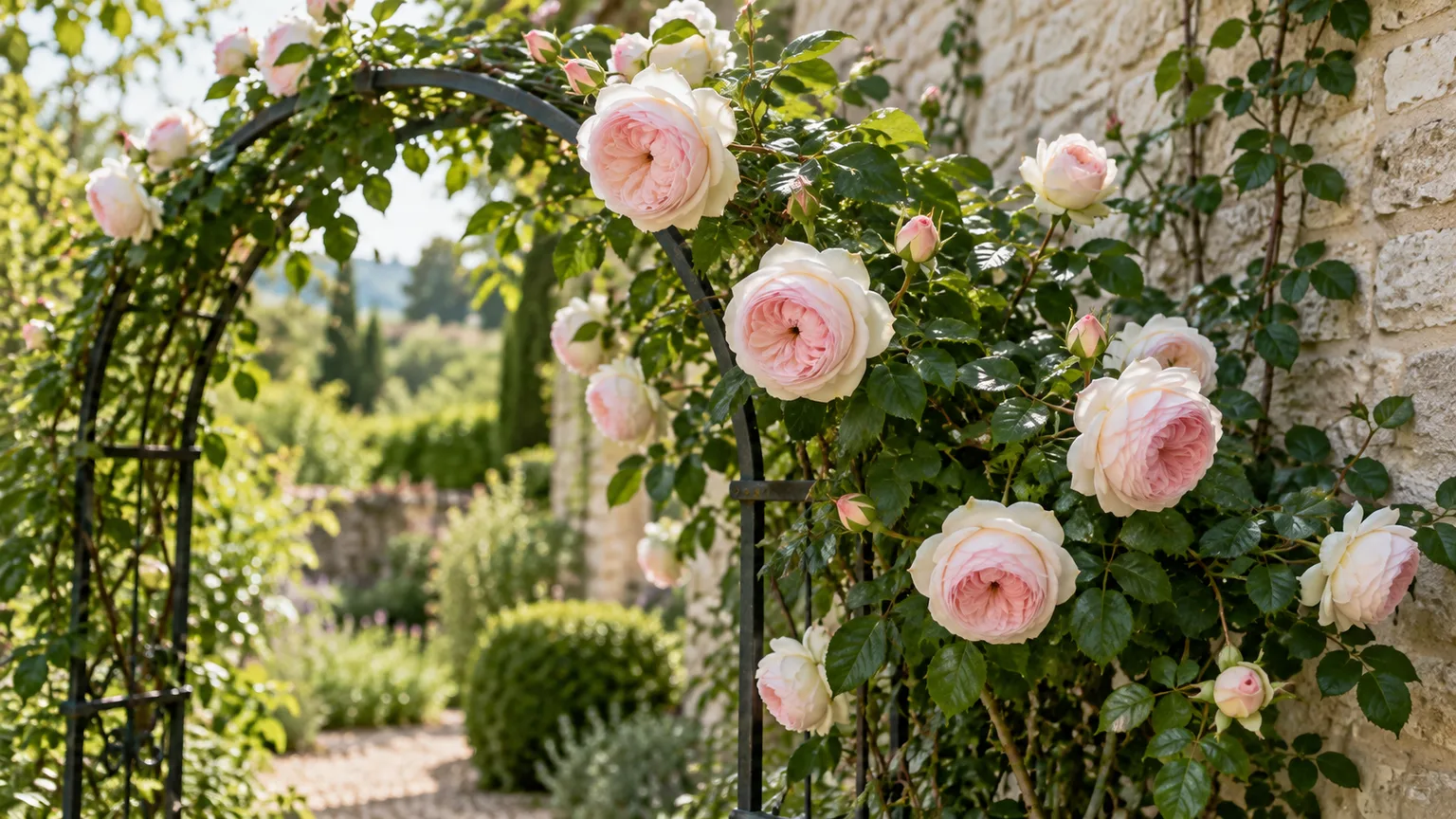
Roses give an English-style border a recognizable anchor, but “rose” is not one growth habit. A shrub rose can stand among perennials; a climber needs a strong support and room to reach it; a groundcover type can spill across the front. Choose first by site and habit, then by flower form and color. The RHS notes that roses generally prefer full sun and moist but well-drained soil, while repeat flowering and mature size depend on the type and cultivar.
If you want flowers over a longer period, look for repeat-blooming varieties rather than assuming every old-fashioned rose repeats. An old rose that flowers once can still earn a place if you value its scent or use it to mark an arch; just combine it with later flowers so the structure remains attractive after its main flush. Keep roses where they have room for airflow and access for pruning. For a small garden, one well-positioned shrub rose or climber repeated with a few supporting perennials is more cohesive than a collection of unrelated rose varieties.
Build a bloom sequence instead of one short peak
A border that flowers beautifully for two weeks can still feel empty for much of the year. Think in overlapping waves: primroses and early bulbs begin the season; peonies and early roses follow; delphiniums, dianthus, and hardy geraniums bridge into summer; phlox and repeat-flowering roses carry midsummer; Japanese anemones take over later. The timing shifts with latitude, elevation, cultivar, and the year’s weather. A calendar written for the United Kingdom is a useful reference for sequence, not a promise for a U.S. yard; the Garden UK seasonal planting plan makes its month-by-month schedule for a UK garden, so adjust dates to your local frost and flowering pattern.
For a first-year border, buy fewer species and repeat them. For example, a sunny bed could use three delphiniums at the back, two or three peony clumps in the middle, a repeated line of hardy geranium, and small groups of dianthus and lavender at the edge. Add Japanese anemone where soil moisture supports it, rather than distributing it evenly through a dry border. The resulting pattern reads as abundant because color and form recur, not because every square foot contains a different plant.
Self-seeders can make the composition feel settled, but they need editing. Allow one or two plants to set seed in a space where seedlings can be moved or removed; do not let seedlings fill the path or crowd young perennials. The Royal Horticultural Society’s description of cottage gardens pairs self-seeding with dense planting, and Garden Ninja’s cottage-garden design advice similarly emphasizes layering and repeated plants. The practical takeaway is controlled looseness: decide where spontaneity is welcome, then keep paths and plant crowns clear.
Adapt the plant list to shade, heat, and limited space
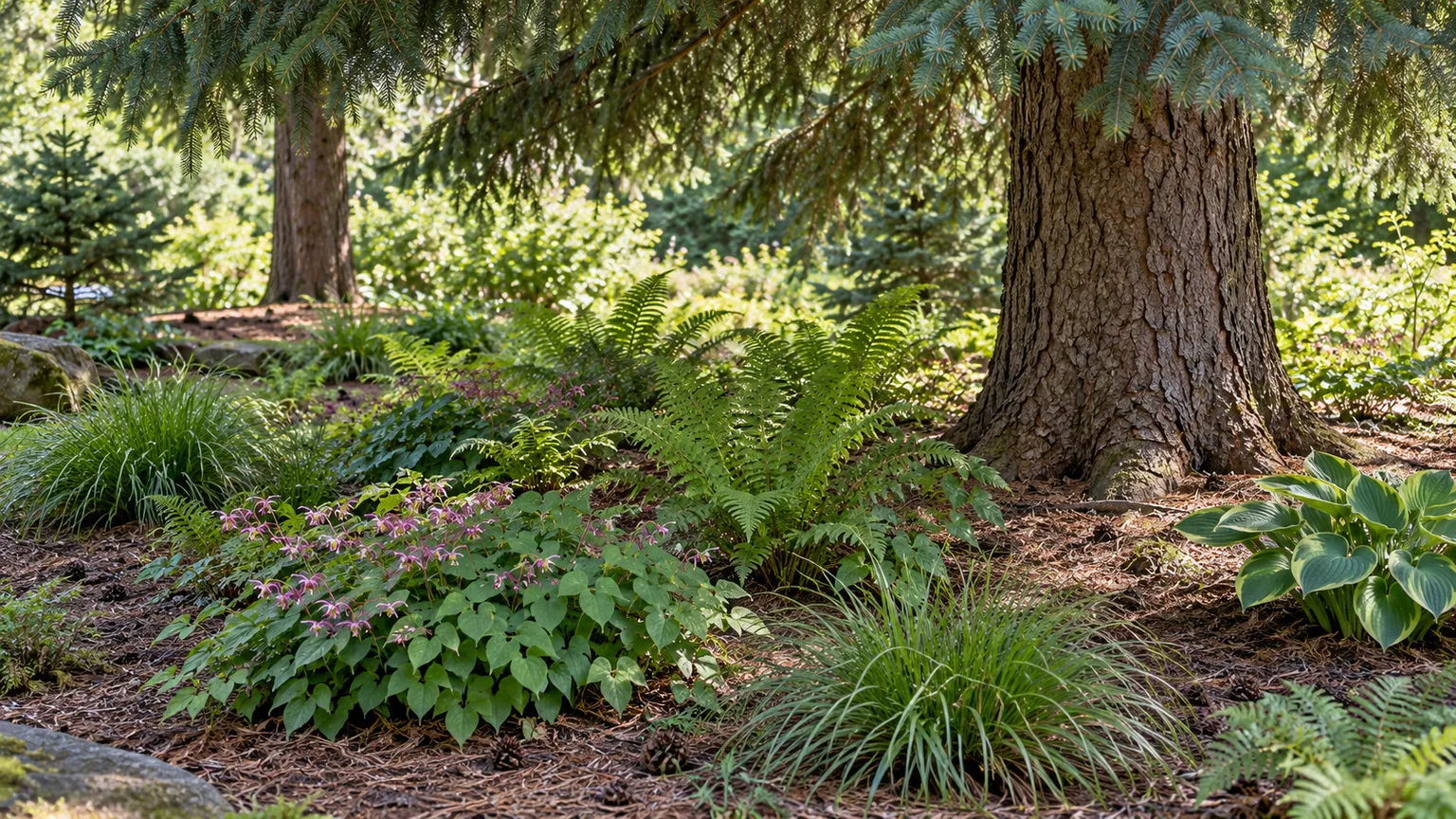
For partial shade, do not force a full-sun palette into the dimmest corner. Start with primrose, hardy geranium, and Japanese anemone, then check the cultivar and local advice for the exact shade level. Lady’s mantle can soften a brighter woodland edge. Delphinium and lavender need more sun to perform well; moving them into shade usually produces weaker flowering rather than a more “romantic” border. In deep shade, focus on foliage and shade-adapted perennials instead of expecting these 12 choices to cover the site.
For hot summers, provide morning sun and afternoon shade to plants that flag, and use mulch to reduce rapid moisture loss without piling it against stems. Primroses may be better treated as cool-season accents. Lavender and cottage pinks are better candidates for the driest sunny edge, provided winter drainage is also good. In a wet climate, reverse the priority: select plants that tolerate consistent moisture for the low spots and reserve lavender for a raised, freely draining position. A wet-season test is more informative than a midsummer glance at the soil surface.
A small space can still carry the style. Use one tall plant rather than a row of hollyhocks, train a rose on an existing fence, and repeat two or three compact species in drifts. A narrow bed can look layered if you choose plants with suitable scale, but do not fill it with sprawling anemones or oversized delphiniums just to include every classic. Containers work for lavender, dianthus, or compact roses where the mix drains freely; the trade-off is that pots dry and freeze faster than in-ground beds. The goal is the same visual rhythm in less space, not a miniature copy of a large border.
Avoid the planting mistakes that spoil the effect
The first common mistake is buying one of everything. That produces a botanical sampler rather than a unified English border. Pick a limited palette—perhaps blue, soft pink, and white—and repeat several species in small drifts. Repetition gives a busy planting a visual thread. Leave breathing room around plants that widen, especially peonies, roses, and Japanese anemones, and use temporary annuals to fill gaps while perennials mature instead of packing them shoulder to shoulder from day one.
The second is treating all soil as “rich garden soil.” Lavender and dianthus can decline in persistently wet ground, while primroses dislike drying out. Match the plant to the moisture pattern or change the site deliberately with a raised bed, a slope, or soil improvement that addresses the whole root zone. Do not put a gravel layer in the bottom of a planting hole as a universal drainage fix; it can create a water-holding interface instead of solving the site’s drainage problem.
Finally, do not wait for a tall stem to flop before supporting it, and do not deadhead every plant automatically. Stake delphiniums while the stems are still manageable. Deadhead repeat bloomers when you want another flush; leave some seedheads if you value winter structure or want seedlings. Prune roses according to their type and flowering habit, and remove diseased leaves from hollyhocks or phlox without turning routine garden care into unnecessary chemical treatment. A good English-style border is edited through observation: keep what performs, move what is mismatched, and let the plants that suit the site earn their space.
Conclusion
The best English garden plants are the ones that fit your actual light, drainage, climate, and time for upkeep. Bellflowers, dianthus, delphiniums, hardy geraniums, hollyhocks, Japanese anemones, lady’s mantle, lavender, peonies, garden phlox, primroses, and roses offer a flexible palette, not a mandatory shopping list. Start with a few repeated plants, layer them by mature height, and choose different species for the sunny and shaded parts of the border. Once those conditions are right, the garden can feel generous and informal without becoming a tangle.