Cat Palm Care Indoors: Light, Water, and Humidity
Learn cat palm care indoors, including light, watering, soil, humidity, fertilizer, pruning, repotting, outdoor transitions, pests, and safety.
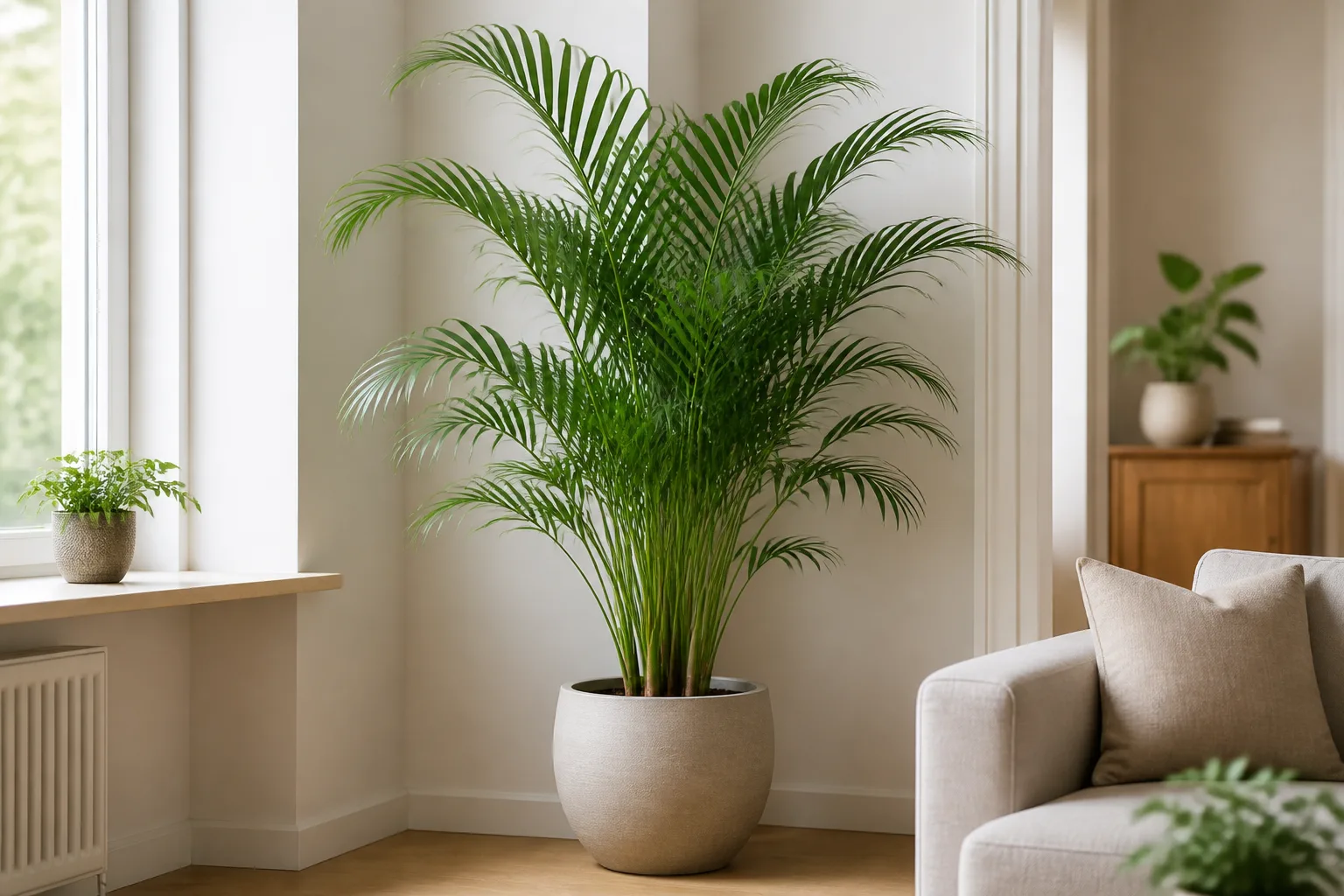
Cat palm (Chamaedorea cataractarum) is a trunkless, clumping palm whose arching fronds can bring a soft jungle texture to a bright room. In the wild it grows along streambanks and moist forest floors in southern Mexico and Central America, which tells you something important about indoor care: this is not a drought palm. Its roots want evenly moist, airy soil and steady warmth, but they fail quickly when a pot stays saturated or when dry winter air pulls moisture from fine leaflets faster than the roots can replace it.
The useful mental model is balance, not pampering. Give cat palm bright filtered light, water based on the root zone rather than a calendar, and treat humidity as support for the leaves rather than a substitute for good drainage. When fronds brown, inspect light, soil moisture, salts, and pests in that order before reaching for fertilizer or another repot.
What Makes Cat Palm Different From Other Indoor Palms
Cat palm is often sold beside parlor palm, areca palm, and majesty palm, but the care labels are not interchangeable. Chamaedorea cataractarum forms a dense clump of slender green stems with pinnate fronds and no central trunk. Wikipedia notes that it typically reaches about 3 feet indoors and spreads into a bushy mound as new shoots emerge from the base. That clumping habit is why mature plants look full even without a tree-like trunk — and why division propagation is realistic once the clump is established.
The species name cataractarum refers to waterfall habitats. Healthy Houseplants describes cat palms growing along streambanks where soil stays periodically moist. That background explains why cat palm tolerates more consistent moisture than many houseplants, yet still rots in a waterlogged pot. Parlor palm (Chamaedorea elegans), by contrast, is more forgiving of missed waterings and lower light, while areca palm (Dypsis lutescens) often wants brighter light and can show potassium-related tip burn when overfed. Majesty palm (Ravenea rivularis) is another moisture lover that punishes dry air even faster.
| Trait | Cat palm | Parlor palm | Areca palm |
|---|---|---|---|
| Growth habit | Clumping, trunkless | Often solitary or multi-stem pot | Clustering cane stems |
| Moisture preference | Evenly moist, not soggy | Tolerates slight dry-down | Steady moisture, sensitive to salts |
| Light indoors | Bright indirect; not a dark-corner palm | Tolerates lower light better | Bright filtered to gentle sun |
| Typical indoor height | About 3–6 feet | Often under 5 feet | Can reach ceiling height |
| Propagation | Division of clumps | Usually seed or division | Division of offsets |
Epic Gardening lists cascade palm at roughly 3–6 feet with watering when the top 1–2 inches of soil dry and part sun to indirect sun indoors. Those numbers are a starting point, not a rule — your room, pot, and season will shift the interval. The takeaway is that cat palm sits closer to the “steady moisture + bright room” end of the indoor palm spectrum than the “forgive me if I forget to water” end.
Cat Palm Care at a Glance
Use this table to set a baseline, then adjust after you watch how your specific pot dries in your home.
| Care factor | Practical target | What changes the decision |
|---|---|---|
| Light | Bright indirect; gentle morning sun often OK | Window direction, season, curtains, distance from glass |
| Water | When upper soil begins to dry; soak until runoff | Pot size, mix, light, temperature, humidity |
| Soil | Moisture-retentive but fast-draining | Peat-heavy mixes that stay wet too long |
| Humidity | Moderate to high; ~50% is a useful goal | Winter heat, AC, fans, grouping plants |
| Temperature | Warm room; protect from cold drafts | Winter windows, doors, transport below ~50°F |
| Fertilizer | Diluted complete or palm formula in active growth | Fresh potting mix, low light, winter pause |
| Repotting | Every 2–3 years when rootbound | Disturb roots minimally; one size up |
| Pet safety | Generally non-toxic; chewing can still upset stomach | ASPCA lists Chamaedorea as non-toxic to dogs and cats |
Choose a Healthy Cat Palm at the Nursery
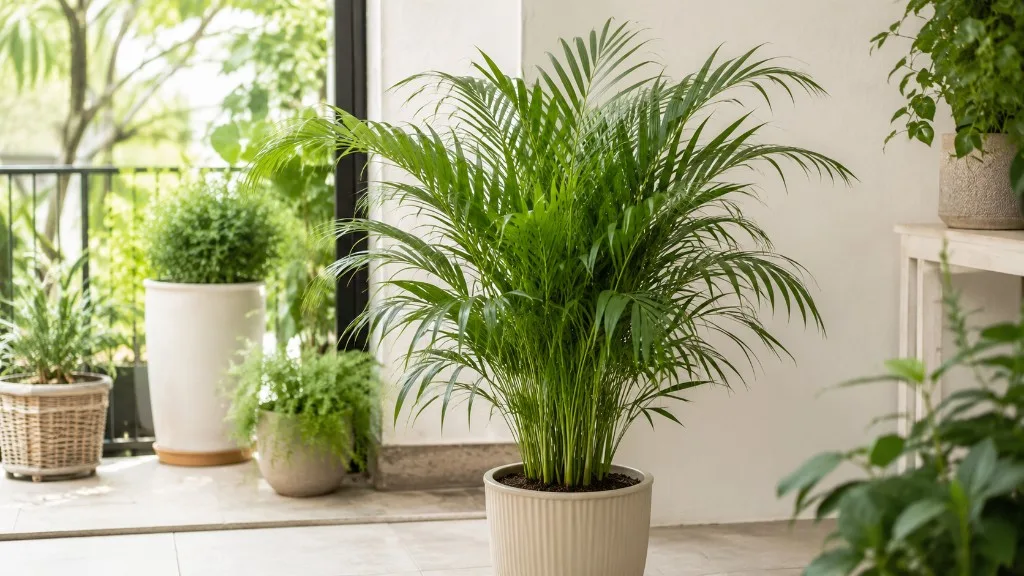
Most cat palms arrive as multi-stem clumps in a single pot, which creates instant fullness. That is normal, but it also means you are buying a community of stems sharing one root mass. Inspect the whole plant, not just the prettiest frond on top.
Signs of a Strong Specimen Versus a Stressed One
Look for upright stems, deep green fronds without widespread spotting, and new spears opening cleanly from the center. A few older brown leaflet tips on the lowest fronds are common in shipping, but widespread yellowing, blackened bases, or a sour smell from the soil suggest overwatering or root trouble already underway. Check the undersides of leaflets for fine webbing (spider mites), cottony clusters (mealybugs), or hard brown bumps (scale).
Lift the pot if you can. A plant that feels oddly light for its size may be under-watered and stressed; one that feels heavy with wet soil and limp fronds may already have compromised roots. Avoid pots sitting in saucers full of water at the store — that habit often continues at home.
Cat Palm Look-Alikes to Watch For
Parlor palm has finer, more delicate leaflets on thinner stems and tolerates lower light. Bamboo palm (Chamaedorea seifrizii) has more prominent stem nodes and a taller, vase-shaped clump. Areca palm shows thicker yellow-green canes and longer fronds. Kentia palm has wider, more leathery leaflets on a different silhouette. If the tag only says “palm,” use stem thickness, leaflet texture, and clumping habit to confirm you have C. cataractarum before you copy care advice meant for a different species.
Light and Indoor Placement
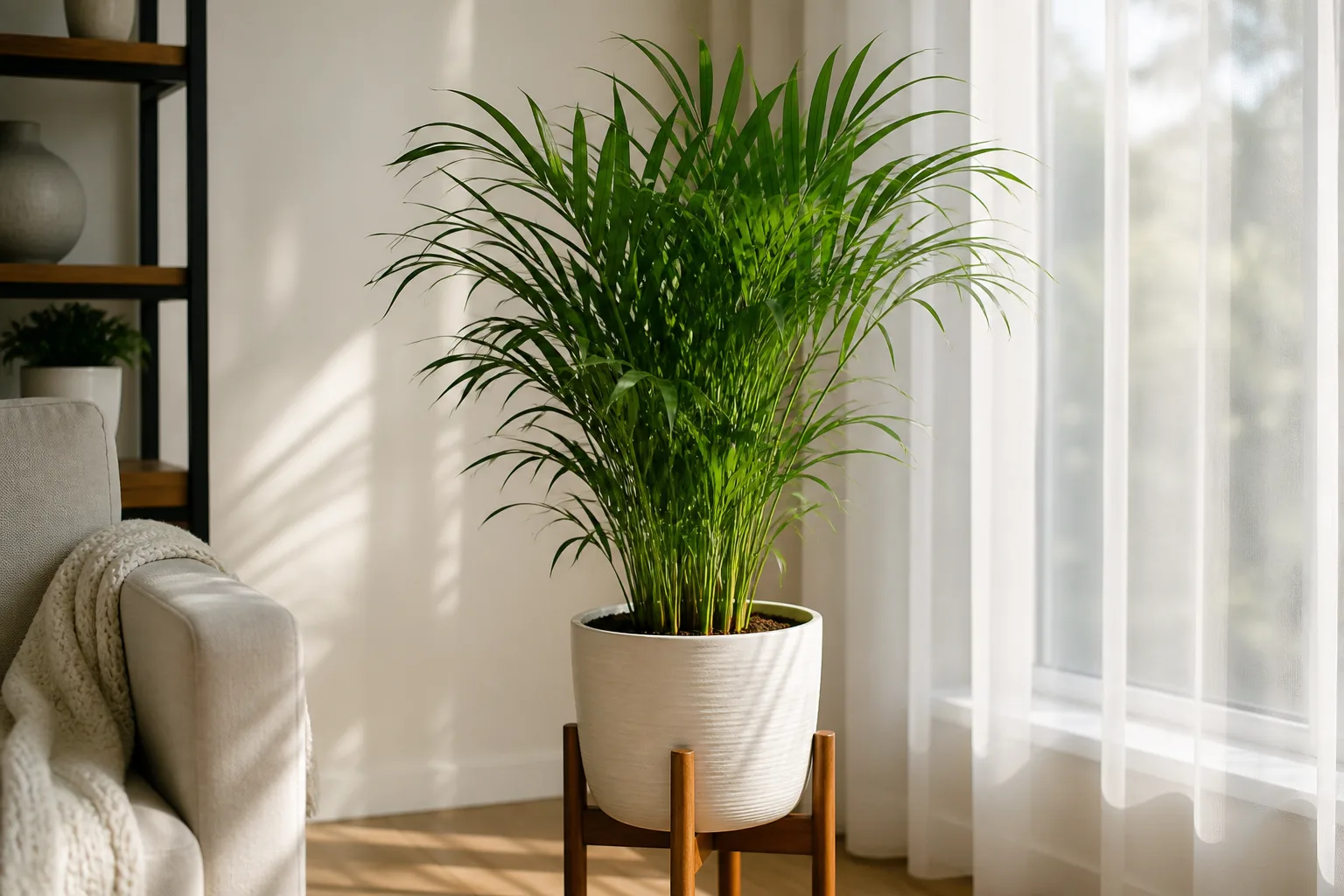
Cat palms need bright, filtered light to stay full indoors. Wikipedia’s cultivation notes emphasize high light for indoor specimens, which matches what growers see in practice: a cat palm in a dim hallway may survive for a while, but new fronds stay small and the clump opens up. An east-facing window is an easy default. A few feet back from a south- or west-facing window, or behind a sheer curtain, usually provides enough brightness without the scorch risk of hot afternoon glass.
Gentle direct morning sun is often acceptable, especially in winter when rays are weaker. Harsh midday or afternoon sun can bleach or burn leaflets, particularly on plants grown in lower light and then moved suddenly. Rotate the pot a quarter turn every week or two once the plant is settled so fronds do not lean hard toward one direction.
Keep cat palm away from air-conditioning vents, heat registers, and frequently opened exterior doors. Cold drafts and rapid temperature swings stress tropical foliage faster than owners expect. NC State Extension notes that Chamaedorea houseplants are sensitive to overwatering and benefit from well-drained soil — light and water work together because a dim plant uses less water and stays wet longer.
Acclimate Slowly When Light Changes
Never move a greenhouse-grown cat palm straight into a hot south window or direct outdoor sun. Increase usable light over one to two weeks: start in bright shade or filtered indoor light, then add a little gentle morning sun if leaves remain firm and green. Pale tan patches on the window-facing side after a sudden move are sun scorch; that tissue will not green up again, so back the plant off and filter the light.
If you use a grow light, position it close enough to reach the whole clump and run it on a consistent day-length schedule. Changing light, watering, and repotting in the same week makes troubleshooting impossible.
Watering, Humidity, and Air Quality
Water cat palm when the upper soil begins to dry, then soak until excess runs from the drainage holes and empty the saucer. Epic Gardening suggests checking when the top 1–2 inches are dry; in a heavy peat mix or a dim room, wait until the top feels barely dry rather than bone dry through the whole root ball. In bright summer conditions, the same pot may need checks every few days; in a cool winter room, the interval can stretch considerably.
Pour slowly and evenly so water reaches the center of the root mass, not just the pot edges. After watering, lift the pot once it has drained — that “freshly watered” weight becomes your reference for the next decision. If the pot still feels heavy and the surface looks dark days later, skip watering and investigate light, pot size, or mix compaction.
Use room-temperature water when you can. Repeated drenching with icy tap water can stress roots in winter. If your tap water is very hard, accumulated minerals sometimes show up as crust on the soil surface or brown leaflet margins; flushing the pot occasionally in a sink or switching to filtered water for a few cycles can help.
Why Misting Alone Will Not Save Brown Tips
Cat palms appreciate moderate to high humidity. Epic Gardening recommends about 50 percent for cascade palm, which is a reasonable indoor target. A humidifier near the plant — not blasting directly into the foliage — raises the room environment more reliably than misting. Brief misting evaporates quickly, may leave leaflets wet overnight, and does not fix underwatering or poor drainage.
Grouping plants can raise local humidity slightly. A pebble tray with the pot sitting above the water line adds a little moisture near the canopy. Wiping dust from leaflets with a damp cloth improves light capture and lets you inspect for pests; NC State Extension mentions cleaning and misting for spider mite prevention on related Chamaedorea species, but treat that as hygiene, not a humidity strategy.

Soil, Pots, and Drainage
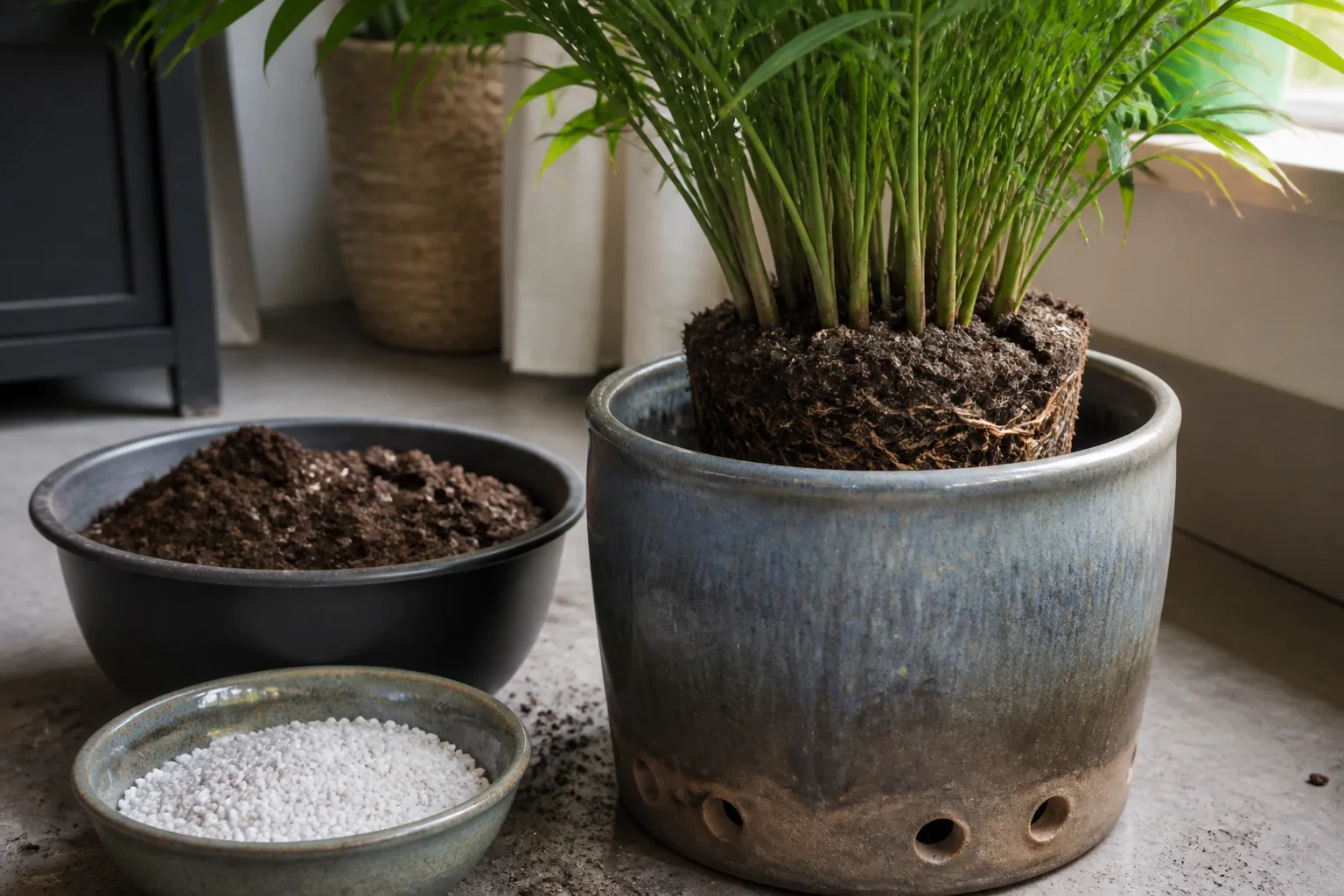
Plant cat palm in a moisture-retentive but fast-draining mix. A quality peat- or coco-based houseplant blend with perlite or bark works well. You can also use a labeled palm mix or blend potting soil with equal parts pine bark and perlite for extra structure. The goal is a mix that holds water long enough for fine roots to access it, yet releases excess instead of collapsing into an anaerobic block.
The pot must have a drainage hole. Terracotta or unglazed clay can help a heavy-handed waterer because the walls breathe and dry slightly faster than plastic. Choose a pot only slightly larger than the root ball — an oversized container holds too much wet soil relative to the roots and is one of the fastest routes to rot.
Do not let the plant sit in a decorative cachepot that holds runoff. After every watering, empty standing water within 30 minutes. If you must use a cachepot, lift the inner nursery pot to water at the sink, then return it only when dripping has stopped.
Fertilizer Through the Seasons
Feed cat palm during active growth with a balanced liquid houseplant fertilizer or a palm-specific formula diluted to half the label strength. Monthly applications from early spring through late summer match how most indoor palms use nutrients. Stop or sharply reduce feeding in fall and winter when light drops and growth slows.
Fertilizer cannot fix low light, root rot, or spider mites. If fronds are pale and the plant has not been fed in a year, a light dose during the growing season may help. If lower fronds show tip necrosis while new growth looks normal, the issue may be salt buildup or potassium imbalance rather than hunger — UF/IFAS documents that palm nutrient disorders often appear on older leaves first, and overfeeding high-nitrogen formulas can worsen some deficiencies. Flush the soil with plain water before increasing fertilizer.
Pruning and Routine Maintenance
Cat palm does not need shaping cuts to stay healthy. Remove fully brown or dead fronds at the base with clean, sharp shears. Sterilize blades between plants if you are trimming multiple palms. If only leaflet tips are brown, trim the dead tissue following the natural curve of the frond, then fix the underlying cause — dry air, inconsistent water, salts, or sun — before removing more green tissue.
Do not cut green fronds just because they are older. Palms recycle nutrients from aging leaves before they die. Stripping too much living foliage weakens a clump quickly. Wipe dust from leaflets monthly during the heating season so light reaches the photosynthetic tissue.
Repotting Without Shock
Cat palms are slow growers indoors and dislike heavy root disturbance. Repot every two to three years, or when roots circle densely, water runs straight through dry mix, or the plant is top-heavy and unstable. Choose a pot only 1–2 inches wider in diameter than the current one.
Slide the root ball out gently. If the mix is sound and roots are healthy and white or tan, place the plant in the new pot at the same depth and backfill with fresh mix. Do not aggressively tease apart a tight cat palm clump unless you are deliberately dividing it. Water once to settle the mix, then return the plant to bright indirect light and hold off fertilizer for four to six weeks while roots recover.
The best repotting window is spring or early summer when warmth and light support recovery. Avoid repotting a stressed, wilted plant until you know whether the problem is rot, drought, or pests.
Propagation by Division
Mature cat palms propagate most reliably by division. Unpot the clump and look for natural sections — each should include several stems and a share of roots. Sever the sections with a clean knife or pruners, keeping as many roots intact as possible.
Pot each division in fresh, draining mix at the same depth it grew before. Water thoroughly, then keep humidity moderately high and light bright but indirect while new roots establish. Divisions may wilt for a few days; avoid direct sun and do not fertilize until you see new growth. Not every stem in a store-bought multi-stem pot is equally vigorous, so keep the strongest sections and compost weak, rotted offsets.
Moving a Cat Palm Outdoors for Summer
A summer outdoors can boost growth when nights are warm and frost is impossible. Wait until night temperatures stay above 55–60°F consistently before moving cat palm outside. Start in bright shade or dappled light for several days, then introduce gentle morning sun if the plant looks firm and green. Never place an indoor-grown cat palm in direct afternoon sun without acclimation.
Protect the clump from strong wind and heavy rain that can shred fronds or saturate the mix for days. Elevate the pot on feet if it sits on a patio that holds heat. Water more frequently outdoors because wind and sun increase evaporation, but still verify the soil before each drink.
Before nights drop into the 50s again, bring the plant inside. Inspect leaf undersides, stem bases, and the soil surface for insects. Isolate it from other houseplants for a week if possible. Rinse dust and pollen from fronds, then place it back in its brightest indoor spot.
Diagnose Brown, Yellow, or Wilting Fronds
Brown tips and yellow fronds are messages, not separate diseases. Read them with soil moisture, light, and pest checks before treating.
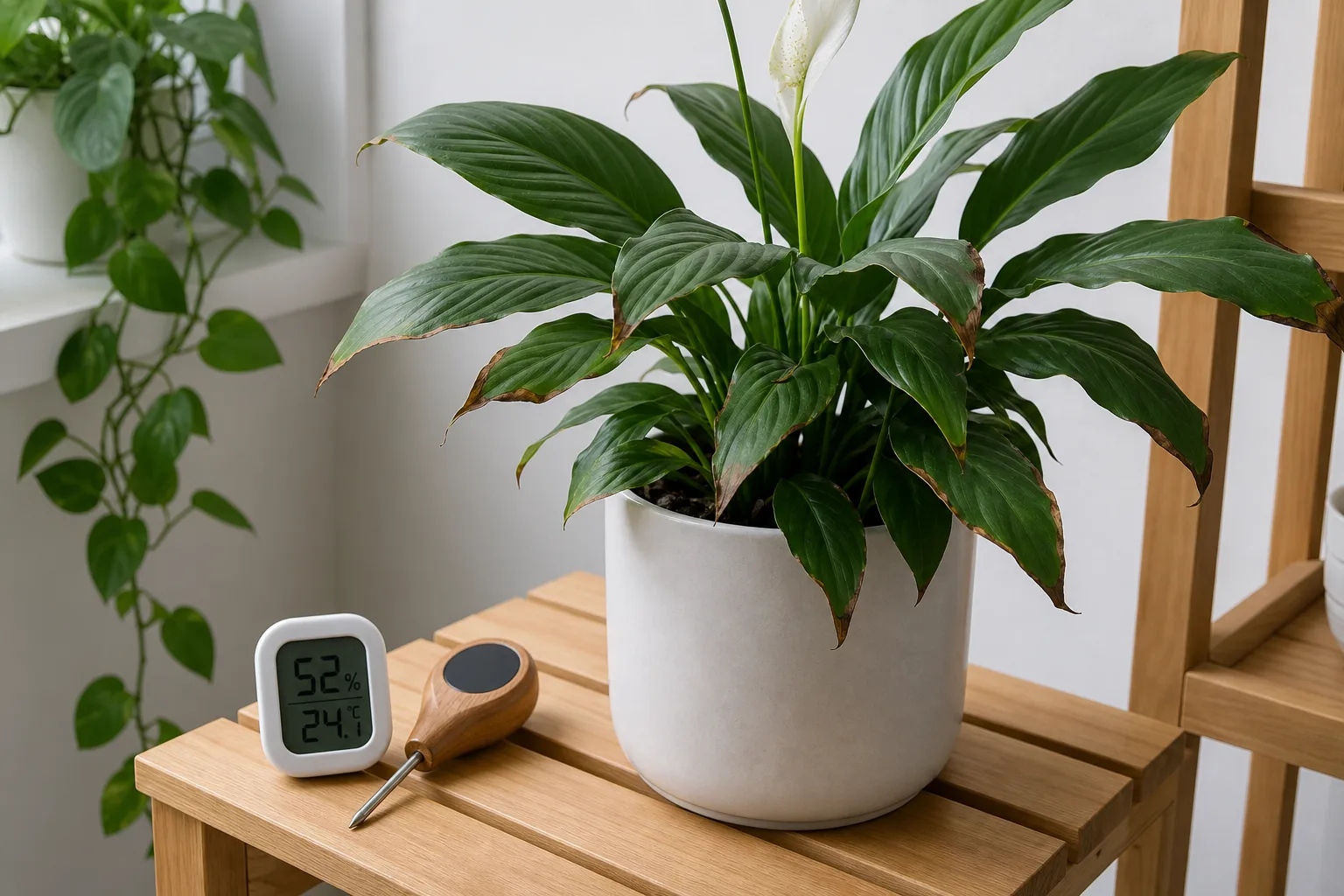
Brown leaflet tips and margins often trace to dry air, inconsistent watering, mineral salts, or hot sun. Check the root zone first: if soil is soggy, reduce water and improve drainage; if it is dusty dry several inches down, water thoroughly and adjust your schedule. If tips appear on many fronds after fertilizing, flush the pot and pause feeding.
Yellowing fronds on one old stem usually mean normal aging — remove that frond when it is mostly brown. Widespread yellowing with wet soil suggests root stress or rot. Yellowing with dry soil and limp fronds suggests underwatering or heat stress. Pale new growth in a dim room points to insufficient light rather than fertilizer deficiency.
Wilting with wet soil is a warning sign. Damaged roots cannot take up water, so the plant looks thirsty while the mix stays damp. Unpot only if you are prepared to trim mushy roots, repot into fresh dry mix, and reduce water while the plant recovers.
Sparse, pale new fronds mean the plant needs more usable light and possibly a slow increase in watering once photosynthesis improves. Rotate the pot and consider a grow light before repotting again.
Pests, Problems, and Pet Safety
Indoor cat palms most often struggle with spider mites, mealybugs, and scale when air is dry and airflow is poor. Mites leave fine webbing and stippled leaflets; mealybugs look like cotton along stems; scale forms hard shells on stems and leaf bases. Isolate affected plants, rinse accessible pests off in the shower, and wipe stems with a damp cloth. For persistent infestations, use a product labeled for indoor ornamentals and follow the label exactly.
Root rot from overwatering remains the most common cultural problem. Symptoms include brown frond bases, a sour smell, black mushy roots, and soil that stays wet for weeks. Cut back watering, improve drainage, and repot only if a significant portion of the root mass is still firm.
Cat palm is widely sold as a pet-friendly houseplant. The ASPCA lists Chamaedorea as non-toxic to dogs and cats. That does not mean pets should eat it — the ASPCA notes that any plant material can cause vomiting or gastrointestinal upset. Keep fallen fronds off the floor, place pots out of reach if your cat chews plants, and contact your veterinarian or ASPCA Animal Poison Control at (888) 426-4435 if a pet eats a large amount or acts ill.
Conclusion
Cat palm rewards a steady indoor routine: bright filtered light, evenly moist but well-drained soil, protection from vents and sudden sun, and humidity that supports the fronds without replacing good watering habits. Treat it as a moisture-loving understory palm, not a succulent, and check the root zone before you react to brown tips.
When something looks wrong, change one variable at a time. Inspect soil and drainage, then light and pests, then fertilizer. A healthy clump grows slowly but gracefully indoors for years — and with gentle division or a careful summer outdoors, you can keep that lush, tropical mound looking full without constant rescue missions.