Crown Rot on Rose: Causes, Checks & Fixes
Quick answer
Crown rot on Rose usually follows waterlogged soil at the graft union or stem base. First step: Stop watering, expose the crown, and inspect for mushy bark before trimming or repotting.
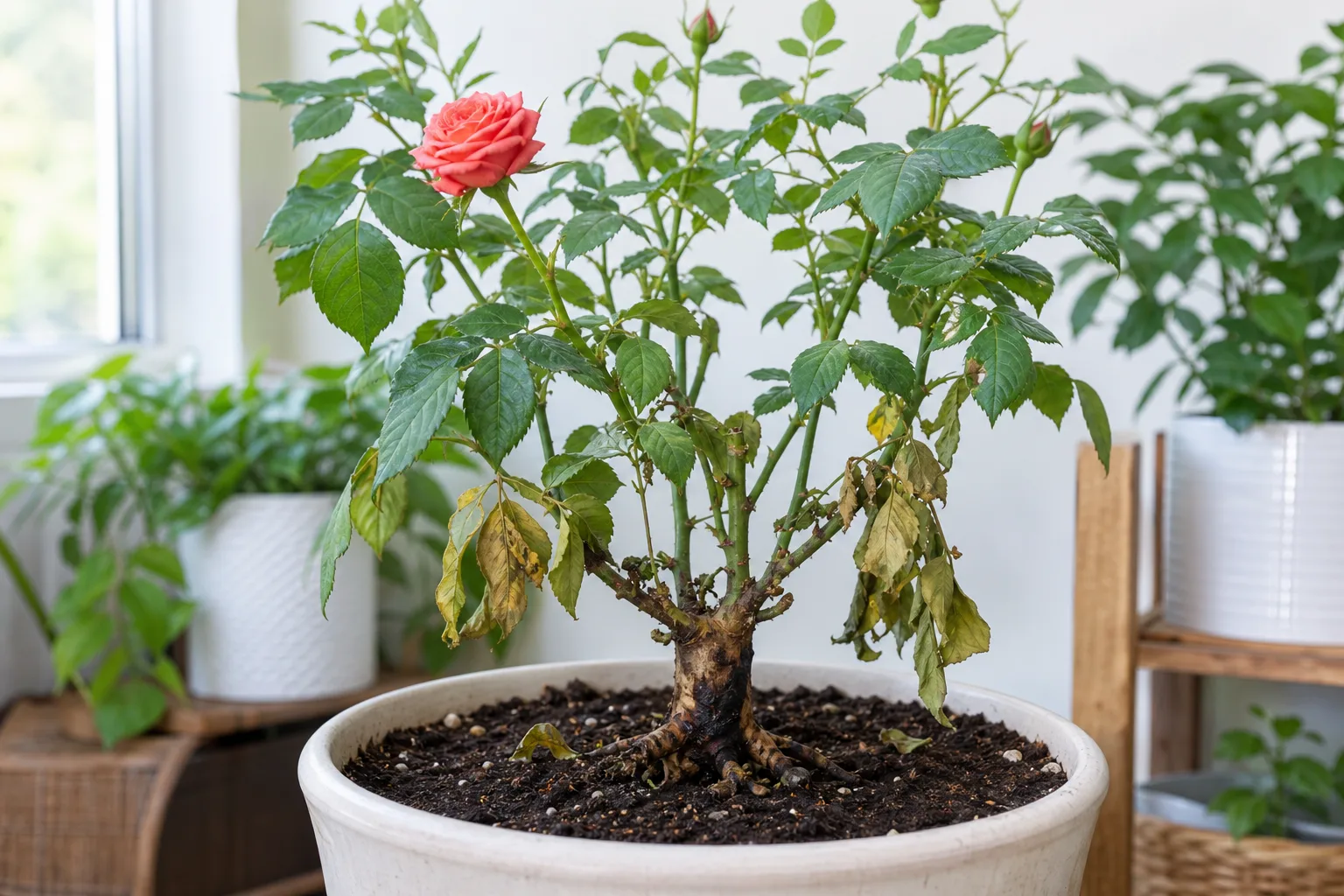
Crown Rot on Rose: Causes, Checks & Fixes
This guide covers crown rot on Rose. See also the general Crown Rot guide, watering, and light pages for this plant.
Crown Rot on Rose: Causes, Checks & Fixes
Quick answer
Crown rot on Rose is decay at the graft union or stem base-where canes meet roots-not just yellow leaves on wet soil. If roots are mushy but the graft union still feels firm, start with the root rot on Rose guide instead. Use this page when the union itself is soft, dark, or water-soaked.
Phytophthora and related water molds thrive when container mix stays saturated around the crown. The signature paradox is wilting canes on soil that still feels damp-because functional crown tissue and roots are already gone even though you have been watering.
First step: stop watering, brush soil away from the graft union, and feel whether the bark is firm or mushy. Do not add more water hoping limp leaves will perk up.
Crown rot vs. root rot vs. overwatering on Rose
These three problems overlap on container hybrid teas, but the inspection target differs:
| Problem | Soil moisture | Graft union feel | Root feel | Where to go next |
|---|---|---|---|---|
| Overwatering (early) | Wet days after watering | Firm | Mostly firm, pale | Overwatering guide - dry-down and rhythm fix |
| Root rot | Wet, often sour-smelling | Firm | Brown, mushy, slipping apart | Root rot guide - trim and repot |
| Crown rot | Wet at soil line | Soft, dark, water-soaked | May be mushy too | This page - crown rescue |
| Drought stress | Dry 3–4 cm down | Firm | Firm, pale | Rose watering guide - deep soak once |
| Black spot defoliation | Variable | Firm | Firm if checked | Black spots guide - fungal leaf disease |
On grafted hybrid teas, chronic wetness at the soil line can advance from root rot into crown rot at the union-often fatal. If the graft feels spongy, stay on this page even if some roots still look partly firm.
What crown rot looks like on Rose
Crown rot shows at the soil line before the whole bush collapses. Watch for this progression:
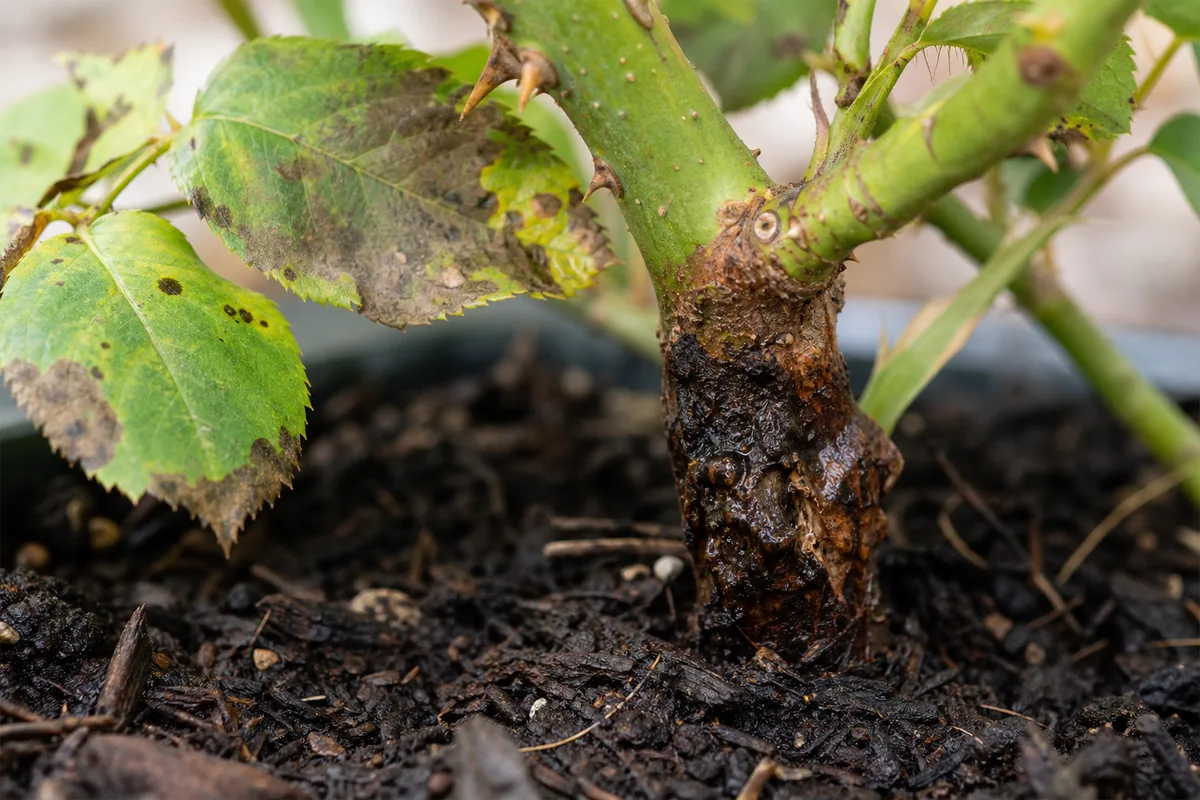
Crown Rot symptoms on Rose - compare with healthy tissue on the same plant.
Early signs:
- Canes wilt on a warm afternoon while mix stays wet for days
- Lower leaves yellow or redden, then drop; new buds abort
- Pot feels heavy when lifted despite limp foliage
- White mold, algae, or fungus gnats on the surface
Confirmed crown rot (probe the union):
- Canes rock easily when you tug lightly at the base
- Bark at the graft union turns dark brown to black and feels water-soaked or spongy
- A sour smell rises when you lift the pot or brush soil from the crown
- Aboveground drought stress appears even though you have been watering-because crown tissue is already dead
Scenario checkpoints (no photo required):
- Buried graft in a patio pot: union sits flush with or below mix; outer canes look fine while the base darkens
- Saucer + cool weather: daily watering through autumn keeps the crown saturated even when growth slows
- Fresh repot piled too high: soil mounded against the stem buries a previously visible graft knob within one season
Why Rose gets crown rot
Grafted hybrid tea and floribunda vulnerability
Grafted hybrid tea and floribunda roses carry a delicate union between rootstock and scion. When that junction sits below the soil surface or stays wet for days, water molds invade inner bark tissue and spread upward. The scion cannot survive once the union is fully destroyed-unlike own-root roses where the crown is simply the stem base.
Phytophthora and waterlogged crown tissue
Phytophthora spp. are fungus-like water molds that attack fine roots first, then spread into crowns and lower stems on woody plants. Poorly drained, waterlogged soil or media and excess irrigation favor these organisms. UC IPM notes that Phytophthora infects crowns and larger roots on woody ornamentals, producing dark discolored tissues that become soft and mushy.
Container drainage failures
Roses want rich, moist but well-drained soil; dense peat in dim corners, saucers holding runoff, and daily watering through cool weather keep the crown oxygen-starved. Overhead-wet foliage is a separate issue-crown rot is a soil and drainage failure at the base.
| Growing setup | Why crown rot shows up here | What to check first |
|---|---|---|
| Balcony container with saucer | Runoff sits at the graft level for hours after every watering | Saucer depth and emptying time |
| Oversized pot after repot | Wet outer ring never dries while roots occupy only the center | Pot size vs. root ball |
| In-ground bed with heavy mulch | Mulch piled against the stem buries the graft | Soil line vs. graft height |
| Own-root patio rose | No graft knob-rot is stem-base decay, often slower | Firm wood above rot line |
How to confirm the cause
Work through these checks in order:
- Brush soil down to the graft union on container roses. Healthy crown bark is firm and greenish-cream under a thin outer layer; rotting tissue is soft, dark, and may weep.
- Finger-test moisture 3–4 cm deep at the pot rim. Wet several days after watering with a soft union confirms saturation-not thirst.
- Tug canes gently at the base. Independent rocking of scion wood from rootstock means union failure.
- Smell the crown when soil is brushed back. Sour anaerobic odor points to advanced decay.
- Rule out mechanical damage from a tight stake tie rubbing the stem, or fresh transplant shock where soil was piled too high.
- Compare with roots: if bark stays firm but roots are black and slimy, focus on root rot; if the union itself is collapsing, crown rot is confirmed.
First fix for Rose
Stop all watering immediately. Every extra soak drives rot deeper into the crown while leaves still look merely limp.
Gently remove the plant from its pot and rinse soil from the crown and upper roots. With clean, sterilized pruners, cut back to firm, light-colored wood only-remove every soft dark section at the base. If the graft union is fully destroyed, the scion cannot recover on that rootstock; save healthy cane cuttings above the rot line if any firm wood remains.
Do not fertilize, fungicide-drench, or repot into a giant new container on the same day. Oxygen and dry-down come first.
Step-by-step recovery
Once you have stopped watering and confirmed mushy crown tissue:
- Unpot and rinse - Shake off wet mix; rinse the crown and upper roots with lukewarm water so you can see every dark zone.
- Trim to firm wood - Cut incrementally until cross-sections show light-colored firm tissue. Sterilize pruners between cuts with rubbing alcohol or a 10% bleach solution.
- Air-dry the wound - Let trimmed bases sit in shade with good airflow for 12–24 hours so cuts callus slightly before repotting.
- Repot above the soil line - Use fresh airy mix with compost, cocopeat, and perlite per our soil guide. Set the graft union at least 2–3 cm above the new soil surface per our repotting guide.
- Hold water - Do not water until the top 3–4 cm of mix dries. Resume base watering only per our watering guide.
- Watch for new breaks - Success means firm wood at the base, stable rooting, and clean shoots emerging above the union within four to eight weeks in warm active growth.
If step 2 reveals the graft is more than half hollow, take cane cuttings from firm wood above the rot line before the base collapses-see When to propagate instead below.
When to propagate instead
Hybrid teas rarely recover once the graft union is fully destroyed-the scion variety dies even if rootstock roots remain alive. When firm cane wood still exists above the rot line:
- Take softwood or semi-hardwood cuttings from healthy canes before the base softens further
- Root them separately per our rose propagation guide
- Discard the rotting base and any reused soggy mix to avoid re-infection
Own-root roses offer more salvage room: if firm stem tissue remains above the rot, the same plant may regrow from the base after aggressive trim.
Recovery timeline
Localized crown lesions caught early may heal over with firm new bark in four to six weeks if drainage stays excellent and temperatures sit in the active growth range-timelines stretch in cool weather or low light. Widespread mush at the graft union is usually fatal on hybrid teas; expect collapse rather than full recovery.
| Stage | What you should see | What means trouble |
|---|---|---|
| Week 1–2 | Rot stops advancing; trimmed wood stays firm and dry | Union turns darker or weeps again |
| Week 3–4 | No new yellowing; soil dries predictably between waterings | Canes continue wilting on wet mix |
| Week 5–8 | First clean breaks above the union; bush roots firmly when tugged | Scion canes rock independently; sour smell returns |
Judge success by firm wood at the base, stable rooting, and clean new breaks emerging above the union-not by old yellow leaves greening up.
Lookalike symptoms
| Symptom pattern | Likely cause | Key differentiator |
|---|---|---|
| Soft dark graft + wet soil + sour smell | Crown rot | Union itself is mushy |
| Mushy roots + firm graft | Root rot | Probe union-it stays hard |
| Purple-black leaf spots with yellow halos | Black spot | Defoliates from spotted leaves upward, not soft base |
| Whole plant limp + dry soil 3–4 cm down | Drought | Bark firm; perks after deep soak |
| Brown exposed cane tips in late winter | Winter dieback | Buried crown stays hard when scraped |
| Wilting on wet soil + firm graft + no base darkening | Early overwatering | Fix rhythm before crown fails |
What not to do
Do not keep watering a limp bush when soil is wet-that drives rot deeper into the crown.
Do not bury the graft union deeper at repot “for stability.” UC ANR guidance is explicit: never cover the graft union with soil or mulch.
Do not reach for fungicide as your first move on Phytophthora crown rot. PNWH notes that preventative fungicide drenches are a nursery production tool-home rescue depends on drainage correction, trim to firm wood, and dry-down. Spraying foliage fungicide on a rotting crown wastes time while decay advances.
Do not reuse soggy mix or unsterilized pruners on healthy roses. Spores survive in debris and contaminated media.
Do not confuse black spot defoliation with crown failure-spotted leaves on a firm graft need fungicide and foliage management, not crown surgery.
How to prevent crown rot on Rose
Prevention aligns with our rose watering guide and repotting guide:
- Set the graft union 2–3 cm above soil at planting and after every repot
- Finger test 3–4 cm deep before every major watering-never on a fixed calendar alone
- Water at the base until a little drains out; skip routine overhead sprays
- Empty saucers within 30 minutes of watering
- Match pot size to the root ball-oversized pots keep the crown wet longest
- Use well-draining mix with compost and perlite; refresh collapsed peat
- Reduce frequency in cool, shaded, or dormant months when growth slows
- Quarantine new purchases before mixing them with established bushes
In-ground beds: keep mulch pulled back from the graft knob and improve drainage in heavy clay before planting. Miniature and patio roses in small pots dry faster but also saturate faster-check saucers daily in rainy seasons.
Related Rose guides
- Root rot on Rose - When roots are mushy but the graft stays firm
- Overwatering on Rose - Early wet-soil triage before crown fails
- Rose watering - Dry-down rhythm and prevention
- Rose repotting - Graft union height at repot
- Rose propagation - Cane salvage when the graft is destroyed
- Black spots on Rose - Leaf disease vs. crown failure
- Rose soil - Mix and drainage for containers
Conclusion
Crown rot on Rose is a drainage failure centered on the graft union-not a random wilt disease. Stop watering, expose the crown, probe the union honestly, and trim every soft section back to firm wood. The wilt-on-wet-soil paradox tells the truth when leaves lie. Catch damage early, keep the graft above soil, and take cane cuttings as insurance when decay has already hollowed the base.