Heat Stress on Mint: Causes, Checks & Fixes
Quick answer
Heat stress wilts mint and browns leaf margins when temperatures exceed 30°C with dry soil in exposed containers. First step: Water thoroughly in early morning, move the pot to afternoon shade, and check that stems stay firm-not mushy like root rot.
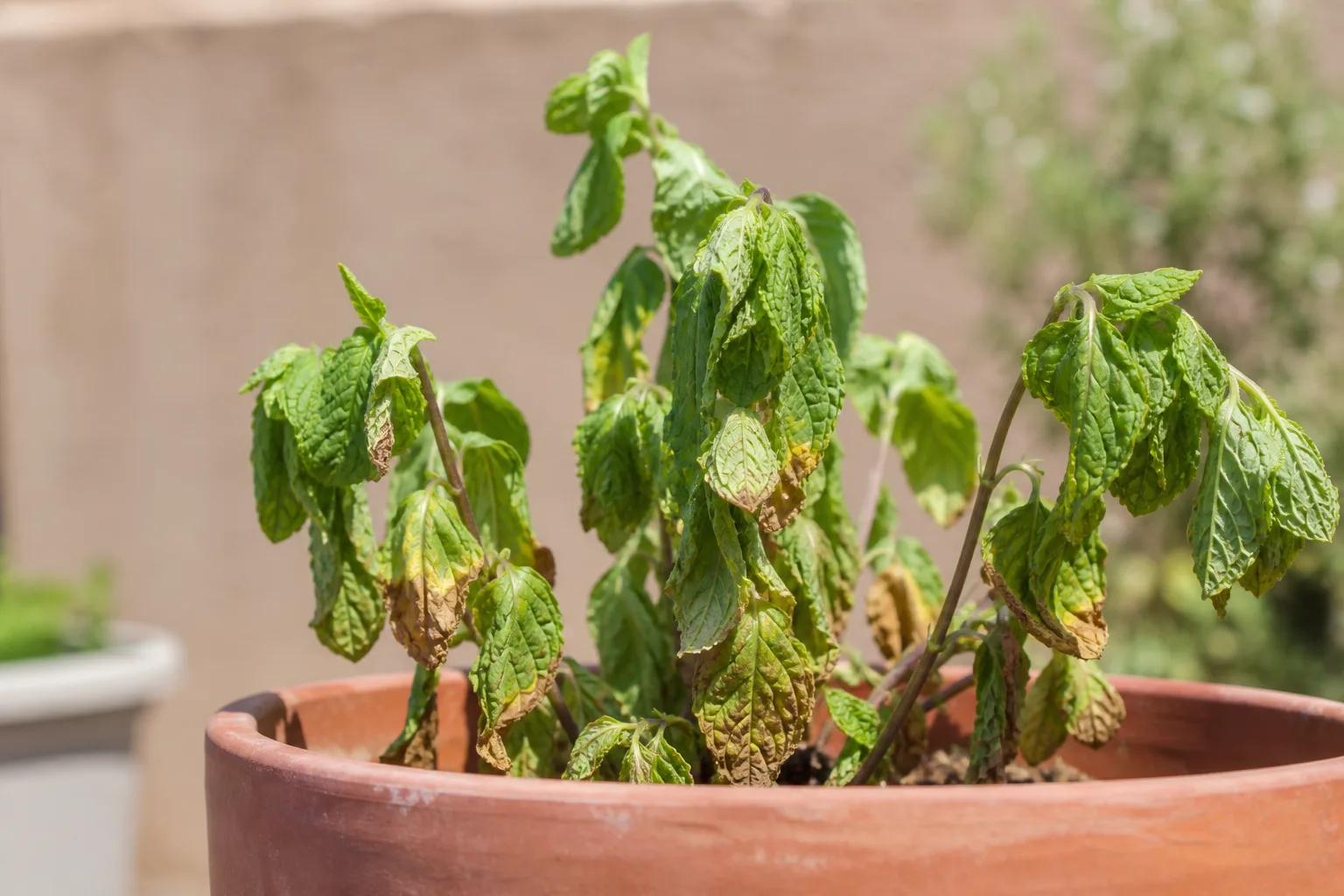
Heat Stress on Mint: Causes, Checks & Fixes
This guide covers heat stress on Mint. See also the general Heat Stress guide, watering, and light pages for this plant.
Heat Stress on Mint: Causes, Checks & Fixes
Quick answer
Mint (Mentha spicata, spearmint) wilts in afternoon heat when transpiration outpaces what roots can supply-especially in small dark pots on sun-baked terraces and west-facing rails. The signature pattern is collapse by 2 p.m. that recovers by morning on firm stems, with brown crispy margins on outer leaves and a light, dry pot.
First step: water thoroughly in early morning before heat builds, then move the pot to afternoon shade for the rest of the day. Do not add a splash at noon on a collapsed plant without checking soil first-deep morning watering matters more than reactive midday splashes.
Scope on this site: This page covers afternoon heat collapse on dry or fast-drying container mint. For directional scorch after a sudden light jump, see sunburn on mint. For year-round placement and acclimation, start with the mint light guide. For moisture-first triage when wilt could be drought or rot, use wilting on mint.
Heat stress vs sunburn vs drought wilt on mint
These three problems overlap on summer patios but need different first fixes:
| Signal | Heat stress (this page) | Sunburn | Drought wilt |
|---|---|---|---|
| Timing | Worst wilting peaks mid-afternoon on hot days; often recovers overnight | Damage appears within 24–48 hours of a light jump or first blazing day | Builds over several dry days |
| Pattern | Whole pot wilts; brown crispy margins on outer leaves; fragrance may fade | Tan-brown dry patches on sun-facing leaves only; shaded leaves often stay green | Even wilt; dull limp leaves without distinct one-sided bleaching |
| Soil at noon | Often dry and light pot weight; surface may bake while deeper mix still holds some moisture | Can be moist or dry | Dry throughout; pot very light |
| Overnight | Turgor often returns by morning if roots rehydrate and temps drop | Scorched tissue stays brown; plant may look unchanged | Perks up after a deep soak |
| Stems/roots | Firm stems if caught early; roots white and firm when checked | Firm stems; firm roots | Firm roots |
| First fix | Deep morning water + afternoon shade | Shade + gradual hardening | Deep soak; then adjust watering rhythm |
If leaves show directional bleaching on one side after a patio move, read sunburn before treating heat alone. If wilt persists on wet soggy soil with soft stems, see root rot instead.
What heat stress looks like on mint
Heat collapse on mint has a recognizable daily rhythm on broad, soft leaves:
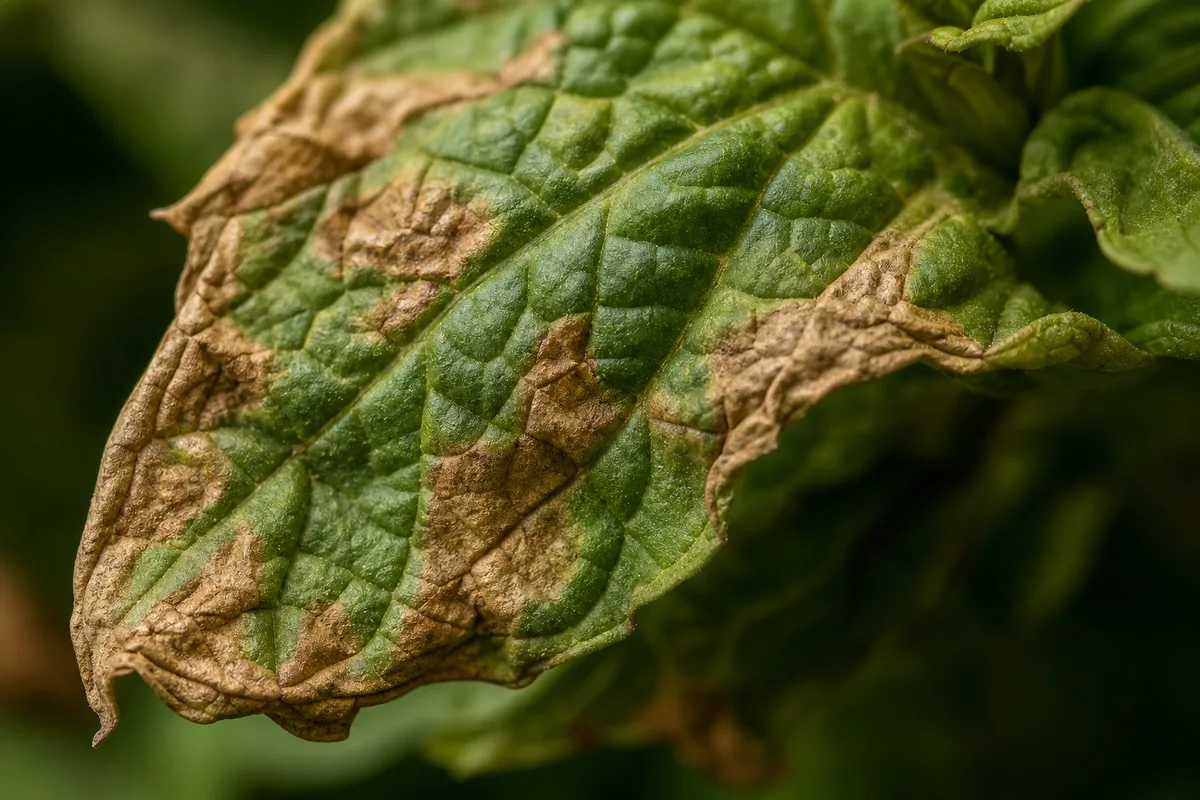
Heat Stress symptoms on Mint - compare with healthy tissue on the same plant.
- Midday wilting despite morning watering-the plant looks thirsty at 2 p.m. even when you watered at 7 a.m.
- Brown crispy margins on outer leaves, especially on shoots at the sun-facing pot rim
- Leggy soft stems that perk up overnight then wilt again the next afternoon when heat returns
- Fragrance fade during severe hot dry spells-crushed leaves smell weaker until recovery
- Light, dry pot weight at noon-unlike root rot, where soil stays heavy and wet
Photo callout - midday wilt: Picture a west-facing terrace spearmint in a 15 cm black nursery pot on concrete: outer stems hang limp by early afternoon, leaf edges look papery brown, but the same plant stands firmer by 8 p.m. after shade and a morning soak.
Photo callout - evening recovery: The same pot moved under a balcony overhang after a 32°C afternoon: shoot tips regain turgor by evening while old margin burn stays crisp-recovery shows in new firm tissue, not re-greening of burnt edges.
Differs from drooping leaves caused by chronic underwatering, which does not follow a strict afternoon-only clock. Differs from sunburn, which scars one side of each leaf after a light jump rather than wilting the whole pot uniformly.
Why container mint overheats faster than garden mint
Mint evolved for rich, moist soil in sun to partial shade. In the ground, soil mass buffers temperature swings and rhizomes can reach deeper moisture. In containers, restricted root volume and exposed pot walls change the equation entirely.
High air temperature increases water loss from broad mint leaves through transpiration. When air temperature climbs past roughly 30°C with dry surface soil, leaves lose water faster than roots pull it up-even when deeper mix still holds some moisture.
Dark pots on hot surfaces raise root-zone temperature. Black nursery pots on stone, concrete, or metal rails transfer heat directly into the mix. RHS container guidance notes that plants in pots dry quickly in hot weather and that recovering from wilting may still slow growth even after turgor returns.
Small root-bound pots dry within hours. Mint spreads by rhizomes and runners, packing container edges densely. A 10 cm pot may need water twice daily in summer; a 20 cm pot holds more buffer. Edge shoots wilt first because rhizomes fill the rim and leave little water-holding mix at the hottest face of the pot.
Reflected heat from walls and paving pushes stress faster than in-ground garden mint on the same property. West-facing rails and white balustrades that bounce afternoon glare compound transpiration loss.
Harvest-stripped mint loses soil-shade cover. Heavy cutting exposes bare mix to direct sun, accelerating surface drying on hot days.
In-ground vs. container: Garden mint on moist soil tolerates more afternoon heat than the same cultivar in a dark patio pot. RHS grow-your-own guidance notes that mint in pots dries faster than in-ground plantings-mobility and shade are your main levers on terraces.
Spearmint vs. peppermint: Both wilt in heat; peppermint’s darker leaves may hide margin burn slightly longer, but neither tolerates repeated daily collapse in a baking small pot. In hot humid climates, UF/IFAS recommends light or part shade for mint-afternoon protection is normal productive culture, not failure.
Six-step confirmation checklist
Work through these checks in order before you repot, fertilize, or assume disease.
- Time-of-day pattern - Are symptoms worst between noon and 5 p.m. and noticeably better by morning? Afternoon-only collapse with overnight recovery strongly suggests heat stress, not rot.
- Soil moisture at noon - Press your finger 2 cm into the mix. Dry, pale, or pulled-away soil confirms drought compounding heat. Wet soggy mix with a heavy pot points to root rot or overwatering-do not bottom-water.
- Pot weight and color - Lift the pot. Light weight fits dry heat stress. Dark plastic on hot paving is a common trigger. Feel the pot wall at midday-too hot to hold comfortably means root-zone stress.
- Stem firmness - Pinch a stem above the soil line. Firm green tissue fits heat or drought. Soft mushy bases on wet soil need rot treatment before any extra watering.
- Shade-test response - Move the pot to shade for two to three hours on a hot afternoon. Rapid turgor improvement confirms heat as the driver. No improvement on wet soil suggests rot or severe root damage.
- Overnight recovery check - Note whether shoots stand firmer by 8–10 p.m. or next morning. Heat-stressed mint on firm roots often recovers overnight once temperatures drop. Wilt that never recovers despite moist soil needs the broader wilting workup.
University of Minnesota Extension advises never allowing herbs to wilt between waterings, but also warns that constantly soggy soil encourages root rots-match your fix to actual moisture, not to how sad the leaves look.
Confirmation decision table
| If you find… | Likely cause | Next step |
|---|---|---|
| Afternoon wilt + dry light pot + overnight recovery | Heat stress | Morning soak + afternoon shade |
| Directional dry scorch + recent light jump | Sunburn | Sunburn guide |
| Even wilt + very dry soil throughout | Drought | Deep soak; watering guide |
| Mushy stems + wet sour soil | Root rot | Root rot-stop watering |
| Wilting on wet soil that never recovers | Rot or root failure | Wilting moisture branch |
First 24 hours: fix heat-stressed mint
Hour 0 (morning, before heat builds): water thoroughly if the top 2 cm of soil is dry.
Soak until water runs from drainage holes, then let the pot drain fully. For very dry, hydrophobic mix in a small root-bound pot, bottom-water briefly in a basin for 20–30 minutes so the root ball rewets, then drain completely. This single morning drink sets the plant up for the day better than reactive noon splashes.
Hours 1–4: move to afternoon shade.
Shift the pot to eastern exposure, dappled afternoon shade, a balcony overhang, or behind a taller plant group. Grouping pots raises local humidity and reduces water loss-useful on open terraces. Do not plunge heat-stressed mint into blasting midday sun to “toughen it up.”
Midday (if wilt returns): check before you water again.
If soil is still moist 2 cm down and stems are firm, shade alone may be enough-adding water to already wet mix invites rot during recovery. If the top 2 cm is dry and the pot is light, a second deep soak is reasonable; empty any saucer within 15 minutes.
Evening: assess recovery.
Firm shoot tips by night are a positive sign. Brown margins on old leaves stay crisp permanently-do not expect them to re-green. Trim badly burnt margins only after stability returns for several days.
Do not bottom-water plants with suspected rot-wet heavy pots, soft stems, or sour smell mean root rot, not dry heat stress.
Recovery note (west-facing terrace spearmint, June 2025): A root-bound clump in a 12 cm black pot on west-facing concrete collapsed by 2 p.m. daily for four days above 30°C. After one deep morning soak, afternoon shade under a railing, and upsizing to an 18 cm light-colored pot the following week, turgor returned by 8 p.m. each day; clean new tips without margin burn appeared on day 10. Old crispy edges never recovered.
Recovery timeline
Same day: Turgor often improves by evening once morning water and shade align. Shoot tips should feel firmer within hours-not days-if roots are healthy.
3–7 days: Daily afternoon collapse should lessen once pot size, shade, and watering rhythm stabilize. Fragrance on new growth typically returns before old burnt tissue looks better.
1–2 weeks: New leaves without margin burn appear during active summer growth. RHS notes that plants may recover from wilting but growth can still slow if heat collapse repeats daily-treat repeated midday collapse as urgent.
Permanent damage: Crisp brown edges on affected leaves do not turn green again. Judge success by new clean shoots, not old margins.
Worsening signs: Daily collapse despite shade and proper morning watering; wilt on wet soil with mushy stems; no new tips after three weeks in warm light-escalate to wilting and rot checks.
Lookalike symptoms to rule out
Sunburn scorch - Directional tan-brown dry patches on sun-facing leaves within days of a light jump. See sunburn on mint.
Simple drought wilt - Even limp leaves on very dry soil throughout, without the strict afternoon-only recovery rhythm if you have not watered for many days. Deep soak once, then stabilize watering.
Root rot - Yellowing and wilt on wet soil, sour smell, mushy brown roots. Moving a rotting pot to shade without fixing drainage worsens collapse. See root rot.
Combined heat + rot - A common summer trap: heat collapse followed by panic overwatering in recovery shade. Wet soggy mix plus soft stems means stop watering and inspect roots-not more afternoon soaks.
Low light stretch - Long pale stems reaching toward glass in dim rooms-not crispy afternoon margin burn on a hot patio. See not enough light.
Mistakes to avoid
Do not water only a splash at noon on a collapsed plant when the real fix is deep morning watering and shade. Avoid assuming all wilting means rot and stopping water during a heat wave-dry mint in sun needs hydration.
Do not leave black nursery pots on sun-baked stone without shade, elevation, or upsizing. Do not bottom-water when soil is already wet and stems are soft.
Do not fertilize heat-stressed mint until new growth looks clean for two weeks-salts on stressed roots worsen uptake problems.
Do not overwater during recovery shade because leaves still look limp at noon-check soil depth first. RHS heat-stress guidance links wilting, rolling, and crispy leaves to heat stress in hot rooms-the same physiology applies on blazing terraces.
How to prevent heat stress on mint
- Upsize pots before summer - Move root-bound mint into containers at least 18–20 cm wide before June heat; rhizome-filled rims dry fastest.
- Water early in the day - UMN Extension recommends thorough watering for container herbs in hot weather; check the top 2 cm daily on patios.
- Afternoon shade on terraces - Shade cloth, eastern exposure, or grouping pots when temperatures exceed 30°C on exposed rails.
- Light-colored pots elevated off hot paving - Reduces root-zone heat transfer into the mix.
- Light mulch on soil surface - Slows evaporation; keep mulch off crown stems to avoid rot.
- Harvest regularly but leave leaf cover - Enough foliage shades the soil and supports recovery after cuts.
- Review placement annually - Pair with the mint light guide so summer shade is planned, not reactive.
In-ground garden mint on moist soil needs less intervention than terrace pots-but containers let you move plants to shade, which is why UF/IFAS recommends containers partly to control spread and partly for strategic repositioning in Florida heat.
When to worry
Act same week when mint collapses by noon daily despite morning watering, soil is parched in small pots below 15 cm, or combined heat and direct sun crisp most leaves in one day.
Also escalate when:
- Wilt persists overnight on wet soil with soft stems-rot overlap, not heat alone
- Daily collapse continues two weeks after shade, upsizing, and corrected watering
- Fragrance does not return on new tips after heat breaks-roots may be damaged
Lower urgency when afternoon wilt appears once after a single hot day, stems stay firm, and the pot recovers overnight after one morning soak and shade move.
Conclusion
Heat-stressed mint needs morning hydration, afternoon shade, and cooler root zones-not permanent dim placement or panic overwatering. The overnight-recovery pattern is your best diagnostic tool: collapse by afternoon that firms up by evening on dry light pots points here, not to sunburn’s directional scorch or rot’s wet heavy soil. Confirm with the table above, rule out sunburn and root rot, and trust clean new tips within one to two weeks once heat and water align. For year-round brightness, pair this drill-down with the mint light guide; for moisture-first triage, use wilting on mint.
Related tool
Use the Plant Problem Diagnosis Tool to narrow causes for heat stress on this plant before changing multiple variables at once.