Ficus Burgundy Fertilizer: When, How, and Mistakes to Avoid
Ficus Burgundy Fertilizer: When, How, and Mistakes to Avoid
Ficus Burgundy Fertilizer: When, How, and Mistakes to Avoid
Author: sai-ananth · Reviewed by: LeafyPixels Review Board · Updated: 2026-06-15
Ficus Burgundy Fertilizer: When, How, and Mistakes to Avoid
White salt crust on the soil surface is easy to miss on a Ficus Burgundy until the next new leaf emerges pale green instead of wine-dark from its red sheath. Ficus elastica ‘Burgundy’ - the burgundy rubber plant sold for near-black glossy foliage - carries large leaves that make fertilizer burn visible fast: crisp brown tips on 20 cm blades show up before you notice the same mistake on a smaller houseplant. That visibility is useful. Salt buildup, winter feeding on a resting plant, and chasing burgundy color loss with extra nitrogen when light is actually too low are the three feeding errors Burgundy growers repeat most often.
The baseline schedule for most homes is a balanced water-soluble fertilizer at half label strength, once monthly from spring through early fall, on moist soil, with a complete winter pause - details in the frequency section below. This guide covers Burgundy-specific biology (dark-leaf nitrogen demand, red-sheath emergence timing), how that differs from variegated Ficus Tineke feeding, dilution math, flush recovery, and internal links to the Ficus Burgundy overview, soil, watering, light, and repotting guides.
Why Ficus Burgundy Fertilizer Matters (Not a Rescue for Light or Water Problems)
Feeding replaces nutrients a container-bound rubber plant depletes over months of watering and growth. It does not fix a plant in a dim hallway, a waterlogged pot, or a root ball that has not been refreshed in three years. NC State Extension lists ‘Burgundy’ among Ficus elastica cultivars with dark green leaves and burgundy hints, grown indoors for large glossy foliage - that leaf mass is why nitrogen demand is real but moderate, not why you should pour full-strength formula on a stressed specimen.
Burgundy Cultivar Biology and Container Nutrient Depletion
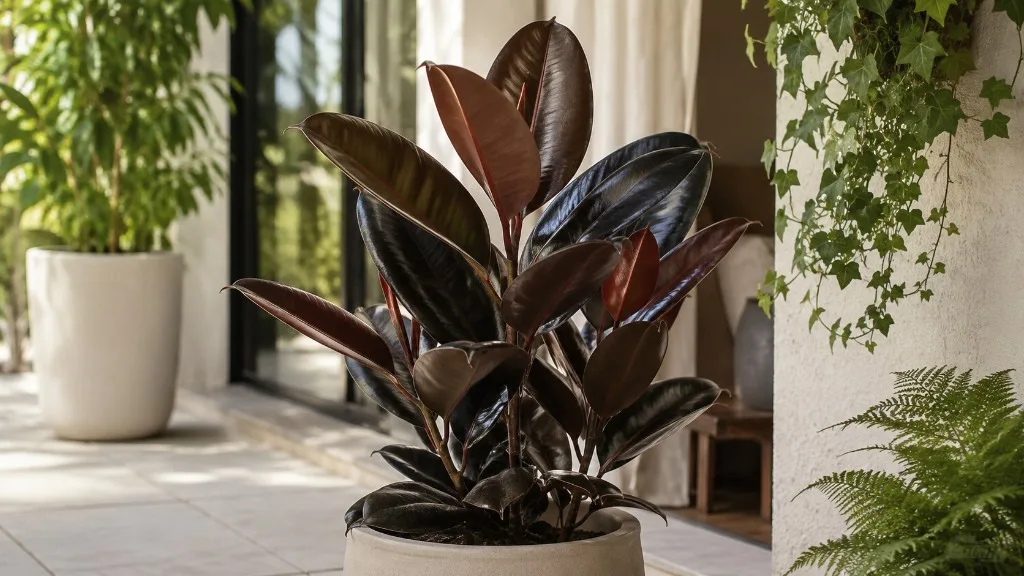
Burgundy rubber plants are native to Southeast Asian forests where they grow as large trees. Indoors they typically add roughly 30–60 cm of height per year under bright indirect light - a practitioner range, not a guarantee - with individual leaves commonly exceeding 15–20 cm on mature specimens. Each new leaf unfurls from a red protective sheath; when nutrition and light align, that emerging blade stays deep burgundy before maturing to near-black green with a wine-colored underside. Commercial potting mix ships with weeks to a few months of baseline fertility, not years. Thorough watering leaches dissolved minerals; root growth consumes others. Without seasonal feeding during active growth, even a well-lit Burgundy eventually pushes smaller, paler new leaves.
Solid dark leaves contain more chlorophyll per square centimeter than variegated Ficus elastica cultivars, so Burgundy can use nitrogen somewhat more efficiently for photosynthesis - but large leaf area still draws potassium and trace elements steadily. The mistake is assuming dark leaves mean “heavy feeder.” They mean visible salt damage when you overdo it. Missouri Botanical Garden notes rubber plants benefit from regular fertilization during active growth while excess fertilizer can damage roots. Treat nutrients as maintenance for an actively growing plant after light and watering are stable.
Observed feeding timeline (home grower, south-facing filtered window, 22°C, 20 cm terracotta pot): April - first half-strength 10-10-10 feed on moist soil; May–July - monthly repeats with new red-sheath leaves every three to four weeks; August - faint white crystals on soil rim; early September - three plain-water flushes in the sink; late September - next new leaf deep burgundy again by week three. Your intervals will differ by pot size and soil mix, but the sequence - feed → crust → flush → clean new growth - is the pattern to watch for.
When to Fertilize: Growing Season vs Winter Rest
Feed when Burgundy is actively producing new leaves and extending stems; pause when growth slows. Indoors that tracks warm weather, long days, and bright light more than the calendar alone.
Spring and Summer Feeding Window
Start when you see fresh shoots - new blades emerging from red sheaths, firm stems, roots visible at drainage holes if you check gently. In temperate homes that usually means mid-spring through early fall. Clemson HGIC recommends water-soluble houseplant fertilizer every two weeks during active spring and summer growth, with less frequent feeding in lower light. Many indoor growers reconcile that guidance with half-strength monthly feeding - fewer salt spikes on large leaves while still replacing nutrients. Very bright setups pushing a new leaf every two to three weeks may feed every three to four weeks at half strength if you flush salts every two to three months.
| Month (temperate climate) | Growth phase | Feeding guidance |
|---|---|---|
| March–April | New red-sheath shoots | Start half-strength when growth is visible |
| May–August | Peak foliage production | Monthly half-strength; flush every 2–3 months |
| September | Slowing | Extend interval to 6–8 weeks or taper |
| October | Wind-down | Final light feed if still growing, then pause |
| November–February | Low indoor growth | No fertilizer for typical setups |
Fall Taper and Winter Pause
Taper in early fall as day length drops. Give a final half-strength feed only if new leaves still unfurl, then pause from late autumn through winter - typically October or November through February or March. Clemson HGIC indoor fertilizing guidance notes many houseplants enter a resting stage in short winter days and should not receive fertilizer during that period. Winter feeding on a plant not using nutrients is a common path to brown tips and leaf drop in January.
Grow-light winter exception: If you run a full-spectrum LED 10–14 hours daily and Burgundy keeps pushing red-sheath shoots through December, you may feed lightly every six to eight weeks at half strength - still far less than summer. Clemson HGIC rubber plant guidance notes plants in lower light should be fertilized less often, which applies doubly when winter metabolism is partial even under artificial light. Flush every two months because salts accumulate faster when evaporation from grow lamps dries the soil surface between waterings.
Best Fertilizer Type for Ficus Burgundy
Most homes do best with a complete water-soluble balanced houseplant formula - nitrogen for foliage, moderate phosphorus for roots, potassium for overall vigor, plus micronutrients on the label.
Balanced Liquid Formulas and NPK Ratios
10-10-10 or 20-20-20 diluted to half strength is the standard default. The numbers are percent by weight of nitrogen, phosphorus, and potassium; 20-20-20 at half strength delivers a similar nutrient balance to 10-10-10 at full label rate - concentration matters more than chasing a specific ratio. Slightly nitrogen-forward foliage formulas (e.g., 3-1-2) are acceptable. Avoid high-phosphorus bloom boosters - indoor Burgundy rarely flowers, and extra phosphorus adds salt without improving leaf color. Never pour undiluted granules on the soil surface.
Worked dilution: Label says 5 ml per liter for indoor plants → use 2.5 ml per liter (half strength). For a 20 cm pot, one session uses enough solution to moisten the full root zone - scale volume with pot diameter, not tree height, but keep concentration at half strength always.
Organic Options and What to Skip
Diluted fish emulsion, worm castings top-dressed thinly in spring, or compost tea can work during active growth. Organic liquids smell and may attract fungus gnats if over-applied - a grower observation, not an extension rule. Skip or use cautiously: slow-release pellets in small pots (especially fresh repotting mix already containing prills), foliar feeding as primary method (waxy cuticle limits uptake), fertilizer-pesticide combos, and full-strength doses “because the plant is big.”
Burgundy vs variegated feeding: Ficus Tineke and Ruby carry less chlorophyll in cream or pink zones, so salt burn often appears on pale margins first. Burgundy’s solid dark tissue hides early stress slightly longer, then shows tip burn across large blades at once. Variegates may need brighter light overall; Burgundy tolerates slightly dimmer conditions but still greens when light is inadequate - extra fertilizer will not re-darken those leaves.
How Much and How Often
Half strength is non-negotiable for routine container feeding. Read the label’s indoor/houseplant rate, not outdoor garden rates.
Dilution Math - Worked Example
If your bottle specifies 10 ml per gallon for houseplants, halve to 5 ml per gallon. Hard tap water adds calcium and magnesium that compound with fertilizer salts - if you see recurring crust despite conservative feeding, alternate a feeding week with plain water or flush before resuming (see flush section). In hard-water homes, plan proactive flushes every six to eight weeks during the feeding season rather than waiting for visible crust on dark soil where white crystals are harder to spot against chunky bark mixes. University of Maryland Extension links excess fertilizer to high soluble salts, brown leaf tips, and root damage in indoor plants.
Large floor specimens in porous soil with extra perlite may need only three to four liquid feeds per year if you top-dress worm compost each spring - judge by new leaf size and burgundy tone on emergence, not a rigid monthly calendar on a slow-growing mature tree.
Frequency Tiers by Light and Growth Rate
| Scenario | Interval | Dose | Flush interval | Expected outcome |
|---|---|---|---|---|
| Standard indoor bright indirect | Monthly | Half strength | Every 2–3 months | Steady burgundy new growth |
| High light, fast dry-down | Every 3–4 weeks | Half strength | Every 2 months | Larger summer leaves; watch crust |
| Post-repot enriched mix | Hold 3–6 months | None initially | N/A | Avoid double-dosing prills |
| Winter grow-light active growth | Every 6–8 weeks | Half strength | Every 2 months | Limited winter push |
| Recovery after flush | 4–6 week pause | None | Already done | Next leaf clean margins |
Proceed / pause / flush decision tree: Proceed - firm new growth, moist soil, no white crust, growing season. Pause - dry soil, recent repot, leaf drop, pest treatment, or winter rest. Flush - visible salt crust, brown tips after feeding, wilting in wet soil post-feed. Flush first; do not feed on top of crust.
Step-by-Step: How to Feed Ficus Burgundy Safely
- Check season and plant - active growth visible; not in winter pause unless under strong grow lights.
- Moisten if needed - top 2–3 cm should not be bone dry (matches watering guide dry-down).
- Mix half strength - measure with a syringe or marked can for repeatability.
- Apply to soil surface - pour slowly around the stem; wipe fertilizer splashes off glossy leaves to avoid spot damage and latex sap contact on skin.
- Empty the saucer after 15–30 minutes.
- Log the date - prevents double-feeding after a busy month.
Pre-Feed Checks and the Moist-Soil Rule
Fertilizer ions move into roots more aggressively when the soil solution is concentrated. Dry soil plus fresh fertilizer causes osmotic shock on fine root hairs. If crust is present, flush before the next feed. Pause if you repotted within the last month into enriched mix, just brought the plant home from a nursery (likely recently fed), or see widespread yellowing or wilting in wet soil - diagnose watering and roots before adding nutrients.
Signs Your Ficus Burgundy Needs More Nutrition
Under-fertilizing is less common than over-fertilizing, but it happens in the same pot two or more years without repotting or feeding, especially in bright light where growth outpaces soil reserves.
Watch for pale or small new leaves compared to older foliage when light is already adequate; slow internode extension with weak stem color (distinguish from low-light etiolation by confirming brightness); uniform light-green shift over months; stalled spring/summer growth despite proper watering. Confirm half-strength monthly before increasing frequency - never jump to full strength. Fresh soil refresh often helps as much as doubling fertilizer.
Burgundy Tone Loss vs Light Deficiency
This is the Burgundy-specific diagnostic that generic rubber-plant articles skip. New leaves emerging green or muddy olive from the red sheath while older leaves stay dark usually means insufficient light for anthocyanin production - move the plant or add grow light per the light guide. New leaves are small and pale yellow-green in an already bright window with firm watering may indicate depleted nitrogen. Brown crispy tips after a recent feed mean salts, not hunger. Chasing color loss with fertilizer in a dim room adds nitrogen without restoring burgundy tone and accelerates salt buildup.
Signs of Over-Fertilizing and How to Flush
Over-feeding symptoms include brown crisp tips and margins (often on oldest large leaves first), white or yellowish soil crust, sudden leaf drop after a winter feed, wilting despite moist soil, and stunted twisted new growth. Clemson HGIC indoor fertilizing guidance describes white film on soil or pot rims as a sign of overfertilizing and/or overwatering, with salt buildup damaging roots.
Flush procedure: Stop all fertilizer for four to six weeks. Place the pot in a sink or tub. Water slowly with plain room-temperature water until it runs freely from drainage holes; wait a few minutes; repeat two to three more times. Let drain completely. Resume half-strength monthly only when new growth shows clean margins. Existing burnt edges do not heal - judge recovery by the next leaf flush. Severe cases with foul soil or blackened roots need trim and repot into unfertilized mix.
Fertilizer and the Rest of Burgundy Care
Nutrients are fuel, not a substitute for the rest of the stack. Light sets demand - Burgundy in bright indirect light uses fertilizer efficiently; the same plant in a dim hallway needs less food, and feeding heavily in low light pushes salts without proportional growth. Watering rhythm affects salt concentration - soggy mix plus fertilizer accelerates root decline, so leaner feeding is safer if you tend to overwater per the watering guide. Soil structure determines how long salts linger; chunky perlite-amended mix flushes more effectively than heavy peat that stays wet at the bottom. After repotting, hold liquid feed until new growth proves roots have recovered - slow-release prills in fresh bagged mix count as hidden fertilizer.
Common Fertilizer Mistakes
Feeding on calendar autopilot through winter burns roots on a resting plant. Full label strength because leaves are large - container soil cannot dilute salts like garden earth. Fertilizing dry soil for convenience. Ignoring crust and feeding on top. Feeding immediately after repot into slow-release mix. Bloom booster on a foliage tree. Double-dosing after a skipped month. Chasing burgundy fade with nitrogen when light is the real issue. Storing concentrate within pet reach - ASPCA lists rubber plant as toxic to cats and dogs if ingested; sap from wiped leaves can irritate skin (PlantTalk Colorado notes milky sap irritates skin on broken tissue).
When to use this page vs other Ficus Burgundy guides
- Ficus Burgundy overview - Start here for whole-plant context before deep-diving this topic.
- Ficus Burgundy problems hub - Jump to symptom-specific fix guides when this care topic does not resolve the issue.
Related Ficus Burgundy guides
- Ficus Burgundy overview
- Ficus Burgundy watering
- Ficus Burgundy light
- Ficus Burgundy soil
- Ficus Burgundy propagation
- Ficus Burgundy repotting
- Ficus Burgundy problems
Conclusion
Ficus Burgundy feeding rewards conservative rhythm: half-strength balanced liquid on moist soil during active growth, winter pause, periodic flushing, and fixing light before you chase leaf color with nitrogen. Use the scenario table and proceed/pause/flush tree when crust or tip burn appears - large dark leaves make those signals impossible to ignore once you know what to look for.