Low Humidity on English Ivy: Causes, Checks & Fixes
Quick answer
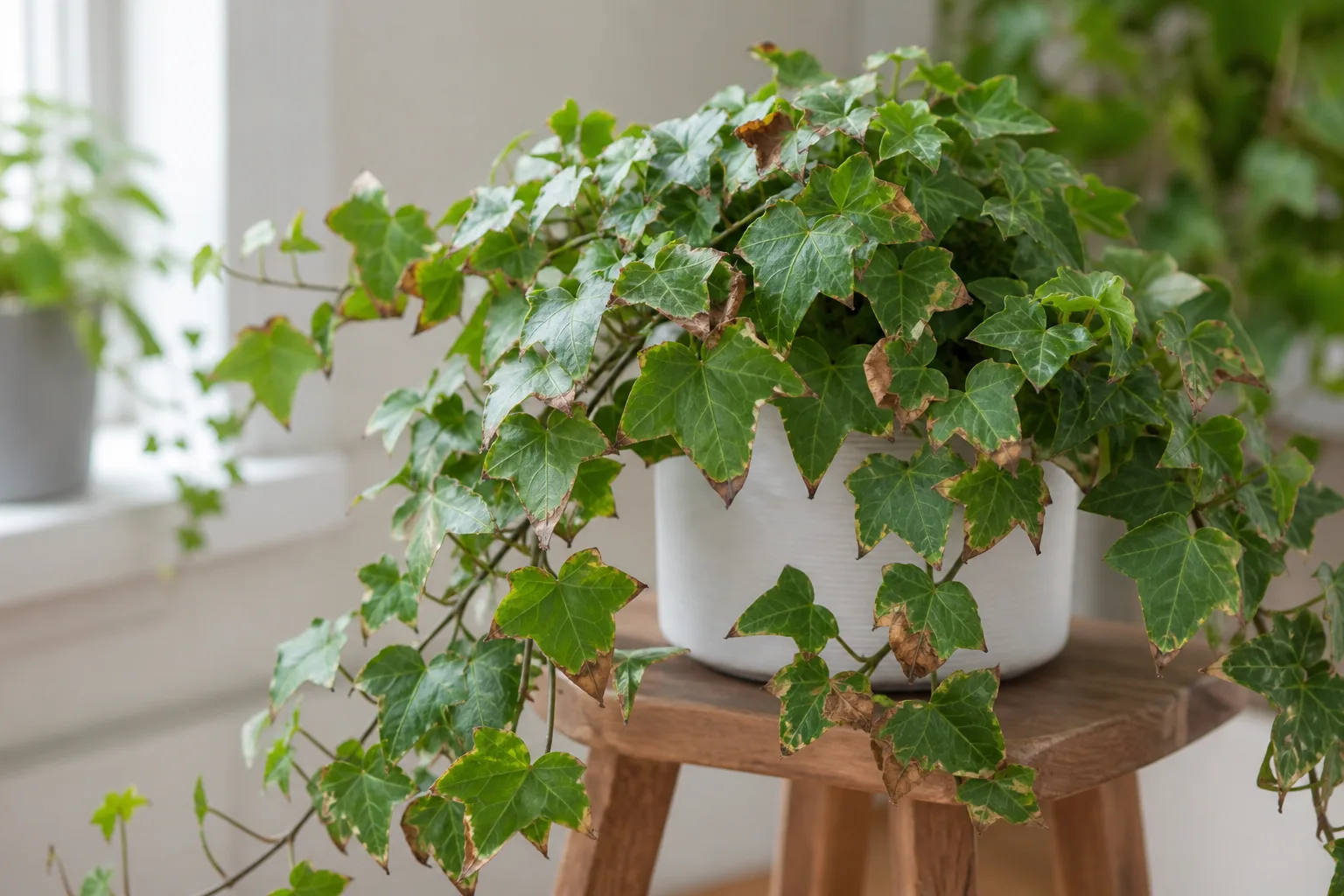
Low humidity on English ivy shows as dry brown margins on lobed leaves and increased spider-mite risk-especially in heated winter rooms below 30% RH. First step: place a hygrometer beside the trailing canopy; if the reading is under 40%, run a humidifier near the plant and slide the basket away from radiators and heat registers before you change watering.
Low Humidity on English Ivy: Causes, Checks & Fixes
This guide covers low humidity on English Ivy. See also the general Low Humidity guide, watering, and light pages for this plant.
Low Humidity on English Ivy: Causes, Checks & Fixes
Quick answer
English ivy (Hedera helix) evolved in cool, humid woodlands native to Europe and Scandinavia-not in hot, dry living rooms. Its thin lobed leaves transpire steadily from trailing stems, and when ambient relative humidity drops, margins and tips desiccate first while vines often stay firm. Heated winter air commonly falls below 30% RH, which accelerates brown edges and sets the stage for spider mites weeks later.
First step: measure relative humidity beside the trailing canopy with a hygrometer. If the reading is below 40%, run a small humidifier within a few feet of the plant and move the basket away from radiators, heat registers, and fireplace mantels before you repot, fertilize, or increase watering. Clemson Extension recommends raising humidity with a tray of wet pebbles and notes that cooler temperatures with higher humidity help prevent common insect pests on indoor ivy-humidity is not a cosmetic preference on this species.
This page covers dry-air stress on Hedera helix. For margin browning from salt buildup or tap water, see brown tips. For stippling and webbing after humidity crashes, see spider mites. For limp vines on bone-dry soil, see underwatering.
What humidity English ivy needs indoors
English ivy is not a tropical rainforest plant. It tolerates average home humidity better than a calathea, but it still performs best when relative humidity stays in the 40 to 60% band beside the foliage-the same target in the English ivy overview Temperature and Humidity section. Clemson Extension states that although ivies prefer moderate humidity, they will tolerate normal low home levels-which is why damage can creep in slowly until winter heating drops RH sharply.
Temperature and humidity work together on ivy. Ivies do well at cool to moderate room temperatures of 50 to 70 °F during the day, with nights about 5 to 10 °F cooler when possible. A hot dry living room above 75 °F (24 °C) with furnace air below 30% RH is the opposite of the cool woodland rhythm this vine expects. A bright cool bedroom or east-facing office often supports healthier trailing growth than a sofa-side spot above a heat register.
Trailing ivy in a hanging basket loses moisture from leaves at every lobe tip farthest from the pot. The canopy you see at eye level is the first place dry air shows up-not necessarily the soil line hidden inside the basket.
How low humidity shows up on lobed ivy leaves
Low-humidity damage on English ivy is a margin-first pattern on firm trailing stems-not the whole-vine collapse of severe underwatering or root failure.
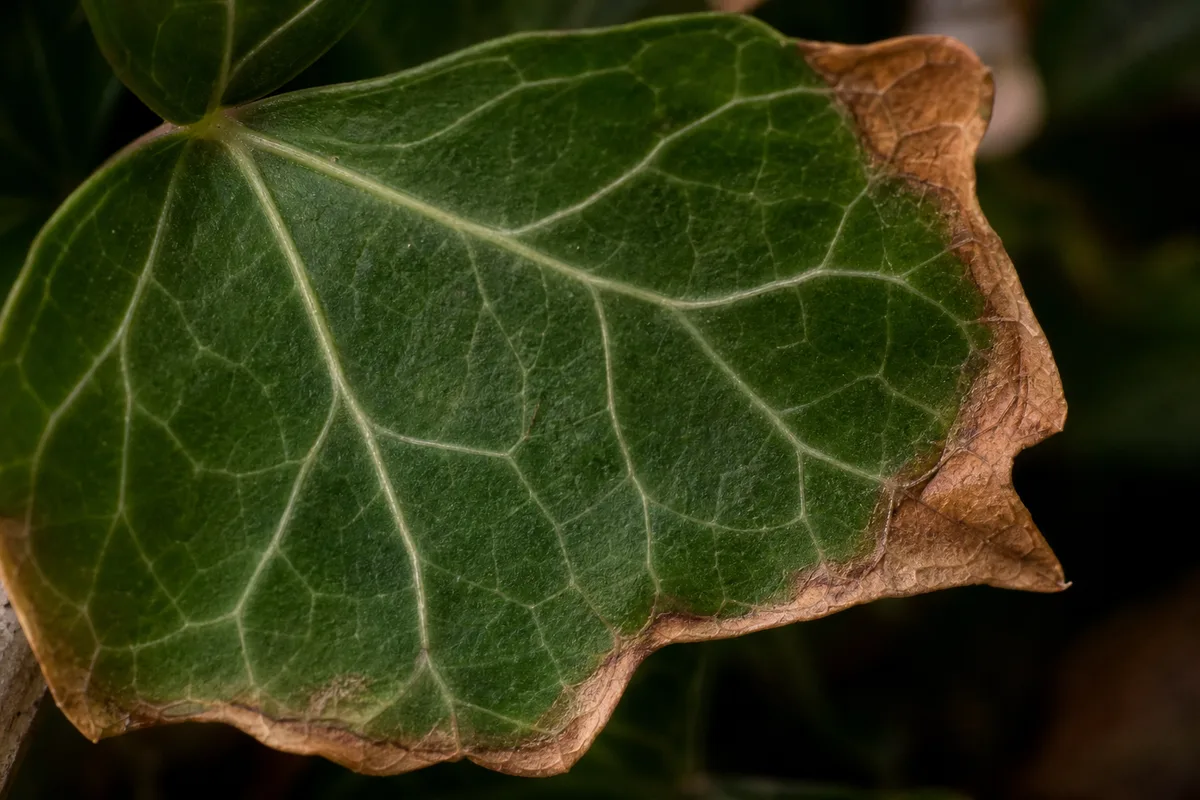
Low Humidity symptoms on English Ivy - compare with healthy tissue on the same plant.
The signature sign is dry, light brown, papery edges on lobed juvenile leaves, often starting at the farthest lobe tips and creeping inward slowly over weeks. Tip dieback on newer leaves is common when heated winter air strips moisture from thin leaf tissue. Affected areas feel crispy and thin, not soft or water-soaked. Trailing stems usually stay springy unless a second problem is also present.
Seasonal timing is a strong clue. Damage that accelerates after the furnace starts, or on baskets hung beside a south window with a heat register below, fits dry air more than a sudden root crisis. Multiple leaves browning at outer lobes simultaneously-while inner leaf tissue stays green-points to environmental moisture loss.
Variegated cultivars such as Glacier or Gold Child can show faded margins on stressed tissue before full necrosis. That fade is not always variegation loss from low light; pair it with an RH reading before you move the plant to a brighter window.
Brown edges and tips in dry winter air
Central heating replaces moist air with dry heated air. University of Minnesota Extension notes that humidity levels are low indoors during winter months, which hurts humidity-loving plants. Many homes that read near 40% RH in summer drop toward 20–30% once heat runs steadily. On Hedera helix, that gap shows up as crisp brown lobes within weeks even when your watering rhythm has not changed.
Placement compounds the problem. Ivy hung within three feet of a radiator, forced-air vent, or fireplace desiccates faster than ivy in a cool bright room away from heat paths. The damage is often one-sided on the foliage closest to the dry blast.
Spider mites as a secondary dry-air problem
Very dry winter air does not always produce mites the day humidity drops. On English ivy, mite outbreaks often follow a humidity crash by three to four weeks-stressed lobed leaves lose resilience, and NC State Extension lists twospotted spider mites among common problems on Hedera helix. Fine stippling on leaf undersides or delicate webbing at leaf bases means pests, not humidity alone-open the spider mites page and treat before you rely on humidity fixes only.
How to confirm low humidity is the cause
Work through these checks in order:
- Hygrometer beside the canopy - Place a digital hygrometer at trailing-vine height, not on the floor. Readings under 40% support low humidity; 40–60% suggests look elsewhere first.
- Heat-path scan - Note distance to radiators, floor registers, portable heaters, and fireplace mantels. Lobed leaves within three feet of a winter heat blast often crisp at margins first.
- Soil moisture fork - Press one inch into the mix. Normal dry-down with firm stems and edge-only browning fits dry air. Bone-dry throughout with a light pot and limp vines points to underwatering overlap-fix both if present.
- Damage pattern - Margin-first, slow, winter-linked browning on lobed leaves fits humidity. Uniform wilt on dry soil fits thirst. Stippling and webbing fit mites. Bleached sun-facing patches fit light stress.
- Salt crust check - White deposits on the soil surface or tip burn after feeding can mimic humidity browning. Flush the pot and review brown tips if fertilizer or hard tap water is recent.
- Leaf undersides - Fine pale dots or silk threads mean pests, not humidity-treat pests before running humidity fixes only.
Hygrometer check and seasonal context
A $10 digital hygrometer removes guesswork. Log readings morning and evening for three days after the furnace starts. If RH stays under 35% beside the basket while edges brown, humidity is confirmed as a primary stressor even if watering is correct.
Rule out underwatering, salt burn, and pests
| Pattern | What you see on H. helix | Stem / pot clues | RH clue |
|---|---|---|---|
| Low humidity (this page) | Dry papery lobe margins; tips crisp first; slow spread | Firm trailing stems; typical pot weight | Hygrometer under 40% near canopy |
| Underwatering | Crisp edges plus limp vines; dull gray-green leaves | Very light pot; dry mix deep down | RH may be normal; soil is dry |
| Salt / fluoride burn | Tip burn after feeding; crust on soil surface | Recent fertilizer or hard tap water | RH often adequate |
| Spider mites | Fine stippling on undersides; webbing at leaf bases | Warm dry microclimate | Low RH plus pest signs |
Low humidity is confirmed when RH is low at the canopy, stems are firm, soil moisture is appropriate, and damage is dry margin browning without stippling.
First fix for English Ivy
Run a humidifier near the trailing canopy until RH reaches 40–60%, and move the basket away from heat registers and radiators-as one placement-and-humidity correction.
Choose a cool-mist or evaporative humidifier sized for the room; point output so moisture drifts toward leaves without soaking them against a cold window overnight. Clemson Extension recommends raising humidity by setting plants on a tray of wet pebbles-use that as a supplement, not a substitute for a humidifier when a hygrometer stays under 40%.
Move the basket so no trailing stem sits in the direct path of a heat register or radiator. Even three to six feet of separation can stop active margin burn. English ivy dislikes sudden relocations across the house-slide the hanger within the same room when possible.
Do not increase watering because edges look dry. Soggy roots on stressed ivy trigger yellowing and mite-prone tissue faster than dry margins. Confirm soil dryness at the top inch before adding water.
Humidifier placement and runtime
For hanging trailing ivy, place the humidifier beside the canopy, not only on the floor-RH at vine height matters more than floor readings. Run it from first furnace use through late winter in dry climates, refilling daily on small units. Aim for 40–60% beside the leaves; sustained readings above 70% with poor airflow can invite fungal spotting on wet lobed foliage in dim corners.
Pebble trays and plant grouping
UMN Extension recommends clay pebbles and water in a saucer below the pot top so evaporation adds moisture around the plant. Elevate the pot above the water line-ivy roots rot if the basket base sits in standing water. Grouping plants slightly shares transpired moisture but rarely fixes a whole dry living room alone.
Misting: optional limits on lobed foliage
Light misting does not sustain 40–60% room RH for more than minutes-room humidifiers work better than misting for raising ambient moisture indoors. It can rinse dust from lobed leaves and briefly cool leaf surfaces in a hot room, but wet foliage in stagnant air invites spotting on sensitive cultivars. If you mist, do it morning only with airflow, and still run a humidifier through heating season.
Recovery timeline
Margin spread should slow within one to two weeks once RH rises and heat paths are removed. Existing brown tissue does not turn green-judge progress by new growth at vine tips with clean lobes, not by old damaged tissue.
Expect the first healthy new leaves within three to six weeks during spring or summer active growth if humidity, light, and cool temperatures align. Winter corrections may stall until longer days return-keep the humidifier running rather than moving the basket repeatedly.
Worsening signs: browning marching rapidly into leaf centers on multiple lobes while soil stays wet (rule out overwatering); stippling with webbing (mites-see spider mites); soft stems at the crown (root failure-not humidity alone).
What not to do
Do not soak the plant because edges look dry-confirm the top inch is dry before watering per the watering guide.
Do not mist heavily twice daily as a humidity strategy-brief surface moisture does not fix 25% room RH and can leave wet lobed leaves that spot in dim winter light.
Do not fertilize to “heal” brown edges-salts on stressed roots burn tips further. Wait until new growth looks normal for two weeks.
Do not stack English Ivy repotting guide, pruning, and pesticide on the same day you add a humidifier. Make one care correction at a time so you can read the plant’s response over the next week.
Do not park the basket so the pot base touches standing water in a pebble tray-root rot on English Ivy follows, and humidity was not the real problem.
How to prevent dry-air damage next winter
Target 40 to 60% RH year-round beside the trailing canopy-run a humidifier from first furnace use through late winter in dry climates. A hygrometer beside the vines removes guesswork.
Keep ivy away from heat registers, radiators, fireplaces, and AC vents when you choose a long-term hanger spot. Cool bright rooms in the 50 to 70 °F band outperform hot dry living rooms for dense trailing growth.
Group plants slightly to share transpired moisture, but maintain good air circulation-Clemson Extension notes ivies benefit from air circulation and should not be crowded.
Scout leaf undersides weekly in heating season; dry indoor air increases pest pressure on foliage, and spider mites often follow humidity crashes on ivy.
For complete species care-light, watering, cool-room biology, and toxicity-see the English ivy overview.
Conclusion
Low humidity on English ivy is a cool-climate vine in dry winter air: lobed margins crisp because transpiration outruns supply in heated rooms below 40% RH-not because the plant is mysteriously “unhappy.” Confirm with a hygrometer, raise RH to 40–60% with a humidifier, and pull the basket off the heat-register path-then wait for clean new lobes at vine tips as proof. Brown edges already necrotic will not re-green; stability and humidity beat repeated watering or relocation. Get the air right, and Hedera helix holds the trailing green curtain that makes this vine worth the cool-room commitment.
Related guides
- English ivy care overview - temperature, humidity, woodland biology, toxicity
- English ivy watering - dry-down rhythm vs. dry-air margin browning
- Brown tips on English Ivy - salt, water quality, and overlapping margin damage
- Spider mites on English Ivy - dry warm air pest outbreaks
- Underwatering on English Ivy - light pot and limp vines vs. edge crisping
When to use this page vs other English Ivy guides
- English Ivy watering guide - Use for routine moisture checks before assuming low humidity is the main issue.
- English Ivy problems hub - Browse all 16 common issues on this species.
- Brown Tips on English Ivy - Different entry point when symptoms overlap with low humidity.