Leggy Growth on English Ivy: Causes, Checks & Fixes
Quick answer
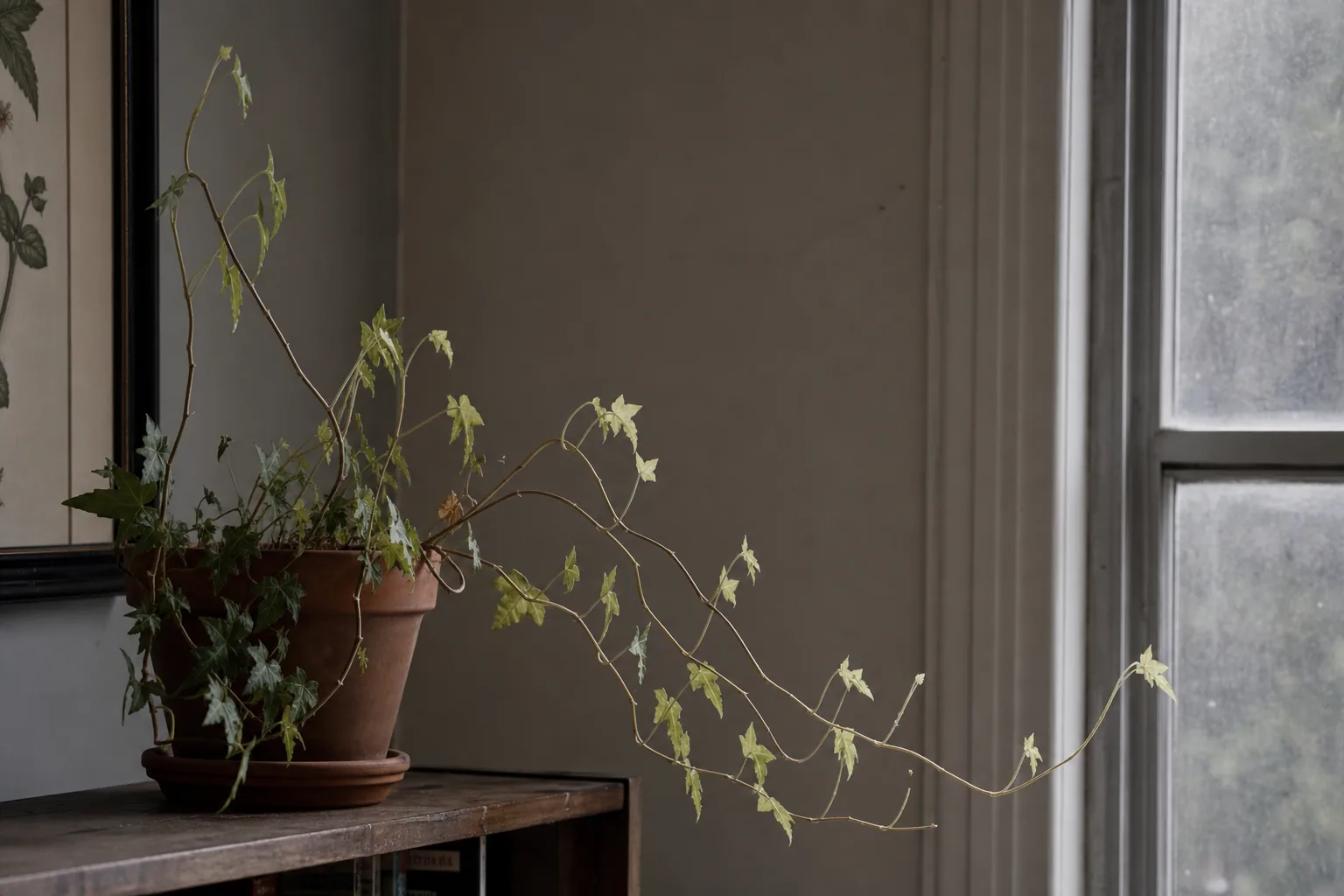
Leggy English ivy is etiolation-long bare runners with lobed leaves only at the tips as vines stretch toward light. First step: move the pot to bright indirect light and rotate it weekly. Old stretched internodes never shorten; pinch bare stems only after new growth looks compact and firm.
Leggy Growth on English Ivy: Causes, Checks & Fixes
This guide covers leggy growth on English Ivy. See also the general Leggy Growth guide, watering, and light pages for this plant.
Leggy Growth on English Ivy: Causes, Checks & Fixes
Quick answer
Leggy growth on English ivy (Hedera helix) is etiolation-the vine elongates internodes and produces long bare runners toward usable light because photosynthesis at the leaf surface is too weak to support compact trailing architecture indoors. Outdoors, juvenile ivy tolerates shade at forest edges; indoors, the same species in a dim corner stretches rather than fills out, producing a thin curtain instead of a dense cascade.
First step: move the pot to bright indirect light-near an east window, a bright north exposure in summer, or set back from south or west glass where harsh midday sun will not scorch the lobes. Rotate the pot a quarter turn each week. Do not repot, fertilize, or mass-prune on day one; light is the primary fix. Old stretched sections never shorten-judge recovery on new vine tips only.
This page focuses on stretch, bare runners, and pinching timing-what etiolation looks like on trailing Hedera helix, how to confirm it, and when to cut back length. For the broader low-light picture including pale stalled foliage, slow dry-down, and wet-soil root-stress patterns, see not enough light on English Ivy. For window placement and grow-light distance, see the English Ivy light guide.
What leggy growth looks like on English ivy
Leggy growth on Hedera helix shows up as form problems on flexible trailing stems, not soft wilt from drought. Each lobed leaf sits on a thin vine; when energy is scarce, internodes stretch and the plant leans toward the brightest direction.
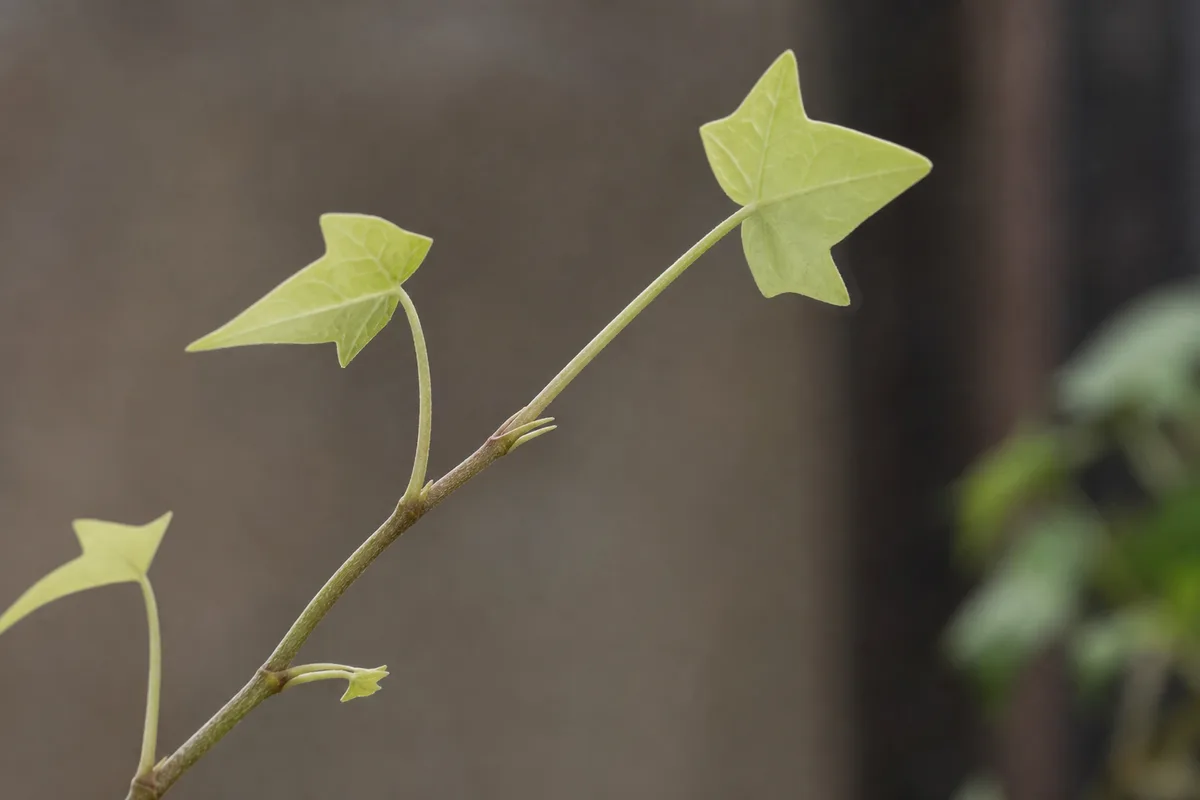
Leggy Growth symptoms on English Ivy - compare with healthy tissue on the same plant.
On hanging baskets and high shelves, the crown near the window rim may look acceptable while lower cascading vines sit in shadow, dropping leaves and leaving long naked stems. On windowsill pots, the whole plant leans toward glass with wide spacing between lobes on new growth compared to when you bought it.
Typical leggy patterns:
- Long bare runners with leafy tips only-the classic sparse trailer
- Wide internode gaps on new vines; low light causes elongated spacing between leaves as stems search for photons
- Smaller, thinner new lobes than older foliage lower on the stem
- Hard lean toward one window when the basket is never rotated
- Variegation fade on cultivars like ‘Glacier’ or ‘Gold Child’-Clemson Extension notes variegated ivies may turn all green in low to medium light while growth slows
- Upper-bright, lower-bare display on hangers where only the top of the pot receives adequate brightness
Leggy ivy is usually still green and alive-unlike drought wilt, which softens tissue uniformly before recovery after watering.
What leggy growth usually is not: crisp brown patches after a sudden move to hot south glass (sun scorch-see the light guide); widespread yellowing with sour wet soil (overwatering or root stress in dim corners); or fine stippling and webbing on undersides (spider mites in dry heat).
Why English ivy gets leggy
English ivy evolved as a forest-edge climber across Europe and western Asia. Juvenile stems tolerate lower light than sun-hungry tropical foliage, but tolerance is not preference. In weak indoor light, the plant elongates internodes to place leaves closer to the window.
Insufficient or uneven light on trailing form
Indoor light intensity drops sharply with distance from glass. A trailing habit makes this worse: upright plants receive even light at the crown; ivy on a high shelf gets a bright top and shadowed bottom cascade. The growing tip at the end of a long drop may sit in room-level dimness even when the pot rim catches window brightness.
Variegated cultivars need more photons
Pale sectors on variegated leaves contain less chlorophyll. RHS ivy guidance links variegation loss to insufficient light-the plant reverts toward green tissue that captures energy more efficiently when photons are scarce. Variegated leggy ivy often shows solid green new growth alongside stretch before pale color becomes the main complaint.
Seasonal daylight decline
Stretch that worsens after October often traces to shorter days, not a sudden care mistake. The pot stayed in the same corner while the photon budget dropped. North windows and interior rooms need grow-light supplementation through winter or a seasonal move closer to glass.
Low light paired with slow dry-down
In shade, ivy uses water slowly. The same watering rhythm from a bright summer window leaves mix wet for weeks in a dim corner-pairing stretch with overwatering misdiagnosis. That compound pattern belongs on the not-enough-light page; this page treats active reaching and bare runners as the primary signal.
Leggy growth vs. related problems
| Pattern | Likely cause | First check |
|---|---|---|
| Long bare runners, wide gaps on new tips, window lean, green leaves | Leggy etiolation (low light) | Shadow test at crown; two-week light move |
| Same stretch plus pale dull foliage, stalled growth, wet soil for weeks | Chronic not-enough-light | Not enough light + watering guide |
| Few new leaves but normal internode spacing on old vines | Slow growth in marginal light | Slow growth vs. active stretch |
| Yellow leaves, sour wet soil, soft stems in a dim corner | Root stress + weak light | Fix light and dry-down before pruning |
| Crispy brown edges in hot dry air above a radiator | Heat and humidity stress | Move off heat source; not internode elongation |
Leggy growth and not enough light overlap heavily on English ivy-etiolation is often the visible signature of chronic under-lighting. This page goes deeper on internode stretch, hanging-basket shadow patterns, pinching timing, and the rule that old bare sections never shorten; the sibling page covers the full low-light picture including pale color, stalled flushes, and wet-soil mistakes.
How to confirm the cause
Work through these checks before heavy pruning or repotting:
- Shadow test at foliage level - Bright indirect light casts a distinctive shadow without sun rays hitting leaves directly. Faint blur at the crown means expect leggy growth.
- Internode comparison - Measure spacing on the newest six inches of vine vs. older sections from a brighter season. Widening gaps on fresh growth confirm recent stretch; uniform bare lower stem on very old trailers alone may be aging.
- Trailing display pattern - Leafy tips on long bare runners, especially on elevated hangers, point to uneven light-not random senescence.
- Variegation check - Loss of crisp white or gold margins on newest leaves supports light diagnosis over nutrient mystery.
- Two-week placement trial - Move to brighter indirect light without changing water, fertilizer, or pot size. If the next vine tips show tighter lobe spacing, light was limiting growth.
- Soil dry-down - Top inch damp for two weeks while vines stretch means reduce water after improving light.
- Pest scan - Spider mites on stressed ivy in dry heat cause stippling separate from stretch; confirm light first.
If light is clearly inadequate and no urgent root-rot signs appear, you have enough to move the plant. You do not need to repot to confirm etiolation.
First fix for English ivy
Move the pot to the brightest location that avoids harsh direct sun on the lobes. Clemson Extension recommends bright light without direct sun, near north, east, or west windows for most ivy cultivars.
Practical placements:
- East windowsill or floor beside it-morning sun through east glass is excellent bright indirect
- Bright north window in summer when outdoor brightness boosts north exposure-for green ivy; variegated forms often need more from autumn through spring
- Two to four feet back from filtered south or west glass-acclimate gradually if jumping from deep shade
- Full-spectrum LED 12 to 18 inches above the crown for north rooms or winter-see grow-light guidance below
Rotate weekly so all sides of the trailing mass receive light. Lower the hanger or shorten the cascade if the growing tip sits in shadow below the window rim.
Hold everything else steady while you test the move:
- Do not repot on the same day.
- Do not apply fertilizer to a stretched plant.
- Do not prune all bare runners hoping for compact regrowth in the same dim spot.
- Do not increase watering because vines look limp-check soil first.
If the best window still fails the shadow test, add supplemental lighting before assuming the plant is permanently weak.
Grow lights for north rooms and winter
When architecture or season limits natural sun, a full-spectrum LED replaces missing photons. English ivy sits in the medium-light range for indoor plants-roughly 15 to 20 watts of efficient LED draw per square foot of canopy, or a 15 to 25 watt clip-on or bar fixture for a single hanging basket.
Practical setup:
- Position the fixture 12 to 18 inches (30–45 cm) above the foliage crown, not the floor
- Run it 10 to 12 hours daily on a timer through October to March
- If new tips still reach toward the bulb after two weeks, move the light closer or add window light-stretch toward a single source means intensity is still low at the leaf surface
- Prefer fixtures that list PPF or foot-candles over wattage alone; watts measure energy use, not light delivered to leaves
Details on exposure by window direction sit in the English Ivy light guide.
When to pinch and prune bare runners
Pinching is a second step, not the first fix for legginess.
- Do not strip all long green runners immediately-they still photosynthesize, even weakly.
- Do remove fully yellow or dead leaves anytime.
- Wait two to four weeks after a meaningful light move and inspect new vine tips for tighter lobe spacing before cutting length.
- Pinch soft growing tips with clean fingers or scissors just above a leaf node once compact new growth confirms the diagnosis-this redirects auxin and encourages side shoots from lower nodes per the pruning guide.
- Cut bare runners back to a healthy node near the crown for appearance after fresh growth looks firm; never slice midway along a naked internode, which leaves a brown stub.
- Limit each session to one-third of living foliage; stagger heavy rejuvenation over several weeks.
- Never prune heavily in the same week as a large light jump or repot-stacking stress slows recovery.
The goal is compact new trailing architecture, not forcing the plant to releaf from stored reserves in unchanged dim conditions. Pinching fixes shape temporarily; etiolation returns within a flush if light stays weak.
Pinching vs. hard cutback
Pinching removes only the soft apical bud at a vine tip-best for maintaining density on vines that already receive adequate light. Hard cutback shortens long bare sections to nodes near the soil line-best after light improves and you want to reset a sparse hanger. NC State notes regular trimming above nodes maintains shape and prevents legginess on Hedera helix when underlying care is sound.
Step-by-step recovery
After the light move:
- Wait two to four weeks and inspect new vine tips for tighter lobe spacing and richer color.
- Adjust watering to the new dry-down speed-brighter spots need water more often; do not keep a dim-corner schedule per the watering guide.
- Pinch or prune bare runners once compact new growth confirms the fix-cut back to a healthy node or side shoot.
- Avoid heavy shearing before light improves-cutting without photons produces weak regrowth.
- Supplement variegated cultivars with slightly brighter placement than solid-green ‘Baltica’ in the same room.
- Treat mites if stippling appears on undersides after stress.
Make one major change at a time so the next flush of growth tells you whether placement was enough.
Recovery timeline
New vine tips often show tighter internodes within two to four weeks after a meaningful light increase in cool bright conditions. Old stretched sections never shorten-plan to trim bare runners for aesthetics once fresh growth looks healthy.
Winter recovery may take longer unless you add supplemental lighting. Variegation on old leaves may not return; new lobes carry the color signal.
Worsening signs after a light increase: Brown scorched patches mean too much direct sun too fast-pull back from hot glass and acclimate over 7 to 14 days. Yellowing with wet soil means reduce water even though light improved.
Lookalike symptoms to rule out
- Normal lower-leaf drop on old trailers - Some bare lower stem on very long vines is aging, but widening gaps on new tips mean light stress.
- Overwatering in dim light - Yellow leaves, sour soil, soft stems; fix water and light together per not enough light.
- Root-bound slowdown - Whole plant static with circling roots at drainage holes; see repotting.
- Slow growth without stretch - Few new leaves but normal internode spacing; see slow growth.
- Heat stress above radiators - Crisp brown edges in hot dry air, not internode elongation.
Mistakes to avoid
Do not fertilize to compensate for low light-nitrogen cannot replace photons. Do not prune heavily before placement improves; weak regrowth in shade stays leggy.
Do not assume ivy prefers darkness because it survives dim corners-survival produces bare runners, not lush trails. Do not move straight to hot south glass from a dark shelf without acclimation; variegated lobes scorch easily.
Do not ignore the crown on hanging baskets-if only the pot rim sees light, lower vines will stay bare no matter how much you water. Do not confuse this page with not-enough-light and skip the light move because foliage still looks green-stretch is etiolation even when color has not faded yet.
English ivy care cross-check
Dense trailing ivy needs bright indirect light, cool stable temperatures roughly 50 to 70°F (10 to 21°C), and water when the top inch dries. Review light for window specifics and watering for dry-down rhythm after you move the pot.
A vine that looked full at the nursery under greenhouse brightness will go leggy within months on a dim interior shelf unless you match photons to Hedera helix juvenile growth habit.
How to prevent leggy growth next time
Install new ivy where the foliage crown casts a clear shadow daily. Rotate hangers and shelves weekly. Move variegated pots one step brighter than green forms. Add winter grow lights before stretch appears in November-not after bare runners dominate the display.
Pinch growing tips lightly after active flushes to encourage side shoots on compact vines. Train on a wire frame if you want vertical fill instead of a long bare cascade. Catch elongation on the second long internode, not the fifth.
When to worry
Escalate if yellow leaves pile up while soil stays wet in the same dim spot-root stress may follow stretch. That urgent compound pattern is covered in depth on not enough light. Mite webbing on pale stressed vines needs treatment alongside light correction.
Pure stretch with firm green tissue at the tips is low urgency but worsens cosmetically every month you delay a light move. Variegated cultivars that revert entirely to green on new growth need brighter placement within weeks.
Conclusion
Leggy English ivy is almost always stretch for light on trailing stems, not a disease. Move to bright indirect placement, rotate weekly, adjust watering to the new spot, and pinch bare runners only after new growth compacts. Old internodes never shorten-judge success on fresh vine tips. For pale sparse foliage and wet-soil patterns in deep shade, cross-check not enough light; for cut placement and rejuvenation timing, see pruning.
Related English Ivy guides
- Not enough light - full low-light diagnosis including pale color, stalled growth, and wet-soil root-stress patterns
- Light guide - window placement, shadow test, variegated cultivar rules
- Pruning - node cuts, pinching, and one-third rule after light improves
- Watering - dry-down rhythm after you increase light
- Overview - species context and placement basics