Wilting on Calathea Peacock Plant: Causes, Checks & Fixes
Quick answer
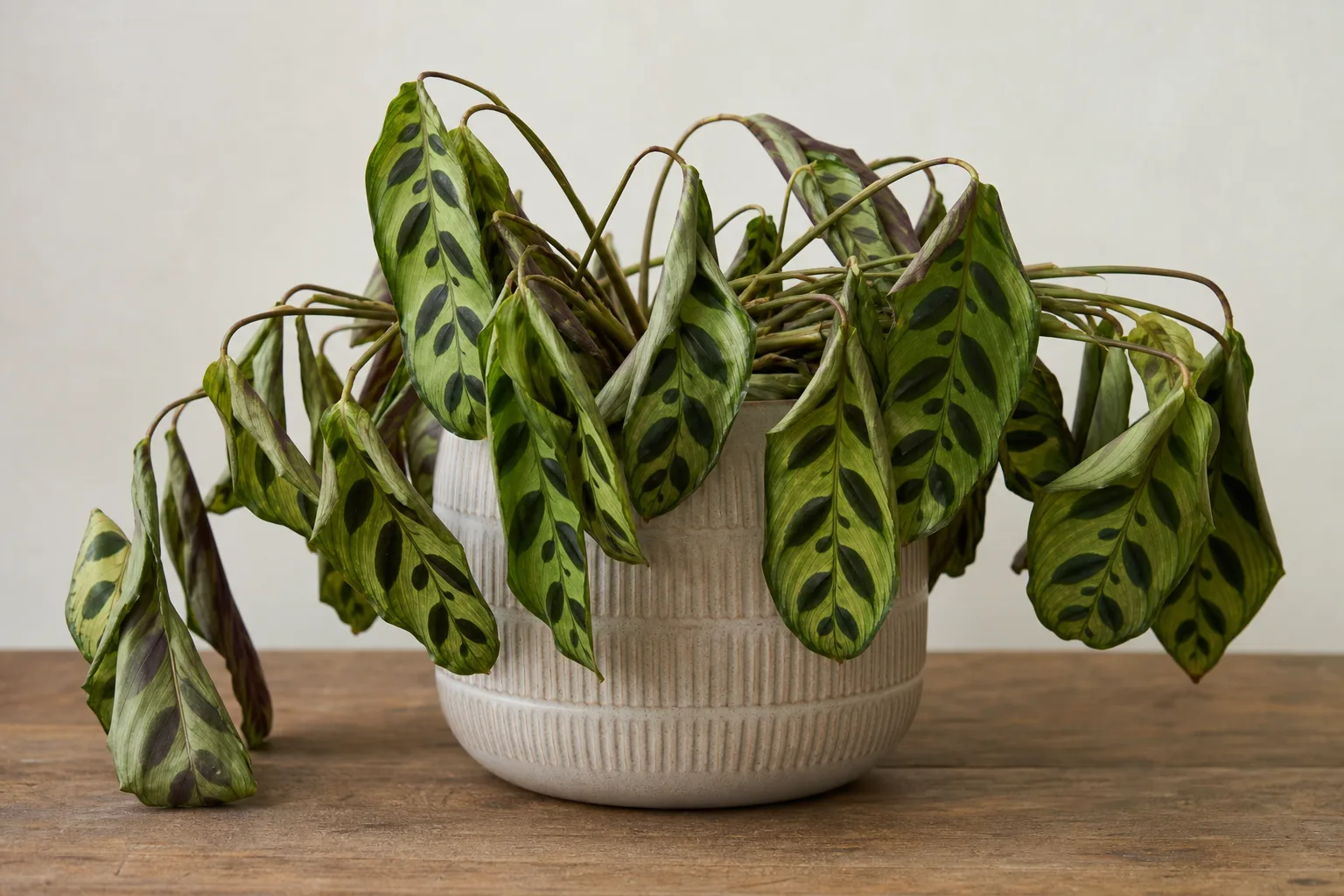
Wilting on Calathea makoyana means sudden loss of leaf firmness-stems go limp and blades feel thin. Check soil moisture first: wet heavy mix means pause watering and inspect roots; dry top 1–2 inches means a thorough soak. Evening leaf folding alone is normal nyctinasty, not wilt.
Wilting on Calathea Peacock Plant: Causes, Checks & Fixes
This guide covers wilting on Calathea Peacock Plant. See also the general Wilting guide, watering, and light pages for this plant.
Wilting on Calathea Peacock Plant: Causes, Checks & Fixes
Quick answer
Wilting on Calathea peacock - botanically Goeppertia makoyana, though sold as Calathea makoyana - is acute turgor collapse: leaf blades and stems lose firmness quickly, feel thin or papery, and the clump may look collapsed rather than merely arching. This differs from the slower drooping posture covered in our drooping leaves guide and from normal evening leaf folding (nyctinasty), which reverses by morning on healthy plants.
First step: stick your finger into the top 1–2 inches of mix and lift the pot. Wet and heavy → stop watering and read the wet-soil branch below. Dry and crumbly with a light pot → water thoroughly until drainage runs, then empty the saucer. Do not water on reflex when soil is already saturated-that is the most common mistake on finicky Marantaceae prayer plants.
What wilting looks like on Calathea peacock (vs. normal evening droop)
On makoyana, wilt shows up on thin, patterned leaves with high surface area-turgor drops faster here than on thick-leaved houseplants like Aglaonema.
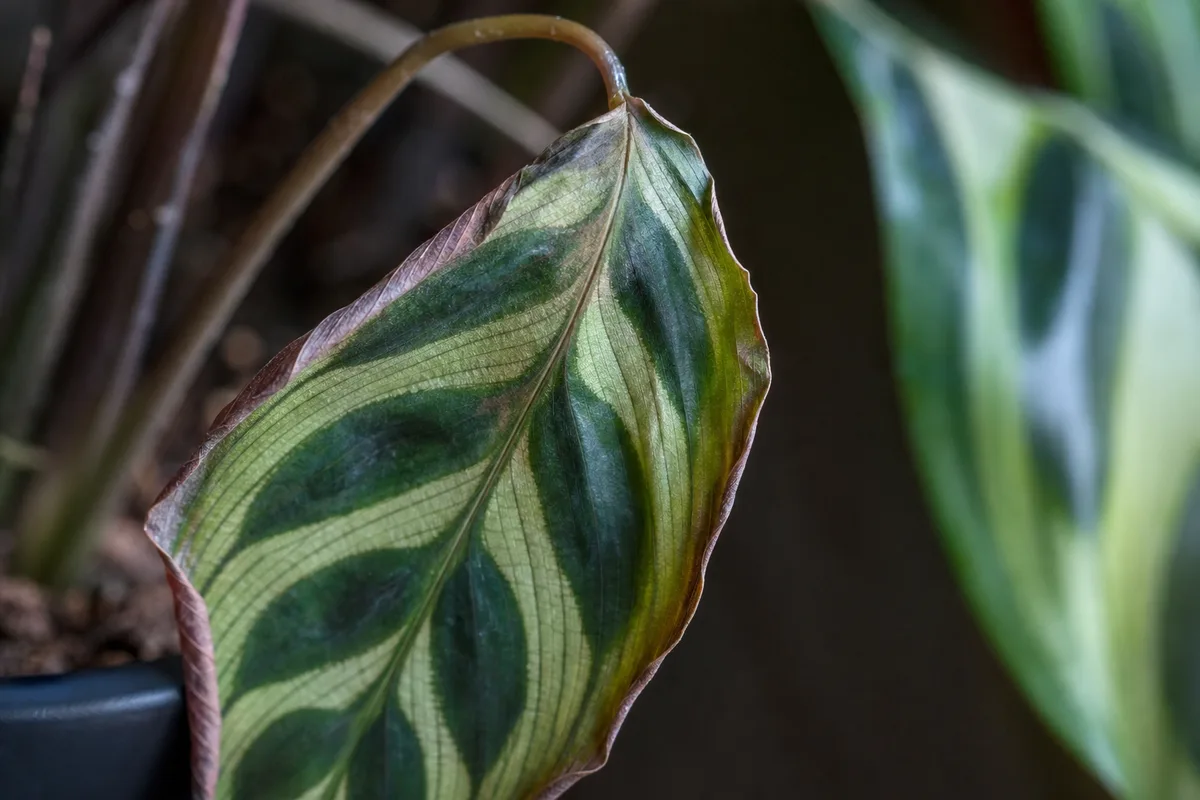
Wilting symptoms on Calathea Peacock Plant - compare with healthy tissue on the same plant.
Crisis wilt (pathological):
- Stems and petioles feel soft or limp, not just angled downward
- Leaves lose thickness; blades may curl tightly or hang straight down through midday
- Whole clump collapses over hours to a few days, not only outer leaves
- Pattern may look washed out as cells dehydrate
Normal nyctinasty (not wilt):
- Leaves fold or rise in late afternoon or evening and flatten again by late morning
- Stems stay firm; tissue feels flexible, not papery
- Soil follows the usual partial dry-down cycle-neither bone dry for a week nor wet for many days
How wilt differs from drooping leaves: Drooping is often a chronic arch-blades hang below their normal horizontal line while stems stay relatively firm. Wilting is sharper turgor loss; stems go weak and leaves feel deflated. Severe droop can progress to wilt if the stressor continues. For arching-only cases, start with drooping leaves on Calathea peacock.
Why Calathea peacock wilts
Goeppertia makoyana evolved in humid Brazilian understory shade with fine, shallow feeder roots and thin foliage. Indoor stress hits that biology hard:
Overwatering and root oxygen loss - Saturated mix suffocates fine roots. Leaves wilt from failed uptake while soil stays wet-the dangerous “wet wilt” that tricks owners into adding more water. Roots in waterlogged soil lose function. See overwatering on Calathea peacock for full wet-soil signs.
Underwatering - When the root zone dries too far, cells lose pressure and the whole clump collapses. Dry top 1–2 inches, light pot, and inward leaf curl point here. Details: underwatering.
Low humidity - Below 60% RH recommended by NC State, transpiration outpaces root delivery. Leaves wilt with adequate soil moisture and crisp brown edges may appear. Read low humidity.
Heat, drafts, and temperature swings - Hot direct sun, radiator blasts, or cold window glass shock root function. Makoyana is intolerant of cold drafts and inconsistent temperatures.
Pests - Spider mites in dry air drain leaf tissue, producing stippling plus sudden limpness. Check spider mites if webbing appears.
Root rot escalation - Wet soil plus soft crown tissue means advancing decay. Route to root rot if mix smells sour or roots are mushy.
Wet soil vs. dry soil - decide in 60 seconds
This fork solves most wilt emergencies on peacock plant:
| Your check | What it means | First move |
|---|---|---|
| Top 1–2 in. dry, pot light, margins curled inward | Underwatering wilt | Thorough soak until drainage runs; empty saucer |
| Mix wet/heavy many days, yellow lower leaves, limp blades | Wet wilt / root stress | Stop watering until top inch dries; check drainage |
| Moist soil, limp leaves, RH below 50% at canopy | Low-humidity wilt | Humidifier to ~60% RH at leaf height |
| Evening fold only, firm stems, normal by morning | Nyctinasty | No fix needed-monitor soil rhythm |
| Soft crown, sour smell, black mushy roots | Root rot | Inspect roots; see root-rot guide |
Critical rule: Never pour water on a wilted Calathea when soil is already wet and heavy. That deepens oxygen loss and accelerates rot.
How to confirm the cause
Work through these checks in order:
- Time-of-day photo - Snap the plant at 9 a.m. and 9 p.m. for two days. Night fold with morning recovery is nyctinasty, not wilt.
- Soil moisture at depth - Finger to the second knuckle. Pair feel with pot weight-light when dry, heavy when saturated.
- Leaf texture - Papery, thin blades support drought or failed root uptake. Soft yellow lower leaves with wet mix support overwatering.
- Humidity at canopy - Hygrometer 15–30 cm above the pot. Limp foliage with moist soil and RH under 50% implicates dry air.
- Drainage and smell - Lift the inner pot. Sour odor near holes suggests rot stress.
- Newest spear - A firm rolled leaf that stalls may combine humidity and water issues. Mushy crown is urgent.
- Undersides - Tap marked leaves over white paper for mites.
If signals conflict-wet soil but crisp edges-address drainage first, then humidity, then reassess before the next watering. Our watering guide explains the top-inch dry-down rhythm that protects fine roots.
First fix for Calathea peacock
Match one confirmed cause-do not stack repot, fertilizer, and heavy pruning the same day.
- Dry top 1–2 inches and light pot → Water thoroughly until excess drains, empty the saucer, recheck in four to six hours. Follow the watering guide going forward.
- Wet heavy soil with limp leaves → Stop watering until the top inch dries. Move to brighter indirect light if the spot is dim-evaporation slows in shade. If wilt persists after the surface dries, inspect roots per root rot guidance.
- Moist soil, limp leaves, RH below 50% → Run a humidifier near the canopy until RH reaches roughly 60%. See low humidity.
- Confirmed mites → Rinse undersides and isolate; treat pests after stabilizing moisture and humidity.
One variable at a time lets you read the plant’s response over seven to ten days.
Recovery timeline
Simple underwatering - Leaves often re-firm within four to twelve hours after a full, drained watering if roots are intact.
Early overwatering - Pause watering; foliage may stabilize in three to seven days as soil oxygen returns. Yellow lower leaves may not green up again.
Low humidity - Next spear opens more upright within one to two weeks once RH stays consistently above 55–60%. Older limp blades may stay slightly soft.
Root rot or crown damage - Recovery takes weeks to months depending on healthy root tissue remaining. Judge by new upright spears, not old damaged blades.
Heat or draft shock - Often improves within one to three days once the plant returns to stable 65–75°F (18–24°C) and away from air streams.
Damaged leaf tissue rarely returns to perfect firmness. Success means stopped spread, firm stems, and normal nightly folding returning on healthy tissue.
What not to do
Do not water a wilted peacock plant when soil is already wet and heavy.
Do not assume evening droop is wilt-check whether leaves reopen by mid-morning.
Do not mist instead of fixing root-zone moisture or room-level humidity-brief leaf wetting does not replace either.
Do not fertilize a collapsed Calathea before confirming moisture, humidity, and root health.
Do not repot on day one unless roots are clearly mushy and smell sour-transplant shock adds stress.
Do not use cold tap water on a stressed plant; room-temperature filtered or rainwater reduces fluoride stress on this species.
Do not stack saucer water, pebble-tray submersion, and daily top-ups-that mimics overwatering.
How to prevent wilting next time
Align daily care with makoyana biology:
- Water - Let the top 1–2 inches begin to dry, then soak fully and drain per the watering guide.
- Humidity - Maintain at least 60% RH near the canopy through dry seasons.
- Light - Bright indirect light per the light guide; avoid hot direct sun that spikes transpiration.
- Temperature - Keep away from AC blasts, radiator ledges, and cold window glass in winter.
- Inspection - Weekly checks on soil weight, newest spears, and hygrometer readings catch wilt before whole-clump collapse.
When wilting is urgent
Escalate when stems soften at the soil line, mix smells sour with persistent collapse, new spears wilt before opening, or mites coat multiple leaves. Those patterns need root inspection, pest treatment, or both-not another watering guess.
Low urgency: evening fold on firm tissue with clean new growth and stable soil cycles-that is healthy prayer-plant behavior, not pathology.
Conclusion
Wilting on Calathea peacock is an acute turgor crisis-not normal nightly nyctinasty and not the same as slow arching droop. Check soil moisture and pot weight first: wet means pause and protect roots; dry means a full soak. Layer humidity, temperature, and pest checks when soil alone does not explain the collapse. Fix one confirmed cause, watch new spears for recovery, and keep watering aligned with the partial dry-down rhythm that fine Marantaceae roots require.
Related Calathea peacock problems
- Overwatering - wet-soil wilt and yellow lower leaves
- Underwatering - collapse with dry, light pots
- Drooping leaves - chronic arch vs. acute wilt
- Low humidity - limp foliage with crisp margins in dry air
- Root rot - crown softening and sour wet mix
- Calathea peacock overview - makoyana biology and baseline care
When to use this page vs other Calathea Peacock Plant guides
- Calathea Peacock Plant watering guide - Use for routine moisture checks before assuming wilting is the main issue.
- Calathea Peacock Plant problems hub - Browse all 16 common issues on this species.
- Underwatering on Calathea Peacock Plant - Different entry point when symptoms overlap with wilting.
- Overwatering on Calathea Peacock Plant - Different entry point when symptoms overlap with wilting.
- Root Rot on Calathea Peacock Plant - Different entry point when symptoms overlap with wilting.
Related Calathea Peacock Plant guides
- Calathea Peacock Plant overview
- Calathea Peacock Plant watering
- Calathea Peacock Plant light
- Calathea Peacock Plant soil
- Underwatering on Calathea Peacock Plant
- Overwatering on Calathea Peacock Plant
- Root Rot on Calathea Peacock Plant
- Drooping Leaves on Calathea Peacock Plant
- Yellow Leaves on Calathea Peacock Plant
- Calathea Peacock Plant problems