Leggy Growth on Calathea Peacock: Causes, Checks & Fixes
Quick answer
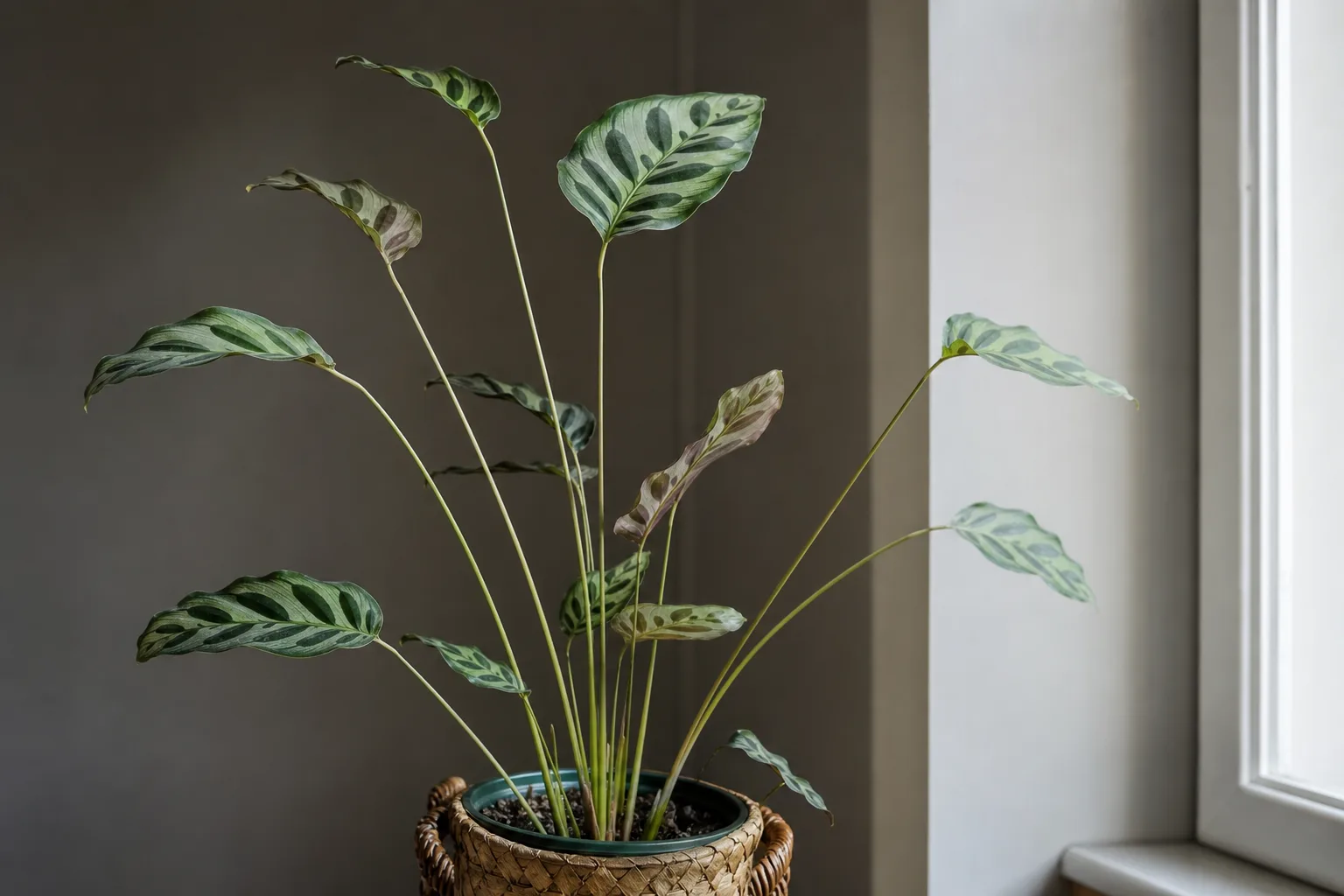
Leggy Calathea peacock growth is etiolation-long thin maroon petioles reaching toward the brightest window with a sparse, one-sided crown. First step: move the pot today to the brightest filtered indirect spot you have, or add a full-spectrum grow light 12–18 inches above the foliage.
Leggy Growth on Calathea Peacock: Causes, Checks & Fixes
This guide covers leggy growth on Calathea Peacock Plant. See also the general Leggy Growth guide, watering, and light pages for this plant.
Leggy Growth on Calathea Peacock: Causes, Checks & Fixes
Quick answer
Leggy growth on Calathea peacock (Calathea makoyana, also sold as Goeppertia makoyana) is etiolation-the plant stretching toward insufficient light by producing long thin petioles, smaller pale new blades, and a sparse crown that leans toward the brightest direction.
First step: move the pot today to the brightest filtered indirect location you have-within about 1–2 meters of an east-facing window, a bright north exposure, or several feet back from a south- or west-facing pane behind a sheer curtain. If no window spot passes a soft hand-shadow test, add a full-spectrum LED grow light 12–18 inches above the crown for 10–12 hours daily.
Do not fertilize, repot, or increase watering to fix stretch. On this cultivar, dim light and soggy soil often arrive together because photosynthesis slows and the plant drinks less. Fix placement first.
This page covers advanced stretch-obvious long maroon petioles and a sparse reaching crown. If your main symptom is faded feather pattern on new leaves without much stem length yet, start with not enough light on Calathea peacock for earlier-stage diagnosis.
What leggy growth looks like on Calathea peacock
Peacock plant is grown for papery, erect leaves with cream-and-green feather patterning and purple undersides. When light has been too low long enough for etiolation, the architecture of the clump changes-not just leaf color.
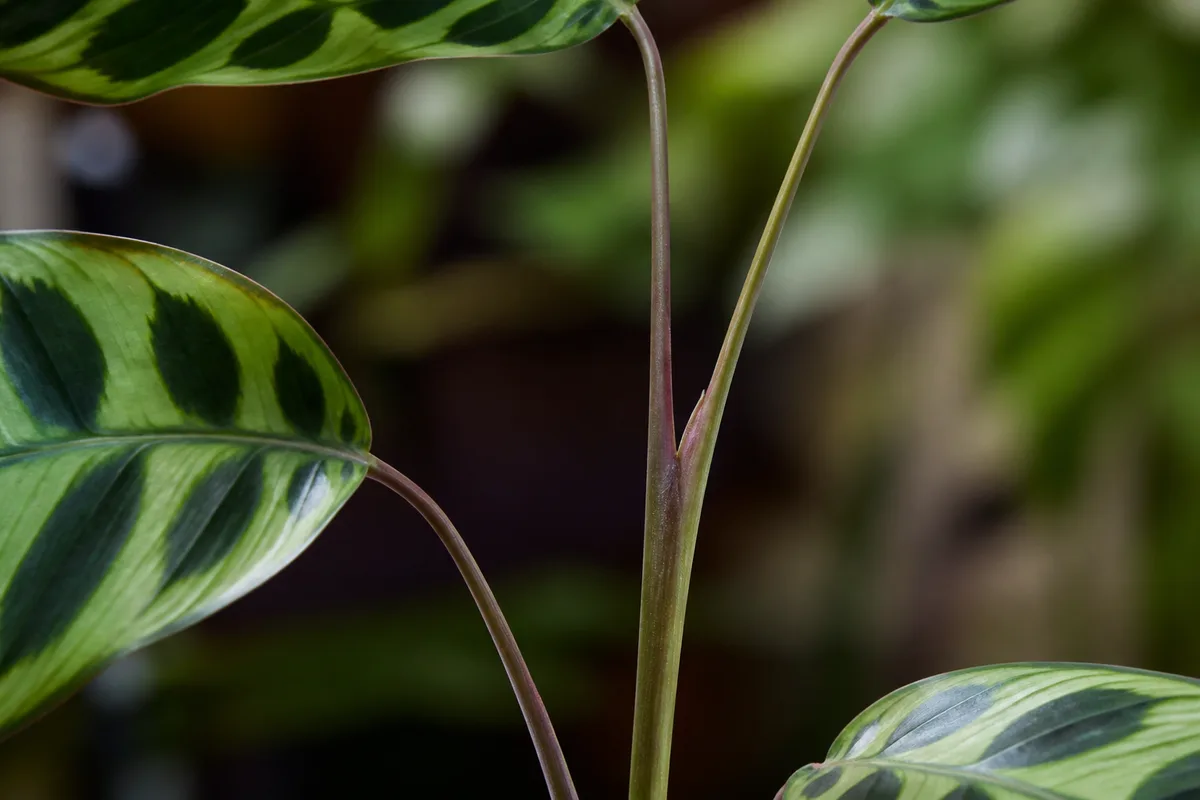
Leggy Growth symptoms on Calathea Peacock Plant - compare with healthy tissue on the same plant.
Typical leggy signs include:
- Long, thin maroon petioles - leaf stems visibly longer than earlier growth, often 15 cm or more on mature clumps, reaching toward glass
- Sparse crown - fewer leaves per vertical inch; gaps open between petiole bases
- One-sided lean - the whole clump tilts or opens only toward the window; indoor plants stretch and lean when light reaches them from one direction
- Smaller, paler new blades - each unfurling leaf shorter or narrower than the previous one, with weak cream-and-green contrast
- Reduced nightly folding - prayer-plant movement may look sluggish when the crown is chronically starved for photons
- Soil that stays wet - top 2 cm damp far longer than your normal rhythm because growth slowed
Normal lookalike: One or two older outer leaves on long petioles while the center keeps producing compact new rolls is often natural aging. Leggy etiolation is the pattern when every new leaf for several weeks opens on a longer, thinner stem than the last.
Why Calathea peacock gets leggy
In the wild, peacock plant grows on the tropical rainforest floor of southeastern Brazil, under filtered canopy light. It evolved for steady bright indirect exposure-not a hallway shelf more than 2–3 meters from any window.
NC State Extension notes that Goeppertia makoyana prefers bright, indirect sun or partial shade and that inadequate light makes foliage color fade. When foot-candles drop below what the crown needs, the plant allocates growth toward length-elongating petioles to place leaf blades closer to the photon source-rather than building dense patterned tissue.
Common home triggers:
- Interior placement - more than 2–3 meters from window glass, or blocked by furniture and tinted panes
- Winter daylight drop - same shelf becomes weaker October through February even if you never moved the pot
- One-sided placement - half the clump faces a wall year-round; only the window side receives usable light
- Failure to rotate - persistent lean compounds into a permanently lopsided crown
- Overcrowded shelf - neighboring plants shade lower leaves and block even diffuse light
- Dusty foliage - dust on leaves slows photosynthesis, effectively lowering available light at the leaf surface
Direct sun is not the fix. Direct sunlight can cause leaf burn on Calathea Peacock Plant overview. Moving a leggy plant suddenly onto an unfiltered south sill trades etiolation for bleached pattern and crispy edges.
Leggy growth vs. slow growth vs. not enough light
These three Calathea peacock problem pages overlap because all can involve low light-but they describe different stages and reader questions.
| What you see | Most likely issue | Where to read next |
|---|---|---|
| Faded pattern on new leaves; petioles still fairly short | Early low light | Not enough light |
| Long maroon petioles, sparse crown, obvious lean | Advanced etiolation (this page) | Stay here; fix light first |
| Few or no new rolls for weeks; little stem stretch | Slow growth (light, roots, season, or care rhythm) | Slow growth |
| Yellow lower leaves with wet heavy soil | Overwatering in slow growth | Overwatering |
| Crispy brown edges; pattern still bold on older leaves | Humidity or tap-water salts | Brown tips |
Leggy growth usually follows untreated low light. If pattern fade was the first warning and you did not move the pot, stretch is the next chapter-not a separate disease.
How to confirm the cause
Work through these checks before changing fertilizer, humidity gear, or soil:
- Petiole length trend - Compare the last three new leaves. Each on a longer, thinner maroon stem than the last strongly confirms etiolation.
- Shadow test at the pot - At midday, hold your hand between the plant and the window. A soft, faint shadow suggests usable indirect light. No shadow means the spot is likely too dim. A sharp dark shadow on leaves means direct sun is hitting foliage-too much, not too little.
- Lean direction - Consistent tilt toward one window confirms the plant is searching for more energy.
- New-leaf size and pattern - Smaller blades with weak cream feathering on elongated stems fit light starvation. Bold pattern on firm short petioles does not.
- Dry-down speed - Top 2 cm wet for 10+ days in a warm room often means the plant is not active enough for its Calathea Peacock Plant watering guide-common with chronic low light.
- Distance and obstacles - Measure rough distance to glass. Note sheers, blinds, porch overhangs, and neighboring buildings. Light intensity drops rapidly as you move away from the source.
- Season check - Problems beginning in late fall with no pot move suggest shorter days pushed a borderline spot into deficiency.
If the pot is light, mix is dry throughout, and leaves are limp, underwatering on Calathea Peacock Plant may explain collapse better than etiolation-do not assume dim placement without checking moisture.
Confirmed leggy etiolation: long thin petioles on new growth, sparse reaching crown, lean toward window, dim shadow test-without wet-soil rot smell or pest coating on new growth.
First fix for Calathea peacock
Move the pot to brighter filtered indirect light today-or add a grow light if no window qualifies.
Choose the brightest location that still protects leaves from direct sunbeams:
- East window: Often ideal; morning light is gentle and bright
- North window with open sky: Acceptable if the plant sits close and new leaves show vivid pattern
- South or west window: Pull the pot back several feet or hang a sheer curtain so leaves never sit in hot direct rays
Shift in one step to a still-indirect spot. Peacock plant usually handles a single move to filtered brightness better than weeks in an unchanged dark corner.
After the move:
- Rotate the pot a quarter turn every few days so all sides receive light and the crown does not crowd permanently toward glass
- Wipe dust from leaves with a damp soft cloth-NC Extension recommends dusting leaves gently as needed
- Pause your watering clock and re-check the top 2 cm before the next drink-better light often speeds dry-down, and the old schedule may now be too much
If no window spot passes the soft-shadow test, add a full-spectrum LED grow light 12–18 inches above the crown for 10–12 hours daily rather than leaving the plant in a dark room. Full placement guidance lives in the Calathea peacock light guide.
Do not jump to a south-facing sill with unfiltered noon sun to “fix” stretch quickly. That trades etiolation for pattern wash-out and burn.
Step-by-step recovery
Once the pot is in brighter filtered light:
- Week 1 - Hold fertilizer. Water only when the top 2 cm begins to dry, even if that arrives sooner than before. Rotate the pot.
- Week 2 - Watch the next leaf roll. Sharper cream feathering and a shorter petiole mean the new level works. If the new leaf is still pale on a long stem, move slightly closer to the light source or lower the grow lamp-still avoiding direct sun on leaves.
- Week 3–4 - Trim fully yellow or collapsed lower leaves only after you see stable new growth. Old stretched blades and petioles do not regain compact length; they can stay as a record of the dim period.
- After stable new compact growth - Optional: remove the most etiolated outer stems at the soil line for a cleaner mound. Follow the Calathea peacock pruning guide-cut at the petiole base, not through healthy green tissue expecting branching.
Avoid Calathea Peacock Plant repotting guide during recovery unless roots are clearly rotting in sour wet mix. Low light alone does not require fresh soil.
Recovery timeline
Expect to read improvement on the next one or two new leaves, often within two to four weeks after light improves. Peacock plant is not a fast vine; crown growth sets the pace.
Signs the fix is working:
- New leaves open with stronger cream-and-green contrast
- Petioles on new growth are shorter and more upright
- The plant produces new rolls more regularly
- Soil dries on a predictable rhythm again
- Nightly leaf folding looks more pronounced
Signs the problem is continuing or worsening:
- Each new leaf is paler or on a longer stem than the last
- Yellowing spreads up the plant while soil stays wet
- Stems collapse at the base with a sour smell from the pot
- Leaves bleach or crisp on the window-facing side-too much direct sun, not too little
Judge recovery by new foliage, not old stretched petioles. Stretched or faded growth does not revert, but new leaves improve once light is correct. Plan on living with some long maroon stems until you prune them-or until new compact crown leaves hide them from view.
Lookalike symptoms to rule out
| What you see | More likely cause | Quick check |
|---|---|---|
| Bleached or papery patches on one side | Direct sun or sudden exposure | Damage only on sun-facing leaves |
| Crispy brown leaf edges, pattern still bold | Low humidity or tap water salts | Humidity below 50%, unfiltered water |
| Yellow lower leaves with wet heavy soil | Overwatering in slow growth | Top 2 cm wet for many days |
| Few new rolls, little petiole stretch | Slow growth (multiple causes) | Slow growth guide |
| Webbing, stippling, sticky residue | Spider mites on stressed growth | Inspect undersides with a light |
Low light and overwatering often overlap on peacock plant. Brighter light fixes the energy shortage; it also helps the mix dry faster, which reduces secondary yellowing.
What not to do
- Placing in direct south or west sun to correct stretch-pattern washes out and leaves burn before the plant recovers
- Watering on a calendar without checking dry-down after a light increase-roots can sit wet while you think you are helping a “thirsty” stretched plant
- Fertilizing pale elongated leaves before fixing placement-nutrients do not replace photons on a stressed Calathea
- Repotting or dividing when the only issue is a dark shelf-extra root disturbance slows recovery
- Expecting old petioles to shorten after light improves-they will not; only new crown growth compacts
- Ignoring dust on broad leaves-clean foliage uses available light more efficiently
How to prevent leggy growth next time
Treat peacock plant as a display plant that follows the light, not the décor.
- Place it where medium to bright indirect light reaches the full crown-UF IFAS research suggests roughly 150–200 foot-candles indoors for good Calathea appearance
- Rotate weekly so leaves do not lean and crowd one another into permanent one-sided stretch
- Clean windows and leaves seasonally-grime cuts usable light more than owners expect
- Supplement in winter with a grow light when days shorten; tropical foliage often stalls without help from October through February in northern homes
- Adjust watering when light changes-brighter months usually need more frequent checks; dim months need less water, not more sympathy watering
- Check new leaf petiole length monthly-this species tells you early when placement slips; do not wait until the crown is obviously sparse
When to prune stretched stems
Cosmetic etiolation on firm stems with healthy roots is frustrating but reversible with better light over weeks.
Consider pruning after light is corrected and you see at least one compact new leaf at the crown:
- Remove the most elongated outer petioles at the soil line for a cleaner mound
- Do not remove more than about one-third of living foliage in one session during active growth
- Stretched stems you leave in place will not shorten-they simply become the lower layer under new compact growth
Full technique and timing: Calathea peacock pruning guide.
Worry and inspect roots when:
- Multiple leaves yellow at once while soil stays wet and the pot smells sour
- New growth stops entirely for more than a month in warm weather even after a light move
- Stems soften at soil line-that is rot or crown trouble, not simple etiolation
- Pests explode on weak new growth in a stagnant dark corner
If wet soil and collapse dominate the picture, read that as a watering-and-roots emergency first. Improve light as part of recovery, but do not keep watering a dark, soggy peacock plant because the stems look long.
Bottom line
Calathea peacock tells you about chronic low light through long maroon petioles and a sparse reaching crown-not through a generic “sad houseplant” look. When stretch is obvious, move to brighter filtered indirect exposure, clean the foliage, and let the next unfurling prove the spot is right. Old elongated stems are permanent until you prune them; vivid new patterning on shorter petioles is the sign you fixed leggy growth.
For earlier warning signs before obvious stretch, see not enough light on Calathea peacock. For window placement, foot-candles, and grow-light setup, see the light guide.
When to use this page vs other Calathea Peacock Plant guides
- Calathea Peacock Plant watering guide - Use for routine moisture checks before assuming leggy growth is the main issue.
- Calathea Peacock Plant problems hub - Browse all 16 common issues on this species.
- Not Enough Light on Calathea Peacock Plant - Different entry point when symptoms overlap with leggy growth.
- Slow Growth on Calathea Peacock Plant - Different entry point when symptoms overlap with leggy growth.
- Yellow Leaves on Calathea Peacock Plant - Different entry point when symptoms overlap with leggy growth.