Fungus Gnats Near Anubias Tanks: Where They Actually Breed
Quick answer
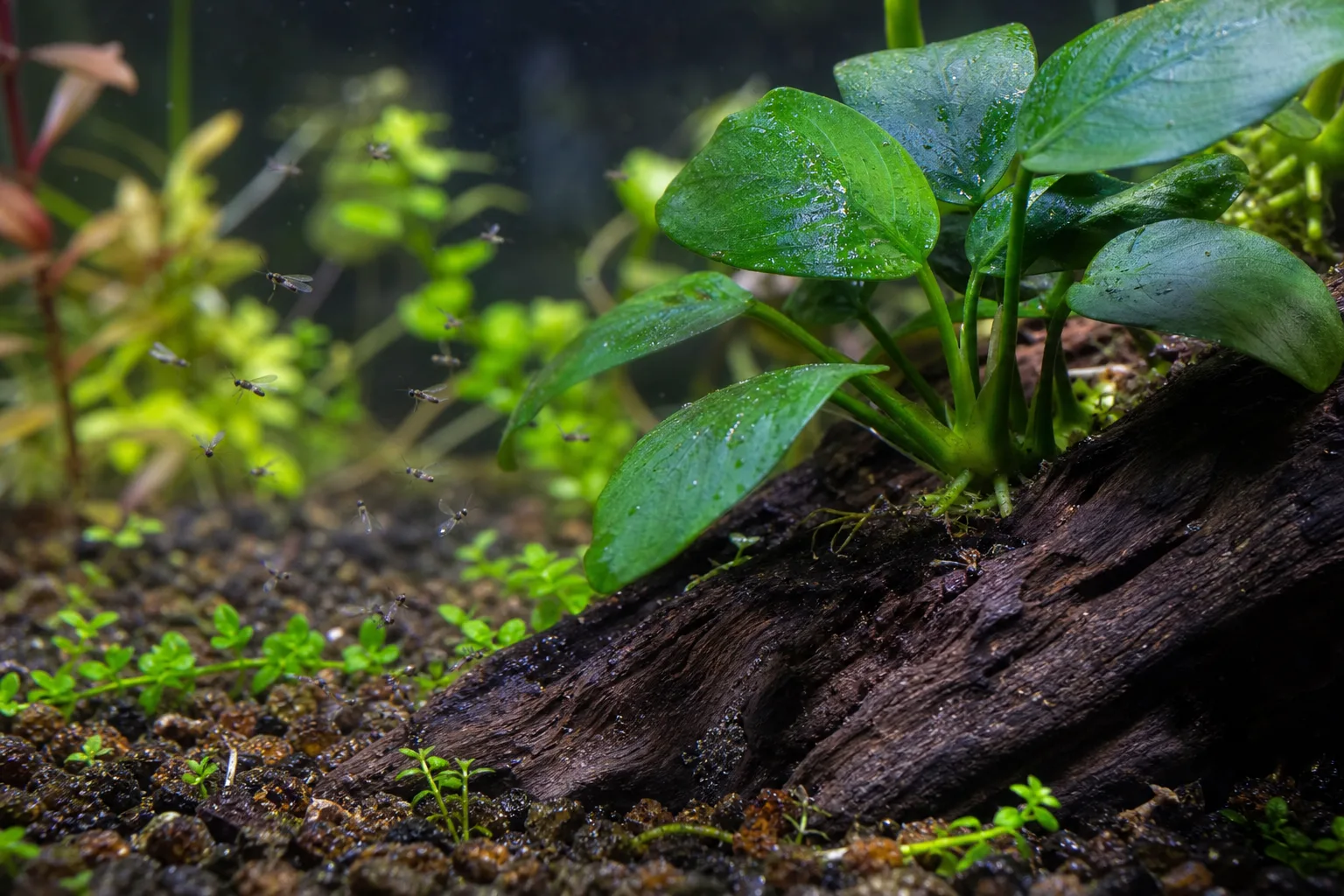
Submerged Anubias on rock or wood is not normal fungus gnat habitat. Larvae need moist organic media at the air-soil surface, not underwater hardscape. First step: find the damp pot, tray, or land section that is actually breeding the flies.
Fungus Gnats Near Anubias Tanks: Where They Actually Breed
This guide covers fungus gnats on Anubias. See also the general Fungus Gnats guide, watering, and light pages for this plant.
Fungus Gnats Near Anubias Tanks: Where They Actually Breed
Quick answer
If your Anubias is mounted on rock or wood and growing fully underwater, fungus gnats are almost certainly coming from somewhere else. Fungus gnat larvae develop in moist potting media and similar organic surfaces, not on submerged aquarium hardscape or leathery Anubias leaves (UC IPM).
First step: find the breeding surface before treating anything. Check damp houseplant pots, emersed propagation trays, and paludarium land sections before you add a soil drench, sticky trap, or pesticide anywhere near tank water.
Why normal submerged Anubias is the wrong habitat
Anubias is usually grown as an aquarium epiphyte with the rhizome attached to hardscape and left exposed (Tropica planting guide). Fungus gnats do not need a leaf host in the way spider mites or aphids do. They need a moist, organic, air-exposed breeding layer where adults can lay eggs and larvae can feed on fungi and decaying material.
That is why the standard submerged setup fails the fungus-gnat test:
- the rhizome is above substrate, not buried in potting soil
- the surrounding material is usually inert gravel, sand, rock, or wood
- the plant surface is underwater, not at an air-soil interface
- larvae that depend on moist surface media are not living on submerged leaves
Extension guidance is consistent that fungus gnats are pests of moist potting media and related container substrates (UC IPM; Colorado State Extension).
When this page does apply
This page is still useful in a few edge cases:
- you are keeping Anubias emersed in a nursery pot or propagation tray
- a paludarium land section has peat, sphagnum, or ABG-style mix
- a quarantine tub has organic media exposed above the waterline
- nearby houseplants share the same shelf or light as the aquarium
In those cases, the flies are still responding to wet organic media. The question is just whether the source is next to the Anubias or under the emersed Anubias setup.
What fungus gnats look like near a tank
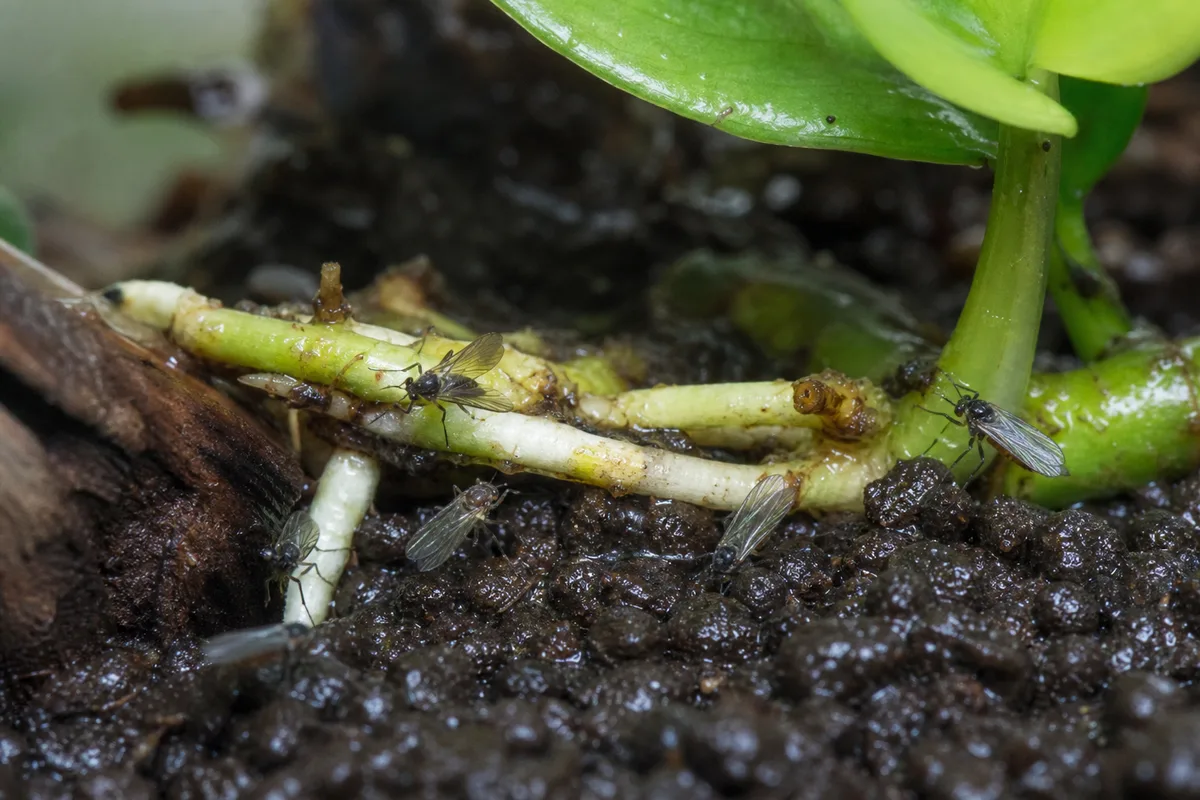
Fungus gnats near an aquarium are a source-tracing problem, not usually a submerged-leaf diagnosis.
Typical fungus gnat pattern:
- tiny dark mosquito-like flies
- weak flight near lights, windows, or damp surfaces
- adults rise when you disturb wet media
- larvae live in the top layer of damp organic substrate, not on submerged hardscape (Colorado State Extension)
Common lookalikes:
| What you see | More likely source | First check |
|---|---|---|
| Flies rise when a pothos pot is watered | Fungus gnats in that pot | Dry the pot surface and trap adults there |
| Tiny fuzzy flies by a sink or drain | Drain flies | Clean the drain biofilm, not the tank |
| White fuzz on gravel or wood | Mold or biofilm on organic debris | Clean mulm and read mold-on-soil |
| Flies only in paludarium land section | Gnats in emersed substrate | Dry the surface and reduce misting there |
How to confirm the source
Treat this as a source audit, not a leaf-damage article.
- Disturb every damp pot nearby. Adults often lift off within seconds when the real source is watered or touched.
- Check whether Anubias is actually in organic media. If it is glued or tied to rock underwater, it is not the breeding site.
- Inspect any emersed tray or land section. Wet peat, coco coir, or sphagnum is far more likely than the submerged tank.
- Check open food and debris. Fruit flies and drain flies are often misread as fungus gnats around aquarium rooms.
- Use a potato-slice or sticky-trap test only on the suspected media. CSU Extension describes potato slices and sticky traps for confirming larvae and adults in moist potting surfaces (Colorado State Extension).
If the flies never emerge from any plant pot, land section, or emersed tray, broaden the search. A submerged Anubias display tank is still low on the suspect list.
First fix
Dry or isolate the actual breeding media.
That might mean:
- reducing watering on a nearby houseplant
- removing an emersed Anubias pot from the tank stand
- improving airflow and dry-down in a paludarium land section
- clearing decaying plant matter from exposed damp surfaces
For ordinary houseplant infestations, extension advice centers on letting the surface dry and targeting the breeding medium itself, not spraying the room at random (UC IPM).
If the source is an emersed Anubias setup
If you really are growing Anubias in exposed damp media, the fix sequence is closer to greenhouse IPM:
- let the top layer dry slightly between misting or watering
- remove dead organic debris from the surface
- keep the rhizome exposed rather than buried
- use sticky traps around the setup, not in the water
- use biological or drench controls only on the media itself, and only if safe for the animals in that enclosure
Do not translate a houseplant drench straight into an aquarium workflow.
What not to do
- Do not bury the rhizome to “dry out the flies.”
- Do not dump houseplant pesticides or drenches into an aquarium without livestock-safe labeling.
- Do not assume every small fly near water is a fungus gnat.
- Do not keep treating the tank while the real source is an overwatered pot on the same shelf.
- Do not confuse biofilm or mold on hardscape with insect larvae.
Related Anubias problems to check instead
If your plant itself looks bad, these are more likely than fungus gnats on submerged Anubias:
- Mold on Soil on Anubias - for fuzz on organic debris or exposed media
- Root Rot on Anubias - for buried, dark, or mushy rhizomes
- Yellow Leaves on Anubias - for transition melt and water-quality decline
- Overwatering on Anubias - for emersed setups staying wet too long
When to use this page vs other Anubias guides
- Anubias overview - use for standard submerged setup and rhizome placement
- Anubias watering guide - use for aquarium water quality and maintenance
- Mold on Soil on Anubias - use when the issue is fuzzy growth rather than flying insects
- Root Rot on Anubias - use when the rhizome is the failing tissue
- Low Humidity on Anubias - use only for emersed leaves exposed to air