Low Humidity on Anubias Above the Waterline: Emersed Causes
Quick answer
Low humidity matters on Anubias only when part of the plant is growing in air, such as a paludarium, open quarantine tub, or emersed farm pot. Fully submerged leaves are not limited by room humidity. First step: confirm whether any leaves are actually above the waterline, then raise enclosure humidity while keeping the rhizome wet and exposed.
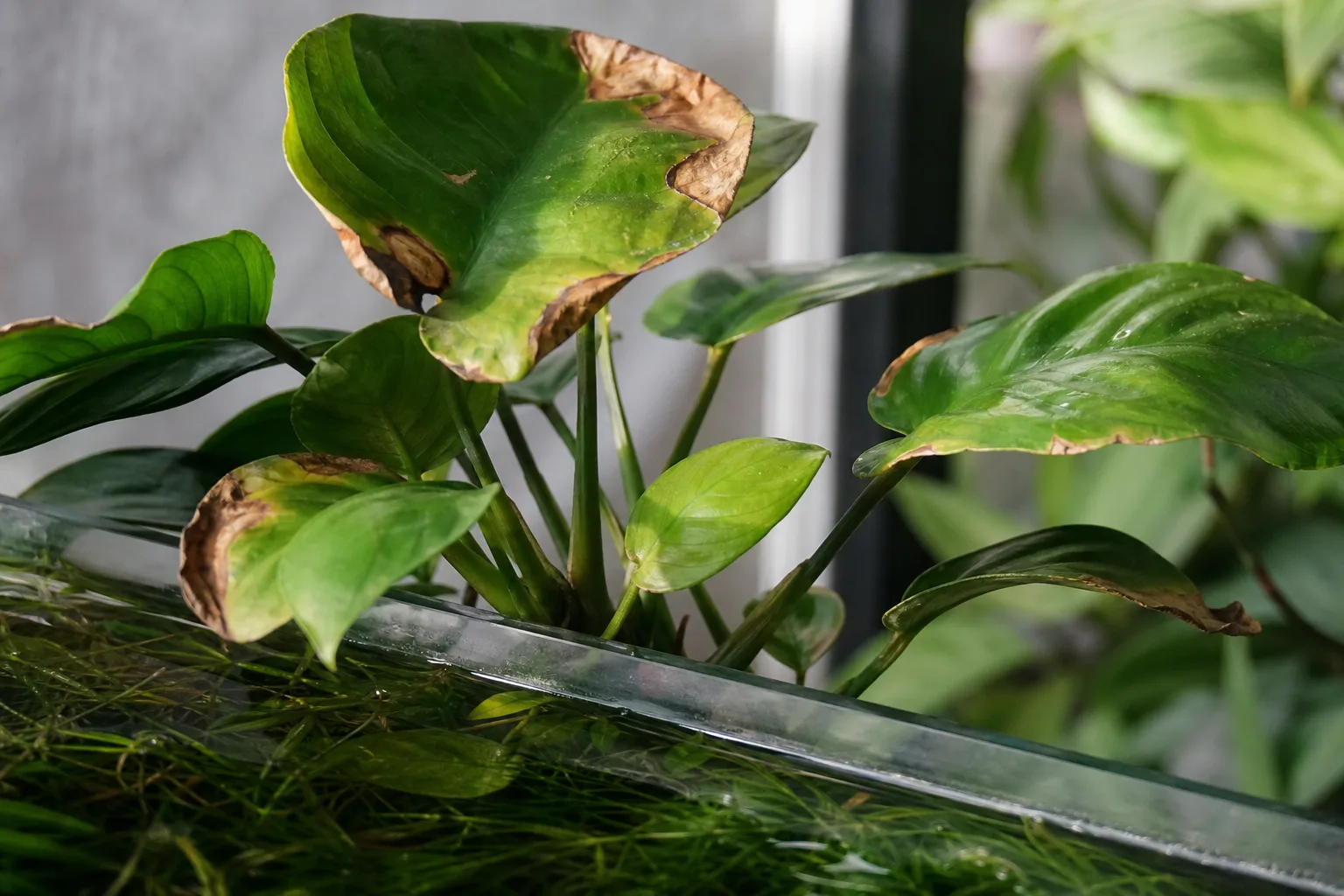
Low Humidity on Anubias Above the Waterline: Emersed Causes & Fixes
This guide covers low humidity on Anubias. See also the general Low Humidity guide, watering, and light pages for this plant.
Low Humidity on Anubias Above the Waterline: Emersed Causes & Fixes
Quick answer
This page is for emersed Anubias, not the normal submerged aquarium setup. Anubias is commonly sold for tanks, but low room humidity only becomes relevant when leaves are growing above the waterline in a paludarium, humid propagation tub, or greenhouse-style emersed setup. If your plant is fully underwater, skip dry-air fixes and troubleshoot tank conditions instead.
First step: confirm whether any leaf tissue is actually in air. If yes, raise humidity around those leaves today and keep the rhizome wet but exposed. If no, room humidity is not your problem. Anubias is an aquatic aroid whose rhizome should stay attached to hardscape and not be buried (Tropica planting guide).
When this page applies and when it does not
Use this page when:
- the crown or leaves sit above the waterline in a paludarium
- you are acclimating nursery stock in an open container
- a quarantine or propagation tub has leaves in air
- you intentionally grow Anubias emersed on rock or wood
Do not use this page when:
- every leaf is fully submerged in an aquarium
- you are seeing old leaves yellow and melt after purchase
- the rhizome was buried in gravel or soil
- algae or mulm is coating slow leaves in a low-flow tank
That distinction matters because emersed and submerged growth behave differently. Florida aquatic-plant guidance describes emersed culture as roots in wet media or shallow water with leaves in humid air (UF/IFAS). A normal tank plant never experiences that air-exposed leaf environment.
What low humidity looks like on emersed Anubias
Dry-air damage on Anubias is usually easy to separate from submerged melt once you look at where the damage stops.
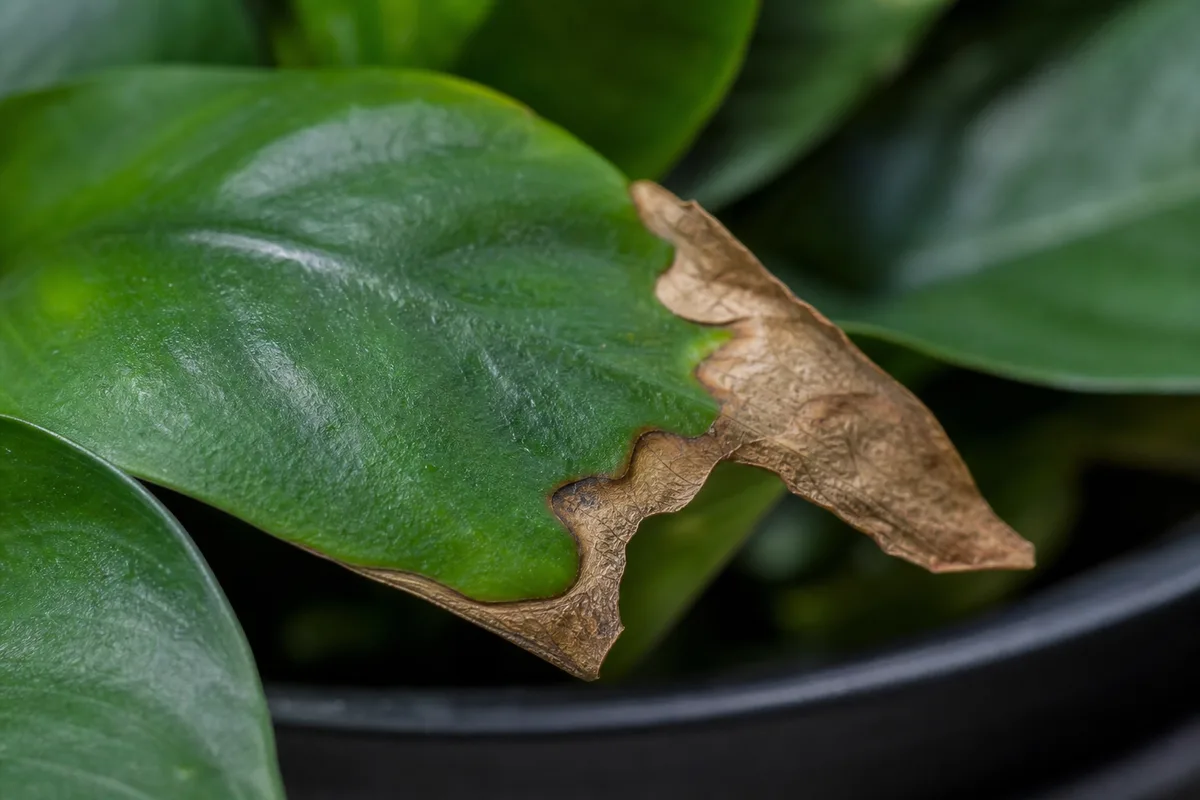
Low humidity symptoms on emersed Anubias show up on leaf tissue exposed to air, not on submerged portions.
Typical low-humidity signs:
- crispy brown edges or tips on leaves that sit above the waterline
- papery leaf texture instead of a firm, leathery surface
- curled or cupped emersed leaves after a lid was left open
- stalled new buds at the crown while the rhizome still feels firm
- damage concentrated on aerial growth, with submerged portions still green
What low humidity usually does not look like:
- transparent or mushy old leaves underwater after purchase
- black mushy rhizome tissue
- algae film or beard algae on submerged leaves
- widespread decline on all leaves in a stable submerged tank
If the damage pattern changes at the waterline, dry air is plausible. If the whole plant is underwater and declining evenly, it is not.
Why Anubias gets dry-air damage above the waterline
Anubias naturally grows along wet stream margins and can live either submerged or emersed depending on conditions (NParks). The key is that emersed growth still expects high local humidity and constant root-zone moisture.
Low humidity becomes a problem in a few repeat scenarios:
1. Emersed leaves moved into ordinary room air too quickly
Commercial Anubias is often farmed emersed because it grows faster that way. When those leaves leave greenhouse humidity and sit in a dry room, they lose water faster than they can replace it.
2. Open-top containers and paludariums
Anubias can handle leaves in air, but not in the same way as a pothos on a shelf. In an open-top tank or mesh-topped vivarium, humidity near the crown can collapse fast even while roots stay wet.
3. Submerged-to-emersed conversion
Submerged-grown leaves have thin, water-adapted surfaces. Peer-reviewed work on aquatic heterophylly shows submerged and aerial leaves are structurally different (PMC review). If you lift submerged growth into room air without a humid transition, those leaves often crisp before replacement leaves form.
What this is often confused with
The most common misdiagnosis here is normal emersed-to-submersed melt. Newly bought Anubias often loses old greenhouse leaves after it is planted underwater. That is a transition issue, not dry air.
Use this table before you change anything:
| Pattern | More likely cause | First action |
|---|---|---|
| Crispy tissue only above waterline | Low humidity on emersed growth | Close lid or cover and raise local RH |
| Transparent or dissolving old leaves underwater | Normal transition melt | Leave rhizome attached and wait for submerged leaves |
| Soft black rhizome | Burial or rot | Uncover rhizome and cut back decay |
| Algae or mulm on slow leaves | Light and flow issue | Clean hardscape and improve circulation |
| Whole plant underwater, no aerial growth | Not a humidity problem | Check water quality, burial, and acclimation |
How to confirm the cause
Work through these checks in order:
- Leaf position check. Are any leaves above the surface at all? If not, stop diagnosing humidity.
- Rhizome check. Anubias rhizomes should stay exposed, not buried (Tropica). Firm rhizome plus crispy aerial leaves supports dry-air stress. Soft rhizome points to rot.
- Transition history. Was the plant recently moved from submerged to emersed, or from a sealed bag to an open room? Sudden environmental change is a strong clue.
- Cover test. If you cover the setup for 24 to 48 hours and new crisping stops, humidity was likely the missing variable.
- Waterline pattern. Damage that stops where the leaf meets water is classic emersed dryness, not a whole-plant care failure.
If you cannot pass step one, this page is not the right diagnosis.
First fix for emersed Anubias
Raise humidity around the aerial leaves immediately without burying the rhizome.
That usually means one of these actions:
- close the lid or cover on the propagation tub
- move the plant into a higher-humidity enclosure
- mist the enclosure walls and surrounding air, not just the leaf once
- raise the water level or add a wetter microclimate around the hardscape
Keep the rhizome and roots wet, but do not pack them under substrate. Planting guidance for Anubias is consistent on this point: burying the rhizome is a rot trigger, not a humidity solution (Tropica).
Recovery expectations
Old crispy leaves do not recover. The question is whether the rhizome stays alive long enough to replace them.
Good signs:
- rhizome stays firm and green
- no new crisping after humidity is raised
- a fresh leaf bud starts moving within two to six weeks
Bad signs:
- the crown wrinkles or turns dark
- leaves continue to crisp even inside a covered setup
- the rhizome softens at the attachment point
Anubias grows slowly even when healthy. Expect recovery to be measured in weeks, not days.
What not to do
- Do not treat a submerged tank with room humidifiers as the main fix.
- Do not bury the rhizome to hold moisture.
- Do not assume old submerged leaves will become good emersed leaves.
- Do not stack fertilizer, repotting, and lighting changes on the same day you correct humidity.
- Do not keep opening the enclosure every few hours to check progress.
How to prevent it next time
- acclimate emersed stock under a cover before exposing it to open room air
- keep humidity high during submerged-to-emersed transitions
- use a stable paludarium or covered tub for aerial growth
- keep the rhizome attached to hardscape and exposed
- separate true humidity problems from ordinary submerged melt
When to use this page vs other Anubias guides
- Anubias overview - use for normal submerged setup, rhizome placement, and general tank culture
- Anubias watering guide - use for aquarium water quality, temperature, and flow
- Underwatering on Anubias - use when the rhizome itself dried out or was left out of water
- Root Rot on Anubias - use when the rhizome is soft, dark, or buried
- Yellow Leaves on Anubias - use when old submerged leaves are declining after transition