Should You Water Grass on a Sunny Day? How to Do It
Watering grass on a sunny day will not burn your lawn. Learn when to water, check soil moisture, measure sprinkler output, and adapt for heat or new grass.

Yes. You can water grass while the sun is shining; ordinary sprinkler droplets do not burn a lawn. The practical reason to prefer a cooler time is efficiency: heat and wind can evaporate or blow some spray away before it reaches the soil. If your lawn is genuinely dry and midday is your available window, water it correctly instead of leaving it stressed because of a sun-scorch myth.
The better question is not “Is the sun out?” but “Does this lawn need water, and can my sprinkler get it into the root zone without runoff?” An established lawn with moist soil may need no irrigation on a bright day. A newly seeded patch may need a light pass even if the sun is high. Those are different situations, so the schedule should follow the grass and soil rather than a single clock rule.
Yes—sunlight does not make sprinkler water burn turf
A sprinkler running in sunshine will not normally scorch or kill healthy grass. The familiar explanation that each droplet acts like a tiny magnifying glass focuses sunlight on a blade is not a useful basis for lawn care. Water from a sprinkler is distributed across a large, uneven canopy and soil surface; the real concerns are how much water reaches the ground, how quickly it evaporates or drifts, and whether the soil is already wet enough.
If a lawn turns dull, folds its blades, or leaves footprints after a hot afternoon, that points to moisture stress, not sunbeams burning droplets into the grass. Direct sun does increase the plant’s demand for water, and hot, dry air can pull moisture from leaves and soil faster. That can make irrigation less efficient in the middle of the day, but the sunlight itself is not a reason to withhold needed water.
A sunny-day watering can also be completely reasonable for a newly seeded area. Seed needs moisture close to the surface to germinate, and the exposed top layer can dry quickly in sun and wind. Use a gentle spray, check the seedbed afterward, and stop before water pools or carries seed downhill. Established turf, by contrast, usually benefits from a deeper application less often rather than repeated surface wetting.
Why the “water droplets act like magnifying glasses” theory misses the point
The lens explanation distracts from variables that do change lawn outcomes. A windy afternoon may carry sprinkler spray onto pavement, while a hot, low-volume mist may evaporate quickly. A heavy stream on compacted clay can run off before it soaks in. Any of these can leave roots short of water even though the blades look wet for a few minutes.
So judge an irrigation session by the soil after it runs, not by whether sunlight touched the wet blades. If the root zone remains dry, the water did not reach the place the lawn needs it. If the soil is damp several inches down and the grass is not showing stress, another sunny-day watering is more likely to waste water than help.
When watering is most efficient
For most established lawns, early morning is the easiest default. Air tends to be cooler and wind calmer than during a hot afternoon, so more of the sprinkler output can land where it belongs. The grass also has daylight ahead for surface moisture to dry, which can matter in humid climates or lawns prone to leaf diseases.
“Early morning” is a target for better delivery, not a rule that grass can only be watered before sunrise. If a system cannot run at dawn, if a heat wave has left the soil dry, or if local watering rules allow a different window, adjust the method. A well-measured daytime watering is safer for turf than delaying until an already stressed lawn receives no water at all.
Early morning is a useful target, not a strict deadline
Better Homes & Gardens identifies roughly 4 to 8 a.m. as a useful window because cooler temperatures and lower wind reduce water loss, and blades have time to dry as the day warms. University of Georgia Extension likewise recommends watering lawns in the morning in its local county guidance, while emphasizing that rainfall and turf condition should change the weekly amount. These time ranges are practical recommendations, not a universal cutoff that applies to every climate, sprinkler, or water restriction.
If your sprinkler timer is set for a very early hour, check that the irrigation is not producing runoff while you are asleep. A timer can repeat a bad schedule just as reliably as a good one. Inspect a cycle while it runs at least once: look for overspray onto sidewalks, dry corners, puddling, and water moving downhill, then correct the heads or split the cycle.
What if the lawn needs water at noon?
Watering at midday is allowed when the lawn needs it. Compared with calm morning conditions, a hot, windy hour can lose more water to evaporation and drift, so you may need to adjust the application or accept a less efficient session. That is a resource trade-off—not evidence that droplets burn the grass.
Use a sprinkler that throws larger, steady drops rather than a fine mist if wind is carrying the spray away. Aim it at turf rather than pavement, and run one zone at a time if pressure drops when several zones operate together. If the water begins to puddle or run off, pause, let it soak, then resume; a shorter cycle followed by a soak is often more useful than extending one continuous run.
An urgent watering does not have to wait for a “perfect” hour. If footprints remain in the lawn and the soil is dry a few inches down, water when you can and check whether it reached the roots. On a breezy day, prioritize the thirsty or sun-exposed part of the lawn instead of automatically irrigating every square foot.
Why late evening is a weaker routine
The issue with routine late-evening watering is how long susceptible grass blades stay wet, not a rule that any water after sunset makes roots rot. Long periods of leaf wetness combined with warm, humid conditions can favor certain turf diseases. Morning irrigation usually gives the blades a chance to dry before night, so it is a sensible default where disease pressure is a concern.
Advice about night watering is not identical everywhere. A UGA Extension article from Bartow County describes a window after dew has formed and before sunrise as efficient and unlikely to increase disease problems, while Better Homes & Gardens favors morning and cautions against wet foliage through the night. This difference reflects local conditions and how long the canopy remains wet; it is not a reason to treat the entire evening as dangerous. If morning is impossible, use a low, targeted application, avoid frequent light sprinkling, and watch for disease in warm, humid weather.
For a lawn with a history of fungal patches, ask your local cooperative extension about the disease and local irrigation window. Keep irrigation equipment from wetting foliage unnecessarily, and do not add water to already soggy soil. A timing adjustment cannot cure an existing turf disease, but it can avoid adding another source of prolonged moisture.
Check whether the lawn actually needs water
A fixed weekly schedule can overwater during a rainy stretch and underwater during a dry, windy one. Before turning on a sprinkler, look for signs that the turf is using more water than the root zone can supply. UGA Extension’s home-lawn guidance points to dull or bluish-green color, folded or rolled blades, and footprints that remain visible as practical moisture-stress signals; it suggests using these signs across a meaningful part of the lawn rather than reacting to one isolated blade.
A single brown patch is not proof the whole lawn is thirsty. A patch beside a downspout may be too wet, while a sunny slope may dry first. Check several representative locations, including sunny and shaded areas, lawn edges, and the zone that appears most stressed. If the lawn is green and springy and the soil is moist below the surface, skip irrigation even if the forecast is hot.
Read turf stress alongside root-zone soil
Grass may look tired during the hottest part of a day and recover as temperatures fall. That temporary droop does not automatically mean you should water every afternoon. Look for a combination of persistent blue-gray color, leaves folding lengthwise, and footprints that linger; then inspect the soil beneath the canopy with a screwdriver, soil probe, or narrow trowel.
A screwdriver that enters dry, firm soil only a short distance can suggest the root zone needs water, but soil texture changes how that test feels. Compare a dry-looking sunny spot with a shaded or well-watered one in the same lawn. After irrigation, inspect again to see how deeply moisture moved. The goal is not to saturate the whole yard but to rewet the soil where active roots can use it.
If the lawn has recurring dry spots while nearby turf remains wet, check the irrigation pattern before increasing the entire system’s runtime. A clogged head, a blocked spray, poor overlap, a leak, a slope, or compacted soil can make one section dry while another receives too much. Treating the whole lawn for a localized delivery problem wastes water and may create new disease or runoff issues.
Deliver enough water without runoff
The familiar “one inch of water per week” is a planning reference, not an order to apply exactly one inch every seven days. Rain counts. So do differences in grass species, soil, shade, root depth, temperature, wind, mowing height, and whether the lawn is actively growing or entering dormancy. UGA Extension’s home-lawn guidance uses about an inch as a general amount to wet soil several inches deep. Its Lincoln County guidance calls an inch of supplemental water in a week a rule of thumb when no rain falls, while a Bartow County article gives roughly an inch over seven to ten days as a regional starting point; neither should override the conditions in your yard or local water rules.
The aim for established grass is to wet the root zone, then allow the surface to dry before watering again. Frequent, tiny applications can keep only the top layer damp and encourage roots to stay shallow. A deeper application followed by a dry-down period generally makes better use of water, but only if your soil can absorb it without running off.
Treat “one inch a week” as a starting point
One inch across 1,000 square feet is about 623 gallons of water, so a weekly inch is not a trivial amount. It is a rough baseline for active turf in a dry period, not a requirement during a cool, rainy week. If rainfall has already delivered half an inch, that may reduce the supplemental amount; if rain fell hard enough to run off, it may not have soaked into the root zone as effectively as the gauge suggests.
Do not water by calendar if soil is still damp several inches below the surface. Conversely, do not assume a brief shower replaced an irrigation cycle; check a rain gauge and the soil. A lawn may use more water during prolonged heat and wind than in mild weather, while a shaded lawn or one on moisture-retaining soil may need less. Follow water restrictions and local extension guidance first, especially during drought declarations.
Measure sprinkler output with catch cans
“Run the sprinkler for 20 minutes” is not a reliable lawn-wide instruction because sprinkler models, nozzle pressure, water pressure, and coverage differ. Use several identical, straight-sided containers—rain gauges, tuna cans, or similar small cups—to see what your sprinkler actually applies. Put them across one irrigation zone, including near the sprinkler and in spots that often look dry, then run the system for a set time.
Measure the water depth in each container. If the cups differ widely, the problem may be poor coverage or wind drift rather than insufficient runtime. If the average depth is a quarter inch after 15 minutes, for example, then the system would need about an hour to apply an inch under similar conditions—but verify that estimate with another run and stop sooner if water begins to flow away. The example converts measured output to a starting runtime; it does not mean every lawn should receive a full inch in one session.
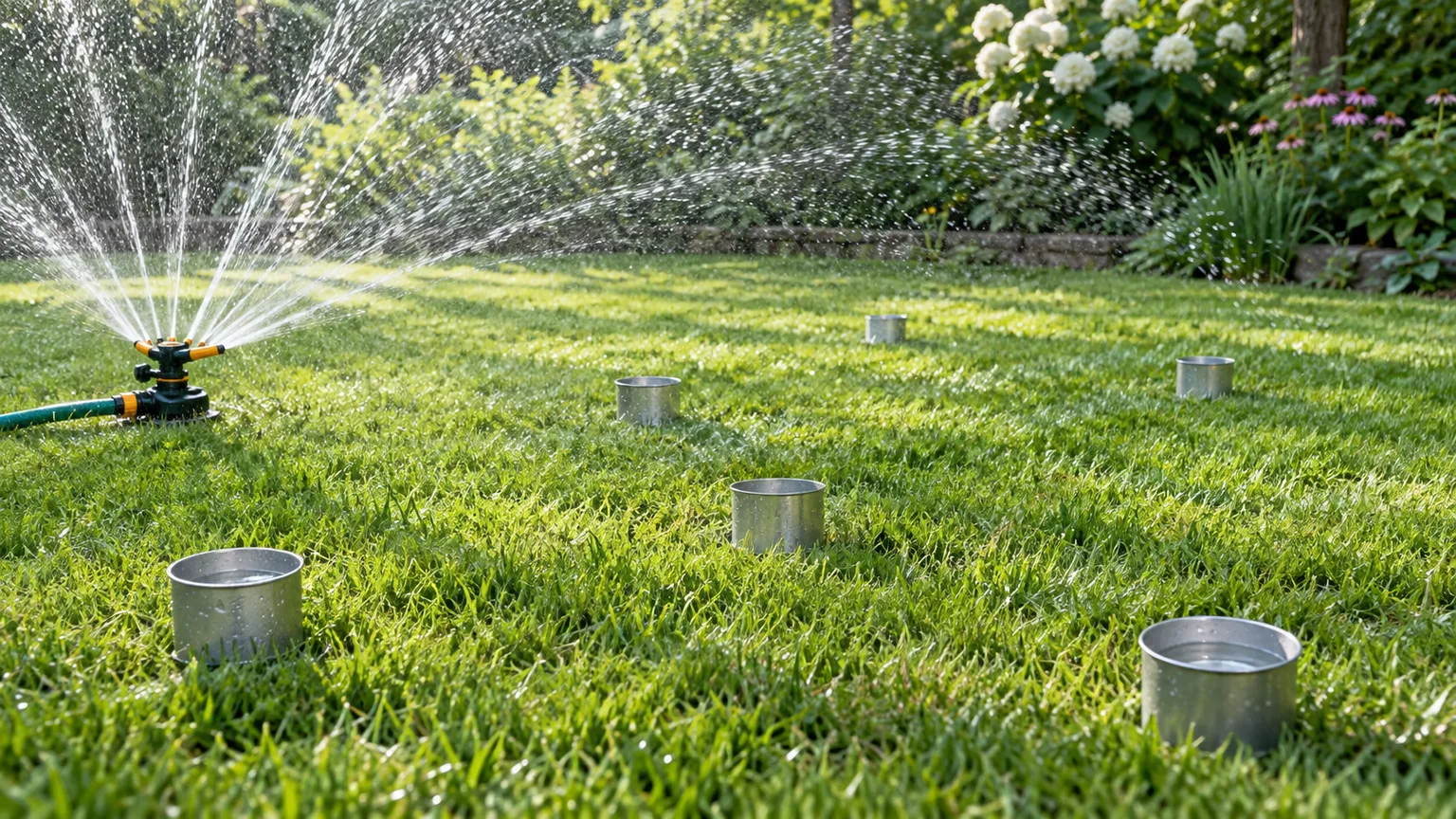
A catch-can test also reveals uneven zones: one cup may collect twice as much as another. Move or adjust a head, clear obstructions, and retest before lengthening all watering cycles. For an in-ground system, check whether each zone has matched heads and whether the controller has a rain sensor; a sensor can prevent a scheduled cycle after measurable rainfall, but it should be tested rather than assumed to work.
Adapt run time to soil, slope, wind, and coverage
Soil is the governor on how fast you can apply water. Sandy soil usually drains more quickly and may need smaller amounts at shorter intervals than a heavier soil. Clay or compacted soil may accept water slowly; applying a long cycle can leave water on the surface while roots below stay dry. On slopes, runoff can begin before the soil is wetted to the desired depth.
For slow-absorbing soil or a hill, try cycle-and-soak: run the zone for a short interval, pause long enough for water to infiltrate, then run another interval. The right interval depends on the site, so watch the ground rather than copying a universal number. If runoff continues, reduce each cycle’s length, redirect water away from pavement, and investigate compaction or thatch instead of simply adding more minutes.
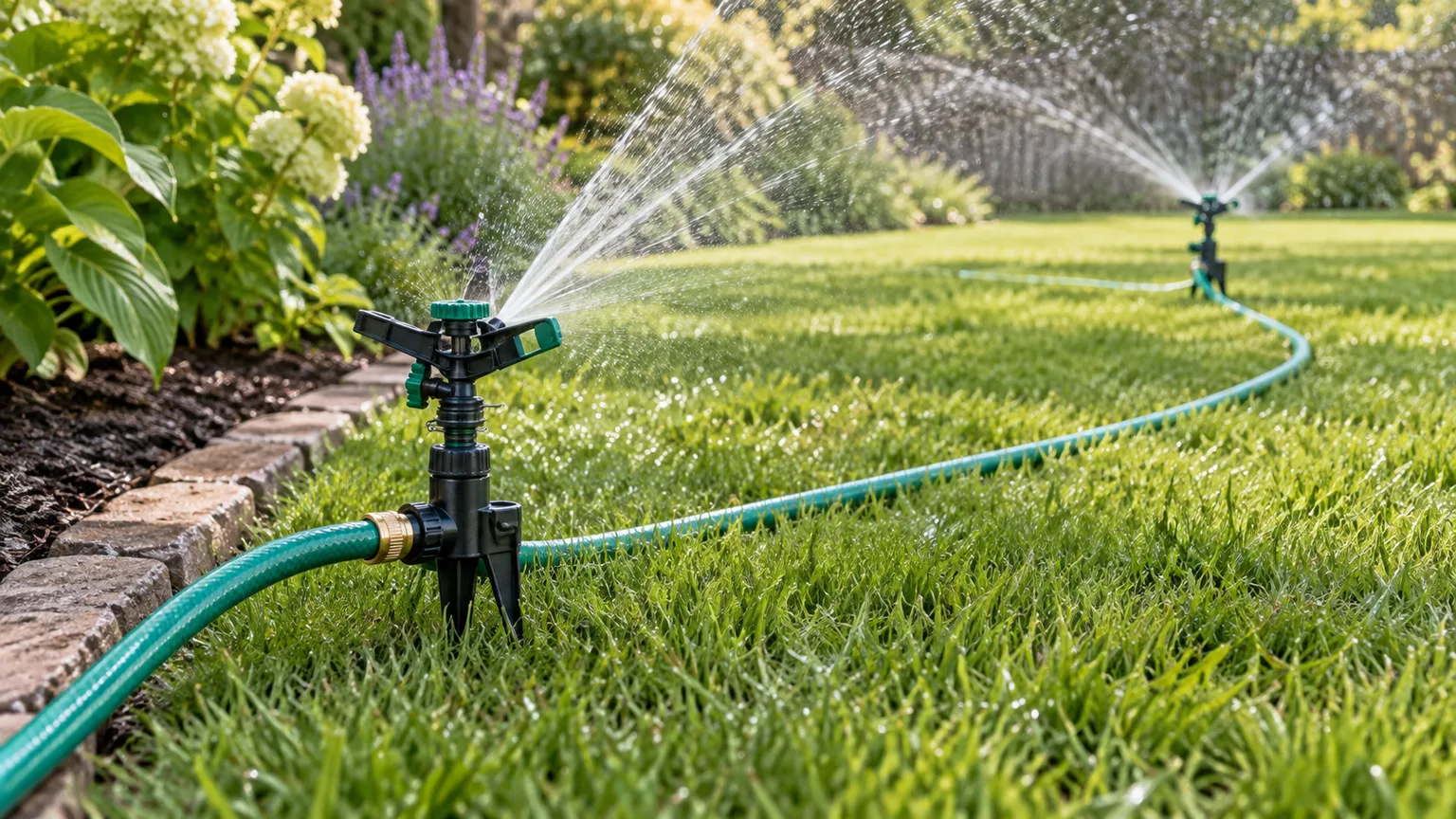
Wind changes where water lands, and even a well-designed sprinkler can throw too much onto a driveway or miss an edge. Run zones separately if pressure is weak, keep the nozzle clean, and adjust spray direction so you are watering lawn rather than sidewalk. After a cycle, use a soil probe to confirm the water reached the intended depth. More time only helps when the water is actually entering the soil.
New seed and sod follow different rules
An established lawn has roots and stored reserves that let it tolerate a longer interval between thorough watering sessions. New seed and sod have shallow or unfinished root systems, so they can dry out much faster. Apply the established-lawn rule to a new patch and it may wilt; apply the new-grass schedule to an established lawn and you can waste water and keep the surface unnecessarily wet.
The first days after seeding or installation are about steady establishment, not about waiting for the whole lawn to show drought stress. Keep the seed zone moist enough for germination, or keep sod and its soil interface from drying, while avoiding puddles and saturated conditions. Once roots develop, gradually transition toward deeper, less frequent watering.
Keep a seedbed lightly and frequently moist
Grass seed needs moisture close to the surface to germinate. In sunny, breezy weather, that thin layer can dry quickly, so a new seedbed may need several gentle applications during the day. Yes, one of those can happen while the sun is shining if the seed zone is drying; use a fine but non-misting spray that wets the surface without washing seed away.
Check the soil rather than running a timer blindly. The seedbed should stay evenly moist, not waterlogged. If water pools, runs downhill, or exposes seed, reduce the flow and divide the watering into shorter passes. Follow the seed supplier’s guidance because germination speed varies among species and temperatures. As seedlings establish and roots deepen, decrease frequency and increase the amount per session gradually.
The detailed schedule for new grass seed is different from this established-lawn guide; see how often to water new grass seed for the establishment stages. If you are overseeding a large area, use the instructions for that seed and local extension recommendations, because the existing turf and young seedlings may need different treatment in the same yard.
Keep new sod moist while roots establish
Fresh sod can dry at the edges and where strips meet, especially on hot, windy days. Water soon after installation so the sod and the soil beneath it make contact with moisture, then check beneath a corner or use a probe to see whether the root zone is damp. The surface should not be left to bake dry, but standing water and soggy soil can starve roots of oxygen and encourage disease.
New sod schedules change as roots knit into the soil. During establishment, smaller and more frequent applications may be necessary; as roots anchor, reduce frequency and water more deeply. Do not mow or walk heavily on saturated new sod, and avoid letting a timer continue on the established-lawn program if weather or rainfall makes the site wet. For a practical runtime framework, see how long to water a lawn, then verify the actual moisture under the sod.
Epic Gardening’s lawn guidance also separates newly seeded and established turf: seed areas may need light, frequent moisture while established lawns are allowed to dry between deeper applications. That is a useful distinction, but exact timing still depends on your seed, temperature, soil, and rain.
Heat, grass type, dormancy, and restrictions
A lawn’s response to heat depends partly on whether it is a cool-season or warm-season grass. Kentucky bluegrass, perennial ryegrass, and many fescues are cool-season turf that can struggle during intense summer heat; bermudagrass, zoysiagrass, and St. Augustinegrass generally grow more actively in warmer conditions. Those categories do not replace a local species-specific schedule, but they help explain why two nearby lawns may not need identical water.
During prolonged drought, some established turf can go dormant and turn brown aboveground while crowns and roots survive. If water is limited or restricted, keeping every blade green may not be realistic. Avoid occasional light “sips” that repeatedly wet only the surface; follow local extension advice on whether to water enough to protect crowns or let the lawn remain dormant. The best choice depends on species, soil, drought duration, and whether the lawn is newly established.
If you must water during a heat wave, check for genuine stress, measure how much water reaches the lawn, and avoid a fast application that runs off. Raise mowing height within the correct range for your grass and avoid removing more than one-third of the blade at a time; a taller canopy can shade the soil, but mowing advice is species-specific. Do not apply fertilizer to heat-stressed or dormant grass as a way to make it green faster.
Finally, check your municipality or water provider’s current schedule. Drought rules may limit watering days, times, or sprinkler types, and those requirements take priority over a general article. Where the lawn is not a high-priority use, reducing irrigated area, fixing leaks, and letting established turf rest through dormancy can conserve water without causing the damage a few brown blades might suggest.
Conclusion
You can water grass on a sunny day. Sunlight does not make ordinary sprinkler droplets burn a lawn; the real question is whether water can reach the root zone efficiently and whether the turf needs it. Early morning is a useful default because cooler, calmer conditions reduce loss and let foliage dry, but noon watering is acceptable when the lawn needs water and that is your available window.
Check grass stress and soil moisture, count rainfall, and use catch cans to learn what your sprinkler delivers. Water established turf deeply enough to reach roots without runoff, then let the soil dry before the next session. Keep new seed and sod on their own establishment schedules, and follow local restrictions during drought. That approach protects the lawn far better than waiting for the sun to go away.