How to Get Rid of Moss in Your Lawn
Learn how to get rid of moss in your lawn, diagnose why it formed, remove it without needlessly damaging grass, and repair the conditions that invite it back.
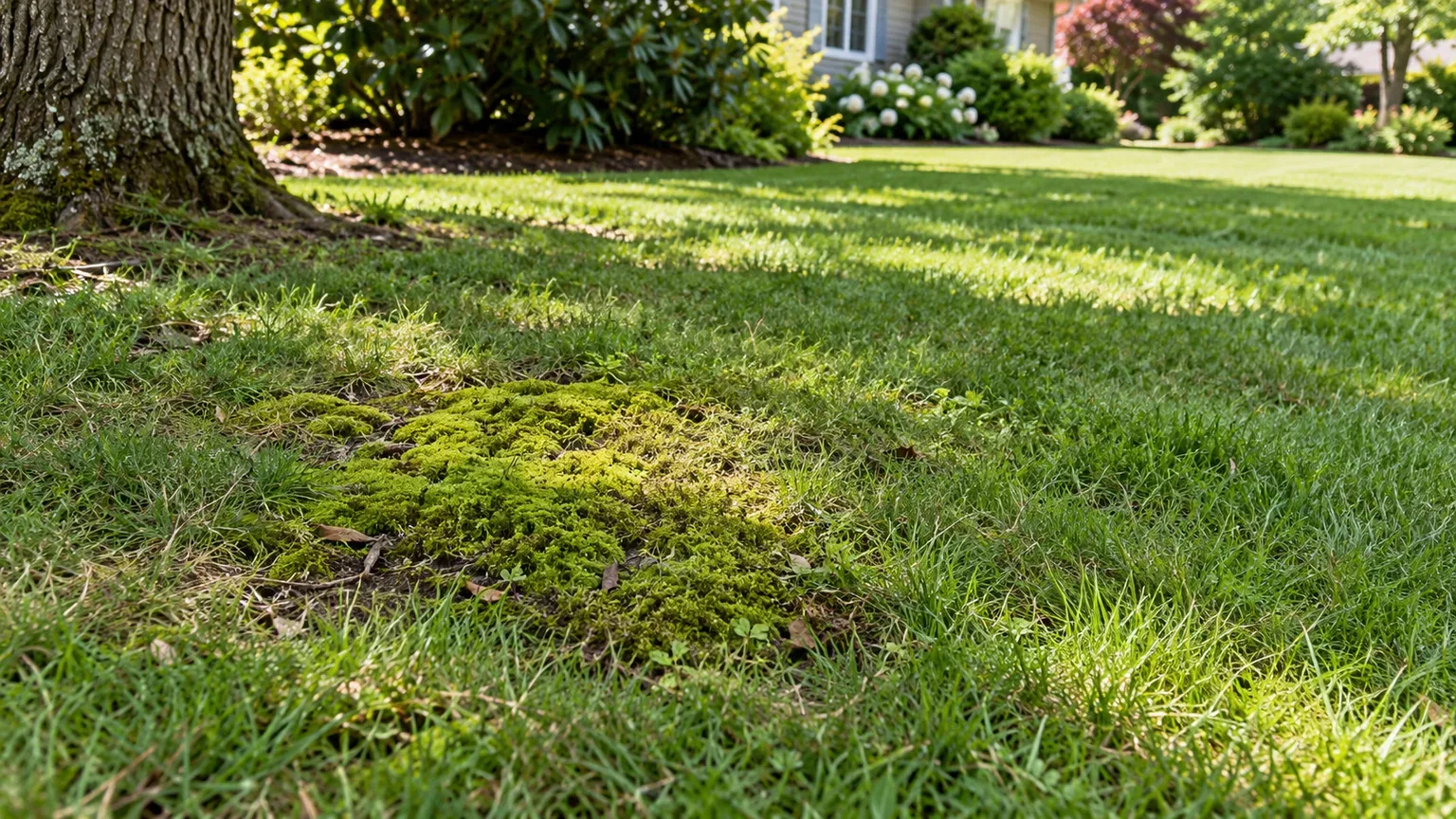
Moss is easy to pull out because it sits close to the soil surface. The hard part is deciding what should replace it. If the patch is bare because grass lacks light, the soil stays wet, or foot traffic has compacted the ground, removing moss alone exposes the same conditions that let it grow. It may return, or the opening may fill with weeds instead.
For a lasting change, start by choosing your goal: a denser grass lawn, a tidy mixed lawn, or a low-maintenance mossy corner. Then remove moss only where it conflicts with that goal, address the specific cause you can correct, and reseed only when the site can support turf. Moss does not automatically mean the lawn is unhealthy; the right fix depends on what you want the space to do.
First decide what you want from the patch
If moss is soft underfoot, stays green in a shady area, and does not interfere with how you use the yard, you can leave it. In a low-traffic spot where turf repeatedly thins, moss may function as ground cover rather than a crisis. The Royal Horticultural Society notes that moss can support small invertebrates and that some gardeners retain it or encourage it where grass struggles. That choice is especially practical beneath mature trees, where roots compete for water and light is limited.
A grass lawn is a better fit if the area needs to handle play, regular walking, sports, or a uniform turf surface. Moss generally does not tolerate heavy wear as well as established grass, so a moss-heavy path can become patchy when people repeatedly cross it. If your goal is grass, assess whether the location can supply enough light, drainage, and growing-season recovery before spending money on moss killer, seed, or fertilizer.
The decision can be local rather than all-or-nothing. Keep a shaded, unused strip as moss or replace it with a shade-tolerant ground cover, while repairing the sunny, usable lawn around it. That boundary can reduce maintenance and avoid repeatedly reseeding a place where the grass will never stay dense.
Diagnose why moss has a foothold
Moss is a clue, not a soil test. It commonly occupies thin or bare places where turf is weak, but its presence does not prove that one specific problem—such as acidic soil—is responsible. The University of Wisconsin–Madison Division of Extension explains that moss grows in bare areas rather than killing living turf; poor drainage and shade can cause grass loss while also favoring moss. UConn Extension likewise treats weeds and similar growth as indicators of site conditions, not substitutes for testing or diagnosis.
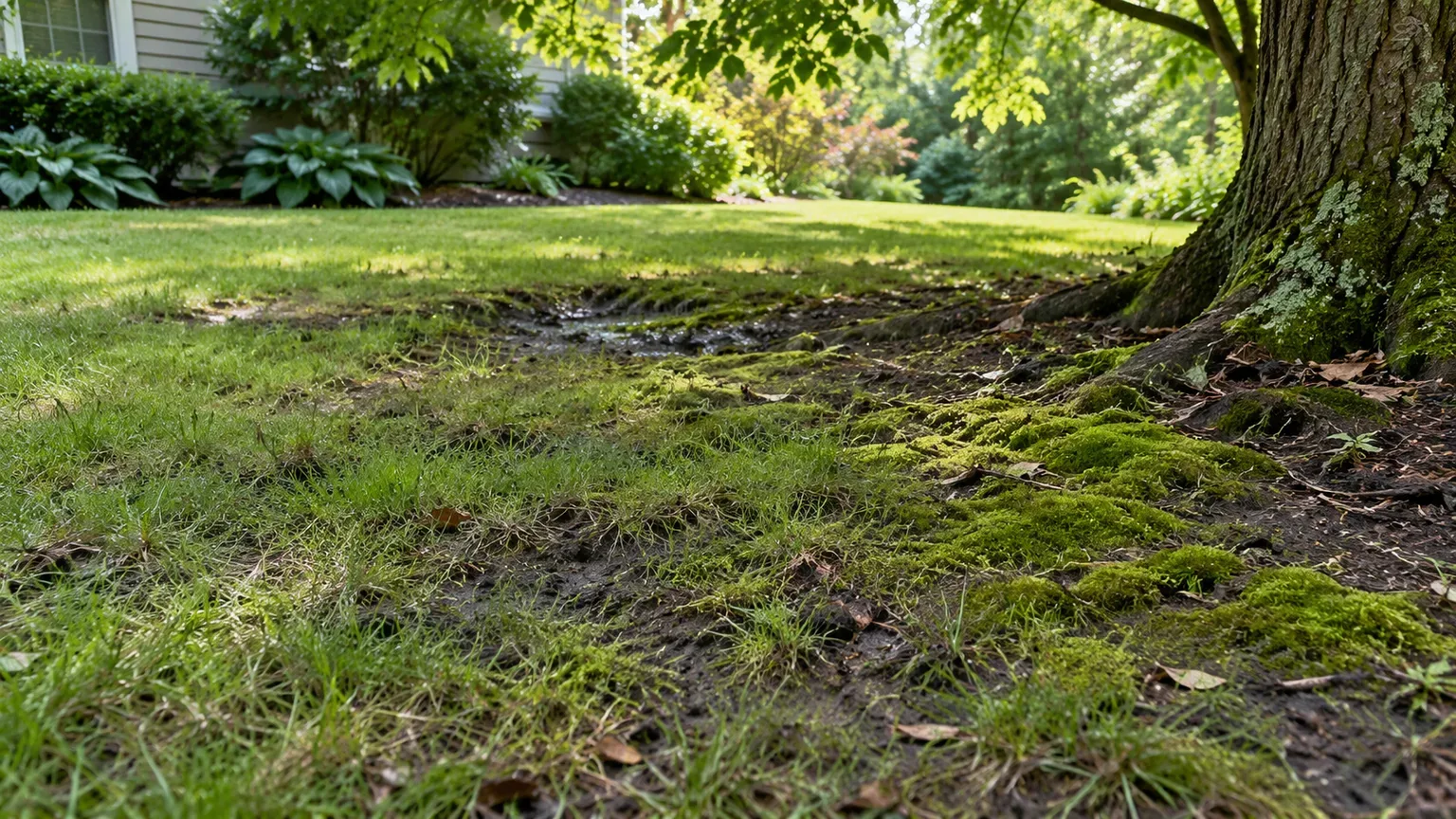
Look at the shape of the patch and what happens there after rain. Moss concentrated below a tree suggests light and root competition; a strip beside a gate may reflect repeated traffic; a low spot that stays slick or puddled points toward water movement. Several causes can overlap, so fix the visible constraint first instead of applying every lawn treatment at once.
Shade and tree competition
Grass needs enough light for its species and local climate. If moss clusters under a dense canopy, alongside a north-facing wall, or behind a fence, the first question is whether you can realistically increase light. Pruning selected lower branches or thinning shrubs may improve daylight and air movement, but do not remove a healthy tree just to save a small lawn patch without considering the tree’s value, safety, and alternatives.
Where the shade cannot be changed, identify a seed mix specifically suited to the region and the amount of shade. Fine fescues are common cool-season options for partial shade, but no grass seed can turn deep, year-round darkness into a reliable lawn. Washington State University Extension emphasizes matching turfgrass to the site’s light, soil, drainage, and use; its recommendations are regional, so ask a local extension office or reputable turf supplier for the correct species and cultivar in your climate.
Compaction, traffic, and thatch
A compacted lawn often has hard soil, shallow roots, and puddles that linger after rain. The problem is common on shortcuts, play areas, and places regularly driven over by mowers or equipment. A screwdriver or narrow trowel can help you compare a mossy patch with nearby healthy turf: if the tool enters the healthy area easily but stops at a hard layer in the patch, compaction is plausible, though it is not a substitute for a soil assessment.
Thatch is a distinct issue. It is a dense layer of dead stems and roots between green blades and soil, not simply a scattering of grass clippings on the surface. A spongy feel, visible mat at the base of the grass, or water that beads above the soil can justify closer inspection. Scarifying or dethatching removes excessive surface material; aeration addresses compacted soil below it. Doing both just because moss is present can stress a thin lawn, so use the tool that matches the problem.
Wet soil, irrigation, and drainage
Moss can thrive when the lawn surface remains damp, but “poor drainage” has several causes. Overwatering, a leaking sprinkler, downspout discharge, a compacted layer, a low basin, and a high water table call for different solutions. Note whether water stands only during storms or whether the soil remains saturated for days, and check sprinkler coverage before changing the grade or installing drainage.
Reduce irrigation if the lawn is being watered on a fixed schedule despite cool or rainy weather. Water established turf according to its actual needs, preferably less often and deeply enough to encourage roots rather than keeping the surface constantly wet. Do not simply divert water onto a neighbor’s property or into a place where it can damage a foundation; persistent ponding or runoff may warrant a drainage professional.
Soil pH and nutrition: test before amending
Moss is often blamed on acidic soil, and acidity can limit some turfgrasses, but appearance alone cannot tell you the pH. UConn Extension recommends soil testing to track pH and nutrients and notes that turf nutrient availability depends on the actual soil result. A test also helps prevent the common overcorrection of adding lime when the lawn does not need it.
Lime is not a moss killer. It raises soil pH when applied at a rate based on a test; if acidity is not the problem, it may not improve turf and could push the soil farther from the target range for your grass. Use the soil lab’s recommendation for lime and fertilizer, and retest on the schedule your local lab suggests rather than repeatedly adding amendments by habit.
Remove existing moss without sacrificing grass
Choose a period when the lawn is not drought-stressed, frozen, heat-stressed, or waterlogged and when the turf can recover. For many cool-season lawns, that means a mild growing period in spring or early fall; warm-season lawns generally recover best in their active growth window. Local climate, grass type, and the instructions on any product you use matter more than a calendar date copied from another region.
Before removal, mow only if the grass is tall enough to obstruct the work, and avoid scalping the lawn. Mark sprinkler heads, shallow cables, and tree roots before using powered equipment. If the moss covers a small patch, manual removal is usually enough; if it covers a large area, first decide how you will repair the bare soil rather than assuming a machine will solve the underlying cause.
Rake small patches and collect debris
On a small area, use a spring-tined lawn rake or dethatching rake and work in short passes. Start with light pressure, then increase only enough to lift moss without digging furrows into the soil or pulling up healthy grass crowns. Working from two directions can loosen a mat, but aggressive repeated raking can turn a thin lawn into bare ground.
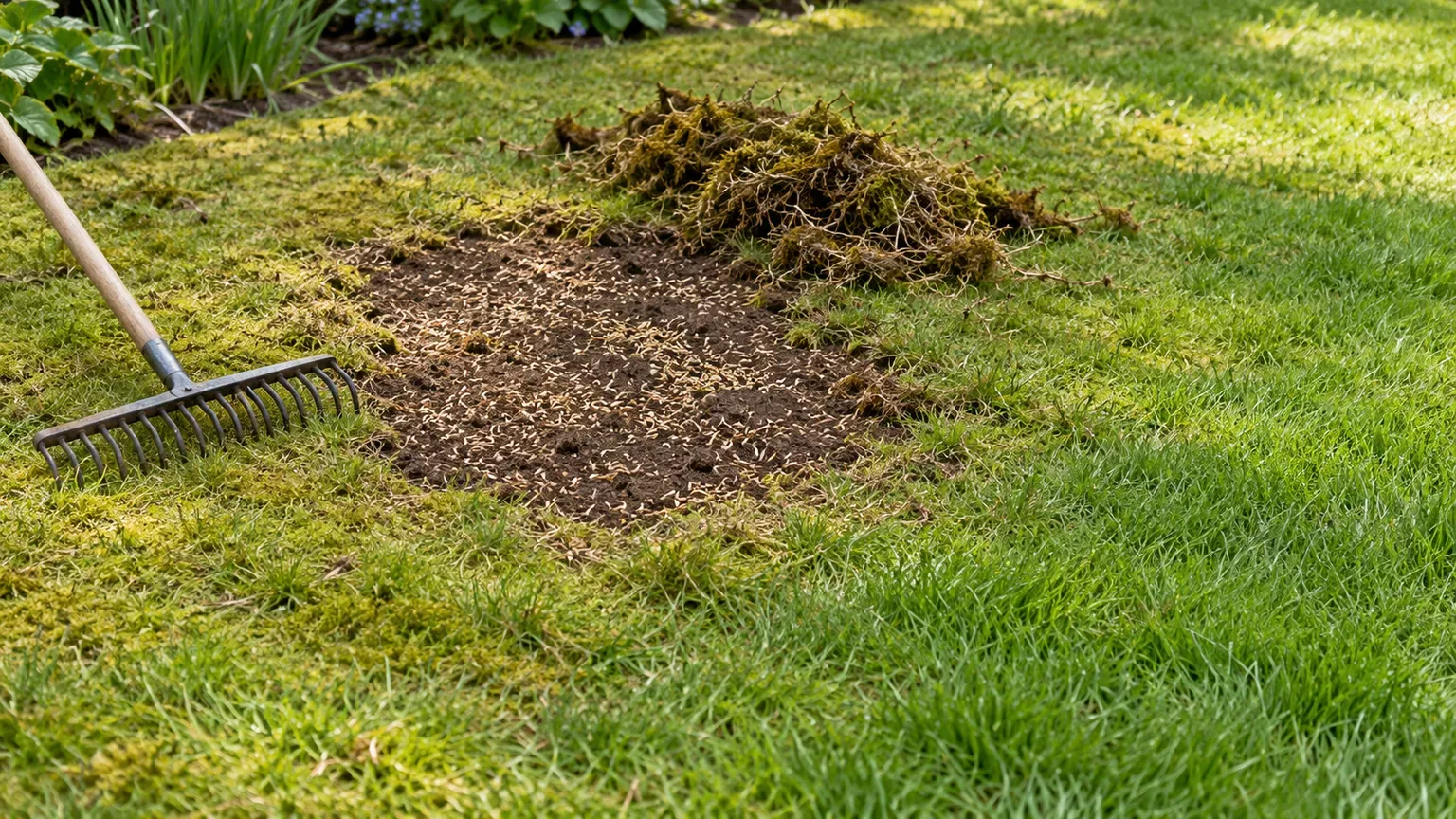
Rake when the moss is dry enough to lift cleanly and the soil is firm, not saturated. Wet ground compacts more easily underfoot, and sticky debris is harder to gather. Collect the loosened moss and thatch rather than leaving a thick mat on the turf; if you compost it, mix it through the pile with other materials instead of depositing a dense layer on a garden bed.
For a broad infestation, a powered scarifier can save time, but it is easy to set too deeply. Make a shallow test pass, inspect how much living grass has been removed, and adjust before continuing. A lawn that looks rough after scarifying is not necessarily ruined, but a severe pass at the wrong season can leave too little healthy turf to recover.
Use labeled moss controls carefully
A lawn-labeled moss control can make removal easier when moss is extensive or tightly woven through the grass. Products with iron sulfate may darken or kill moss, after which dead material often needs raking; other formulations work differently. Never infer the application rate or waiting period from an article, a different brand, or a lawn in another country: follow the product label for the exact turf, rate, protective steps, weather conditions, pets, and reseeding interval.
Treat a moss control as a cleanup tool, not a repair plan. The Royal Horticultural Society notes that no product kills moss permanently if favorable conditions remain, and BBC Gardeners’ World Magazine also describes moss control as short-term unless the cause is addressed. Iron products can stain paving or concrete, and an off-label or concentrated application can injure grass. Keep spray or granules off paths, drains, ponds, and other surfaces where runoff is a concern, and do not apply a product unless its label permits that use in your location.
Skip homemade recipes using bleach, vinegar, baking soda, or dish detergent on the lawn. Household products are not calibrated as turf treatments; a mixture strong enough to desiccate moss can scorch grass, affect nearby plants, or create runoff problems. If you want a nonchemical method, careful raking and a correction to the growing conditions are more predictable than experimenting on the whole lawn.
Repair the site in a lasting order
Once moss is out, look at the exposed patch before adding anything. Decide whether it is mostly too dark, compacted, wet, or thin from use, then make the smallest change that addresses the cause. The sequence matters: seed will not compensate for standing water, fertilizer will not create sunlight, and aerating a site with no compaction may do little for moss recurrence.
A practical order is: correct easy surface issues, relieve confirmed compaction if needed, prepare the soil, then seed or replace the area if grass is still a sensible choice. Repairing in stages makes it easier to see which intervention helped and limits unnecessary disturbance.
Correct light, water, and mowing conditions
If the cause is shade, reduce it where that is safe and practical; otherwise switch to a locally recommended shade-tolerant mix or a different ground cover. If irrigation is excessive, adjust the schedule and repair misdirected heads. If foot traffic created the opening, redirect the route with a stepping stone or path so new grass is not trampled before it establishes.
Mow high enough for the grass type and never remove so much blade that the lawn is scalped. Taller leaf area can help turf maintain vigor and cover the soil, but “mow higher” is not a universal number because recommended height differs by species and season. Use your local extension or seed supplier’s guidance, keep mower blades sharp, and reduce mowing frequency during drought or heat stress.
Fertilizer should follow the soil test and your grass’s seasonal needs. More nitrogen is not automatically better: excessive growth can increase mowing, stress roots, and fail to solve shade or drainage. A thin shaded lawn may need a lighter feeding program than a sunny, actively growing turf area; apply only the nutrients the test and regional schedule support.
Relieve confirmed compaction and improve drainage
Core aeration is most useful where compacted soil limits water and air movement. A core aerator removes small plugs; the holes create space for roots and water to move into the soil. For a small patch, a garden fork may loosen the surface, but repeated solid-tine holes do not remove soil and may be less effective in heavily compacted clay than hollow-tine aeration.
Aerate when the turf is actively growing and the soil is moist enough to penetrate but not saturated. Avoid working extremely wet soil, which can smear and compact, or very dry soil, which resists the tines. If you pull cores, leave them to break down or remove them according to the method recommended for your lawn; do not bury the crowns of grass with a thick layer of topdressing.
Persistent waterlogging needs more than routine aeration. A shallow depression may be corrected with careful grading and small, repeated topdressings compatible with the existing soil, while a drainage failure caused by a dense subsoil, slope, or runoff may need a designed drain or professional assessment. Dumping sand or compost over the lawn without understanding the soil profile can create a layered surface and make future drainage harder.
Reseed when the grass can establish
After moss removal, seed the exposed ground only when you can provide suitable conditions for germination and early growth. Choose a mix for the lawn’s region, sunlight, soil, and use; a tough play lawn, a dry sunny slope, and a low-traffic shade strip do not need the same seed. Follow the seed label for soil preparation, depth, and watering rather than scattering seed onto thick thatch or compacted soil.
Rake the surface lightly to expose soil, then spread seed evenly at the package rate. Press it into contact with the soil without burying it deeply, and keep the seedbed consistently moist until seedlings are established. After germination, reduce watering gradually and protect the patch from heavy traffic; young grass can be uprooted long before it is ready for normal use.
If a moss-control product was used, respect the label’s waiting interval before seeding. Some treatments require a delay, and the interval varies by formulation. Where the site remains too shaded or wet for turf, adding more seed is not a repair; convert the patch to a suitable ground cover, mulch, or path instead.
Follow a recovery calendar and evaluate results
Think in growing phases rather than expecting the lawn to look perfect the day moss disappears. First, remove moss during weather that allows safe access and turf recovery. Next, address the cause and seed during the locally appropriate establishment window. Then keep traffic light and water consistently while seedlings take hold; a lawn may need several weeks of care before a repaired area can tolerate normal use.
For cool-season turf, early fall is often a useful period for renovation because grass can grow while summer heat has eased, but spring can work when the soil and weather are suitable. Warm-season turf usually repairs best during warm active growth. These are broad regional patterns, not product instructions: a local extension calendar and the seed or treatment label should determine exact timing.
Inspect the patch after rain and again during the next season. If water still pools, roots remain shallow, or the area receives less light than nearby grass, expect another decline even if the first reseeding looks successful. Reassess the cause before repeating moss treatment; recurring moss in the same shape and location is useful evidence that the site has not changed enough for the lawn you want.
When a moss lawn or different ground cover is better
A mossy corner can be a reasonable finished landscape when it is shady, damp, and lightly used. Keeping it may reduce mowing and repeated seed purchases, preserve a soft green surface, and retain habitat used by small invertebrates. The Royal Horticultural Society describes moss as a viable alternative in conditions where lawn grasses struggle, while also noting that preferences and uses differ; moss is not the right surface for every garden or activity.
If you prefer a planted look, choose regionally appropriate shade ground covers that can handle the site’s moisture and foot traffic. For a route people use often, a stepping-stone path or durable surface may be more dependable than any living ground cover. Check how a plant spreads before using it, especially near natural areas or property boundaries, and confirm it is suitable for your climate.
The best choice is the one that matches the constraints rather than fighting them indefinitely. If trees provide deep shade you want to preserve and the ground stays damp, accept that the lawn may not behave like turf grown in full sun. Removing moss can still be worthwhile for a temporary cleanup, but a permanent moss-free promise is unrealistic when spores can arrive and the same favorable conditions remain.
Conclusion
To get rid of moss in your lawn, remove the existing mat with careful raking or a properly labeled lawn treatment, then make the area more suitable for the grass you want to grow. Start with the visible clues—shade, puddling, compacted soil, excess thatch, traffic, or weak turf—and confirm soil pH or nutrient issues with a test before applying lime or fertilizer.
If the patch can support grass, correct the cause, aerate only where compaction is real, and reseed with a locally suited mix during an active growth window. If it cannot support turf or receives little use, retaining moss or choosing another ground cover may be the lower-maintenance answer. The lasting result comes from matching the surface to the site, not from trying to sterilize every patch of moss.