How to Grow and Care for Flax Lily
Learn how to grow flax lily (*Dianella tasmanica*): choose the right light and climate, water it well, divide clumps, and solve common leaf problems.
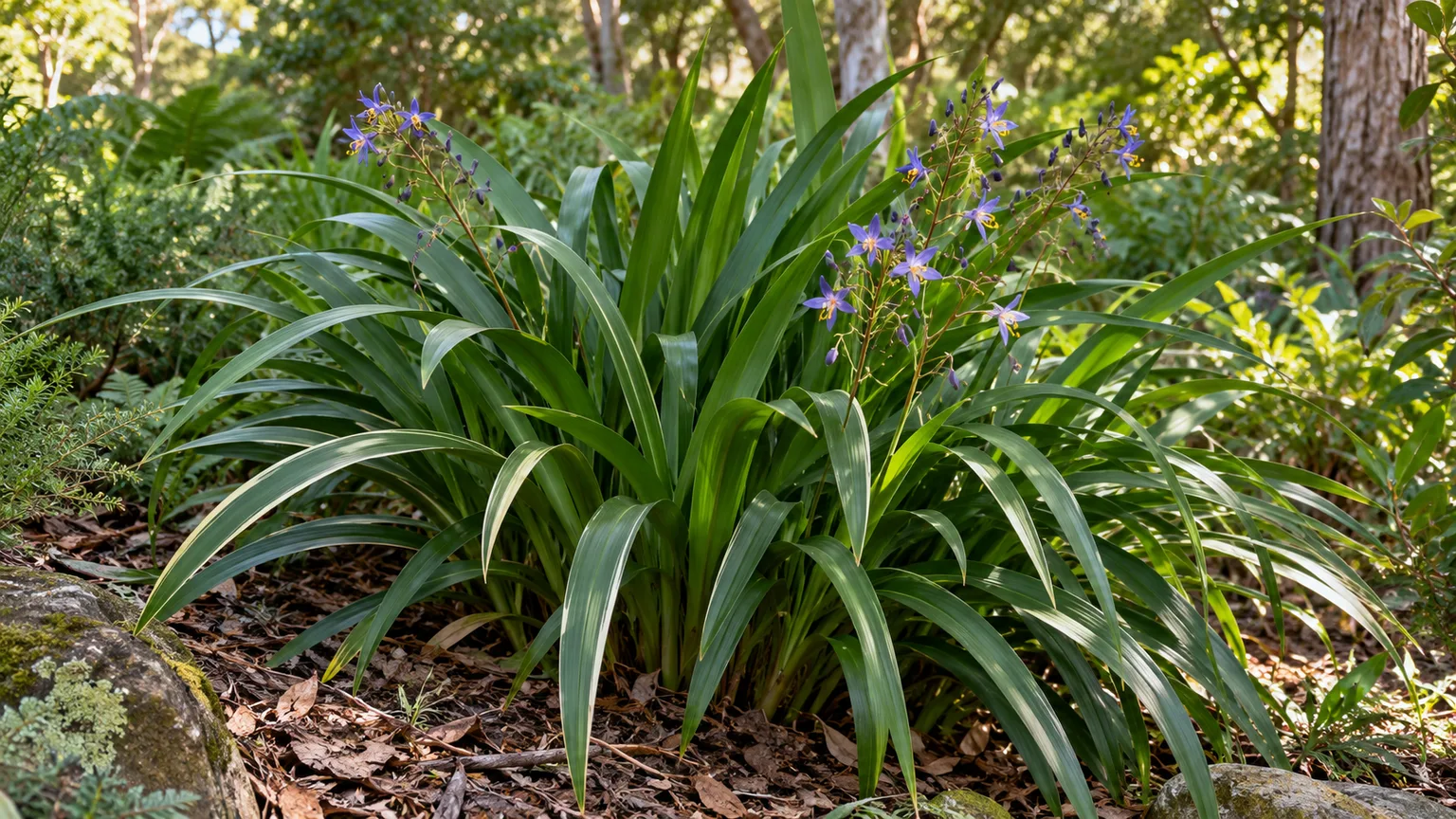
Flax lily is a useful choice when a garden needs bold, strappy foliage in a spot where flowering perennials often struggle. The plant most often sold under this name is Dianella tasmanica, a rhizomatous perennial from southeastern Australia and Tasmania; it is grown for its arching leaves, small blue flowers, and glossy blue berries. The name can also refer to other plants, so check the botanical label before you buy or follow a care guide. UF/IFAS Gardening Solutions describes its landscape and container uses, while the Royal Horticultural Society plant profile documents its native range and growth habit.
The main growing challenge is not feeding or frequent pruning. It is matching the plant to your light, winter temperatures, and soil drainage. Flax lily can handle some sun, shade, and dry spells after establishment, but those tolerances shift with climate and cultivar. A well-sited clump usually needs only occasional cleanup; a plant forced into baking sun or standing water can brown or collapse even if you follow a rigid calendar.
What Is Flax Lily?
Dianella tasmanica forms fans of linear, sword-shaped leaves from a short underground rhizome. Depending on the cultivar and growing conditions, a clump can stay compact or widen into a substantial mass; UF/IFAS reports many landscape plants around 1 to 3 feet tall and wide, while the RHS lists taller potential growth. Treat a nursery’s cultivar label and the space available in your own bed as better guides than one universal mature-size number.
The flowers are secondary to the foliage but worth noticing. Small blue to violet flowers, often with conspicuous yellow stamens, rise on branched stalks; shiny blue-purple berries may follow where flowers are pollinated. Flowering season varies by region: warm-climate references describe winter to spring bloom, while other garden references report spring into summer. Do not worry if your plant’s calendar differs from a neighboring climate’s description.
Tell Dianella tasmanica From Other “Flax Lilies”
“Flax lily” is not a precise botanical name. Dianella tasmanica is unrelated to common flax, Linum usitatissimum, which is grown for seed and fiber, and it is not a true lily. It is also distinct from New Zealand flax, Phormium, a different genus with much larger, tougher leaves and a more architectural fan shape. Nursery labels can also use “flax lily” for other Dianella species, so identify the plant by the Latin name before assessing its climate or environmental risk.
That distinction matters in Florida. UF/IFAS notes that D. tasmanica is used in Florida landscapes but separately identifies Dianella ensifolia as invasive and not recommended for natural areas in the state. The UF/IFAS Assessment entry for D. ensifolia lists it as invasive. This is not a blanket verdict on every plant sold as “flax lily”: check your local invasive-plant guidance using the botanical name on the pot.
Is Flax Lily Right for Your Climate and Garden?
The species is evergreen in mild conditions and is commonly grown outdoors in warm regions. Published hardiness guidance is not perfectly uniform: some horticultural references place it mainly in USDA Zones 9–11, while a UF/IFAS Extension blog suggests Zones 8–11 for variegated flax lily. That spread is a signal to treat a zone number as a starting point, not a guarantee. A sheltered urban courtyard, a windy exposed bed, a wet winter, and a dry freeze can produce different outcomes within the same zone.
In a mild climate, plant it as a perennial in a border, under light tree cover, or as a groundcover accent. In a marginal cold zone, favor a protected site with excellent drainage and accept that leaves may be cut back by frost even if the crown resprouts. Where hard freezes are regular or prolonged, grow it in a movable pot and overwinter it in a bright, frost-free place rather than gambling on a fixed outdoor planting. Gardenia’s Dianella tasmanica guide also emphasizes cold exposure and wet winter soil as limits.
Think about the plant’s spread before using it as a groundcover. Rhizomes help a clump fill space, but they can make later removal harder and allow it to edge beyond a small bed. Leave room around paths and neighboring plants, or keep it in a container if you want a tidy, confined accent. If local authorities list the species as invasive or discourage its planting, follow that guidance even if a nursery offers it for sale.
Where to Plant Flax Lily and How Much Sun It Needs
Aim for bright shade, dappled light, or morning sun with protection from intense afternoon heat. In a cool or mild-summer region, more direct sun may give compact growth and stronger flowering if the soil does not dry out. In a hot-summer climate, the same exposure can scorch leaf tips, so move toward filtered light or afternoon shade. The South Australian Plant Selector recommends it for shaded understory situations, while UF/IFAS reports that it can grow in sun or part shade in Florida; together, those recommendations show why climate changes the best placement.
Avoid a permanently dark corner if you want a dense clump or flowers. Deep shade can thin growth and, according to UF/IFAS Extension Nassau County, may make flax lily more susceptible to scale. The practical target is enough ambient daylight to read comfortably outdoors, but not necessarily direct sun on the leaves all afternoon.
Soil, Drainage, and Bed Preparation
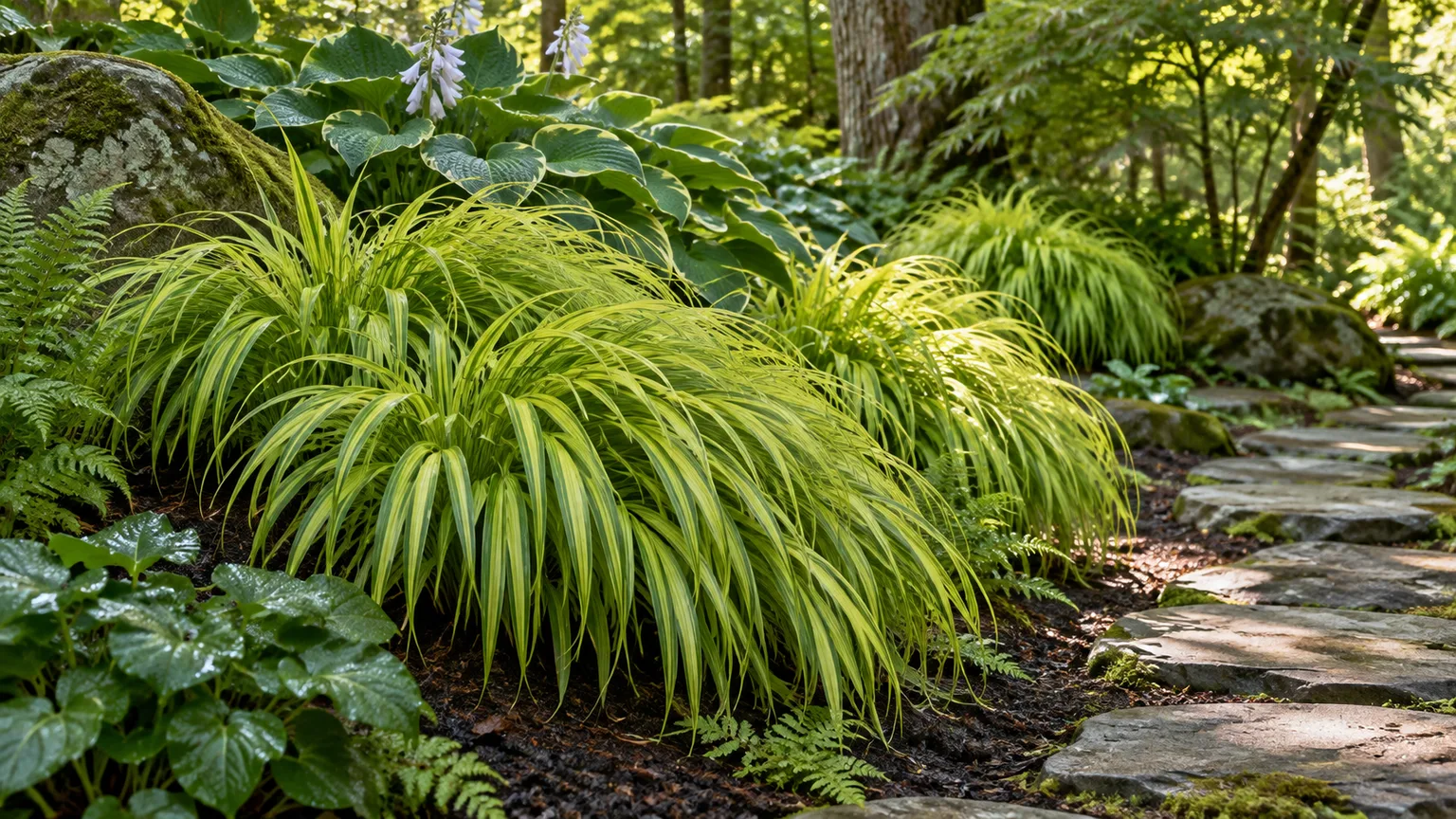
Flax lily is adaptable about soil texture, but the root zone should drain rather than stay saturated. The RHS recommends moderately fertile, humus-rich, well-drained soil with neutral to acidic pH. UF/IFAS describes it as tolerant of a range of garden soils as long as drainage is good. A heavy soil is not an automatic reason to reject the plant; a heavy, compacted basin that holds water around the crown is.
Before planting, watch the site after rain or irrigation. If water remains pooled for hours, improve the bed broadly by loosening compacted soil and blending in organic matter, or choose a raised bed or container. Avoid digging a small pocket of fluffy soil into dense clay: water can collect at the interface and keep roots too wet. In sand, add compost to improve moisture retention, then still let excess water escape.
A light mulch helps moderate soil temperature and slows drying, especially while new roots establish. Keep mulch a few inches away from the leaf bases so that the crown can breathe. More mulch is not a substitute for fixing a drainage problem.
How to Plant Flax Lily and Space It
Plant in spring when the soil is workable and the weather is not yet at its harshest. In mild climates, early fall can also work if the plant has time to root before cold weather. Water the nursery pot first, slide out the root ball, and loosen only roots that are tightly circling. Set the crown at the same depth it grew in the pot; burying the leaf bases can trap moisture and invite decline.
Spacing depends on the cultivar and how quickly you want the bed to fill. For individual accents, leave enough space for the mature width listed on the tag, often around 1 to 3 feet for landscape forms. For a mass planting, closer spacing closes gaps sooner but costs more and increases competition; measure from plant center to plant center rather than packing crowns together. Water slowly after planting so the entire root ball and surrounding soil settle without washing it out.
How to Water Flax Lily as It Establishes
Water newly planted flax lily deeply enough to moisten the root ball and the soil just beyond it. During the first several weeks, check the soil every few days rather than following a fixed “twice a week” schedule. If the root zone is dry a finger-depth down, water; if it is still cool and moist, wait. Heat, wind, rainfall, shade, soil texture, and pot size all change how quickly it dries.
As the plant roots into the bed, lengthen the time between waterings and water during prolonged dry spells. Established plants can tolerate drought better than a newly planted division, but “drought tolerant” does not mean that foliage stays pristine without water. A dry plant often has crisp margins and dry soil; an overwatered plant may droop while the soil remains wet and can develop soft or yellowing leaves. Check the soil before adding more water.
For containers, feel the mix near the drainage holes and lift the pot if its weight gives you a reliable dry-versus-wet comparison. Water until excess flows out, empty any saucer, and do not leave the pot standing in runoff. Reduce watering in cool, low-light winter conditions, but do not let the root ball become bone dry for long periods indoors.
Does Flax Lily Need Fertilizer or Mulch?
Usually, no heavy feeding is needed. Start with reasonably fertile soil and a thin layer of compost; if growth is pale or weak after the plant has established, use a modest, balanced slow-release fertilizer in spring according to its label. Avoid strong doses of acid-loving-plant fertilizer by default: the RHS accepts neutral as well as acidic soil, and an unnecessary high-nitrogen feed can push soft foliage without correcting shade, drainage, or root problems.
Mulch is often more useful than fertilizer. A shallow organic layer can conserve moisture and improve soil over time, while leaving the crown uncovered prevents a persistently damp collar. If foliage growth is healthy and the plant is expanding, do not add fertilizer simply because the calendar says spring.
Seasonal Care and Pruning
Flax lily is not a plant that needs an annual haircut to perform. Remove individual dead, damaged, or unattractive leaves at their base with clean pruners, and cut spent flower stalks only if you do not want the berries. The RHS says routine pruning is unnecessary; UF/IFAS recommends cutting an established plant to the crown in late winter when it has extensive dead leaves or when variegated growth has reverted to solid green. Reserve that hard reset for a real cleanup need, not as a yearly rule.
In spring, check whether the clump is overcrowded, whether old leaves are hiding healthy new growth, and whether the crown has stayed firm through winter. In summer, monitor recently planted clumps and containers during heat waves. In fall, avoid late heavy pruning in regions where foliage offers some protection from cold; remove damaged leaves after you can see what survived.
What to Do After Frost Without Shearing the Clump
After a freeze, brown leaves do not prove the roots are dead. Wait until the worst cold has passed and new growth begins, then trim only foliage that is clearly dead. If the whole clump has collapsed, cut back damaged material close to the crown without slicing into it, and keep the soil lightly moist but not waterlogged while you wait for recovery. Established plants may resprout from the roots in warm weather, as UF/IFAS notes, but recovery is less dependable after severe cold, prolonged wet, or a weakly rooted fall planting.
How to Divide and Propagate Flax Lily
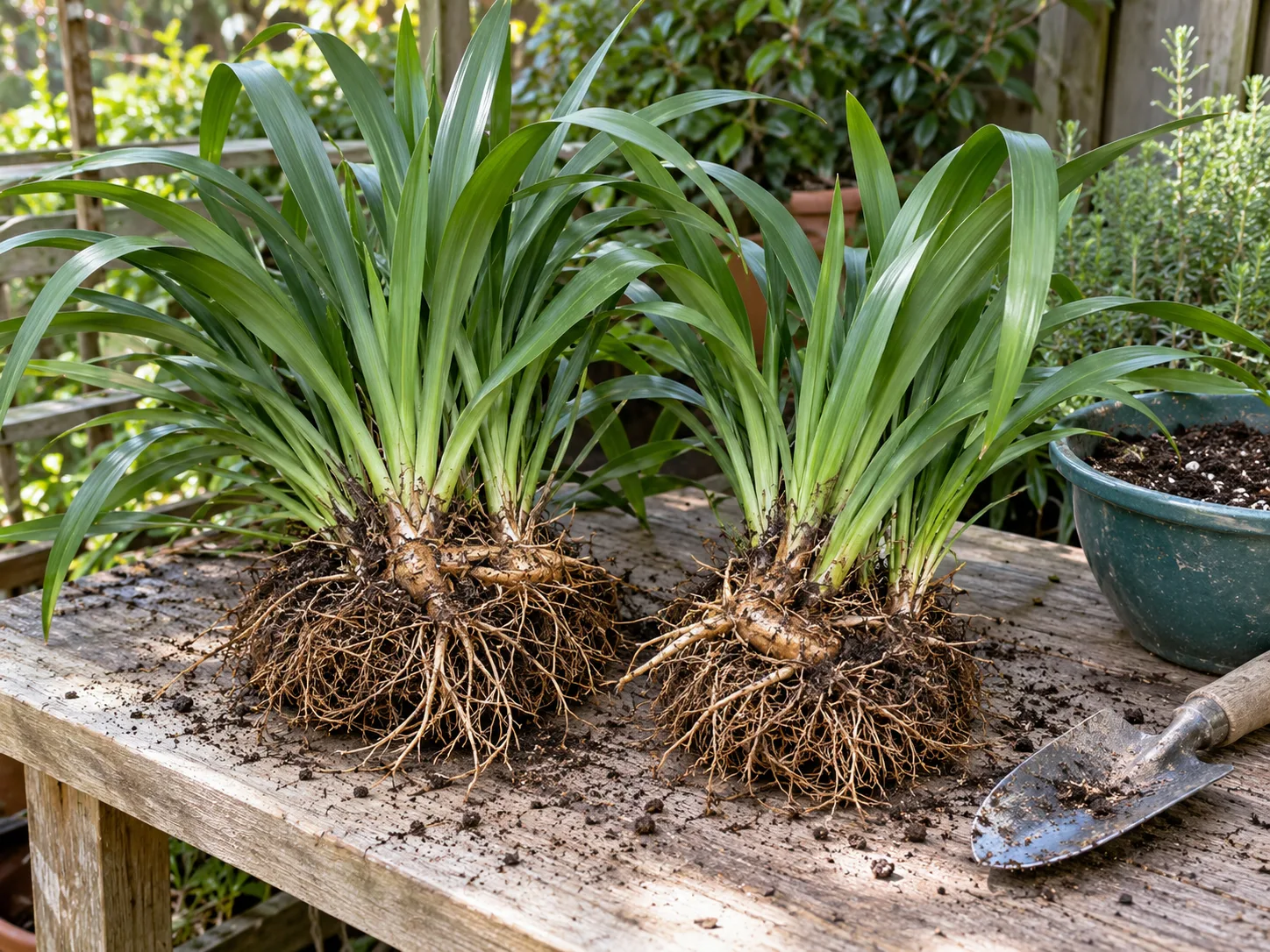
Division is the easiest way to make more plants and rejuvenate an oversized clump. The RHS recommends dividing rhizomes in mid-spring, and UF/IFAS likewise recommends spring division. Choose a cool day after rain or water the plant the evening before, so the root mass is easier to lift and less likely to dry while you work.
- Dig around the outer edge of the clump, keeping the shovel far enough from the leaves to preserve a generous root mass.
- Lift the clump and brush away loose soil until you can see the rhizomes and the points where fans of leaves emerge.
- Pull apart natural sections or cut through a dense mass with a clean, sharp knife. Each division should have several healthy leaves and a substantial piece of rhizome with roots attached; tiny rootless fragments may fail.
- Replant divisions promptly at the original depth, firm soil gently around them, and water thoroughly. Keep them evenly moist while they establish, then taper irrigation as new growth confirms recovery.
Do not divide just because five years have passed. Divide when the center thins, the clump crowds its neighbors, or you need additional plants. Seed propagation is possible, but seedlings take longer and may not match a named variegated cultivar. For a faithful copy of a selected plant, divide it instead.
Growing Flax Lily in Containers
A pot is a practical choice if your winters are colder than the plant can reliably handle, your soil drains poorly, or you want to contain rhizomes. Choose a sturdy container with several open drainage holes and enough width for the clump to expand. A pot only slightly larger than the root mass dries quickly and can tip as the leaves arch outward; a very oversized pot holds wet mix around a small root system for too long.
Use a quality potting mix that drains freely rather than dense garden soil. Set the crown at the same level as before, water until runoff appears, then empty the saucer. Place the container in bright shade or morning sun in hot climates, and check moisture more often in wind or direct sun. In cold regions, move the pot before a hard freeze to a bright, cool, frost-free area; do not wait until the leaves are frozen solid.
Repot or divide when roots fill the container, water runs straight through without wetting the root ball, or the plant has become too crowded to look balanced. If the pot is still appropriately sized, refresh part of the mix and divide only if you want to reduce the clump.
Flowers, Berries, and Cultivar Choices
Foliage is the dependable feature; flowers and berries are seasonal bonuses. Blue-violet blooms on branching stems can appear in different months depending on local temperatures and light. More sun in a mild climate may support flowering, but moving the plant into scorching afternoon sun just to chase blooms is a poor trade if the leaves burn. Give it its preferred light and accept that a young, newly divided, deeply shaded, or indoor-grown plant may flower sparingly.
The white-edged ‘Variegata’ is a commonly grown selection; Singapore’s NParks Flora & Fauna Web describes its cream-edged foliage and notes that it fruits less than the species. Other named forms can differ in stripe color, size, and cold response, so buy by cultivar tag rather than by a photo alone. A green form may blend more naturally under trees, while a variegated form reads clearly against darker foliage.
Treat the shiny blue berries as ornamental, not edible. The RHS flags the fruit as not to be eaten. If children or pets share the garden, remove developing fruit stalks or site the plant out of reach; do not rely on color or bird interest as evidence that a berry is safe for people.
Troubleshooting Flax Lily Leaves
Before changing care, look at three things together: which leaves are affected, how quickly the symptoms appeared, and whether the soil is wet or dry. Older outer leaves naturally age and can be removed; new growth that is uniformly collapsing or discolored points to a more urgent problem. A symptom alone rarely identifies one cause.
Brown Tips or Scorched Leaf Edges
Crisp tips often follow hot afternoon sun, dry wind, a missed watering during establishment, or a container that has dried completely. If the soil is dry, water the root zone and adjust the exposure or checking interval. If soil is moist, do not add more water automatically: move a sun-stressed plant into afternoon shade and inspect for salt crust in a container. Trim brown ends for appearance, but leave green tissue and correct the cause before cutting the whole plant back.
Yellow, Soft, or Drooping Leaves
Drooping can come from thirst, but drooping in wet soil points in the opposite direction. Check several inches down and smell the root zone: consistently wet, sour-smelling soil or a soft crown suggests drainage trouble or root decline. Stop routine irrigation, clear blocked pot holes, and move container plants out of standing water. If the site repeatedly stays saturated, lift and replant in a raised, better-drained bed when conditions allow.
Spots, Powdery Coating, or Scale
Leaf spot and powdery mildew can occur, particularly where foliage stays crowded and damp. Improve air movement, avoid frequent overhead watering, and remove badly affected leaves rather than spraying by guesswork. A powdery coating, discrete spots, and orange rust-like marks are different symptoms and do not automatically call for the same treatment. Inspect leaf undersides for scale, especially in deep shade; if the problem persists, identify the pest or disease and follow local extension guidance and any product label before treatment.
Conclusion
For a healthy flax lily, begin by confirming that the plant is Dianella tasmanica, then match it to a sheltered, bright site with soil that drains. Water consistently while it establishes, ease off once roots spread, and resist unnecessary feeding or yearly shearing. In a cold or wet-winter location, a container gives you control over the two risks that most often defeat an otherwise hardy-looking clump.
Spring division is a simple way to expand or reset an established planting, provided every section keeps roots and a healthy fan of leaves. Give the plant room for its rhizomes, treat its berries as ornamental, and check local guidance by botanical name when planning a landscape. With those choices made up front, flax lily can provide durable foliage with very little routine work.



