Can You Replant a Christmas Tree? Check the Roots
Can you replant a Christmas tree? Learn how to spot a rooted tree, limit indoor time, prepare for frozen ground, plant at the right depth, and care for it.

A Christmas tree can be replanted only if it still has a living root system attached. A tree sold with a soil-covered root ball or grown in a nursery container may be plantable; a cut tree with a bare trunk is not. Before you start digging, check the trunk base and the growing container, then consider whether the species, indoor stay, and winter conditions give it a realistic chance.
That distinction is easy to miss because “real,” “fresh,” “potted,” and “living” are sometimes used loosely at tree lots. The useful question is not whether the needles are green or the trunk is fresh-cut. It is whether healthy roots remain connected to the trunk, and whether those roots can be kept moist and dormant until planting.
The quick answer: roots determine whether replanting is possible
A cut Christmas tree cannot be replanted as a tree. Once the trunk has been severed from the root system, placing its base in soil or water will not restore the roots. A cut evergreen can still be composted, chipped, or used for other local reuse programs, but it cannot be transplanted into a yard as a live tree.
A container-grown or balled-and-burlapped (B&B) tree has roots and may be planted after the holidays. Even then, “may” matters: nursery digging removes some roots, and a warm, dry home can push a cold-adapted evergreen out of dormancy. NC State Extension explains that living trees often fail to establish because the species does not suit the planting climate, the tree dries out, or indoor display lasts too long.
| What you bought | How to recognize it | Can it be replanted? |
|---|---|---|
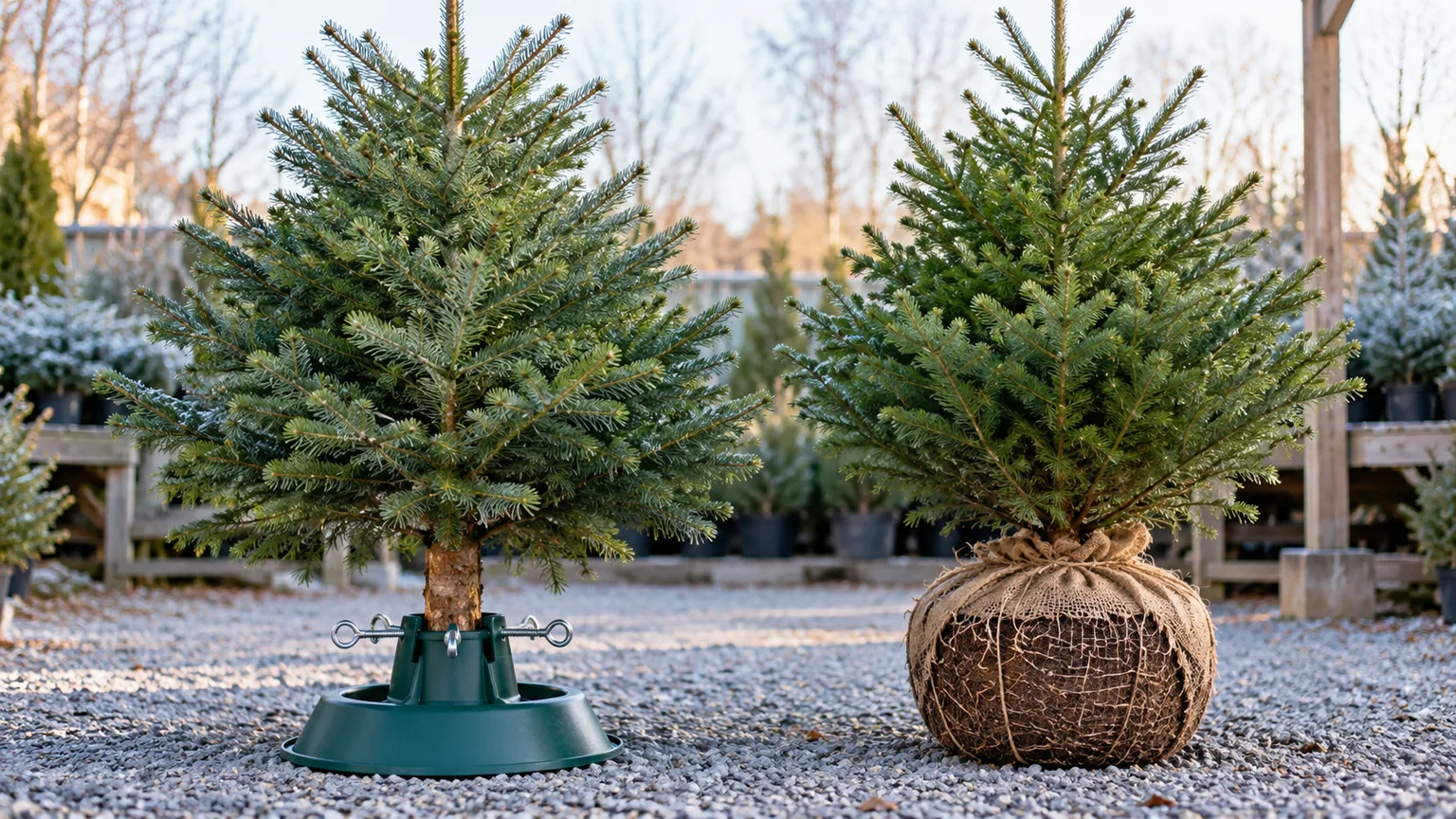
| Cut tree | Trunk has a fresh saw cut and sits in a water stand; no soil or rooted pot is attached | No, not as a whole tree |
| Balled-and-burlapped tree | Soil ball around the roots, usually wrapped in burlap and sometimes held by wire | Yes, if the root ball stays intact and the species fits your site |
| Container-grown tree | Roots and growing mix are established in a nursery pot | Yes, if the tree is healthy, suitable for your climate, and not badly root-bound |
| “Potted” tree with uncertain history | Tree is sitting in a pot, but roots may have been cut or forced into the pot shortly before sale | Maybe; inspect the root system and ask the seller how it was grown |
Identify what kind of Christmas tree you have
Balled-and-burlapped trees
A B&B tree was grown in the ground, then dug with a portion of its roots and surrounding soil intact. The root ball is wrapped to keep that soil together. It is usually heavy, and its weight is one reason to plan the planting site before bringing the tree home. A large crown balanced on a reduced root system also has a harder time replacing water it loses through needles.
Check that the ball feels firm and holds together when the trunk is gently moved. Do not lift the tree by its trunk or drop it onto a hard surface; support the ball from below when moving it. The University of Illinois Extension’s care guide recommends supporting B&B root balls in a watertight tub indoors and keeping the soil moist, not flooded.
Container-grown and “potted” trees
A true container-grown tree has grown in that pot long enough to develop roots through the surrounding mix. When you gently slide the plant from its nursery pot, the root-and-soil mass should hold together, and fine roots should be visible near the outside. Some circling roots are common in nursery pots, but a densely matted root mass or a plant that rocks loosely in the container deserves a closer look.
A pot alone does not prove the tree was grown in it. Some sellers place a recently dug or root-pruned tree into a container to make it easier to display. Ask whether it was container-grown or dug and potted, how long it has been in the pot, and what species it is. If a seller cannot answer, treat success as uncertain rather than assuming a marketing label guarantees a transplant-ready root system.
Cut trees without roots
A trunk cut flat at the bottom and placed in a stand is a cut tree, even if it was recently harvested or sold as fresh. It has no root ball to move into the ground. Setting the trunk in a bucket of soil after Christmas will not make it a rooted tree.
Taking a branch cutting is a separate propagation project, not a way to replant the tree itself. Many evergreen cuttings need the right species, shoot maturity, season, rooting conditions, and time; ordinary decorated boughs are not a reliable shortcut. If yours is cut, use a municipal collection program or another suitable reuse option instead.
Set realistic expectations for survival
A rooted tree is a candidate, not a guaranteed success. B&B trees have lost part of their original roots during digging; container-grown trees may have compacted or circling roots; and either type can suffer after a short spell of dry soil or a long stay in a heated room. A tree with a large canopy relative to its root ball has a more demanding water balance than a small, well-rooted specimen.
The best odds come from a healthy, modest-sized tree of a species adapted to your region, a root ball that has not dried out, a brief indoor display, and a ready planting site. UC Cooperative Extension’s living-tree advice notes that smaller trees are lighter to handle and have a better chance of surviving outdoors. This does not mean a large tree cannot take; it means its extra weight and transplant stress should count in your decision.
Do not judge viability from needle color alone. Green needles do not confirm that roots are intact, and some browning after a difficult transition does not prove the whole tree is dead. The root system, bud condition, species fit, and care history together give a more useful picture than a single symptom.
Choose a tree and site that fit your climate and yard
Select the permanent planting spot before buying the tree. Many familiar Christmas-tree species become large landscape trees, with a wide branch spread and roots that need room. Check the tag for the botanical name and mature size, then consider overhead wires, buildings, paving, drainage, wind exposure, and how much shade the growing tree will cast.
Climate fit is just as important as size. A species that thrives on a cool mountain site may struggle in a hot, humid lowland yard, even if the nursery sells it locally. NC State Extension, for example, distinguishes between mountain conifers and trees better suited to warmer parts of North Carolina. UF/IFAS makes the same practical point for Florida: choose a native or adapted species and do not equate local availability with local suitability.
Ask the nursery for the species and cultivar, the tree’s production method, and the region or hardiness range it can tolerate. A label that says “spruce” or “fir” may not be specific enough for a good landscape decision. If the tree is sold as a tabletop holiday decoration or has been grown in a greenhouse, it may need protected conditions rather than immediate winter planting; follow its tag and local extension advice.
Prepare before the tree comes inside
If you want to plant after Christmas, choose the site and prepare for the ground freezing before the holiday. In cold-winter regions, dig a hole while the soil is workable, save the excavated soil somewhere it will not freeze, and cover the open hole safely. Cornell Cooperative Extension recommends preparing the planting area in advance and protecting both the hole and backfill soil from freezing. This small piece of planning can turn a frustrating January job into a manageable one.
Keep the tree outdoors in a sheltered, shaded location until shortly before decorating. Moving it from outdoor cold straight into a warm living room is a sharp change, so a cool porch or unheated garage can serve as a brief transition area. Keep the root ball moist while it waits outside; a root ball that dries before the tree is even displayed starts the holiday period under stress.
Also decide how you will move it. B&B trees can be surprisingly heavy once the soil is wet, and a six-foot tree may require more than one person or a hand truck. Protect the root ball from impacts and plan a route into the house that avoids dragging or tipping the tree by its trunk.
Keep the root ball moist and the tree cool indoors
Use a short indoor display. Guidance differs by region and conditions: University of Missouri recommends only three to five days; Illinois suggests four to five; Cornell says four to seven; and the RHS allows up to 12 days while advising growers to let the tree’s condition guide them. The common principle is more useful than pretending there is one safe number for every tree: the warmer and drier the room, and the longer the display, the greater the risk that a dormant evergreen will lose cold hardiness. For the best chance of replanting, plan on only a few days indoors, especially in a warm home or a region with severe winter cold.
The RHS guidance for Christmas trees recommends a cool room and bringing a living tree inside as late as possible. Keep it away from fireplaces, radiators, heating vents, and direct sun. Low-heat LED lights are a sensible choice because hot bulbs can warm foliage and add another stressor. Skip fertilizer and do not treat the tree as an ordinary houseplant that belongs indoors all winter.
Check moisture at least daily. The roots need a damp growing medium, not a stagnant pool: water container-grown trees when the root ball begins to dry, and use a tub or saucer that catches runoff without leaving the bottom continuously submerged. For B&B trees, a shallow watertight container can help hold moisture, but the ball should not sit in deep water. UF/IFAS recommends moist but not soggy roots, a useful rule whether the tree is in a pot or wrapped in burlap.
Avoid flocking or artificial snow if you plan to plant the tree; it can coat needles and complicate care. Do not rely on misting as a substitute for watering the soil ball. If a tree begins pushing fresh, soft growth indoors, take that as a warning that it may have started leaving dormancy; new growth is more vulnerable when returned to winter weather.
Move the tree back outside gradually
After the holiday, remove ornaments and move the tree to a cool, sheltered place such as an unheated garage, shed, or protected porch. This lets it adjust to colder conditions before it faces outdoor wind and frost. Recommendations vary on the length of this transition: Cornell Cooperative Extension suggests about a week, while the exact interval should reflect how long the tree was indoors, how warm the room was, and how severe the outdoor weather is.
Keep the root ball moist in the transition space and protect it from drying winds. Do not move a tree that has spent a long time in a warm home directly into a hard freeze and assume a day in the garage will erase the stress; NC State Extension cautions that acclimation measures are only marginally helpful once dormancy has already broken. If buds have swollen or new shoots have emerged, protect the tree and ask your local extension office for advice based on your climate rather than rushing into an extreme temperature change.
Plant the tree without burying its root flare
Plant when the soil is workable and the weather is not dangerously harsh. Before you start, water the root ball so the soil is evenly moist and stable. If the ground is frozen solid, do not chip out a small, cramped hole or force the root ball into frozen soil; use the storage plan below until planting can be done properly.
Prepare a wide, shallow hole
Make the hole at least twice as wide as the root ball or nursery pot and no deeper than its height. The sides can be loosened so new roots meet friable soil, but do not make a deep, narrow cavity that leaves the trunk sitting below grade. Gardener’s Supply’s live-tree instructions also call for a hole at least twice the root ball’s width and the same depth.
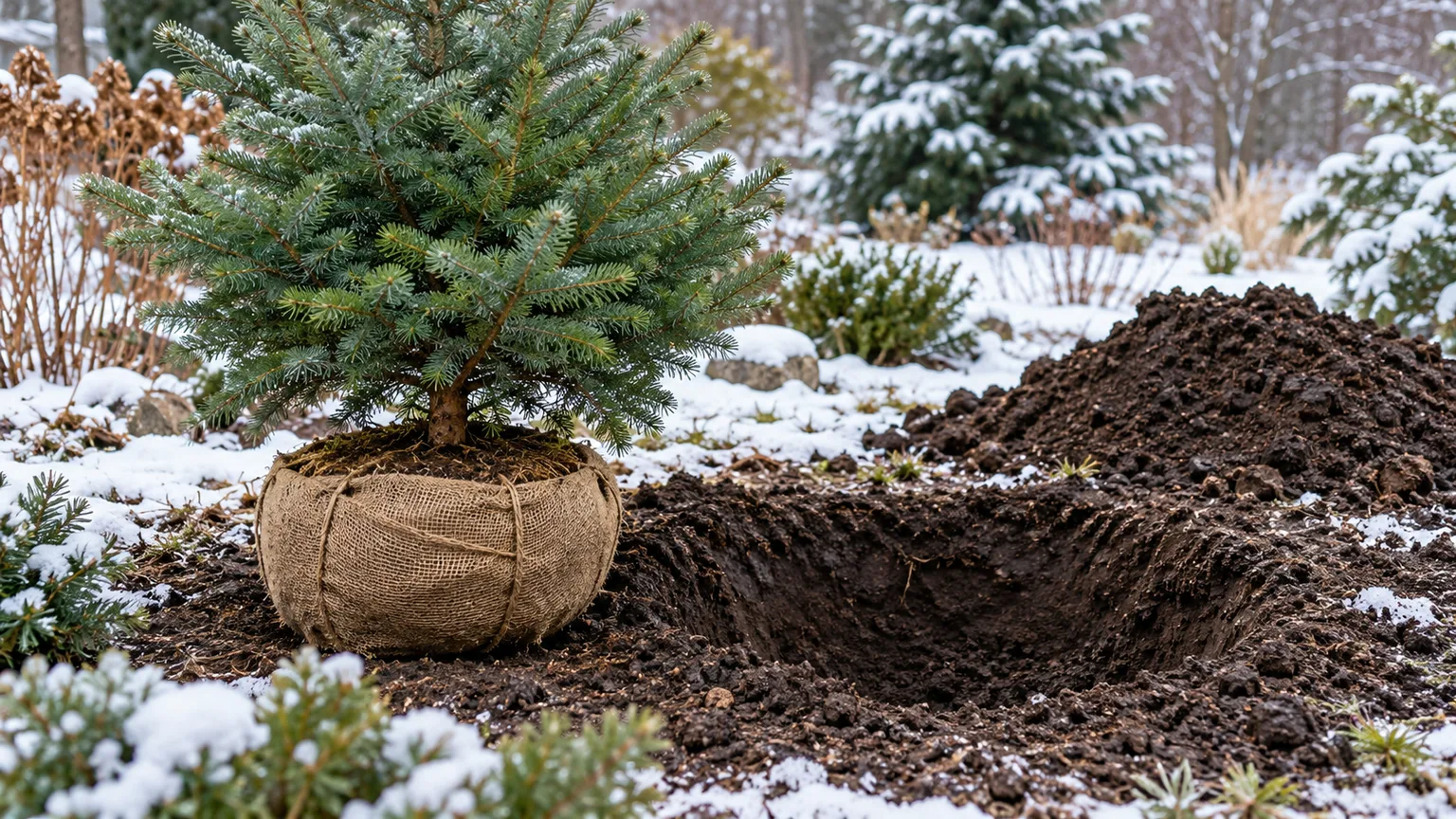
Before setting the tree in the hole, find the root flare: the point where the trunk broadens and the main roots begin. Scrape excess soil from the top of a pot-grown root ball if the flare is buried in nursery mix. The final grade should expose the flare at soil level or slightly above it, not cover the trunk base with a mound of soil. Planting too deeply can keep the trunk base wet and make establishment harder.
Free the roots from the pot or wrapping
Remove a plastic nursery pot completely. If the tree is root-bound, loosen or make a few vertical cuts through tightly circling outer roots so they can grow outward; do not shred the entire root mass. Set the tree at the right height before backfilling, and keep the root ball supported while you remove the container.
For B&B trees, cut away twine and any synthetic or treated material that will not decompose. Advice about natural burlap and wire baskets varies because removing them can disturb a fragile root ball. At minimum, fold back and remove the material from the top of the ball and trunk flare so nothing can constrict the trunk as it grows. If the ball is stable and the wrapping can be removed without breaking it, remove more; if not, avoid dismantling the roots in a way that causes the soil ball to collapse. The NC State guidance distinguishes natural burlap from synthetic material, while Illinois recommends removing the wrapping and twine during planting.
Backfill, water, and mulch
Backfill with the soil you removed unless a local soil test or site condition indicates a specific amendment is needed. Firm the soil gently as you fill to close large air pockets, but do not stomp it into a hard mass. The trunk should remain straight, the root flare visible, and the top of the root ball level with or just above the surrounding soil.
Water slowly and thoroughly after planting so soil settles around the roots. Add a broad layer of organic mulch over the disturbed root area, keeping it a few inches away from the trunk. Mulch helps moderate soil temperature and moisture, but a volcano piled against the trunk traps moisture where bark should stay exposed. Stake only if the tree is unstable or exposed to strong wind; remove support once it is secure so the trunk can move naturally.
What to do when the ground is frozen
If the ground is frozen or snow-covered, the tree does not need to stay in the heated house while you wait for spring. Keep it in an unheated garage, cold frame, shed, or protected outdoor area that shields the foliage and root ball from drying wind and direct sun. Surround or cover the root ball with insulating mulch, leaves, or straw, and check it during mild spells so it does not dry out. The goal is to keep the tree cold and dormant while preventing the roots from freezing hard or drying completely.
The distinction is between cold storage and warm indoor storage. A cold, sheltered space keeps the tree’s seasonal state closer to the outdoors; a heated basement or spare room can prompt growth and expose the tree to weak light. Cornell Cooperative Extension advises holding a tree in an unheated protected place if snow prevents planting, then planting in spring. When the soil thaws and can be worked without smearing or compacting, move the tree outside and plant it at the correct depth.
If the ground is merely cold but not frozen, planting can still be possible during a mild spell. Use local guidance because soil drainage, freeze-thaw cycles, and species hardiness differ by region. Do not water a frozen root ball so heavily that it sits in water that will freeze around it; check moisture and wait for conditions that allow excess water to drain.
Care for the tree through its first year
After planting, monitor soil moisture instead of relying on a fixed calendar. Evergreens continue losing water through their needles in winter, and recently disturbed roots may not replace it quickly. During mild, dry periods when the soil is not frozen, check the root zone and water if it is drying; in spring and summer, water deeply when the root area becomes dry, then allow excess moisture to drain.

The first growing season is about root establishment, not forcing fast top growth. Illinois Extension emphasizes supplemental watering during the first year, and UF/IFAS notes that regular watering may be needed for at least two years, particularly in dry regions. Adjust to your rainfall, soil, and species. A sandy site dries faster than a heavy one, but heavy soil that stays wet can suffocate roots; “water regularly” does not mean keeping the soil saturated.
Hold off on fertilizer at planting. NC State advises waiting until spring growth begins and avoiding heavy nitrogen in the first year while roots establish. Do not prune the tree into a perfect store-bought cone right away; remove broken or dead material, then let the tree recover before shaping. If you want a smaller mature plant, choosing a compact cultivar before purchase is more reliable than repeatedly cutting a full-size evergreen back.
Read early warning signs without overreacting
Some needle loss or brown tips can follow transplant stress, winter wind, or a damaged root system. A few brown interior needles are less concerning than progressive browning at branch tips, widespread needle drop, limp shoots, or buds drying before spring. Check the soil first: a dry root ball needs water when the ground is unfrozen, while sour-smelling, persistently wet soil calls for better drainage rather than more irrigation.
Look for change over time rather than diagnosing from one day. If buds remain firm and green and only a small portion of the foliage is affected, protect the tree from drying wind and maintain appropriate moisture. If the crown turns uniformly brown, the root ball was broken or dried badly, or the tree is clearly unsuited to the site, it may not recover. Do not add fertilizer, prune heavily, and increase watering all at once; those actions can hide the real cause and create new stress.
A rooted holiday tree is a transplant, so it may need a full season before new growth is obvious. Do not assume “no growth by February” means failure, since many conifers are dormant in winter. Wait for spring bud development, continue sensible care, and seek local help if the decline accelerates.
If the tree was cut, reuse it another way
A cut tree cannot go back into the ground, but it still has useful options. Many municipalities collect trees for chipping, composting, or erosion-control projects; check your local rules first, because decorations, flocking, and stands usually need to be removed. You can also cut clean branches into small pieces for a wildlife brush pile or use the woody material in a suitable composting system.
Using a cut tree is not automatically wasteful. The University of Missouri explains that Christmas trees are commonly grown as a renewable crop, often on land less suited to other agriculture, and growers replant after harvest. Choose a re-use route available in your community rather than putting a rootless trunk into a hole where it cannot survive.
Conclusion
You can replant a Christmas tree only when it still has healthy roots, and a rooted tree survives best when it stays dormant, moist, and outdoors for most of the season. Check whether yours is container-grown or B&B, confirm that its species fits your climate and available space, keep indoor display brief, and prepare the planting site before winter freezes the soil.
When the tree is ready, protect the root ball, plant it no deeper than it grew in the nursery, expose the root flare, water thoroughly, and maintain moisture as it establishes. If the ground is frozen, use a cold, sheltered storage spot until the soil is workable. If you have a cut tree, skip the shovel and choose composting or community recycling instead.