How to Grow Cowslip (Primula veris) in Your Garden
Learn how to identify cowslip (Primula veris), choose the right light and soil, start seed through winter dormancy, and support its meadow-style growth.

Common cowslip (Primula veris) is a compact spring perennial with a basal rosette of crinkled leaves and a stem of nodding, golden-yellow bells. It belongs in a garden that can offer cool-season moisture, drainage, and enough light for flowers—not in a permanently soggy bed or a dense, uncut thicket. The plant’s natural history also affects how you grow it: fresh seed can be dormant, seedlings need open ground to establish, and mowing too early removes the next generation.
The advice below separates the European species’ natural habitat from its behavior as a garden introduction elsewhere. That matters because a plant can be a familiar native wildflower in one region and an introduced garden escape in another. Check local guidance before collecting or sowing it outside a cultivated bed.
Cowslip at a glance
| Feature | What to expect |
|---|---|
| Botanical name | Primula veris |
| Plant type | Short-rhizomatous, clump-forming perennial |
| Mature size | Usually a few inches to about a foot tall; varies with site |
| Flowers | Nodding yellow bells in a cluster atop a leafless stem |
| Flowering season | Spring, with timing shifting by climate |
| Best setting | Open meadow edge, short grass, or light woodland margin |
| Soil | Moist but well drained; tolerates a range from mildly acidic to calcareous |
Cowslip can slowly form a patch by short rhizomes and seed, though a sparse planting may take several seasons to look natural. The Botanical Society of Britain and Ireland (BSBI) describes it as a potentially long-lived perennial of damp but drained grassland, while the RHS recommends moist, well-drained soil and partial shade for garden use (BSBI species account; RHS primrose growing guide).
How to identify common cowslip
Look at the whole plant rather than judging from yellow color alone. Cowslip leaves grow from the base in a flattened rosette; they are green, wrinkled or puckered, and often have shallow irregular teeth. In spring, a slender, mostly leafless stalk rises from that rosette and carries a cluster, or umbel, of several bell-shaped flowers. The flowers usually nod and face outward from one side of the cluster, and many have orange to reddish spots near the throat.
The combination is more useful than any single trait: basal rosette, bare stem, one-sided drooping cluster, and small tubular bells. The exact height and flower count vary with age and growing conditions, so do not reject a healthy plant simply because it is shorter or carries fewer flowers than a photograph. Regional botanical records describe stems around 10 to 20 centimeters and clusters that can hold many flowers, but the garden plant’s stature is not a reliable field mark by itself (BSBI species account; Native Plant Trust’s Go Botany description).
If you are identifying a volunteer in a lawn, wait until it flowers if you can. A leaf-only rosette is harder to confirm and may belong to another primrose or a unrelated broadleaf plant. Do not dig up a wild specimen to check it; photograph the leaves, stalk, and flower cluster, then compare those features with a reliable regional flora or herbarium guide.
Cowslip vs primrose, oxlip, and false oxlip
The common primrose (Primula vulgaris) usually produces single flowers close to the rosette on separate stalks. Cowslip instead raises a taller stem with a cluster of several bells. Their ranges overlap, and both vary, but the flower arrangement is the quickest garden-level distinction. The RHS lists cowslip and common primrose as separate species within Primula (RHS primrose growing guide).
True oxlip (Primula elatior) can be confused with cowslip where they grow together. Its flowers tend to be larger, paler, and more open-faced, while cowslip flowers are smaller, deeper yellow, more tubular, and distinctly nodding. Flower shape and the way the cluster sits on its stem are more dependable than color, which can be affected by age, weather, and cultivar.
“False oxlip” is a name used for hybrids between cowslip and common primrose, often written Primula × polyantha. Hybrid plants can show intermediate features, so a plant that does not fit a field guide exactly is not necessarily a new species. If accurate identification matters—for example, for a local conservation record—send clear photographs or a specimen record to a botanical society rather than relying on a garden label. The BSBI account and a current horticultural overview both note the possibility of natural hybrids where the parent species overlap (BSBI species account; Irish Times gardening column).
Where cowslip grows and what its habitat tells you
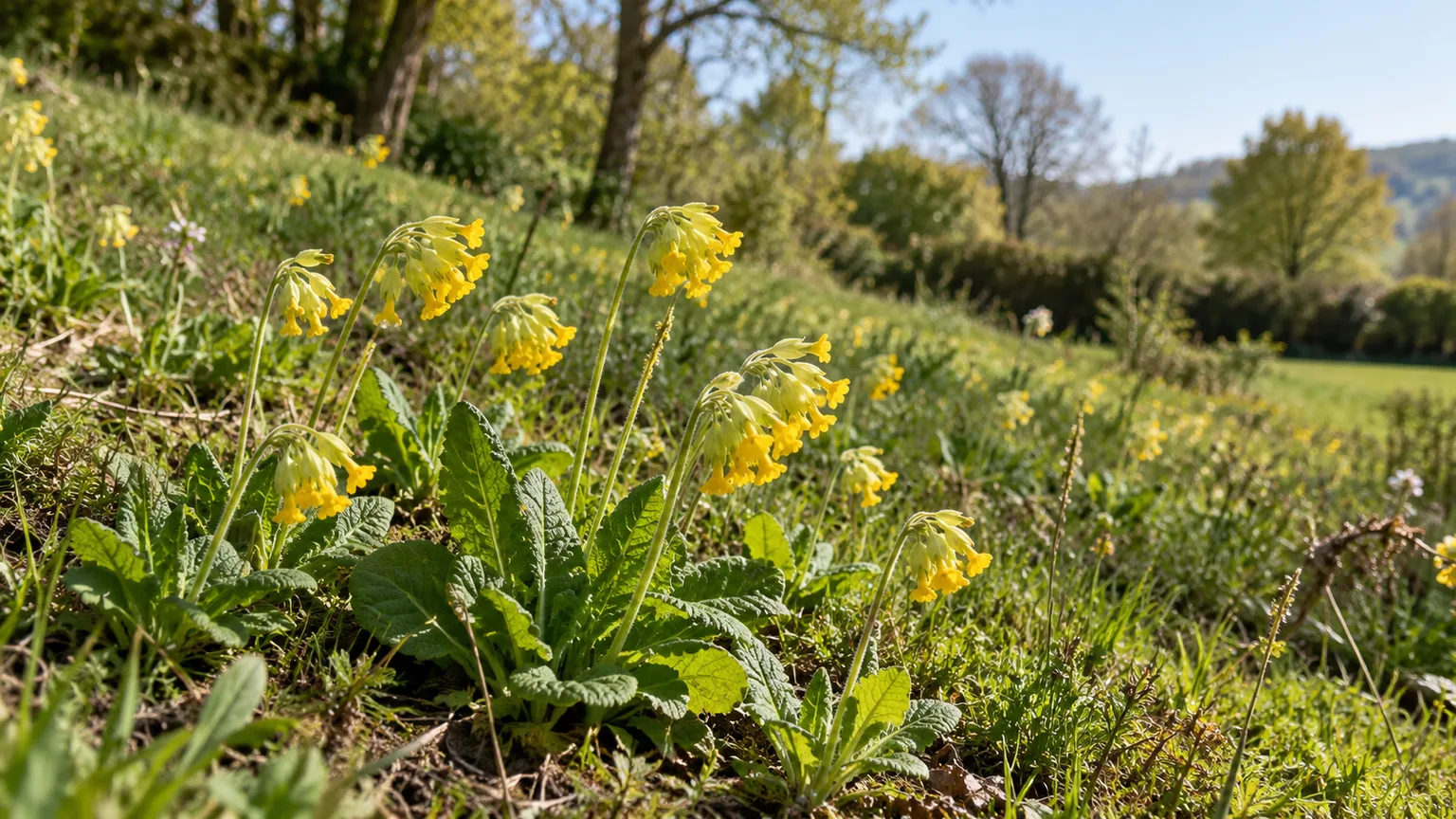
In Europe, cowslip is associated with open or semi-open grasslands, old pasture, road verges, woodland edges, and some stabilized dunes. It is often linked with lime-rich soils, but it is not restricted to strongly alkaline ground: the BSBI account describes populations across a fairly broad soil reaction range. The common thread is usually a well-lit, low-competition site that holds some moisture without staying waterlogged.
That habitat explains why cowslip can be both hardy and frustrating. An established plant may survive a dry spell better than a moisture-loving primrose relative, yet a newly germinated seedling can be vulnerable to drought. In an old meadow, other plants and a regular hay cut create openings and prevent tall vegetation from taking over. In an intensively fertilized lawn, lush grass can shade out young cowslips even when the soil itself is suitable. The species account discusses both its tolerance of some drier sites and the importance of open ground for recruitment (BSBI species account).
Cowslip may help indicate old, open grassland, but one planted clump is not a biodiversity score. Conservation value depends on the wider habitat, its species community, and local management.
Is cowslip native where you garden?
Native status depends on geography. Primula veris is native across much of Europe and extends into parts of western Asia. In New England and some other North American locations, it is recorded as introduced and naturalized, with garden cultivars contributing to variation in escaped plants. The Native Plant Trust’s Go Botany profile classifies the species as non-native in its regional flora (Native Plant Trust, Go Botany).
“Naturalized” means a plant is reproducing outside cultivation; it does not automatically mean it is invasive or harmful in every place where it appears. Conversely, a seed packet labeled “wildflower” is not proof that its contents are appropriate for a local meadow. If you are gardening in North America, buy from a reputable nursery, check state or provincial plant guidance, and keep the plant in a maintained garden area unless local authorities recommend it for restoration. In Europe, use locally sourced plants or seed when conserving a local population, and never collect plants from the wild.
This distinction is particularly important when making a wildlife garden. A plant can feed pollinators and still be non-native in your county. Choose species with the ecological context of your region in mind, not just a generic pollinator label.
Is cowslip a good fit for your garden?
Choose cowslip if you have a spot that stays reasonably moist in spring, drains after rain, and receives open light or light shade. It works well along a meadow edge, in a short-grass orchard, on a sunny bank, or in a loose naturalistic border where its rosette will not be smothered. It is less suited to dense shade, an irrigated bog garden, or a bed receiving frequent high-nitrogen feeding.
Think about mowing before you plant. If you want the patch to reseed, you need a way to leave it uncut until the capsules have ripened and released seed. A very tidy lawn schedule that cuts every week through spring will keep removing flower stems. If you cannot change that schedule, a small bed or container may be a more realistic home for the plant.
Cowslip gives its main color in spring, then shifts attention to foliage and seed. Pair it with later plants that will not smother the rosettes, and leave some open ground if you want seedlings.
Light: open sun to light shade
Provide bright conditions, with protection from harsh afternoon sun in hot, dry climates. In a cool region with reliably moist soil, cowslip can grow in more direct sun; in a warmer garden or a site that dries quickly, light shade can reduce stress. The BSBI account notes that P. veris is less shade tolerant than common primrose, and the RHS recommends partial shade for general garden planting (BSBI species account; RHS primrose growing guide).
Deep shade often gives you foliage without a strong flower display. If a patch produces leaves but few stalks, check the actual amount of light during spring before adding fertilizer. A nearby evergreen hedge or a newly grown tree canopy may have changed the exposure. Shifting the plant to a brighter but still moisture-retentive position is usually a better first correction than feeding it.
Soil and moisture: damp, drained, and not overfed
Aim for soil that remains lightly moist during active growth but sheds excess water. Cowslip is found on a variety of soils, including calcareous grassland soils, so do not assume it needs a single exact pH. Avoid permanently saturated ground: wet crowns and stagnant soil increase the chance of rot. At the other extreme, a shallow, fast-drying bed can stress new plants before their roots establish.
Do not enrich the planting hole with a large amount of compost or fertilizer unless the soil is genuinely poor and compacted. Cowslip often succeeds in relatively lean, open grassland, where moderate fertility limits competition from taller grasses. In a garden bed, heavy feeding can create the wrong result: vigorous surrounding plants grow faster and shade the primrose rosettes. Improve soil structure only as needed, and use a light mulch of leaf mold or fine compost around—not over—the crown if moisture is difficult to maintain. General RHS guidance for primulas also warns against soil that is too wet or too dry (RHS primrose growing guide).
Water newly planted cowslips thoroughly, then check the root zone rather than following a rigid daily schedule. If the top layer dries quickly in a container, water when the mix begins to dry, and empty any saucer after watering. In an established bed, rainfall may be enough; during a dry spring, water slowly at soil level so moisture reaches the roots without leaving the crown underwater.
Planting nursery-grown cowslip
Plant a potted cowslip when conditions are cool and the soil is workable—often in early autumn or spring, depending on your climate and nursery supply. Water the pot first, then ease the rootball out without pulling on the leaves. Set the plant at the same depth it was growing in the pot, keeping the crown at or just above the soil surface; burying it deeply can trap moisture around the center.
Give neighboring plants enough room that mature leaves do not immediately cover the rosette. The RHS suggests spacing plants around 15 to 30 centimeters apart; wider spacing is useful where air circulation is poor, while a naturalized drift can be planted more closely if you can manage competition around it (RHS cowslip profile). Water after planting and keep the site evenly moist while roots settle. A thin, loose mulch can retain moisture, but do not pile it into the crown. Garden Gate also recommends a moisture-retentive, well-drained position and a light mulch, while placing the crown slightly above the soil; match the nursery pot’s depth and avoid burying the center (Garden Gate cowslip guide).
When buying, prefer correctly named Primula veris from a grower who can describe its provenance. Mixed primrose trays and colorful polyanthus hybrids may be attractive, but they are not a reliable way to create a true cowslip planting. If the goal is to support local biodiversity, ask whether the stock is locally propagated and whether it is appropriate for your region.
How to grow cowslip from seed
Seed is the economical way to establish a patch, but it asks for patience. Collect only from plants you are legally permitted to propagate; do not pick or dig from a wild population. Better still, buy fresh seed from a responsible supplier and check that it is the correct species and a suitable provenance. For a local restoration project, follow the land manager’s sourcing instructions rather than introducing an arbitrary commercial mix.
Watch the flowers after they fade. Fertilized flowers form small capsules held within the calyx. Allow the capsules to mature and dry on the plant, then collect them just as they begin to open, before seed is lost. Sow promptly if possible because fresh seed is preferable. If you must store it, keep it cool and dry and understand that storage may not remove dormancy; dry aging alone is not a substitute for winter conditions. The BSBI account notes that freshly shed seed is dormant and usually requires a period of cold to germinate (BSBI species account).
For an easy naturalistic method, scatter fresh seed over prepared open soil in late summer or autumn, press it gently against the surface, and water with a fine rose. Do not bury it deeply. Keep the patch free of thick mulch and dense weeds, then mark the site so you do not mistake the small first-year rosettes for weeds. Seedlings may not flower right away; build the population with careful site management rather than expecting a full display in one spring. For a broader meadow sowing plan, see our guide to growing wildflowers from seed.
Cold stratification and seedling care
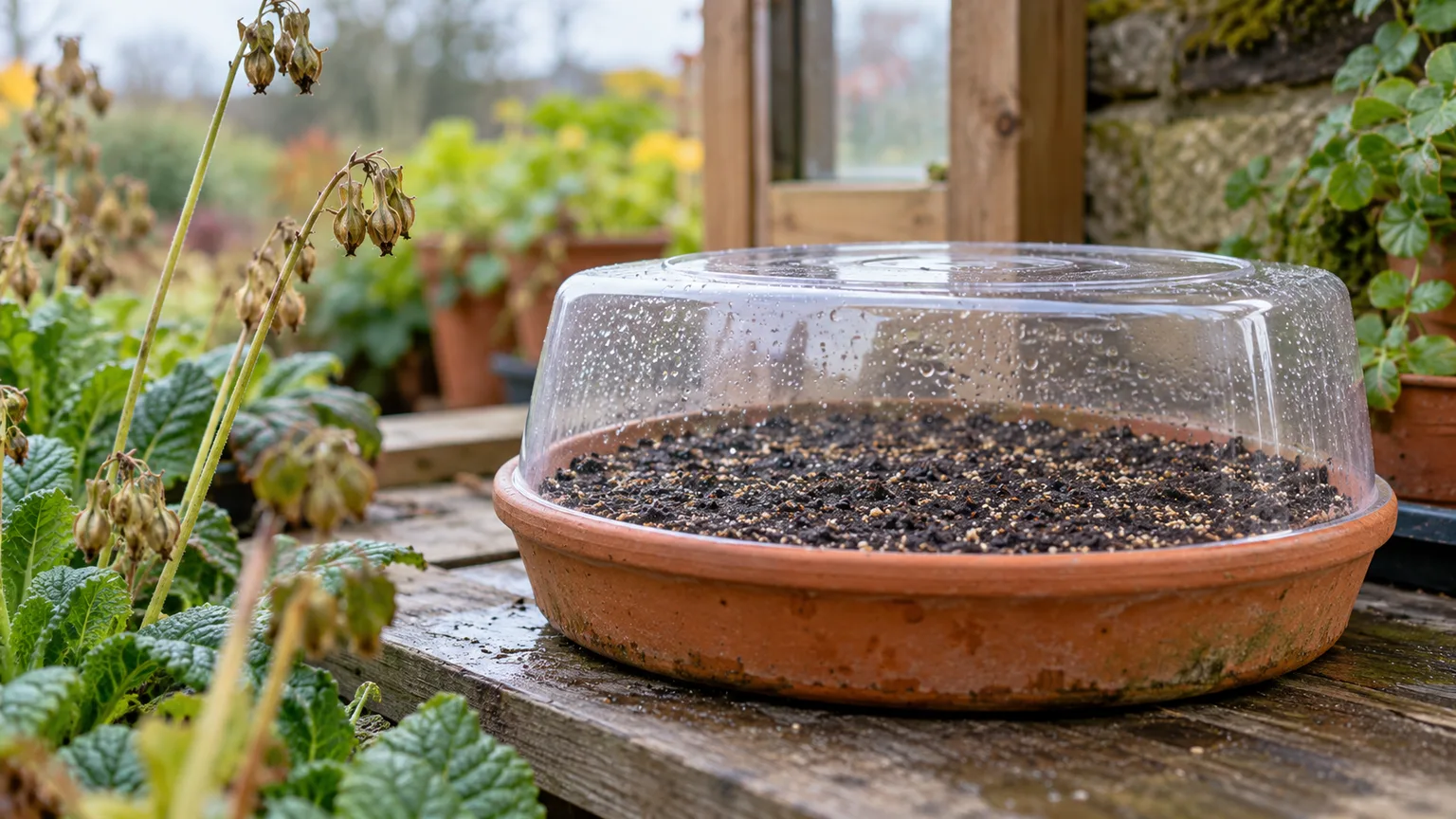
If sowing in trays, use a clean, shallow container with drainage and fine seed-starting mix. Surface-sow the seed, press it in lightly, and cover with a clear lid or bag to slow drying while still allowing light through. Place the container outside in a cool, sheltered, bright position through winter, protected from waterlogging and severe disturbance. This natural seasonal cycle is usually simpler than trying to imitate it indoors.
If you are using stored seed or sowing outside the normal autumn window, cold stratification can help break dormancy. The length required varies with seed condition and method; botanical studies and horticultural instructions do not always use the same duration. A practical approach is to sow in a labeled pot, keep it cool and moist, and allow several weeks of winter-like chilling rather than treating a single calendar number as a guarantee. A horticultural column in the Irish Times suggests an initial cool sowing period and, if germination has not begun, a further five to six weeks of refrigeration for primula seed; the BSBI account likewise describes cold as the main dormancy-breaking cue (Irish Times gardening column; BSBI species account).
Once seedlings appear, remove the cover gradually and keep the mix evenly moist, not saturated. Give them bright light and cool conditions so they do not stretch. When they have several true leaves and are large enough to handle, pot them individually into small cells. Grow them on in a sheltered outdoor position and transplant them to the final site when roots hold the plug together. Avoid leaving tiny seedlings exposed to drying wind, scorching midday sun, or competition from established grass.
After flowering: seed, deadheading, and maintenance
Deadhead selectively. If you want a longer, tidier display and do not need seed, remove spent stalks after flowering. If you want the plant to naturalize, leave at least some stems until their capsules mature. Cutting every stalk as soon as petals fade may keep the patch neat while preventing self-seeding.
Do not shear off the basal leaves after flowering. They continue to support the plant as it replenishes its roots and prepares for the next season. Remove damaged or diseased leaves as needed, but otherwise leave the rosette to die back naturally if it does so in your climate. In mild conditions the foliage may persist; in cold or dry conditions it can retreat. Neither pattern alone means the plant has failed.
Avoid routine heavy fertilizing. If flowering declines, first check light, crowding, drainage, and whether plants are being cut before they set seed. These are more likely to be the limiting factors in a meadow-style planting than a lack of phosphorus.
Manage a meadow or lawn patch around cowslips
For a meadow or orchard lawn, set a “no mow” window that lasts through bloom and seed maturation. The exact date depends on local spring weather, so follow the capsules: wait until they are dry and beginning to release seed, then cut the surrounding grass. Remove or gather cuttings if they would form a dense layer over the rosettes. This lets light reach seedlings and gradually lowers fertility, both of which help prevent taller grasses from taking over.
Do not mow the entire area at once if wildlife and flowering continuity matter. A rotational cut—leaving some strips or patches uncut until later—keeps shelter and nectar available while still controlling rank growth. Avoid scalping the ground in early spring, when flower stalks are emerging, and avoid adding lawn fertilizer to the cowslip area. In a small garden lawn, even a modest protected patch around visible rosettes can preserve flowers and seed.
The BSBI account describes regular removal of competing vegetation as beneficial to cowslip populations, but that does not mean mowing at any time is helpful. The key is timing the cut after flowering and seed set, then keeping the sward open without turning it into bare, compacted soil (BSBI species account). Our meadow lawn guide covers the broader cut-and-remove routine for a garden-scale meadow.
Pollination: pin-eyed and thrum-eyed flowers
Cowslip flowers occur in two forms, commonly called pin-eyed and thrum-eyed. In a pin flower, the stigma sits high in the floral tube and the anthers lower down; in a thrum flower, those positions are reversed. This arrangement, known as heterostyly, can guide pollen between different flower forms when insects visit. Cowslips are therefore not just yellow color in the meadow: their reproduction involves flower structure, insect movement, and compatible pollen.
If a garden plant flowers but forms little seed, check for poor pollinator access, overly shaded conditions, and whether it is growing alone. Many primroses are largely self-incompatible, although self-fertility varies among cowslip populations and morphs. A single plant can sometimes produce seed, so absence of a second plant is not a diagnosis by itself; a group with both flower forms and regular insect visits gives reproduction a better chance. The peer-reviewed Biological Flora account and BSBI species notes describe cowslip’s flower morphs and dependence on insect-mediated cross-pollination (Journal of Ecology biological account; BSBI species account).
Flowers provide spring forage, but a cowslip planting should sit within a broader sequence of bloom and nesting habitat. Add locally appropriate flowers with overlapping seasons, leave some stems and ground cover where practical, and avoid pesticide use on flowering plants. The RHS includes cowslip among plants recognized for pollinator value, while garden placement should still reflect local ecology (RHS primrose growing guide).
Common growing problems and what to change
Leaves wilt or yellow in wet soil: Check drainage before watering again. Move a container out of standing water; in a bed, loosen compaction around—not through—the crown, or replant on a slightly raised, moisture-retentive site. Persistent wetness is different from the evenly moist soil cowslip prefers.
Leaves wilt in a dry spell: Check moisture a few inches below the surface. Water slowly if the root zone is dry, especially for new plantings and seedlings. Established plants may tolerate some drying better than common primrose, but drought can still interrupt flowering or kill young plants.
Foliage grows but flowers are scarce: Check for deep shade, dense grass, overcrowding, or early mowing. Improve light or open the surrounding sward before applying fertilizer. Cowslip needs enough light to flower and enough space for its rosette to remain uncovered.
Seed does not germinate: Freshness, winter chilling, surface light, and moisture are the first checks. Do not discard a correctly sown pot just because nothing appears in a few weeks; some seed may germinate after a longer cold period. Keep the mix moist and cool, but not waterlogged, and label the pot so it can remain undisturbed.
Young plants disappear: Slugs and snails may damage tender rosettes, while dense grass and drying soil can also overwhelm them. Inspect at dusk if leaves are ragged, remove competition around the seedlings, and protect only the small patch that needs help. Avoid blanket pesticide treatments; identify the cause and use a locally approved, label-directed option only if simpler measures fail.
Containers, division, and natural spread
Cowslip can grow in a container if the pot has drainage and does not heat or dry too quickly. Choose a fairly broad pot rather than a tiny one, use a free-draining mix with some moisture-holding organic matter, and place it in a bright, cool location. Check the mix more frequently than a garden bed and water when it begins to dry. A container is also a useful way to keep a non-native garden introduction contained, though seed can still travel if left to scatter.
Established clumps may slowly widen through short rhizomes. If a mature clump becomes congested, division is possible, but it is usually less important than giving it an appropriate site and avoiding crowding. Divide after flowering or in a cool, mild period when the plant can recover; keep each piece with roots and a healthy rosette, replant promptly, and water in. Do not split a small or stressed plant just to multiply it.
Self-seeding will be uneven. Cowslip seed tends to fall near the parent, and new plants establish more readily where there are tiny openings in the ground than in a dense mat of grass. Leave some seed heads, maintain a low but not scalped sward, and give seedlings time. If spread becomes more than you want in a garden bed, deadhead selected stalks before capsules open and remove young volunteers while small.
Conclusion
Cowslip grows best when the garden recreates the useful parts of its grassland habitat: open light, soil that stays gently moist but drains, and enough space for a low rosette to avoid being smothered. Identify it by the basal leaves and nodding cluster of bells, and distinguish it from primrose or oxlip by flower arrangement and shape rather than yellow color alone.
For a new patch, use correctly named, responsibly sourced plants or fresh seed. Sow seed at the surface and let it experience winter chill, then protect seedlings from drying and competition. In lawns and meadows, delay cutting until flowers have finished and seed is ready to fall. Those choices support both the plant’s persistence and a more realistic, locally responsible planting.