When to Fertilize Your Lawn in Spring: What to Use
Learn when cool- and warm-season lawns need spring fertilizer, how soil tests guide NPK choices, and how to calculate a careful rate without guessing or risking runoff.

There is no single spring date that works for every lawn. Cool-season grasses such as fescue, Kentucky bluegrass, and perennial ryegrass grow during cool weather, while warm-season grasses such as bermudagrass, zoysiagrass, St. Augustinegrass, and centipedegrass wait for sustained warmth. The useful rule is to identify your grass, wait until it is growing at the right point in its season, and match the fertilizer amount to local guidance and a soil test.
That means a lawn that looks brown in March may need patience, not nitrogen. It also means the same calendar week can be a reasonable feeding window for one yard and too early for a nearby yard with a different grass, elevation, soil, or growing season. Start with the grass and your local extension calendar; choose a product only after you know what the lawn actually needs.
Start with grass type, growth stage, and soil test
Before buying fertilizer, answer three questions: What grass is growing here? Is it actively growing rather than just showing a little green? What does the soil test say about pH, phosphorus, and potassium? Those answers are more useful than a bag’s “spring lawn food” label, because the bag cannot know your species, soil, climate, or local restrictions.
Cool-season lawns often need less nitrogen in early spring than their owners expect, especially if a fall application already supplied nutrients. Warm-season lawns generally should not receive nitrogen while they are dormant or only beginning to green. For either type, a soil test can prevent adding phosphorus or potassium that is already present in adequate amounts.
Also check whether the lawn is under a local fertilizer ordinance, near water, newly seeded, or planned for overseeding. Those conditions can change which products are legal or useful, even when the grass is ready to grow. The simplest safe first step is to identify the grass and read the latest guidance from the cooperative extension office serving your county or state.
Time cool-season lawns by active growth
Tall and fine fescues, Kentucky bluegrass, and perennial ryegrass are cool-season grasses. Their strongest growth tends to come in spring and fall, so spring is a valid feeding period, but it is not automatically the best time to put down the largest dose of the year. Penn State Extension’s home-lawn calendar describes annual nitrogen needs as commonly met with some slow-release fertilizer in mid- to late spring and/or late summer to early fall, with the amount tied to the product label and the lawn’s needs.
For a homeowner, “mid- to late spring” is a regional cue, not a date to copy onto every calendar. Wait until the lawn has resumed steady growth and can use nutrients; do not use the first warm afternoon as the signal. If the lawn is already dense, has a history of heavy fall feeding, or is growing well after winter, a light program or no spring application may be more appropriate than repeating a full package schedule. See Penn State Extension’s seasonal lawn guidance for the regional basis and its caveat that unusual drought, heat, or cold can shift normal calendar practices.
A fall-focused program is often useful for cool-season turf because the grass has active growth in fall too. That does not mean spring fertilizer is always wrong; it means the season’s total nitrogen matters. Add up what was applied last fall and what is planned for this spring before spreading anything. If you do not know the grass variety or prior product, keep notes for the next cycle and ask a local extension educator to help identify the lawn.
Time warm-season lawns after green-up
Bermudagrass, zoysiagrass, St. Augustinegrass, centipedegrass, and bahiagrass are warm-season grasses. Their main growth occurs in warm weather. A few green tips after a mild spell do not necessarily mean a dormant lawn is ready for its spring nitrogen dose; applying too early can feed the wrong part of the season and may expose nutrients to loss before the grass is actively using them.
North Carolina Cooperative Extension’s 2025 guidance makes this distinction concrete: it places bermudagrass feeding in the warmer May-to-August period, calls for only one low-nitrogen application in June for centipedegrass, and describes low-nitrogen monthly feeding from May through August for St. Augustinegrass. It gives a different April, June, and August schedule for zoysiagrass. Those windows are examples for North Carolina’s climate, not a national calendar, and they show why “warm-season grass” is not one fertilizer prescription. Read N.C. Cooperative Extension’s guidance on avoiding early lawn fertilizer for the species differences.
A second regional example shows how rates can differ as well as dates. For North Carolina zoysiagrass, NC State Extension says that when a soil test is unavailable, a homeowner can apply one-half pound of actual nitrogen per 1,000 square feet about three weeks after green-up; its calendar also sets an annual ceiling for that species and region. That is not a recommendation for centipedegrass, bermudagrass, cool-season lawns, or every zoysia lawn in another climate. Use it to see how a local recommendation is expressed, then follow the extension guidance for your grass and location. The full NC State zoysiagrass maintenance calendar includes the context and later-season applications.
Centipedegrass deserves particular restraint. It is commonly harmed by feeding it as if it were bermudagrass, and the North Carolina schedule uses one low-nitrogen June application rather than frequent spring feeding. If you are not certain which warm-season grass you have, take a clear sample or photograph to your local extension office before choosing a high-nitrogen product.
Let growth and weather set the final window
The calendar narrows the season; the lawn and forecast decide whether today is suitable. For cool-season turf, look for reliable active growth rather than isolated green patches. For warm-season turf, look for sustained green-up across the lawn and normal growth, not a short-lived warm spell followed by cold weather. Soil and air temperature patterns, elevation, shade, and local weather can all delay that point.
Do not apply to frozen ground, saturated soil, a drought-stressed lawn, or turf that is not actively growing. If soil is already wet enough that footsteps leave deep prints or the spreader leaves ruts, wait until the surface can carry equipment without damage. On a slope, near a ditch, or next to a pond or stream, be more conservative because water can move nutrients out of the lawn quickly.
Check the forecast for wind and heavy rain. A light irrigation after a granular application may be required by the label, but that is different from spreading fertilizer before a storm that can carry granules or dissolved nutrients into a storm drain. EPA lawn-care advice says to apply only when needed, avoid windy or rainy days, and keep fertilizer away from waterways. It also notes that seasonal timing should track active plant growth, which occurs on different schedules in cool and warm climates. Review the EPA’s lawn-care practices for reducing nutrient pollution alongside local extension and product directions.
Test soil before choosing an N-P-K formula
A soil test is the best way to decide whether your lawn needs phosphorus, potassium, or lime. It can also show pH, which affects whether nutrients are available to roots. If a report says phosphorus or potassium is already adequate, buying a “complete” fertilizer that adds more of both can waste money and add nutrients the lawn does not need.
Collect samples from the lawn area you want to treat, following the lab’s depth and sampling instructions. If the front lawn, side yard, and back lawn have different soils, drainage, or treatment histories, sample them separately instead of blending everything together. Avoid sampling immediately after applying fertilizer or lime, because a recent treatment can skew results. Many extension programs recommend retesting every few years or sooner when a lawn’s conditions change; follow your lab’s schedule.
A lab report may recommend lime as well as nutrients. Do not add lime just because the bag or a neighbor suggests it; too much lime can push soil pH outside the useful range. Read the test’s recommendation for the turfgrass species, then calculate product amounts from the nutrient target rather than buying an all-purpose blend by habit. Penn State Extension explains that the needed phosphorus and potassium are determined by soil testing, while nitrogen needs depend on the species, soil, management, timing, and amount applied.
What a lawn soil test can and cannot tell you
Most lawn soil tests are useful for pH, phosphorus, potassium, and lime recommendations. They do not provide a simple nitrogen score that tells every homeowner how much N to apply. Nitrogen is mobile and turf demand changes with the grass type, soil, season, mowing, irrigation, and whether clippings stay on the lawn.
Treat the result as a decision tool, not a fertilizer shopping list. If a test shows adequate P and K but local turf guidance recommends nitrogen, look for a lawn product that supplies the indicated N without unnecessary phosphorus or potassium. If the lawn is thin or pale, also check mowing height, drainage, compaction, shade, and disease before assuming it needs more fertilizer. Color alone cannot distinguish a nutrient shortage from a stressed root system or poor growing conditions.
Joe Lamp’l’s practical spring lawn-renovation sequence also begins with a soil test before amendments or fertilizer, which is a useful order when you are improving a lawn rather than following an established program. His spring lawn renovation guide is a practical companion to the region-specific extension recommendations.
Choose a product by nutrient need, release speed, and format
The three numbers on a fertilizer label show the percentages of nitrogen, phosphate, and potash by weight, in that order. A 20-0-5 product contains 20% nitrogen, no phosphate, and 5% potash. The right analysis is the one that supplies the nutrients your local recommendation calls for, not necessarily the most balanced-looking formula or the bag with the strongest green lawn on its packaging.
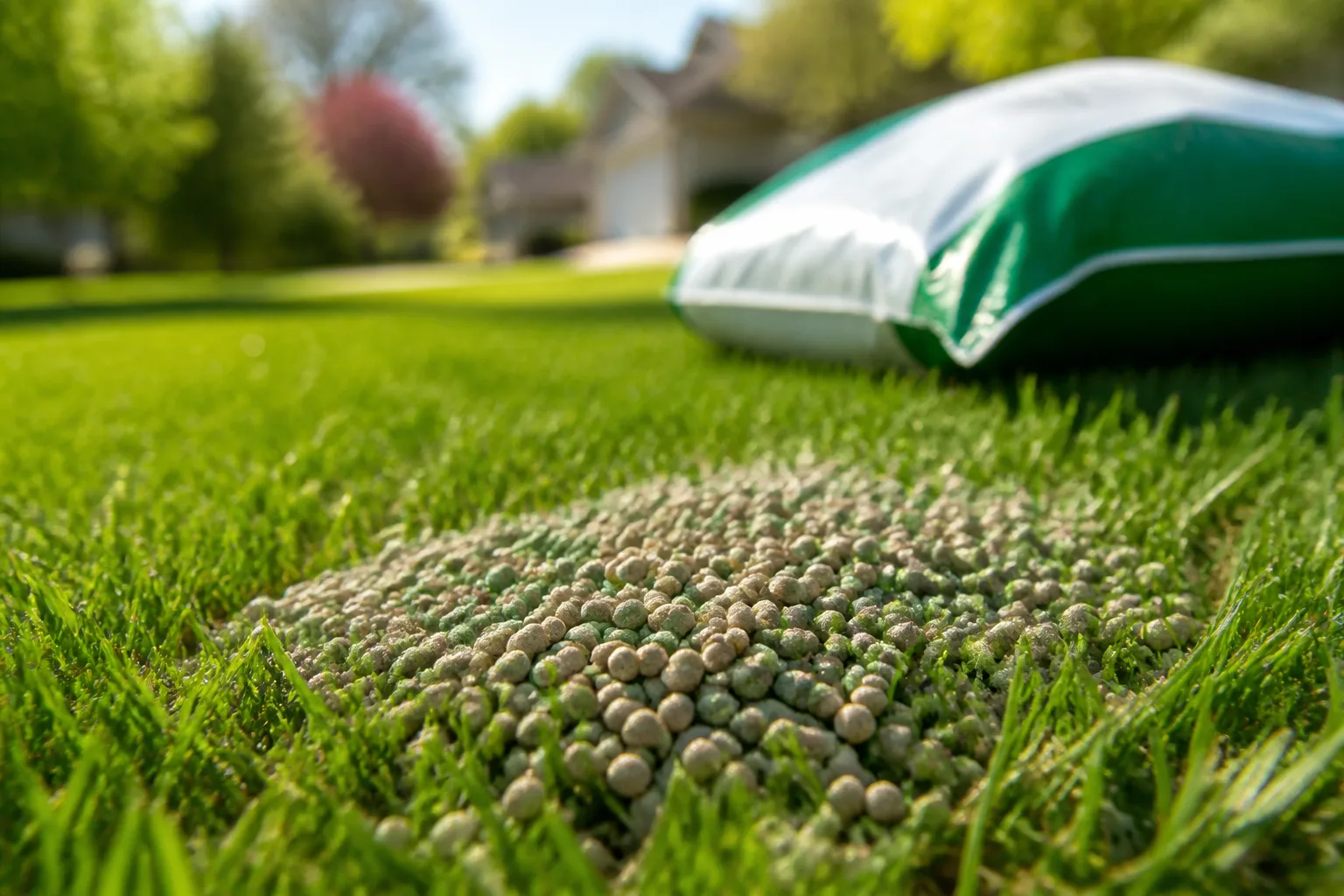
For many established lawns, nitrogen is the main nutrient supplied through fertilizer, while phosphorus and potassium should follow a soil-test recommendation. A product with zero in the middle can be appropriate when the soil does not need phosphorus and local rules restrict it. A starter fertilizer may be appropriate for a new lawn when the test or local guidance supports it, but the word “starter” does not make it necessary for an established lawn.
Read the product label for the grass types it can be used on, its nitrogen sources, the amount to apply, spreader settings, watering directions, and any restrictions on reseeding or pet and people access. “Lawn fertilizer” is not a guarantee that every product suits every grass. If a product includes herbicide, the active weed and the grass must both match the label.
Slow-release and quick-release nitrogen
Quick-release nitrogen is soluble and can green turf quickly, but it is easier to overapply and may need more frequent applications. Slow-release or controlled-release nitrogen releases nutrients over a longer period, which can make growth steadier and reduce the sharp flush that follows a fast feed. Penn State Extension explains that slow-release sources can last weeks to months and that the label identifies those sources as controlled-release, slowly available, or water-insoluble nitrogen.
Neither form cancels the need to follow a rate. Slow-release fertilizer can still supply too much nitrogen if applied too heavily or too often, and it can still move off-site if it lands on pavement or is carried by runoff. Granular products are often easier to measure across a lawn with a broadcast or drop spreader; liquids may distribute quickly but require careful dilution and even application. Choose by lawn size, label directions, and the local nutrient target rather than assuming liquid is always faster or granules are always safer.
Organic fertilizers, compost, and grass clippings
Organic products can supply nitrogen from plant, animal, or microbial materials, while synthetic products supply nutrients from manufactured sources. The label still matters: organic fertilizers contain measurable nutrients, may release them more gradually, and can be overapplied. A “natural” label does not make a product exempt from fertilizer regulations or runoff precautions.
Compost is useful when the goal is to add organic matter and improve the soil surface, but its nutrient analysis is variable. It is not a precise substitute for a measured nitrogen application when a soil test or extension recommendation calls for a specific amount. Savvy Gardening describes a thin compost topdressing and practical ways to distribute it; its lawn compost topdressing guide is useful for technique, while a local extension recommendation should guide nutrient rates.
Grass clippings are another way to recycle nutrients. If you mow often enough that clippings are short and disperse through the turf, leaving them in place returns nutrients as they decompose and can reduce the amount of fertilizer you need. It does not give you a dependable pounds-of-nitrogen figure for the season, so count it as part of a lower-input lawn plan rather than proof that the lawn never needs a soil test or fertilizer.
Calculate a measured rate instead of guessing
Keep two numbers separate: the rate of actual nitrogen the grass should receive and the weight of fertilizer product needed to deliver it. The first number on the bag is the percent nitrogen. To calculate product weight, divide the target pounds of nitrogen per 1,000 square feet by the nitrogen percentage written as a decimal.
For example, if your local recommendation calls for one-half pound of nitrogen per 1,000 square feet and the bag contains 20% nitrogen, divide 0.5 by 0.20. The result is 2.5 pounds of product per 1,000 square feet. That example shows the math only; it is not a universal spring rate. Penn State Extension’s fertilizer calculation guide uses the same method and works through examples with different analyses.

Then multiply that product rate by the number of 1,000-square-foot units in your lawn. If a measured lawn is 5,000 square feet, there are five units, so the sample 2.5-pound rate would require 12.5 pounds of that product for the entire area. Measure the turf rather than estimating from the lot size, and subtract the house, driveway, beds, and other unfertilized surfaces. For irregular yards, split the grass into rectangles or triangles and add their areas.
A local recommendation may split the season’s total nitrogen into separate applications or specify a maximum annual amount. Never apply the annual total all at once just because the math makes it easy. The bag’s directions, extension guidance, and local law set the actual maximum and schedule. In North Carolina, for example, NC State’s zoysiagrass calendar gives a species- and region-specific half-pound-of-nitrogen example after green-up and a yearly ceiling; other grasses and climates have different plans.
Apply evenly and keep fertilizer out of drains
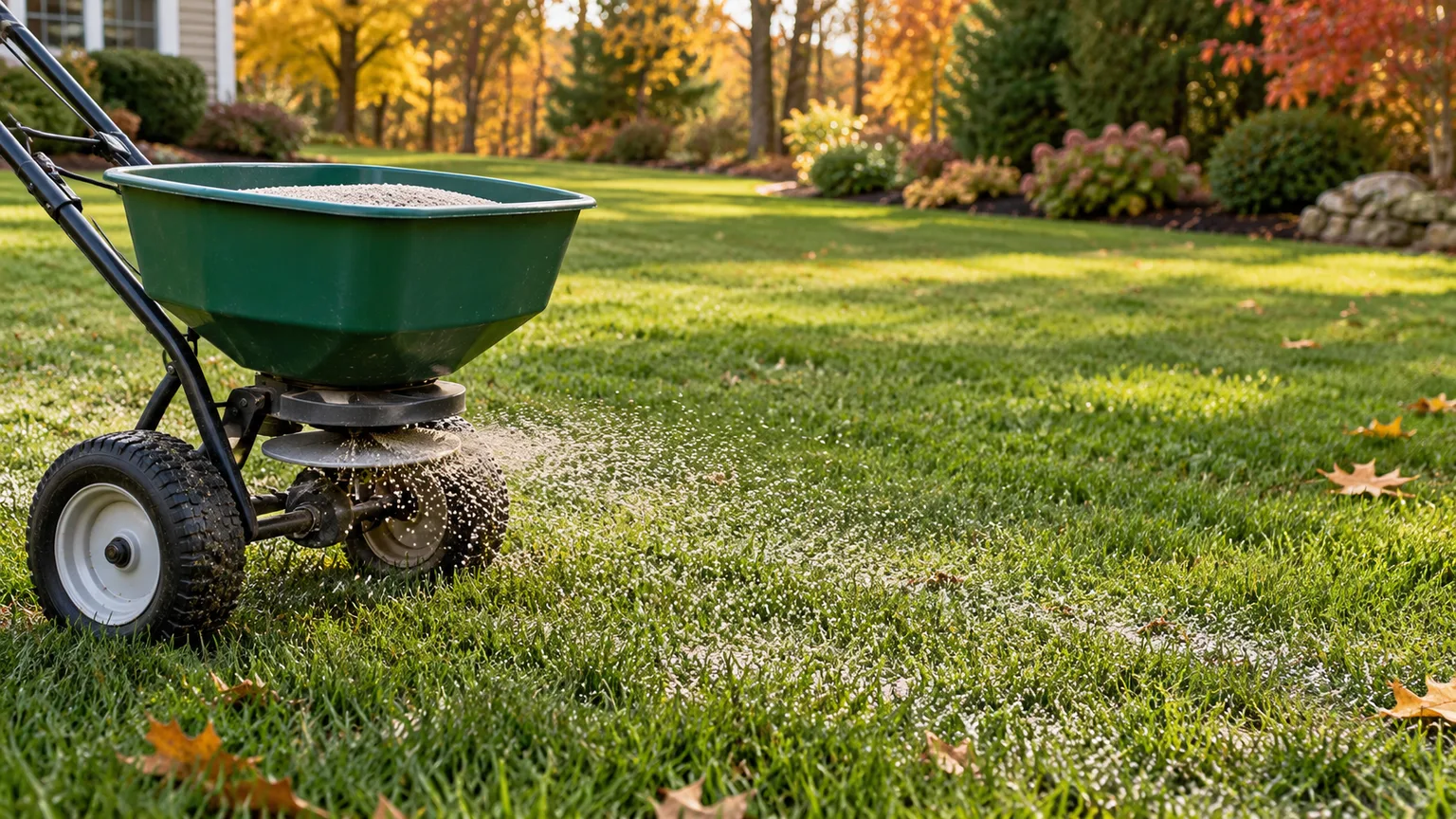
An accurate target can still produce patchy growth if you distribute granules unevenly. Use a spreader that fits the lawn, set it according to the fertilizer label, and walk at a steady pace. Penn State Extension emphasizes that small errors in measuring or applying fertilizer can create poor results or turf injury; calibrating a spreader with a known area and measured amount is more reliable than guessing a gate setting.
Before loading, sweep the sidewalk and driveway so granules that spill are easy to collect. Keep the spreader on the lawn when opening or closing the gate, avoid overlapping passes heavily, and use a drop spreader near water or a narrow edge where a rotary spreader could throw granules past the turf. Sweep fertilizer back onto the lawn from paved surfaces instead of rinsing it toward the storm drain. EPA explains that stormwater can carry nitrogen and phosphorus from hard surfaces directly to drains and water bodies.
Water the product in only as the label instructs. Some granular products need a light watering to release nutrients into the soil; others are designed to remain on the lawn until rain or irrigation. If you water, apply enough to follow the product directions but stop before water runs down a slope or pools at a curb. Do not apply ahead of a forecast downpour, onto frozen ground, or where runoff is already moving. NC State’s water-quality guidance for home lawns also advises matching application to turf needs, using slow-release nitrogen where it reduces loss risk, and taking extra care on slopes and near water.
Treat weed-and-feed and overseeding as separate decisions
A weed-and-feed product combines fertilizer with an herbicide, so its timing has to suit both jobs. The grass may not be ready for nitrogen when the target weed is at the right control stage, or the lawn may need fertilizer when the listed weed is absent. Identify the weed, read the herbicide label, and use the product only on a grass type and at a growth stage allowed by that label.
Pre-emergent herbicides add another timing conflict: they are intended to stop weed seeds from establishing, and some can also interfere with new grass seed. If you plan to overseed, check the product’s reseeding interval and confirm whether the active ingredient is compatible with that plan. Do not assume a fertilizer-herbicide combination is a complete spring lawn program or that an early application is harmless to warm-season grass.
The practical choice is often to handle nutrition and weed control separately. Apply only a fertilizer that matches the soil and grass, then treat a verified weed problem with a product labeled for that grass and the current conditions. If no weed is present or the label conditions are not met, skip the herbicide instead of applying it because it happens to be attached to a fertilizer bag.
Avoid spring mistakes that cause trouble
The most common mistake is feeding by the date printed on a bag or a generic calendar. That can put fertilizer on dormant warm-season turf, push excess growth in cool-season turf, or conflict with a local schedule. Wait for the right grass to be growing and compare the plan with local extension guidance.
The next mistake is adding phosphorus without a soil-test need. Minnesota law, for example, prohibits applying phosphorus-containing fertilizer to turf except under specific conditions, including a recent test showing inadequate soil phosphorus or establishment of new turf during its first growing season. Other places have their own rules. Check state and municipal restrictions before buying a product, especially if it contains phosphorus or if your lawn borders water. The current Minnesota turf-phosphorus statute illustrates how a local rule can override a product’s general label directions.
Overlapping spreader passes, applying the full season’s fertilizer in one go, and watering until runoff are also avoidable. Keep a note of the product, analysis, area, and date so you can total the season’s nitrogen and avoid duplicate applications. A darker lawn is not automatically a healthier lawn; overfeeding can mean more mowing and can increase nutrient movement away from the turf.
If the lawn is pale or fertilizer is already down
Pale grass is a clue, not a diagnosis. Yellowing can follow nitrogen shortage, but drainage problems, compacted soil, low pH, drought, disease, insects, or normal warm-season dormancy can also change color. Check whether the entire lawn is affected or whether patches follow shade, foot traffic, low spots, or the pattern of a spreader. If the cause is unclear, use a soil test and local extension diagnosis before applying a second product.
If fertilizer is already down earlier than planned, do not add another dose to “correct” it or double the next application. Check the bag to identify its analysis, estimate how much was applied over the measured area, and include that nitrogen in the season total. If it was a normal labeled application but the grass was still dormant, wait for active growth and follow the label’s watering directions without causing runoff.
If a concentrated spill or heavy overlap left visible granules on the grass, pavement, or near a drain, collect what you can safely remove and do not wash it into the street. Keep children and pets off according to the product label. For a large overdose or damage that continues after the product is removed, contact the product manufacturer or local cooperative extension office with the fertilizer bag and application details.
Conclusion
Fertilize in spring when your lawn’s species is actively growing and local guidance says the nutrients are useful. Cool-season lawns and warm-season lawns follow different rhythms, and a local calendar may split the dose or limit nitrogen for a particular grass. A soil test helps decide whether phosphorus, potassium, or lime belongs in the plan.
Choose a product by its nutrient analysis and release profile, calculate product weight from the recommended nitrogen target, and apply it evenly under calm conditions with no heavy rain or runoff expected. If the grass is dormant, the soil test does not support the product, or local rules restrict it, waiting or skipping that application is the better lawn-care decision.