When to Fertilize a Lawn by Grass Type
Learn when to fertilize cool- and warm-season lawns, how soil tests and weather change timing, and which local rules to check before applying.

The most reliable rule: feed active growth
The best time to fertilize a lawn is when its grass is actively growing, has access to moisture, and can use the nutrients without being pushed through heat, drought, or dormancy. That window changes with grass species and climate. A fall application that helps a northern fescue lawn can be the wrong choice for a warm-season lawn that is slowing down before winter, while a summer feeding may suit actively growing Bermuda grass but stress a cool-season lawn during heat.
Before choosing a date, answer four questions: What grass is growing here? Is it growing steadily now? Does it need nutrients? Do the product label and local rules allow an application? If any answer is unclear, wait and investigate rather than treating a calendar reminder as a prescription. The timing advice below gives useful regional patterns, but your local Cooperative Extension service and product label should settle the details for your lawn.
Identify your grass before choosing a date
A lawn’s green color does not tell you its growth type. Look for the seed or sod receipt, old landscaping records, or a local Extension identification guide; if you cannot identify it, take clear close-up photos of the blades and growth pattern to your county Extension office or a qualified turf professional. A mixed lawn may include different species in sun and shade, so identify the areas separately before using one schedule across the whole yard.
Cool-season grasses
Kentucky bluegrass, perennial ryegrass, and most fescues are cool-season grasses. They grow most reliably during cooler stretches, typically spring and fall in much of the United States, and can slow or become dormant in summer heat. In warm climates they may survive mainly in shade or as winter overseeding over a warm-season base, which means their calendar can differ from the dominant lawn nearby.
For these grasses, a productive timing cue is recovery from summer stress as temperatures moderate and the lawn resumes steady growth. University guidance in Wisconsin and Kansas City emphasizes fall feeding for cool-season lawns in those local climates, while Purdue’s Midwest guidance also places most annual nitrogen applications from late summer into fall. Those recommendations are regional, not a nationwide date. Wisconsin Extension, K-State Extension Johnson County, and Purdue Extension explain why local season and lawn-management goals matter.
Warm-season grasses
Bermudagrass, zoysiagrass, St. Augustinegrass, centipedegrass, and buffalograss grow most strongly during warm weather. Many turn brown or pause growth in winter, then green up as conditions warm. Their useful fertilizer window generally begins only after the lawn has greened up and begun growing consistently; do not try to wake a still-dormant lawn with fertilizer.
A warm-season lawn can handle an active-season application only when heat, water, soil conditions, local restrictions, and the product label support it. “Warm-season” does not mean “fertilize whenever it is hot”: prolonged drought, extreme heat, waterlogged soil, or a local rainy-season blackout may make waiting the better choice. The timing section below shows how to use the growth stage rather than a fixed month.
Transition zones and mixed lawns
Across the broad transition region of the central United States, either grass type may be grown, and homeowners sometimes maintain cool-season grass over a warm-season base for winter color. State lines and hardiness zones are only rough clues; elevation, shade, irrigation, soil, and the exact turf species shift when a lawn grows. Where a yard has separate turf types, treat each area according to its own growth cycle rather than broadcasting one product everywhere.
Overseeded lawns need special care because the established grass and seedlings may have different fertilizer needs. For example, Southern Living’s discussion of overseeding in southern lawns advises pausing warm-season-grass feeding ahead of seeding and waiting until newly emerged cool-season seedlings are established before applying fertilizer. Use that as a reminder to check a local overseeding recommendation, not as a universal interval for every seed mix or starter product. Southern Living’s lawn timing guide describes this transition-zone complication.
Seasonal timing by grass type
Think of the seasons as a way to estimate growth, not an automatic schedule. If the lawn has just been fed, the soil test shows no need, the turf is stressed, or a local rule blocks application, skip that calendar window. When in doubt, ask a local Extension service for timing matched to your grass and region.
Cool-season timing
In many northern and midwestern lawns, late summer into fall is the main feeding period because cool-season grass is recovering from summer and growing in more favorable temperatures. Kansas State’s Johnson County guidance highlights September for Kansas City lawns, and Wisconsin Extension gives early fall emphasis for Wisconsin. Both dates describe their regions. In a warmer southern setting, fescue in a shaded lawn or winter overseed may follow a different local schedule.
Spring can be another opportunity, but avoid feeding too early or heavily just because the grass greens up. Cool-season lawns often produce a natural spring flush; adding nitrogen before that growth surge settles may make top growth harder to manage and leave the turf less prepared for summer stress. K-State’s early-May recommendation is specifically for its Kansas City audience, so look for the equivalent local guidance in your area rather than copying the date. Do not fertilize a cool-season lawn through peak heat or while it is brown and dormant from drought.
Warm-season timing
For warm-season grass, wait until it is mostly green and growing steadily after winter dormancy. Then use a local recommendation to decide whether the lawn needs one or more feeding windows during its active season. Southern Living describes post-green-up and active-season windows for warm-season turf, but the exact schedule differs by species, climate, rainfall, soil, and local law. Do not assume that every warm-season lawn benefits from the same number of applications. Southern Living’s lawn timing guide treats those timings as grass-specific rather than a single calendar.
As growth slows toward fall, be conservative about late nitrogen. A local Extension office can explain the cutoff for your region and grass type; an application that comes after the lawn has begun preparing for dormancy may not help it use nutrients well. In places with fertilizer blackouts, the legal restriction can override the ideal biological window. For instance, a homeowner in Lake County, Florida, must account for the county’s own seasonal restriction described below; that rule does not apply just because another lawn is in a warm climate.
Decide whether your lawn needs fertilizer
A lawn can be green and healthy without frequent feeding, especially if it receives returning clippings or organic matter. Fertilizer is most useful when it addresses a real nutrient need and the grass can take it up. If you are feeding simply because neighbors are, because a bag says “seasonal,” or because a lawn looks pale, pause first: color can be affected by shade, mowing, water stress, disease, pests, and soil pH as well as nutrients.
Start with a soil test and recent feeding history
A soil test is the best starting point for phosphorus, potassium, and pH; it helps prevent adding nutrients that the soil already has. Purdue Extension recommends testing rather than guessing at nutrient need, and notes that nitrogen decisions for established turf also depend on desired appearance, growth, and maintenance. Soil tests do not diagnose every lawn problem, and testing may not provide a universal nitrogen prescription, so combine results with your local Extension guidance and the product label.
Keep a simple record of the product, approximate treated area, date, and application made. Check the bag or receipt from previous feedings before applying again, and note whether clippings are returned. This prevents accidental back-to-back applications when a previous treatment is still releasing nutrients. If the lawn is thin or yellow, do not use extra fertilizer as a diagnostic experiment: compacted soil, poor drainage, drought, unsuitable pH, insects, or disease may be responsible, and feeding may not correct them.
If the test recommends no phosphorus or potassium, choose a product that avoids adding unnecessary amounts of those nutrients. Established lawns do not automatically need a “balanced” fertilizer, and more nutrient numbers on a label do not mean a better match. Follow the test report’s interpretation for turf and have your local Extension office help if the report or fertilizer analysis is hard to understand.
Account for clippings and the lawn’s actual condition
When you mow often enough that clippings are short and disperse through the turf, leaving them in place returns some nutrients as they break down. That does not guarantee the lawn needs no fertilizer, but it changes how much may need to be replaced over time. If clippings are collected, the lawn is heavily used, or the turf is recovering from damage, its nutrient balance may differ from a lightly maintained yard. Purdue’s turf guide discusses clippings and maintenance level as part of a lawn fertility plan.
Consider what the lawn needs from you. If you want low-maintenance ground cover rather than dark, fast-growing turf, a modest fertility program—or no application when soil and grass condition support it—may be preferable to repeated feeding. More nitrogen can mean more mowing and does not fix shade, thin soil, poor drainage, or an unsuitable grass species. A persistent patch should be diagnosed before treating the entire lawn with fertilizer.
Check weather and site conditions
Even the right season can be the wrong day. Granular material can drift, stick to wet blades, or wash away; soluble fertilizer needs enough moisture to move into the root zone, but heavy rainfall can carry nutrients off-site. Check the forecast and your ability to irrigate before opening a bag. Apply only when you can keep product on the lawn and meet its label directions.
Heat, drought, rain, saturated or frozen soil
Do not fertilize a lawn that is drought-stressed, wilting, or in severe heat unless a locally recommended product specifically says otherwise. A stressed lawn may not take up nutrients well, and the combination of fertilizer salts and inadequate water can injure turf. Restore moisture and wait until growth resumes rather than expecting fertilizer to reverse drought damage.
Avoid an application just before intense rain, especially on sloped, compacted, or paved sites where runoff is likely. A gentle rainfall or irrigation may be appropriate after some granular products, but the label decides whether and when to water; weed-and-feed products can have different instructions from plain lawn fertilizer. Do not apply to frozen or snow-covered ground, where product cannot reach actively growing roots and runoff is more likely, or to waterlogged soil that cannot drain. When conditions are uncertain, postpone and recheck the forecast.
Let local rules and product labels set the limits
Fertilizer ordinances vary by state, county, city, and even watershed. Check the rules for the exact address where you apply, including seasonal nitrogen or phosphorus blackouts, setbacks from water, required slow-release content, and rain-related restrictions. A neighboring town’s rule may not be yours. The Southwest Florida Water Management District notes that it does not itself impose fertilizer restrictions, while counties and municipalities within its region do; its county list shows different blackout periods in different jurisdictions. SWFWMD’s county fertilizer restrictions page is a useful example of why local checking matters.
Lake County, Florida, illustrates a rule that must stay local: its county ordinance bars applying turf fertilizer containing nitrogen or phosphorus from June 1 through September 30, prohibits fertilizer within 15 feet of water bodies, and requires at least 50 percent slow-release nitrogen in nitrogen fertilizer applied to turf or landscaping during the rest of its stated season. These requirements apply to Lake County’s jurisdiction and may not describe rules in nearby counties or elsewhere in Florida. Check the current county code and municipal requirements for your property before relying on this example. Lake County’s fertilizer ordinance page summarizes the county’s rules.
The product label also controls timing, application method, watering, re-entry, and repeat applications. Do not use a lawn fertilizer on an area or grass type that the label excludes, and do not exceed its instructions because a regional article uses a different rate. If a local rule is stricter than a general recommendation, follow the local rule. If the label and a soil-test recommendation appear to conflict, ask the soil lab, your Extension office, or local government for guidance before applying.
Choose a calm application window and water as directed
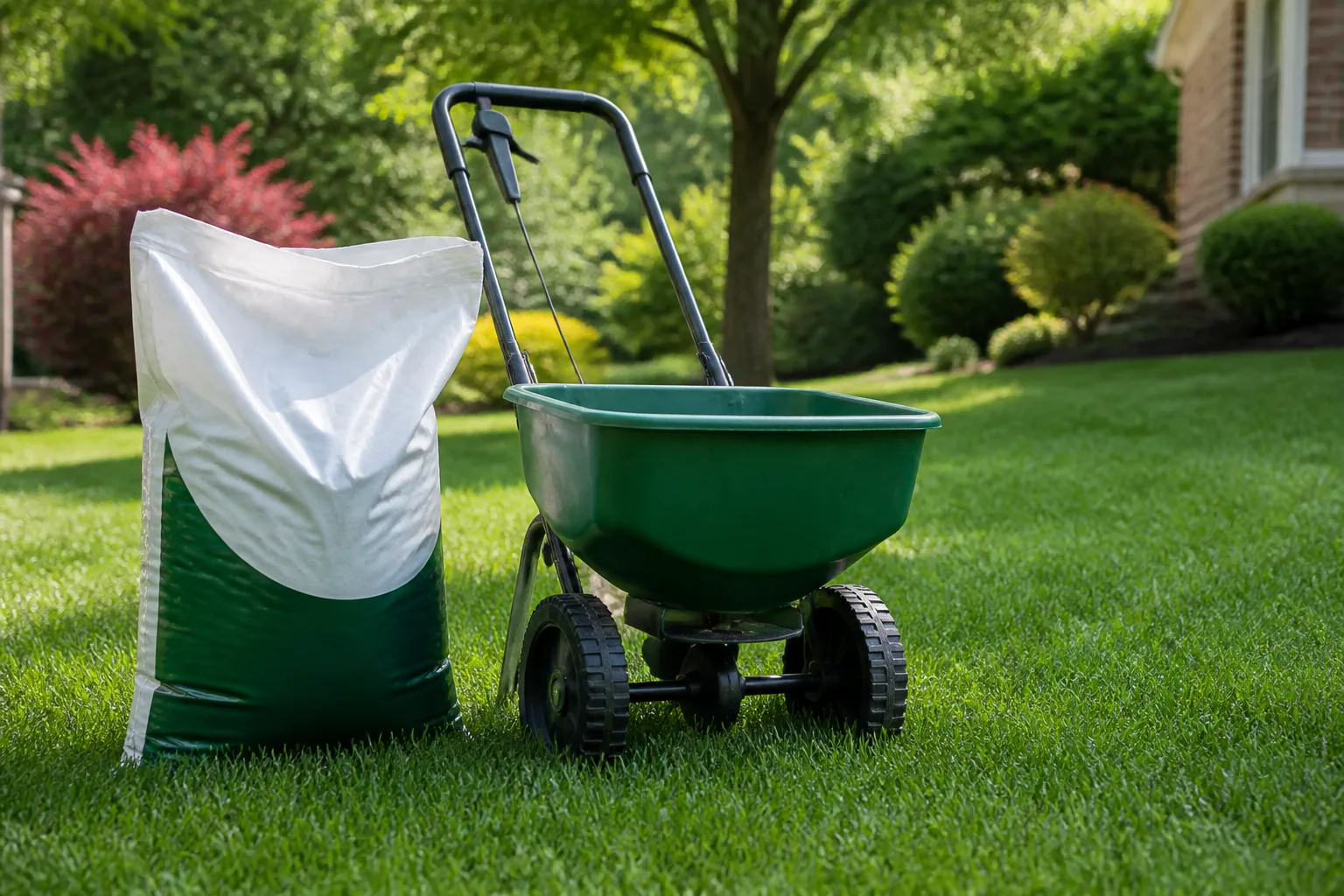
Plan the application when the grass is dry enough for even spreading, wind is low, and weather is not likely to wash material away. A morning or late-afternoon time may make comfortable work easier, but there is no time-of-day shortcut that overrides the product label, temperature, or irrigation instructions. Use a calibrated spreader at the label setting, apply evenly without overlaps or missed strips, and keep granules on turf rather than sidewalks, driveways, or storm drains.

For granular products, follow label directions about watering in; some products need irrigation while others, particularly combined weed-control products, may require a period without watering. If watering is recommended, use enough to move product from the leaf surface without creating runoff. Sweep stray granules from hard surfaces back onto the lawn. K-State Extension and Southern Living both emphasize keeping fertilizer off pavement because rain can carry it into storm drains and waterways.
Timing mistakes that waste fertilizer or stress grass
The most common mistake is treating one month as a universal answer. September is a useful cool-season reference in parts of the Midwest, but it is not a national rule for warm-season turf, southern overseeding, or local blackout periods. Translate a regional recommendation into its underlying signal—grass species, season, growth, and stress—and verify it locally.
Other errors include fertilizing brown dormant grass, feeding during drought, applying before a downpour, repeating a dose before checking the previous application, and spreading beyond the label rate. Avoid diagnosing yellow color with fertilizer alone; poor drainage, mowing too short, insects, disease, shade, and pH can create similar symptoms. Finally, do not import a blackout date or application rate from an online calendar, another county, or a product designed for a different lawn. When timing is uncertain, waiting for active growth, a soil-test result, and a clear weather window is often safer than forcing a feeding.
Conclusion
To decide when to fertilize a lawn, identify the grass, look for active growth, and confirm the soil or lawn-management need before applying anything. Cool-season lawns often use fall as their main feeding window in northern regions; warm-season lawns generally wait for full green-up and grow through their warm season. Those are patterns, not fixed dates.
Then check recent applications, clippings, weather, local ordinances, and the product label. Delay feeding if the turf is dormant, drought-stressed, waterlogged, or near a heavy rain, and avoid adding nutrients the lawn does not need. A small amount applied at the right stage—and kept on the lawn—is more useful than a calendar-driven application that the grass cannot use.