How to Grow and Care for a Hong Kong Orchid Tree
Plan the right site, water a young Bauhinia × blakeana correctly, train a sound canopy, and troubleshoot weak flowers, yellow leaves, and cold damage.
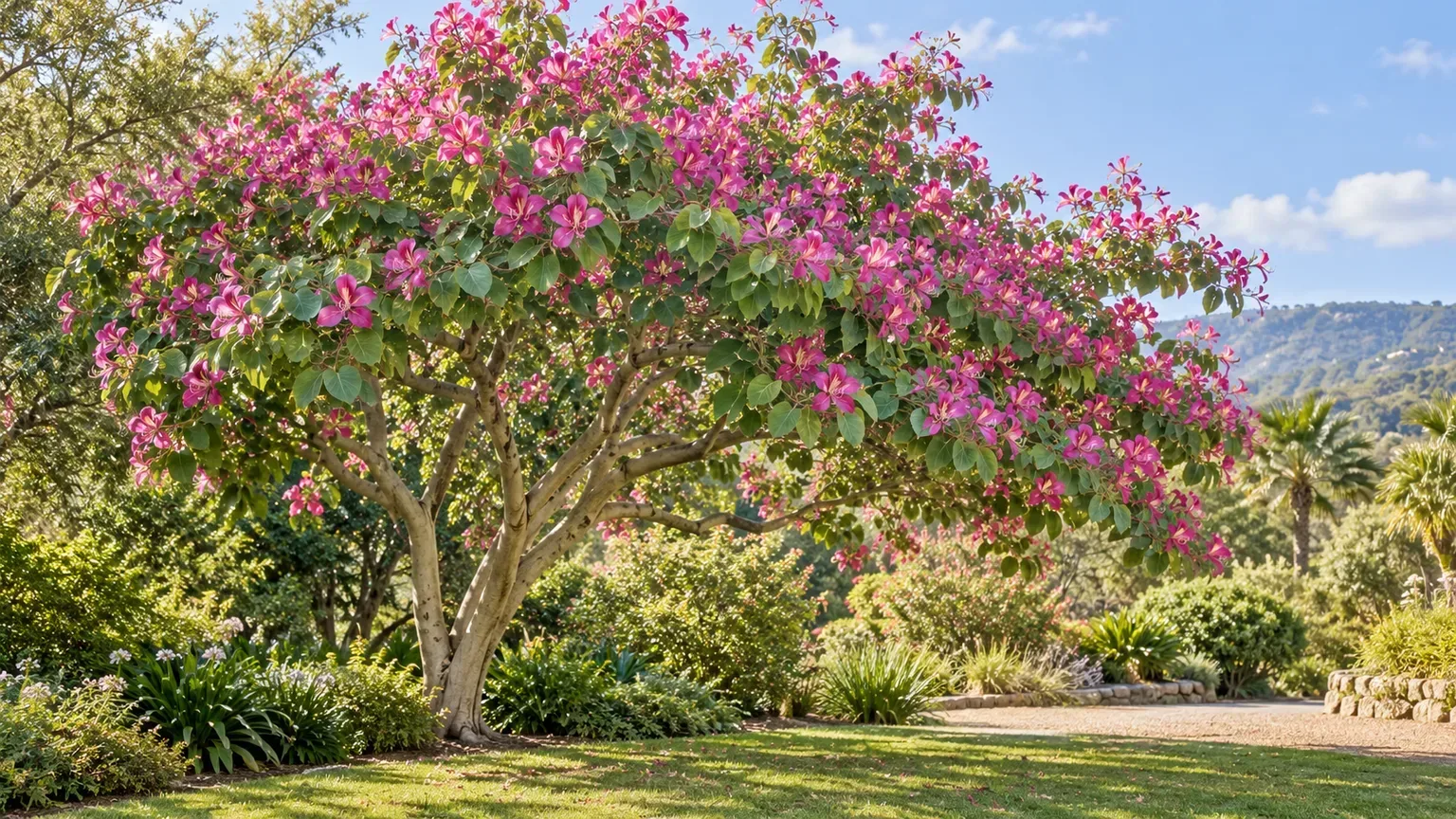
The Hong Kong orchid tree (Bauhinia × blakeana) earns its place as a specimen tree with huge rose-purple flowers and distinctive, two-lobed leaves. It is not an orchid: it is a subtropical flowering tree in the legume family. Give it sun, drainage, room for a broad crown, and protection from hard freezes, and it can bring color to a garden when many temperate trees are bare.
The main decision comes before planting. This is a fast-growing tree with a broad, sometimes weakly branched canopy, so it needs a warm site where branches can spread without crowding a roof, walk, driveway, or overhead line. It also behaves differently by climate: the tree can be partly deciduous, and its winter-to-spring flowering window shifts with local conditions.
For pets, treat the tree as an ornamental, not a food plant. I could not verify a species-specific toxicity listing for this hybrid; the ASPCA notes that its plant list is not exhaustive and that eating any plant material can cause gastrointestinal upset. Keep animals from chewing it and contact a veterinarian or poison-control service if one eats the leaves or flowers.
Is This Tree Right for Your Climate and Yard?
Hong Kong orchid tree is best suited to frost-light subtropical and tropical gardens. Plant profiles place it around USDA Zones 9b through 11, but gardeners in the colder edge of that range should treat the number as a starting point, not a guarantee: a sheltered urban yard may protect a tree better than an exposed slope, while a long freeze can damage even an established specimen. NC State Extension and the Missouri Botanical Garden report foliage damage near or below freezing and serious risk when temperatures remain in the mid-20s Fahrenheit.
Plan for a tree roughly 12 to 20 feet tall and 20 to 25 feet wide in many landscapes; exceptionally favorable warm sites can produce taller specimens, sometimes approaching 30 to 40 feet. Its mature size and quick growth make it a poor fit for a narrow courtyard, small foundation bed, or place where you must cut the canopy back every year. The Missouri Botanical Garden and NC State Extension list a typical 20-to-25-foot spread, while Florida landscape guidance notes that local trees can grow larger.
This is a good choice if your yard has full sun, well-drained soil, and enough open space to let a rounded crown develop. It is a risky choice where cold wind funnels through, heavy soil stays wet, or strong storms routinely hit unprotected trees. If winter minimums regularly fall below the mid-20s, select a more cold-hardy flowering tree for a permanent planting.
Hong Kong Orchid Tree Care at a Glance
| Need | Practical target |
|---|---|
| Light | Full sun for the strongest flowering; light shade is tolerated |
| Climate | Usually most dependable in Zones 10–11; warmer parts of 9b may work with shelter |
| Mature size | Often 12–20 feet tall and 20–25 feet wide; larger in warm, favorable sites |
| Soil | Any soil that drains well; slightly acidic soil is preferred |
| Water | Moderate while establishing; established trees tolerate dry spells but may show leaf-edge scorch |
| Bloom | Late fall through spring in seasonal subtropical climates; local timing varies |
| Growth habit | Fast-growing, commonly multi-trunked, irregular rounded crown |
| Propagation | Vegetative methods such as grafting, layering, or cuttings; no viable seed crop |
This quick profile blends the species-specific information in NC State Extension’s plant profile, the Missouri Botanical Garden’s Plant Finder, and NParks Flora & Fauna Web. Use the ranges to plan, then adapt watering and protection to your soil and local winter weather.
Choose a Site With Sun, Room, and Shelter
Choose a spot that receives at least six hours of direct sun if you want the fullest bloom display. Light shade is usually tolerated, but a tree under a dense canopy or on the north side of a building may grow leaves without flowering as freely. A warm, open site also helps the crown dry after rain and gives the tree room to branch.
Allow for the mature canopy rather than the nursery pot. A spread of 20 to 25 feet means branches can reach 10 to 12 feet from the trunk, and some trees grow larger; place the trunk far enough from eaves, walks, parked cars, and overhead wires that normal growth will not require repeated hard cuts. Advice to plant only 8 or 10 feet from a house is a bare minimum, not a comfortable clearance for a broad canopy. Choose a location with some wind shelter, but do not tuck the tree into a narrow gap where it will scrape the building.
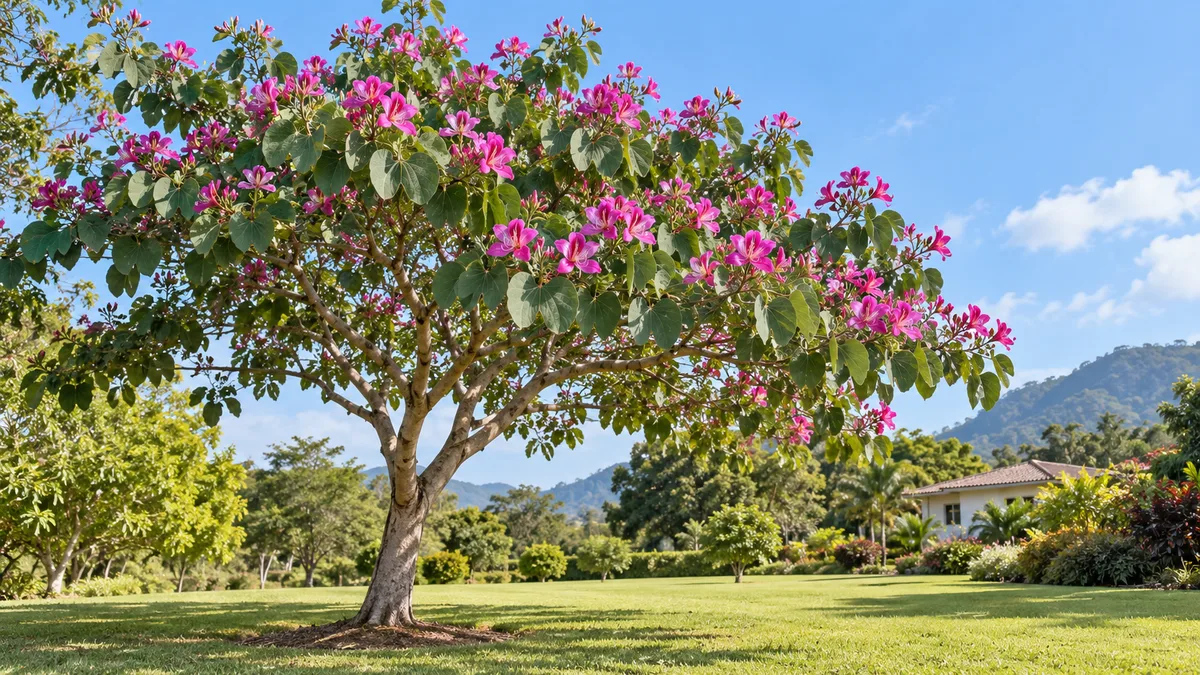
Avoid low spots where water lingers after rain. The tree handles heat and, once established, periods of drought; it is less forgiving of persistently saturated soil and hard cold. The Missouri Botanical Garden recommends protecting it from cold winds and frost, and the South Florida Plant Guide also cautions against high-wind locations because fast-growing wood is less dense than that of slower-growing shade trees.
Plant a Young Tree Without Burying the Trunk
Plant during a warm, mild part of the growing season, when the tree has time to root before either peak heat or winter cold. Dig a hole two to three times wider than the root ball but no deeper. Loosen circling roots around the outside of a container-grown plant, then set the root flare at or slightly above the surrounding soil surface; a deep hole that settles can bury the trunk base and hold moisture against the bark.
Backfill with the soil you removed unless a soil test or a severe site problem calls for a specific correction. A pocket of rich compost or peat inside the hole can encourage roots to stay in that pocket instead of growing into the surrounding soil. If the ground drains slowly, choose a raised planting area or a different site rather than trying to fix a waterlogged planting hole with fertilizer or a small amount of amendment.
Water the root ball thoroughly after planting to settle soil around the roots. Spread a 2- to 3-inch layer of organic mulch over the root zone, extending it outward as the tree grows, but keep mulch several inches away from the trunk. A wide, shallow mulch ring helps conserve moisture and reduces lawn competition without creating a damp collar around the bark.
Water Deeply While It Establishes, Then Ease Back
A newly planted tree needs more dependable moisture than a mature one. For the first growing season, check the original root ball and the adjacent soil rather than following a rigid calendar: when the upper few inches dry and the root zone is no longer cool and moist, water slowly enough to soak the root ball. Sandy soil and hot, windy weather may require more frequent checks than clay or cool weather.
After the first season, lengthen the interval between watering as the roots move into the surrounding soil. The goal is a deep wetting followed by time for air to return to the soil, not a constant wet surface. NParks describes the species as moderately watered and drought tolerant once established; the Missouri Botanical Garden similarly notes that established trees tolerate dry conditions but leaf edges can brown during drought or dry heat.
When leaves droop during a hot afternoon, check the soil before reaching for the hose. A tree in dry soil may need a slow soak, but a tree in wet soil may have stressed roots that cannot take up water. Yellowing, a sour smell in the root zone, or soil that stays wet for days points toward drainage trouble rather than a need for more frequent watering.
Use Well-Drained Soil and a Wide Mulch Ring
Hong Kong orchid tree grows in a range of soil textures if excess water can drain away. It performs well in loam or sandy soil, and the Missouri Botanical Garden notes that a variety of soils can work when drainage is good. A slightly acidic soil is a useful target, but do not try to change pH just because the plant is described as preferring acid soil.
If you have heavy clay, assess drainage before you plant. Water should not sit around the root ball for long after rainfall; if it does, plant on a broad berm or select a better-drained location. Do not put gravel at the bottom of the hole or create a narrow amended pocket, because neither solves a poorly drained planting site.
Keep mulch broad and shallow as the tree matures. Renew it when it thins, and pull it back from the trunk so bark stays dry. Grass and groundcovers can compete with a young tree for surface moisture, so maintain an open ring while the roots establish and expand it as the canopy grows.
Fertilize Only After You Diagnose a Need
Do not feed this tree on a fixed three-times-a-year schedule simply to force flowers. A healthy tree growing in suitable soil may not need regular fertilizer, and extra nitrogen can push leafy growth when the actual problem is shade, drainage, pruning, or cold injury. Use a soil test when growth is persistently weak or leaves show a repeated pattern of discoloration.
Yellow leaf tissue with green veins can point to nutrient availability problems in alkaline soil. NParks identifies interveinal chlorosis as a risk in alkaline conditions, but yellowing can also result from root stress or cold. Confirm soil pH and likely nutrient need before applying iron or a general fertilizer; use the product label or local extension guidance for the rate, and keep fertilizer off the trunk.
If you do feed, choose a product appropriate to the test result and apply it during active growth, not just before a predicted bloom. Spread it over the root zone instead of piling it near the trunk, water it in as directed, and avoid fertilizing a drought-stressed tree until the water problem is corrected.
Prune for Clearance and a Stronger Canopy
The tree naturally forms an irregular, often multi-trunked crown, so pruning is for structure and clearance rather than a formal shape. Begin while the tree is young, when small cuts are easier to make: remove dead or damaged limbs, branches that cross and rub, and shoots that are likely to block a walk or driveway. NC State Extension recommends regular early pruning to develop a more uniform crown, while NParks advises pruning for form and removing crossing branches.
For routine shaping, wait until the main flowering flush is finishing, then remove only what is needed; a Top Tropicals care profile likewise says pruning is usually unnecessary and is best left until after flowering when needed. Make a clean cut just outside the branch collar; do not leave a long stub, and do not cut flush against the trunk. Avoid topping the tree or shortening every branch to the same line, since hard reduction creates weak regrowth and takes away the natural spreading canopy.
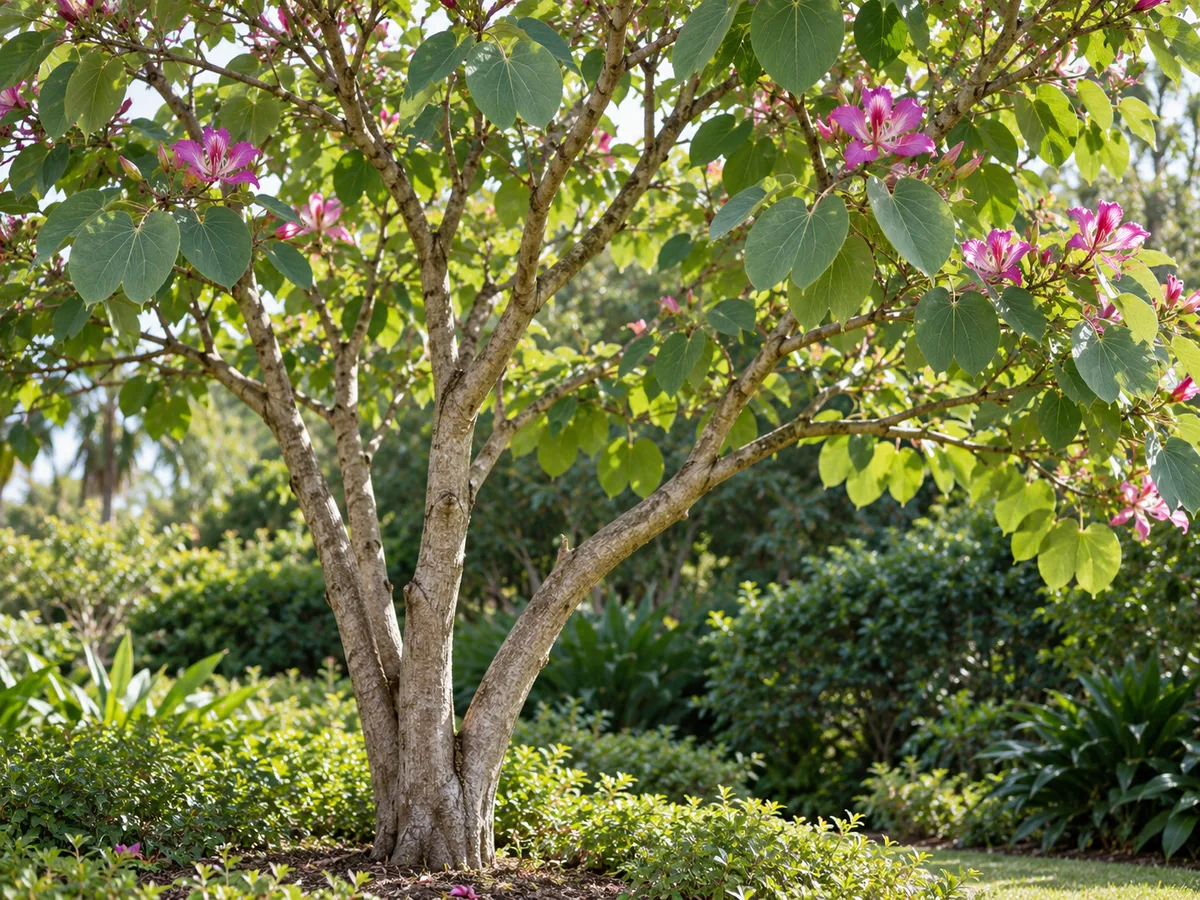
Treat large or storm-damaged limbs differently from small training cuts. If a major branch is cracked, hanging over a structure, or attached at a narrow, splitting union, keep people clear and ask a qualified arborist to assess it. The tree’s rapid growth and potential for a weak branch union make early training useful, but severe cuts on an older tree can leave a much larger wound than simple clearance work.
Decide Whether to Train One Trunk or Keep Several
Both a single-trunk tree and a multi-trunk specimen can work. If you want a small shade canopy over a path, select a strong central leader early and gradually remove competing leaders while they are still small. If you prefer the natural multi-trunk form, keep a few well-spaced stems with broad attachment angles and remove stems that press against one another or create a tight fork.
Do not try to convert a mature multi-stemmed tree in one pruning session. Take only modest cuts over time, and preserve branches that are well attached and evenly distributed around the crown. A tree that already has a deep crack, a large co-dominant stem, or a heavy limb over a roof is a case for an arborist rather than repeated homeowner trimming.
When It Blooms—and Why Flowers May Be Sparse
In seasonal subtropical climates, blooms commonly appear from late fall into spring. The Missouri Botanical Garden lists November through April, while South Florida planting guidance describes a January-to-May display in its local landscape; these are regional observations, not a universal calendar. In places without a strong seasonal shift, bloom timing may be less pronounced, as NParks notes for tropical Singapore.
Large rose-purple flowers can reach about 5 or 6 inches across and appear among gray-green, butterfly-shaped leaves. The tree may shed some foliage as its flowering season begins, so partial leaf drop does not automatically mean disease. The hybrid is semi-evergreen to partly deciduous, with how much it holds leaves depending on climate and winter conditions.
If bloom is weak, check the site before changing the fertilizer. Too much shade, a very young or recently transplanted tree, heavy pruning, drought stress, or excessive nitrogen can all reduce flowering. Give it time to establish in a sunny spot, avoid cutting off the canopy every year, and judge it against the flowering window of trees in your region rather than expecting the same month in every climate.
Propagate a Sterile Hybrid Without Seeds
Hong Kong orchid tree is a sterile hybrid and does not produce the long seed pods seen on some other Bauhinia species. NParks describes it as perpetuated through horticultural propagation such as grafting, while the Hong Kong Herbarium records propagation by cuttings, grafting, and air layering. The important practical point is that seed is not a reliable way to grow this exact tree.
Vegetative propagation is possible, but rooting cuttings and air layers takes skill and can be inconsistent. Home gardeners who want the same ornamental tree are usually better served by buying a correctly labeled nursery plant, often one propagated by grafting or another vegetative method. If your tree makes long, flat pods, verify its identity: it may be a different orchid-tree species or hybrid.
Grow It in a Container or Protect It From Winter Cold
A large container can hold a young tree temporarily, but it is not a realistic permanent home for a plant that can grow 20 feet or more and develop a crown wider than a small patio. The South Florida Plant Guide notes that young trees can be grown in large containers, but rapid growth means you will need to monitor root crowding, water more often than an in-ground tree, and pot up before roots circle densely.
Container culture makes sense when you are keeping a small specimen for a limited time or protecting it in a greenhouse through winter. Use a stable pot with open drainage holes and a coarse, well-drained growing mix. Move it before a cold front rather than after leaves are already damaged, and expect to keep it in a bright, warm space; a dim living room is not a good substitute for the sun this tree needs.
For an in-ground tree near the cool edge of its range, choose a warm microclimate near a south- or west-facing wall only if there is still enough canopy clearance. Protect a young trunk and root zone during an unusual cold snap, and water normally before the cold arrives if soil is dry; do not leave the tree saturated. Repeated hard freezes are a sign that the site is unsuitable, not a problem that routine pruning or fertilizer can solve.
Troubleshoot Leaf Drop, Yellowing, and Weak Growth
Start by identifying what changed and when. A late-season flush of leaf drop can be normal for a semi-deciduous tree; yellowing during warm weather may point to soil pH, wet roots, drought, or a pest. Check the pattern across the canopy, feel the soil at the root ball, and compare symptoms with recent heat, rain, wind, and cold before applying any treatment.
Yellow Leaves With Green Veins
If the tissue between the veins turns yellow while veins stay green, check soil pH and drainage first. Alkaline soil can make iron less available to roots, but a similar appearance can occur when roots stay too wet or are damaged. Test rather than adding fertilizer by guesswork; correct the cause and follow local soil-test recommendations for any nutrient application.
If yellowing begins after an unusually cold night, wait for the extent of damage to become clear before pruning live branches. Cold-stressed foliage may drop while wood remains alive. Scratch a small twig only if you need to test it: green tissue just under the bark indicates living wood, while dry brown tissue may be dead.
Brown Edges or Sudden Leaf Drop
Brown margins after hot, dry weather usually call for a moisture check, not a stronger fertilizer. Water deeply if the root zone is dry and extend the mulch ring, but improve drainage if the soil is still wet. Established trees tolerate dry spells better than new plantings, yet dry heat can still scorch leaves or reduce flowering.
A wave of leaf drop after frost or a cold, dry wind is different from gradual seasonal shedding. Protect the tree from further exposure, keep irrigation moderate, and wait until new growth shows which twigs survived. Prune dead wood after the injury is evident; cutting too early can remove branches that would have leafed out again.
Few Flowers or Weak Growth
For few flowers, count direct-sun hours and consider whether the tree was recently planted or heavily pruned. A young tree may put energy into roots and framework before it produces a full display; shade and repeated hard trimming can keep it from reaching that point. Correct those constraints before trying a bloom fertilizer.
Weak overall growth can reflect poor drainage, cold injury, root competition, or a real nutrient shortage. Look for more than one clue: persistently wet soil, repeated yellowing, dieback at branch tips, or a sudden decline after a freeze. A soil test and local extension diagnosis are more useful than applying a general fertilizer whenever the tree looks tired.
Watch for Pests Without Treating Blindly
The tree is not usually described as having serious disease problems, though a few insects can chew its foliage. The Missouri Botanical Garden and NC State Extension both list the Chinese rose beetle as a leaf-feeding pest. Inspect leaves for fresh holes or ragged edges and check the underside before deciding that a cosmetic problem needs control.
Do not spray a flowering canopy just because an insect is present. First decide whether damage is limited and the tree is still growing normally; if the damage is severe or you cannot identify the pest, take a clear leaf or insect photo to a local extension service or arborist. The same principle applies to leaf spots: remove fallen diseased leaves where practical, avoid unnecessary leaf wetness, and get a diagnosis before using a fungicide.
Conclusion
The best Hong Kong orchid tree care starts with the right site: a warm climate, full sun, fast-draining soil, space for a 20- to 25-foot canopy, and shelter from hard frost and strong wind. Water a young tree deeply when its root zone begins to dry, then reduce the frequency as it establishes; prune early for a sound framework and avoid routine heavy feeding or topping.
Expect a broad, sometimes multi-trunked tree with a partly deciduous habit and a long but region-dependent fall-to-spring flowering season. If leaves yellow, edges scorch, or flowers stay sparse, check soil pH, drainage, sunlight, water, and recent cold before treating. The hybrid does not make seed pods, so buy a nursery-grown tree or use vegetative propagation if you want to preserve its distinctive flowers.