How to Grow and Care for Blue Princess Holly
Learn how to site, plant, water, prune, and protect Blue Princess holly, plus how to choose a pollinator and troubleshoot sparse berries.
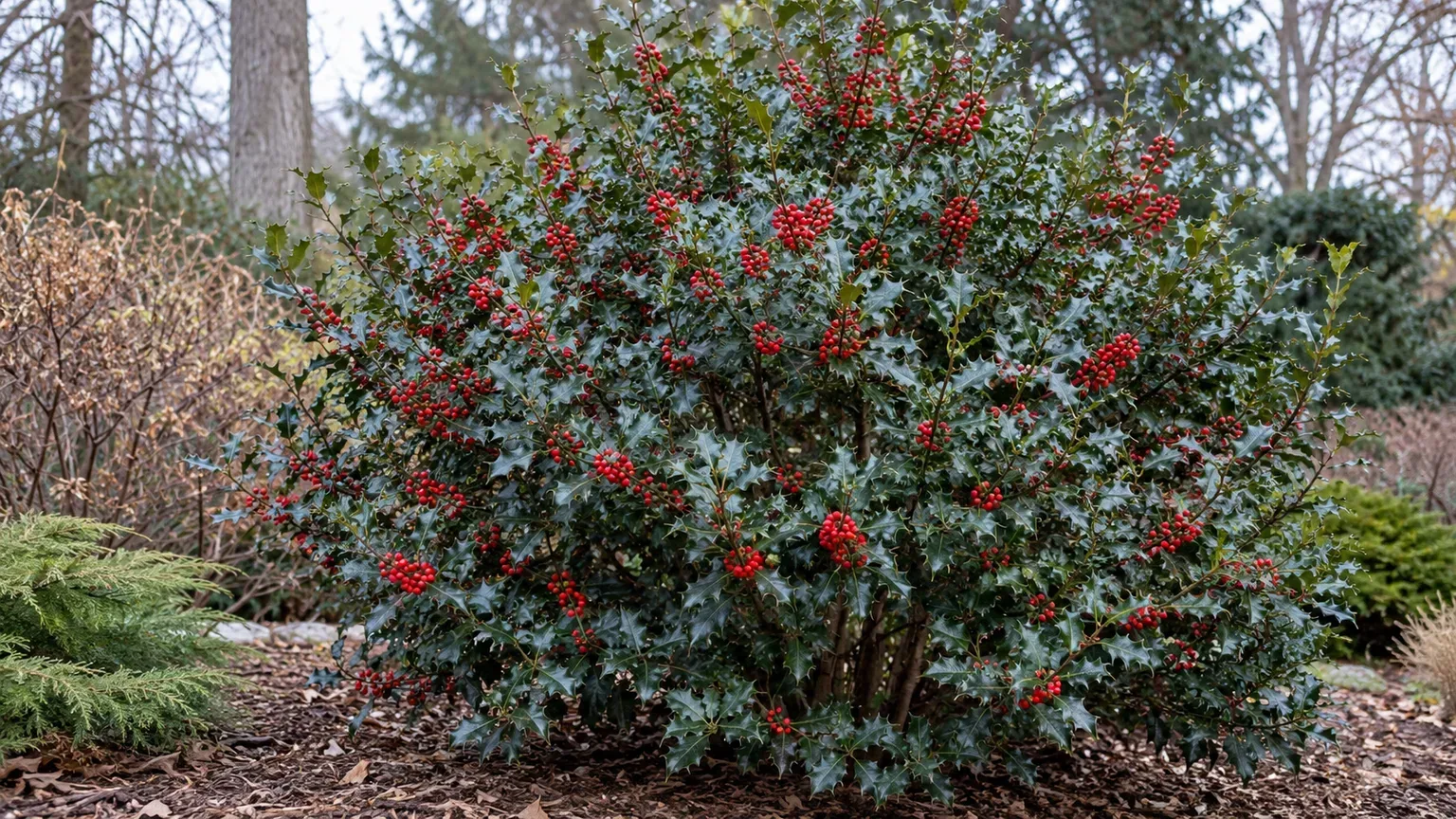
‘Blue Princess’ is an evergreen female Meserve holly (Ilex × meserveae) grown for its blue-green, spiny leaves and red winter berries. The berry display depends on a separate male holly flowering nearby, and the shrub’s success also depends on a site with drainage, enough light, and protection from drying winter winds. If your plant is healthy but bare of berries, start by checking pollination and pruning history before adding fertilizer or treating it for disease.
This is a broad, substantial shrub, not a naturally compact foundation plant. Allow room for its eventual spread, keep the root zone evenly moist while it establishes, and make only the cuts you need if flowers and berries are a priority. Size and hardiness estimates vary across plant references, so use the guidance below as a planning range and adjust it to your local climate and the plant’s actual label.
Blue Princess holly at a glance
| Feature | What to expect |
|---|---|
| Botanical identity | Female cultivar of Ilex × meserveae, or Meserve holly |
| Mature size | Commonly listed around 8–12 feet tall; some references allow 15 feet, with a broad 6–10-foot spread |
| Light | Full sun to partial shade; afternoon shade can help in hot-summer regions |
| Soil | Moist but well drained; acidic soil is preferred |
| Flowers and fruit | Small spring flowers; red fruit develops on a pollinated female plant |
| Pollination | A compatible male, commonly ‘Blue Prince,’ must flower nearby |
| Main risks | Poor drainage, winter wind exposure, aggressive pruning, and unverified fertilizer or pesticide use |
The NC State Extension plant profile describes Meserve holly as a dense shrub that can reach roughly 8 to 12 feet and prefers moist, well-drained, acidic soil. UConn’s plant database gives a potential height of about 15 feet for the group, while Garden Design’s holly guide lists ‘Blue Princess’ in a similar broad range. That spread is why spacing and mature-size planning matter more than whether a new plant looks small in its nursery pot.
Hardiness labels also differ among references and named selections. NC State’s species-level profile and the University of Arkansas Extension’s Blue Princess profile center on colder parts of the South and Mid-Atlantic, while other horticulture references give a wider range. Treat a zone number as a screening tool, not a promise: winter wind, drainage, exposure, snow cover, and summer heat can shift how a plant performs in a particular yard.
Why this female holly needs a pollinator for berries
Meserve hollies are dioecious: individual plants produce flowers that function as male or female, rather than both. ‘Blue Princess’ is female. Gardening Know How’s holly guide likewise advises checking for a male plant when fruit is the goal. Its flowers can develop into red berries only after pollen reaches them from a compatible male plant whose flowers open at the same time. The common partner is ‘Blue Prince,’ but an established, compatible male Meserve holly may also serve if its bloom overlaps.
A female shrub can grow for years without fruit if it has no suitable pollen source. It can also set fewer berries when the male is too distant, flowering periods do not overlap, or spring weather limits pollinator activity. So a bare plant does not automatically mean the shrub is unhealthy or incorrectly fertilized. Start with plant identity and bloom, then consider site stress.
UConn’s plant record notes that a male plant nearby supports strong fruiting and uses about 300 feet as a reference distance. That is a useful planning cue, not a guarantee or strict cutoff: buildings, wind, planting density, local insect activity, and the number of flowers can affect results. If you are planting a pair from scratch, place them within the same garden area and choose a clearly labeled male that is known to flower alongside ‘Blue Princess.’
Choose a site with enough room, light, and shelter
Give ‘Blue Princess’ room to mature instead of squeezing it against a walkway, window, or utility line. A planting distance of roughly 6 to 10 feet from structures and other large shrubs may be a sensible starting point, but use the nursery’s cultivar dimensions and the mature size of neighboring plants to set the final spacing. If you want a hedge, account for the eventual width and airflow rather than setting plants tightly because they are small at purchase.
Full sun generally supports denser growth and more flower production. Partial shade is tolerated, but a heavily shaded site may produce a looser, less floriferous plant. In hotter regions, a spot that receives morning sun and some protection from intense late-afternoon heat can reduce stress; Arkansas Extension specifically notes the value of afternoon shade in southern landscapes. More shade is not an automatic cure for leaf scorch, however. Check soil moisture, drainage, reflected heat from walls, and winter exposure as well.
Shelter from desiccating wind is especially helpful in cold regions. Evergreen leaves continue to lose moisture when the ground is frozen and roots cannot replace it quickly, so a windswept corner can cause browning even when temperatures are within a published hardiness range. A house wall or mixed shrub border can buffer wind, but do not plant so close that the roof sheds water onto the root ball or the mature branches are trapped against siding.
Prepare acidic, moist, well-drained soil
The goal is soil that holds enough moisture for roots without staying saturated. Meserve holly grows best in acidic soil; NC State recommends a pH below 6 for the group. A neutral or mildly alkaline garden may still support growth, but high pH can limit nutrient availability and contribute to chlorosis. Test the soil before adding sulfur, an acidifying fertilizer, or iron: the right correction depends on actual pH, soil type, and local recommendations.
Drainage matters as much as acidity. If water pools after rain or the planting area remains soggy, choose a different site, improve the broader bed, or consult local extension guidance about planting on a raised berm. A hole filled with fluffy potting mix inside dense clay can act like a basin and hold water around roots. Amend a broad area only when a soil test or local planting guidance supports it; do not create an isolated pocket with a radically different texture.
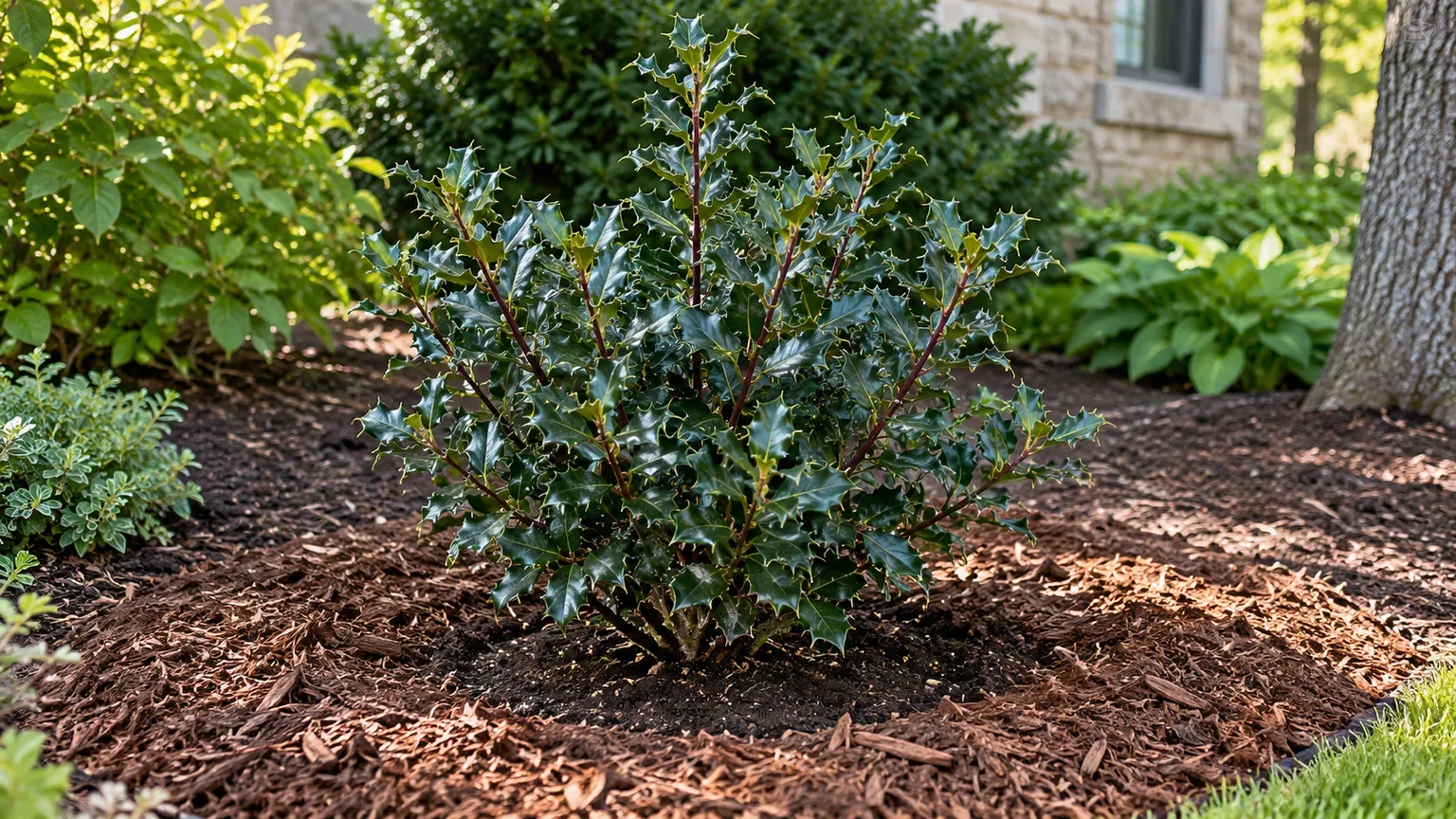
A 2- to 3-inch organic mulch layer helps moderate soil temperature and reduce moisture swings. Keep mulch several inches away from the stems and root flare so bark stays dry and visible. Pine bark or shredded leaves can work as surface mulch, but do not depend on mulch alone to change soil pH quickly. Re-test before making large chemical adjustments.
Plant the shrub without burying the root flare
Plant in spring or early fall when the soil is workable and the plant has time to root before extreme heat or deep cold. Dig a hole about two to three times the root ball’s width but no deeper than the root ball itself. If roots circle tightly around the container, loosen the outer roots gently so they can grow outward; avoid tearing the root ball apart.
Set the plant so the top of its root ball is level with, or slightly above, the surrounding grade. The first structural roots should remain near the surface rather than buried under extra soil. Backfill with the excavated soil, firm it lightly to remove large air pockets, water slowly to settle it, and finish with mulch that leaves the base clear. A planting that is too deep can decline gradually and may be mistaken for a fertilizer problem.
Water the root ball through the first growing season
The container root ball and surrounding native soil may dry at different rates. Check both with your fingers or a soil probe before watering; a damp surface does not prove the center of the root ball is moist, and a dry surface does not always mean the deeper soil needs water. When the root zone is beginning to dry, water slowly enough to soak the full ball and the adjacent soil, then let excess drain away.
Use weather and soil texture to set the interval instead of following a rigid weekly rule. Sandy soil and summer heat may call for more frequent checks than cool weather or clay. Watering deeply and less often encourages roots to move into surrounding soil; frequent shallow sprinkling keeps roots concentrated at the surface. Reduce irrigation when rain has soaked the bed, and do not keep the soil saturated in an effort to prevent winter injury.
Water and feed according to soil, not a calendar
After establishment, ‘Blue Princess’ usually needs supplemental water during prolonged dry spells rather than routine irrigation every week regardless of rain. Check below the mulch before watering. If the soil is cool and moist several inches down, wait; if it is dry through the root zone and there has been little rain, give a slow, deep soak. Newly planted shrubs and plants in very free-draining soil need closer monitoring than established shrubs in loam.
Fertilizer is not a reliable way to force flowering or berries. A heavy nitrogen application can push leafy shoots at the expense of balanced growth and may contribute to nutrient runoff or root injury. Start with a soil test if the shrub grows poorly or foliage looks abnormal. If a test or local extension recommendation supports fertilizer, choose a product labeled for broadleaf evergreens and follow its rate and timing; never exceed the label or apply it to dry, stressed roots.
A layer of finished compost at planting can add organic matter, but it does not replace site drainage or a soil-test-based nutrient plan. Avoid stacking several products—compost, lawn fertilizer, acidifier, and “holly food”—without accounting for the nutrients they contain. More inputs can create salts, imbalanced growth, or pH problems without solving the limiting factor.
How to get berries from Blue Princess holly
Work through the berry problem in a fixed order: verify the cultivar, confirm a compatible male is present, look for spring flowers on both shrubs, consider whether pruning removed flowering wood, and then assess light, water, and winter stress. This sequence is more efficient than immediately adding fertilizer or pesticide. Take notes during spring bloom because the evidence is easiest to see then.
Confirm the plant and pollinator identities
A ‘Blue Princess’ label indicates a female selection, but a plant sold simply as “blue holly” may be another cultivar. The tag or invoice is useful if you need fruit and should be kept with the planting record. If the shrub has never produced berries, no berries alone cannot tell you whether it is male or female. Inspect flowers in spring or ask the nursery to confirm its cultivar.
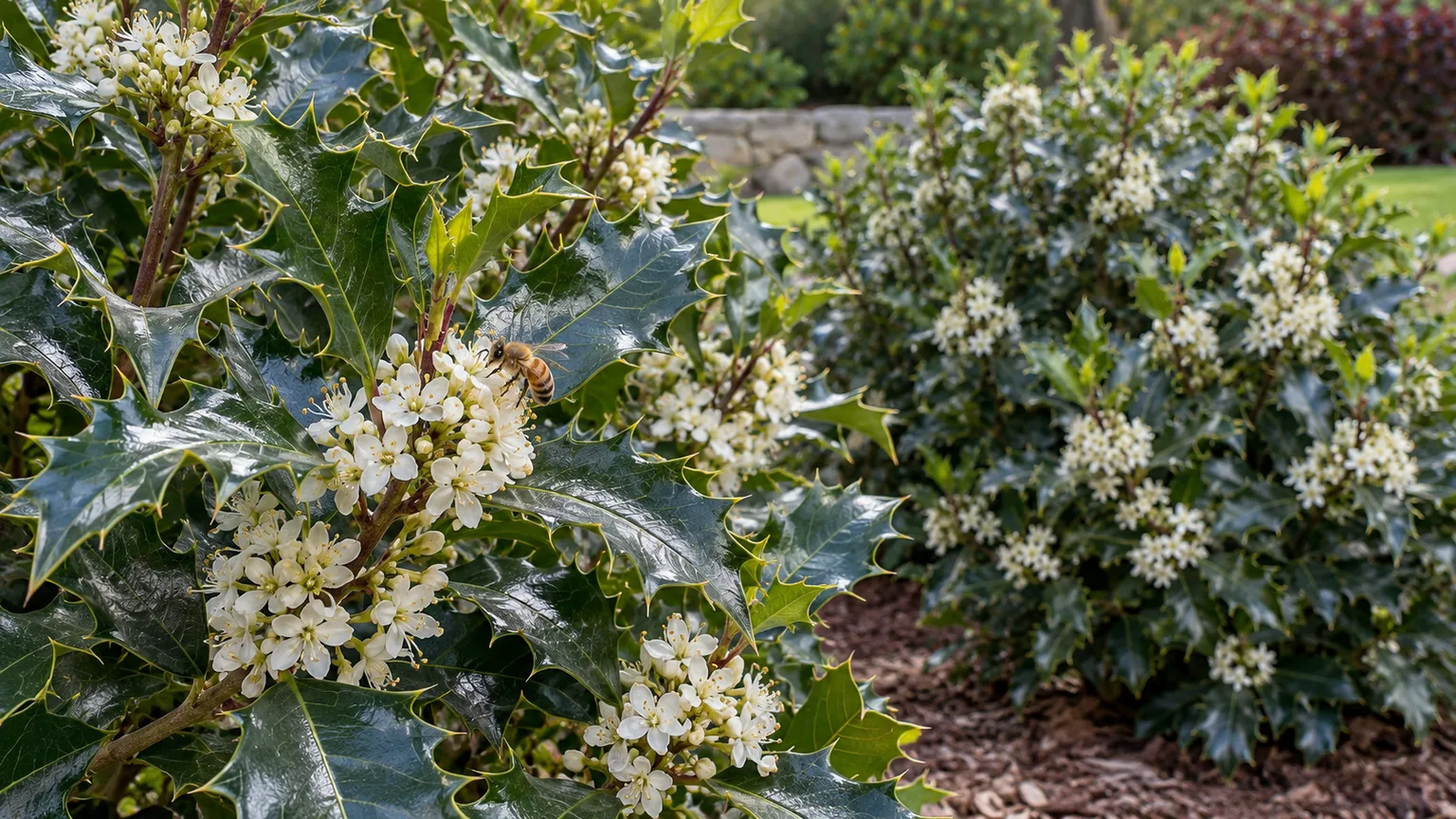
Female flowers have a central ovary; male flowers have pollen-bearing stamens. These small structures can be difficult to inspect without a hand lens, so a reliable label is usually the simplest first check. ‘Blue Prince’ is the traditional male partner for ‘Blue Princess.’ If you already have a male blue holly, confirm its named type and compare bloom timing before buying another plant. A second female will not solve a pollination gap.
Check distance and spring flower overlap
Both shrubs need to flower during the same period. UConn describes Meserve holly flowers in late April or early May in its region, but local flowering shifts with latitude, elevation, and spring temperatures. Watch the actual plants rather than assuming a calendar date. If one shrub flowers much earlier or later, ask a local nursery or extension office for a male cultivar with overlapping bloom in your area.
Place the male in the same general landscape, not behind a building or far beyond the garden if you have room to bring it closer. The UConn distance note of about 300 feet can guide a large-property layout, but a nearer plant is a conservative choice when berry set matters. A single compatible male can pollinate multiple females, though the practical result depends on the plants’ size, bloom, distance, and local pollinators.
Be patient after planting. A small or newly transplanted holly may need time to establish before it flowers heavily. If both shrubs are flowering but fruit remains scarce for a season, note the weather during bloom and watch again the following spring rather than applying a broad-spectrum insecticide that could also harm pollinating insects.
Preserve flowers and developing fruit
Evergreen Meserve hollies generally carry flower buds on growth formed in the prior season. A late winter or spring cut that shortens many shoots can remove the flowers that would have produced berries, and a sheared outline often sacrifices more fruit-bearing tips than selective cuts. If winter berries are the main reason you grow the plant, let the shrub keep its natural form or prune only enough to remove damaged, crossing, or unsafe branches.
Avoid pesticide sprays during bloom unless a pest has been correctly identified and a product is specifically needed. A treatment that kills visiting insects can undermine pollination even when the male plant is nearby. If pruning is necessary, use our guide to when to prune holly to weigh the local timing and berry trade-off; remove no more than the plant can reasonably replace in one season.
Prune lightly when berry display matters
‘Blue Princess’ can become a large shrub, so set its location and shape expectations before planting. For an informal specimen, selective cuts that shorten an unwanted branch back to a lateral shoot preserve a more natural outline than clipping every surface into a box. A formal hedge can be sheared, but frequent shearing removes flower-bearing tips and may keep the plant leafy without delivering many berries.
For routine shaping, prune after you understand the flowering and fruiting cycle in your climate. If berries are valuable, wait until flowers have finished and fruit is visible before elective shaping, and avoid cutting berry-bearing stems you want to keep. If size control is more urgent, prioritize safety and structure, then accept that the next fruit display may be reduced. Dead, broken, or diseased wood can be removed when noticed; disinfect tools between plants if disease is suspected.
Do not plan to hold a naturally large cultivar at a tiny size forever by repeatedly cutting into bare interior wood. That creates a thin outer shell and exposes empty branches when the shrub is cut back. If the plant has outgrown its space, make gradual selective reductions or consider moving/replacing it while young. For broader holly pruning decisions, see our guide to pruning holly for holiday decor, which explains how harvest cuts affect the display.
Protect the shrub from winter wind and drying
Cold tolerance varies by source, cultivar, and site. Rather than relying on a single zone number, use a locally recommended range and consider the conditions around the plant. A sheltered, well-drained position may succeed where an exposed, wet, or wind-tunneled site fails. UConn reports good cold hardiness for Meserve holly, while NC State notes that its regional plant profile is not reliably winter hardy in all exposures; that difference is a reason to think about microclimate, not a reason to ignore local limits.
Water thoroughly before the ground freezes if autumn has been dry, then maintain mulch over the root zone without piling it against the stems. For a young shrub in a windy site, a temporary burlap screen on stakes can reduce desiccating wind while allowing air circulation. Do not wrap foliage tightly in plastic, and remove protection when the harsh exposure passes so the plant does not overheat or remain damp.
Winter leaf browning can appear on the windward side or at exposed branch tips. Wait until spring growth makes the boundary between living and dead wood clear before cutting back extensively. If the shrub is damaged repeatedly in the same spot, the durable fix may be a wind screen or a better site, not a stronger fertilizer dose.
Diagnose yellow leaves, leaf drop, and bare branches
Yellowing is a symptom, not a diagnosis. On a holly that prefers acidic soil, high pH can limit iron availability and cause chlorosis, but root stress from waterlogging, drought, transplant shock, or buried roots can also yellow foliage. Check the soil moisture and drainage first, review planting depth, and use a soil test before adding acidifier or iron. Treat only the cause the evidence supports.
A few older leaves dropping can be normal evergreen turnover, especially after seasonal stress. Widespread leaf drop, dark spotting, or branch dieback calls for closer inspection of the root zone, irrigation, exposure, and pest signs. If a branch is brittle and brown, scratch a small spot on the stem to check for green tissue beneath the bark; prune back only to living growth, not on a fixed calendar.
Sparse berries without overall decline point more often to pollination, flowering, or pruning than to a general nutrient shortage. A shrub with pale leaves and few berries may have multiple problems, so solve them one at a time: drainage and moisture, then soil chemistry, then bloom and pollinator conditions. Photograph symptoms and bring a leaf sample or soil test to a local extension office if the pattern continues.
Check pests and leaf-spot symptoms before treating
Holly leaf miners can leave trails or blotches within leaves; scale insects may appear as small raised shells or cottony patches on stems and foliage; spider mites can cause fine stippling, particularly in hot, dry conditions. Identify the pest before spraying. Check leaf undersides and several branches, and distinguish old injury from active feeding before taking action.
Fungal leaf spots may create discrete dark or pale lesions, while poor drainage and winter burn often affect broader areas. Improve airflow, water at soil level, remove fallen diseased foliage, and avoid keeping the canopy wet overnight. Fungicides are not a general-purpose cure: use one only when the problem is diagnosed and the label lists the plant and disease, and follow all directions. University extension clinics can help identify unclear symptoms before treatment.
Propagate the named cultivar from cuttings
A seedling from a berry will not reliably reproduce the named ‘Blue Princess’ traits because it is a hybrid and the seed has a different genetic parentage. To preserve the cultivar, use vegetative propagation. NC State lists stem cuttings as a propagation method for Meserve holly; a healthy, correctly labeled parent plant matters if you want the resulting shrub to be the same selection.
Take softwood or semi-ripe cuttings during a locally suitable period when new growth has begun to firm but is not fully woody. Use clean pruners, remove lower leaves, and place the cutting in a sterile, airy propagation medium kept evenly moist. Rooting hormone may help, but follow its label and avoid leaving the medium waterlogged. Rooting can take weeks or longer, and not every cutting succeeds.
Keep rooted cuttings protected while they develop a substantial root system, then harden them gradually before planting outside. Home propagation is slower than buying a nursery plant and does not guarantee a particular size or berry crop by a certain date. If dependable fruit is the goal, buy a labeled female and a compatible male from a knowledgeable nursery rather than relying on an unknown seedling.
Keep berries and foliage away from children and pets
Do not eat holly berries or leaves. NC State’s Meserve holly profile identifies toxicity concerns and notes gastrointestinal symptoms such as vomiting and diarrhea. The ASPCA’s general holly entry also warns that holly plants can cause gastrointestinal signs in dogs, cats, and horses, but it discusses a different Ilex listing; use it as a conservative genus-level pet warning, not as cultivar-specific toxicology.
Place the shrub where young children and pets are not likely to snack on the berries, and pick up fallen fruit if an animal is prone to eating garden material. Wear gloves when pruning because the stiff leaf points can scratch skin; wash hands after handling plant material. If someone or an animal eats berries or leaves, contact a poison-control service, veterinarian, or medical professional promptly and provide the plant’s label or a clear photo for identification.
Conclusion
Grow ‘Blue Princess’ in a roomy, well-drained site with enough sun, moderate soil moisture, and shelter from drying winter wind. Keep the root flare visible, avoid unnecessary fertilizer, and use soil tests to guide pH or nutrient corrections. The plant can tolerate some shade, but a bright location and stable growing conditions generally support better structure and flowering.
For berries, think like a pollination detective: confirm the shrub is ‘Blue Princess,’ place a compatible male such as ‘Blue Prince’ nearby, check that both flower at the same time, and preserve flowering wood with light, selective pruning. If the shrub remains sparse or declines, investigate drainage, soil pH, pests, and winter exposure before applying treatments. With the right pair and a sensible site, the red fruit becomes a seasonal bonus rather than a mystery.