How to Grow and Care for Flamingo Willow Shrubs
Learn where to plant Flamingo willow, how to keep its soil evenly moist, and when to prune for pink spring shoots without losing a graceful shape as it grows.

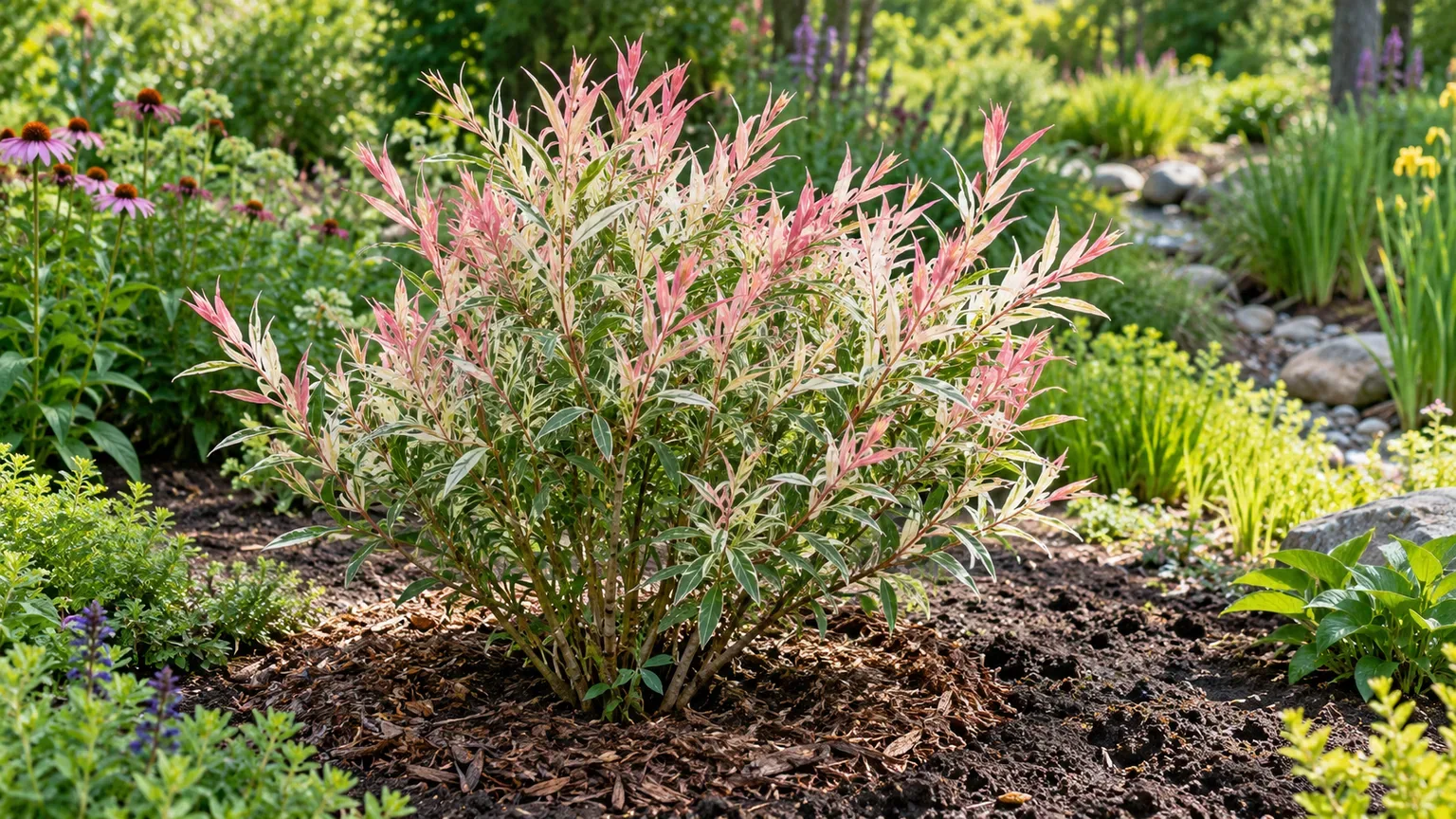
Flamingo willow (Salix integra ‘Flamingo’) is a deciduous ornamental willow grown for new leaves that open in pink, cream, and green. It is a good choice when you want a fast-growing shrub with a vivid spring flush and can give it steady moisture and an annual pruning check. The color is strongest on fresh shoots and usually fades toward green as the leaves mature, so a pink display is seasonal rather than permanent.
Before planting, check whether you have a multi-stem shrub or a grafted standard with a round crown on a trunk. The distinction changes its mature height and how you prune it. Plant either form in bright light and soil that stays evenly moist but still drains; it does not need to stand in a bog.
Flamingo Willow at a Glance
| Care factor | What to plan for |
|---|---|
| Plant | Deciduous willow shrub or grafted standard; sold under overlapping Flamingo and dappled-willow names |
| Size | A shrub is often listed around 4–6 feet tall and 5–7 feet wide, but it can grow larger without pruning; a standard’s trunk adds height |
| Light | Full sun for the best foliage color; partial shade is useful in hot-summer climates |
| Soil | Fertile, moisture-retentive soil that drains; a pond edge is optional, standing water is not |
| Water | Keep a new plant consistently moist while roots establish; water established plants during prolonged dry spells |
| Pruning | Prune in late winter or early spring; choose light shaping or stronger renewal cuts based on the form and color goal |
| Cold range | Arkansas Extension lists dappled willow in USDA zones 4–9; check the local cultivar label, since surviving winter does not guarantee vivid color in summer heat |
| Main drawback | Fast growth means the best compact shape and spring color usually require periodic pruning |
Published size estimates differ. North Carolina State Extension lists ‘Hakuro Nishiki’ at roughly 4 to 6 feet tall and 5 to 7 feet wide, while Oregon State University notes that it may reach about 10 feet and can be kept smaller. The Royal Horticultural Society gives a broader 1.5-to-2.5-meter range for the profile it calls Flamingo willow. Use the full cultivar label and the nursery’s local estimate, then leave space for a wider, less-pruned plant rather than planning around its smallest advertised size. (NC State Extension Plant Toolbox, Oregon State University Landscape Plants, Royal Horticultural Society)
Know Which Flamingo Willow You Bought
The name on a nursery tag may say Flamingo willow, dappled willow, Japanese willow, or Salix integra ‘Hakuro-nishiki’. Those names overlap in garden references. NC State Extension uses Flamingo willow as a common name for ‘Hakuro Nishiki’; Arkansas Extension describes ‘Flamingo’ as a selection from ‘Hakuro-nishiki’; and the RHS profile uses Flamingo willow as a common name for its ‘Hakuro-nishiki’ entry. If exact cultivar identity matters, read the botanical name on the tag and keep it with the plant record. (NC State Extension, University of Arkansas Cooperative Extension, RHS profile)
You may also find the plant sold as a shrub or as a “standard.” A shrub has several stems emerging near the soil line, and its height is controlled by pruning. A standard has the ornamental willow grafted onto a taller trunk; the finished plant is taller by the length of that trunk and keeps a rounded crown above it. The graft union is often visible as a swelling or change in bark near the top of the trunk. Ask which form you are buying, because a six-foot shrub and a six-foot standard are not the same landscape feature.
Decide Whether It Fits Your Garden
Choose Flamingo willow for its foliage, not for year-round pink leaves. The first flush can be striking, the leaves gradually mature to more green and white, and fresh growth later in the season may bring another small flash of pink. Its flexible, reddish young stems also provide some winter interest, though the plant loses its foliage and looks more open in winter. The cultivar’s growth and color are described in the extension and RHS profiles, which also note that cooler summer conditions tend to favor more vivid foliage. (University of Arkansas Cooperative Extension, NC State Extension)
The trade-off is speed. A willow can fill a space quickly, but new shoots also make the shrub broader and less tidy if you never thin or shorten them. It suits a border, an open rain-garden edge, or a courtyard with enough room and a gardener who is comfortable pruning. If you need a slow-growing plant that stays compact without annual attention, choose a different shrub.
Hardiness listings vary with the cultivar reference and climate system. Arkansas Extension describes dappled willow for USDA zones 4 through 9, while the RHS profile gives a UK hardiness rating of H5; these scales are not directly interchangeable. Check the full cultivar name on the nursery tag and local growing advice, and remember that a plant may survive winter while producing less vivid foliage in a hot summer. (Arkansas Extension, Royal Horticultural Society)
Where to Plant Flamingo Willow
Give it a spot with full sun for the most colorful new leaves. In climates with hot afternoons, a little afternoon shade can reduce leaf stress, but deep shade tends to produce weaker growth and less vivid color. NC State Extension recommends full sun to partial shade and notes that afternoon shade can help where summers are hot; Arkansas Extension likewise reports the best foliage color in areas with cooler summers. (NC State Extension, Arkansas Extension)
Pick a place where the root ball can receive regular moisture and the mature crown can spread without being squeezed against a wall, walkway, or neighboring shrub. A rain-garden edge or pond margin can be suitable if the soil drains after rain. Do not plant it in a hole that stays flooded for long periods just because it is a willow; damp and oxygenated is a safer target than persistently saturated soil.
Allow roughly the mature spread on the plant’s label, and more if you want it to grow without frequent shaping. Keep the planting away from underground service lines, drain fields, and tight foundation beds where a fast-growing shrub would be difficult to prune or inspect. For a hedge, space plants according to their expected adult width and the look you want; planting them too close may create a dense, poorly ventilated row that needs more clipping.
How to Plant It Correctly
Plant a container-grown willow when the weather is mild and you can keep the root ball moist during establishment. In a hot or dry climate, avoid planting just before the harshest part of summer unless you can irrigate reliably. Before digging, confirm the planting distance from underground utilities and check that water drains from the chosen spot after a heavy rain.
Dig a hole about twice as wide as the root ball and no deeper than it. Loosen circling roots gently, set the top of the root ball level with surrounding soil, and backfill with the excavated soil. A planting hole filled with rich compost can hold water differently from the surrounding ground, so do not create a small amended pocket in heavy soil; improve a whole bed only when the site genuinely needs it.
Water slowly after planting so the soil settles around the roots. Spread a two- to three-inch layer of organic mulch over the root zone, leaving a clear gap around stems and the trunk. Check the plant every few days during the first couple of weeks, then adjust to rain, temperature, and soil texture rather than following a fixed calendar.
Light and Color: Why New Growth Looks Pink
The colorful leaves are not flowers. New growth opens with pink and cream markings mixed with green; as each leaf matures, the pink usually becomes less prominent and the plant can look mostly green by summer. NC State Extension describes that seasonal shift, and Arkansas Extension notes that each new flush can briefly renew the pink display. This is normal development, not a sign that the plant needs fertilizer. (NC State Extension Plant Toolbox, Arkansas Extension)
Light and summer temperature affect the show. A plant in deep shade may grow leaves but produce a less vivid flush, while hot weather can make the pale parts of the leaves more prone to scorch. In a warm climate, morning sun with protection from the hottest late-afternoon sun is a reasonable compromise. In a cool-summer climate, a sunnier position generally gives stronger color, provided the roots do not dry out.
Pruning can encourage a new flush because new shoots carry the strongest color, but repeated hard cutting is not the only route to a healthy plant. Decide whether you want a naturally arching shrub, a compact mound, or a fresh flush of young growth, then prune to that purpose. The next section explains how to choose the cut without treating every form the same way.
Soil and Water: Keep It Moist, Not Boggy
Flamingo willow prefers soil that holds moisture without staying airless. The RHS lists moist but well-drained soil, while NC State Extension says the plant tolerates wet soils and, unlike many willows, can also tolerate somewhat drier conditions. That flexibility does not mean a new plant can be left to dry out or that a container should sit in a saucer of water. (RHS profile, NC State Extension)
For a new planting, water deeply when the upper few inches of soil begin to dry, checking both the original root ball and the soil around it. The root ball can dry faster than nearby clay, so feel inside it rather than judging by the surface alone. During the first growing season, consistent moisture helps roots expand beyond the nursery mix; after establishment, irrigate during prolonged hot or dry weather and let rainfall do the rest when the soil stays damp.
If leaves wilt, check the soil before reaching for the hose. Dry soil points toward drought stress; soil that remains soggy for days may be starving roots of oxygen. Watering a waterlogged shrub makes the problem worse. In heavy clay, use a higher or better-drained planting location rather than digging a deep pit that collects water around the root ball.
Fertilizer and Mulch
Routine fertilizer is rarely needed in ordinary garden soil. The plant is naturally fast-growing, and extra nitrogen can push long, soft shoots that make the crown harder to manage. If growth is weak, inspect watering, drainage, sun exposure, root disturbance, and pests first; a soil test is more useful than guessing at a fertilizer deficiency.
A thin layer of compost or leaf mold under the mulch can improve the soil gradually. Keep organic mulch a few inches away from the base of the shrub and do not pile it against a grafted trunk. Refresh the mulch when it has broken down, but avoid a deep “volcano” around the stem that can hide bark damage and keep the crown wet.
Pruning: Choose the Shape Before You Cut
Late winter to early spring, while the shrub is dormant and before strong new growth starts, is the main pruning window. NC State Extension recommends light pruning in late winter or early spring, while Arkansas Extension describes more severe late-winter pruning when gardeners want to limit size and encourage new colorful growth. Those approaches serve different goals; they are not contradictory instructions to cut every specimen back hard each year. (NC State Extension, Arkansas Extension)
Start by removing dead, broken, rubbing, or diseased branches. Then decide how much height and width you want to remove. Use clean bypass pruners for small stems and loppers for thicker branches, cutting just above a healthy bud or at the branch collar rather than leaving long stubs. Avoid a late-summer or autumn hard prune that leaves soft new growth exposed just before cold weather.
Pruning a Multi-Stem Shrub
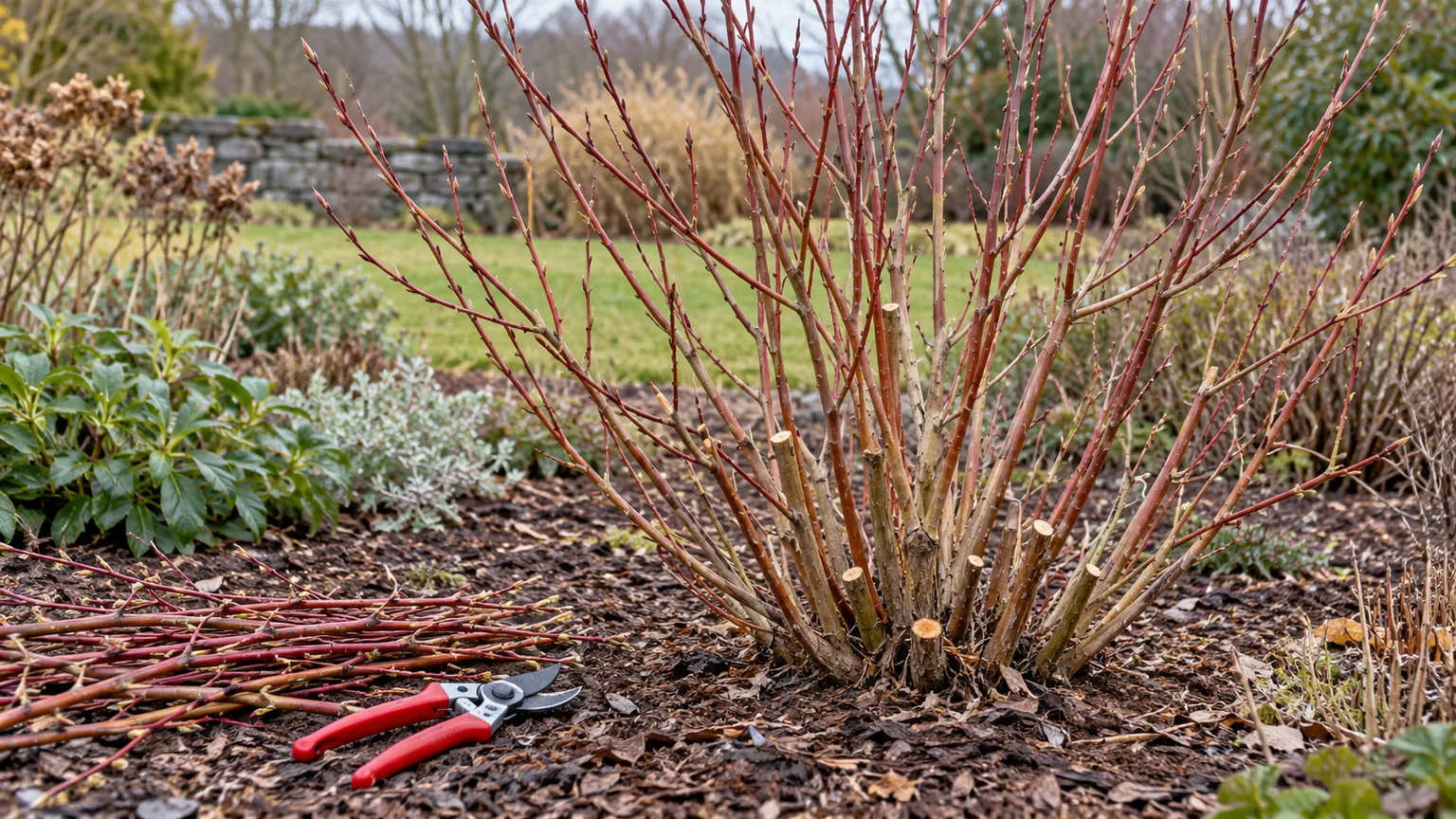
A multi-stem shrub can be kept as a loose, arching mound or cut back more firmly for a compact shape and a fresh spring flush. If you like its natural silhouette, thin out the oldest or most crowded stems at ground level and shorten only branches that are too long. Removing roughly one out of every three older stems over time renews the plant without making the whole shrub look freshly sheared at once.
Choose a Light Trim or a Renewal Cut
For a light annual trim, remove the dead and crossing wood, then shorten the longest shoots by up to about a third to restore the outline. This preserves a taller, more natural shrub and limits the amount of vigorous regrowth. The practical pruning guidance from Gardening Know How similarly recommends removing dead or crowded branches first, then shaping the dappled willow to the size that suits the landscape.
For stronger color and a smaller plant, a well-established shrub can be renewed more heavily in late winter. Remove selected older stems close to the ground and reduce the remaining framework so fresh shoots can fill in. Extension guidance supports severe dormant pruning for size control, but a new or stressed plant should first be allowed to establish; do not repeatedly cut it to the same low stubs if it is making weak growth or has dieback.
An optional summer trim can produce another burst of young foliage on a vigorous, established shrub, but it also removes some of the season’s leaves and creates more work. If you try it, do so after the main spring flush and early enough that new growth has time to mature before cold weather. In hot, dry regions, skip it unless water is reliable.
Pruning a Grafted Standard
Treat a grafted standard differently from a multi-stem shrub. Keep the ornamental crown above the graft union; do not cut the main trunk or prune the head back into the graft. Remove dead or crossing branches within the crown and shorten long shoots to maintain a balanced outline. Because the crown is supported by a trunk, avoid leaving a top-heavy mass of shoots after a hard trim.
Check the trunk below the graft for shoots with plain green leaves. These usually come from the rootstock, not the colorful cultivar, and can eventually outgrow the ornamental crown. Cut them back to their point of origin as soon as you see them. Garden Ninja’s practical discussion of Flamingo willow also distinguishes rootstock suckers below the graft from the desired variegated growth above it. (Garden Ninja)
Propagating Flamingo Willow From Cuttings
Cuttings are the practical way to reproduce a named cultivar and keep its foliage traits. The RHS lists both softwood and hardwood cuttings for its Flamingo willow profile. Take material only from a healthy plant you own or have permission to use; avoid relying on seed if you want a plant that matches the parent. (Royal Horticultural Society)
In late spring or early summer, select a healthy, non-flowering shoot and cut a section several inches long just below a leaf node. Remove leaves from the lower part, insert the bare end into a clean pot of moist propagation mix, and place it in bright shade out of hot wind. Keep the mix evenly damp, not saturated, and tug very gently after a few weeks to check for resistance from roots.
You can also take firm dormant wood in winter and root it in a sheltered container or suitable outdoor nursery bed. Label the cultivar and date, keep the medium moist, and wait for rooted growth before moving it into a permanent position. Willow cuttings can root readily, so keep discarded pieces off wet soil and compost them securely if you do not want them to sprout elsewhere.
Growing Flamingo Willow in a Container
A container is useful for a patio, courtyard, or temporary display, but the plant will need more attention than it would in open ground. Choose a large, stable pot with drainage holes and enough volume for the root ball to expand. A grafted standard may be top-heavy, so use a heavy container that will not tip in wind and check the graft and stake regularly.
Container soil dries faster than garden soil, especially in summer. Check moisture frequently, water thoroughly when the upper layer begins to dry, and let excess water drain freely. Do not leave the pot standing in a full saucer. Use a free-draining container mix, refresh the compost or repot when roots crowd the pot, and protect the root ball from severe winter exposure in colder regions.
The plant can be grown outdoors in a container, but it is not an indoor houseplant. Its mature size, deciduous habit, and need for seasonal outdoor conditions make a bright living-room spot a poor permanent substitute for a garden or patio. If watering a large pot during every hot spell sounds burdensome, plant it in the ground where the site is suitable or choose a smaller ornamental shrub.
Troubleshooting Color, Wilting, and Dieback
Read the whole plant and the soil together. A single green leaf or a few brown tips rarely identify one cause by themselves. Check whether the plant was recently moved, whether the soil is dry or saturated, how much sun the crown receives, and whether symptoms begin above or below the graft.
Pink and Cream Leaves Turn Mostly Green
This is usually the normal progression from new to mature foliage. Wait for the next flush before judging the plant’s color, and remember that cooler summers and strong light tend to produce a more vivid display than hot, shaded sites. If every new shoot has plain green leaves on a grafted tree, inspect for growth below the graft; it may be rootstock taking over rather than the desired cultivar.
If new growth above the graft is also plain green, confirm the cultivar name on your tag and look at its light conditions. Heavy shade and an old, unpruned canopy can reduce the fresh colored growth that makes the plant distinctive. Prune at the appropriate dormant-season window, then judge the next flush rather than applying fertilizer to try to change leaf color.
Brown Leaves, Wilting, or Leaf Drop
Start with the soil. A dry root ball, hot wind, or a recently planted shrub can cause curling, brown edges, wilt, or premature leaf drop. Water slowly and deeply if the root zone is dry, then use mulch to reduce evaporation while leaving air around the stems. If the soil is already wet, stop adding water and look for poor drainage or root disturbance.
After transplanting or hard pruning, some leaf loss can reflect stress while roots and shoots rebalance. Keep moisture consistent and avoid another hard prune or an automatic fertilizer dose while the plant recovers. For branches that may be dead, lightly scratch a small patch of bark: living tissue underneath is moist and green, while dead wood is dry and brown. Prune dead tips back to healthy tissue in the dormant season, and ask a local extension office to assess widespread dieback, cankers, or fast-spreading lesions.
On a grafted standard, shoots from below the graft are rootstock growth. Remove them at their base so they do not shade or weaken the ornamental crown. Do not apply this rule to a multi-stem shrub: stems emerging from the soil around an ungrafted shrub are part of its normal form and are the very branches you manage through renewal pruning.
Pests and Diseases to Watch For
Aphids, willow scale, leaf beetles, lace bugs, and caterpillars can feed on willows. Inspect leaf undersides and tender tips; aphids may leave sticky honeydew, while leaf-feeding insects leave holes or scraped patches. A light infestation can often be managed by rinsing foliage or removing affected leaves and caterpillars by hand. Identify the pest before using a pesticide, and follow the product label and local guidance if treatment is necessary. (RHS plant profile, NC State Extension)
Willows can also develop leaf spots, rust, scab, cankers, and other fungal or bacterial problems. Improve air movement by thinning crowded growth, water at soil level when practical, and remove fallen or clearly diseased material instead of leaving it beneath the shrub. Do not spray a fungicide simply because a leaf is brown; drought, heat, transplant stress, and waterlogged roots can create similar symptoms, and treatment depends on the diagnosis. The RHS profile lists willow anthracnose, scab, canker, honey fungus, and rust among possible diseases. (Royal Horticultural Society)
Conclusion
Flamingo willow is manageable when you match the pruning to the form you bought. Give a multi-stem shrub room, bright light, and soil that stays moist but drains; then choose whether you prefer light shaping or a stronger dormant-season renewal cut for a compact flush of young color. A grafted standard needs crown maintenance and quick removal of shoots below the graft, not shrub-style cutting to the ground.
The pink display will ebb as the leaves mature, and a hot summer can make it less intense. That seasonal change is part of the plant’s character. If you are comfortable with that rhythm—and can check moisture during dry weather—Flamingo willow can bring a vivid spring accent without requiring a bog or constant pruning.