How Early Is Too Early to Use a Leaf Blower?
Find out how early you can use a leaf blower, how to check local noise rules, and when to leave leaves for healthy turf, better soil, and wildlife habitat.

If you do not know your local rule, wait until at least 8 or 9 a.m. on a weekday and 9 or 10 a.m. on a weekend before using a leaf blower. Treat those times as a courtesy guideline, not legal permission: some cities allow earlier use, some allow it later, and others restrict the equipment or prohibit it on certain days. In a close neighborhood, choose the later end of that window, run the blower for one planned session, and stop before the evening quiet period.
Before you pull the starter or press the trigger, check what actually needs clearing. A leaf-covered lawn does not always need to be bare; light leaves can be mulched into turf, and leaves in beds or a quiet garden corner can shelter wildlife and return organic matter to soil. The best cleanup is often smaller, shorter, and less noisy than a full-yard sweep.
The short answer: wait until your neighbors are up
A leaf blower is outdoor power equipment, and its sound carries across property lines even when the task seems quick from the operator’s side of the yard. If your city or association publishes quiet hours, follow those first. If there is no clear rule, a practical courtesy window is roughly 8–9 a.m. on weekdays and 9–10 a.m. on weekends; use the later time when homes are close together, bedrooms face the yard, or the neighborhood is still quiet.
Those hours are not a national standard. Homes & Gardens’ practical reporting cites etiquette guidance that places common starts around 8 or 9 a.m. on weekdays and 9 or 10 a.m. on weekends, while emphasizing that the neighborhood context matters (Homes & Gardens’ leaf blower etiquette guide). The point is not that a specific minute is universally polite; it is to avoid waking people and to keep a noisy job out of the earliest and latest parts of the day.
If you are hiring a lawn crew, ask what time they plan to arrive and request a later blower pass if the schedule would wake nearby households. For a one-time heavy cleanup, a quick heads-up to an immediately adjacent neighbor can prevent surprise, especially if you know someone works nights, has a new baby, or is recovering at home. Courtesy cannot override a legal restriction, but it can help you select a better slot within the allowed hours.
There is no universal legal start time
The legal answer depends on your address. Leaf blower rules may sit in a city or county noise code, a landscape-equipment ordinance, a seasonal restriction, or a rule aimed specifically at contractors. The same jurisdiction can have different limits for weekdays, Saturdays, Sundays, commercial properties, equipment type, sound level, or length of use, so a time that is lawful in one town may bring a warning in the next.
For example, the City of Pasadena’s posted leaf blower FAQ lists weekday and Saturday hours, disallows Sunday use, sets a sound limit for electric blowers measured at a stated distance, and limits operating time on some parcels (City of Pasadena leaf blower rules). That is a local example, not a template for other cities. It shows why “leaf blowers are allowed after 8 a.m.” is not a safe assumption unless you have checked the rule where you live.
Check the rules that apply to your address
Start with your city or county website and search its official code or noise-control page for “leaf blower,” “landscape equipment,” “yard maintenance,” “outdoor power equipment,” and “residential noise.” Some municipalities publish a plain-language FAQ; if you need to rely on a precise start time, equipment ban, or decibel limit, follow the linked ordinance or contact the responsible code-enforcement office rather than trusting a search snippet or an old neighborhood post.
Then check the rules that apply to your property. A homeowners association, co-op, condominium board, lease, or property manager may set narrower hours than the city allows. If a contractor is doing the work, ask whether separate commercial landscaping rules apply; a resident’s schedule may not cover a paid crew. When rules disagree, use the stricter applicable requirement until the responsible authority clarifies it.
What leaf blower rules can cover
Do not look only for a start time. A code may distinguish gas from battery or corded equipment, set a noise ceiling at a particular measurement point, restrict the days of use, limit run time, or prohibit the tool in certain zones. A “quiet” or “electric” label does not automatically exempt a blower from all local rules; the code’s wording and measurement method matter.
Rules can also change. A city may adopt a seasonal restriction, phase in an equipment ban, or issue temporary directions during an emergency. Check the official page near the date you plan to work, especially if you have just moved, changed equipment, or are scheduling a contractor. If you cannot find the answer online, call the municipal office that handles noise complaints or code enforcement and ask what rule applies to your address and equipment.
Choose a considerate cleanup window
Once you know the legal window, choose a time that is considerate in practice. Avoid the early morning and dinner-hour edges even if the ordinance allows them. Midmorning or early afternoon usually gives neighbors a chance to wake, open windows, and finish their own quiet routines before yard work starts; it can also give dew time to dry so you are not running the blower longer on damp leaves.
The right hour shifts with the setting. In a wide rural lot, distance may reduce the disturbance, but it does not erase a local restriction. On a compact suburban street, a few minutes of noise can reach several houses, so later morning is the safer choice. In an apartment courtyard or tightly spaced row of homes, ask building management about quiet hours and avoid assuming that “outdoors” means nobody can hear you.
Consider the people around you, not only the clock. A neighbor may be sleeping after a night shift, a child may nap at a predictable time, or a nearby business may be taking customer calls. If you need to clear a path for immediate access or safety, use the quietest effective method and clear only that route; postpone a full-lawn cleanup until an appropriate window.
Why leaf blowing can be disruptive even when it is brief
The sound is only one part of the nuisance. Blowers can send dry dust, grass clippings, seed pods, and leaves across fences or toward open doors, parked cars, sidewalks, and roadways. If the operator starts and stops repeatedly, or chases every leaf across a large yard, the noise lasts longer and the debris tends to travel farther.
This is why the considerate choice is not simply “use a quieter machine.” Battery and corded models avoid exhaust at the point of use and may be less intrusive than some gas equipment, but the actual sound depends on the particular model, its setting, condition, distance, and the surface reflecting it. If your local rule gives a measured limit, use the required measurement method; a manufacturer’s sound rating may have been taken at a different distance or under different conditions.
The yard itself also has a stake in the decision. Blowing every fallen leaf off every surface removes a useful material from the landscape and can turn an easy maintenance task into a recurring noise event. First decide where leaves are a problem and where they are useful; then choose the lowest-noise method for that specific spot.
Keep leaves where they help your landscape
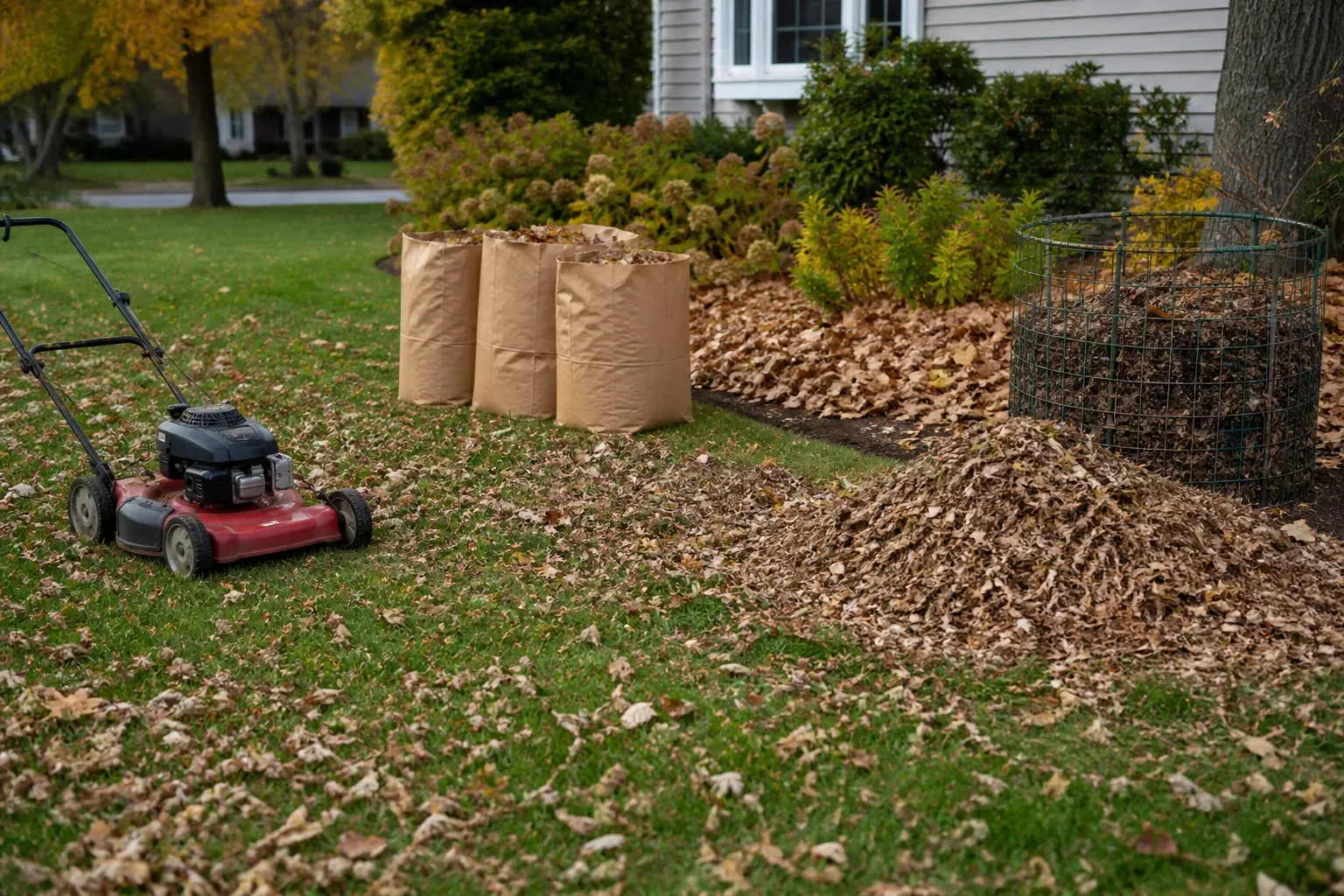
A blanket of leaves is neither automatically beneficial nor automatically harmful. On a lawn, a thick, wet mat can shade the grass and interfere with growth, while a light covering can often be chopped into small pieces with a mower. In beds, under shrubs, and in a quiet corner, leaves can function as mulch, add organic matter as they break down, and provide shelter for overwintering wildlife.
A quick walk-through helps you avoid treating every surface the same way. Mark three zones in your head: clear where leaves create a slipping, drainage, or visibility problem; mulch a light layer across open turf; and keep or move leaves into beds or a quiet habitat patch. This simple sort prevents a “clean the whole yard” job from becoming the default, and it gives you a destination for each pile before the blower starts.
North Carolina Cooperative Extension explains that leaf litter can provide overwintering shelter and pupation sites for insects and pollinators, while decomposing leaves contribute organic matter and help retain soil moisture (N.C. Cooperative Extension’s leaf-litter guidance). That does not mean every leaf should remain exactly where it lands. It means you can move leaves selectively—off surfaces where they create a real problem and into places where they can do useful work.
On a lawn: mulch a light layer, move a thick mat
If you can still see much of the grass through a light scatter of dry leaves, you may not need to rake or blow them away. Penn State Extension recommends mowing leaves while they are relatively dry and not too thick, and says a shredded layer up to about one-half inch can benefit the lawn (Penn State Extension’s fall leaf guide). If the mower leaves clumps or the grass disappears under a dense layer, collect the excess and move it to a bed, compost pile, or approved yard-waste collection.
Mulch-mowing is often quieter and quicker than blowing leaves from the lawn into a pile, then bagging them. It also keeps leaf material on your property. Do not try to mow a heavy blanket all at once simply to avoid raking; make a pass when the layer is light, or rake some of it away first so the remaining pieces can settle between the grass blades.
In beds and quiet corners: keep useful leaf litter
Under trees, around shrubs, and in perennial beds, leaves can protect the soil surface and gradually return organic matter. Penn State Extension describes shredded leaves as a useful mulch for beds and woody plants, while N.C. Cooperative Extension recommends moving leaves under trees, shrubs, and garden beds and leaving some undisturbed leaf litter in a quiet area. Keep the material from smothering plant crowns or piling tightly against trunks, and follow local horticulture guidance for plants with a known disease problem.
You can designate a tidy leaf area rather than leaving leaves scattered everywhere. Rake them beneath a shrub border, behind a shed, or into a contained pile at the edge of a garden; that keeps paths and the lawn usable while preserving some shelter. Penn State Extension notes that a pile in an already wooded area should not simply be added on top of existing leaf litter, because animals and insects use particular depths of that habitat.
Leaves can also become a practical soil resource. Penn State Extension explains that shredded leaves break down faster than whole leaves and can be used as mulch; its guide describes leaf mold as a soil amendment that can improve structure and water retention. GrowVeg’s gardening guide offers additional ways to collect leaves for leaf mold, compost, and mulch (GrowVeg’s guide to using autumn leaves). If you have more than you need, store dry leaves for later as a carbon-rich compost ingredient instead of making several noisy trips to the curb.
On paths, drives, and drains: clear only what needs clearing
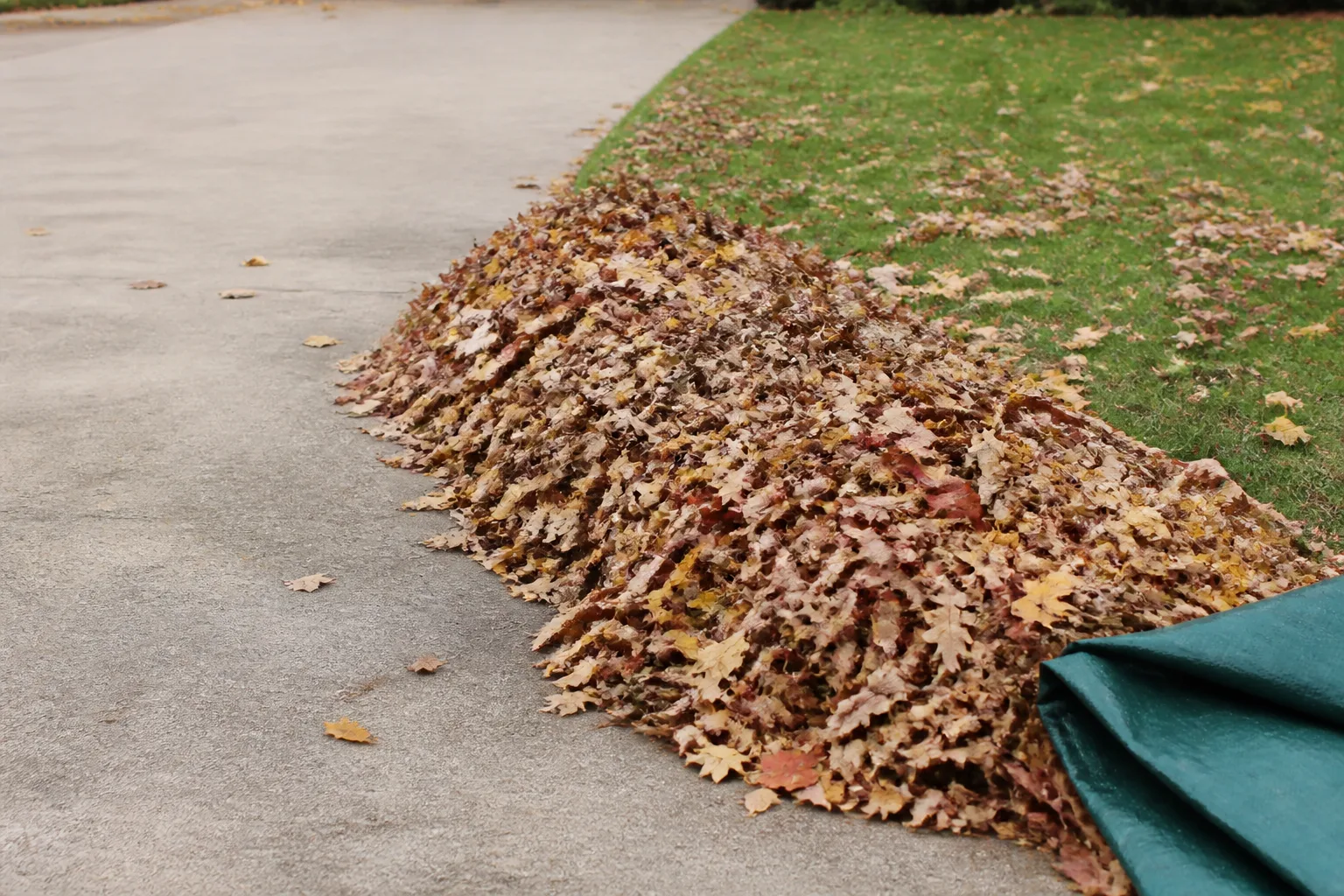
Clear leaves from a slippery walkway, frequently used steps, or a driveway sightline when they interfere with safe access. You usually do not need to strip the whole yard to do that. Use a broom or rake for a small surface, or gather leaves into a contained pile before using a blower to finish the remaining debris.
Keep leaves on your property and out of streets, storm drains, and neighboring yards. A gust can undo a careful cleanup, so aim toward a tarp, bed, compost area, or collection bin rather than toward the curb. If your city has a yard-waste pickup program, check how it wants leaves packaged and where piles may be placed; a municipal collection schedule does not necessarily allow leaves to be blown into a road or drain.
Make blower use shorter and more controlled
A planned pass is less disruptive than chasing leaves around the yard. Before you start, decide which surfaces need clearing, where the leaves will go, and how you will collect them. Put the tarp, compost bin, or yard-waste bag near the destination first, then move leaves in small sections so wind does not scatter the pile while you work.
Work in a sequence: clear the entrance and high-use path first, then the areas where a dense layer is covering grass, and finish at the chosen collection point. Leave the bed edge and habitat corner for last so you can see whether any leaves have drifted into the areas you meant to preserve. If you are doing only a small job, a rake or broom may finish it before unpacking a blower would. If you are doing a larger job, staging a tarp and bags in advance helps you collect as you go instead of leaving a row of loose piles exposed to wind.
Choose the smallest tool and setting that can do the job. Use the lowest effective throttle, keep the nozzle angled down and close enough to the ground to move leaves without blasting soil or lifting a cloud of dust, and stop rather than directing air at people, pets, vehicles, or open doors. Follow the manufacturer’s instructions, use appropriate eye and hearing protection, and switch the tool off when someone passes close by.
Wait for dry leaves and calmer weather
Wet leaves are heavier and tend to stick together, so the blower may need more time and repeated passes. Homes & Gardens notes that morning dew can make leaf blowing less effective; waiting until the surface dries can shorten the session as well as reduce frustration. Skip the job if rain has made the leaves clumpy or if a gusty day will send them back across the property.
Wind direction matters, but it does not make it acceptable to send debris onto someone else’s land. If the wind is pushing leaves toward a neighbor, road, or drain, choose another direction, collect them by hand, or wait for calmer conditions. A short delay can save a longer cleanup and an avoidable disagreement.
Gather debris on your own property
Move leaves in controlled bands toward a destination you can manage. Do not aim the nozzle along a fence line, across a public sidewalk, or down a driveway toward the street. If you are clearing a large yard, pause after each section to bag, compost, mulch, or relocate the pile; leaving several loose mounds until the end makes them easier for wind to scatter.
Be especially deliberate near beds and tree roots. A high-throttle pass can strip away leaf cover you meant to keep, disturb a quiet habitat patch, or scatter soil and small debris. Where a few leaves are harmless, stop trying to make the surface look perfect. A finished yard can still have leaf litter beneath shrubs and at the back of beds.
Choose a quieter alternative when the timing is wrong
A rake is the simplest alternative when the task is small, your local rule prohibits powered equipment, or you want to avoid waking people. A wide leaf rake can gather dry leaves from a lawn or bed without exhaust or motor noise, although raking a large property takes more time and repeated aggressive raking can disturb habitat. Work only where removal is useful and leave a quiet patch intact. For a few leaves on a porch, steps, or narrow path, a broom may be enough; there is no reason to start a motor for a handful of debris.
For a light leaf layer on turf, a mulching mower can chop leaves into smaller pieces rather than blowing them into a pile. Penn State Extension recommends this approach when leaves are dry and not too thick; if a mower leaves visible clumps, remove some leaves before making another pass. A leaf vacuum or shredder can collect material efficiently, but it is still powered equipment and may be subject to the same local hours or noise limits as a blower. It also makes the most sense when you have a clear plan for the collected leaves; otherwise, it only changes where the pile sits. Choose a method based on the amount and location of debris, not on a belief that every fallen leaf has to leave the property.
If you are not sure where collected leaves should go, ask your municipality about yard-waste pickup or composting guidance. At home, leaves can be layered into a compost pile, piled separately to make leaf mold, or used as mulch where appropriate. GrowVeg describes a simple leaf-mold pile as a low-effort way to keep leaves in circulation, while Penn State Extension notes that whole leaves and shredded leaves have different uses and break down at different rates.
The most neighborly option may be to leave much of the yard alone. Clear a wet, dense lawn mat and important walking surfaces; move the remainder to a bed or leaf pile; and schedule powered cleanup only for the surfaces that still need it. This reduces the time you operate a loud tool and avoids turning a normal seasonal leaf fall into an all-yard clearing project.
Conclusion
If you do not know your local leaf blower hours, use a considerate default: wait until at least 8 or 9 a.m. on weekdays and 9 or 10 a.m. on weekends, and choose a later slot in a close or quiet neighborhood. Confirm the actual rule with your city or county, then check any HOA, lease, or contractor restrictions before operating; a courtesy guideline never replaces local law.
Then make the job smaller. Mulch a light layer on the lawn, move excess leaves to beds or compost, keep paths and drains clear, and preserve a quiet patch of leaf litter where it can support soil and wildlife. When you do need the blower, use it briefly, direct debris into a planned collection area, and finish before the neighborhood’s evening quiet.