Office Plant Finder
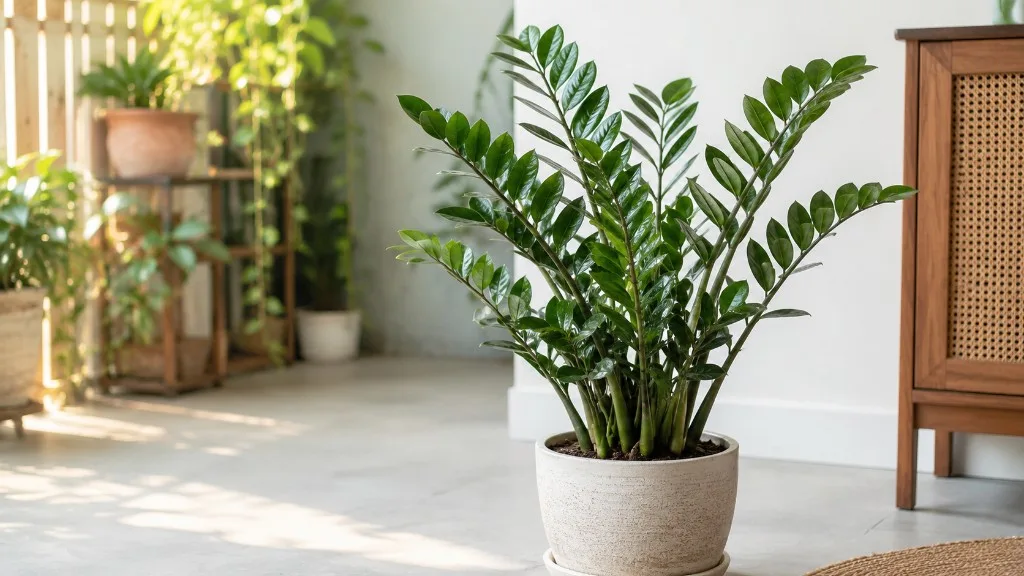
The hardest part of choosing an office plant is not finding a plant that looks good on a desk. It is finding one that still looks good after a month of air conditioning, weekend darkness, missed watering, low humidity, fluorescent or LED ceiling light, and a pot that nobody wants to move during a busy workday.
Office Plant Finder is built around that reality. It helps you filter plants by light, pet safety, room type, care level, and placement so the shortlist reflects the office you actually have. A bright corner office, a shared reception desk, a windowless cubicle, a meeting room with weekend lights off, and a home-office shelf all need different answers.
Use the result as a practical shortlist, not as a guarantee. A good office plant still needs enough light to photosynthesize, a pot with drainage, and a human who checks the soil before watering. The tool’s job is to narrow the field before you buy, move, or replace a plant.
What Office Plant Finder does
The finder turns office conditions into a plant-matching decision. It does not simply rank popular houseplants. It asks which plants can tolerate the limiting conditions in a workplace: low to medium light, dry conditioned air, irregular attention, desk-level space, pet or child access, and the possibility that artificial lights turn off outside business hours.
That matters because office plant failure is usually a mismatch problem. The plant may be healthy at purchase, but the room may be too dim, the pot may stay wet too long, or the care routine may swing between neglect and overwatering. UF/IFAS Extension notes that houseplants often require different light levels and that light should be the first factor considered when choosing an indoor plant indoor light levels.
The result should help you answer three questions. Which plants fit the available light? Which plants fit the attention level? Which plants are safe and sized appropriately for the people and animals who share the space? When those three line up, the plant has a much better chance than a trend-driven purchase.
No plant finder can turn a dark room into a plant-friendly room. Low-light-tolerant plants are still living plants, not permanent desk decor. They may grow slowly, stretch, lose variegation, or need less water in dim locations. If there is no reliable natural light and office lights are off for long stretches, the best result may be a tougher plant plus supplemental light.
The tool also cannot inspect the exact microclimate around the plant. A desk beside an air-conditioning vent is different from a desk three feet away. A reception counter near glass doors is different from a conference room with blinds closed most of the day. A plant under bright office lights during business hours may still get a long dark period every weekend.
Treat the recommendation as a starting decision. Before buying, open the relevant /plants/ guide, check mature size and toxicity, and decide whether the plant’s normal care rhythm fits the office. If the shortlist feels too narrow, that is useful information: the space may need a grow light, a different placement, or a more durable plant type.
The office conditions that matter most
Light is the first input because it sets the plant’s energy budget. Clemson Extension’s indoor plant guidance places low-light foliage plants around 100 foot-candles and separates that from medium and high light needs low-light foliage plants. Many offices feel bright to people but are weak for plants because human eyes adapt well to indoor light.
Watering consistency is the second input. Office plants are often watered by calendar, by whoever notices them, or by the person who happens to be present that day. That can lead to both drought and chronic wet soil. A good office candidate should tolerate some delay but should not require constant moisture unless someone is assigned to care for it.
Air movement and humidity are the third layer. Air conditioning and heating can dry leaf edges, speed surface drying, and create hot or cold drafts. Missouri Extension notes that 40 to 60 percent relative humidity is best for most houseplants, while many indoor spaces are drier than that relative humidity. This does not mean every office needs a humidifier. It means ferns, calatheas, and other humidity-sensitive plants are weaker office choices unless the room supports them.
Safety and access are the fourth layer. If pets visit the office, if children can reach the plant, or if leaves may be handled by many people, plant toxicity matters. The ASPCA toxic and non-toxic plant database is a practical cross-check for cats, dogs, and horses toxic and non-toxic plants.
Do not answer the light question based on how bright the room feels during a video call. Answer it from the plant’s position. A plant on a windowsill, a plant on a desk near the same window, and a plant on a shelf across the room receive very different usable light.
Use a simple office scale. Bright indirect light means the spot is near a window or under a strong, plant-useful lamp, but leaves are not being scorched by direct sun through glass. Medium light means the plant can clearly “see” a window or strong overhead lighting for much of the workday. Low light means the room is usable for people but the plant is far from the window, shaded by partitions, or dependent on office lights. Very low light means the plant is in a windowless or rarely lit area.
If you are unsure, choose the lower light category. Most people overestimate indoor plant light. The finder should reward plants that can tolerate the weaker condition because a plant that can handle dimmer light can usually cope with a slightly brighter desk, while a plant that needs bright indirect light may decline quietly in a cubicle.
How to use pet and public-access filters
Pet safety is a hard filter when leaves are reachable. Many famous office plants are not good choices for chew-risk homes or pet-friendly workplaces. Pothos, peace lily, philodendron, dieffenbachia, and snake plant are common indoor plants with toxicity listings in pet-safety databases. ASPCA lists mother-in-law’s tongue, commonly sold as snake plant, as toxic to dogs and cats because of saponins mother-in-law’s tongue.
Public access is a separate issue. A plant in a lobby, classroom, clinic, coworking lounge, or reception area may be touched, bumped, trimmed, or watered by people who are not the plant owner. In those spaces, avoid brittle plants, thorny plants, messy plants, and anything with a high toxicity concern. Choose stable pots, avoid trailing vines at child height, and make care ownership explicit.
If the tool returns a plant you like but the safety filter is borderline, do not solve the problem with wishful thinking. Move the plant out of reach, choose a non-toxic alternative, or use the /tools/pet-safe-plant-finder/ and /tools/pet-safe-plant-checker/ before purchasing.
Best plant profiles for offices
The strongest office plants usually share a few traits. They tolerate lower indoor light, do not collapse after a missed watering, stay attractive between care visits, recover from ordinary indoor humidity, and do not demand daily attention. Plain green foliage often outperforms dramatic variegation in dim offices because green tissue is better suited to limited light.
ZZ plant is a strong candidate for low-care offices because it stores water in rhizomes and tolerates neglect better than many soft-leaved tropicals. NC State Extension describes ZZ plant as a low-maintenance houseplant that tolerates low light and low water ZZ plant. It is not a pet-safe plant, so use it where animals cannot chew it.
Snake plant is another durable office candidate when pets are not a concern. Penn State Extension describes snake plant as forgiving and low-maintenance, with tolerance for low-light areas while performing best in bright indirect light snake plant. That distinction is important: tolerance is not the same as ideal growth.
Pothos works well for many desks, shelves, and cabinets because it adapts to ordinary indoor conditions and can be pruned. Penn State Extension notes that pothos can survive low light for some time but may lose desirable qualities such as leaf size or variegation when light is poor pothos. Use it in offices where trailing stems can be managed and pet access is controlled.
Peace lily can work in brighter low-light offices, especially where someone can check water regularly. Clemson Extension says peace lilies tolerate low light and grow best in bright indirect light peace lily. They are not ideal for a fully neglected desk, and they are not pet-safe if leaves can be chewed.
Parlor palm, peperomia, spider plant, cast iron plant, Chinese evergreen, and dracaena can also fit certain office conditions. The right choice depends on the exact light, safety needs, and space. A compact peperomia may be better for a small desk. A cast iron plant may be better for a low-light floor corner. A spider plant may be better for a pet-sensitive office if light is adequate and arching leaves have room.
Plants to avoid in typical offices
Avoid plants that need high light unless the office has a bright window or a real grow light. Many succulents, cacti, citrus plants, herbs, crotons, and flowering plants struggle in ordinary office lighting. They may survive on stored energy for a while, then stretch, drop leaves, or rot because the soil stays wet while growth slows.
Avoid high-humidity plants in dry, air-conditioned offices unless you can provide stable moisture without making the desk damp. Maidenhair fern, many calatheas, and some thin-leaved tropicals can look excellent in ideal conditions but become frustrating in drafty rooms.
Avoid plants that outgrow the placement. A small nursery plant can become a wide floor plant, a long vine, or a top-heavy specimen. Mature size matters more in an office than at home because workspace, cleaning access, fire exits, and shared surfaces have to stay clear.
A worked example: windowless cubicle
Suppose the plant will sit in a windowless cubicle with overhead lights on Monday through Friday, roughly during business hours, and no one wants to water more than every one or two weeks. Pets are not present. The finder should treat light as the limiting factor and care frequency as the second constraint.
The best shortlist would lean toward the toughest foliage plants: ZZ plant, snake plant, or possibly a very tolerant pothos if there is enough overhead light and the vine can be kept tidy. It should not favor succulents, flowering plants, or humidity-sensitive foliage. If the office lights turn off all weekend and the cubicle is dark, even the toughest plant may decline over time.
In that case, the practical decision is not just “which plant?” It is “plant or light?” A small full-spectrum LED on a timer can make the shortlist wider and the care routine more forgiving. Without added light, choose the most tolerant plant and expect slow growth.
A worked example: bright reception desk
Now imagine a reception desk six feet from a large north- or east-facing window. The lights are on during business hours, the plant is visible to visitors, and several people may be tempted to water it. There are no pets, but children may pass through the space.
The finder should widen the plant options but still prioritize tidy, durable plants. A compact pothos, peperomia, aglaonema, peace lily, or parlor palm may work, depending on the safety policy and care ownership. A dramatic plant that sheds, sprawls, or needs frequent grooming may be less useful than a modest plant that stays clean and predictable.
The key risk here is not lack of attention. It is too much attention. Put one person in charge of watering, use a pot with drainage, and add a small care note out of public view if multiple staff members want to help.
A worked example: home office with a curious cat
A home office adds a different constraint: the plant may share space with pets. Suppose the desk is near a bright window, the owner works from home most days, and a cat can jump onto the desk. The light is good and care is consistent, but safety controls the shortlist.
The tool should push common toxic office plants lower and favor better safety matches. Spider plant, peperomia, some hoyas, and certain palms may be more appropriate than pothos, peace lily, snake plant, or philodendron. ASPCA lists spider plant as non-toxic to cats in its cat plant list spider plant, while exact species should still be verified before purchase.
Placement still matters. A hanging planter may reduce chewing, but cats can climb and trailing leaves can invite play. In pet-accessible offices, the safer plant is usually the better plant, even if a toxic plant would be easier horticulturally.
Watering office plants without guesswork
The most common office watering mistake is using a fixed day of the week. Calendar watering ignores light, pot size, soil mix, season, room temperature, and the plant’s current growth rate. A plant in weak office light often uses water slowly, so weekly watering can keep the lower root zone wet for too long.
Check the pot before watering. Lift it if possible, feel the mix near the drainage hole, or use a wooden skewer to check whether the lower root zone is still damp. Water thoroughly only when the plant’s care guide and actual soil condition agree. Empty any cachepot or saucer after water drains through.
If several people share the office, assign one plant owner. A simple hidden note with the last watering date prevents duplicate watering. For a larger office collection, use /tools/plant-watering-calculator/ after the finder narrows the plant list, because the watering interval depends on plant type, pot size, light, and room conditions.
Air conditioning, drafts, and weekends
Office HVAC systems create plant stress that people may not notice. Cold air can hit one side of a plant for hours. Warm vents can dry leaf edges. Airflow can dry the top of the pot while the lower root ball remains wet. That combination tempts people to water because the surface looks dry even though roots are still sitting in moisture.
Move plants away from direct vents when possible. If a leaf edge browns only on the vent-facing side, treat placement as a suspect before changing fertilizer or water quality. If leaves droop on Monday morning, check whether the room becomes much colder, darker, or hotter over the weekend.
Weekend darkness is an office-specific issue. Plants in windowless offices may receive useful light only when the building lights are on. If lights are off for two or three days every week, choose the most tolerant plants or add a lamp on a timer. A plant that performs well in a bright home may not behave the same way in a dark office after hours.
How to read the result
Read the tool result as a fit ranking. The top plant is not necessarily the most beautiful plant or the fastest grower. It is the plant whose known tolerances best match the constraints you entered.
If the result recommends tough, plain foliage plants, do not dismiss that as boring. The tool is telling you the office has real limits. You can make a durable plant look intentional with a good pot, correct scale, clean leaves, and thoughtful placement.
If the result includes a plant you already wanted but ranks it lower, check the reason. It may need brighter light, steadier moisture, better humidity, more space, or safer placement. Fixing that one constraint may make the plant reasonable. Ignoring it usually turns the plant into a rescue project.
Common mistakes the finder helps prevent
The first mistake is treating artificial office light as equal to plant light. Some office lighting is bright enough to support tolerant foliage plants, but many ceiling fixtures are too far from the leaves to replace a window. Distance, duration, and intensity all matter.
The second mistake is choosing a plant for a photo rather than for maintenance. A plant in a styled office image may have been placed there for a shoot, not grown there successfully. Pick for the conditions, then style around the plant.
The third mistake is ignoring toxicity because the plant is “just in an office.” A lobby, classroom, therapy office, coworking room, or home office may include pets, children, or visitors who interact with the plant. Safety is part of fit.
The fourth mistake is using fertilizer to solve low light. Fertilizer supplies nutrients, not energy. If a plant lacks usable light, extra fertilizer will not fix the core problem and may add salt stress.
Using LeafyPixels guides with the finder
Office Plant Finder works best when paired with plant-specific and symptom-specific guides. Use the finder to narrow the shortlist, then open the guide for /plant-care/zz-plant/, /plant-care/snake-plant/, /plant-care/pothos/, /plant-care/peace-lily/, /plant-care/parlor-palm/, /plant-care/spider-plant/, or /plant-care/peperomia/ before buying.
If the plant is already struggling, use symptom pages under /symptoms/ instead of guessing. Yellow leaves, brown tips, drooping leaves, fungus gnats, root rot, pale leaves, and plant leaning can all appear when light, watering, and office air are out of balance.
Related tools can sharpen the next decision. Use /tools/low-light-plant-finder/ if light is the main constraint, /tools/beginner-plant-finder/ if care difficulty matters most, /tools/pet-safe-plant-finder/ for pet-sensitive spaces, /tools/light-requirement-calculator/ for placement questions, and /tools/vacation-plant-care-planner/ when absences or office closures affect watering.
When to choose a grow light instead
A grow light is the better answer when the tool keeps returning only the toughest plants and you still want more variety. It is also useful when a windowless office turns lights off after hours, when a plant repeatedly stretches toward a distant window, or when winter light drops below what the plant tolerated in summer.
Supplemental light does not need to be complicated for a desk plant. A compact full-spectrum LED, placed close enough to reach the leaves without heating them, can make a poor spot workable. Use a timer so the plant gets a consistent photoperiod instead of relying on whoever leaves the office last.
Do not use a decorative lamp across the room as your only fix. If the light is too weak or too far away, it may improve the mood of the room without meaningfully improving plant growth. If the plant is valuable or light-sensitive, use /tools/grow-light-distance-calculator/ to think through distance and intensity.
Office plants and workplace benefits
Office plants can make a workspace feel calmer and more finished, and there is research suggesting measurable workplace benefits. A field-experiment paper in Scientific Reports found that “green” offices enriched with plants improved several workplace measures compared with lean offices, including productivity in the studied settings green offices.
That evidence is useful, but it should not be inflated. A desk plant is not a cure for poor management, bad ergonomics, poor ventilation, or workload stress. It is one small environmental improvement that can support a better workspace when basic conditions are already addressed.
Be especially careful with air-quality claims. Houseplants can exchange gases and some research has explored pollutant removal under controlled conditions, but a few office plants should not be treated as a substitute for ventilation, source control, or building maintenance. Choose plants for fit, care success, and human enjoyment first.
Conclusion
Office Plant Finder is most useful when you treat the office as a real growing environment, not as a backdrop. Start with the plant’s exact position, choose the lower light category when unsure, apply pet and public-access filters strictly, and be honest about who will water.
The best office plant is not the most impressive plant on day one. It is the plant that can handle your light, your air, your schedule, your space, and your safety limits after the first month. Use the finder to build that shortlist, verify the plant guide before buying, and change the placement or lighting when the room is the real constraint.