Aphids on Petunia: Causes, Checks & Fixes
Quick answer
Aphids on petunias cluster on soft new growth and stems, leaving sticky honeydew and curled tips. Move the basket away from neighbors, blast colonies off with a strong water stream early in the day, and repeat every few days before reaching for insecticidal soap.
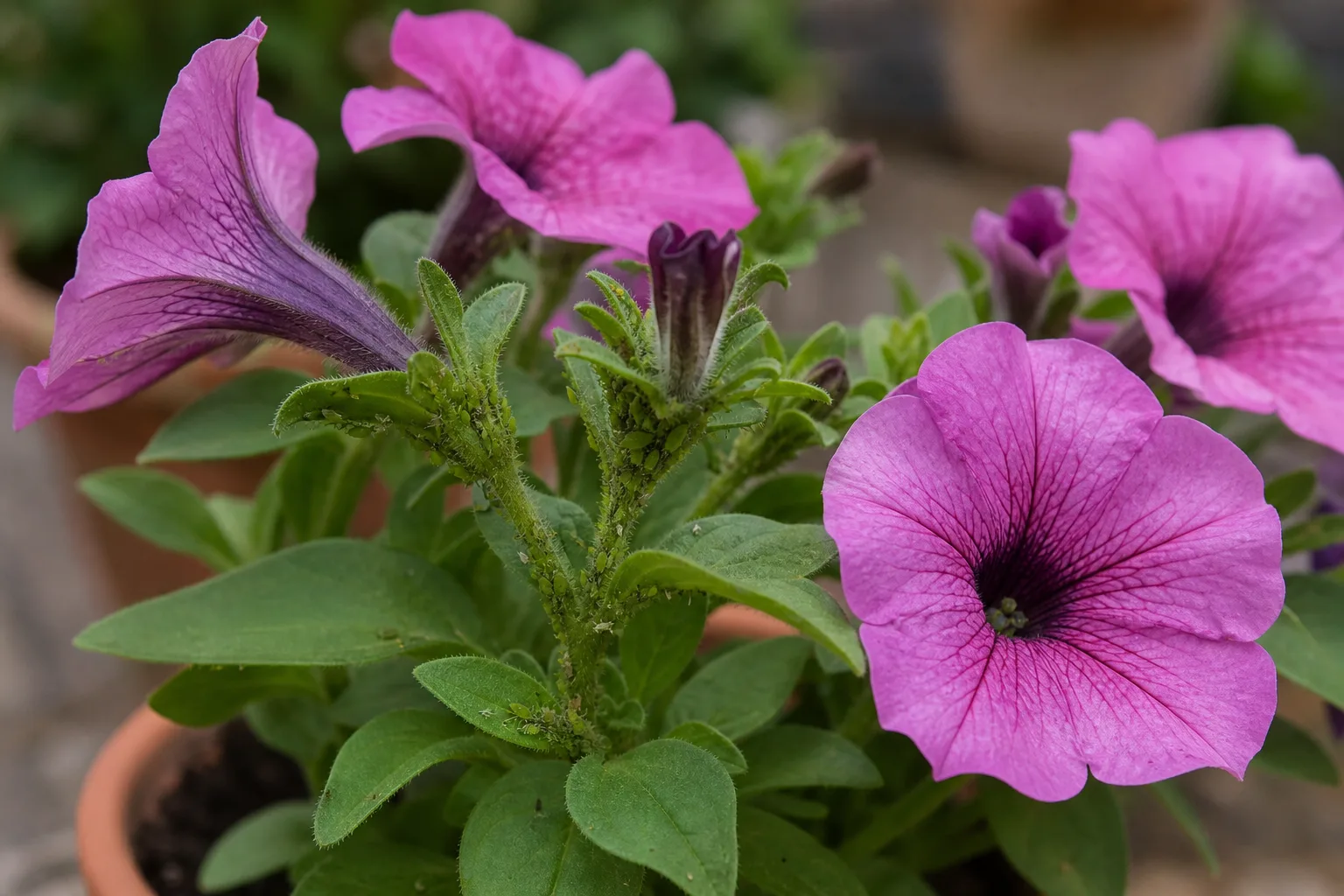
Aphids on Petunia: Causes, Checks & Fixes
This guide covers aphids on Petunia. See also the general Aphids guide, watering, and light pages for this plant.
Aphids on Petunia: Causes, Checks & Fixes
Quick answer
Aphids on petunia are soft-bodied sap feeders that colonize the tender tissue this plant produces constantly during bloom season-new leaf tips, soft stems, and swelling buds on trailing Wave, Supertunia, and grandiflora baskets. You may see green, pink, black, or yellow insects in dense groups, plus shiny honeydew on leaves below and ants marching up stems or basket hooks.
First step: move the basket away from mixed window boxes and neighbors, then rinse leaf undersides and bud stalks with a strong stream of water early in the morning. That knocks off live aphids and fresh honeydew before you reach for soap or oil. On heavily blooming balcony petunias, schedule rinses when bees are less active and direct spray to stems and undersides rather than open trumpets.
Aphids can vector viruses on petunias. Distorted mottled growth after heavy infestation warrants removing affected plants rather than repeated cosmetic spray alone-see mosaic virus on petunia if mottling appears.
Why Petunia gets aphids
Petunia × atkinsiana hybrids push soft new shoots whenever light and temperature support continuous summer bloom. Aphids prefer that succulent tissue on stem tips and unopened buds-the same fresh growth you deadhead to keep flowers coming. Clemson Extension notes aphids may become a problem on petunias during active growth, especially on tender shoots in containers and hanging baskets.
Bloom-season biology is the main attractant. Unlike woody perennials, petunias do not pause between flushes. Trailing cultivars in full sun produce new tips weekly through peak summer, giving aphids a steady food supply on basket edges where airflow is often stagnant.
Drought-stressed petunias are more vulnerable. Even moisture supports healthy petunias, but containers that swing between bone dry and flooded produce stressed soft shoots aphids colonize fast. Sticky honeydew on upper leaves distinguishes sap feeding from simple drought wilt-see petunia watering guidance for the top 2 cm dry test on baskets vs in-ground beds.
Excess nitrogen pushes pest-friendly growth. High nitrogen promotes succulent new growth preferred by aphids. Heavy feeding while chasing more Wave blooms produces tall soft tips that are easier to pierce than moderately fed, firm stems. Hold aggressive fertilizer during active outbreaks per petunia fertilizer guidance.
Ants protect colonies. Ants harvest honeydew and defend aphids from predators, which slows natural control on sheltered balcony setups where lady beetles and lacewings are scarce. Ant trails on basket hooks, rails, or pot feet often appear before the aphid count looks alarming.
Aphids spread virus on petunias. Cucumber mosaic virus is spread by aphids on petunias, among other pathogens. Distorted, mottled leaves after heavy aphid pressure may mean the plant is infected-not just mechanically damaged. Tobacco mosaic virus spreads mechanically through sap on hands and tools rather than aphids, but mixed-virus risk still argues for early aphid control on petunias you handle often for deadheading.
Introduction routes matter. Aphids hitchhike on nursery stock, shared garden tools, and open windows near outdoor infestations. Mixed window-box groupings let colonies walk or drift to neighboring pots before you notice a few insects on one bud stalk.
What aphids look like on Petunia
Typical aphid signs:
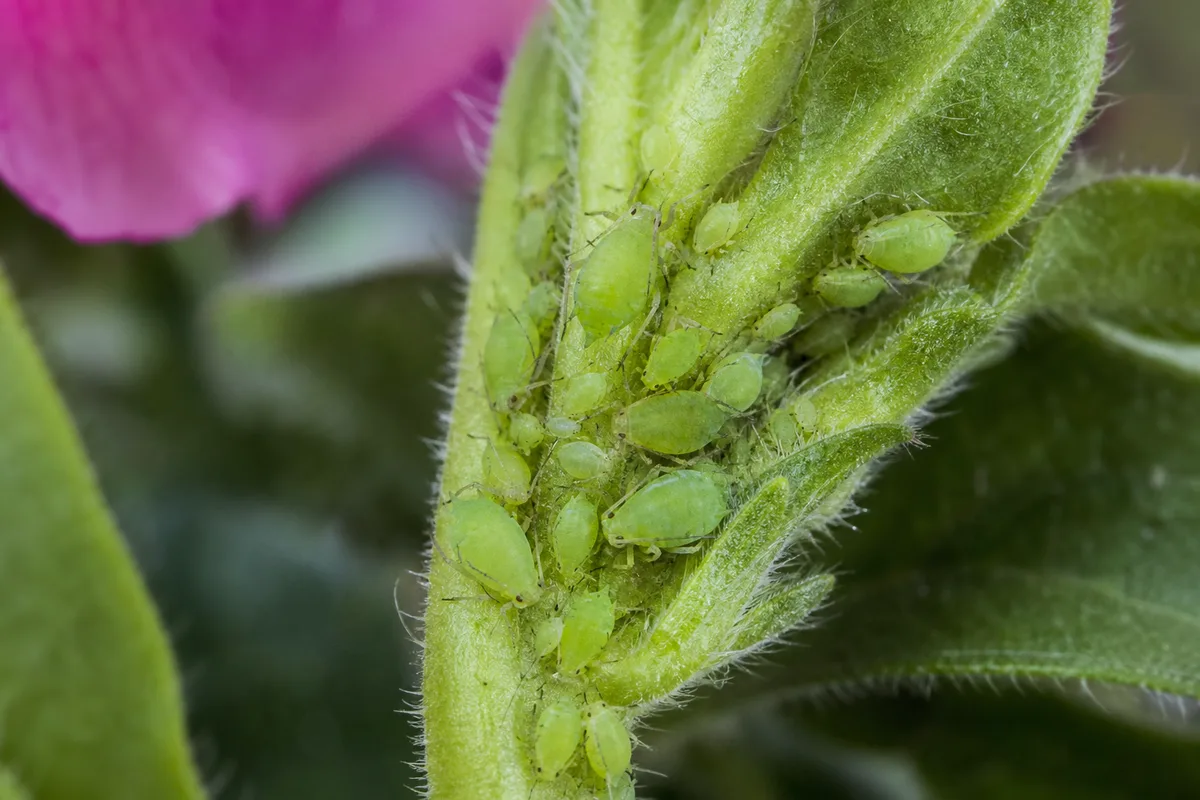
Aphids symptoms on Petunia - compare with healthy tissue on the same plant.
- Soft pear-shaped insects 1–3 mm long in colonies on new leaves, stem tips, and unopened buds
- Color matching the host-green, pink, black, or yellow clusters rather than single scattered dots
- Colonies tucked under developing trumpets and at the base of swelling buds on trailing stems
- Curled or twisted young leaves when feeding is heavy on shoot tips
- Shiny, sticky honeydew on upper leaves below feeding sites or on deck rails under hanging baskets
- Black sooty mold that wipes off with a damp cloth-not a leaf infection itself
- Ant trails on stems, pot rims, basket hooks, or balcony rails
- Stunted or aborted flower buds when colonies sit directly on bud tissue before peak bloom
- White cast skins on leaf undersides after aphids molt
Aphids feed in colonies on the newest, most succulent petunia tissues. On mature lower leaves, minor feeding may barely show; the damage becomes obvious when colonies hit the soft growth above your last deadheading cut on a Wave or Supertunia basket.
Winged aphids can appear when populations crowd a stem. On enclosed balconies, that means nearby pots are at risk even if only one petunia looked bad yesterday.
Unlike powdery mildew, aphids are moving insects-not a dry white powder on leaf surfaces. Unlike caterpillars, aphids do not chew ragged holes; they suck sap and leave tissue curled rather than eaten through.
How to confirm the cause
Work through these checks in order:
- Location on the plant - Aphids cluster on tender tips and bud stalks. Lower yellow leaves with no insects point to watering stress or nitrogen issues, not aphids. Start at the topmost growing point on trailing baskets.
- Movement test - Disturb a colony with a toothpick. Aphids move slowly. Thrips jump or streak away; spider mites are nearly invisible without stippling and webbing.
- Body texture - Soft, rounded bodies confirm aphids. Hard brown bumps that do not move are scale. White cottony masses in leaf axils are mealybugs-see mealybugs on petunia.
- Honeydew check - Rub a shiny upper leaf. Sticky residue that attracts ants or grows black mold confirms sap feeding. Dry crispy edges without stickiness suggest drought or salt buildup. If leaves are sticky but you find no insects, see sticky leaves on petunia for non-pest causes.
- Underside inspection - Lift flower stalks and flip upper leaves on basket edges. Aphids hide on protected undersides and at stem joints where future flower clusters form. Spray from below on hanging baskets to reach these spots.
- Ant trail follow - Ants marching up stems or basket hooks strongly suggest aphids or other honeydew producers on new growth above.
- Virus screening - Look for mosaic mottling or severe leaf distortion beyond simple curling. That pattern after heavy aphid feeding may indicate virus-not recoverable with pest sprays alone. See mosaic virus on petunia before you trim and wait.
- Neighbor scan - Check other petunias, calibrachoa, or mixed basket plants within a few feet. Shared outbreaks confirm active spread across a window-box display.
If you find insects but no honeydew yet, you likely caught the infestation early-that is the best time for water rinses before sticky residue and sooty mold complicate cleanup.
Lookalike symptoms to rule out
| What you see | Key difference | Likely cause |
|---|---|---|
| Soft green, pink, or black clusters on new tips | Pear-shaped bodies; move when disturbed; honeydew below | Aphids (this guide) |
| Small insects fly in a cloud when stems are shaken | Flat pale nymphs on undersides; winged adults | Whiteflies |
| White cottony wax in leaf axils and stem crevices | Does not colonize open bud tips; alcohol dissolves wax | Mealybugs |
| Silvery scraped patches on petals; slender fast insects | No typical pear-shaped clusters on tips | Thrips |
| Fine stippling and webbing at leaf bases in hot dry air | Little honeydew on bud stalks; confirm with tap test | Spider mites |
| Sticky leaves without visible pests | Residue only; no moving colonies | Sticky leaves |
| Irregular yellow-green mottling with strap-shaped new leaves | Persists after aphids are gone; no cure | Mosaic virus |
First fix for Petunia
Isolate the basket and rinse all tender shoots, leaf undersides, and flower stalks with a strong stream of lukewarm water early in the day.
Move the petunia away from mixed window boxes and neighboring containers before you rinse so dislodged aphids do not drop onto clean plants below. On trailing baskets, tilt the pot and spray from below so water hits the backs of upper leaves and the joints where bud stalks emerge-colonies hide where stems trail over basket rims.
A strong spray of water knocks aphids off sturdy plants and washes fresh honeydew before ants or sooty mold take hold. Let foliage dry in bright light the same day. Petunias tolerate sun and dry air well; leaving wet crowns overnight in cool damp corners invites grey mould on spent flowers-a separate problem you do not need while fighting aphids.
On heavily blooming Wave or Supertunia displays, rinse when bees are less active and aim at stems and undersides rather than soaking open trumpets. Evening rinses work when morning bee traffic is heavy on balcony rails.
Do not apply horticultural oil or insecticidal soap on day one if a thorough rinse removed every visible colony. Do not deadhead every flower at once unless bud stalks are heavily infested; removing one or two coated bud clusters into a sealed bag is enough initially.
Do not fertilize during an active outbreak. Excess nitrogen produces soft, succulent growth that attracts aphids.
Step-by-step recovery
After the initial rinse:
- Repeat water sprays every two to three days until hand-lens inspection shows no live colonies on new tips for two consecutive checks.
- Apply labeled insecticidal soap or horticultural oil if aphids return after several rinses. Cover tops and undersides thoroughly; these products kill only insects contacted during application. Repeat every four to seven days through at least two to three cycles to catch newly hatched nymphs.
- Treat early morning or evening when temperatures stay below 90°F and bees are less active on open petunia blooms. Soaps and oils can burn foliage in hot midday sun on drought-stressed baskets.
- Remove heavily infested bud stalks you cannot reach with spray or water. Snip the coated cluster at a healthy node and discard the cutting in sealed trash-not the compost pile on a balcony shared with other petunias.
- Manage ants if they persist on basket hooks, rails, or pot feet. Ant barriers on pot feet or sticky bands on hanging-basket chains help predators reach aphids; controlling ants alone does not replace rinsing or soap on the plant.
- Wash sooty mold off upper leaves with plain water once honeydew production stops. Trim leaves that stay more than half blackened if they no longer support the plant.
- Remove mosaic-suspect plants showing irregular mottling or strap-shaped new growth after severe infestation. Do not compost virus-risk tissue near garden beds or seed-starting trays-see mosaic virus on petunia.
- Hold isolation until you see one full week with no new colonies on tender growth after your last treatment before returning the basket to a mixed display.
Recovery timeline
Water knockdown shows results within two to three days when colonies are moderate. Soap or oil courses typically need one to two weeks with label-interval repeats because aphids reproduce quickly with multiple generations per year and eggs hatch within days of the first application.
Expect clean new shoots and undamaged buds within one to two weeks once feeding stops. Old curled leaves may stay slightly twisted; judge success by normal bud opening and unstippled fresh growth above your last cut-not by perfect older foliage.
Honeydew and sooty mold dry up within days after insects are gone. Black coating on lower leaves wipes away gradually as you rinse or as those leaves are replaced.
Flower buds that dropped from heavy feeding before bloom will not reopen on that stem. Petunias bloom in flushes on trailing cultivars; recovery means the next buds open clean.
Mistakes to avoid
Do not treat once and assume aphids are gone. Repeat applications are necessary because soaps and oils have no residual activity.
Do not use homemade dish soap. Commercial insecticidal soaps are formulated and tested for plant safety; harsh detergents burn petunia leaves in sun.
Do not spray insecticidal soap on water-stressed petunias in midday heat-leaf burn risk rises above 90°F.
Do not return an isolated basket to a mixed window box after a single rinse. One missed egg mass on a bud stalk reinfects the whole display within a week.
Do not ignore ants on basket rails while only spraying leaves. Ant protection keeps colonies rebounding until you address both.
Do not compost heavily infested or virus-suspect clippings near seed-starting trays or garden beds.
Do not fight a severely virus-mottled petunia with repeated chemicals-remove it to protect neighbors. Summer annuals in mixed baskets are often cheaper to replace than endless spray cycles on a failing plant.
Do not fertilize heavily during active aphid bloom-that pushes soft growth aphids prefer.
Petunia care cross-check
Aphids exploit care gaps more than they cause them, but weak petunias recover slowly.
Confirm the pot dries appropriately between waterings per petunia watering guidance. Petunias want the top 2 cm dry before watering; chronically wet mix weakens roots while aphids drain shoots above.
Verify the plant gets enough direct sun. Leggy pale growth in shade stays soft longer and hides colonies in crowded trailing stem tips.
Pause high-nitrogen feeding until the infestation clears. Resume light balanced feeding per petunia fertilizer guidance only after new growth looks clean for at least two weeks.
Improve airflow between crowded balcony pots. Stagnant warm pockets let aphid numbers build before natural enemies arrive.
How to prevent aphids next time
Scout new shoots and bud stalks weekly during active bloom-the window when petunias produce the tissue aphids prefer. On trailing baskets, one pass from soil line to the topmost bud cluster takes minutes once you know the hiding spots.
Quarantine new nursery baskets for seven to fourteen days before placing them beside existing petunias in mixed displays. Inspect undersides at purchase; reject plants with sticky residue or curled tips.
Preserve beneficial insects. Lady beetles, lacewings, and parasitic wasps control aphids when broad-spectrum sprays have not eliminated them. Low-risk strategies like water sprays and commercial insecticidal soap spare migrating natural enemies once dry.
Avoid excess nitrogen during spring and summer push. Steady feeding produces firmer growth than bursts of lush soft shoots.
Deadhead spent blooms regularly. Removing old flower clusters reduces hidden staging points near fresh buds where aphids colonize next.
Keep trailing stems from bridging between containers on balcony rails. Crawlers and winged aphids cross short gaps between pots.
Wash dust off leaves occasionally on roadside baskets. Clean foliage supports plant vigor and makes early colonies easier to spot on scalloped grandiflora leaves.
When to worry
Treat as urgent when colonies coat most unopened buds before peak bloom, honeydew drips daily onto surfaces below, sooty mold blocks light on more than a third of the canopy, or leaves show virus-like mosaic mottling after heavy sap-feeder pressure. Bud abortion before bloom on an otherwise healthy watering schedule strongly suggests heavy sap feeding.
Aphids vector cucumber mosaic virus on petunias, among other pathogens. Severe leaf mottling, strap-shaped new growth, or flower color break after a heavy infestation may mean virus-isolate that plant and avoid propagating cuttings from it. See mosaic virus on petunia for removal protocol rather than repeated cosmetic sprays.
Replace severely declining specimens in mixed displays rather than cycling endless sprays on a plant that no longer pushes clean buds. Starting with clean stock is often faster than fighting entrenched balcony colonies across multiple pots.
A handful of aphids on one new stem during routine deadheading is not an emergency. Rinse, monitor, and escalate only if counts rise over the next week.
Related Petunia guides
- Petunia overview - cultivar types, full-sun culture, and basket basics
- Mosaic virus on petunia - mottling and color break after aphid pressure
- Sticky leaves on petunia - honeydew vs dew vs other causes
- Whiteflies on petunia - honeydew-producing lookalike that flies
- Mealybugs on petunia - white wax in axils, not open bud tips
- Thrips on petunia - silvery petal scarring
- Petunia watering - even moisture without boom-bust cycles
- Petunia fertilizer - nitrogen moderation during pest season
Conclusion
Aphids on petunia concentrate on the same tender shoots and bud stalks that make Wave and Supertunia baskets bloom so well in summer sun. Isolate mixed displays early, rinse undersides from below on trailing stems before you spray, and repeat until new growth emerges clean. That sequence stops honeydew and sooty mold before they spread across a whole balcony rail-and keeps your treatment focused on confirmed insects rather than every speck on a leaf. When mottling appears after heavy feeding, shift from pest control to virus removal so neighboring petunias stay protected through peak bloom.