Overwatering on Calathea Dottie: Wet Mix & Pink Vein Checks
Quick answer
Overwatering on Calathea Dottie shows up as a heavy wet pot, soft yellow lower leaves on dark blades, black water spots, and limp foliage while the top 2 cm of mix still feels damp—not the normal evening prayer-plant leaf fold. First step: stop watering and empty any standing water in saucers or cachepots before you repot or fertilize.
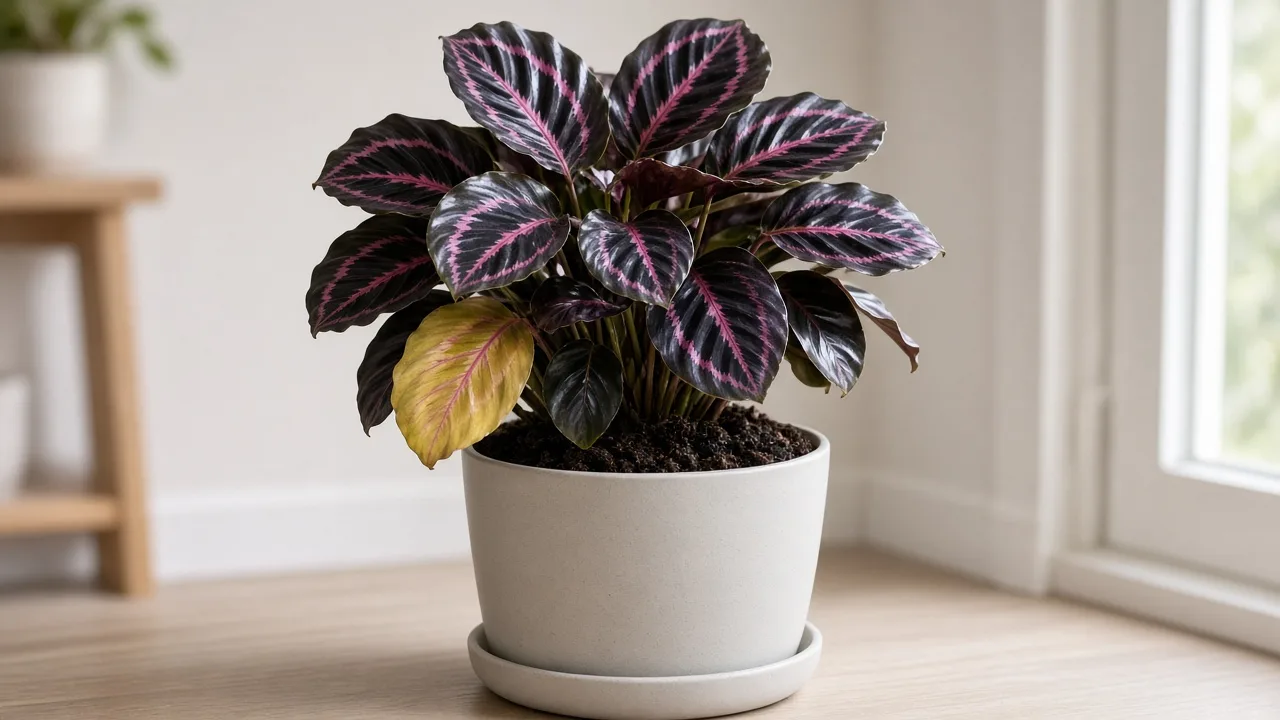
Overwatering on Calathea Dottie: Causes, Checks & Fixes
This guide covers overwatering on Calathea Dottie. See also the general Overwatering guide, watering, and light pages for this plant.
Overwatering on Calathea Dottie: Causes, Checks & Fixes
Quick answer
Overwatering on Goeppertia roseopicta ‘Dottie’ is the “moist but never soggy” trap taken too far: a prayer plant that wants moist, well-drained peaty mix with perlite, not a permanently wet root ball. Dottie’s near-black blades with hot-pink midrib feathering make damage obvious early—soft yellow lower leaves, black water spots, and limp spears while the top of the mix still feels damp.
For how chronic wet soil kills roots in general, see our overwatering guide. On Calathea Dottie, the tell is a heavy pot long after watering, oldest leaves yellowing on wet peat, and wilt that does not match a dry skewer—not the normal evening leaf fold of a prayer plant.
First step: stop watering and empty any standing water in saucers, cachepots, or decorative outer pots. Do not repot, fertilize, or mist heavily until you know whether the top 2 cm are drying on schedule. If stems are mushy at the soil line, escalate to root rot on Calathea Dottie the same day.
When to use this page vs other Calathea Dottie guides
| Pattern | Read next |
|---|---|
| Top 2 cm dry, light pot, crisp curl by day | Underwatering |
| Heavy wet pot, soft yellow lowers (this page) | Stay here; escalate to root rot if stems mush |
| Pink edges brown on new unfurl only | Brown tips — often fluoride or dry air |
| Whole plant limp on wet mix | Wilting or drooping leaves |
| Yellow lowers, firm crown, mix barely damp | Yellow leaves — light or age |
| White fuzz on damp surface | Mold on soil |
| Small flies at pot rim | Fungus gnats |
| Faded pink veins, wet mix, dim room | Cross-check light and soil |
What overwatering looks like on Calathea Dottie
Rose-painted calatheas carry round, glossy blades on short petioles in a clump about 1–2 feet tall. On the Dottie cultivar, NC State describes dark green leaves with a pink central vein and pink feathering—that painted surface is permanent tissue. Any yellowing, black blotches, or washed-out pink on a leaf will not “heal” back to perfect contrast.
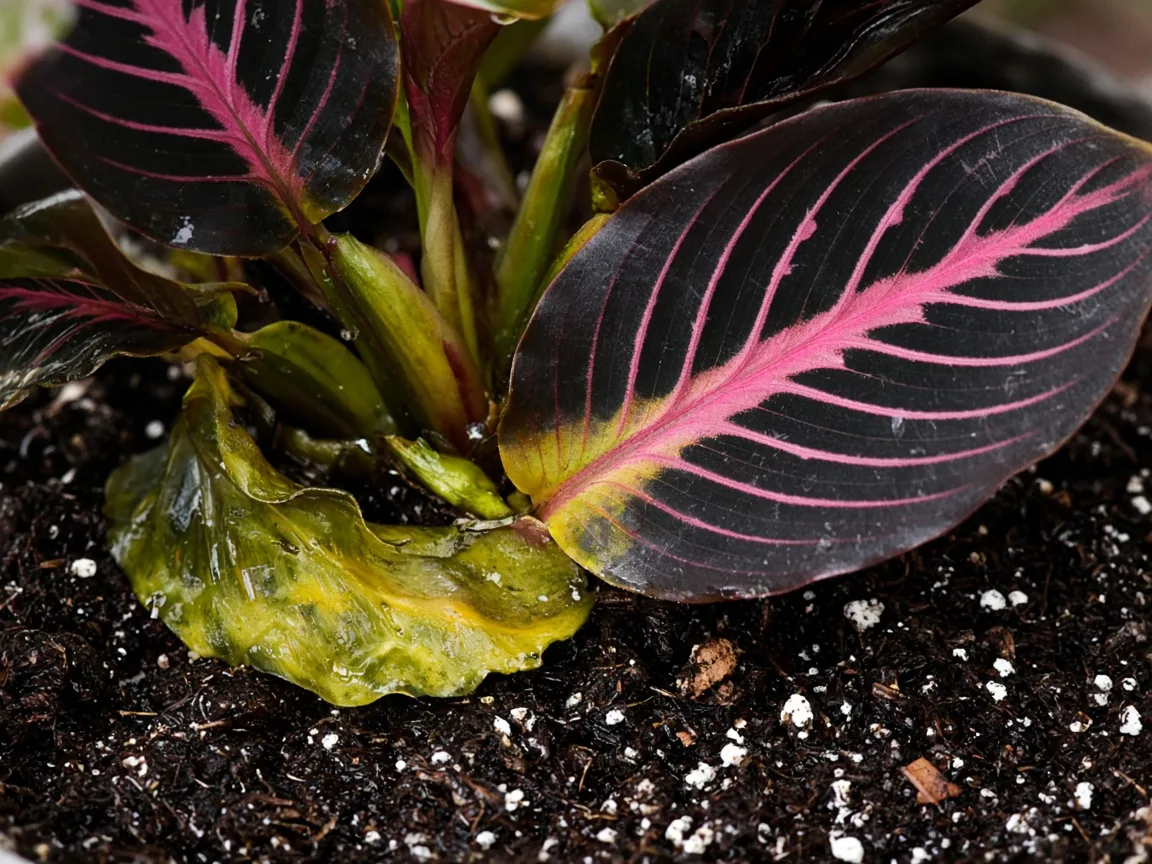
Early overwatering at the soil line—oldest leaf yellowing while dark upper blades still show pink veining; wet peat visible at the pot rim.
Early signs
- Heavy pot several days after the last watering
- Soft yellow lower leaves while newer dark blades still look painted
- Pink vein contrast fading on stressed leaves (often combined with low light on wet mix)
- Black or brown water-soaked spots on leaf margins or centers from wet foliage or poor airflow
- New spears limp or stalled while mix stays damp below the surface
- Persistent damp top 2 cm on finger or skewer tests
- Fungus gnats or surface mold—chronically wet peat is their habitat; see mold on soil
Advanced signs
- Mushy stem base at the soil line
- Sour or rotten smell from the pot
- Wilting during the day on mix that is still wet—damaged fine roots cannot move water even when soil is saturated
- Multiple leaves yellowing within one to two weeks
- Crown collapse on a formerly full clump—often means rot has moved from rhizome to petioles
Evening leaf folding alone is not overwatering. Like other Marantaceae, Dottie folds leaves at night and reopens them by morning through nyctinasty. Overwatering adds wet mix + soft yellow lowers + daytime limpness that persists to that picture.
Evening prayer fold vs overwatering wilt
This check only makes sense on a calathea—not on a snake plant or pothos.
- Normal nyctinasty: Leaves stand more upright by day, fold upward at dusk, plant feels firm at the crown, top 2 cm dry slightly between drinks.
- Overwatered wilt: Leaves stay limp or droopy through the day, lower blades yellow on heavy wet mix, pink veining looks dull even when folded.
- Underwatered curl: Leaves curl or crisp, pot feels light, skewer in top 2 cm is dry—see underwatering.
Always pair leaf posture with soil moisture at 2 cm depth and pot weight. Dottie owners often water because leaves look “sad” at night when the real issue is soggy peat from yesterday’s soak.
Top-2 cm dry-down on peat-based mix
Goeppertia roseopicta evolved as an understory rainforest plant with fine, shallow feeder roots that need air as much as moisture. NC State is explicit: mix should be moist but not soggy or wet, and the species is tagged wet-soils intolerant in the toolbox.
Before you change anything:
- Lift the pot when you think it is dry versus two days after watering. Learn heavy vs light.
- Probe the top 2 cm (about 1 inch) with a clean finger or dry skewer along the pot wall. Surface color can lie on peat—UF/IFAS recommends allowing the surface of potting media to dry slightly before watering indoors.
- Compare to the watering guide rhythm: partial dry-down, not drought and not constant saturation.
- Sniff the drainage hole. Sour odor means treat as confirmed rot—see root rot.
- Check cachepots. A nursery pot sitting in an outer pot with stale water is one of the fastest ways to overwater Dottie without noticing.
The RHS notes keeping compost evenly moist during the growing season—“evenly moist” still means oxygen at the roots, not a swamp. When in doubt, wait one day and re-test the top 2 cm rather than adding another drink.
Why Calathea Dottie gets overwatering
Most chronic cases are setup and habit, not a single accidental pour.
Calendar watering in a dim room. A fixed Tuesday soak ignores how fast your pot dries. Dottie in a bright humid bathroom may need water every five to seven days in summer; the same plant in a cool north room may stay wet for two weeks.
Misreading “moist” as “always damp.” Retail advice to keep calatheas moist leads owners to water when the top still feels cool. Overwatering can cause root rot on rose-painted calatheas; UF/IFAS lists over-watering among causes of leaf chlorosis.
Oversized pots and dense peat. Extra soil volume around a small rhizome holds water for days. Peat-heavy mix without enough perlite stays saturated at the center while the surface looks merely dark—see the soil guide.
Low light slowing uptake. Understory plants in too little light use less water; wet mix lingers. Faded pink veining on dark leaves often means combined low light and wet roots.
Standing saucer water and cachepots. Even one afternoon of submerged drainage holes rewets the whole root zone on fine roots.
Misting the crown repeatedly. Wet foliage plus poor airflow invites leaf spot from wetting leaves while watering—black spots can look like disease when the driver is water management.
Winter rhythm mismatch. Cooler rooms and shorter days mean slower dry-down. Continuing summer frequency in November keeps rhizomes wet while growth has stalled.
How to confirm the cause
Work through this list in order. Two or more wet-soil matches confirm overwatering before you repot.
- Pot weight — Heavy days after the last watering means trapped moisture.
- Top 2 cm skewer or finger test — Cool, clinging soil confirms wait; do not water.
- Leaf age pattern — Yellowing starts on oldest lower leaves first on wet mix.
- Stem feel at soil line — Soft or hollow means escalate; firm means dry-down may be enough.
- Daytime posture — Persistent limp on wet mix, not just evening fold.
- Gnats, mold, or sour smell — All support chronic wet peat.
- Recent care changes — New cachepot, bigger pot, or “extra love” watering after pink fade.
First fix for Calathea Dottie
Stop watering and empty all standing water from saucers and outer pots. Leave the plant in its usual bright indirect spot with stable humidity—do not move a stressed Dottie into harsh new sun.
That single pause lets the top 2 cm begin drying so you can read the plant for seven to ten days without stacking repot, fertilizer, and heavy misting. Waterlogged roots lose oxygen and stop functioning; dry-down is the first way to restore air to fine roots.
If the stem base is already mushy or the mix smells sour, skip the wait—follow root rot unpotting steps the same day.
Step-by-step recovery
Mild cases (firm crown, heavy wet pot)
- Hold water until the top 2 cm read dry on finger or skewer tests.
- Improve airflow around the pot base; tilt cachepots so drainage is never blocked.
- Resume top watering with rainwater or filtered water only when the partial dry-down returns—details in the watering guide.
- Remove fully yellow lower leaves with sterile snips so the plant stops feeding dead tissue.
- Watch for a firm new spear unfurling with sharp pink veining within three to six weeks.
Moderate cases (slight stem softening, mostly firm roots on inspection)
- Unpot gently, shake off wet peat, and inspect the rhizome and fine roots. Trim brown mush with sterile shears.
- Let trimmed roots air on newspaper in bright indirect light for several hours—not direct sun.
- Repot into fresh airy peat-perlite mix in the same or slightly smaller pot with drainage—see repotting.
- Water lightly once after repot if mix was crumbly dry; otherwise wait until the top 2 cm dry.
- Run a humidifier for 60%+ relative humidity while roots re-establish.
Severe cases (mushy rhizome, crown collapse)
- Salvage firm sections by division at healthy rhizome joints with at least one leaf each—NC State lists division of rhizomatous roots as the best propagation method.
- Pot divisions in small containers with fresh mix per the propagation guide.
- Discard fully mushy rhizome tissue; do not compost wet rot indoors.
Recovery timeline
| Severity | What to expect |
|---|---|
| Mild (firm crown) | Mix dries in 1–2 weeks; yellowing stops; new spear in 3–6 weeks |
| Moderate (trimmed roots) | 6–10 weeks before confident new painted leaves |
| Severe (division salvage) | 8–12 weeks for a small clump to stabilize |
Judge success by firm new spears and stable pink veining on fresh leaves—not by old yellow blades re-darkening. Scarred leaves often stay discolored permanently on Dottie.
Lookalike symptoms
| What you see | Likely cause |
|---|---|
| Dry top 2 cm, light pot, crisp curl | Underwatering |
| Pink margins brown on new unfurl only | Brown tips — fluoride or low humidity |
| One old lower leaf yellow, firm crown, correct moisture | Normal aging—yellow leaves |
| Limp all day on wet mix | Advanced rot—root rot |
| Slow new growth, firm roots, appropriate moisture | Slow growth from light or season |
| Faded pink, wet mix, far from window | Not enough light plus water stress |
Mistakes to avoid
- Watering because leaves folded at night without checking the top 2 cm
- Fertilizing a stressed Dottie before roots recover
- Repotting into a larger pot while soil is still soggy
- Blasting with direct sun to “dry the plant out”—Dottie scorches in direct sunlight
- Heavy misting instead of humidifier use for chronic wet crowns
- Using tap water to “flush” wet mix when fluoride already browns margins—switch to filtered water after dry-down
- Assuming pink fade is only a light problem when mix has been wet for weeks
Hold fertilizer until new spear growth looks normal for several weeks and the crown stays firm.
How to prevent overwatering next time
Match water to partial dry-down, not a calendar.
Water thoroughly when the top 2 cm begin to dry, then let excess drain and never leave the pot in standing water. In winter, stretch intervals sharply per the watering guide even if leaves look slightly dull—cool rooms need longer dry-down.
Use moisture-retentive but airy mix with perlite in a pot sized to the rhizome, not an oversized decorative container.
Keep bright indirect light and 60%+ humidity so transpiration matches your soak schedule.
Learn dry pot weight monthly. Scout the drainage hole whenever you consider watering—especially after bringing Dottie home from a nursery that kept mix evenly wet.
When to worry
Mild yellowing on one or two lower leaves after a single over-soak usually responds to a dry-down pause. Escalate same-day when:
- The stem base feels mushy
- Black spots spread across multiple leaves within a week
- The mix smells sour
- The plant wilts heavily while mix is still wet
- No firm new spear appears after two months of corrected care
If rot has consumed the rhizome, division salvage through propagation is often more realistic than saving a collapsed crown.
Related Calathea Dottie guides
- Overview — culture and pink-vein display
- Problems hub — full symptom index
- Watering — top-2 cm checks and filtered water
- Soil — peat-perlite balance that breathes
- Root rot — mushy rhizome protocol
- Underwatering — dry skewer and crisp curl
- Fungus gnats — flies on chronically wet peat
Conclusion
Overwatering on Calathea Dottie is a top-2 cm and pot-weight problem disguised by dramatic dark foliage and normal evening prayer folds. Stop water, empty saucers, and let peat begin partial dry-down before you repot or feed. Firm new spears with sharp pink veining are the recovery signal; yellow lower leaves will not re-paint, and that is normal once the root zone stabilizes.
Related tool
Use the Root Rot Risk Checker to narrow causes for overwatering on this plant before changing multiple variables at once.