Brown Tips on Calathea Dottie: Pink Edge Checks
Quick answer
Brown tips on Calathea Dottie are usually dry tan or papery necrosis along leaf margins and points—often starting on the pink midrib feathering where the dark leaf shows stress first. First step: water the next cycle with room-temperature rainwater, distilled, or filtered water and check whether new spears unfurl clean before you change humidity or repot.
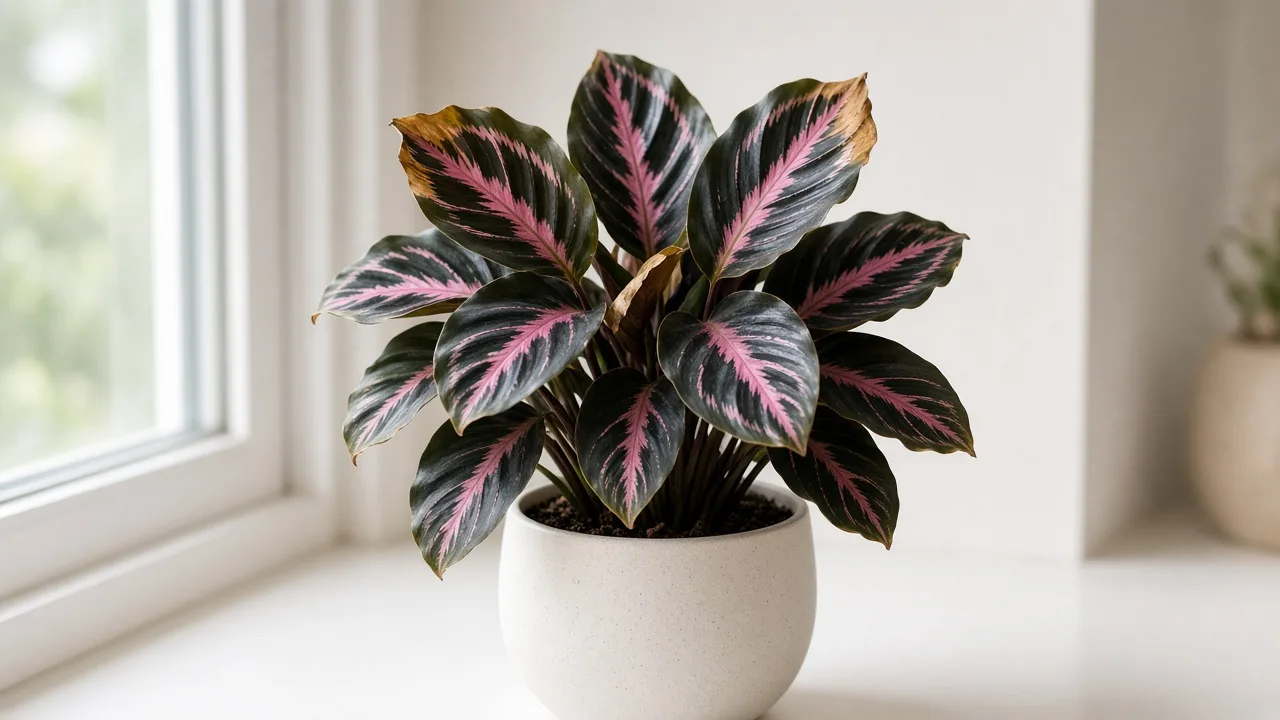
Brown Tips on Calathea Dottie: Causes, Checks & Fixes
This guide covers brown tips on Calathea Dottie. See also the general Brown Tips guide, watering, and light pages for this plant.
Brown Tips on Calathea Dottie: Causes, Checks & Fixes
Quick answer
Brown tips on Calathea Dottie (Goeppertia roseopicta ‘Dottie’) mean dry tan or papery necrosis at leaf points and margins, often creeping inward along the pink midrib feathering on near-black blades. For how margin browning works on houseplants in general, see our brown tips hub. On Dottie, the first fork is water quality and unfurl-time humidity—not a generic “water more” guess.
First step: switch the next watering to room-temperature rainwater, distilled, or filtered water and watch the next spear unfurl. NC State notes that fluoride in tap water can brown rose-painted calathea foliage even when other care looks fine. Only after two clean new leaves should you adjust humidity or repot.
When to use this page vs other Calathea Dottie guides
| Pattern | Read next |
|---|---|
| Tan papery tips or pink-edge crisping, firm stems | This page |
| Leaves roll inward, dry pot, light weight | Underwatering |
| Soft yellow lower leaves, wet mix, sour smell | Overwatering or root rot |
| Crisp edges plus constant winter heat, no water change | Low humidity |
| Pink veins washed out, long petioles, no crisp necrosis | Not enough light |
| Evening curl with limp blades | Wilting or drooping leaves |
| Broad yellowing, not just margins | Yellow leaves |
| Stippling on undersides | Spider mites |
| Long-term soak rhythm and filtered water | Watering guide |
What brown tips look like on Calathea Dottie
Dottie’s dark green to maroon leaves with a vivid pink central vein make tip burn easy to spot—and easy to confuse with normal pink fading:
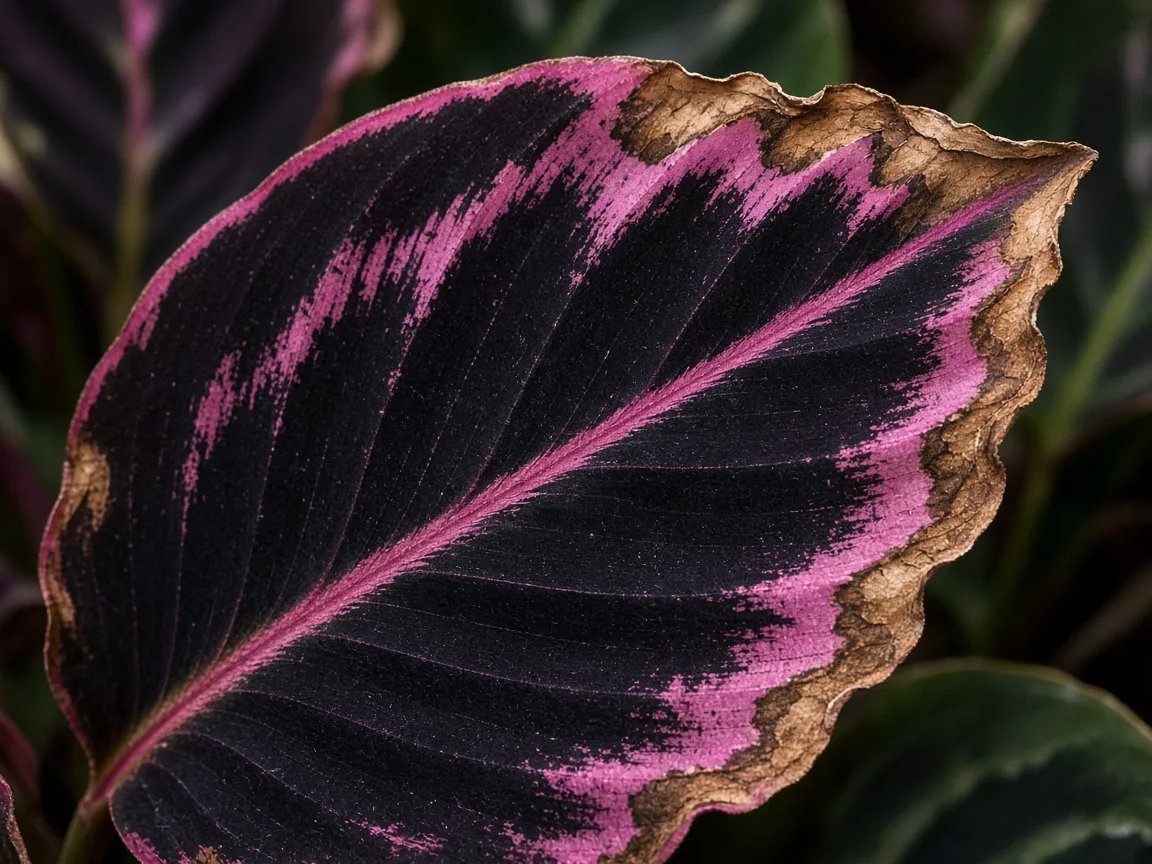
Tan necrosis along the pink feathering and leaf tip—the dead margin will not re-green; judge recovery on the next unfurling spear.
- Narrow tan band at the leaf tip or pink edge — Often fluoride or mineral buildup from tap water; may appear on older leaves first, then on new growth if water does not change.
- Crisp margins on a leaf still unfurling from the central spear — Usually dry air during unfurl or inconsistent moisture; RHS links tip and edge browning to low humidity on calatheas.
- Brown only on the oldest lowest leaves — Often age-out after months indoors; fine if new spears stay clean.
- Bleached pink veins with tan patches after a window move — Light stress; cross-check light guide before blaming water alone.
- Yellowing with soft tissue and wet mix — Not tip burn; see overwatering.
A single older leaf with a dry tip on an otherwise perky clump is low urgency. Crisp edges climbing onto every new spear needs a water or humidity correction within a week.
Pink-vein stress: why Dottie shows tips before the rest of the cluster
This section is Dottie-specific—it would not apply to a snake plant or jade.
- The ‘Dottie’ cultivar has dark leaves with pink central vein and pink feathering—the thinnest painted tissue at the margin desiccates first when transpiration outruns root uptake in dry air.
- New leaves emerge rolled from a central spear; if humidity drops below about 60% while NC State’s rose-painted calathea profile recommends, the outer margin can crisp before the blade fully expands.
- Prayer-plant nyctinasty (leaves folding at night) is normal; persistent daytime curl with crisp tips usually means drought or dry air—not the same as isolated margin necrosis on an otherwise flat leaf.
- Pink contrast fades in too little light before tips brown; if veins are dull but margins are not tan, read not enough light instead of soaking.
Track which leaf generation browns: old-only suggests age or past water; newest spear suggests current water quality or humidity.
Why Calathea Dottie gets brown tips
Rose-painted calatheas evolved as understory rainforest plants needing moist air and acidic, well-drained peat mix. Apartments fight that with heated dry winter air, mineral-rich tap water, and cachepots that hide soggy roots.
Fluoride and salts in tap water. NC State advises rain or distilled water and warns tap fluoride browns foliage. PlantSolve notes that letting tap water stand overnight removes chlorine but not fluoride—a common mistake on Calatheas. Bovees ranks water quality first among calathea tip-burn causes.
Low humidity during unfurl or winter heat. RHS lists browning of leaf tips and edges from dry air and recommends raising humidity around calatheas. Dottie in a drafty heat vent lane often browns pink edges on new leaves while soil moisture still reads acceptable—see low humidity.
Underwatering at the margin. When the top 2 cm goes hard and the pot feels light, leaf edges desiccate before the center wilts. That pattern overlaps underwatering—confirm with a finger test per the watering guide, not leaf curl alone.
Overwatering and root stress (lookalike). Chronic wet mix does not always start at tips; it often shows yellow lower leaves and soft stems first. Tip burn on an oversized wet pot can still happen from salt buildup—pause feeding and review fertilizer before leaching.
Pests and fungus gnats (secondary). NC State lists spider mites, mealybugs, and aphids on rose-painted calathea. Stippling plus webbing fits spider mites; chronic wet surface mix invites fungus gnats without crisp margins.
The water-jar and unfurl check (first diagnostics)
Before repotting or buying a humidifier, run this Dottie-tuned sequence:
- Water source audit — Have you used straight tap for three or more weeks? White crust on the pot rim strengthens the fluoride/salt hypothesis.
- Spear inspection — Peel back the outer leaf slightly on the newest roll (gently). Tan on the still-folded margin confirms active unfurl burn.
- Top 2 cm moisture — Match the watering guide dry-down; record pot weight dry vs. freshly watered.
- Room context — Heating season, fan blast, or glass radiating heat? Pair with humidity calculator if unsure.
- Undersides — Silvery mite stippling or cottony mealy clusters change the fix entirely.
How to confirm the cause
| Clue | Likely cause | First action |
|---|---|---|
| Tan tips on multiple ages, tap water habit | Fluoride/minerals | Switch to filtered or rain water |
| Crisp unfurl, dry winter air, soil mid-range | Low humidity | Humidifier or pebble tray; see low humidity page |
| Crisp tips, very light pot, hard dry surface | Underwatering | One full soak, drain saucer |
| Yellow + wet mix, not just margins | Overwatering | Stop water; inspect roots |
| Dull pink veins, no tan necrosis | Low light | Adjust per light guide |
| Stippling on undersides | Spider mites | Isolate and treat |
Separate confirmed margin necrosis from possible root decline: tips alone rarely kill Dottie; stem softness on wet mix does.
First fix for Calathea Dottie
Make one change first: water the next cycle with room-temperature rainwater, distilled, or filtered water, let excess drain fully, and never leave the nursery pot sitting in cachepot water. Keep every other variable stable for two weeks so you can read the next spears.
Do not repot, fertilize, or crank humidity and change water the same day. Do not trim half-green leaves aggressively—remove only fully dead tan tissue.
If the pot was bone dry and light before tips appeared, the first fix is instead a single thorough soak per underwatering—not filtered water alone.
Step-by-step recovery
After the first fix, work in this order over four to eight weeks:
- Water quality — Stay off untreated tap; occasional top-to-bottom flush in spring reduces salt crust (use the same low-mineral water).
- Humidity — Target 60%+ RH where NC State recommends for rose-painted calathea; run a humidifier near the plant during unfurl, not just misting.
- Water rhythm — Evenly moist peat-perlite mix without soggy cores; RHS suggests letting the surface dry slightly in winter before rewetting.
- Light — Bright indirect per light guide; no direct sun that bleaches pink veins.
- Feed pause — Hold fertilizer until two new leaves open clean; then resume lightly per fertilizer guide.
- Pest pass — If stippling appears, treat before declaring water “fixed.”
Recovery timeline
Brown margin tissue does not re-green. Judge success by new spears unfurling without crisp pink edges, stable evening leaf movement, and no spread onto every new leaf. Water-quality fixes often show on the second or third new leaf (roughly three to six weeks in active growth). Humidity corrections during winter may take a full heating season to look perfect.
If tips keep advancing on wet, heavy mix with yellowing, unpot and inspect rhizomes for rot per root rot before buying more filtered water.
Mistakes to avoid
- Mist-spraying leaves while still using hard tap water at the root zone
- Assuming brown tips mean “underwater” and soaking a already wet pot
- Repotting into heavier mix because edges look dry
- Fertilizing to “heal” necrotic tips on a stressed plant
- Placing Dottie against cold winter glass and running a heat vent across the same leaf
How to prevent brown tips next time
Keep low-mineral water on calendar like watering itself, maintain 60%+ humidity through unfurl, match watering to top-2-cm dry-down, use open, airy soil, and review the Calathea Dottie overview plus problems hub when symptoms overlap.
Related Calathea Dottie guides
Conclusion
Brown tips on Calathea Dottie are margin necrosis on dark, pink-veined prayer-plant leaves, usually tracing to fluoride-heavy tap water, dry air at unfurl, or occasional drought—not a mystery fungus. Change water first, read the next spears, then adjust humidity or soak rhythm. Dead tan tissue stays tan; clean new pink edges are the win.
Related tool
Use the Brown Tips Diagnosis Tool to narrow causes for brown tips on this plant before changing multiple variables at once.