Low Humidity on Calathea Dottie: Pink Veins, Unfurl & Fixes
Quick answer
When Calathea Dottie shows papery brown or pink-tinted margins, washed-out central veins, or stuck unfurling spears—but the top 2 cm of mix feels evenly moist—dry air is the likely cause. First step: log RH beside the foliage and run a humidifier until readings hold 60% or higher before you add water or repot.

Low Humidity on Calathea Dottie: Causes, Checks & Fixes
This guide covers low humidity on Calathea Dottie. See also the general Low Humidity guide, watering, and light pages for this plant.
Low Humidity on Calathea Dottie: Causes, Checks & Fixes
Quick answer
Use this page when your Calathea Dottie (Goeppertia roseopicta ‘Dottie’) shows crisp brown or pink-tinged leaf margins, dull pink central veins, or spears that stick while unfurling—but the top 2 cm of mix still feels evenly moist and rhizomes stay firm. That pattern means raise humidity, not water more.
For how dry air pulls moisture from foliage in general, see our low humidity hub. On Dottie, the display fails first: near-black blades with vivid pink midribs lose contrast at the edges before the whole plant collapses, because NC State lists ‘Dottie’ as dark green leaves with pink central vein and pink feathering—and extension guidance ties brown tips and leaf curl on rose-painted calatheas to low humidity or fluoride in tap water, not thirst alone.
First step: place a digital hygrometer within 12 inches of the leaf tips and run a cool-mist or ultrasonic humidifier beside the plant until RH holds 60% or higher for a full day. Move the pot off heating vents and cold window glass before you soak the root ball or repot.
When to use this page vs other Calathea Dottie guides
| Your pattern | Best guide | Why |
|---|---|---|
| Moist top 2 cm + crisp margins + faded pink veins + weak night folding + RH below 50% | This page | Air is too dry; roots are not the bottleneck |
| Brown tips only + stable humidity above 55% + possible white crust on soil | Brown tips | Fluoride, salts, or water quality stacked on dry air |
| Light pot, hard dry surface mix, daytime curl that does not recover at night | Underwatering | Root-zone drought—not humidity alone |
| Yellow lower leaves, sour smell, wet heavy mix | Overwatering or root rot | Crown failure—not humidity alone |
| Stippling plus fine webbing on undersides | Spider mites | Mites exploit hot, dry microclimates |
| Limp collapse with wet soil | Wilting or drooping leaves | Turgor loss from roots or heat, not just RH |
When in doubt, log RH at leaf height and run the 2 cm finger test before choosing a fix. Adding water to moist mix because dark leaves look dry is the most common Dottie mistake in heated apartments.
What low humidity looks like on Calathea Dottie
Humidity stress on rose-painted calatheas usually starts at leaf margins and along the pink midrib, not the center of the blade. On a healthy Dottie, leaves fold slightly in the evening and reopen by morning; low humidity often weakens that movement before roots fail.
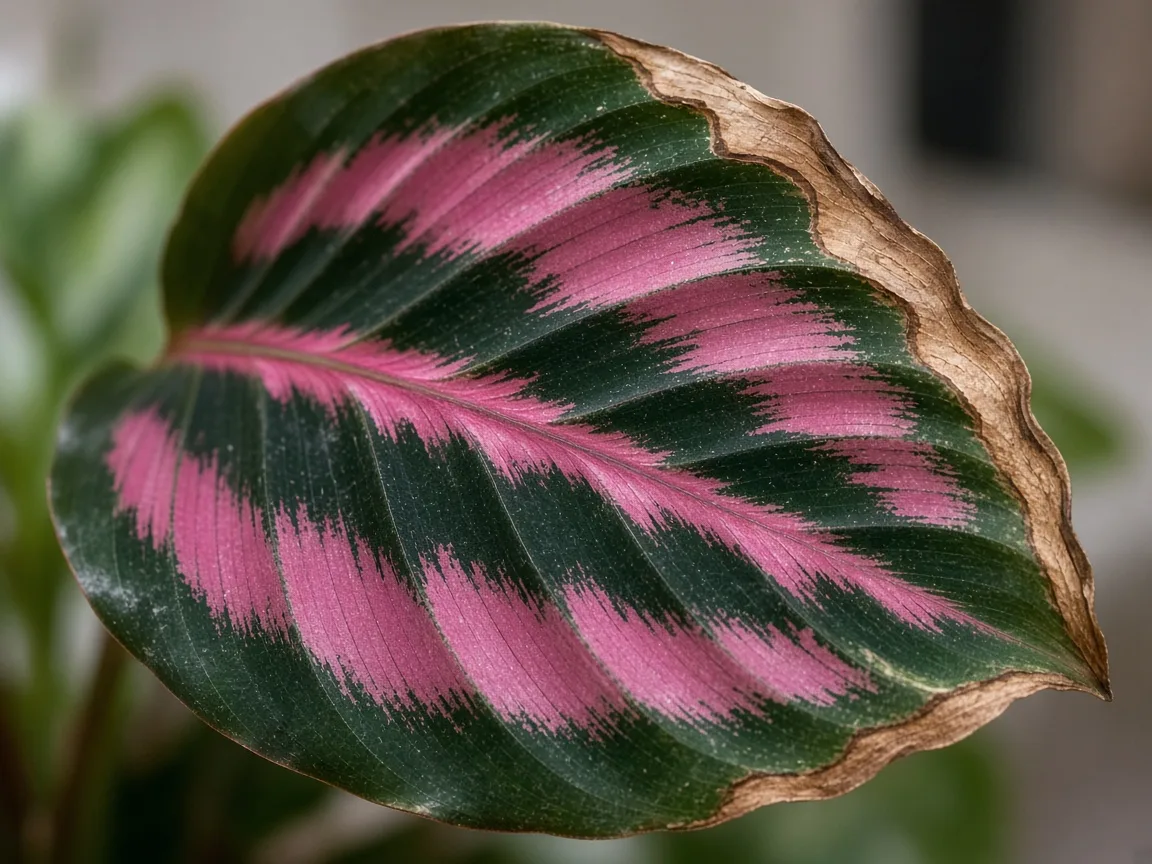
Papery tan margin on a Dottie blade with pink veining still visible in the center—dead edge tissue will not re-pink; watch the next unfurling spear.
Early signs:
- Dry, papery brown or tan margins while the pink central stripe still reads clearly
- Pink feathering looks washed out compared with older, healthy leaves on the same clump
- New spears stick or tear while unfurling, leaving ragged pink edges on the newest blade
- Leaves curl inward slightly in daytime dry air—not the dramatic evening prayer fold
- Damage clusters on leaves nearest a heat vent, radiator, monitor, or drafty window
Progressed stress:
- Brown margins spreading inward on multiple leaves at once
- Night folding becomes less dramatic; blades stay flatter after lights out
- Spider mites may appear as fine stippling on undersides when air stays hot and dry
- Slow growth during an otherwise warm, bright season on the overview
Because Dottie grows as a compact rhizomatous clump rather than a trailing vine, outer leaves on the side facing the vent often crisp first while inner spears still look fine—a clue that localized dry air, not whole-pot failure, is the trigger.
Pink vein fade on unfurling spears (Dottie-specific)
On many houseplants, margin crisping is cosmetic. On Dottie, the pink brushstroke pattern is the whole point—and it develops on the newest spear as it unfurls. When RH drops during heating season, that spear can open with already-tan edges and muted pink lines, even though you watered on schedule.
RHS notes that Goeppertia roseopicta is grown for colourful variegated leaves including the rose-painted type. If the newest leaf loses pink contrast while older leaves still look painted, treat that as an active humidity problem, not old age. Fixing water alone will not restore pigment on tissue that already dried during unfurl.
Nyctinastic fold vs daytime humidity curl
Prayer plants lift and lower leaves on a daily rhythm tied to light and turgor in the pulvinus at each petiole base. Low humidity adds a different signal: persistent inward curl or limp hang during the day, with moist mix at 2 cm depth.
Before you diagnose humidity, watch one leaf for two evenings. Healthy Dottie blades should rise noticeably after dark when temperature is stable. If folding stops for several nights while soil moisture reads normal, dry air is starving leaf tissue of turgor even though rhizomes still drink. If folding stops and mix is wet and sour, pivot to overwatering instead.
Why Calathea Dottie struggles in dry air
Goeppertia roseopicta evolved in warm, moist tropical understories where RH stays high year-round. Indoors, forced-air heat and AC can pull ambient moisture far below what thin, glossy elliptical leaves tolerate. Missouri Botanical Garden states that plants need high humidity, which can be difficult in winter, and that they do not thrive in low humidity where leaves may roll or turn brown.
Several Dottie traits amplify the problem:
- Large leaf surface on a short clump — Transpiration losses add up fast when air is dry.
- Dark leaf color — Shows pink-edge burn and margin tan sooner than on lighter cultivars.
- Shallow rhizome — Roots sit near the surface; they cannot deep-draw water to replace heavy leaf moisture loss when RH crashes.
- Winter room climate — The same watering rhythm that worked in summer may mask dry air until several blades crisp at once.
RHS explains that when air humidity is low, plants transpire quickly and risk wilting if water leaves foliage faster than roots absorb it—even when compost feels adequately moist. Hot air from floor vents desiccates blades in hours. Cold window glass in winter creates a pocket where leaves lose moisture on both sides.
How to confirm low humidity is the cause
Work through these checks before changing fertilizer, soil, or pot size:
-
Hygrometer at leaf height — Log RH for 24 hours beside the foliage. Readings consistently below 50% support low humidity; above 55% suggests leaning toward brown tips (water quality) or light stress.
-
2 cm moisture check — From the watering guide. Evenly moist mix plus crispy margins points to air stress. Bone-dry mix points to underwatering. Wet, heavy mix with yellow lowers suggests overwatering.
-
Pot weight and rhizome feel — Lift the pot. Moderate weight with firm rhizomes at the soil line rules out advanced root rot. Mushy crowns mean waterlogged mix—not humidity alone.
-
Timing and placement — Did symptoms appear after turning on heat, moving near a west window, or placing the pot under a new AC vent? Seasonal timing strongly favors environmental dryness.
-
New spear quality — Inspect the leaf still rolled in the center. Humidity-stressed Dottie often shows tan on the outer roll before the blade fully opens.
-
Pest scan — Hold leaves to the light. Stippling plus webbing means fix humidity and treat spider mites together.
First fix for Calathea Dottie
Apply one humidity correction first, then wait for the next spear unfurl before stacking changes.
If RH is low beside the foliage
Run a humidifier within 1–2 metres of the plant and aim for 60% or higher at leaf height—matching NC State’s above-60% humidity guidance for rose-painted calathea. Keep the mist stream in the air, not blasting directly onto dark leaves. Move the pot off radiators and cold glass the same day.
Add a pebble tray (pot base above water) or group Dottie with other tropicals so they share transpired moisture, as RHS calathea care describes—but treat trays as support, not a substitute for a humidifier in a furnace-heated room.
If a new spear is stuck mid-unfurl
Raise RH first; do not tug the leaf. Once humidity holds for several days, the spear may finish opening on its own. If it remains creased, leave it until a cleaner replacement leaf emerges—then trim the torn blade with clean scissors.
Cosmetic trim (after RH stabilizes)
Snip fully dead margin tissue only after readings stay steady for about a week. Brown edges will not re-pink; trimming is optional for appearance.
Recovery timeline
Damaged margin tissue is permanent. Judge success by stopped spread and vivid pink pattern on newly unfurled leaves.
- After humidifier runs: Existing tan margins stay tan; the next spear should open with cleaner pink feathering within one to two weeks if RH holds.
- After moving off a vent: Outer crisp leaves may remain; inner growth should look fresher within 10–14 days.
- If spider mites were involved: Margin recovery waits until mite pressure drops—often two to three weeks after humidity rises and you follow the spider mite guide.
If three consecutive spears unfurl with intact pink veining and nightly folding returns, consider the dry-air problem controlled. Return to everyday Calathea Dottie care when symptoms overlap sibling guides.
What not to do
- Do not soak the pot because margins are brown while the top 2 cm is already cool and moist—that deepens overwatering on a rhizome-sensitive prayer plant.
- Do not mist heavily at night on a still windowsill; water can sit on dark blades and invite leaf spot. Prefer ambient humidification.
- Do not repot on day one unless you confirm sour, failing roots—dry air rarely requires fresh soil to fix.
- Do not fertilize a crisping Dottie to “push” pink color; feed only after growth stabilizes per the fertilizer guide.
- Do not ignore mites when stippling appears—dry air and pests often arrive together.
How to prevent low humidity damage on Calathea Dottie
- Start a humidifier with the first heating cycle, not after every leaf crisps.
- Keep filtered or rainwater on hand—fluoride damage stacks on dry-air margins.
- Place Dottie in a bright bathroom or kitchen only if humidity stays high and light remains indirect—never dark, steam-only corners.
- Group tropicals to share moisture; leave air space so foliage does not stay wet against neighbors.
- Log hygrometer readings weekly in winter so you humidify before pink veins wash out on the next spear.
When to worry
Treat as urgent if crisping spreads to most new spears within a week, stems soften at the soil line on wet mix, or webbing covers undersides—those patterns point past dry air toward root rot, chronic wet stress, or mite explosion.
Lower urgency: papery edges on a few outer leaves while rhizomes stay firm, the 2 cm check reads normal, and a new spear is pushing with partial pink pattern intact. Fix RH and vent placement before repotting.
Conclusion
Low humidity on Calathea Dottie is usually an air-layer problem on rose-painted prayer-plant foliage, not a mysterious leaf disease. Goeppertia roseopicta ‘Dottie’ tells you the room is too dry when pink contrast fades, margins crisp, and spears stick while roots still drink on schedule. Measure RH at the blades, humidify to 60%+, and keep the 2 cm dry-down honest—then read the next unfurling leaf for the verdict.
Related Calathea Dottie guides
- Calathea Dottie overview — pink veins, filtered water, and cluster map
- Calathea Dottie watering — 2 cm check and seasonal rhythm
- Calathea Dottie light — bright indirect without scorch on dark blades
- Calathea Dottie soil — moisture retention without waterlogging
- Brown tips on Calathea Dottie — when water quality, not RH, is primary
- Calathea Dottie problems hub — all common issues on this cultivar
Related tool
Use the Humidity Calculator to narrow causes for low humidity on this plant before changing multiple variables at once.