How to Identify and Remove Yellow Dock
Learn how to tell yellow dock from broadleaf dock, rhubarb, and burdock, when to dig it, how to handle seedheads, and what to do if it returns.
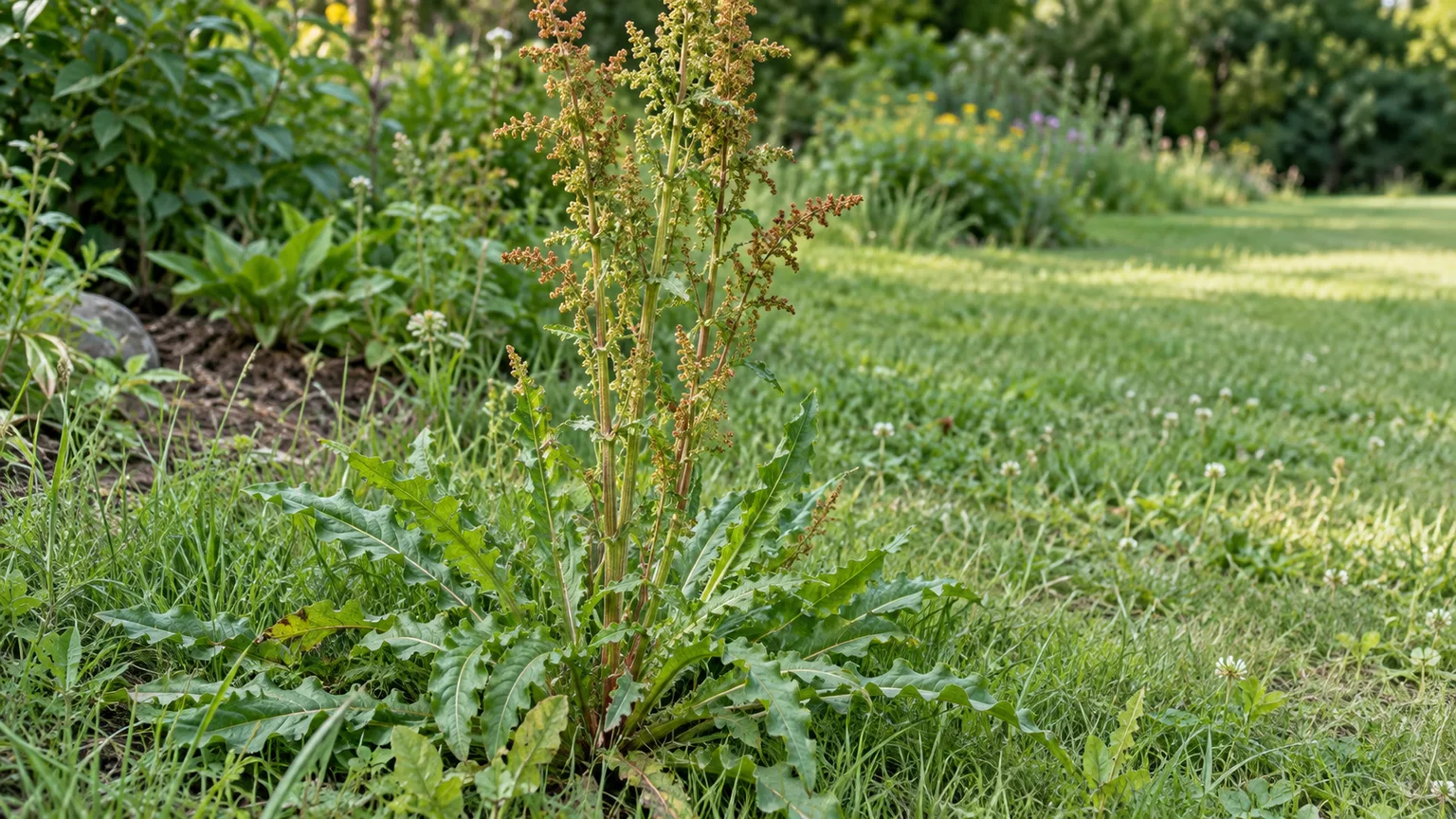
Yellow dock is easiest to control before it sends up a tall flower stalk, but first make sure you have the right plant. Look for a low rosette of long, narrow leaves with strongly wavy edges; mature plants add a ribbed upright stem and clusters of green flowers that turn rusty brown as the fruits dry. The name yellow dock usually refers to curly dock, Rumex crispus, also called curled dock. If the leaves do not fit, pause before digging or applying anything.
For one or two young plants, loosen the soil around the crown and follow the taproot downward with a narrow weeder or garden fork. A quick tug often snaps the root instead of removing it. For a mature plant or a patch, prevent seed spread first, then use careful digging, repeated cutting, smothering, or a site-appropriate herbicide whose current label includes the target and setting. Plan to check the area again: established roots and seeds already in the soil can outlast the first treatment.
Yellow dock at a glance
| Feature | Yellow dock / curly dock |
|---|---|
| Botanical name | Rumex crispus |
| Growth habit | Long-lived herbaceous perennial with a basal rosette and a taproot |
| Best first ID clue | Narrow, lance-shaped leaves with conspicuously wavy or curled margins |
| Mature clue | Upright ribbed stalk with small greenish flowers and dry rusty-brown fruit clusters |
| Best removal window | While the plant is a small rosette and before fruits mature |
| Main reason for follow-up | Root fragments may regrow; seeds can remain viable in soil for years |
“Yellow dock,” “curly dock,” and “curled dock” are common names for R. crispus. Common names are not perfectly consistent across regions, and “dock” can also mean other Rumex species, so a single leaf or the plant’s color is not enough to confirm it. North Carolina State Extension describes R. crispus as a long-lived perennial that tolerates a broad range of soils and moisture conditions; it also notes that seeds can remain viable for up to 50 years, an upper-end warning about persistence rather than a prediction that every seed will last that long. (NC State Extension Plant Toolbox)
Confirm the plant from its leaves, stem, and seedhead
Yellow dock changes shape as it grows. A small spring rosette may look unlike the tall, rusty plant you noticed at the fence line in late summer, so use several clues together and take a clear photo of the whole plant, a leaf, and the stem before you remove it.
Start with the basal rosette
The first-year growth forms a flat or slightly raised circle of leaves from a central crown. Each leaf is usually long and lance-shaped, widest below the midpoint, and tapers toward the tip; its edge is visibly undulate, often appearing ruffled or curled. The blade may be several inches to more than a foot long on a mature rosette, but size varies with growing conditions, so shape matters more than a ruler.
Look at how the leaves attach as well as their outline. Leaves arise from the crown on distinct stalks, and older foliage can develop reddish tones, but red color alone is not diagnostic. If you can safely inspect a mature stem, dock species have conspicuous nodes; the thin papery sheath that can encircle a node is called an ocrea, a family trait that helps separate docks from unrelated broadleaf weeds.
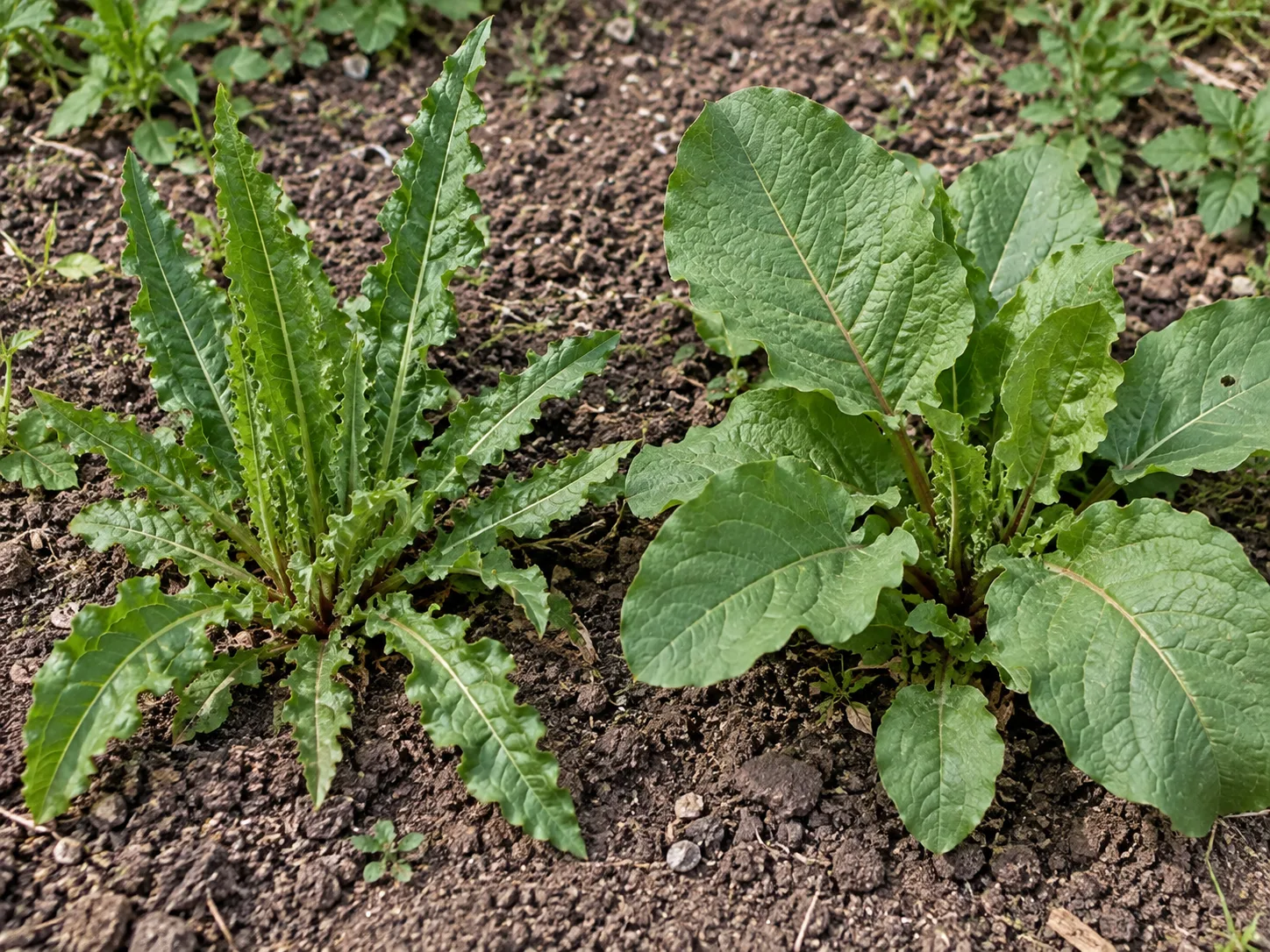
Compare overall leaf width and outline; do not identify a plant from color alone.
Check the flowering stalk and mature fruits
A flowering plant sends up one or more sturdy, ribbed stems with smaller alternate leaves. The flowers are small and greenish, not showy; after flowering, their clustered fruits dry to a reddish or rusty brown and can remain visible after the foliage fades. That winter seed structure makes a mature plant easier to spot, but it also means the plant may already have scattered fruit.
A reddish stalk, broad leaf, or yellow-colored root is not proof by itself. If the specimen is very young, damaged, or growing among cultivated rhubarb or another dock, compare it with a local extension identification page or ask a county extension office before removing a plant you may want to keep. The RHS guide to docks notes that docks can hybridize and that identification across the group can be challenging; its detailed leaf and fruit traits are useful, but local species and hybrids vary.
Tell yellow dock from broadleaf dock and lookalikes
The closest common lookalike is broadleaf dock, Rumex obtusifolius. It also forms a large rosette and develops a tall flower stalk, but its leaves are wider and more oval or heart-shaped at the base, with less dramatically curled margins. The Royal Horticultural Society gives a useful field comparison: curled dock leaves are generally narrower, often no more than about 3 inches wide, while broadleaf dock can be much wider. That measurement is a guide, not a hard cutoff.
Other plants can confuse a quick inspection. Rhubarb has much broader, often nearly round leaf blades on thick, fleshy petioles and is usually found where someone planted it; burdock starts with very large heart-shaped leaves and later forms burrs that cling to clothing or fur. Sorrel is also a Rumex, but many garden sorrels have arrow-shaped basal leaves or red veins rather than the long, mostly unlobed leaf blade typical of yellow dock.
| Plant | Clues that argue against yellow dock | What to do |
|---|---|---|
| Broadleaf dock | Broader oval leaves, often with a more heart-shaped base | Treat it as a separate dock species; use the same confirmation-first approach |
| Rhubarb | Huge rounded blades on thick, fleshy leaf stalks; often in a cultivated row | Do not dig until you know whether it is a planted crown |
| Burdock | Very large heart-shaped leaves, often with a woolly underside; later produces burrs | Confirm from leaf underside and mature burrs before removal |
| Sorrel | Often arrow-shaped lobes or prominent red veins, depending on species | Do not assume all Rumex plants are the same species |
When the plant is still a two-leaf seedling, these distinctions may not be clear. Mark it, photograph it, and revisit after it produces true leaves; if it is already flowering, save a close photo of the fruit cluster. If the identity remains uncertain, do not eat it, spray it, or pull a plant that may be a desired rhubarb or wildlife plant. A county extension office, native-plant society, or local herbarium may be able to check a photo or specimen.
Why a pulled dock can return
Yellow dock is a perennial, so cutting off the leaves does not immediately remove the crown or stored root reserves. The taproot anchors the plant below the soil surface; if you pull only the rosette and snap the root near the crown, surviving tissue can send up new growth. Not every fragment has the same chance of regrowth, but chopping, tilling, or leaving the upper root in place makes repeat growth more likely.
The plant also spreads by seed. NC State Extension reports that seeds can remain viable for up to 50 years, while the RHS notes that dock seeds can persist for many years and move by wind, water, animals, and contaminated organic material such as manure. These figures describe why follow-up matters, not a reason to assume your garden has a 50-year infestation. A new seedling may have arrived recently from a nearby source even if you have never had dock in that bed before. (RHS: Docks)
Do not rototill a patch as a shortcut. A tiller can chop roots into pieces and bury or redistribute seeds, while also bringing buried seeds closer to the surface. In a small bed, targeted lifting disturbs less soil; across a larger site, repeated cutting before flowering or covering the patch can be less disruptive than turning the whole area over. (Epic Gardening’s weed-removal guide)
Decide whether to remove it and when to act
Yellow dock is not automatically a threat everywhere it grows. A single plant at the edge of a meadow or wildlife area may be tolerable if it is not spreading into a bed, lawn, pasture, or neighboring property. Removal makes more sense where its rosette shades seedlings, its mature crown competes with crops or ornamentals, its seed stalk is close to a managed area, or local rules require control.
Timing depends on the plant’s stage, not a universal calendar date. The easiest moment to dig is when the rosette is small and the soil is moist enough to loosen around the root. If you find a tall plant with green flowers or developing fruit, make seed containment the first job; digging can wait until the soil is workable, but do not let dry fruits brush against clothing or scatter as you work.
A useful decision rule is: small rosette, dig; flowering or seeding stalk, contain first; dense patch, choose a repeatable suppression plan; uncertain ID, stop and confirm. If you are managing pasture, crop ground, public land, or a natural area, ask a local extension specialist about site-specific methods before using a lawn or garden product there.
Dig out young yellow dock while the root is manageable
Choose a day when the ground is moist but not saturated. Very dry soil grips the root and makes it more likely to snap; muddy soil can collapse into the hole and obscure the root, while also making footing unsafe. A narrow dandelion weeder, hori-hori knife, or hand fork works better than a wide spade beside ornamentals because it lets you loosen a small column of soil without chopping through the root.
Use this sequence:
- Clear mulch or loose leaves from around the crown so you can see where the leaves meet the root.
- Insert the tool several inches from the crown and angle it down beside the root, not through its center.
- Loosen the soil on two or three sides, then gently rock the tool to lift the root column.
- Hold the crown low and ease it upward while following the root down; do not yank the leaves as a handle.
- If the root snaps, widen the hole and retrieve the accessible upper section rather than churning the whole bed.
- Replace and firm the soil, then inspect the hole and surrounding bed for broken root pieces or overlooked seedlings.
The goal is to remove the crown and as much of the upper taproot as practical, not to dig a trench through your garden. The RHS recommends removing docks while young and targeting roughly the upper 5 to 6 inches of root; it cautions that root sections can regenerate, while deeper pieces are less likely to regrow. Consider that a practical starting depth for garden dock control, not a guarantee that every root below that line is harmless. (RHS: Docks)
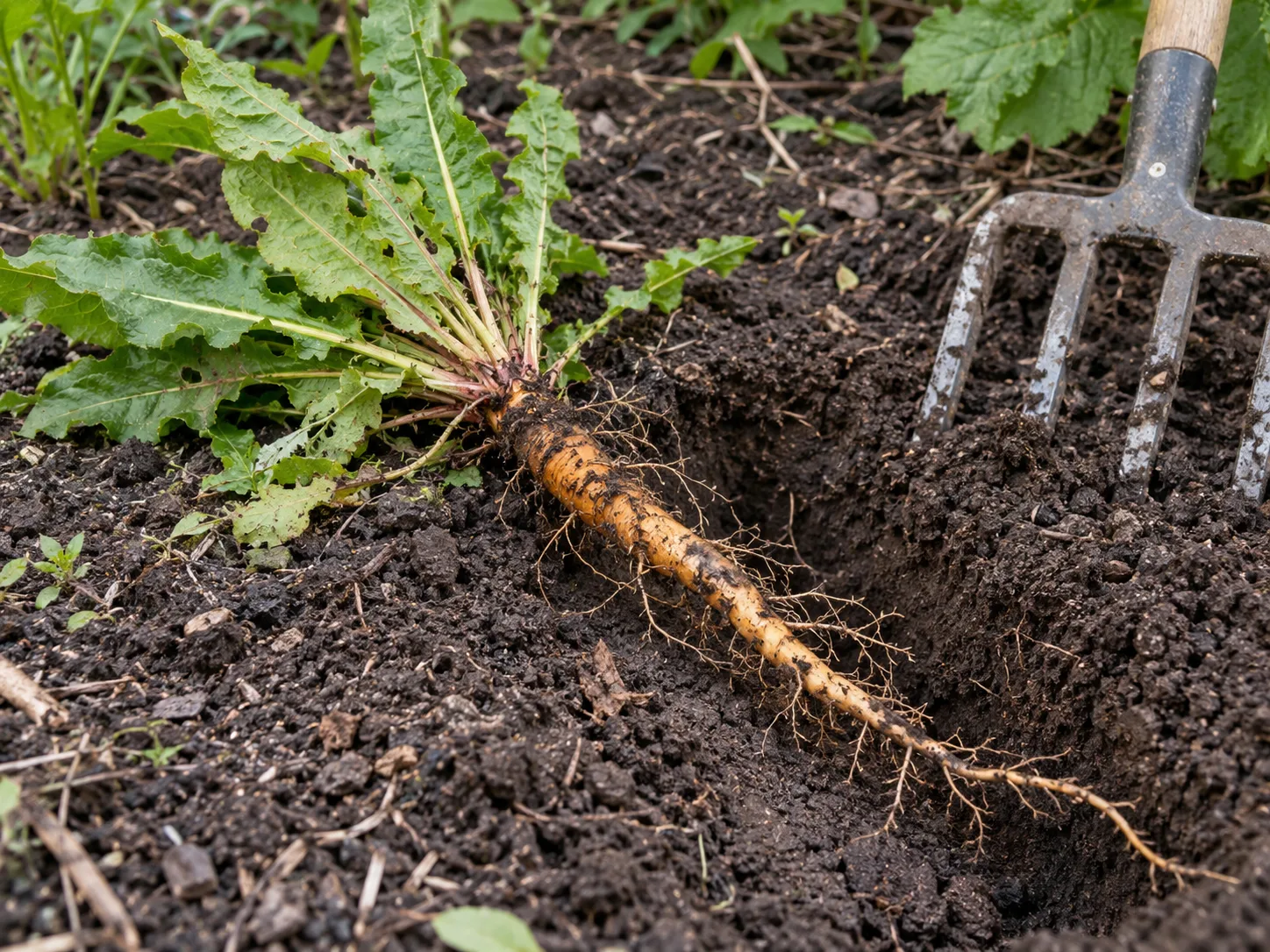
Follow the taproot down from the crown and loosen soil alongside it to limit breakage.
If the root is wedged between established plant roots, stop before you damage the planting you want to keep. Cut the dock down at the crown, note the location, and remove new leaves whenever they appear; repeated depletion is slower than complete lifting but can be the more selective choice. For a plant growing through a paved crack, a narrow puller can lift the root, and regular removal of top growth can weaken one you cannot extract fully. (RHS: Weeds on hard surfaces)
Handle mature plants before seeds disperse
When a dock has flowered, examine the fruit before touching the stalk. Green flower clusters have not reached the same seed-dispersal stage as dry, rusty-brown fruit, but a mature stalk can release seeds when bent, shaken, or carried across the yard. Hold a bag around the seed cluster before cutting it, lower the stem into the bag, and close it before moving the plant.
If fruits are already dry, do not put the stalk on a tarp and drag it across the lawn. Bag it where it stands, clean loose seeds from gloves and tools over the bag, and check nearby paths or mower decks for hitchhikers. Removing seedheads prevents additional seed from entering the site; it does not kill the perennial root, so return later to dig or cut the regrowth.
The rusty winter stalk can look dead even while its root remains alive. Gardening Know How’s dock-control guide notes that curly dock can persist in its dry brown stage, which is why both seed containment and follow-up matter.
For large patches, mark the edges and work from the outside inward, containing the plants nearest beds, paths, or neighboring property first. The RHS dock guidance recommends deadheading to limit self-seeding, and Epic Gardening’s weed-control article similarly advises bagging seedheads before they scatter. The practical value is simple: even if complete root removal takes time, you can stop a mature stand from adding another crop of seeds this season.
Use repeated cutting or smothering for a patch
Mowing or cutting can reduce yellow dock, but one pass is not eradication. If the crown and taproot remain, the plant can replace its leaves; repeated cuts remove the photosynthetic growth the root depends on and gradually weaken it. Cut before seed fruit matures, then check again whenever leaves return. If a cut stem already carries dry fruit, bag it rather than leaving it in the mower’s path.
Repeated cutting is most practical in grass or a larger rough area where digging every crown would disturb too much soil. Keep the cut low enough to remove the leaves but high enough not to scalp turf or damage desired plants, and expect the process to take more than one season for established crowns. In a small ornamental bed, hand-cutting and targeted root lifting are more precise.
Smothering is useful when you can leave an area covered and the plants are not woven through desirable roots. First cut or remove flowering tops and bag mature seedheads; then cover the patch with overlapping cardboard or another opaque material and a generous organic mulch. The RHS suggests keeping covered ground in place for years because buried seed can remain viable, and checking for seedlings when the cover comes off. Do not use a thin layer of mulch over a tall, established dock and assume the root is dead; inspect the edges and any shoots that emerge through gaps.
When selective herbicide may fit
For one plant in a bed, careful digging is usually more precise than spraying. A broadleaf herbicide that controls dock can also injure nearby flowers, vegetables, shrubs, or groundcovers, so a product that is suitable for turf may be unsuitable in a mixed border or food garden. Do not transfer a rate or active ingredient from a different crop, lawn type, or country; products and registered uses vary.
If the infestation is large and mechanical control is impractical, identify the site first—turf, pasture, crop, fence line, or ornamental bed—then choose only a current product label that specifically permits that site and target weed. Follow its directions for timing, protective equipment, weather, application method, re-entry, and any grazing or harvest interval; keep people and animals away as directed. If the label does not cover the plant and site, do not improvise a treatment. A local cooperative extension office can help interpret whether a selective product is appropriate for your grass or crop.
Timing also matters. A herbicide works only on the plant tissue and stage described on its label; treating a dormant or seed-mature plant may not solve the underlying problem. In particular, spraying a mature stalk does not remove seeds already on it or seeds already in the soil, so contain seedheads separately and continue checking for regrowth.
Prevent a new generation and restore the site
After removal, close the opening rather than leaving bare soil. Replant the bed with the intended crop, ornamental, or a suitable groundcover, and water it enough to establish without keeping the area persistently soggy. In a lawn, restore thin spots with the right grass for your region and mowing conditions. Dense cover gives dock seedlings fewer open patches in which to settle, although it cannot prevent every seed from arriving.
Inspect the site after rain, irrigation, and each mowing through the growing season. Young dock seedlings often show a simple rosette before the adult stalk appears; lift them while small, when the root is easier to remove. Also inspect compost, manure, topsoil, straw, and equipment brought from elsewhere, because weed seeds can arrive with materials or soil stuck to machinery. Avoid deep cultivation that repeatedly turns new soil to the surface.
If dock returns in the same spot, check what changed rather than simply digging deeper. A surviving crown, a broken upper root, seed released from a nearby plant, or a continuing source in a ditch or field can each explain another plant. Wet, disturbed ground is a common place to find dock, but R. crispus tolerates a wide range of conditions; improving drainage or fertility may help the desired planting, yet no single soil correction guarantees that dock will disappear. (NC State Extension Plant Toolbox)
Dispose of roots and protect pets
Do not put mature seedheads or dock roots in an ordinary home compost pile. Backyard piles may not heat every material enough to kill seeds or root fragments; keep the material contained and use municipal green-waste disposal only if your program accepts invasive weeds or seeded weeds. Otherwise follow local yard-waste guidance, which may mean sealing it for household trash. Never dump plant waste at the edge of a field, ditch, or natural area.
Wear gloves when removing unknown plants, keep the work area away from children and pets, and wash tools after use. NC State Extension records low-severity poison characteristics for R. crispus, and the ASPCA lists “Dock” (Rumex species) as toxic to dogs, cats, and horses, with soluble calcium oxalates as the toxic principle. Because the ASPCA entry is at genus level, it does not establish identical risk for every dock species; it is still a sound reason not to let animals chew the plant. If a pet eats dock or shows symptoms, contact a veterinarian or animal poison-control service promptly. (ASPCA Animal Poison Control: Dock)
Do not use this weed-identification guide as a foraging guide. Yellow dock and related plants can be confused with other species, and this page does not verify food or medicinal uses; leave plants out of meals, teas, and home remedies unless a qualified local expert has confirmed the species and use. A correct plant ID is the first safety step, not a reason to ingest it.
Avoid these dock-removal mistakes
- Pulling by the leaves: the top can detach while the crown and root remain. Loosen soil beside the taproot and lift from the crown.
- Waiting for a dry seed stalk: dry fruit can scatter while you move it. Bag mature heads where they stand before digging.
- Using a tiller: it can chop roots and distribute seeds. Use targeted lifting or a deliberate suppression plan instead.
- Composting seedheads or roots: a home pile may not destroy them. Use local green-waste rules or contained disposal.
- Assuming mowing killed the plant: one cut removes leaves, not the perennial root. Schedule repeated cuts and inspect for regrowth.
- Spraying without checking the label: a turf product can injure broadleaf ornamentals or a food crop. Confirm the site and target are both covered.
- Removing every dock automatically: a dock in a wildlife corner may be acceptable. Decide based on competition, seed movement, local requirements, and what you want that area to support.
Conclusion
Identify yellow dock from the combination of a narrow, wavy-edged basal rosette and, on mature plants, a ribbed stalk with rusty fruit clusters. If the plant is still young, use a local identification resource when you are unsure; confusing a dock with rhubarb, broadleaf dock, burdock, or a desired wildflower can turn weed control into an avoidable loss.
For a confirmed small plant, work in moist soil and follow the root down from the crown. For flowering plants, contain seedheads first; for large patches, use repeated cutting, smothering, or a selective product only when its current label fits the exact site. Then replant, reduce bare ground, and inspect for seedlings and regrowth. Yellow dock is persistent, but a clear identification and a steady follow-up plan keep one plant from becoming a recurring patch.