How to Grow Wild Strawberry: Planting and Care Guide
Learn how to grow wild strawberry in a bed or pot, choose a sunny but cool site, manage runners, identify lookalikes, and harvest the small berries at home.

Wild strawberry (Fragaria virginiana) is a low, spreading North American perennial that can fill the space between taller plants with white spring flowers, small red fruit, and a steady supply of new rosettes. It is easiest to grow when you decide up front whether you want a wildlife-friendly ground cover, a small berry patch, or both: the first goal rewards letting runners roam, while the second depends on more sun, dependable moisture, and enough access to pick fruit before birds find it.
Unlike a large-fruited garden strawberry, this species is valued as much for its native-plant role and compact foliage as for its delicate berries. Give it a well-drained site with at least four hours of direct light, keep new plantings watered as roots establish, and manage the runners at the edge of the area you want covered. Those three choices do more for success than frequent feeding or fussy pruning.
Wild strawberry growing requirements at a glance
| Growing factor | Practical starting point | What changes the result |
|---|---|---|
| Light | Four or more hours of direct sun; partial shade is tolerated | More light generally supports flowering and fruit; afternoon shade helps in hot summers |
| Soil | Moist to moderately dry, fertile, well-drained soil | Avoid persistently saturated ground and compacted clay pockets |
| Spacing | About 12 inches between nursery plants | Runners bridge the gaps; widen spacing if you want a slower, easier-to-edge patch |
| Water | Water new plants thoroughly, then during prolonged dry spells | Containers dry faster; moisture matters most around flowering and fruit development |
| Spread | Low foliage with aboveground stolons | Each rooted node can become a new plant, so define a boundary before planting |
| Harvest | Small, soft red berries after spring flowering | Timing varies with local climate, exposure, and spring weather |
The table is a starting point, not a rigid calendar. NC State Extension describes the plant as a roughly five-inch-tall, two-foot-wide perennial that spreads by runners and tolerates full sun to part shade in fertile, well-drained soils; its flowering and fruiting respond to local conditions. In practice, a warm, dry spring may produce a thick leafy mat and few berries, while a cooler site with regular moisture can set more fruit. (NC State Extension)
Identify the right strawberry before you plant or eat it
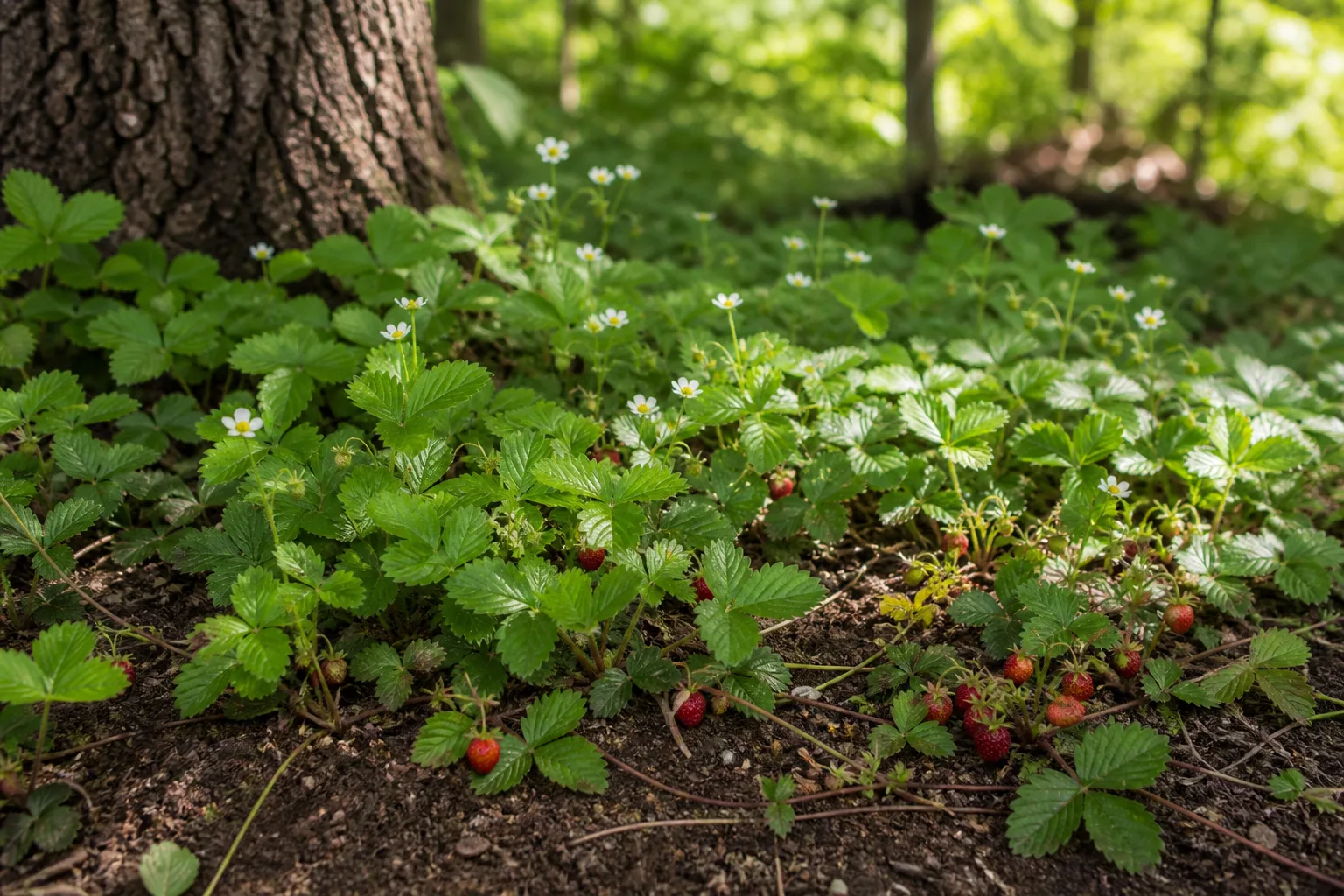
A wild strawberry plant forms a low crown with leaves divided into three coarsely toothed leaflets. The leaf stalks and runners emerge close to the ground, while spring flower stems lift clusters of small white flowers above or just beyond the foliage. After pollination, each flower develops into a red fruit dotted with tiny achenes; on F. virginiana, those achenes sit in shallow pits rather than standing on prominent bumps.
Use several traits together instead of relying on one leaf or berry. The University of Maine Cooperative Extension’s field sheet describes the trifoliate, toothed leaves, white flowers with yellow centers, spreading runners, and seasonal progression from spring growth to flowers and early-summer fruit. These clues are useful in a garden, but they are not a substitute for a reliable regional plant identification when you are uncertain. (University of Maine Cooperative Extension)
Wild, woodland, garden, and mock strawberries compared
Several plants are called “wild strawberry,” and they do not have identical habits. The woodland or alpine strawberry, Fragaria vesca, also has three-part leaves and edible fruit, but its berries tend to be more elongated and its achenes sit on the surface. The familiar large garden strawberry is usually a hybrid, Fragaria × ananassa, selected for larger fruit and crop production; it is a better fit if your main goal is a dependable bowl of berries rather than native ground cover.
Mock strawberry, Potentilla indica (also known historically as Duchesnea indica), can confuse gardeners because it also has three leaflets and red fruit. Its yellow flowers are a strong clue, while true Fragaria flowers are white; fruit orientation and seed placement provide additional clues. Epic Gardening’s species profile summarizes these distinctions, and NC State Extension also flags P. indica as a plant that is often confused with F. virginiana. (Epic Gardening; NC State Extension)
Do not eat a berry because it merely looks strawberry-shaped or because a plant has a certain flower color. Confirm the species from the whole plant with a trustworthy local field guide or extension resource, and avoid harvesting where plants may have been treated with herbicide, pesticide, or contaminated runoff. If you cannot make a confident identification, leave the fruit in place for wildlife and buy nursery-grown plants for an edible patch.
Choose a site and decide how much spread you want
Wild strawberry fits best where its low growth and creeping habit are useful: the front edge of a native border, a sunny slope, a meadow-like planting, a raised bed margin, or the open ground beneath taller plants that do not smother it. It can knit soil together as its runners root, but it is not a magic weed barrier. A dense mat can reduce open soil and compete with some small seedlings, yet aggressive grasses and taller perennials can shade the strawberry out.
Before planting, draw the patch boundary in your mind and consider what lies beyond it. If a lawn, neighboring bed, or path edge must stay clear, plant inside a physical edge or in a container and inspect the perimeter during active growth. Runner stems can extend beyond the original crown and root wherever a node touches suitable soil; cutting those stems before they root is simpler than trying to remove a network after it has spread.
For a low-maintenance ground cover, let a few runners root and fill the gaps, then thin only where the patch becomes crowded. For a tidier edible bed, remove most runners and keep a narrow, reachable row so fruit is visible and easy to harvest. The plant can tolerate part shade, but if berries matter, favor the brightest site that avoids harsh, drying afternoon exposure in a hot climate.
Plant wild strawberry so crowns establish cleanly
Buy plants from a native-plant nursery when possible, especially if you are adding the species to a naturalized area. Select stock identified as Fragaria virginiana and ask whether it is appropriate to your ecoregion; a plant native somewhere in North America is not necessarily native to every state, province, or habitat. Avoid digging from roadsides, parks, or public natural areas unless collection is explicitly allowed, and never remove plants from private land without permission.
A potted plant or rooted runner is the easiest way to start a patch because it establishes faster than seed and remains true to the parent. Choose healthy plants with firm crowns and no mushy roots or widespread leaf spotting. If planting bare-root divisions, keep the roots from drying while you prepare the hole and plant them promptly.
Planting time and spacing
Plant in spring after the soil can be worked, or in early fall while there is still time for roots to settle before hard freezing. In regions with hot summers, spring or early fall weather reduces transplant stress; avoid setting out small divisions just before a heat wave. The best window is local rather than universal, so use your extension service’s planting calendar if your area has unusual frost or summer-heat patterns.
Set plants about 12 inches apart as a manageable starting layout. That spacing leaves room to weed and inspect the crowns while allowing runners to bridge the gaps. If you want a fast carpet, arrange plants more closely; if you want to control a patch, leave more open space and remove runners that cross the line. Do not bury plants under a thick layer of mulch simply to suppress weeds, because young leaves and crowns need to emerge freely.
Set the crown at soil level
Dig a hole wide enough to spread the roots without bending them sharply upward. Hold the plant so its crown—the short central point where leaves and roots meet—rests at the soil surface, backfill around the roots, and press gently to remove large air pockets. A crown planted too deep stays damp and can rot; one left high with exposed roots dries out.
Water the planting thoroughly to settle soil around the roots. For the first few weeks, check moisture below the surface rather than relying on the top layer: the root zone should remain lightly moist, not waterlogged. Once you see fresh leaves and the plant resists a gentle tug, reduce watering to match rainfall and weather.
Care for the patch through changing seasons
Wild strawberry is not a high-input crop, but “low maintenance” does not mean “ignore it.” Its performance depends on a few predictable conditions: enough light for flowers, moisture while fruit is developing, open drainage, and occasional thinning where runners create a congested mat. Watch the plant’s seasonal rhythm rather than forcing it to grow continuously.
Balance sunlight and moisture
Four hours of direct sunlight is a useful minimum, with more sun usually producing more flowers and fruit when the soil stays moist. NC State lists full sun and partial shade as suitable exposures, while horticulture guidance from GrowIt BuildIt notes that shaded plants may spread less and produce little fruit. In a hot region, morning sun followed by afternoon shade can protect foliage from heat stress; in a cool summer climate, a brighter position is more likely to support a harvest. (GrowIt BuildIt)
Water after planting and during a prolonged dry period, especially from flower bud development through fruiting. Do not use a fixed weekly schedule without checking the soil: rain, wind, soil texture, and container size all change how quickly the root zone dries. If the soil is still damp a finger’s depth down, wait; if it is dry and plants are drooping in warm weather, water slowly at the base so moisture reaches the roots.
A hot spell can pause growth or cause partial summer dieback, particularly in plants receiving full afternoon sun. That does not automatically mean the patch is dead. Keep the crown from drying completely, avoid heavy pruning in the heat, and look for new growth as temperatures ease; do not keep saturating soil in an attempt to force a dormant plant back into growth.
Keep the soil open, mulched, and lightly fed
The roots need oxygen as much as water, so drainage matters more than a precise recipe. Wild strawberry grows in a range of soils, including sandy loam and heavier loam, if water does not stand around the crown. Work a modest amount of finished compost into a new bed if the soil is poor, but do not dig deeply around an established patch where shallow roots and runners are already spreading.
A soil test is more useful than applying fertilizer by habit. If the patch has healthy leaves and steady runner growth, supplemental fertilizer may add little; too much nitrogen can favor lush foliage and runners over flowers and fruit. A thin layer of compost can replenish organic matter, while a light straw or leaf mulch can moderate moisture and keep berries from resting directly on bare soil. Keep mulch loose and away from the crown, and pull weeds while they are small rather than hoeing through the shallow roots.
Soil pH recommendations vary slightly among cultivation sources, and garden soil does not need to be changed just to match a number if plants are growing well. If growth is persistently weak or a large edible planting is planned, test the soil and use locally recommended amendments rather than adding lime, sulfur, or concentrated feed by guesswork. (Epic Gardening)
Thin crowded growth and watch for common problems
A patch that becomes a solid tangle can trap humidity, hide ripe fruit, and make it difficult to spot weeds. In late winter or early spring, remove dead leaves and thin some rooted daughter plants if the middle has become crowded; retain vigorous young crowns around the edge to renew the patch. Do not scalp the whole planting. The goal is airflow and access, not a bare bed.
Slugs and birds are often more noticeable than serious plant damage because the berries are small and attractive to wildlife. Pick fruit as it ripens, remove debris where slugs shelter, and consider a removable bird net only after flowers have finished and pollinators are no longer visiting. Check netting frequently so birds and other wildlife do not become trapped. Avoid spraying flowers or fruit with pesticides; if a pest or disease is severe, identify it first and follow an applicable local extension recommendation and product label.
Leaf spots, fruit rots, and gray mold are more likely when foliage stays wet or the patch is crowded. Water at soil level when practical, remove badly affected leaves and rotting fruit, and improve air circulation by thinning. NC State Extension lists several diseases and insect pests that can affect strawberries, including leaf spot, fruit rot, aphids, mites, and slugs; the presence of one damaged leaf does not mean the entire patch needs treatment. (NC State Extension)
Encourage spring flowers and a realistic berry crop
Wild strawberry flowers in spring, but the calendar shifts with latitude, elevation, weather, and local ecotype. Maine’s phenology guidance notes spring leaf growth, flowers later in spring, and fruit appearing around June in its New England context; elsewhere, flowering and ripening may arrive earlier or later. Use the first blooms and the color change of berries as your local cues rather than expecting every patch to follow one harvest month. (University of Maine Cooperative Extension)
Each flower has both pollen-producing and seed-bearing structures, and pollinators help move pollen among flowers. Leave the blooms undisturbed if fruit is the goal, and avoid covering flowering plants with a solid barrier that blocks pollinator visits. A patch can flower well and still yield few berries if it is too shaded, dries during fruit development, experiences hot spring weather, or loses fruit to birds and other animals.
Manage runners according to the result you want. More runners create faster ground cover but compete with the mother plant for space and can make the patch harder to pick through; removing some can keep crowns open and fruit accessible. A first-year planting may also spend energy establishing roots and spreading, so a modest initial crop is more realistic than expecting a full yield immediately.
Harvest ripe fruit without crushing it
Pick berries when they are uniformly red, fragrant, and slightly soft but not collapsing. Taste one from a confidently identified plant before collecting a bowl, because fruit size and sweetness vary among plants and seasons. A ripe berry can detach with a gentle lift or a small snip that leaves its cap and short stem intact; avoid squeezing it between your fingers, since the thin fruit bruises easily.
Harvest in small passes every day or two while fruit is ripening. This catches berries near peak flavor and reduces the chance that overripe fruit will soften or rot in damp weather. Place them in a shallow dish rather than piling them into a deep container, and refrigerate promptly if you are not eating them right away.
Expect a handful of tiny berries, not the yield of a commercial strawberry row. The fruit is intensely aromatic and useful fresh, folded into yogurt, or added to a small batch of jam, but collecting enough for a large recipe takes patience. If you care more about a continuous wildlife-friendly carpet than your own harvest, leave some berries for birds and let the plants naturalize within the area you chose.
Propagate wild strawberry from runners or seed
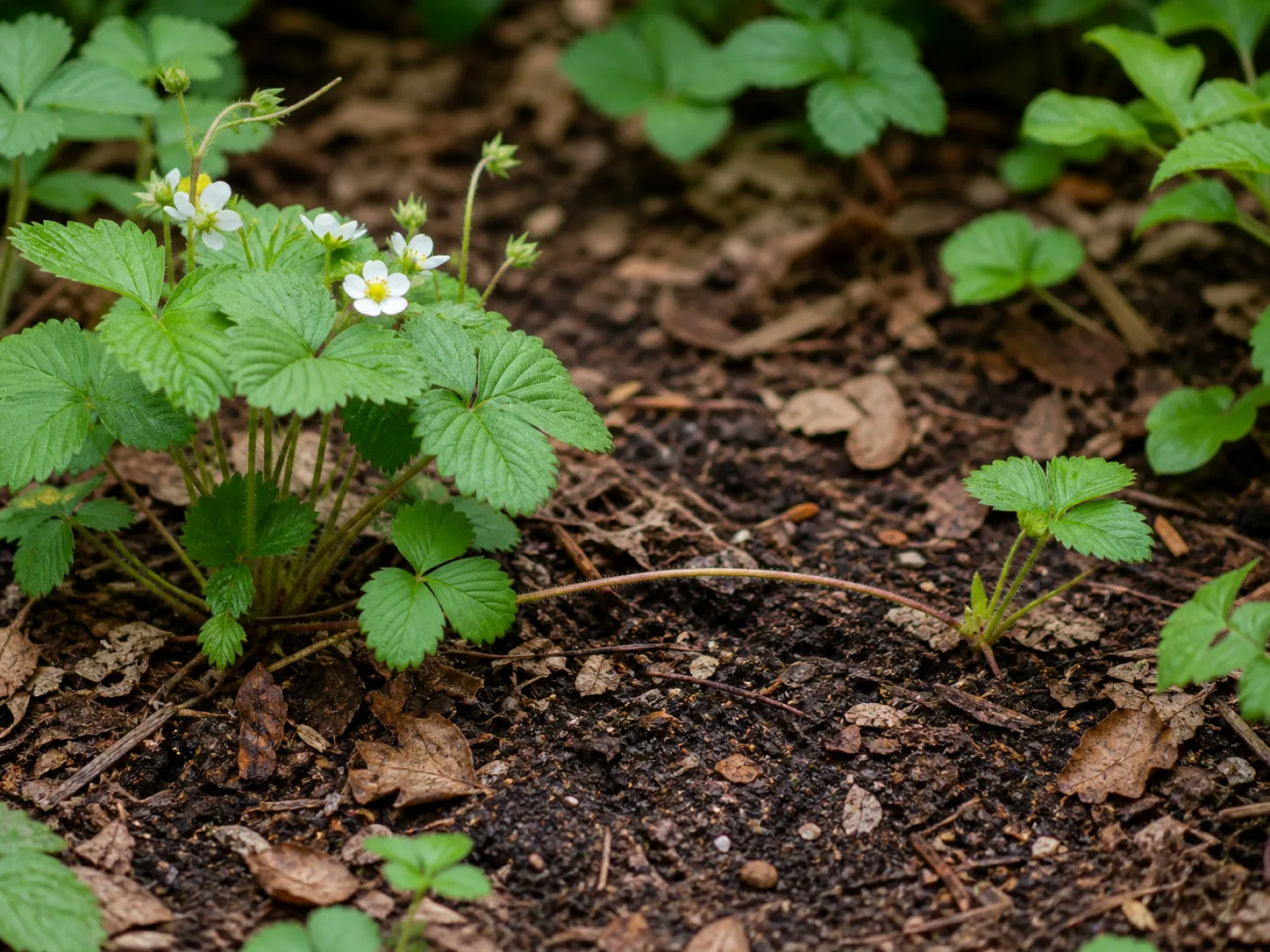
Runners are the practical choice for most home gardeners. A runner is a horizontal stem that grows away from the parent crown; where a small leafy rosette touches moist soil, it can form roots and become an independent plant. This vegetative method gives you a faster start and preserves the characteristics of the parent.
Root and move a runner plantlet
Choose a healthy daughter rosette with several leaves and a runner still attached to the mother plant. If it has not rooted, set a small pot of moist mix beneath the node or pin it to prepared soil with a garden staple, then keep that spot lightly moist. Let it remain connected until you can feel roots holding the rosette in place with a very gentle tug.
Once rooted, snip the runner between the new plant and its parent. Lift the rooted plantlet with as much soil around its roots as possible, move it promptly, and water it in. A cloudy day or cool part of the season is easier on a small division than a hot afternoon. If you are controlling spread instead of expanding the patch, cut runners before the plantlets root and remove any daughters that appear outside the boundary.
Start seed with patience
Seed is slower and less predictable than runner propagation, but it is useful when you want several plants or a particular local seed source. Let a fully ripe berry soften, separate the tiny achenes from the pulp, and dry them before storage. Sow them shallowly on fine, moist seed-starting mix; do not bury small seeds deeply, and keep the surface from drying while you wait.
Cold-stratification advice is not uniform: one species-specific guide recommends about three to four weeks in the refrigerator, while GrowIt BuildIt suggests a longer two-to-three-month period. Because seed lots and source populations can behave differently, follow the instructions from the nursery that supplied the seed or split a small batch between treatment lengths rather than gambling the entire packet on one schedule. (Epic Gardening; GrowIt BuildIt)
After chilling, keep the seed tray warm and bright but out of harsh direct sun, and maintain light surface moisture without waterlogging it. Germination can take several weeks and may be uneven. Grow seedlings until they have several true leaves and sturdy roots, then harden them off gradually before moving them outdoors after frost risk has passed. Seed-grown plants may take longer to flower than rooted runners, so label the sowing date and do not mistake a slow first season for failure.
Grow wild strawberry in a pot and protect it over winter
A container is useful when you want to harvest the berries, observe the plant closely, or prevent runners from entering nearby beds. Choose a broad pot or trough with several drainage holes and enough surface area for leaves and fruit; a narrow, deep pot gives the runners little room and dries unevenly. Use a well-draining potting mix amended with a little finished compost, set the crown at the mix surface, and leave room around it for air circulation.
Pots need more frequent moisture checks than garden beds because their limited soil volume warms and dries quickly. Water when the top layer begins to dry and excess water can drain freely; do not leave a nursery pot sitting in a saucer full of water. Trim runners that escape over the rim or let one or two root back into the same container if you want the plant to fill the pot. Refresh crowded pots every couple of years by dividing vigorous rosettes into fresh mix.
In cold-winter regions, an in-ground plant is generally better insulated than one in a small pot. Move the pot beside a sheltered wall or into an unheated protected space, and keep the root ball barely moist rather than either bone-dry or soaked. Avoid bringing it into a warm living room for winter; the plant needs a seasonal rest. In mild climates, foliage may remain partly green, while heat or frost can cause temporary dieback. RHS botanical notes describe Fragaria as a stolon-forming perennial with three-part leaves and edible fruit, and list F. virginiana as native to eastern North America. (Royal Horticultural Society)
Conclusion
Wild strawberry is a good choice when you want a low native planting that can flower, feed wildlife, and offer a small but flavorful harvest. Start with correctly identified, locally appropriate plants; give them light, open drainage, and moisture during establishment; then decide whether runners should fill the bed or stop at a clear edge.
If flowers appear but berries do not, check light, spring heat, and water before adding fertilizer. If the patch becomes crowded, thin it and root selected runners elsewhere. A little planning turns this quick-spreading perennial from an accidental lawn guest into a deliberate ground cover you can enjoy and manage.