Vermiculite vs. Perlite: Differences and How to Use Each
Compare vermiculite and perlite by water retention, aeration, particle size, and use. Choose the right one for seed starting, houseplants, cuttings, or beds.
If a bag of potting mix seems to dry too fast, stay soggy too long, or pack down around roots, the right mineral amendment can help—but vermiculite and perlite do different jobs. Vermiculite is the stronger choice when you need a mix to hold moisture more evenly; perlite is usually the better choice when you want more air space and faster movement of excess water through a container mix. Neither material is a fertilizer, a complete potting soil, or a substitute for a pot with drainage.
The simplest way to choose is to diagnose the problem first. If seeds or moisture-loving plants dry before you can water again, consider a modest amount of vermiculite; if a mix stays wet and dense after watering, perlite is more likely to help. The outcome still depends on the base mix, particle grade, container, climate, and how often you water.
The Quick Answer
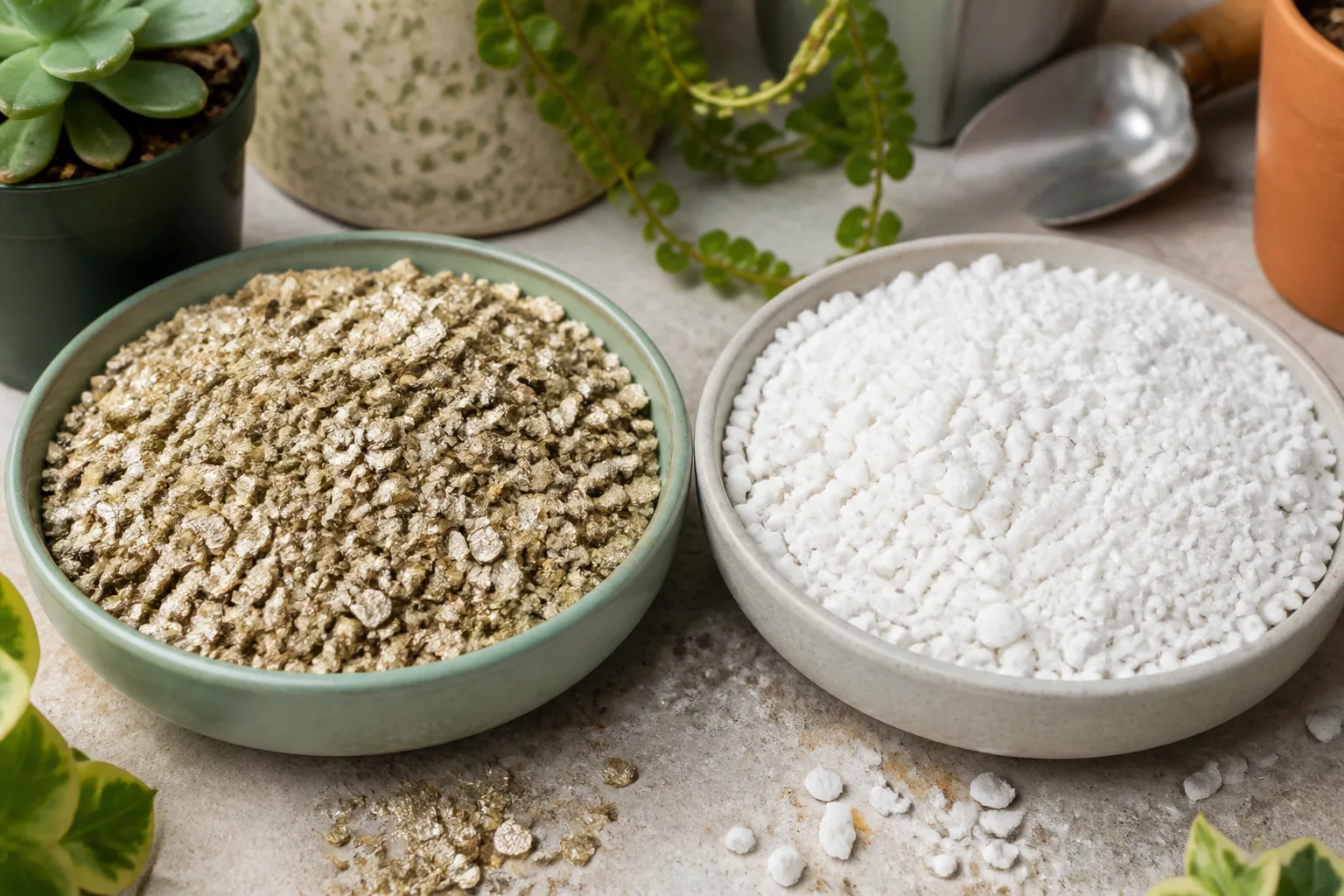
Vermiculite looks like tan, gold, or silvery flakes and holds substantially more water than perlite. It can also hold some positively charged nutrients, which is useful in soilless growing media, but it does not supply a balanced fertilizer. Perlite is white, light, and granular; its main value is keeping a mix more open so roots can get oxygen as water drains.
Choose vermiculite for seed-starting mixes or containers that need a longer moisture buffer, provided the plant tolerates evenly moist media. Choose perlite for a root zone that needs better aeration and a faster dry-down, such as many succulent or cactus mixes. Use both only when your recipe needs both effects; mixing them together is not automatically an upgrade.
What Vermiculite and Perlite Are
These materials look like simple add-ins, but they begin as different minerals and behave differently when processed. Both are heated until they expand into lightweight horticultural particles, yet the original structure of each mineral helps explain why a bag of one is not interchangeable with a bag of the other.
Vermiculite is an expanded, layered mineral
Vermiculite begins as a hydrated, sheet-like magnesium-aluminum-iron silicate mineral that resembles mica. When the flakes are heated, water between the layers turns to steam and the mineral expands into light, accordion-like granules. The U.S. Geological Survey’s mineral description explains this exfoliation process and notes vermiculite’s ability to absorb liquids; its flakes range from silvery to brown or yellow.
The expanded layers and pores make vermiculite useful for holding water and some nutrients in a growing medium. Oklahoma State University Extension’s growing-media guide describes horticultural vermiculite as porous, water-retentive, and relatively high in cation-exchange capacity, or the capacity to hold and exchange certain nutrient ions. That property can help keep nutrients available in a soilless mix, but it does not replace a complete fertilizer plan.
Perlite is expanded volcanic glass
Perlite begins as volcanic glass. Heating it rapidly expands the material into irregular, white, porous particles that feel lightweight and brittle. Oklahoma State University Extension describes perlite as lightweight and porous with strong oxygen retention; the Royal Horticultural Society’s houseplant media guide explains its role in improving aeration and drainage.
Perlite is not completely dry or non-absorbent: water can occupy surface pores, and some moisture clings between particles. Its larger contribution is structural. When incorporated evenly into a container mix, its particles help preserve open spaces around roots after free water drains.
What Changes After Watering
A useful comparison looks beyond the words “holds water” and “drains.” A growing medium has pores of different sizes; after irrigation, some spaces retain water while others empty and refill with air. Roots need both moisture and oxygen, and a mix can fail if too much pore space stays water-filled or if water runs through before fine roots can use it.
Water storage is different from drainage
Vermiculite absorbs and holds more moisture than perlite, then releases some as the surrounding medium dries. That can smooth out short gaps between waterings, particularly in a seed tray or a container that otherwise dries quickly. It does not mean you should water less by a fixed schedule: a shaded pot in cool weather can remain wet much longer than the same recipe in summer sun.
Perlite holds some water in its pores, but generally contributes less moisture storage than vermiculite. A mix with more perlite may need watering sooner under hot, windy, or bright conditions, especially in a small pot. Particle size also matters: fine particles can fill spaces between larger ingredients, while coarse particles can create larger gaps; the product grade and the whole recipe change the result.
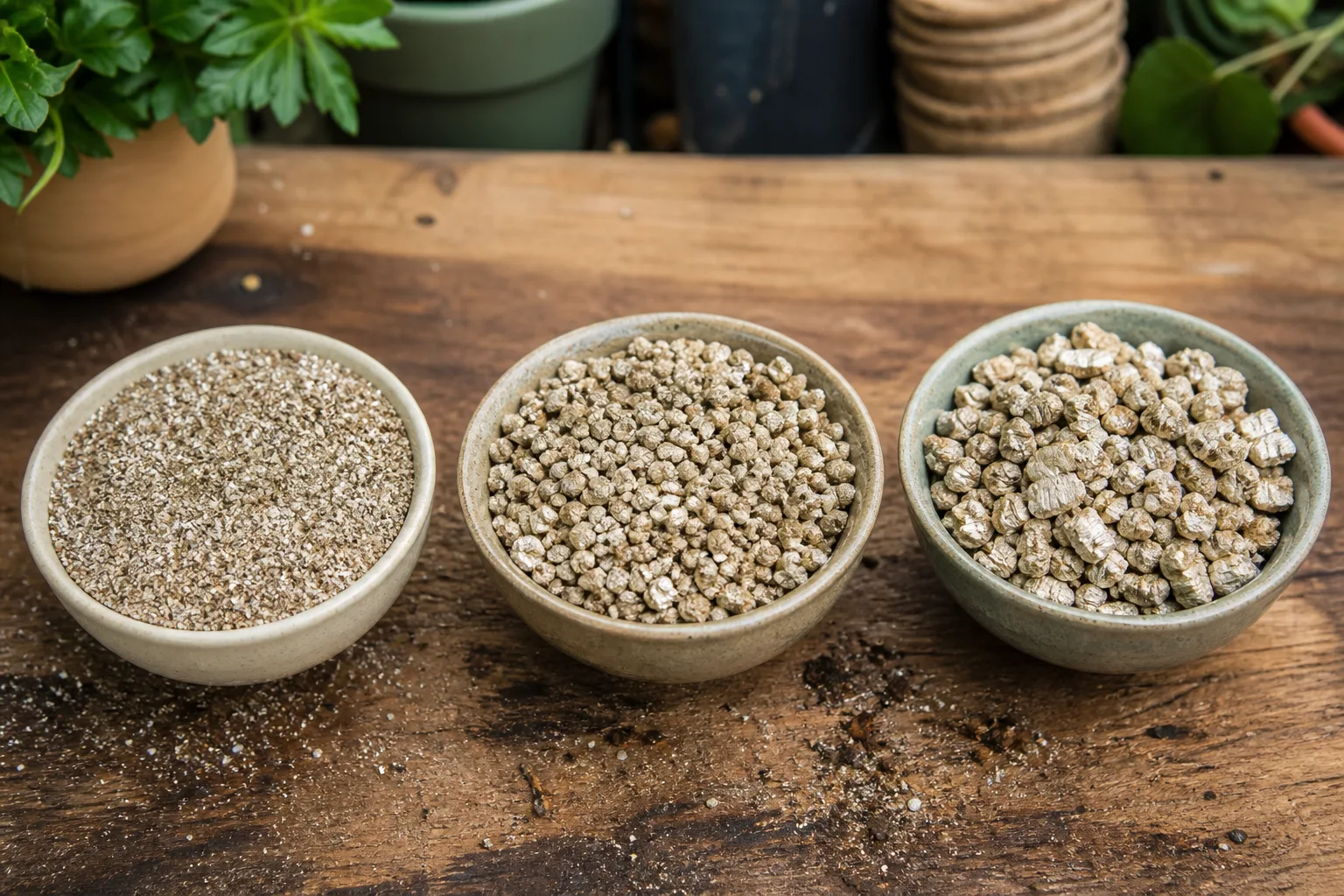
The same handful of amendment can therefore behave differently in two homes. A warm terracotta pot in a bright window loses water faster than a glazed pot in a cool room, while a large container usually stays moist longer than a small cell. Choose the ingredient to nudge the mix, then adjust watering based on the actual pot rather than the bag’s general description.
Air space matters as a mix drains
“Drainage” has two related meanings in everyday gardening. Water must be able to leave the container through an open drainage hole, and the mix itself must keep enough pore space for air to reach roots after watering. Perlite can help with the second job, but it cannot make water escape a sealed pot or a saucer that stays full.
A potting medium that remains waterlogged can deprive roots of oxygen even if the surface looks dry. The RHS explains that compacted or waterlogged media limit air around roots, while bulky ingredients such as pumice, bark, and clay pellets can create air spaces. Perlite is often used for this structural role, but it will not repair blocked holes or dense, degraded mix by itself.
Do not judge drainage by how quickly the first splash leaves the bottom of the pot. Water may run down a gap beside a shrunken root ball while the center remains dry, or a fine, compacted mix may stay saturated above the drainage hole. A full soak followed by a check of the pot’s weight and moisture below the surface tells you more than a quick pour test.
Vermiculite vs. Perlite at a Glance
| Feature | Vermiculite | Perlite |
|---|---|---|
| Appearance | Layered flakes; tan, bronze, or silvery | White, irregular, lightweight granules |
| Main contribution | Greater moisture storage and nutrient-ion retention | More persistent air space and movement of excess water |
| Best fit | Seed starts, moisture-buffering mixes, some propagation | Airy container mixes, many drought-tolerant plants, some propagation |
| Main caution | Can keep an already moisture-retentive mix too wet | Can make a small pot dry sooner and can float or blow away |
| Plant nutrition | Not a complete fertilizer | Does not provide balanced plant nutrition |
Which Material Fits the Gardening Job?
The material should solve a specific limitation in the mix, not merely appear in every recipe. Match the amendment to the life stage of the plant, the container, and how quickly the mix dries in your conditions.
Seed starting and seedling trays
Seeds need moisture to begin germination, but seedlings also need oxygen at the roots once they emerge. Fine-grade vermiculite can help a seed-starting medium stay evenly moist, and a light top layer can reduce how quickly the surface dries. For very small seeds, check the packet: some need light and should not be covered.
Perlite can also appear in seed-starting recipes because it adds air space and reduces the chance that a fine mix becomes dense. There is no single correct ingredient list; Penn State Extension’s seedling-media guidance includes recipes using vermiculite, perlite, or both alongside peat, compost, and fertility amendments. The base mix still needs to provide water, nutrients, and aeration, so a tray filled with either mineral alone is not a complete long-term seedling medium.
For direct sowing, seed depth and the seed’s light requirement still control the cover. Vermiculite is an optional surface material, not a reason to bury seeds more deeply or keep a covered tray sealed after germination. If you bottom-water, let the cells absorb what they need and then empty standing water so the mix does not remain submerged.
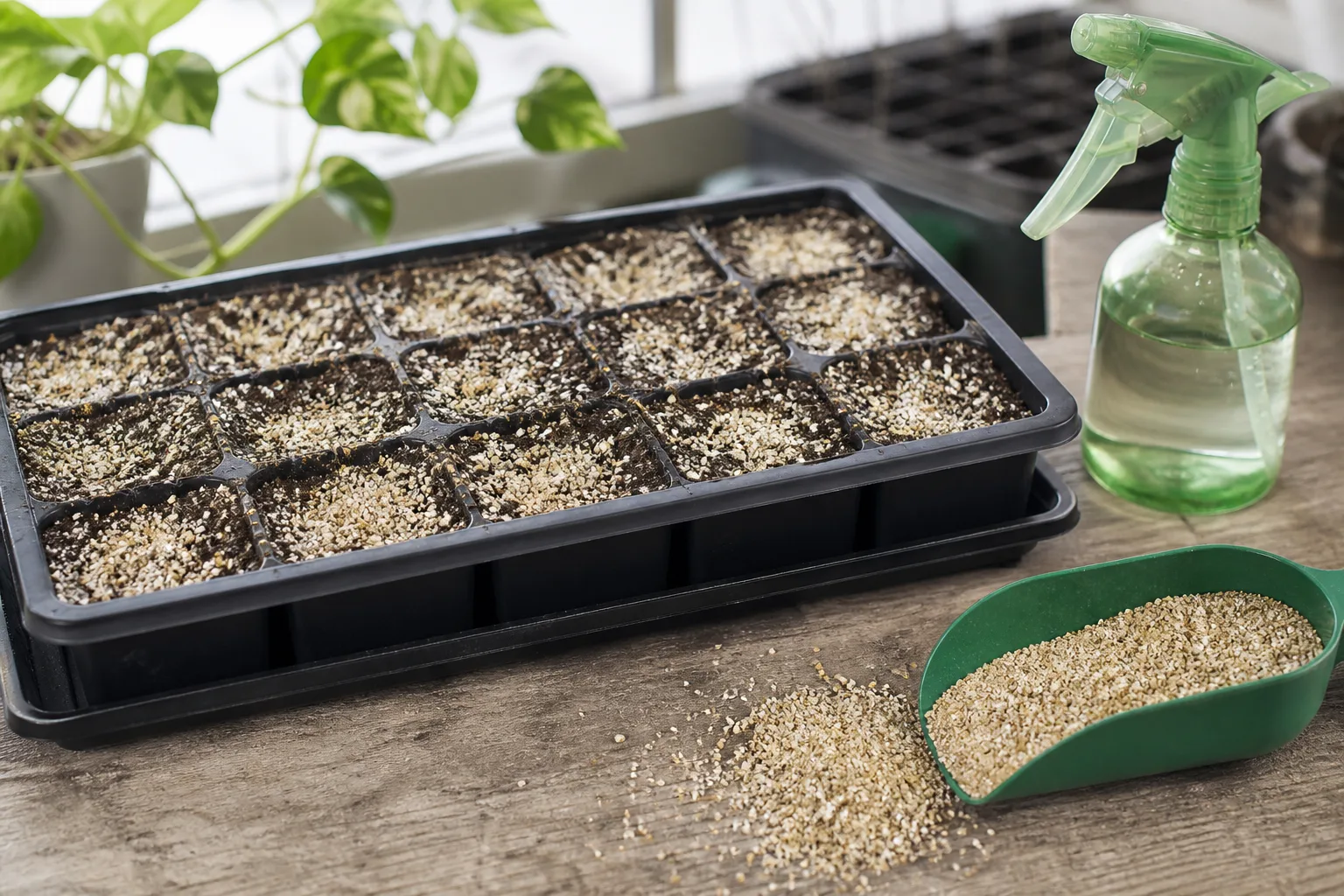
Do not assume a vermiculite cover prevents damping-off disease. Clean trays, suitable temperature, airflow, light, and careful watering matter; a moisture-holding top layer can work against you if the tray stays saturated. Check seedlings daily, ventilate humidity domes after emergence, and let the surface condition—not a calendar—guide watering.
Houseplants and container mixes
For a houseplant that repeatedly wilts because its mix dries quickly, a small addition of vermiculite may buffer moisture between waterings. This is more appropriate for plants that prefer consistently moist conditions than for species that need the root zone to dry substantially. If the mix already contains a lot of coir, peat, or other water-retentive material, adding vermiculite may leave the pot wet too long.
For a plant in a mix that stays heavy and damp, perlite is usually more useful. It can add air space to a general potting mix for plants that benefit from a faster dry-down, including many succulents and cacti. Still, “succulent soil” is not one formula: light levels, pot size, temperature, mineral content, and watering habits all affect how quickly a root ball dries.
The pot matters as much as the ingredient. Unglazed clay loses water through its sides, while plastic and glazed ceramic do not; a small pot exposes more mix to air relative to its volume. If you move a plant from plastic to clay or from a wide shallow pot to a tall one, expect its watering interval to change even when the mix is unchanged.
Judge the mix after a thorough watering. If water pours out immediately but the center of the root ball remains dry, the medium may be hydrophobic or unevenly wetted; adding more perlite is unlikely to fix that. If a pot remains heavy and wet for many days, check for a blocked drainage hole, an oversized container, compacted media, or a watering routine that does not match the plant before changing the recipe.
Cuttings and propagation
Perlite, vermiculite, or a blend can serve as a temporary rooting medium for cuttings, but each creates a different balance. Perlite is useful when a cutting needs aeration and you can keep it from drying out; vermiculite can provide a steadier moisture reserve for a cutting that wilts readily. The Epic Gardening comparison discusses both materials for propagation, but species, humidity, and watering still determine which medium is easier to manage.
Treat propagation media as a support and moisture-control system, not as a complete source of nutrition. Keep the medium evenly moist rather than waterlogged, use a clean container, and transplant once roots are established enough to handle. If a cutting turns mushy, increasing water retention is the wrong adjustment; improve airflow and review the amount of water and humidity.
Garden beds and raised beds
These lightweight minerals are most predictable in containers and small-batch media. In a large in-ground bed, a handful mixed into one planting hole affects only a small pocket, while a large quantity may be impractical and can be displaced by water or cultivation. For broad improvements to garden soil, start with a soil test and locally appropriate organic matter rather than expecting either bagged material to transform the entire bed.
If you use an amendment in a raised bed, spread it evenly through the intended root zone and keep the amount modest until you see how quickly the bed dries. Perlite can reduce density in a containerized mix, while vermiculite can help a sandy blend retain moisture; neither should mask a drainage problem in the site itself. The USGS describes vermiculite’s role as a soil conditioner in clay-rich and sandy soils, but the practical effect depends on the quantity and soil volume being amended.
How to Adjust a Mix Without Guessing
Start with the plant and the symptom, not a universal recipe. If the root zone dries too fast, first confirm that the pot is not root-bound, sitting in direct hot wind, or filled with a very coarse mix; then test a small amount of vermiculite in a separate batch. If the mix stays soggy, inspect drainage holes and watering frequency before blending in perlite.
For a first trial, amend only a small batch rather than an entire collection of pots. A modest starting point is about one part amendment to three or four parts existing mix by volume, but treat that as a test—not a rule for all species, grades, or climates. Mix thoroughly, moisten the substrate, and compare a newly planted pot with one using the original recipe.
Use a clean bucket or tub and measure the same way for every trial. Mix the dry ingredients evenly, add water gradually, and squeeze a handful: the medium should hold together loosely when pressed without dripping or forming a dense mud ball. This quick feel is not a laboratory measurement, but it can reveal whether the amendment has made a very fine mix too sticky or an already coarse mix too loose.
Watch how long each pot takes to become light, whether water wets the root ball evenly, and whether the plant maintains healthy growth between waterings. If vermiculite keeps the mix wet past the plant’s needs, reduce it or return to the original mix. If perlite makes the container dry too quickly, use less, choose a finer grade, or add an appropriate water-retentive ingredient instead.
For seedlings or commercial production, follow a tested recipe suited to the crop and measure by volume consistently. Penn State Extension notes that media composition affects germination, nutrient availability, and seedling growth; it also recommends checking unfamiliar media rather than assuming every mix performs the same. For home gardeners, a side-by-side trial with the same plant and pot size is often the clearest guide.
Give a new recipe a few watering cycles before judging it, unless the plant is visibly stressed or the mix is staying waterlogged. Compare the same container size, plant, light, and location so you do not confuse a weather change with an ingredient effect. Once one mix performs well, record its proportions; that gives you a repeatable starting point when you repot the next plant.
Common Myths That Lead to Poor Mixes
“Perlite is just for drainage.” It can hold some moisture in its pores, but its larger contribution is air space and structure. A mix can still be wet inside a pot, and a no-hole pot cannot drain simply because it contains perlite.
“Vermiculite is always bad for succulents.” The material does not harm a plant by name; the risk is using enough moisture-retentive media that the root zone stays wet longer than the plant can tolerate. A tiny amount in a freely draining recipe may be inconsequential, while a large proportion in a cool, low-light room may prolong wetness.
“Vermiculite is a fertilizer.” Its cation-exchange capacity can help retain some nutrient ions, but that is not the same as supplying all essential elements in plant-available amounts. A seedling or houseplant may still need a suitable fertilizer once its stage and base mix call for it.
“More amendment means better soil.” Too much of either changes the balance. An over-amended mix may dry too quickly, retain too much water, or lose enough fine material that roots and water no longer interact as intended. The useful amount is the smallest adjustment that fixes the problem you observed.
“Mix both together every time.” You can combine them when a recipe needs both moisture buffering and air space, but a complete commercial mix may already provide that balance. Adding both without diagnosing the mix can make watering harder to predict.
Dust, Handling, and Product Context
Fine dust from dry media can irritate eyes and breathing passages. Oklahoma State Extension specifically cautions that perlite dust can cause respiratory and eye irritation and recommends eye and breathing protection during handling. Open bags outdoors or in a well-ventilated place, avoid pouring from height, and gently moisten the material before mixing so particles are less likely to become airborne.
If you are sensitive to dust or mixing only a few pots, use premixed potting medium rather than opening loose mineral bags. The Minnesota Department of Health’s vermiculite information says the health risk to home gardeners from infrequent contact is low while recommending simple precautions and premixed soil as a way to reduce dust. If dust irritates you, stop, move to fresh air, and use a better-ventilated setup next time.
Do not confuse a sealed bag of horticultural-grade vermiculite with unidentified loose-fill material from an attic or wall. If you find old insulation in a building, leave it undisturbed and follow local asbestos guidance or contact a qualified professional; it is not a gardening material to scoop up and reuse. Keep dry amendments away from fans and wind, and close the bag after use.
Alternatives and Environmental Trade-Offs
Both minerals are mined, nonrenewable materials, and their light weight does not mean their extraction and processing have no environmental cost. The RHS notes that perlite’s manufacture, packaging, and distribution can have a substantial impact and points to locally sourced grit or gravel as possible alternatives in some contexts. The best substitute depends on the job: coir or compost can increase water retention, while bark, pumice, or appropriately sized mineral grit can add structure and air space.
Alternatives are not interchangeable either. Pumice is heavier and may stay in a mix more reliably outdoors; bark breaks down and can change a blend over time; coir quality and salt content vary by product. If you replace an ingredient, make a small test mix and observe how it wets and dries instead of swapping by volume and assuming the behavior will be identical.
The practical environmental choice is often to avoid adding an amendment where the existing mix already works. Use the amount needed for the container and plant, reuse clean mineral components only when they have not been exposed to disease or pest problems, and choose a locally available substitute when it performs the same job.
Conclusion
Choose vermiculite when you need a modest moisture buffer or a seed-starting medium that stays evenly damp. Choose perlite when the mix needs more air space and a faster path for excess water to leave the root zone. Both can appear in one recipe, but neither fixes blocked drainage, poor watering, or an unsuitable base mix.
Make one small change, then watch the pot dry rather than following a fixed schedule. A healthy mix holds enough water for the plant while leaving roots access to air; the right amendment is the one that brings your actual pot closer to that balance.