12 Easy-to-Grow Types of Fir Trees for Landscapes
Compare 12 types of fir trees by mature size, climate, foliage, and landscape use, then choose one that can thrive in your yard and learn what to check before planting.
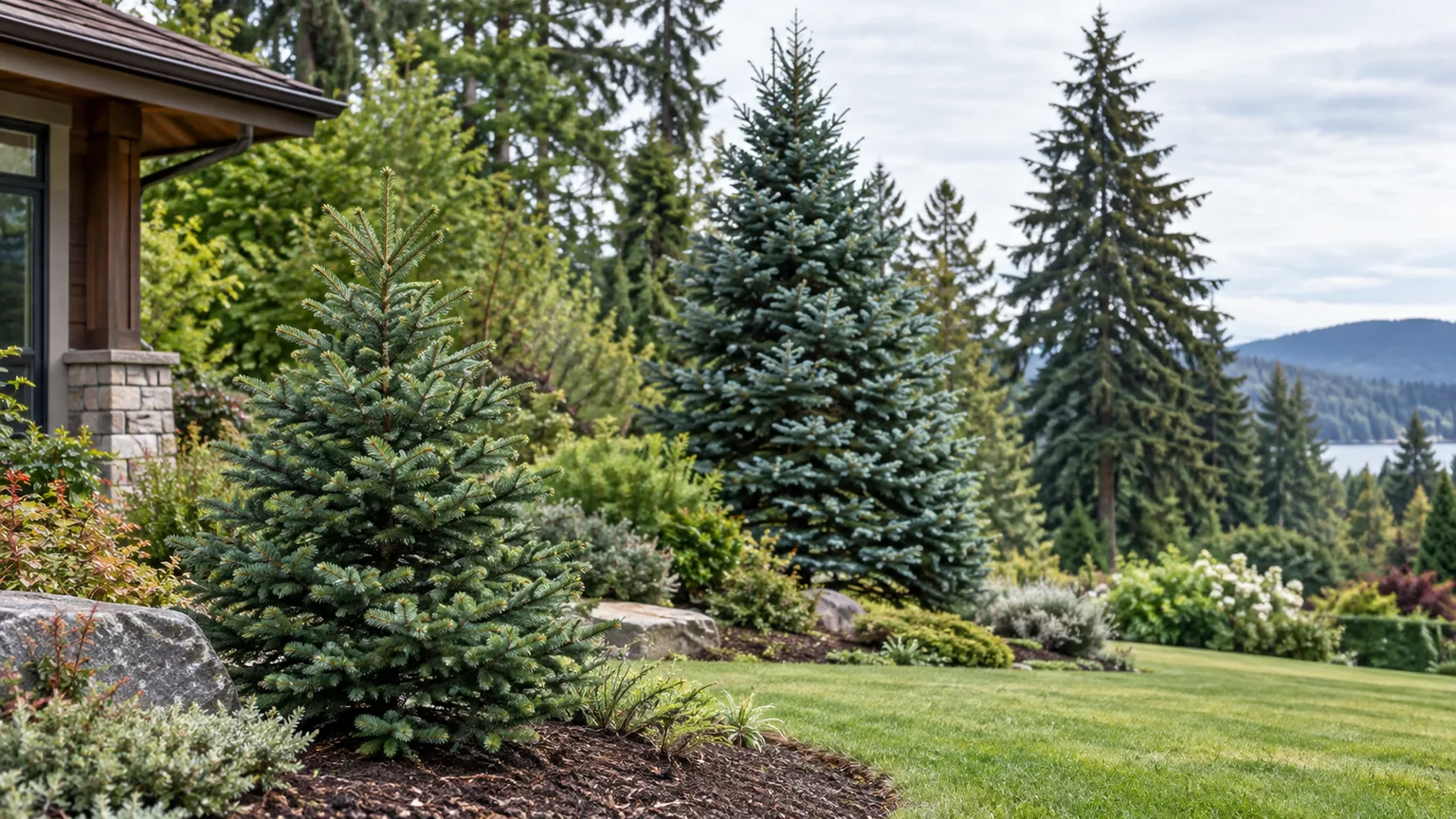
Fir trees can be low-maintenance landscape evergreens, but “easy” is a matter of fit. A balsam fir in a cool, moist climate may settle in with little fuss; the same tree in a hot, dry yard can struggle. Before buying, match the tree’s summer and winter climate, soil drainage, and adult size to the spot where it will live.
The 12 true firs below belong to the genus Abies. They range from relatively compact Korean firs to forest-scale species that are too large for an ordinary foundation bed. A species name and a realistic mature-size estimate matter more than the size of the nursery plant.
Before choosing a fir, check your site
Start with summer conditions, not just the coldest winter temperature. Many firs come from cool mountain or northern forests and dislike long stretches of heat, dry air, or drought; white fir is more adaptable than most, but it still needs a site where roots are not left in soggy soil. Hardiness-zone estimates vary by reference and cultivar, so use the nursery’s label as a first filter, then check with a local extension office about summer performance in your region.
Next, look below and above ground. Fir roots need oxygen, so compacted clay, a low spot that stays wet, or repeated lawn irrigation can turn a promising planting into a slow decline. Look up for wires and nearby rooflines, then measure space for the mature height and spread; a tree sold in a small pot can eventually shade a large area and crowd paths or structures.
Winter hardiness is only one part of the climate check. A tree can survive local cold and still lose vigor after repeated hot summers, so compare the species’ needs with your July and August conditions as well as the lowest winter temperature. Look for established specimens at a nearby arboretum or ask an extension office which firs have grown well in your area. That local record is more useful than assuming a zone number predicts summer performance. Harvest to Table’s general Abies growing guide likewise recommends cool conditions and moist, well-drained soil for firs as a group.
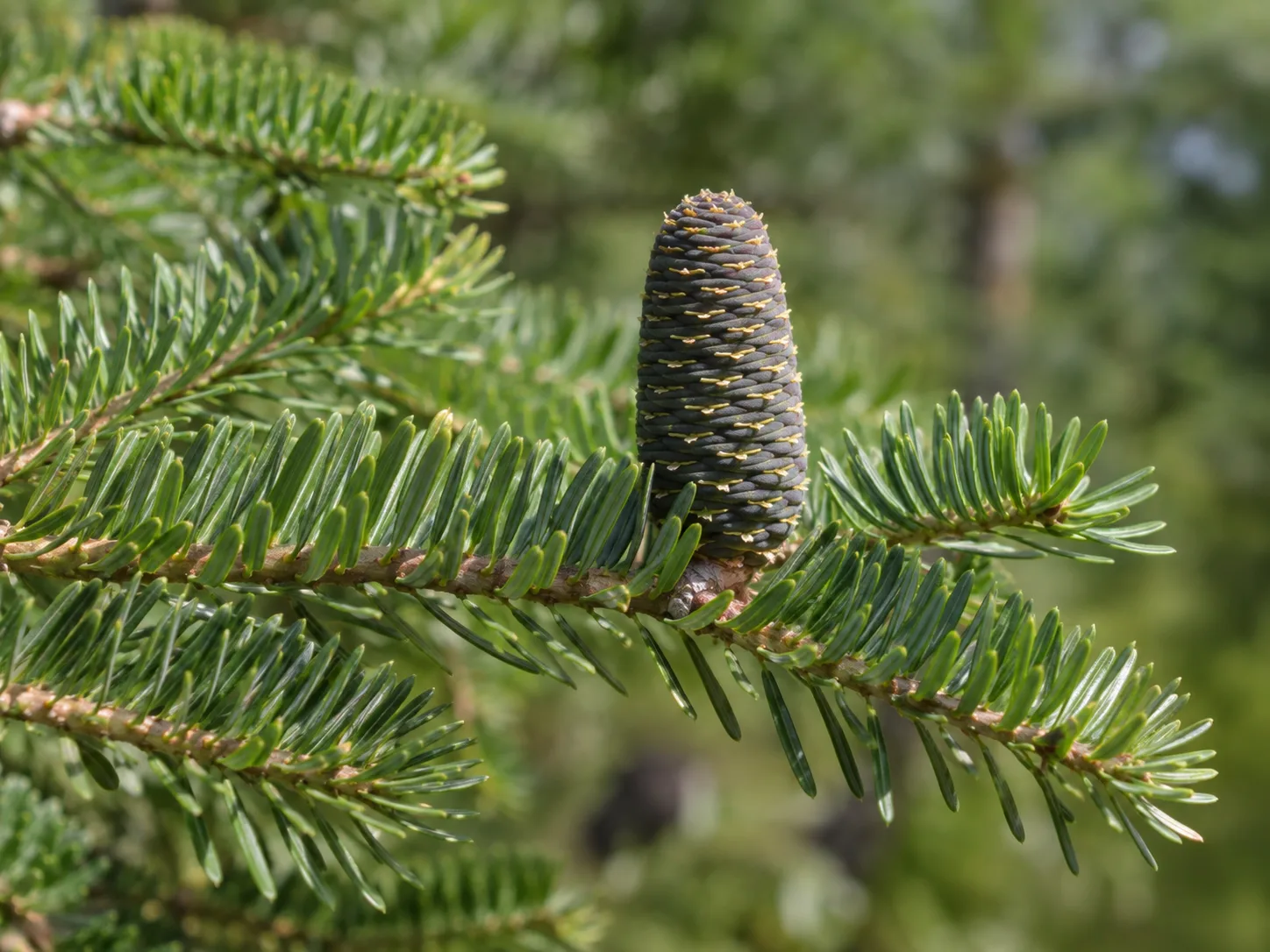
True fir identification can help you confirm what a nursery is selling. Fir needles attach singly and leave small, roundish scars on the twig; their seed cones point upward and break apart on the tree as the seeds mature. Spruce needles attach on small woody pegs and their cones hang down, while a Douglas-fir is in a different genus altogether. Use several traits together rather than squeezing needles: some firs feel softer than others, and some have sharper foliage. Virginia Tech’s Dendrology factsheet for Korean fir and Oregon State University’s grand fir profile illustrate the upright cones and flat needles typical of Abies.
12 fir trees for the landscape
This quick comparison separates the species by the conditions and scale they suit. Size ranges are approximate: wild trees can be much larger than landscape specimens, and cultivars may stay far smaller than the species.
| Fir | Landscape fit | Main caution |
|---|---|---|
| Balsam | Cold-climate specimen; dwarf forms for rock gardens | Heat, dry air, and urban stress |
| Fraser | Cool, moist garden or Christmas-tree planting | Hot summers, wet clay, and road salt |
| Grand | Large Pacific Northwest-style property | A very large eventual tree |
| Himalayan | Spacious, cool-climate specimen | Not a routine small-yard choice |
| Korean | Slow-growing focal point; cones on young trees | Standard form still becomes a medium tree |
| Noble | Large specimen or screen in its native western climate | Needs room and well-drained soil |
| Nordmann | Cool, moist landscape or living Christmas tree | Heat and drought |
| Red | High-elevation or cool western landscape | Does poorly with drought |
| Silver | Large temperate garden or park | Too large for tight spaces |
| Spanish | Collector’s specimen in a suitable, well-drained climate | Check regional summer performance |
| Subalpine | Cold, high-elevation or narrow planting | Hot, humid lowlands |
| White | Adaptable specimen for cooler inland landscapes | Avoid persistently wet, heavy soil |
Balsam Fir (Abies balsamea)
Balsam fir is a slender, fragrant evergreen for gardeners with cool summers and reliably moist—but not waterlogged—soil. It typically reaches about 50 to 60 feet tall and 20 to 30 feet wide, so the species is not a miniature tree even though it grows slowly. The University of Connecticut Plant Database profile notes that it dislikes heat and dry air and can perform poorly in landscape settings outside its preferred conditions.
Choose balsam when the local climate resembles its northern range and you have room for a long-term specimen. If you want its look in a small bed, ask for a named dwarf cultivar such as ‘Nana’ or ‘Hudsonia’; the UConn database describes these as small mounds around 2 feet tall. A standard balsam fir planted in a tiny foundation strip is not made compact by slow growth.
Fraser Fir (Abies fraseri)
Fraser fir is a strong choice for a cool, moist landscape where its tidy pyramidal shape, fragrant needles, and attractive branching can be seen year-round. NC State Extension’s Fraser fir profile describes a mature range of roughly 30 to 55 feet tall, with full sun to light shade and moist, well-drained, acidic loam. It is native to high elevations in the southern Appalachians, so heat and humidity can be harder on it than winter cold.
Do not plant it in compacted wet clay or beside a road where de-icing salt splashes onto the roots. In a suitable region it can be a specimen tree, a natural screen, or a living Christmas tree, but a cut Christmas tree is not a plantable one. For a living tree, buy a container-grown specimen with its root system intact and plant it only where the species is hardy.
Grand Fir (Abies grandis)
Grand fir is the choice for a large landscape, not for a small urban lot. Oregon State University’s profile lists it among the tallest firs, with a typical range around 100 to 250 feet in suitable conditions, and NC State Extension describes it as native to the Pacific Northwest and northern California. Its flat needles turn upward on upper branches and give off a citrus-like scent when crushed; mature cones stand upright.
This tree can suit spacious properties in a cool, moist western climate, especially where a tall evergreen canopy is wanted. But the name is a useful warning: give it room far from buildings, overhead lines, and narrow planting strips. It may tolerate a range of soil textures, yet good drainage is still important; “adaptable” does not mean it should be planted in a site that stays saturated.
Himalayan Fir (Abies spectabilis)
Himalayan fir is a tall, mountain-origin species for a cool garden with substantial room. Its long needles create a distinctive, slightly drooping look along the branches, but its appeal is more specialized than that of a compact landscape cultivar. Treat it as a specimen for a large, cool-climate property rather than a default fir for a warm lowland yard.
Before ordering, confirm the botanical name and the mature dimensions on the supplier’s label. Common names such as Himalayan fir can be used loosely, and a young tree gives little sense of its eventual scale. If your summers are hot or your site is dry, choose a species already proven by local nurseries instead of relying on the plant’s ability to tolerate a short period of stress.
Korean Fir (Abies koreana)
Korean fir is one of the more manageable standard species because it is slow-growing and usually stays smaller than the forest giants. Oregon State University describes a compact tree around 15 to 30 feet tall; its glossy needles show a pale underside, and it can produce violet-purple cones while still young. BBC Gardeners’ World recommends it as a focal point in a larger border rather than describing it as a tiny shrub.
For a modest yard, the species or a selected dwarf cultivar can be a better starting point than a grand or noble fir. Still, check the cultivar’s mature height and width: “slow-growing” means it takes longer to reach full size, not that it stops growing. Korean fir does best in a cool climate with suitable drainage and can tolerate somewhat more heat than many firs, but it is not a desert tree.
Noble Fir (Abies procera)
Noble fir is a handsome, tall western native with silvery blue-green needles and showy upright cones. NC State Extension’s profile gives a cultivated height of about 50 to 100 feet, with larger trees in the wild, and notes that it performs best in its Pacific Northwest native range. Its root system can make it wind-tolerant, but that does not remove the need to plan for its crown and nearby structures.
Use noble fir as a spacious-yard specimen, a windbreak component where local conditions suit it, or a long-lived tree in a cool western climate. Its layered branches also make it a popular cut Christmas tree, but the landscape decision is permanent: do not choose it only for holiday looks if your yard cannot accommodate a tall tree.
Nordmann Fir (Abies nordmanniana)
Nordmann fir, also called Caucasian fir, has dense dark-green foliage and a naturally symmetrical outline. BBC Gardeners’ World lists it as a large tree—about 45 meters tall in favorable conditions—and recommends full sun and rich, free-draining soil. It is also a popular Christmas tree because its needles tend to remain on the branches after cutting, but a nursery-grown landscape tree needs a much larger site than a living room tree suggests.
Consider it where summers are not persistently hot and dry and where the soil drains freely. If you are buying it as a living holiday tree, choose one grown in a container rather than a cut tree pushed into soil; after the holiday, keep it cool and move it outdoors according to local weather before planting. Epic Gardening’s live-tree guide also emphasizes matching a plantable Christmas tree to the climate where it will be planted.
Red Fir (Abies magnifica)
Red fir, sometimes called California red or Shasta fir, is a western mountain tree with blue-green needles and bark that becomes reddish-brown with age. It is a better candidate for cool, higher-elevation western gardens than for a hot, dry lowland landscape. Although it can tolerate frost, it does not handle prolonged drought well.
Give it a spacious site with good drainage and a dependable water source while it establishes. The Gardening Know How species overview describes the California red fir’s narrow crown, upward-curving blue-green needles, and orange-red mature bark; its full size makes that ornamental detail most practical on a large property. Confirm that the nursery is selling Abies magnifica: common names overlap among firs, and “red fir” is also used for other species. Choose it for the regional climate and its mature form, not only for needle color.
Silver Fir (Abies alba)
Silver fir is a large European evergreen, valued for its upright cones and dark needles with pale bands underneath. Harvest to Table’s Abies guide gives European silver fir a mature range of roughly 80 to 150 feet tall and 12 to 20 feet wide. In a landscape it suits a temperate, moist climate and a generous site where a tall tree can develop without competing with buildings or neighboring plants. It is not a quick screen for a small yard, and its eventual size is easy to underestimate while it is young.
Ask local growers whether it performs well through your area’s summer heat and winter pattern before planting. A tree’s native region can help explain its preferences, but it cannot replace local experience: soil, exposure, and cultivar selection alter results. If the only available spot is hot, compacted, or waterlogged, choose a better-matched evergreen.
Spanish Fir (Abies pinsapo)
Spanish fir, also called hedgehog fir, stands out for its short, stiff needles that radiate around the shoot rather than forming the neat two-sided rows many people expect. The species is native to southern Spain and northern Morocco and is most sensible as a specialty specimen where summers, winter lows, and drainage suit the source population. It is not automatically an easy choice just because it comes from a Mediterranean region.
A well-drained site matters; do not confuse a tree adapted to a seasonal dry period with one that tolerates a waterlogged root zone. Some forms are valued for blue-toned foliage, but cultivar sizes and hardiness can differ, so read the plant label carefully. If you are outside a region where local nurseries grow Spanish fir successfully, consider a better-tested species.
Subalpine Fir (Abies lasiocarpa)
Subalpine fir is a narrow, slow-growing evergreen from western North American mountain forests. Its compact outline can work in a cold-climate garden or as an accent where a broad canopy would take too much space, but it is still a tree and eventually needs vertical clearance. The species is most at home where summers are cool and roots stay evenly moist without sitting in water.
It is a poor bet for hot, humid lowlands, even if the winter hardiness number looks favorable. High-elevation species can struggle with summer heat and nighttime warmth that a hardiness-zone label does not capture. If you garden in a cooler mountain region, ask a local nursery which seed source or cultivar has performed well nearby.
White Fir (Abies concolor)
White fir is often the most forgiving starting point for an inland garden because it is more tolerant of heat and dry spells than many firs. The University of Wisconsin–Madison Extension profile describes it as fairly slow-growing and drought-resistant once established, with a typical landscape size around 30 to 70 feet tall and 15 to 30 feet wide. Its soft, blue-green needles and citrus scent when crushed make it easy to recognize.
The trade-off is that it still needs a site with good drainage. The UW Extension and Purdue Arboretum’s fir collection both caution against wet or heavy soils, and young trees need regular watering while roots spread into surrounding ground. Choose white fir if you want a relatively adaptable specimen and have room for its adult form; do not read “drought-resistant” as permission to skip establishment care.
How to choose for your climate and yard
Use this order when narrowing the list. First, eliminate trees that conflict with your summer climate: balsam, Fraser, and subalpine firs are better fits for cool regions, while white fir is comparatively adaptable for inland conditions. Next, rule out any species whose eventual form is too large. A Korean fir may suit a smaller property, but a dwarf cultivar is the safer choice when the space is truly limited.
Then check drainage and water access. Most firs prefer moist soil that drains, not a low spot that holds water. Fraser fir is especially vulnerable to poorly drained soil, while white fir tolerates dry spells better after establishment; neither distinction makes a soaked root zone acceptable. A hose or drip line that can reach the root area for the first growing seasons is useful even if your area usually gets regular rainfall.
Finally, buy by botanical name and cultivar, not by a loose common name or a photo of a small nursery specimen. Ask the grower how wide the plant becomes, whether it is a standard species or a dwarf selection, and whether it has survived summers in your county. If two sources give different mature sizes or zones, use the more conservative size estimate and trust local trial experience over a single catalog number.
Planting and establishment
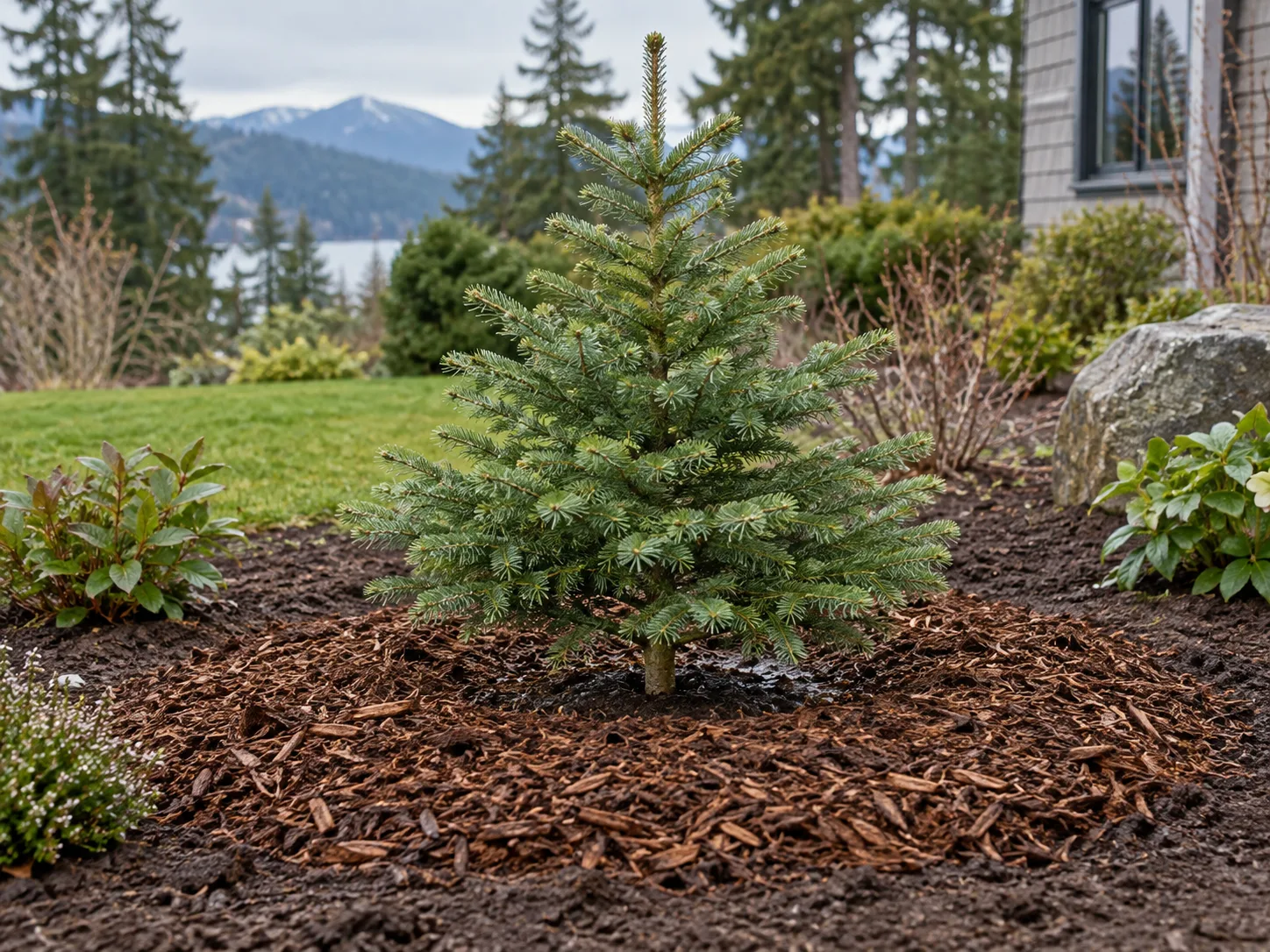
Plant in a cool period when the ground is workable—often early spring or fall, depending on the region—so roots can begin growing before severe summer heat or frozen soil. Choose a final site first; firs do not respond well to repeated moving once established. For a container-grown tree, inspect the root ball for circling roots and loosen them gently before planting rather than burying a tight coil intact.
Dig a hole no deeper than the root ball and wider than it; Better Homes & Gardens’ Fraser fir planting guide recommends a hole about twice the root ball’s width. Set the root flare at the surrounding soil level, backfill with the excavated soil, and water slowly until the entire root ball and nearby soil are moist. Do not improve a poorly drained site by filling the hole with loose compost—the surrounding soil still controls where water goes, so choose a different location if it stays wet.
Add a shallow layer of organic mulch over the root zone to slow moisture loss and moderate soil temperature, but keep it away from the trunk. Water deeply during dry weather in the first one or two growing seasons, adjusting for rainfall and soil texture rather than following a rigid calendar. Check the root ball itself before watering: water can run off a dry, tightly packed root ball even while nearby soil looks damp, while heavy soil can stay saturated long after rain. Once a fir is established, many species need little pruning or fertilizer; remove dead or broken branches and avoid shearing the natural pyramidal shape unless a cultivar’s label calls for a specific form.
What to expect from a fir outdoors
A fir is usually a long-term landscape decision, not a temporary decoration. Trees need years to develop their full shape, and the gap between the plant you carry home and the mature canopy is exactly why spacing matters. Korean fir and named dwarf forms can offer a more compact outline, while grand, noble, Nordmann, and silver firs may become large trees that dominate the view. Give branches room for air and access for future maintenance; a tree crowded between a fence, roof, and neighboring canopy is difficult to prune without spoiling its natural shape.

Firs also support seasonal interest beyond winter greenery: new growth, upright cones, fragrance, and shelter for birds or other wildlife vary by species. If you want a living Christmas tree, purchase one already grown with roots in a container, keep it cool while it waits to be planted, and select a species suited to the outdoor site. A cut tree will not root simply because its trunk is placed in soil.
Conclusion
The easiest fir to grow is the one that matches your summers, soil, and available space. White fir is a practical starting point for many cooler inland gardens; Korean fir offers a slower, smaller standard form; Fraser and balsam firs make more sense where summers stay cool and roots remain evenly moist. For every tree, check the cultivar’s adult dimensions and local performance before planting, then give it good drainage, room to grow, and consistent water while it establishes.