Why Are My Tomato Leaves Turning Purple? Causes and Fixes
Find out why tomato leaves turn purple, how cold soil and low phosphorus differ from virus symptoms, and what to check before feeding your plants.
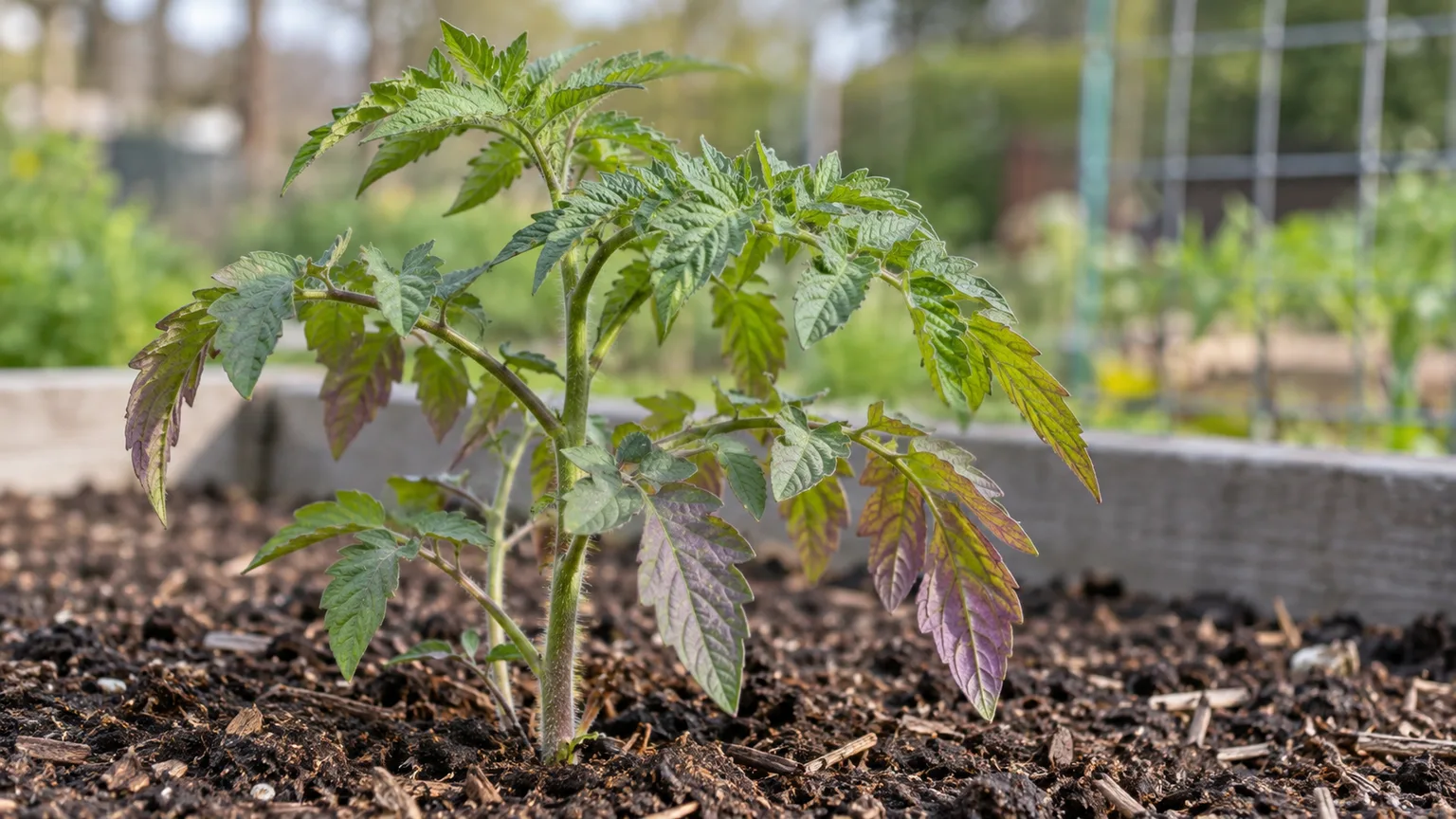
Purple leaves on a tomato plant are a clue, not a diagnosis. In young plants, the most common explanation is that cool roots are temporarily limiting phosphorus uptake; the soil may contain phosphorus even though the seedling cannot use it efficiently. But curled, stiff, stunted growth, unusual spots, or tiny jumping insects change the picture, so check the pattern before adding fertilizer.
Look at the underside of the leaves, compare new growth with older leaves, and recall the weather since transplanting. Those three observations usually tell you whether to give the plant time to establish, test the soil, inspect for pests, or get a disease diagnosis.
What purple tomato leaves look like
A phosphorus-related pattern often begins as reddish-purple color along leaf veins or across the undersides, then becomes more noticeable on the upper surface if the stress continues. It is especially common on stressed transplants and seedlings, and it may appear with slow growth. University of Maryland Extension describes purple undersides and stems on young transplants that commonly recover as roots establish in the garden (University of Maryland Extension).
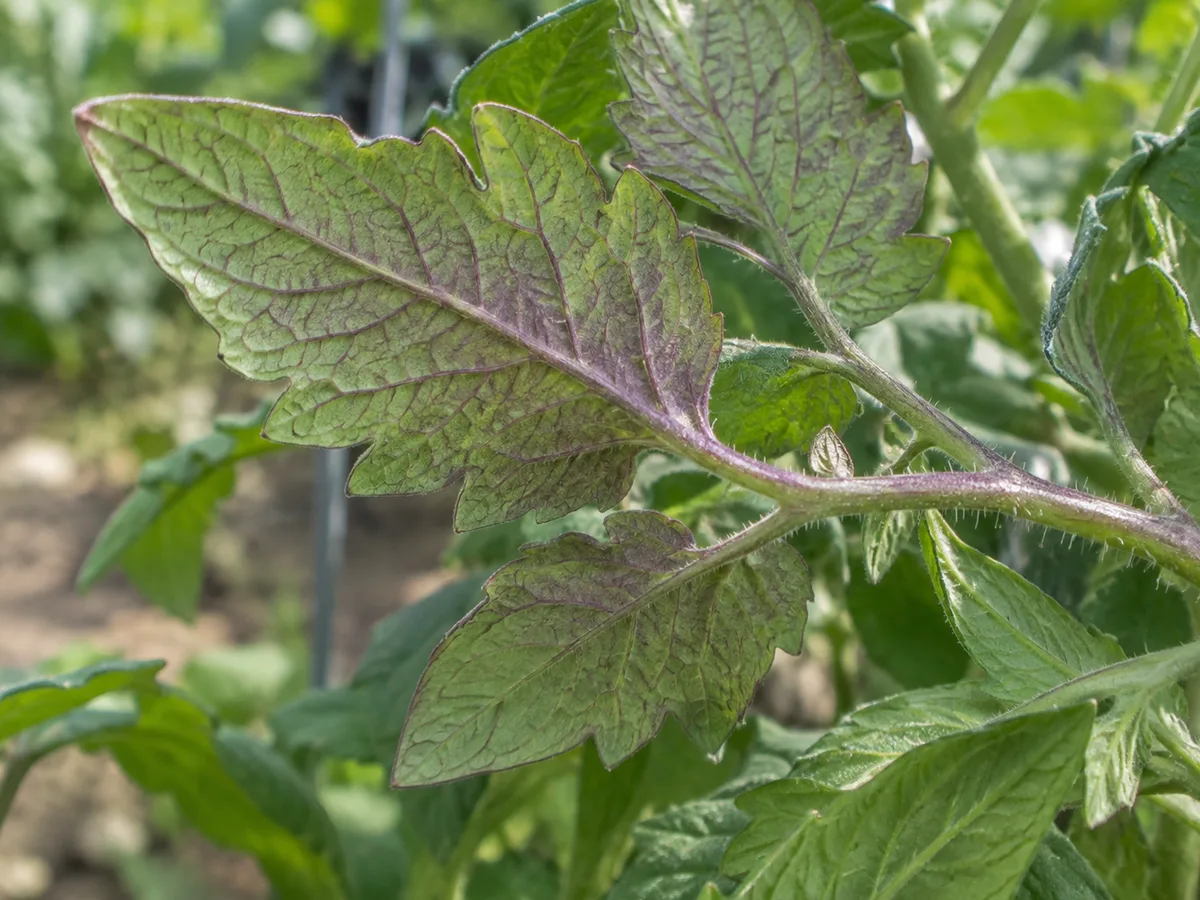
Purple color concentrated on veins and leaf undersides can accompany temporary phosphorus uptake stress, particularly on young plants.
Color alone is not enough. A plant that has a slight purple cast but is making normal new leaves, holding its shape, and growing steadily is less concerning than one whose newest growth is distorted, whose whole plant is declining, or whose fruit is ripening strangely. Some cold-stressed seedlings green up as conditions improve; older colored leaves may not change quickly, so judge recovery by the next leaves the plant produces.
Start with location, age, and timing
Note whether the color is mainly on the undersides, follows the veins, appears on the leaf edges, or forms separate spots. Then note where it started: young transplants and lower leaf undersides after a chilly week suggest a different problem from sudden purple streaks on stems and newly distorted top growth in midsummer.
Compare affected plants with others of the same variety and age. If every plant in a cold raised bed shows similar purpling, the shared root-zone conditions are a stronger lead than a contagious disease. If one plant is deteriorating while its neighbors are normal, photograph it and inspect the pattern closely; viruses, root injury, localized waterlogging, and chemical drift can affect a single plant.
Read the symptoms that travel with the color
Purple undersides with otherwise ordinary leaf shape and a recent cold snap point toward a temporary nutrient-uptake problem. Purple leaves paired with short, slow growth can also reflect phosphorus shortage, root stress, or pH that limits availability; it still does not identify which one without checking conditions.
A different pattern deserves more attention. Rigid, thickened leaves that roll upward, yellowing or bronzing, a stalled growing tip, dark stem streaks, or fruit that colors prematurely can indicate virus or other serious stress. Tiny round pits or irregular holes on tender seedlings suggest feeding damage. Brown, crisp leaf margins that begin on older foliage fit potassium-related symptoms better than a uniform purple underside. Keep a simple note of what changed and when; a photograph taken from the same angle every few days is often more informative than memory.
The common culprit is poor phosphorus uptake
Phosphorus supports energy transfer, root growth, and normal development. Tomato roots can have trouble taking it up when the root zone is cold, and plants may show purpling even when the soil contains a usable amount. Texas A&M AgriLife Extension identifies leaf-vein purpling and loss of vigor with phosphorus deficiency, noting that cold soil is a frequent cause and that improper fertility is more likely in pot culture or some sandy soils (Texas A&M AgriLife Extension).
That distinction matters: a nutrient can be present but temporarily unavailable to roots. Adding a large dose does not warm the soil, repair damaged roots, or fix waterlogged conditions. It can leave the plant with the original stress plus unnecessary fertilizer salts or an imbalanced soil. Start with growing conditions; only correct a measured nutrient shortfall.
Cold roots can make available phosphorus hard to use
Soil temperature matters more than the afternoon air temperature. A sunny day can warm leaves while the root zone remains cold, especially in a deep pot, a shaded bed, or heavy wet soil. Georgia Cooperative Extension explains that phosphorus becomes less available to tomatoes when soil is below about 60°F, and also links purple foliage to phosphorus stress (University of Georgia Cooperative Extension). Arkansas Extension gives a similar soil-temperature threshold for normal phosphorus uptake (University of Arkansas System Division of Agriculture).
If seedlings turned purple just after moving outside, check the recent nights and the soil rather than reacting to the first colored leaf. Wait until frost risk has passed and the bed has warmed before planting tender transplants; local conditions and the cultivar matter more than a fixed calendar date. In a pot, move the container to a brighter, sheltered location during cold spells, but do not bring a large outdoor plant into a dim room for days. A breathable row cover can reduce overnight chill; remove or vent it when daytime temperatures rise so plants do not overheat.
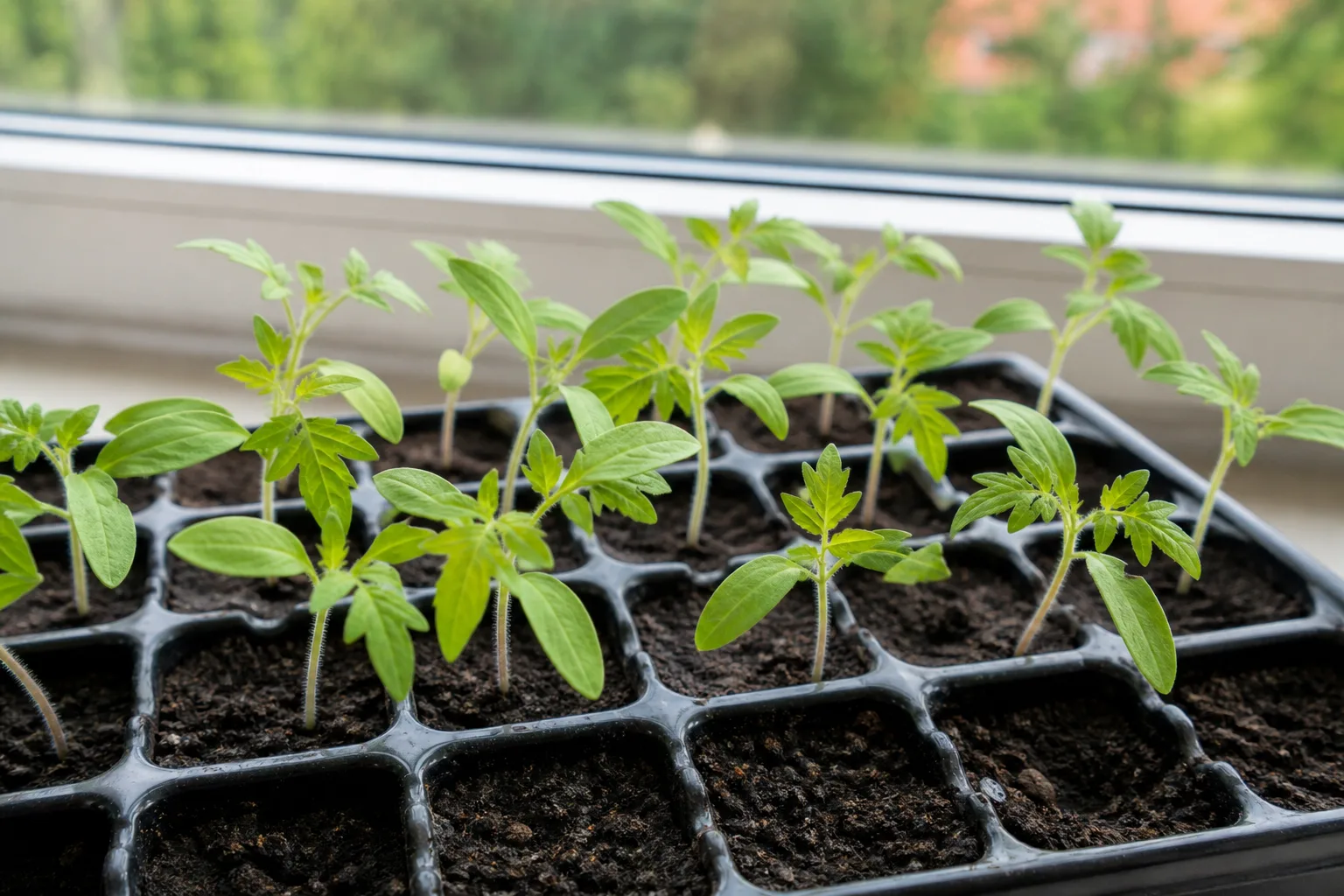
Seedlings are especially likely to show temporary purpling when their small root systems meet cold conditions after transplanting.
Once the soil warms and roots begin growing into surrounding soil, new leaves should look greener and growth should resume. Give the plant several days to a couple of weeks of suitable conditions rather than expecting a dramatic overnight color change. If the plant remains stunted or the purple color spreads despite warm, well-drained soil, move on to a soil and root check.
Wet soil, damaged roots, and pH can keep nutrients out of reach
Cold is not the only root-zone stress. Soil that stays saturated has little air for roots; a compacted potting mix, a container without drainage holes, or frequent watering before the root zone dries can weaken root function. A recently transplanted tomato can also struggle if roots were badly disturbed, bent into a small planting hole, or left exposed during a hot, windy move.
Check moisture a few inches below the surface instead of judging only by the dry crust on top. The root zone should stay evenly moist, not swampy; correct drainage and watering first if it is soggy. For containers, use a light, well-draining potting mix rather than dense garden soil. University of Maryland Extension notes that container roots have a limited volume for water and nutrients and depend on a suitable growing medium (University of Maryland Extension on container vegetables).
Soil pH can also affect phosphorus availability. If the bed has not been tested in several years, or if repeated feeding has failed to help, request a lab test for pH and phosphorus rather than adding lime or a high-phosphorus amendment by guesswork. A soil test measures available nutrients and provides a locally calibrated recommendation; in-ground soil tests generally do not apply to soilless potting mixes, which need different interpretation (University of Minnesota Extension on soil testing; University of Maryland Extension Ask an Expert).
Why potassium is not the automatic answer
Advice about the nutrient behind purple tomato leaves is not perfectly consistent across references. The Missouri Botanical Garden’s tomato foliage guide attributes cold-soil purpling to poor potassium uptake, while University of Maryland, Texas A&M, and Georgia Extension describe purple veins or undersides as a phosphorus pattern (Missouri Botanical Garden). That variation is a reason to avoid diagnosing from color alone, especially because cold stress can interfere with root uptake and the visible symptom is shared.
Look for the rest of the pattern. Potassium shortage more often causes older leaves to develop yellowing and brown, dry margins that progress inward; it can also affect fruit color and ripening. Epic Gardening’s tomato deficiency guide describes this marginal scorch pattern, while phosphorus stress is associated with stunted growth and purple-tinged stems or leaves (Epic Gardening). If your plant has only purple undersides and no edge scorch, do not assume it needs a potassium-heavy tomato fertilizer.
The safest response is to separate symptom from cause. Use the seed packet or plant label to confirm the variety, review recent temperatures, inspect roots and drainage, and use a soil test if the plant is not recovering. If a laboratory recommends potassium, apply the recommended material and rate; if it recommends phosphorus, follow that rate instead. Avoid doubling up on “bloom booster,” bone meal, wood ash, or multiple all-purpose feeds just because the leaf color looks unusual.
Could the purple be normal pigmentation?
Some tomatoes are bred for dark or purple fruit because they produce anthocyanin pigments. Oregon State University’s tomato growing guide describes ‘Indigo Rose’ as a high-anthocyanin fruit variety, but fruit color by itself does not establish that purple foliage is normal for every plant in that seed line (Oregon State University Extension). Cultivars can differ, and pigmentation may be stronger under bright light or cool conditions, so compare the leaves with the variety description and with healthy plants of the same cultivar.
Natural coloring is more plausible when the plant is vigorous, leaves retain their usual shape, and the color is consistent rather than spreading with yellowing, necrosis, or a collapsing growing point. Check whether the seed packet or supplier specifically describes colored foliage; “purple tomato” usually describes the fruit, not necessarily the leaves. If the foliage changed suddenly after transplanting, weather and roots remain more useful first clues than the fruit’s eventual color.
When purple leaves point toward virus
Viruses are less likely than cold-root stress when young plants show only a mild purple underside, but a purple vein is not a virus test. Look for symptoms that progress through the growing point, affect the plant’s shape, or appear on fruit. Insect vectors and the local disease history matter: a virus reported often in a western dry region may be uncommon in a humid northern garden, and vice versa.
Do not spray for a virus. Insecticides may reduce some vectors if used correctly, but they cannot cure a plant that is already infected. When multiple symptoms point to a virus, contact your local Cooperative Extension office or plant diagnostic clinic before destroying valuable plants; a clear phone photo of the whole plant, leaf underside, stem, and fruit can help them triage the case.
Curly top makes new growth stiff, curled, and stunted
Beet curly top virus can cause a tomato to become stunted, yellow or bronze, and stiff, with purple-tinged leaves; green fruit may ripen early. UC Integrated Pest Management identifies beet leafhoppers as the vector and notes that affected plants often decline rather than recover (UC IPM). Utah State University Extension describes the characteristic upward leaf roll, thick or crisp leaves, and purple veins (Utah State University Extension).
That combination is more concerning than purple color by itself. If you see a compact, yellowing plant with brittle or rolled new leaves and premature fruit color, isolate the plant from handling where practical, photograph it, and ask an extension diagnostician. Curly top has strong regional patterns; the absence of visible leafhoppers does not prove the plant is virus-free, and seeing a leafhopper does not prove infection. If local guidance confirms a likely systemic virus, remove and discard the plant according to that guidance rather than putting it in the compost pile.
Spotted wilt brings spots, streaks, and fruit symptoms
Tomato spotted wilt virus can cause dark spots or streaks on stems and leaf stalks, damage near the growing tip, and mottled yellow or light-green rings on fruit. University of Maryland Extension notes that the disease is spread mainly by western flower thrips and can be severe in greenhouse or high-tunnel crops (University of Maryland Extension on tomato spotted wilt). These symptoms differ from a few evenly purple leaf undersides on a recently chilled transplant.
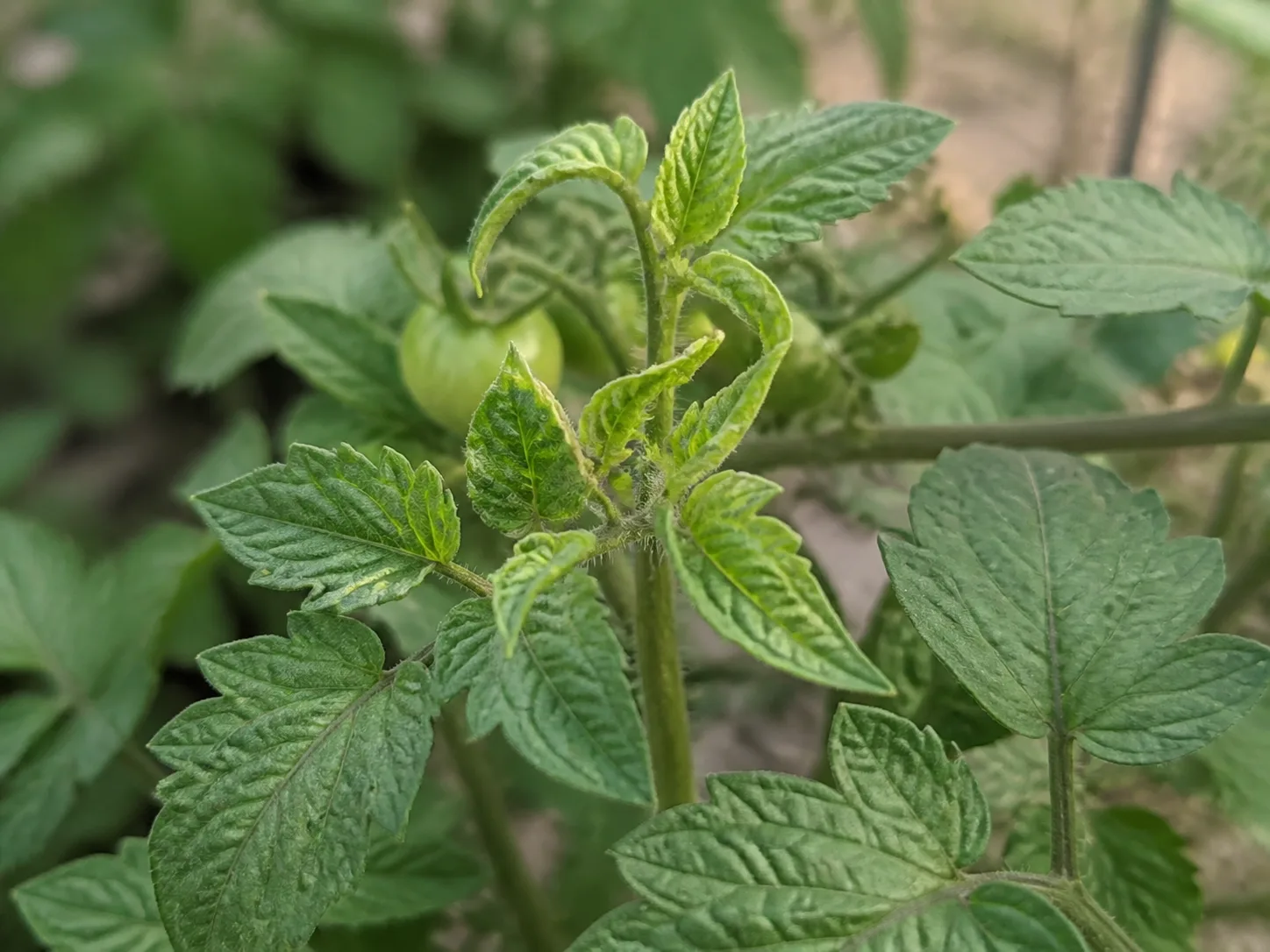
Leaf distortion alongside purpling deserves a closer look; curling alone has several causes, so check the whole plant and fruit before concluding that a virus is present.
Purple spots can also be mistaken for disease when leaf tissue is damaged by weather, nutrient stress, or feeding. Small, discrete lesions with yellow halos, expanding dead patches, or rapid spread from plant to plant warrant diagnosis rather than a fertilizer experiment. Avoid moving pruning tools from a suspicious plant to healthy tomatoes until you have cleaned them, and follow regional extension advice for sanitation and vector management.
What springtails and other insects can explain
Some springtails are purple or bluish and jump when disturbed, but seeing a tiny purple insect does not explain purple leaves. Most springtails feed on fungi, algae, and decaying material; some species can injure tender seedlings in large numbers, leaving minute pits or irregular holes rather than turning healthy leaf tissue uniformly purple. UC IPM notes that established plants are usually not significantly injured, while the University of Connecticut describes occasional pitting on young seedlings and recommends reducing excess moisture rather than reflexively spraying (UC IPM on springtails; UConn Extension).
Look for actual feeding marks before treating. If a very young seedling has pitted leaves and abundant springtails, keep the medium from staying constantly wet, remove decaying debris, and improve airflow. Diatomaceous earth is not a good first response: it can affect beneficial arthropods, loses effectiveness when wet, and does not fix the wet conditions supporting the population. If you see tiny insects but no pits, holes, or plant decline, monitor rather than trying to eliminate every soil organism.
Other pests can cause curling or stippling, but they do not usually produce a simple purple underside pattern. Check the lower leaf surfaces with a hand lens for aphids, thrips, or mites, and look for the injury those pests leave. If insects are present but symptoms are not clearly linked to feeding, avoid a broad pesticide application on an edible crop until you have identified both the pest and an appropriate labeled product.
A practical 10-minute tomato triage
Start with a photograph of the whole plant, then take a close-up of the top and underside of one affected leaf. Record whether the newest growth is normal, whether the purple follows veins or leaf edges, and whether other plants of the same variety have the same pattern. This baseline makes it easier to tell whether the condition is stable or progressing.
Next, check the weather and the root zone. Ask whether the plant was recently transplanted, exposed to nights below its usual growing range, or sitting in cold wet soil. Touch the soil several inches down; if it is soggy, check drainage and reduce irrigation frequency. If the plant is in a container, make sure water can escape through open drainage holes and that the mix is not compacted.
Then inspect both sides of leaves and the stem. Tiny pits suggest seedling feeding; fine stippling or webbing points elsewhere; twisted, thick, brittle new leaves with whole-plant stunting raise a virus or herbicide concern. Look for yellowing, dead spots, fruit rings, or premature ripening. Do not prune or spray based only on color: those steps can remove useful foliage or create new stress without treating the cause.
Finally, compare the plant with its own recent growth. If temperatures are warming and the plant is making normal new leaves, monitor. If symptoms keep worsening, or if you are considering nutrient amendments, get a soil test or local diagnostic opinion. The sequence is deliberate: observe, check environment, inspect for injury, and only then choose a treatment.
Test before you fertilize
If purpling persists after the root zone warms, or the plant remains stunted, use a soil test to check pH and available phosphorus and potassium. For an in-ground bed, sample several spots in the root zone, mix the samples as the testing lab instructs, and request recommendations for a vegetable garden or tomatoes. Do not send a sample that includes fertilizer granules or compost clumps; that can skew the result.
A test also helps prevent a common mistake: adding phosphorus to soil that already contains enough. Minnesota Extension explains that repeated phosphorus additions can contribute to water-quality problems and that excess fertilizer can cost money without helping the crop (University of Minnesota Extension). The right product is the one that addresses the lab’s recommendation, not the one with the largest number on the bag.
Container tomatoes need a slightly different approach because potting mix is not the same as mineral garden soil and a garden-bed soil test may not interpret it accurately. Check the mix’s age, drainage, and the fertilizer label; follow a regular container-vegetable feeding schedule only if the mix and plant’s growth stage call for it. If the plant is in a small pot or old depleted mix, root crowding or exhausted medium may be more relevant than a garden-bed deficiency. Repotting into a larger, well-drained container with fresh mix can be more sensible than layering amendments into a stressed root ball.
Correct the cause and track new growth
For a recent cold snap, protect the plant from additional chill and let the soil warm. Do not keep it waterlogged to “help” the roots; water when the root zone needs it and maintain drainage. A light organic mulch can buffer temperature swings after the soil has warmed, but piling wet mulch against the stem can keep the crown cold and damp.
If a lab confirms low phosphorus or potassium, apply the named nutrient at the recommended rate and timing. Avoid trying to fix a deficiency with a concentrated foliar spray unless the label and local advice support that use; leaves can burn, and foliar feeding does not address damaged or cold roots. Do not combine several fertilizers to speed the response. More is not faster when roots cannot absorb nutrients normally.
If soil pH is outside the tomato range, amend only according to the test recommendation and understand that pH correction may take time. Lime and sulfur are not instant rescue treatments, and overcorrecting pH can make other nutrients less available. If standing water or compaction is the problem, improve drainage or use a more suitable container before feeding. New, healthy growth is the best recovery signal; the purple leaves that formed during stress may remain marked even after the cause is corrected.
Set a follow-up date about a week later. Compare the same leaves and the growing tip with your baseline photo, note whether the plant is producing new leaves, and confirm that the soil is warming and draining. A plant that resumes steady growth but retains some older purple color is usually a better sign than a plant that turns completely green while the top continues to stall or distort.
When to ask for a local diagnosis
Ask a local Extension office or plant clinic when the plant is rapidly declining, more than one symptom is present, the top growth is twisted or brittle, fruit shows rings or premature ripening, or the same issue is appearing on neighboring crops. Include the cultivar name, planting date, recent low temperatures, watering history, fertilizer products and dates, and clear photographs of the whole plant, leaf undersides, stems, and fruit. If you suspect spray drift, note what was applied nearby and when; herbicide injury can resemble a virus or nutrient problem.
Do not pull every purple-leaved tomato in a bed. A single mildly purple seedling after cold weather may recover, while a plant with progressive distortion and a stunted growing tip may need prompt attention. An extension diagnostician can weigh local disease pressure and, where available, recommend testing. This is particularly useful when removing a plant would cost you a season’s harvest or when a contagious disease could threaten a greenhouse or high tunnel.
Conclusion
A tomato’s purple leaves do not automatically mean it needs potassium, phosphorus, or a disease spray. On a young plant, cool soil and slow root establishment are common reasons phosphorus uptake falters; persistent purpling can also reflect pH, root health, true nutrient shortage, cultivar traits, or a less common virus.
Read the color together with leaf age, underside pattern, growth, weather, and fruit. Warm and stabilize the root zone when cold is the likely trigger, inspect for distortion and feeding marks, and test soil before adding nutrients. If new growth keeps worsening or virus-like symptoms appear, get a local diagnosis. That order gives the plant a chance to recover while protecting it from unnecessary fertilizer and pesticide.