How to Grow and Care for Fan Flower (Scaevola)
Learn how to grow fan flower (Scaevola) in sun, containers, and beds. Get clear advice on watering, pruning, fertilizer, pests, cuttings, and overwintering.
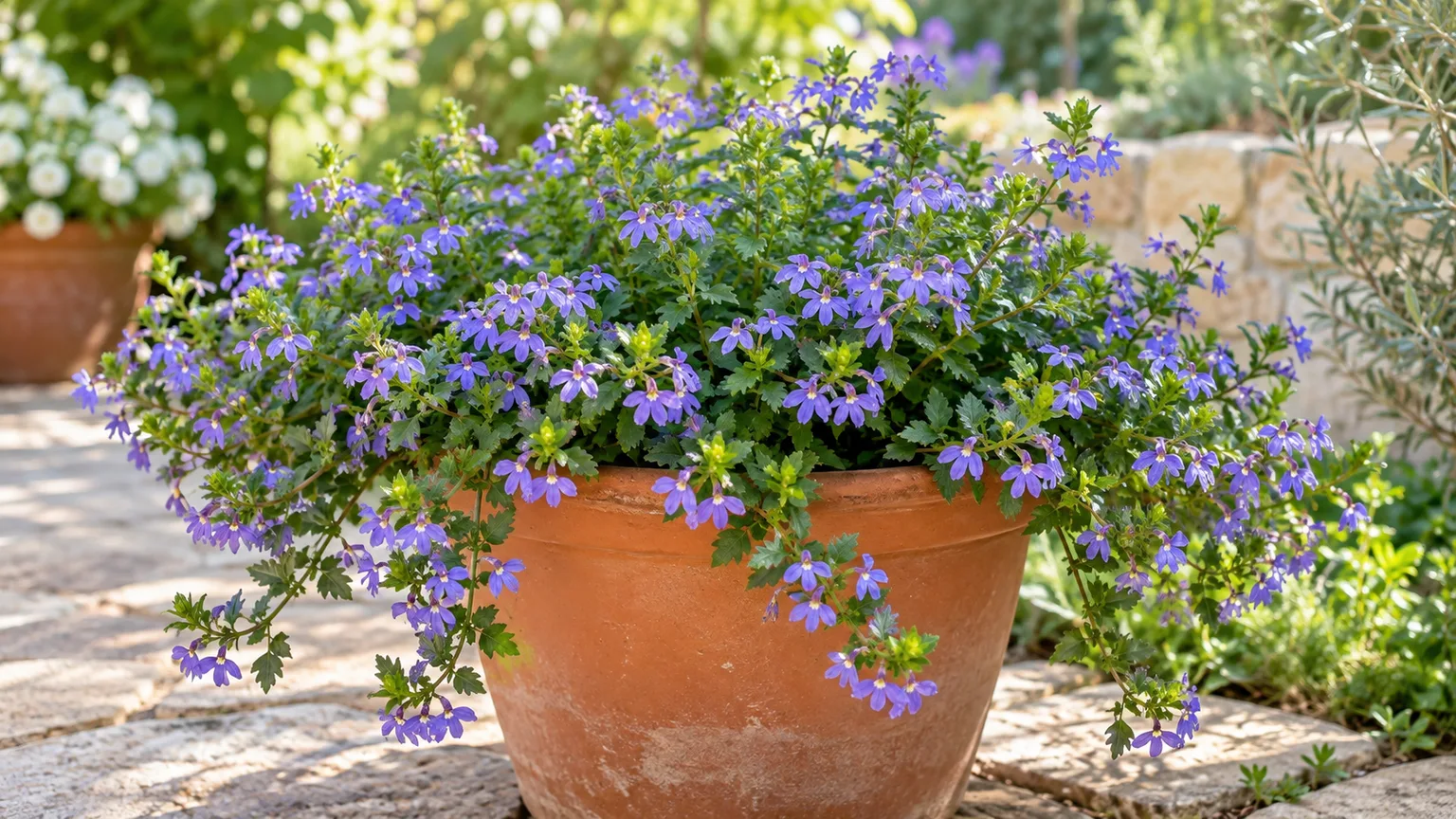
Fan flower (Scaevola aemula) is a heat-loving, trailing plant that produces a steady run of blue, violet, pink, or white flowers through warm weather. It can be forgiving in summer, but its toughness has limits: soggy roots, repeated drying in a small pot, and frost can stop a healthy plant quickly. Give it sun, free-draining soil, and moisture that matches its setting, and it works as a spiller in a basket, a colorful edge along a bed, or a low plant over a wall.
In USDA Zones 10 and 11, fan flower can grow as a tender perennial. In colder climates, gardeners usually treat it as a warm-season annual or take a few cuttings before frost. The details below focus on the commonly sold fairy fan flower, Scaevola aemula; check a plant tag if a nursery label uses only “Scaevola,” since related species and cultivars can differ.
Fan flower care at a glance
| Care factor | Practical target |
|---|---|
| Light | Full sun for the strongest bloom; partial shade can help in very hot locations |
| Soil | Average, loose, well-drained soil or free-draining container mix |
| Water | Keep new plants and container root balls evenly moist, not waterlogged |
| Temperature | Plant outdoors after frost danger has passed and soil has warmed |
| Feeding | Light, label-directed feeding during active container growth; avoid excessive fertilizer |
| Pruning | No deadheading needed; pinch or trim only to shape or shorten leggy stems |
| Winter | Perennial only in warm climates; bring a pot or rooted cuttings indoors before frost |
This table is a starting point, not a watering or feeding calendar. A hanging basket in hot wind can dry in a day, while an in-ground plant in cooler weather may need no extra water after rain. Test the soil and consider the plant’s growth before changing its care.
What fan flower looks like and where it fits
Scaevola aemula is a low, spreading herbaceous perennial from Australia. Its flowers have five petals arranged along one side, like a small fan or half-moon; the foliage is green, slightly toothed, and carried on stems that spread or trail. The familiar blue-purple form is common, but cultivated varieties also flower in pink and white. The species is described by NC State Extension as a heat- and drought-tolerant plant with summer-to-frost bloom and a spreading habit.
Most garden plants are compact or trailing hybrids, often roughly 8 to 14 inches tall and 18 to 24 inches wide, though vigorous selections can spill several feet from a basket. That range is why the plant tag matters: “fan flower” does not guarantee that every plant will fit a narrow trough or behave as a tight groundcover. Choose a mounding selection for a small pot and a vigorous trailing cultivar for a wall, basket, or broad container edge.
It is also easy to confuse the plant with lobelia or other small blue flowers from a distance. Look closely at an individual Scaevola bloom: its petals form a one-sided fan rather than a symmetrical star or a full, round corolla. That distinctive shape, together with the trailing stems, helps identify the plant even when a cultivar has pink or white flowers.
Light: sun for flowers, shade for hot afternoons
Fan flower flowers most freely with at least six hours of direct sun, and many plants perform well with six to eight hours. Give it a bright spot if you want a compact mound and abundant blooms. The Clemson Cooperative Extension fact sheet recommends full sun to part shade, which reflects a useful adjustment: in an extremely hot inland climate, protection from the harshest afternoon sun can reduce stress without putting the plant into deep shade.
If a plant receives only a few hours of weak morning light, it may grow long, sparse stems and produce fewer flowers. Before fertilizing a plant that has stopped blooming, check its actual sun exposure across the day; a patio that looks bright may be shaded for most of the afternoon by a roof, tree, or neighboring building. Move a container gradually to a brighter place over several days if it has been growing in shade, since an abrupt change can scorch leaves.
Soil: drainage is the nonnegotiable
Scaevola tolerates a range of soil types and pH, but it does not thrive with roots sitting in water. Use loose garden soil that drains after rain. If the bed stays saturated or the clay is compacted, plant on a raised edge or in a raised bed rather than trying to solve the problem by putting a small pocket of potting mix in the ground. The pocket can behave like a basin, holding water around the root ball.
For a container, use a fresh, general-purpose potting mix and a pot with open drainage holes. There is no need to add a layer of gravel at the bottom; it does not substitute for drainage holes or a suitable mix. Avoid dense soil scooped from the garden, which can compact in a pot and leave less air around roots. A balanced mix that holds some moisture but releases excess water is a better fit than either waterlogged compost or a gritty mix that dries within hours.
The advice to keep fan flower on the dry side can be misread as “let it go bone-dry.” It is more accurate to think “moisture with oxygen”: water should reach the root ball, then surplus should drain away. A plant can tolerate brief dry spells after establishment, but persistent saturation is a greater root-rot risk than a slightly dry surface.
Water: keep roots evenly moist, not soaked
Watering needs depend on where the plant is growing. A newly planted fan flower has a small root system and needs consistent moisture while it expands into surrounding soil. A mature in-ground plant can tolerate some drying between waterings; a basket or window box loses water quickly and may need attention more often, especially in heat, wind, or direct sun. Both Clemson Extension and horticulture editors at Garden Design emphasize even moisture with well-drained soil and careful establishment.
Use a finger or wooden skewer to check the mix below the surface. If the top inch is dry and the pot feels light, water slowly until water runs from the drainage holes; empty a saucer so the roots are not left standing in it. In a garden bed, water at the base of the plant long enough to moisten the original root ball, not just the surrounding soil. Recheck in hot weather rather than relying on a fixed number of days.
If a plant wilts, inspect the soil before deciding what it needs. Dry, crumbly soil points toward thirst; cool, wet soil suggests the roots may be short of air or damaged. A plant that droops during the hottest part of a summer afternoon but recovers by morning may be heat-stressed rather than truly dry. Watering soggy soil again makes the more serious problem worse.
Temperature, humidity, and hardiness
Fan flower likes warm weather and can continue flowering through summer heat, but it is not frost-hardy. Plant it outside only after frost danger has passed and the soil has warmed. Clemson Extension recommends waiting for soil near 65°F before planting; that is a practical threshold for a warm-season transplant, especially in cool spring gardens. Cold nights can slow growth and flowering, and freezing temperatures can kill plants grown as annuals.
Hardiness references differ at the edge of the plant’s range. NC State Extension lists Scaevola aemula for USDA Zones 10 and 11, while some horticultural references describe it as a tender perennial into Zone 9. Treat it as a tender perennial unless your local climate, cultivar label, and extension guidance support overwintering outdoors. A sheltered wall or well-drained raised bed may help in a mild winter, but a warm exposure cannot protect leaves and roots from every hard freeze.
High summer humidity is not automatically a problem; several references describe fan flower as heat tolerant and suitable for warm climates. The greater risk is humid air combined with waterlogged soil, a blocked drainage hole, or dense foliage that stays wet. Give the plant enough room for airflow, and avoid leaving a container in a rain-filled cachepot.
Fertilizer: feed to match growth
Fan flower does not need heavy feeding to flower. In a garden bed with average soil, begin with good drainage and steady establishment watering; extra fertilizer is not a substitute for adequate light or healthy roots. If foliage is dark and lush but flowers are sparse, stop feeding and check whether the plant is shaded or overwatered before adding another nutrient.
Container plants lose nutrients as water drains through the mix, so they may benefit from a light, balanced fertilizer while actively growing. Follow the label for dilution and frequency, and apply to moist soil rather than a dry root ball. Avoid repeated strong doses or fertilizer with an especially high phosphorus content; Clemson Extension’s Scaevola guidance specifically cautions against high-phosphorus formulas. If you used a potting mix with slow-release fertilizer, wait before adding another feed.
Planting fan flower in a bed or pot
Plant in spring after frost has passed, or at another mild point in the growing season if you can maintain moisture during establishment. Before planting, water the nursery pot so the root ball is evenly damp. Slide it out gently and loosen only tightly circling roots at the outside; do not tear apart a healthy root ball. Set the plant at the same depth it was growing, backfill with the chosen mix, and water it in thoroughly.
Check the mature spread before placing multiple plants. Clemson Extension gives common cultivars a broad range, from compact forms to trailers more than two feet wide. A 12- to 18-inch spacing works for many selections, but the tag’s width is more useful than a single universal spacing number. Leave room for air and let a trailing plant spill from the edge rather than wedging it between plants that will crowd it.
Planting in containers and hanging baskets
Use a pot that is wide enough for the cultivar’s mature spread and has several unobstructed drainage holes. Place the scaevola near the rim so its stems can trail without being shaded by taller plants. In a mixed basket, pair it with plants that also tolerate sun and allow similar watering; a moisture-loving companion can make the container too wet for scaevola, while a very thirsty companion may force more frequent watering than the root system prefers.
Fill the pot with fresh container mix, set the root ball level with the surface, and leave space at the top for watering. If the basket hangs in exposed sun or wind, check it daily during hot spells. A larger volume of mix buffers moisture changes better than a tiny pot, and a saucer or liner should never block drainage. A single scaevola can fill a container edge as it matures, so avoid overplanting for instant fullness.
Planting in a garden bed
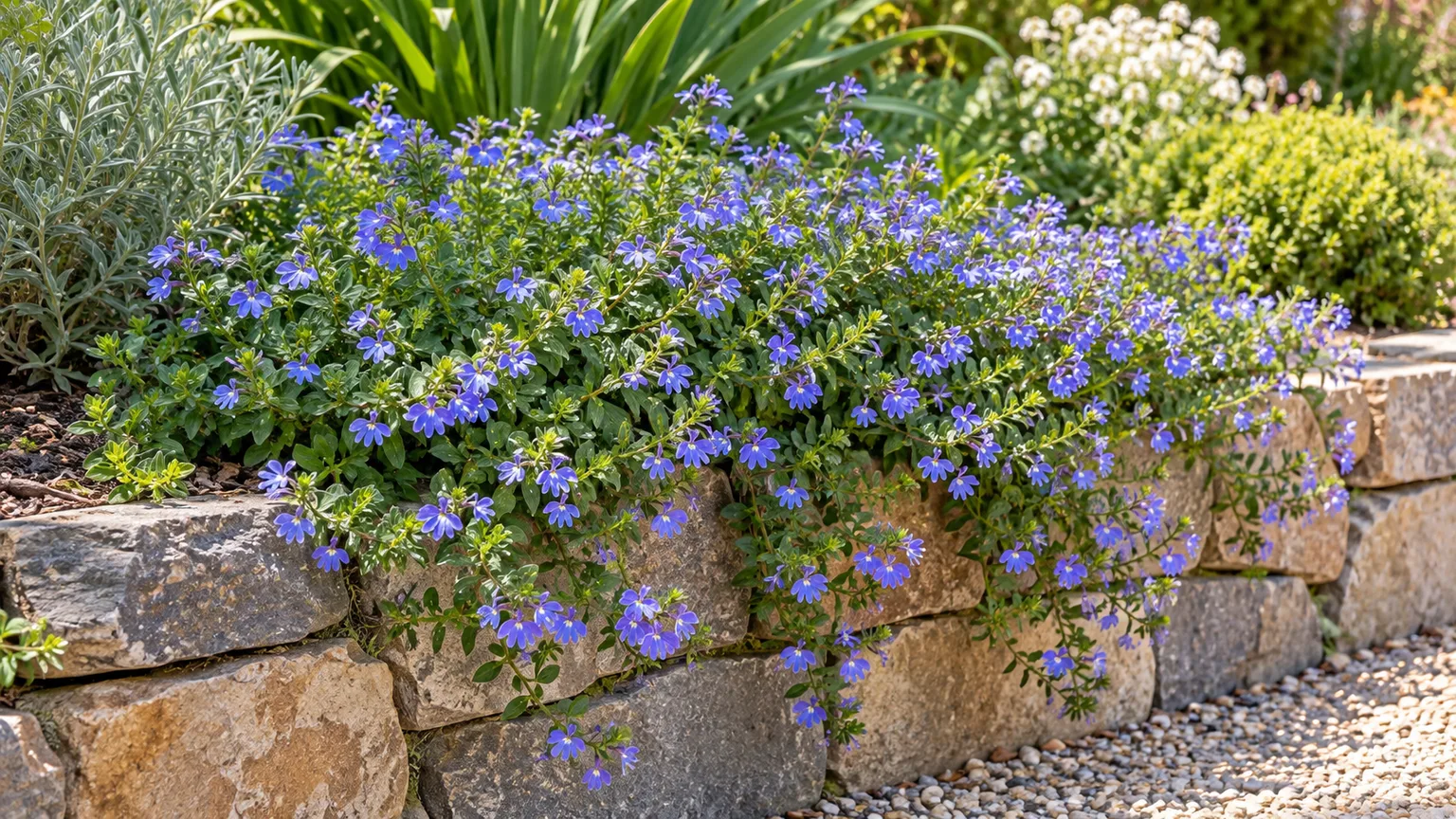
Choose a sunny or lightly shaded spot where water drains freely after a heavy rain. Planting at the front of a border, beside a retaining wall, or along a raised bed lets the trailing stems show without burying the center of the plant. In-ground scaevola can spread into a low carpet in warm regions, but treat it as seasonal bedding where winter freezes are routine.
After planting, water slowly at the root zone and check the soil over the next few days. If a dry spell follows, water deeply enough to wet the nursery root ball and some surrounding soil. Do not keep the bed constantly wet: the goal is a plant that is establishing new roots, not one sitting in mud. Weed nearby so small plants do not have to compete for moisture and light.
Pruning and deadheading
Scaevola is self-cleaning, so you do not need to remove each faded flower. Leaving the spent blooms alone saves time and does not prevent a healthy plant from continuing to flower. This is one reason the plant is convenient in baskets where deadheading every trailing stem would be awkward.
Prune only when the shape calls for it. If stems stretch beyond the container, become sparse, or break, pinch the tips or trim a portion of the longest growth with clean snips. Cutting back by roughly one-quarter to one-third can encourage a fuller outline; avoid a severe cut into bare, woody growth late in the season. After trimming, give the plant bright light and normal moisture, then wait for new growth before feeding.
Propagating fan flower from stem cuttings
Stem cuttings are usually the most reliable way to carry a favorite cultivar into the next season. Many modern hybrids do not come true from seed, and some produce seed that is slow or not viable. Fine Gardening’s plant guide recommends rooting softwood cuttings in late spring or summer; you can take a few before frost as insurance, even if you also plan to keep a mature pot indoors.
Choose a healthy, non-flowering tip and use clean scissors or pruners. Take a cutting about 3 to 5 inches long, remove the leaves from the lower portion, and set the bare stem into a small pot of moist, free-draining propagation mix. Keep the leaves above the surface and place the pot in bright, indirect light in a warm location. The medium should stay slightly moist, not saturated; a clear cover can help retain humidity, but vent it to limit stagnant, wet conditions.
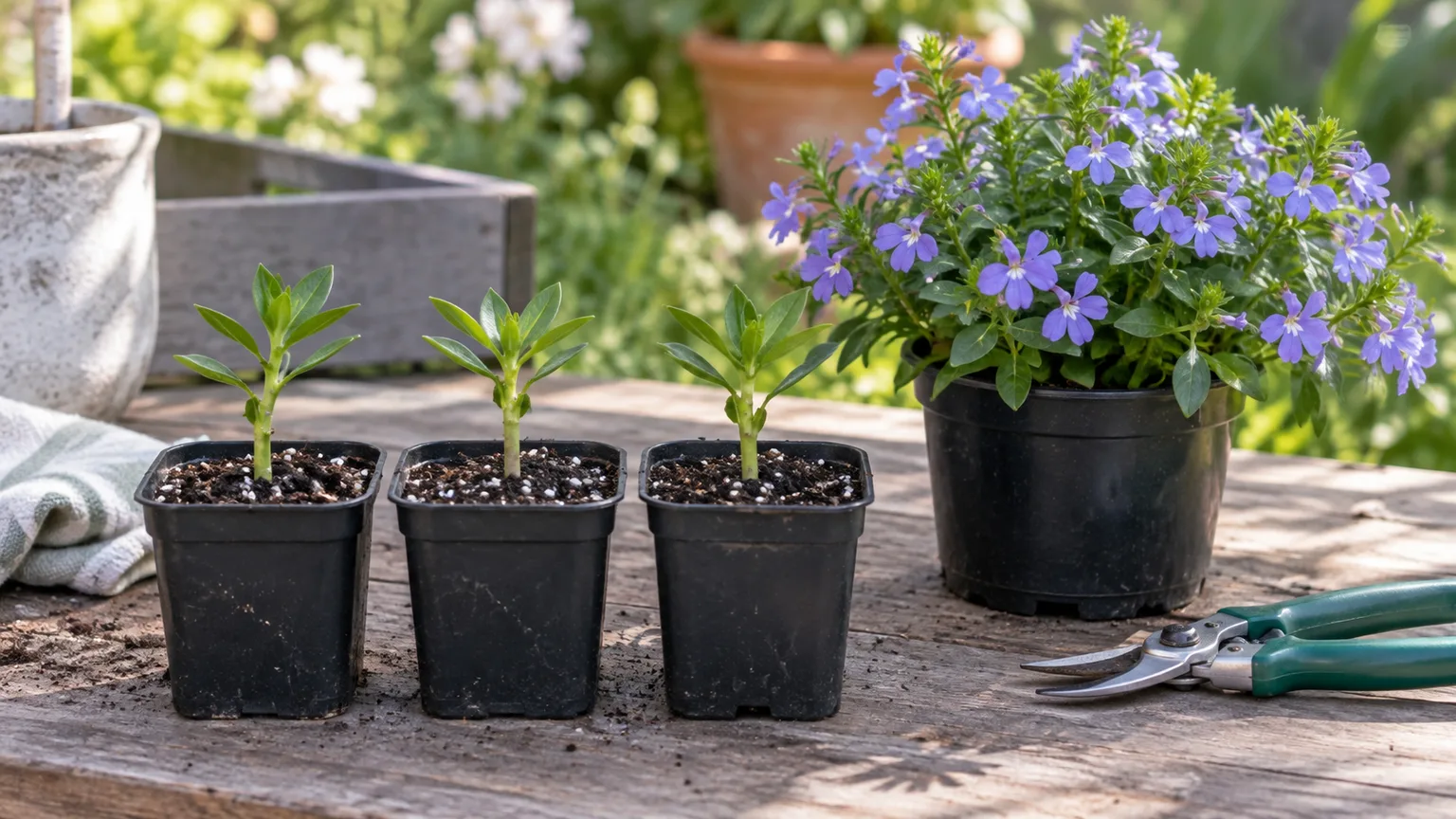
Check for resistance with a very gentle tug after a few weeks rather than repeatedly pulling the cutting out to inspect it. New leaf growth is encouraging, but firm rooting is a better sign that it can move into its own small pot. Let rooted cuttings grow in bright light and acclimate them gradually before moving outdoors after frost. Taking several cuttings improves the chance that at least one will root successfully.
Growing fan flower from seed
Seeds can be hard to find, and some named cultivars are hybrids that may not produce dependable seed. If you want a particular flower color or trailing habit, buy a labeled transplant or take a cutting from that plant. If you are growing the species from seed, use fresh seed from a reputable source and follow the packet’s sowing instructions; tiny seed can be covered too deeply, and slow or uneven germination makes it a less predictable option than cuttings.
Start indoors about six to eight weeks before your local last frost date, as the NC State Extension plant profile suggests for plants grown as annuals. Use a clean seed-starting mix, keep it evenly moist rather than waterlogged, and provide bright light as seedlings emerge. Harden seedlings off over a week or two, then transplant only when frost danger has passed and the soil is warm. Gradual acclimation matters: seedlings raised indoors can scorch or wilt when moved directly into bright sun and wind.
Overwintering fan flower
In a frost-free or very mild climate, a hardy Scaevola aemula may survive as a perennial outdoors. In colder areas, treat the bed as an annual and plan to replace it in spring, or save a small plant or cuttings before the first frost. Garden Design notes that container plants can be brought indoors and that cuttings can be used for winter carryover, but success depends on light, temperature, and the health of the plant.
For a container, inspect leaves and stems for insects before moving it inside. Put it near a bright window where it will not touch cold glass or sit in a draft, then reduce watering because growth slows in lower winter light. Let the surface dry slightly between waterings, and do not keep the mix wet. If the plant becomes thin and leggy, pinch it back lightly and take cuttings as a backup; very large outdoor baskets can be difficult to transition indoors, so a few young cuttings may be easier to manage.
Common problems and how to diagnose them
Fan flower usually has few serious pest problems, but mealybugs may appear on stems or leaf joints. Check along the plant rather than only looking at the flower display, especially before bringing a pot indoors. Root rot is more likely when soil stays wet or a container drains poorly. Clemson Extension identifies mealybugs and root rot as the main issues to watch; the response should start with inspection and drainage rather than automatic spraying or watering.
| What you see | Check first | Practical response |
|---|---|---|
| Yellow leaves with soft stems | Is the mix wet several inches down? | Let the mix drain and dry slightly; clear blocked holes and remove badly rotted material if present |
| Limp leaves and dry, light pot | Is the root ball dry below the surface? | Water slowly until the full root ball is damp, then recheck after drainage |
| Long, sparse stems and few blooms | Does the plant receive at least six hours of direct light? | Move it toward brighter light and pinch back leggy tips |
| Healthy leaves but fewer flowers | Has the weather turned cool, or was fertilizer heavy? | Wait for warmth if seasonal, and correct the feed or light before pruning hard |
| White cottony clusters at leaf joints | Are the marks insects rather than flower fuzz? | Isolate a container plant and inspect stems closely; treat only after confirming the pest |
Do not diagnose yellow leaves from color alone. A dry pot, a waterlogged root zone, low light, and a sudden temperature change can all stress foliage, and the same plant can experience more than one condition. Check soil moisture first, then inspect roots and light exposure if changing the watering approach does not help.
Fan flower varieties to choose
Choose a cultivar by how far it trails and where you will place it, not only by flower color. ‘Blue Wonder’ is a vigorous trailer that may spread several feet in a basket or over a wall, while cultivars in the Bombay and Fairy series tend to be more moderate in size. The compact ‘Pink Charm’ form is useful where a smaller plant is wanted. Dimensions vary among selections, so use the current nursery tag as the final guide.
Common choices include blue or violet ‘Blue Wonder,’ ‘Bombay Blue,’ and ‘Whirlwind Blue’; pink and white forms are also sold under Bombay, Fairy, and Whirlwind names. ‘Purple Fanfare’ is another lavender-blue cultivar, while ‘Carpet’ is selected for a spreading groundcover effect. Names and availability change among breeders and regions, and trademarked series may include multiple sizes. If the label gives a spread larger than your planter, select another cultivar rather than relying on pruning to keep it compact.
Conclusion
Fan flower care comes down to a few decisions: give Scaevola bright light, choose a cultivar that fits its space, and keep the roots moist enough to grow but never waterlogged. It is a reliable warm-weather bloomer, not a frost-proof perennial, so plan for an annual display, an indoor container, or saved cuttings according to your climate. If blooms fade or leaves yellow, check light, soil moisture, and drainage before adding fertilizer or making a drastic cut.