How to Identify and Remove Japanese Honeysuckle Safely
See the leaf, flower, stem, and berry clues for Japanese honeysuckle, then match removal to the site, follow pesticide labels, and plan long-term control.
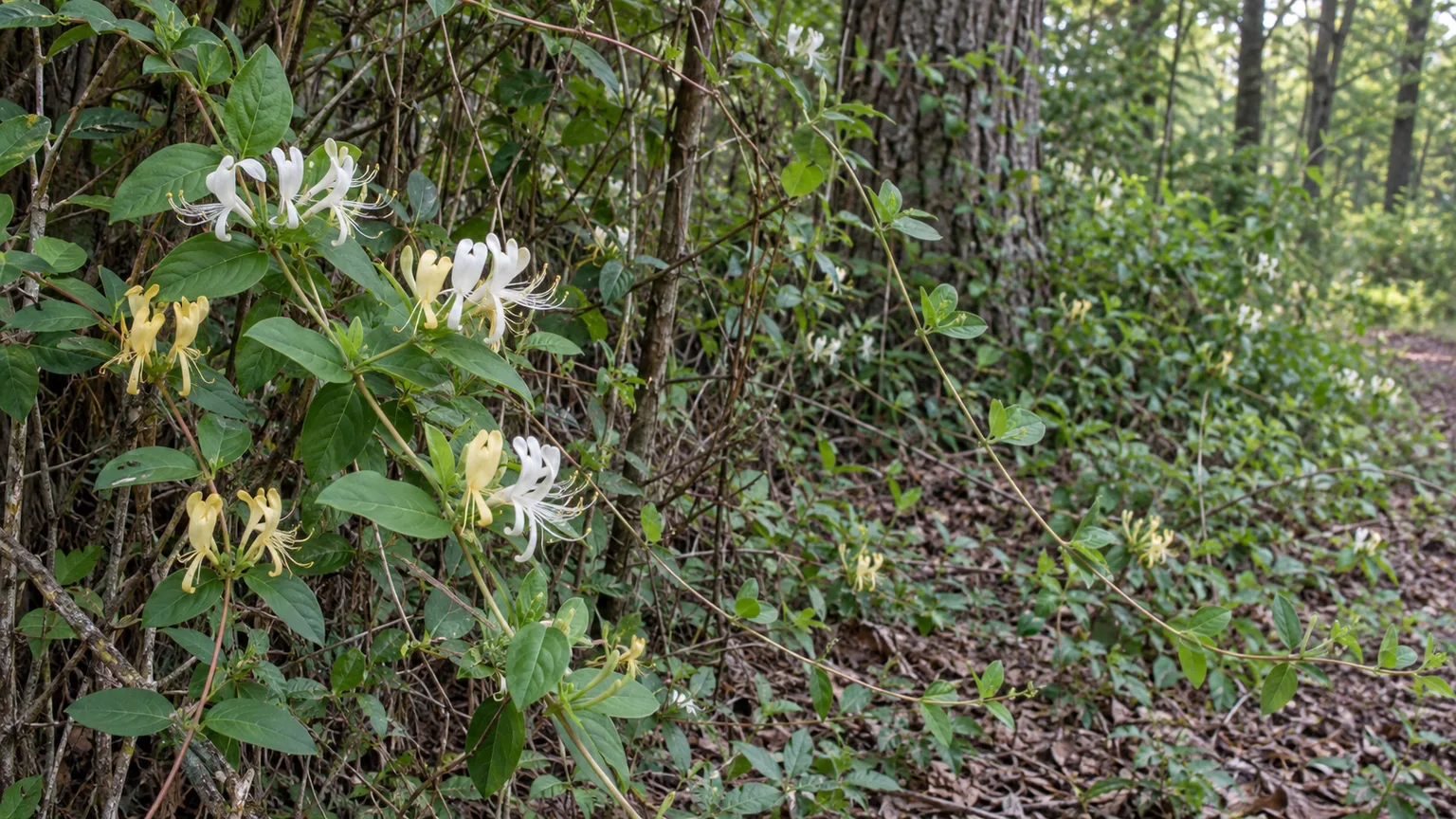
Japanese honeysuckle (Lonicera japonica) is a fast-growing, twining vine that can carpet the ground, climb shrubs, and wind around young trees. Its sweetly scented white flowers fade to yellow, a charming display that can hide a persistent invasive plant. Before cutting anything, check the leaves, flower position, stem, and growth habit together; several native honeysuckles deserve protection, and a mistaken cut can damage a plant you intended to keep.
Once you are confident about the identification, match the control method to the size of the patch and what is growing beside it. A young runner in loose soil is a different job from a mature vine woven through a tree canopy. In either case, one quick cut usually removes only the visible growth, so plan to contain the plant material, revisit the site, and respond to new shoots.
Confirm the Vine Before Cutting
Japanese honeysuckle is a woody perennial vine in the genus Lonicera, native to eastern Asia and naturalized across much of the United States. It may trail along the soil as a groundcover or twine around a support; the same plant can do both. Its leaves are deciduous in colder climates and may remain partly green through winter in milder regions, so winter appearance alone does not rule it out.
If the plant is near a native planting, fence line, stream, woodland, or shared property boundary, take a few clear photographs before intervening. Photograph a whole stem, the way it attaches, a leaf pair, and flowers or fruit if present. Compare those details with your state’s Extension identification page or ask a county Extension office before using herbicide or pulling an uncertain vine.
What Japanese Honeysuckle Looks Like
Start with arrangement, not a single leaf shape. Japanese honeysuckle has simple leaves in opposite pairs, with each pair emerging across from the other at a node; most are oval, smooth-edged, and about 1 to 3 inches long. Some early-season leaves can have shallow lobes, while leaves later in the season are often unlobed. A plant can show both forms, so lobing by itself is not a reliable yes-or-no test.
Look next at the stems and flowers. Young stems are slender and may feel lightly fuzzy; older stems become woody, brittle, and brown, with bark that can peel in strips. The vine climbs by twining its stem around a support, rather than gripping with tendrils or adhesive pads. Fragrant, tubular flowers usually appear in pairs in leaf axils, where the leaf stalk meets the stem; fresh blooms are white, then age to pale yellow. Glossy dark berries may follow in late summer or fall.
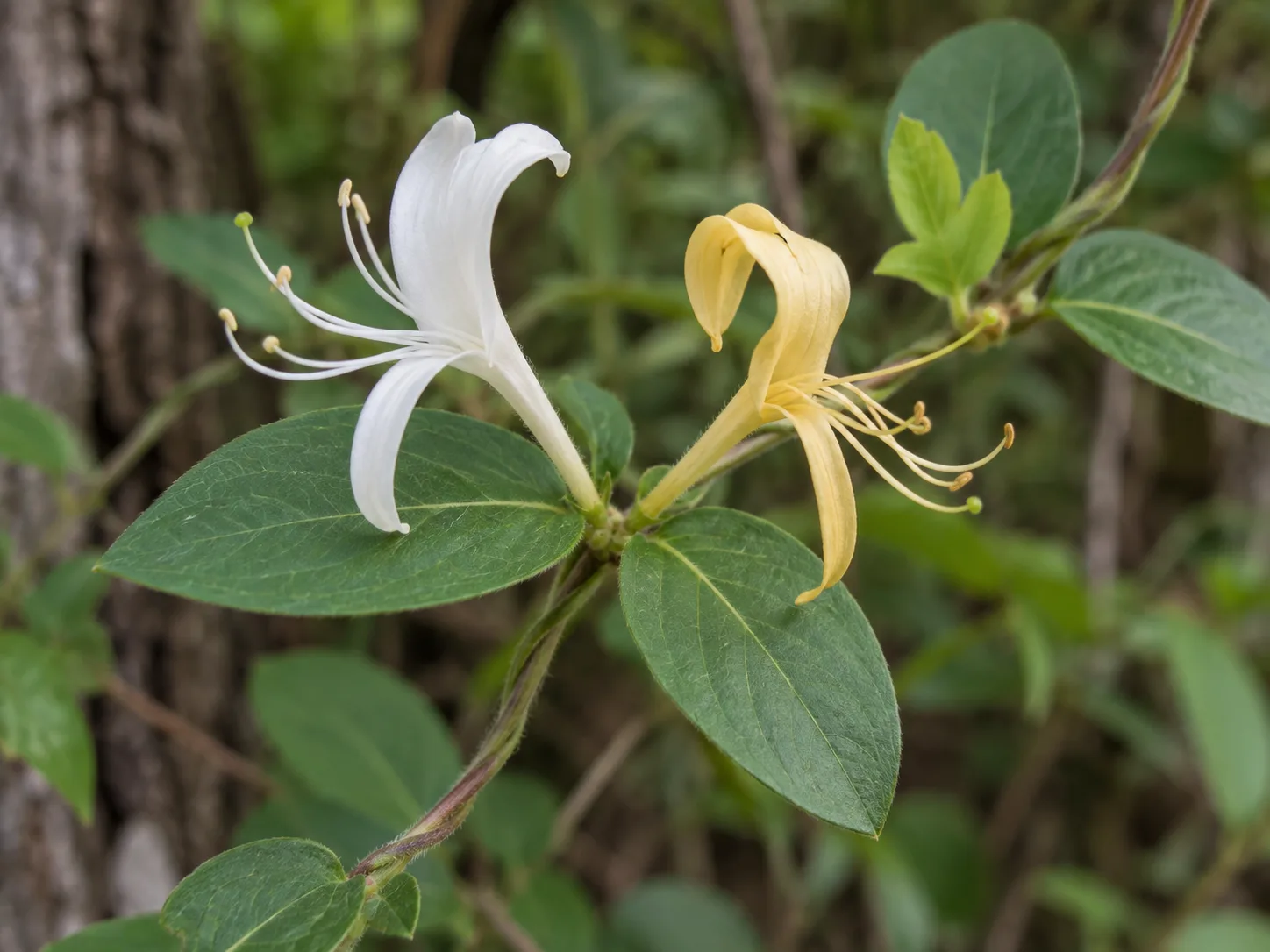
The University of Maryland Extension’s Japanese honeysuckle guide describes the opposite leaves, twining habit, white-to-yellow flowers, and paired black fruit; NC State Extension’s plant profile also notes that the first leaves of the season may be lobed and that older bark peels. Use the combined pattern, not a plant-app result or a single photo, as your field check.
Tell It From Native Honeysuckle and Other Lookalikes
The most useful comparison is with native coral or trumpet honeysuckle (Lonicera sempervirens), which is also a twining vine in parts of eastern North America. Native coral honeysuckle generally bears red or orange flowers at stem tips and red berries; its upper leaves can join around the stem like a collar. Japanese honeysuckle’s leaves do not form that collar, and its flowers are paired in the leaf axils, followed by dark purple-black berries. These are practical clues, not a substitute for checking the species and your region.

Do not confuse a climbing vine with invasive bush honeysuckles, such as Amur honeysuckle (L. maackii), Morrow’s honeysuckle (L. morrowii), or Tatarian honeysuckle (L. tatarica). Those are shrubs rather than twining vines and need a different removal plan. Native honeysuckle species also vary by geography; Illinois Extension’s comparison highlights the difference in leaf collars, flower placement, and berry color, while the Morton Arboretum’s profile notes how growth habit and leaf persistence vary by climate.
If flowers and berries are absent, identification remains possible but less certain. Trace a stem to a leaf pair and look for twining, opposite leaves, and the vine’s distribution across the ground or support; then use a regional key or expert confirmation. Keep the plant intact until you have a confident identification if a native honeysuckle or another valuable vine may be present.
Why Removal Matters After Identification
The problem is not simply that the vine grows quickly. It spreads by seed as well as vegetatively: runners can root where stem nodes touch the ground, underground rhizomes can produce new growth, and birds or other animals can move seeds from dark berries to new sites. That combination explains why pulling a visible stem but leaving rooted nodes or fruit can lead to a return visit.
Once established, a dense mat shades ground-layer plants and competes for growing space; climbing stems can cover shrubs and saplings, restricting light and adding weight to the host. In natural areas, that pressure can reduce the native vegetation that would otherwise occupy the same space. The Missouri Department of Conservation describes effects across forest, prairie, and other natural communities, and the U.S. Forest Service’s species review explains why management in sensitive sites requires care.
Invasiveness and legal restrictions are not identical in every jurisdiction. A plant may be invasive or discouraged locally without being prohibited everywhere; sale, planting, transport, disposal, and herbicide rules can vary by state, county, waterway, or land manager. Check your state agriculture or natural-resources department and local Extension office rather than relying on a national list or assuming a familiar garden plant is lawful to propagate.
Choose a Control Method Based on Patch Size
Before you start, map the patch and decide which parts are actually manageable by hand. Note whether runners have rooted, whether the plant is fruiting, whether stems climb a tree, and whether desirable plants or water are nearby. The table below is a practical starting point; extensive woodland or roadside infestations are management projects, not a quick garden cleanup.
| What you find | Practical first approach | Limitation to plan for |
|---|---|---|
| A few young stems in loose soil | Pull or dig out the crown and rooted nodes; collect fruit | Small root or stem fragments can be missed; recheck |
| A mature vine in a shrub or tree | Cut the vine low, separate it from the support carefully, and assess the rooted base | Cutting top growth alone does not kill roots; pulling can break branches |
| A dense ground mat | Work in manageable sections; repeated cutting or targeted, label-compliant treatment may be needed | One mowing or one treatment can leave rhizomes, runners, or seedlings |
| A large natural-area or waterside infestation | Ask Extension, land manager, or a licensed invasive-plant contractor for a site plan | Broad treatment can injure native vegetation or affect water |
Pull Young, Isolated Vines and Rooted Runners
Hand removal is most realistic when the plant is young, the soil is workable, and you can reach the crown without damaging nearby roots. Moisten dry soil the day before if practical, then follow the visible stem back to where it enters the ground. Loosen soil beside the crown with a narrow fork or trowel and lift slowly; yanking only the vine often snaps it above the root system.
Trace each ground runner to its rooted nodes and remove as much connected material as you can without turning the whole bed over. Japanese honeysuckle can spread through rhizomes and stems that root at nodes, so inspect the disturbed area again after the first pass. Pulling small seedlings is easier than extracting a mature, tangled system, but even a careful hand removal is not proof that every viable root is gone.
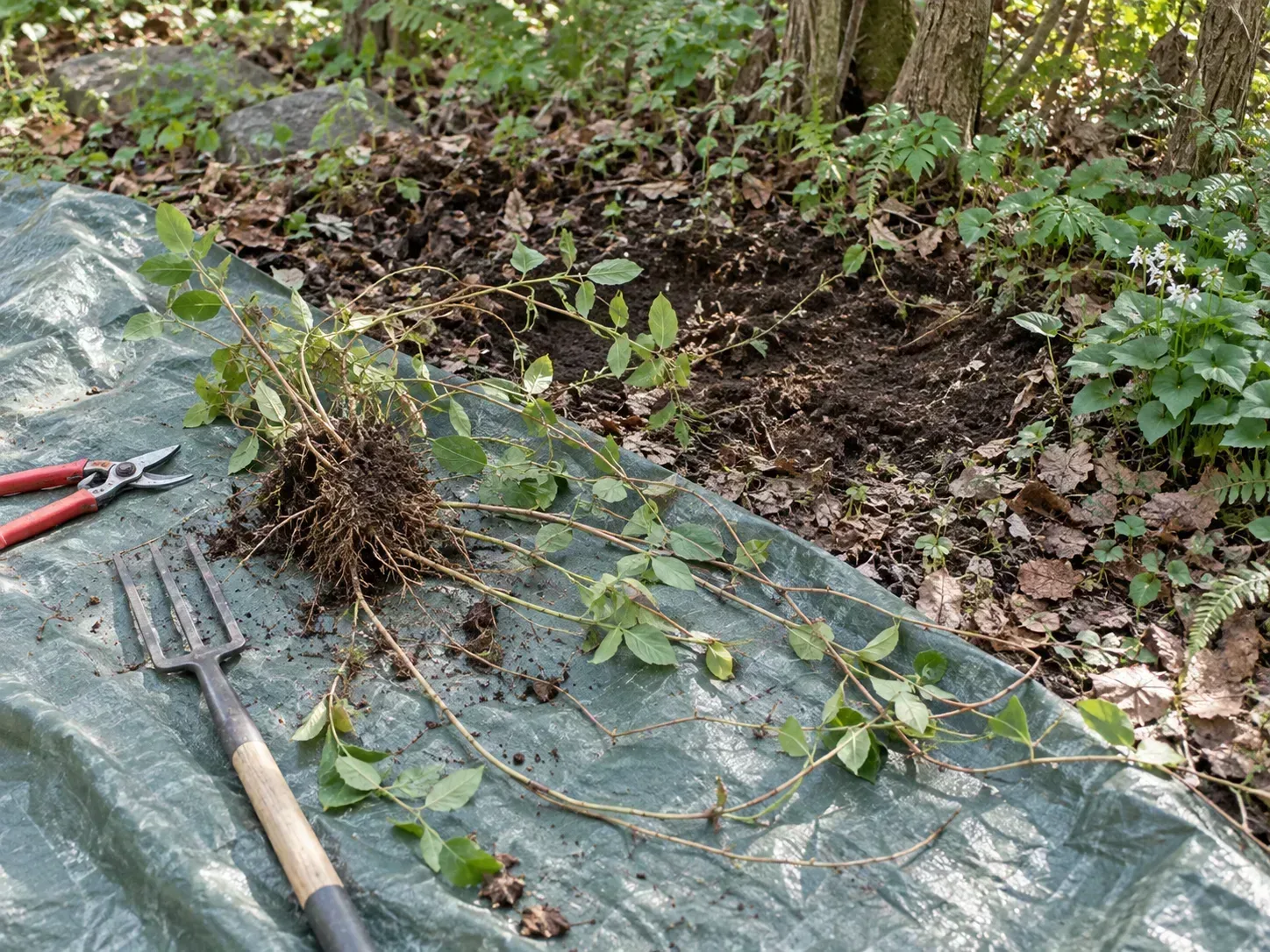
Work outward from the patch edge toward the center, separating honeysuckle from plants you want to save. Put loose fruit, stem fragments, and roots directly into a container or tarp instead of dropping them elsewhere in the garden. If the crown is intertwined with a desirable perennial or shallow-rooted tree, stop before forceful digging causes more damage than the vine; selective repeat cutting may be the better first step.
Free Trees and Shrubs From Established Vines
Do not pull a heavy vine down from a tree. The stems may be wrapped around branches or embedded in the canopy, and dragging them can strip bark or break limbs. Instead, follow a vine to its base and cut it as close to the soil as you can safely reach. If several stems come from separate rooted points, mark and cut each one rather than assuming the visible trunk has a single root crown.
Once severed, upper growth will gradually dry. Remove only loose sections that come away without force; leave high or entangled material to decay in place, or hire an insured arborist if it threatens a tree, structure, walkway, or overhead line. The rooted base may resprout, so keep it visible and return to remove new shoots or apply a suitable treatment according to local guidance and label directions.
For an established vine in a shrub, the same principle applies: cut at the base, then tease out detached stems in short sections while supporting branches. Do not use a machete, saw, or loppers where you cannot see what they will contact. A plant that may be native should be identified before its base is cut, especially in a garden where multiple honeysuckles share a trellis.
Manage Dense Mats in Stages
For a wide patch, divide the area into manageable sections and work from the perimeter so you can see what is being uncovered. Repeated close cutting can suppress top growth and limit flowering or berry production, but it should not be mistaken for guaranteed eradication. Extension sources vary in how they describe mowing: some include it among mechanical controls, while University of Maryland Extension cautions that mowing can stimulate denser growth. The safe takeaway is not to rely on one mowing as a cure; use repeated, planned suppression only when it is appropriate for the site and pair it with root or seedling follow-up.
Where hand digging would churn a large area or injure native plants, consider a controlled cut-and-monitor plan, or ask a local invasive-plant specialist whether a targeted herbicide treatment is justified. Covering a small cleared patch may reduce light at the soil surface, but a vine already rooted outside the cover can grow back into it, and coverings can also smother desired plants. Prescribed fire is used by trained managers in some fire-adapted ecosystems; it is not a backyard burning recommendation and can make conditions worse if the habitat, permits, or follow-up regime are wrong.
Use Herbicides Only When the Site and Label Fit
Herbicide can be useful for mature roots or large infestations that resist physical removal, especially when the product can be applied to the target with limited contact with nearby plants. Commonly discussed active ingredients for Japanese honeysuckle include glyphosate and triclopyr, but products differ in concentration, formulation, permitted sites, application method, and environmental restrictions. Do not copy a mixing rate from an Extension article or another bottle onto the product you own.
The specific product label controls: it describes where the product may be used, which application methods are allowed, personal protective equipment, weather limits, required setbacks, and any water or plant restrictions. The U.S. EPA explains that pesticide labels are legally enforceable, and the North Carolina Cooperative Extension’s 2026 honeysuckle guidance also directs users to follow the label. If the product label does not explicitly allow your site and target method, do not improvise.
For a single thick vine, a cut-stump approach can limit treated surface area: make a clean cut low on the stem, then treat the freshly cut surface only as the product label allows. A small, controlled application is generally easier to keep off neighboring foliage than broadcast spraying, but it still requires care around the root flare of a desirable tree, water, children, pets, and workers. If a vine has many separate stems, every rooted base must be found; treating one stump will not control independent crowns elsewhere in the mat.
Foliar treatment can reach a dense mass where repeated digging is impractical, but spray can drift or contact any susceptible green plant. Use it only when the plant is correctly identified and the label permits use on the site; keep the application as targeted as possible, and avoid windy conditions, rain or temperature restrictions, flowering pollinators, and sensitive vegetation according to the label. Near wetlands, drainage ditches, ponds, streams, or storm drains, do not assume an ordinary landscape product is approved; consult the label, local rules, and a licensed applicator familiar with aquatic buffers.
If you cannot explain how you will avoid treating native plants, keep the product off water, protect yourself, and comply with local rules, pause and get professional advice. A county Extension office can help you compare treatment methods; a licensed pesticide applicator can assess a large or sensitive site. Do not mix products, increase concentration, or repeat sooner than directed to compensate for a missed root.
Choose Timing by Growth Stage and Season
For small plants, removal is easiest before the vine forms a broad mat or produces fruit. Pulling works best when the soil is moist enough to loosen roots but not so wet that it compacts underfoot. If the plant is already bearing berries, contain the fruit before moving the stems so seeds are not shaken or carried into clean parts of the yard.
The best herbicide timing depends on product, climate, and surrounding vegetation rather than a single national calendar date. In parts of the eastern United States, late-season treatment may be useful because Japanese honeysuckle can stay green after native deciduous plants lose leaves; however, a plant must still be actively growing, and a label may impose temperature, rain, freeze, or seasonal restrictions. The University of Maryland Extension’s management notes discuss fall as a useful window in its regional context, while New Hampshire Extension likewise recommends matching treatment to dormant native vegetation. A local recommendation may not transfer to a warmer, colder, wetter, or more regulated site.
If you are cutting without herbicide, timing still affects the job. Removing flowers before fruit set can reduce that season’s seed contribution, but a cut does not remove established roots; repeat the cut when new growth appears. Avoid tackling a large canopy when branches are unstable, soils are saturated, or the work would disturb nesting wildlife or protected vegetation; land managers and local regulations can guide timing in natural areas.
Handle Cuttings, Berries, and Equipment Carefully
Japanese honeysuckle’s dark berries can be eaten by birds and other animals, which help disperse seeds. If fruit is present, clip berry-bearing sections into a bag or bucket before pulling, dragging, or cutting the rest of the vine. Keep the material contained while you work and do not leave a pile where it can blow into a ditch or woodland edge.
Follow municipal and state guidance for invasive plant disposal. Rules for yard-waste collection and composting differ, and a cool backyard pile may not reliably destroy seeds or living plant fragments. Ask whether the local green-waste facility accepts this species; if it does not, use the disposal route your town or state recommends. Do not dump cut vines or roots in a natural area, roadside, or public greenbelt.
After physical removal, knock soil from tools over the affected patch, then clean tools and footwear before moving to a clean bed or property. This is sensible containment for seeds and plant material, not a guarantee that every seed has been captured. If you used pesticide, follow its label for equipment cleanup, leftover mixture, containers, and treated plant debris; never pour leftover product into a drain or onto soil unless the label specifically permits that disposal.
NC State Extension notes that Japanese honeysuckle fruit can be poisonous to people, with concern greatest when quantities are eaten. Do not taste berries or let children use them in play; if ingestion occurs, contact Poison Control or a medical professional for case-specific advice. Avoid making food, tea, or medicinal preparations from any plant you have not independently identified and confirmed safe.
Monitor Regrowth Over Several Seasons
Follow-up is part of the removal method, not an optional cleanup. New shoots may emerge from missed roots, rhizomes, rooted nodes, or seedlings deposited by wildlife; a dead-looking canopy does not prove that the crown has died. Walk the patch after initial treatment, mark the boundaries, and record where shoots appear so that you can tell whether the problem is a missed root or new seedling.
Inspect at least during the active growing season and again when leaves or fruit make the plant easy to recognize. During the first year, check more often if the infestation was dense or the patch borders a seed source. Continue seasonal checks for several years, removing small regrowth before it flowers or roots into the surrounding soil. The Brandywine Conservancy’s practical control overview recommends multi-year monitoring because the vine can resprout, and current Maryland Extension guidance urges early removal of young vines.
Change the approach if the same crown returns repeatedly. If hand-pulling keeps breaking stems, loosen a wider ring of soil around the crown; if cutting produces repeated sprouts, mark and assess the actual number of root bases or ask whether a label-compliant cut-stump treatment is appropriate. If seedlings appear well beyond the treated patch, look uphill, along a fence, in a bird-perching shrub, or across a property line for a continuing seed source.
Restore the Site and Reduce Reinvasion
Removing the vine opens the light and ground space it had occupied. If you leave a broad bare patch, another fast colonizer can take advantage of the disturbance, so protect soil and replant when conditions allow. Choose groundcovers, shrubs, or vines that fit the light, moisture, soil, and wildlife goals of the specific site, and favor species native to your state or ecoregion.
In a woodland edge, restoration may mean protecting existing native seedlings and letting appropriate vegetation recover rather than planting immediately. In a home garden, fill gaps with locally native perennials or shrubs after confirming that the plant can handle shade or sun and will not grow into a tree or across a neighbor’s fence. The objective is not to replace an invasive vine with another aggressive plant; it is to make the site easier to observe and less available to reinvasion.
Keep the new planting accessible for a while. A neat mulch ring or a clearly defined edge can make young honeysuckle seedlings easier to spot, but mulch alone will not stop a runner arriving from outside the bed. Water new plants through establishment, avoid burying their crowns, and leave enough space to inspect the ground and supports during seasonal checks.
Avoid the Removal Mistakes That Cause Setbacks
The most common failure is cutting the vine and walking away. That removes the foliage but leaves roots capable of sending up shoots. Pair cutting with root removal when feasible or with a deliberate follow-up plan; if herbicide is part of that plan, use a product and method allowed by its own label.
Another setback is pulling top growth out of a tree before cutting its base. A tangle may be supporting dead or weakened branches, and a downward tug can injure the tree or the person below it. Cut accessible stems at ground level, let detached growth decline, and use an arborist for overhead hazards rather than climbing or sawing blindly.
Do not assume a pretty white-flowered vine is Japanese honeysuckle. Native species can be valuable to local wildlife, and a lookalike should not be destroyed based only on a phone-app guess. Do not spray a mixed planting on a breezy day, use a pesticide rate copied from a different label, burn a patch yourself, or compost fruiting vines without checking local guidance. Each of those shortcuts can create a separate problem while leaving the original roots alive.
Finally, do not remove more vegetation than you can restore. Clearing a huge patch at once may expose soil, damage desired plants, or create more work than the gardener can follow through on. A smaller, clearly mapped treatment area with repeat visits often leads to better control than a dramatic one-day cutback followed by months without inspection.
Choose a Regionally Appropriate Replacement
If you want a flowering vine, native coral honeysuckle (Lonicera sempervirens) is a candidate in parts of eastern North America. Its red or orange tubular blooms and foliage pattern differ from Japanese honeysuckle, and it can provide a climbing form without choosing the invasive species. Confirm its native range and suitability where you live, because “native somewhere in the United States” does not mean native to every state or habitat.
For a similar fragrant effect without a vine, Maryland Extension suggests shrubs and small trees such as summersweet (Clethra alnifolia) and sweetbay magnolia (Magnolia virginiana), as well as native Virgin’s-bower (Clematis virginiana) for a climbing option in appropriate locations. NC State Extension lists additional alternatives, including crossvine, Carolina jessamine, and native passionflowers in some parts of the Southeast. The Morton Arboretum recommends checking plant attributes and local guidelines before choosing a replacement.
Decide first what the honeysuckle was doing for the garden: screening a fence, covering soil, attracting hummingbirds, or filling a shaded edge. Then choose a locally appropriate plant with that job, while checking mature size and support needs. A native plant nursery, state native-plant society, or Extension office can help narrow the list for your county and soil conditions.
Know When to Call an Extension Office or Land Manager
Ask for help when flowers are missing and the vine resembles a native species, when roots are woven through valuable plants, or when the infestation extends into a woodland, wetland, stream buffer, road easement, or neighboring property. A local expert can confirm species and rules for that exact site; statewide invasive lists may not explain a town ordinance, public-land policy, or waterway restriction. Take photos of leaves, nodes, flowers, fruits, stems, and the whole growth habit to make an identification request more useful.
Bring in a licensed applicator or land-management professional when the patch is too large for regular follow-up, the vine reaches high into trees, or herbicide use near water and native vegetation requires specialized judgment. For overhead branches, contact an arborist rather than cutting from a ladder or pulling a canopy tangle. A good plan defines the treatment area, protects desirable plants, specifies who will inspect for regrowth, and schedules restoration instead of ending at the first application.
Conclusion
Confirm Japanese honeysuckle by reading several clues together: opposite oval leaves, a twining stem, paired white-to-yellow flowers in leaf axils, and dark berries. If the plant is small and isolated, loosen and remove the crown and rooted runners; if it climbs a tree or forms a large mat, cut and manage it in stages without yanking through valuable branches or relying on one mowing.
For herbicide, the exact product label and local rules govern whether and how you can treat the site. Contain fruit and living vine material, revisit the patch through future growing seasons, and restore the space with regionally appropriate plants. That sequence—identify, contain, remove, restore, and monitor—turns a one-time cut into a realistic long-term control plan.