Soil Amendments: Types, Uses, and How to Choose
Learn what soil amendments change, how they differ from fertilizer, and how soil tests can help you choose compost, lime, gypsum, or other materials wisely.

A soil amendment is a material added to soil to change a property that affects roots, such as structure, water movement, organic matter, pH, or nutrient availability. The useful question is not “Which amendment is best?” but “What do I want this soil to do differently, and what evidence says that is the problem?” A bag of compost may help one bed while adding unnecessary salts to another; lime can help an acidic soil and push an already alkaline one farther from the range a crop needs.
Start with the growing area, the plants you want to grow, and a soil test where chemistry is involved. Then choose a material whose job matches the result. This test-first approach prevents the common cycle of adding several products, waiting for a vague improvement, and still not knowing what changed.
Decide what you want the soil to do differently
Before shopping, describe the problem in specific terms. Does water puddle after ordinary rain, or does it drain through a raised bed so quickly that seedlings wilt between waterings? Is the soil hard to work because it is compacted, low in organic matter, or simply dry and crusted on the surface? Those conditions can look similar from above but do not call for the same treatment.
A handful of moist soil can offer a rough texture clue: sand feels gritty, silt feels smooth, and clay can feel sticky and form a ribbon when pressed. That quick check can help you understand what you are handling, but it does not reveal pH, salinity, nutrient levels, or whether sodium is affecting structure. A field observation is a starting point, not a substitute for a lab report when you are considering lime, sulfur, gypsum, or fertilizer.
Also distinguish a soil problem from a site problem. Water that remains because the bed sits in a low spot, the downspout empties nearby, or a compacted layer blocks drainage cannot always be corrected by mixing material into the top few inches. Fixing water flow, relieving traffic compaction, or choosing plants suited to the conditions may matter more than buying another amendment.
Test before changing soil chemistry
For a bed you plan to improve, submit a representative sample to a university or other qualified soil-testing laboratory. Follow that lab’s instructions for sample depth and preparation, and sample separate areas separately if their histories or conditions differ. A vegetable bed, lawn, and blueberry patch may need different interpretation even when they sit a few steps apart.
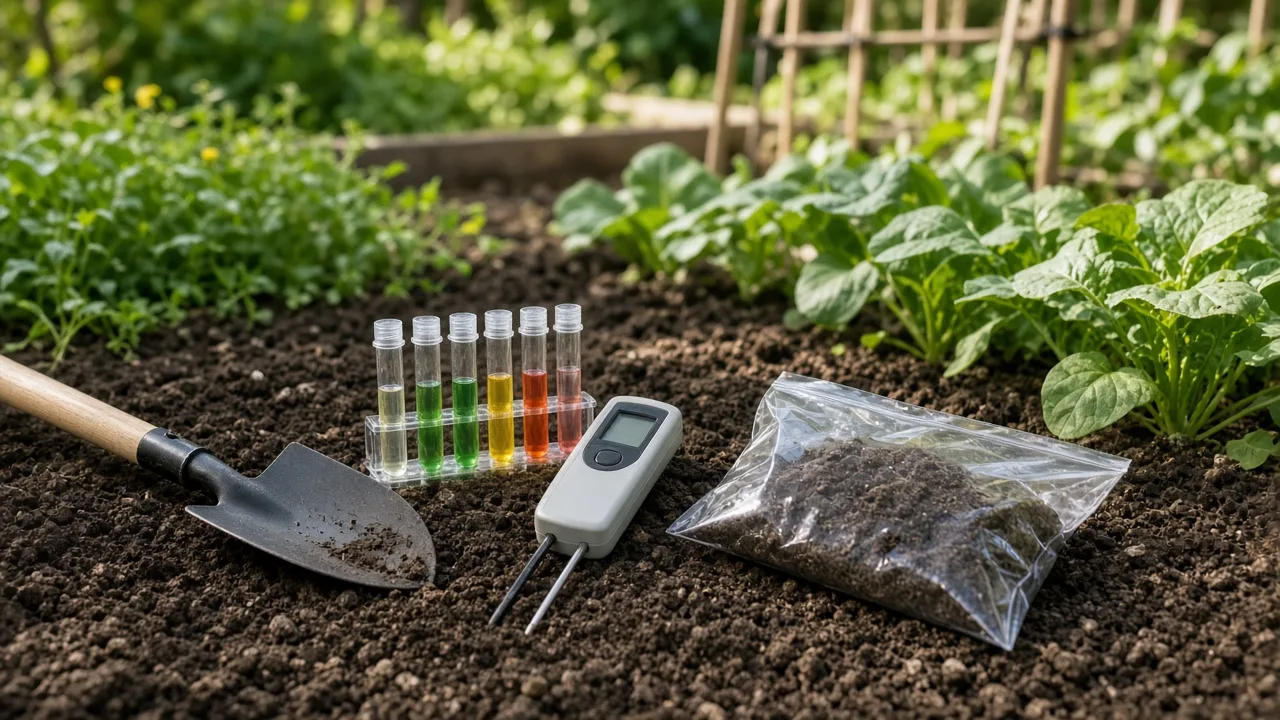
A garden-center pH meter or color kit can be useful for a rough reading, but many simple kits do not provide the recommendations, nutrient analysis, or calibrated accuracy of a laboratory test. North Carolina Cooperative Extension emphasizes soil testing before choosing amendments because the test connects the proposed material to the condition it is meant to address. Many extension labs also let you report the crop or garden use so the interpretation reflects what you intend to grow.
Practical guidance such as Epic Gardening’s soil-amendment overview likewise starts with a soil test and observed site conditions rather than a universal blend. Together, those checks help you separate a nutrient issue from a physical one before you spend money.
Read the whole report rather than treating a single number as a verdict. Pay attention to pH, phosphorus and potassium levels, organic matter if it is reported, soluble salts or sodium when relevant, and the lab’s recommendations for the specific crop. A recommendation for one element does not mean every bed nearby needs that element, and “more organic matter” is not a reason to ignore a high salt result or a nutrient already present in excess.
Match the amendment to a measurable goal
Once you have a test and a goal, match the material to the mechanism. Amendments can change physical conditions, soil chemistry, or biological activity; some affect more than one. The more strongly a product changes pH or supplies a concentrated nutrient, the more important it is to use the lab’s target rate and product analysis rather than a general garden recipe.
Build organic matter and improve structure
Finished compost is a practical way to add organic matter to many garden soils. As it decomposes further, organic matter can support aggregation, improve water infiltration and retention, and provide food for soil organisms. That does not mean compost instantly turns clay into sand or makes a poorly sited bed drain freely; the effect builds gradually, and material quality matters.
Colorado State University Extension notes that organic matter can improve aeration, water infiltration, and water and nutrient holding capacity, while also warning that amendment choice depends on site conditions and soil tests. In a sandy soil, stable organic matter can help water and nutrients remain available longer. In heavy soil, it can support better aggregation over time, but repeated additions do not excuse working wet soil or driving equipment across the root zone.
Adjust pH only when the test calls for it
Soil pH influences which nutrients roots can access. If a crop struggles in soil that is too acidic or alkaline, it is tempting to reach for a pH-adjusting product, but the target depends on the crop, the starting pH, and the soil’s ability to resist change. A pH reading alone may not tell you how much material is needed; texture and buffering capacity also affect the response.
Lime is used to raise pH in acidic soils. Calcitic lime supplies calcium, while dolomitic lime also supplies magnesium, so the test should help determine which form fits rather than encouraging a routine switch to the product with more nutrients. Elemental sulfur can lower pH, but it works through microbial conversion and the response takes time; soil temperature, moisture, texture, and the product formulation affect how quickly the result appears. Do not apply either product by calendar or because a nearby garden uses it.
Correct a nutrient shortage without overfeeding
Some materials marketed as amendments are primarily nutrient sources. Bone meal, blood meal, fish products, alfalfa meal, and many organic blends can supply nutrients, but their composition and release pattern vary. A product can be “natural” and still oversupply phosphorus, nitrogen, salts, or another element when the soil does not need it.
Use a fertilizer recommendation when the test identifies a nutrient shortage, and compare it with the label’s analysis so you do not apply the same nutrient twice through compost plus fertilizer plus a meal product. UF/IFAS explains that organic fertilizers and amendments need to be selected for their nutrient content, the soil’s available nutrients, and the release pattern of the material. This matters especially with bulky products: a gardener may add too much phosphorus while trying to correct a different nutrient or improve soil texture.
Common soil amendments and what they can realistically do
A useful comparison starts with the intended job, then asks what the material does not do. This table is a selection aid, not a universal rate chart; use a soil test and the label or lab recommendation for the amount.
| Material | Most useful when | Limits and cautions |
|---|---|---|
| Finished plant-based compost | You want to build organic matter in an outdoor bed | Nutrient and salt levels vary; excess can add nutrients or salts you do not need |
| Composted manure | A tested bed needs organic matter and the product is mature | Nutrients and salts can be higher or less predictable than in plant-only compost |
| Leaf mold | A light, moisture-holding organic material is useful | It is not a complete fertilizer and may take time to build in quantity |
| Coconut coir | A container or seed mix needs a renewable fiber that holds moisture | It may arrive compressed and can contain salts; rinse or buffer if product directions call for it |
| Peat moss | A mix needs a light material that holds water and is compatible with the crop | Sourcing has environmental trade-offs; it can be hard to rewet after it dries |
| Composted bark or wood products | You want coarse organic structure in a suitable mix or bed | Fresh wood incorporated through the root zone can temporarily tie up nitrogen |
| Perlite or vermiculite | A container mix needs specific air-space or water-holding properties | These are not broad-acre fixes for compacted outdoor soil |
| Garden lime | A soil test calls for raising acidic pH | Overliming can reduce availability of nutrients and harm acid-loving crops |
| Elemental sulfur | A soil test and crop goal support gradual pH reduction | The change takes time and depends on conditions; repeated unmeasured use can overshoot |
| Gypsum | A confirmed sodicity problem calls for calcium to replace sodium | It does not lower pH and is not a universal cure for clay, compaction, or poor drainage |
Household materials can be useful in compost without working as the pH fix people expect. For example, Penn State Extension reports that spent coffee grounds are nearly neutral and can raise pH around acid-loving plants, so use a soil test and a labeled pH amendment instead of relying on coffee grounds to acidify a bed.
Compost, leaf mold, and composted manure
Compost is often the easiest organic amendment to understand because it can contribute stable organic matter and small, variable amounts of nutrients. But compost is not interchangeable with fertilizer: the label may not guarantee a predictable nutrient release, and compost made from manure, biosolids, or mixed feedstocks can differ from leaf- or yard-waste compost. Ask a bulk supplier for a specification sheet or test report when you are treating a large area or when salt buildup is a concern.
Use mature, well-finished compost that has an earthy smell and a crumbly texture rather than a hot, sour, or recognizable pile of scraps. A product labeled compost is not automatically a perfect fit for every bed, so check its ingredients and any available quality data. UF/IFAS describes compost as a material that can improve organic matter and soil water-holding capacity while also supplying nutrients in smaller quantities; those secondary nutrients still count when you plan fertilizer.
Composted manure can be useful, but fresh manure is a different material. It can contain high salts or ammonia and may carry pathogens; do not assume that “aged” and “composted” mean the same thing. For edible crops, follow local food-safety guidance and the product label, especially when the harvested portion grows close to soil or the material is not fully composted.
Coir, peat, and bark for moisture and structure
Coconut coir and peat moss are fibrous materials that can help hold water in potting or seed-starting mixes. They are most useful when a blend needs that specific water-retention behavior, not as a reflexive addition to every garden bed. Coir quality and salt content vary, and peat has sourcing concerns because peatlands accumulate organic material very slowly.
Bark behaves differently depending on particle size and whether it is composted. Fine, aged bark can become part of a growing mix, while coarse fresh bark is usually more effective as a surface mulch than as a material mixed through a vegetable root zone. Colorado State University Extension cautions that fresh wood products can temporarily tie up nitrogen as soil organisms break down the carbon-rich material; the issue is greatest with fine sawdust because it has much more surface area than chips.
Lime, sulfur, and gypsum solve different chemical problems
These three products are often grouped together as “soil fixes,” but they are not substitutes. Lime raises pH in acidic soil; elemental sulfur can gradually lower pH; gypsum supplies calcium and sulfur without acting as lime. Choose among them by the lab’s finding and the crop’s target, not by a claim that one product “loosens” all difficult soil.
Gypsum is most relevant to sodic soil, where excess exchangeable sodium disrupts soil structure. It is not a general cure for ordinary clay, and its calcium does not necessarily improve drainage when sodium is not the problem. Fine Gardening explains the mechanism: calcium can displace sodium from soil exchange sites in the specific conditions where that treatment is appropriate. If a report does not identify sodicity or recommend gypsum, add organic matter or address compaction and water flow only when those are the actual constraints.
Perlite, vermiculite, sand, and gravel have narrower uses
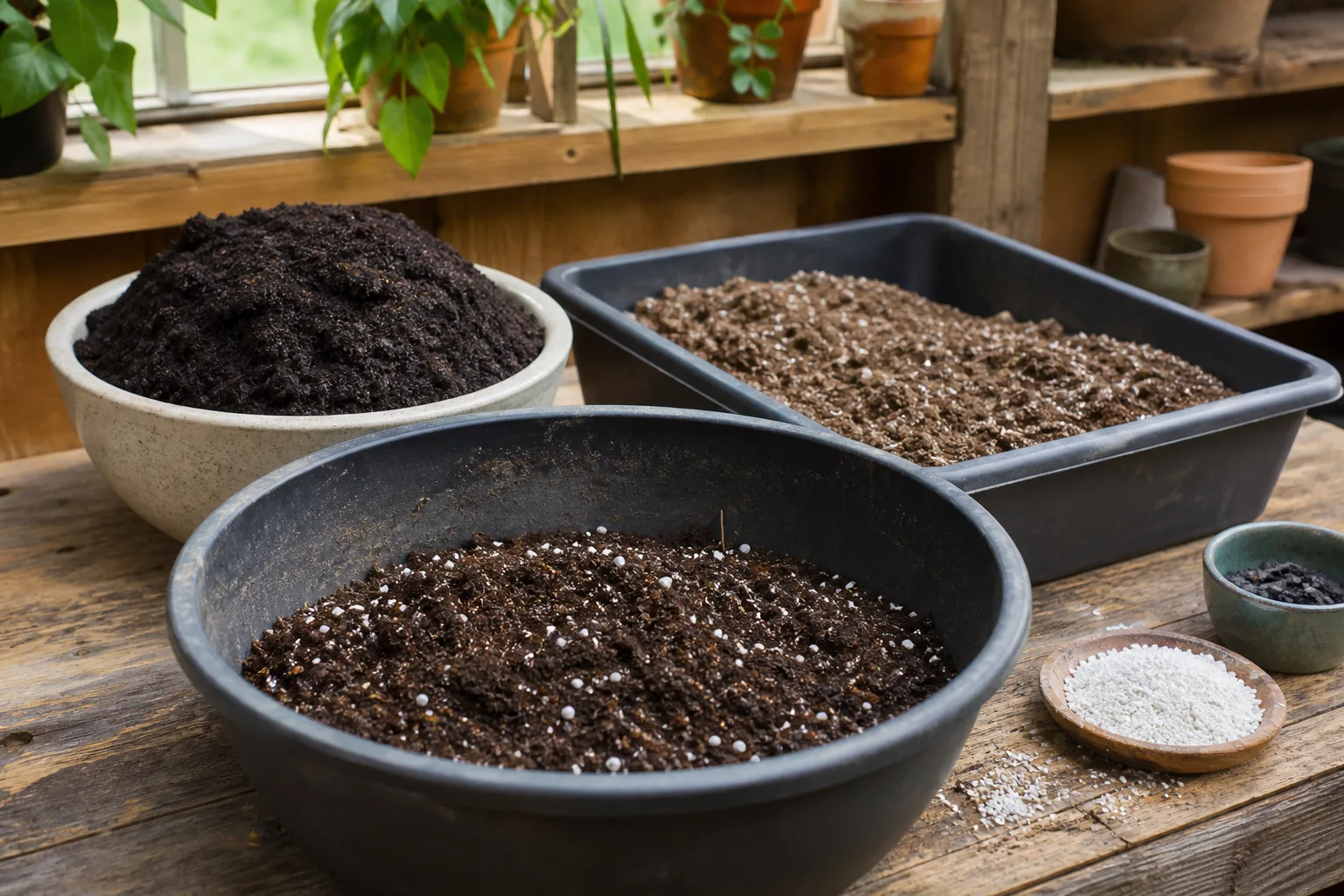
Perlite and vermiculite are lightweight minerals more commonly used in container mixes than in an established landscape bed. Perlite increases air space in a blend; vermiculite can hold water and nutrients. The correct choice depends on the mix and plant, while outdoor soil’s scale makes these bagged materials an expensive way to treat a large area.
Adding a small amount of sand to clay is not a reliable shortcut to a looser garden soil. Soil behavior depends on the proportions and particle sizes of all materials, and a modest sand addition can leave a dense mixture rather than the open structure gardeners expect. Colorado State Extension notes that research on gravel or sand used as an incorporated amendment for drainage is mixed and that some additions can worsen drainage; gravel as a surface mulch has a different function. Treat either material as a targeted design choice, not a universal texture fix.
Soil amendment vs. fertilizer vs. mulch
The categories overlap, but the purpose helps you choose. A fertilizer is applied mainly to supply nutrients; an amendment is selected to change a soil property such as structure, organic matter, pH, or water movement. Compost can be both a soil conditioner and a modest nutrient source, while a concentrated fertilizer may feed plants without adding meaningful organic matter.
Mulch is usually left on the soil surface to slow evaporation, reduce erosion, moderate temperature, and suppress weeds. As a natural mulch breaks down, it contributes organic matter at the surface, but it is not automatically the same as mixing material into the root zone. If you plan to work decomposed mulch into soil later, wait until it is well broken down and account for its composition.
Thinking in terms of job prevents category confusion. If the test says phosphorus is already high, a “soil-building” compost rich in phosphorus may be a poor choice even if it improves texture. If the soil pH is wrong, a generic fertilizer will not replace the pH correction; if soil is already fertile but hard from traffic, feeding it more nutrients will not solve compaction.
Apply amendments at the right depth and amount
Use the depth and placement that match the material. Organic matter intended to improve a new bed is often distributed through the root zone before planting, while a surface mulch stays on top. Lime, sulfur, and gypsum should be spread and incorporated only as the soil-test recommendation directs; mixing the product too shallowly or into only a planting hole can produce uneven treatment.
Avoid deep digging when soil is wet enough to smear or form shiny clods. Working wet clay can destroy pore spaces and compact it more firmly, which is the opposite of the goal. In an established perennial border or around a tree, aggressive cultivation can damage roots; use a surface application or a targeted method recommended for the material and plant rather than turning over the whole root zone.
Calculate the treatment area instead of guessing at a rate
A recommendation may be stated per square foot, per 1,000 square feet, or for a particular incorporation depth. Measure the actual bed area, read the product concentration and label, and scale the amount only after confirming that the recommendation applies to the same crop and soil depth. A rate for one product cannot automatically be transferred to another because particle size, nutrient content, neutralizing value, and salt concentration differ.
For bulk compost, bed volume matters as well as area. Multiply length by width by the depth you intend to add, then convert the result to a volume unit the supplier uses; for a rectangular bed, cubic feet equal length in feet × width in feet × depth in feet. That calculation tells you how much material a layer represents, but it does not establish that a particular layer is beneficial: let the test and compost analysis set the target. For lime, sulfur, manure, or mineral amendments, do not use this volume calculation as a substitute for the lab recommendation.
Avoid fixes that create a second problem
The first avoidable mistake is treating a symptom as a diagnosis. Yellow leaves, slow growth, or water that drains slowly may arise from light, irrigation, pests, roots, compaction, a high water table, or a nutrient problem. Adding a nutrient before checking those causes can waste money and make salinity or nutrient excess worse.
Another common error is treating “organic” as synonymous with harmless or unlimited. Manure-based compost can be salty; wood ash can raise pH and add soluble salts; high-phosphorus products can build phosphorus beyond what a garden needs. Colorado State University Extension notes that amendment products can have high salt levels and that the source and quality of compost matter, so inspect analyses instead of assuming all bags behave alike.
Do not mix fresh wood chips or sawdust into the active root zone as a shortcut for improving structure. Soil organisms use nitrogen while decomposing fresh, high-carbon material, which can temporarily reduce nitrogen available to nearby plants. Keep fresh chips as a surface mulch, or use well-composted wood material when the goal is incorporation.
Finally, avoid applying lime, sulfur, gypsum, wood ash, or specialty mineral products “just in case.” Some products shift pH slowly; others add salts or nutrients that accumulate. The correct treatment can be very different across two neighboring beds, especially if one grows blueberries and another grows vegetables.
Recheck the soil and adjust gradually
Amendment work is a process, not a one-time rescue. Organic matter changes as organisms decompose it, and chemical changes such as pH adjustment may take a season or longer to show clearly. Keep the original test report, note what product you used and where, and repeat testing on the interval recommended by the local lab rather than adding another dose because the first one was hard to see.
Use plant response as a supporting clue, not the only measurement. Better infiltration after rain, fewer crusted surfaces, and roots exploring a deeper layer can indicate physical improvement, while a follow-up soil test shows whether pH or nutrient levels moved toward the target. If the garden still performs poorly, revisit the diagnosis: drainage, compaction, irrigation, crop suitability, and the material’s quality may matter more than the amount applied.
A restrained plan is often more effective than a complicated blend. Address the most limiting, measurable issue first, give the soil time to respond, and change one major factor at a time when you can. That makes the result easier to interpret and helps you stop when the soil reaches the useful range instead of chasing a perfect number.
Conclusion: let the test and the garden goal lead
The best soil amendment is the one that addresses a confirmed need in the place you plan to grow. Test before adjusting pH or nutrients, use compost and other organic materials for a clearly defined soil-building goal, and reserve minerals such as lime, sulfur, and gypsum for the conditions they actually correct. Keep fertilizers, amendments, and mulches distinct by their main job, even when a material can serve more than one role.
Measure the area, read product analyses, follow lab or label rates, and check results before repeating an application. If you are unsure, ask your local extension service to interpret the report for your crop and site. The goal is not to add more products; it is to create a root zone that works better without creating a new imbalance.