Calathea 'White Fusion' Care: Light, Water & Humidity
Keep Calathea 'White Fusion' healthy with a care routine for light, watering, soil, humidity, feeding, repotting, propagation, and common leaf problems.
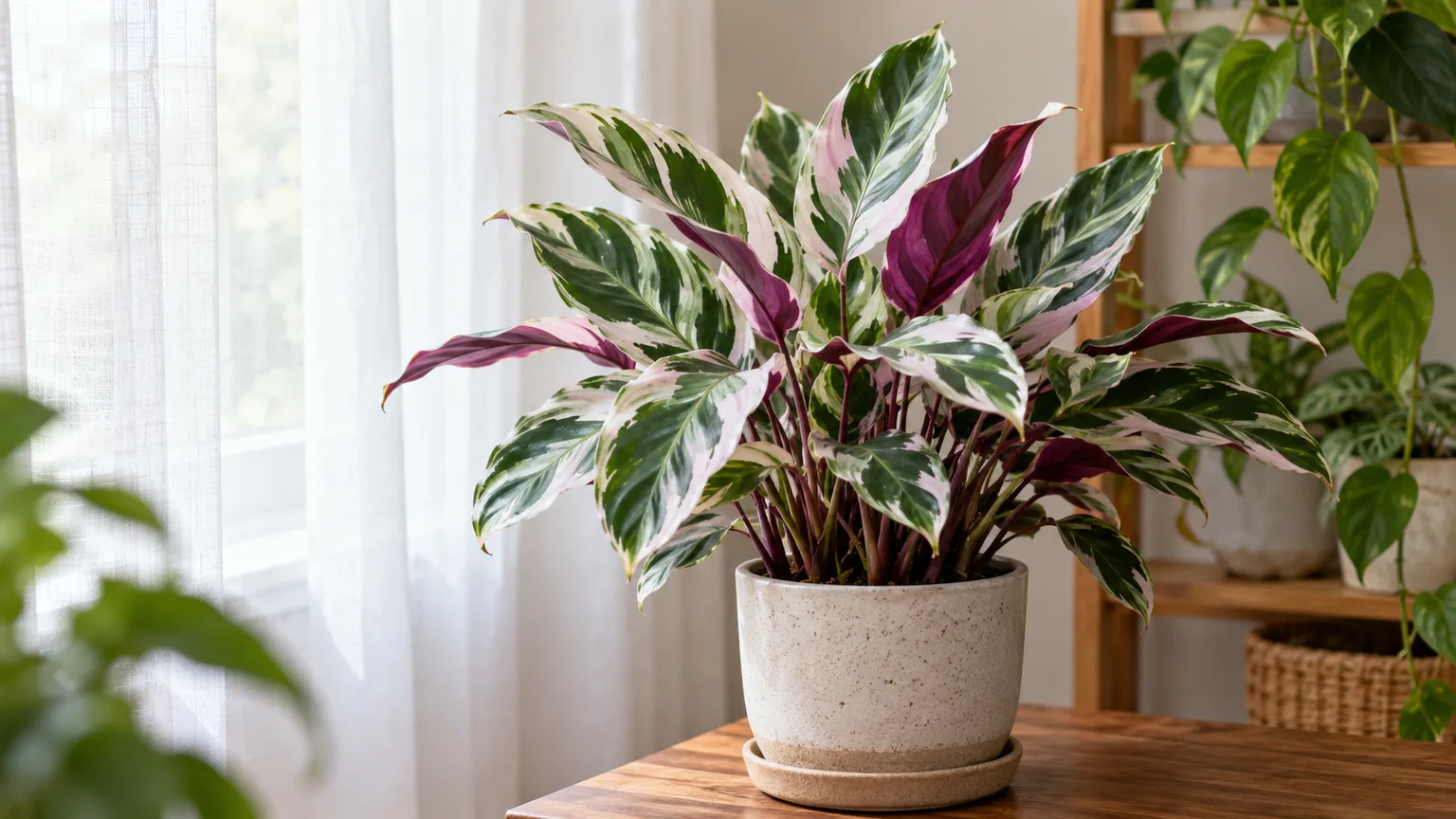
Calathea ‘White Fusion’ is a compact tropical foliage plant for growers who can give it bright indirect light, warm steady air, high humidity, and consistently moist—but never waterlogged—potting mix. The most reliable routine is to check the root zone before watering, use low-mineral water, and change one environmental factor at a time when the leaves look stressed. Its white, green, and lilac marbling is beautiful, but those pale sections can show damage sooner than the greener parts of the leaf.
The plant is also sold under the botanical name Goeppertia lietzei ‘White Fusion’; older plant labels may say Calathea lietzei. The newer genus name matters when you look up care or taxonomy, but it does not change how you grow the plant. Focus on steady indoor conditions rather than chasing a perfect number or responding to each curled leaf with a splash of water.
White Fusion at a glance
White Fusion is a rhizomatous, clump-forming perennial in the Marantaceae, or arrowroot, family. Its elliptic leaves rise on slender petioles and combine white, light green, dark green, and pink-purple tones; each leaf has its own pattern, so a new leaf will not be a copy of the last. NC State Extension describes the species as a compact plant that can reach about 16 inches tall and wide, while the Royal Horticultural Society lists the cultivar at roughly 10 to 50 centimeters. Gardenia’s cultivar profile gives a similar 12- to 18-inch range; in a home, allow roughly a 1- to 2-foot footprint depending on growing conditions. (NC State Extension Plant Toolbox; RHS profile for Goeppertia ‘Fusion White’; Gardenia cultivar profile)
| Care factor | Practical target | Avoid |
|---|---|---|
| Light | Bright, indirect light or partial shade | Strong midday or afternoon sun |
| Water | Keep the mix evenly moist; water after the surface starts to dry | A rigid weekly schedule or standing runoff |
| Humidity | Aim for a consistently humid room, around or above 60% if practical | Dry heater or air-conditioning drafts |
| Temperature | Ordinary warm room conditions, ideally about 65–75°F (18–24°C) | Cold windows, sudden drops, hot vents |
| Potting mix | Moisture-retentive and free-draining, in a pot with drainage | Dense soil and an oversized pot |
| Propagation | Divide a healthy clump in late spring | Leaf-only cuttings without rhizome or roots |
Use these values as starting points, not guarantees. A plant in a small nursery pot beside a warm, bright window loses moisture faster than the same cultivar in a cool room or a larger container, so the soil and leaves tell you more than a calendar does.
Set up a location it can stay in
A stable location makes every other care decision easier. Choose a bright room with filtered light, enough warmth for steady growth, and no direct blast from a radiator, exterior door, or air-conditioning vent. White Fusion can adapt to a home, but repeated moves between a dim shelf, a sunny sill, and a humid bathroom create more stress than a single imperfect location.
Set it where you can inspect the leaves and lift the pot without disturbing it. If you use a decorative cachepot, keep the plant in a nursery pot with drainage holes inside it and empty any water that collects after irrigation. Avoid placing the pot directly against a cold window in winter, even when that window seems like the brightest spot.
Give it bright, filtered light
Bright indirect light is the useful middle ground: the room is bright enough to read in during the day, but the leaf blades are not exposed to hours of hot direct sun. An east-facing window with gentle morning light or a position a few feet back from a strong south- or west-facing window often works. A sheer curtain can soften direct rays. The RHS cultivar profile recommends partial shade, while NC State and the general RHS calathea guide recommend bright indirect light; all point away from harsh direct exposure. (RHS cultivar profile; NC State Extension; RHS Calathea growing guide)
Strong sun can fade or scorch thin foliage, particularly the pale variegated portions. Move the plant back or filter the window if damage appears on the side facing the glass, or if the leaf surface looks bleached and papery. Make the change gradually: a move from a dark room to intense window light can scorch leaves even when the new spot seems like an improvement.
Very low light is not a safer version of indirect light. It slows growth and reduces water use, leaving the mix wet longer; the plant may also produce fewer leaves or lose visual contrast. If a room stays dim, use a grow light at a moderate distance on a consistent daily schedule, and check the soil more often during the first few weeks after changing light.
Hold warmth and humidity steady
NC State Extension places the species’ comfortable temperature range around 65–75°F (18–24°C) and recommends humidity above 60 percent. The RHS likewise advises warm, humid conditions and a stable temperature above 16°C, away from drafts. These are useful targets for a plant with thin tropical foliage, not a reason to chase a precise humidity reading minute by minute. (NC State Extension; RHS cultivar profile)
A small digital hygrometer can tell you whether the room is actually dry. If the reading sits below 40 percent for long stretches, especially while a furnace or air conditioner is running, a room humidifier is the most predictable way to raise humidity around several plants. Keep the humidifier clean and place it so moisture reaches the plant without soaking leaves or walls.
A pebble tray may create a slightly more humid pocket immediately above its surface, but it cannot turn a dry room into a greenhouse. If you use one, set the pot on pebbles above the water line so the drainage holes do not sit in standing water. Grouping plants may make a modest local difference, and a naturally humid, well-lit bathroom can work; misting briefly wets the leaf but does not keep room humidity consistently high.
Warmth matters alongside moisture. Keep the plant away from cold drafts and rapid changes near doors, windows, radiators, fireplaces, or HVAC vents. A room that stays comfortably warm for people is generally more useful than a hot greenhouse-style enclosure that traps stagnant air and leaves foliage wet.
Choose a potting mix that stays airy
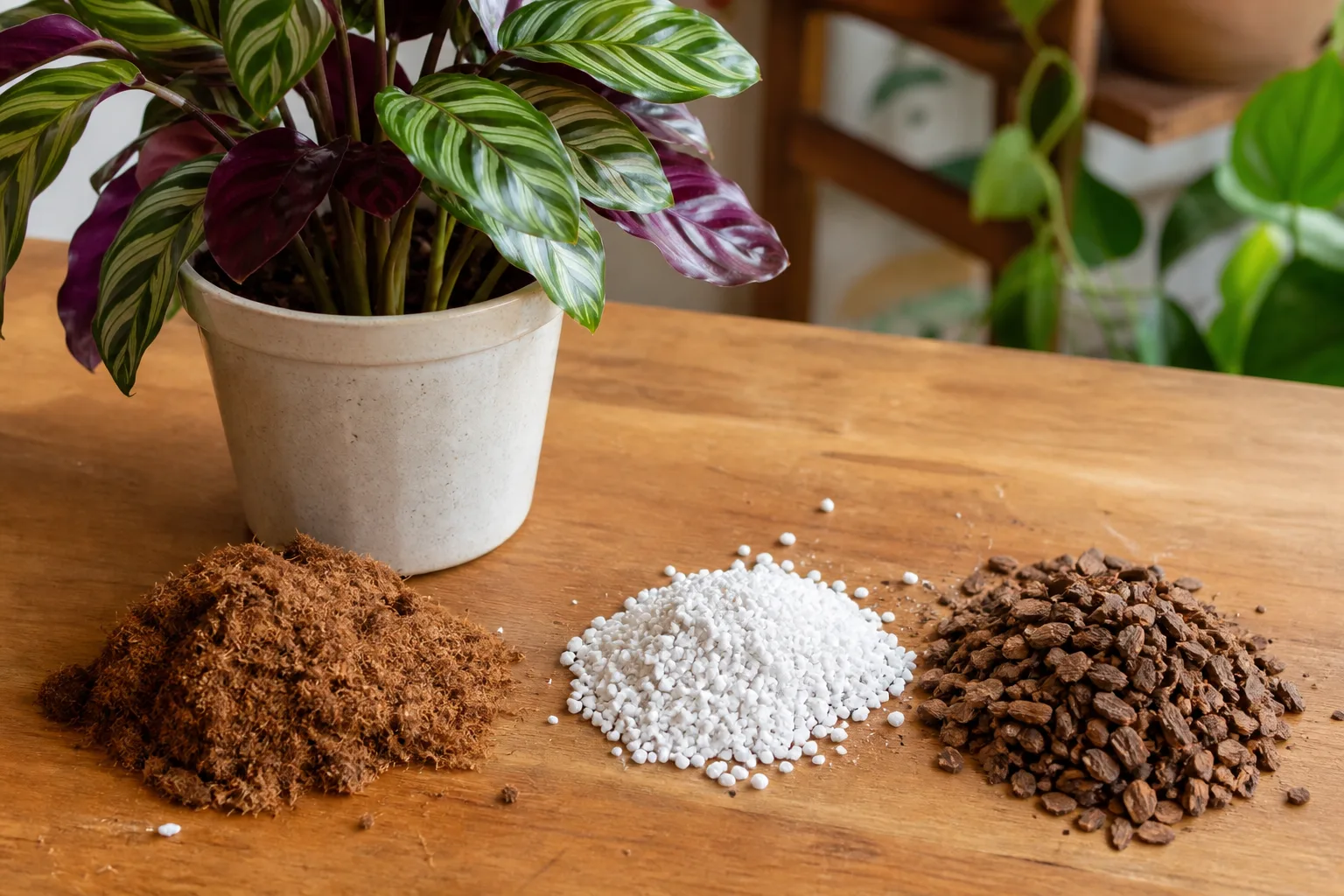
White Fusion needs a mix that holds some moisture without collapsing into a dense, airless mass. The RHS cultivar profile recommends peat-free potting compost, and NC State specifies a moist, well-drained mix amended with perlite or vermiculite. A practical home blend is two parts indoor potting mix or coco-based compost, one part fine orchid bark, and one part perlite or pumice. Adjust the proportions to your room: use a little more aeration if the pot stays wet, and a little more moisture-retentive base if it dries very quickly. (RHS cultivar profile; NC State Extension)
The right texture matters more than a named recipe. After watering, excess should run through the drainage holes, while the mix remains lightly damp around the fine roots rather than turning to mud or drying into a hard block. Epic Gardening’s general calathea guidance also emphasizes an airy, moisture-retentive mix and a pot with drainage; treat those genus-level principles as a starting point, then adjust the texture to your room and container. If water runs straight down the sides while the center stays dry, the mix may have become hydrophobic; rewet it slowly and consider refreshing it at the next appropriate repot. (Epic Gardening’s Calathea care guide)
Use a pot with open drainage holes and a diameter only modestly larger than the rootball. A huge decorative pot may look proportional to the leaves, but the unused mix around the roots can stay wet for too long. If you want a cachepot, use it as a cover and remove the nursery pot for watering or empty it after drainage.
Water by checking the mix, not the calendar
The goal is evenly moist soil with oxygen still available to the roots. Check the top inch or so of the mix with a finger near the pot edge; if it still feels cool and damp, wait. When the surface layer has begun to dry and the pot feels noticeably lighter than after watering, soak the mix thoroughly until water drains from the bottom, then empty the saucer or cachepot.
That procedure is more reliable than watering every seven days. Room temperature, pot size, light, humidity, and soil all change the dry-down rate; a pot that needs water every few days in active summer growth may take much longer in a dim winter room. Use a calendar as a reminder to inspect, not as an instruction to pour.
Avoid letting the rootball become bone dry for long periods, but do not interpret a curled leaf as proof that the plant needs water. Leaves can curl in dry air, cold, or stressed roots, and adding water to an already-wet pot can compound the problem. If the top seems dry but the pot is heavy, check a little deeper at the edge with a wooden skewer before watering.
Choose water with low mineral risk
NC State recommends filtered or distilled water for Goeppertia lietzei, noting that fluoride in tap water can contribute to leaf browning. The RHS general calathea guide says the group prefers rainwater and notes that some plants tolerate tap water left to stand for at least 24 hours, which allows chlorine to evaporate. Standing does not reliably remove fluoride, dissolved salts, or every disinfectant used in municipal supplies, so rainwater, distilled water, or a filter rated for fluoride is the more cautious choice if new leaf margins keep browning. (NC State Extension; RHS Calathea growing guide)
Use room-temperature water and apply it to the potting mix rather than pouring over the leaves. If tap water has worked and the plant is producing clean new foliage, there is no need to switch on principle; instead, look for visible white crust, repeated brown margins, and local water-quality information. Do not use softened household water as a substitute for filtered water because it can add sodium.
Feed lightly while it is growing
New leaves use nutrients, but White Fusion does not benefit from heavy feeding. During active growth in spring and summer, use a balanced liquid houseplant fertilizer at the diluted rate on the label or a conservative half-strength dose if your mix has no slow-release fertilizer. The RHS recommends monthly balanced liquid feeding during the growing season and no feeding in autumn or winter; NC State also recommends modest feeding rather than high-nitrogen dosing. (RHS cultivar profile; RHS Calathea growing guide)
Feed only when the plant is warm and producing new growth. If it is recently repotted, stressed, or sitting in cool, saturated mix, solve that problem first. Fertilizer does not repair brown tissue or compensate for poor light; extra salts can make leaf edges worse, especially when the pot never gets an occasional thorough rinse.
If you see a crust around the soil surface or pot rim, pause feeding and water the mix thoroughly so excess drains away. If the plant is healthy but has not grown in winter, waiting is safer than applying fertilizer on a monthly schedule just because the calendar says so.
Clean leaves and prune only what is spent
Dust on broad leaves blocks some light and makes it harder to notice spider mites, scale, or new damage. Support each leaf from underneath and wipe it gently with a soft damp cloth; do not scrub the pale marbling, use leaf-shine products, or repeatedly wet the foliage in a cool, poorly ventilated room. Clean leaves with plain water and let them dry in normal room airflow.
White Fusion does not need routine shaping. Use clean scissors to remove a fully dead or badly damaged leaf close to its base, without cutting into the crown or neighboring petioles. A brown tip will not turn green again, so you can leave it, trim only the dead portion along the leaf’s natural outline, or remove the whole leaf if most of it has failed.
Do not strip away several leaves at once to make the plant look tidy. Each healthy leaf contributes energy to the clump, and the plant may need several weeks or months to replace a large loss. If damage is spreading, diagnose light, water quality, humidity, drainage, and pests before pruning heavily.
Repot when the clump actually needs room
The RHS recommends repotting calatheas every few years once the clump has filled its pot, typically in spring or summer. You do not need to repot every year just because the plant has grown; repot when roots circle densely, emerge through the drainage holes, or the mix has broken down and no longer drains evenly. A plant that is still growing normally in a stable pot can stay put. (RHS Calathea growing guide; RHS cultivar profile)
Move up one pot size rather than several. Choose a container only a little wider than the clump, use fresh moisture-retentive but free-draining mix, and set the rootball at its original depth. Keep the rhizomes and crown covered at the same level they were before; burying the crown deeply can trap moisture around the stems.
After repotting, water to settle the mix and let excess drain. Return the plant to warm, indirect light and keep its routine steady while it recovers. Avoid dividing, repotting, relocating, and fertilizing all in the same week; making one change at a time helps you identify what the plant responds to.
Propagate by division, not a leaf cutting
White Fusion grows from rhizomes into a clump, so the dependable home propagation method is division. A detached leaf or petiole without a piece of rooted rhizome does not contain the growth point needed to form a complete new clump. NC State lists division as the recommended propagation strategy for G. lietzei, and the RHS cultivar page specifically recommends division in late spring. The scrape’s leaf-node cutting instructions should not be followed for this plant. (NC State Extension; RHS cultivar profile)
Divide only a healthy, established plant that has several rooted shoots. Spring or late spring, when active growth is resuming, gives divisions a better chance to re-establish than a cold, dark winter. Water the parent plant the day before if the rootball is dry, and prepare clean pots, fresh mix, and a sterilized sharp knife before you remove it.
- Slide the plant out while supporting the base of the clump; do not pull on the leaves.
- Gently loosen enough mix to see how the rhizomes and roots connect. Look for natural sections with their own roots and at least one healthy shoot or growth point.
- Separate a natural division by hand if it releases cleanly. If you must cut, make one clean cut through the rhizome with a disinfected blade; avoid chopping the clump into tiny pieces.
- Pot each division at the original depth in a container sized to its roots. Water thoroughly and drain.
- Keep the new plants warm, in bright indirect light and humid air, with the mix evenly moist but not soggy. Do not fertilize until you see stable new growth.
A small division may pause while it rebuilds roots, so judge success by firm stems and new spears rather than expecting instant leaf growth. If the parent plant is already declining, address its light, water, or root problem before multiplying it; division spreads a healthy clump, not a cure for rot.
Read the leaves before changing care
Calathea leaves naturally move with the day-night cycle, folding or lifting at night and opening again in daylight. That normal movement is different from a leaf that stays tightly curled all day, wilts against wet soil, or develops new crispy patches. Note which leaves are affected, how quickly symptoms appeared, and whether the soil was wet or dry before making a change.
White Fusion is especially revealing because the white tissue can show edge damage before the greener areas do. That does not mean every brown spot is a water-quality problem or that every curl needs extra humidity; compare the symptom with recent changes in light, room air, watering, and fertilizer.
Brown edges, curls, and faded patterns
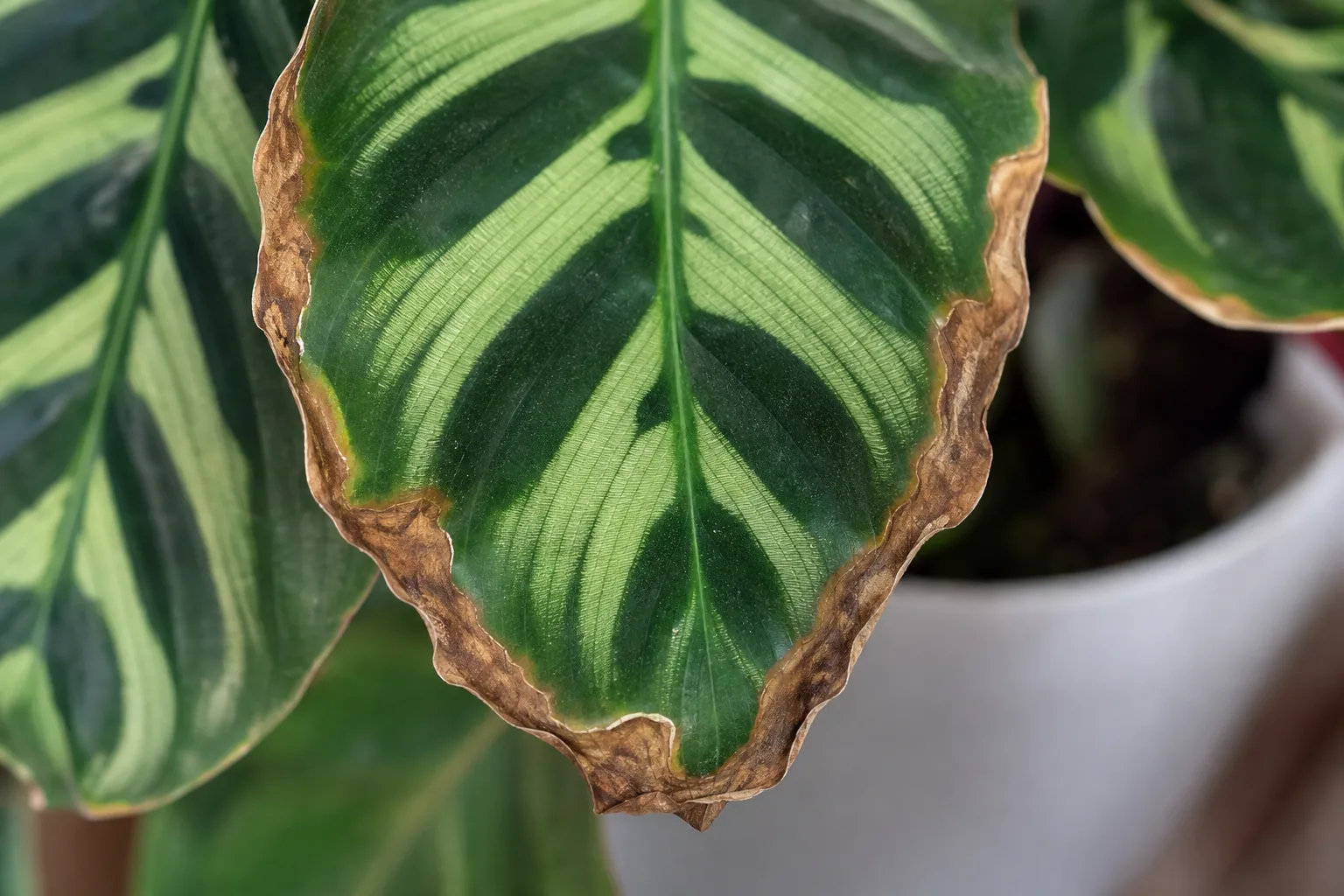
Crispy brown margins can follow low humidity, direct sun, irregular root moisture, fluoride or mineral buildup, or excess fertilizer. Start with the location: damage concentrated on the window-facing side points toward direct sun or heat. Damage on several leaves after a dry heating season makes low humidity more plausible, while a white crust and repeated brown margins make water or fertilizer salts worth checking. The RHS lists dry air as a common cause of calathea edge browning, and NC State flags low humidity and fluoride as risks for G. lietzei. (RHS Calathea growing guide; NC State Extension)
Use a hygrometer and inspect the mix before adding water or misting. If the plant is in direct sun, move it back gradually. If humidity stays low, improve the room conditions with a humidifier; if the new white tissue keeps browning despite good moisture and humidity, trial low-mineral water for several new leaves. Existing brown tissue will remain brown, so judge the adjustment by what unfolds next.
A faded or less distinct pattern can reflect insufficient light, while pale scorch marks often follow too much direct sun. Move toward brighter filtered light in small steps, then reassess after the next leaves form. Do not increase fertilizer to force stronger variegation; leaf patterns are genetic and environmental, and nutrients cannot convert a white sector into green tissue.
Yellow leaves, droop, and wet soil
One aging lower leaf can yellow as the clump grows, but several yellow leaves alongside a persistently wet, heavy pot point to a root-zone problem. Empty standing runoff, stop watering until the upper mix begins to dry, and make sure the pot has clear drainage. If the mix smells sour, stems soften at the base, or the plant wilts while the rootball remains wet, slide it out carefully and inspect the roots for brown, mushy tissue.
If the roots are firm and the mix is dry, rehydrate thoroughly and review how long the plant has been drying between waterings. If leaves curl while the mix is damp, do not pour more water; check humidity, cold drafts, and root health first. The same leaf posture can come from different causes, so use soil condition and recent room changes to choose the next step.
If you need a symptom-specific diagnosis, use the Calathea White Fusion problem guides and the broader Calathea care guide after correcting the basic environment. A single adjustment followed by observation is more informative than combining a rescue repot, extra water, misting, and fertilizer.
Check for pests before treating symptoms
Inspect the undersides of leaves, petiole joints, and the crown when new stippling, fine webbing, cottony clusters, sticky residue, or small moving insects appear. Spider mites, aphids, mealybugs, and scale can affect calatheas; NC State and the RHS both list common sap-feeding pests for this group. Keep a newly affected plant away from the rest of the collection while you confirm what you are seeing. (NC State Extension; RHS cultivar profile)
For a light infestation, rinse foliage and wipe leaves while protecting the potting mix from staying saturated. If you use insecticidal soap or another labeled product, follow its label for indoor use, test a small area first, and keep the plant away from direct sun until treated foliage is dry. Do not apply a pesticide simply because the leaves are brown: environmental stress and pests can look similar, and unnecessary treatment can damage delicate leaves.
Check the neighboring plants too, especially if you find webbing or insects under the newest leaves. Repeat inspections over the next few weeks because eggs and hidden insects may be missed in a single cleaning. Quarantine and careful monitoring are safer than escalating to a broad chemical treatment without confirming the pest.
Keep flowering expectations modest
White Fusion is sold for its foliage, and indoor flowering is uncommon. The RHS notes that the cultivar may produce short stems of greenish-white flowers in summer, but it is usually grown for its patterned leaves; NC State also describes the flowers as rarely seen on a houseplant. If a mature plant blooms, treat it as a bonus rather than a sign that you have discovered a special feeding trick. (RHS cultivar profile; NC State Extension)
Give it steady care rather than trying to trigger a bloom with extra fertilizer, stronger sun, or letting it dry out. Those changes can damage the foliage without making flowering more likely. Remove a spent flower stem near its base if it looks untidy, but leave healthy leaves in place.
Is Calathea ‘White Fusion’ safe for pets?
The ASPCA lists Calathea species as non-toxic to cats, dogs, and horses. That is useful household context, though the listing is at the genus level rather than a separate laboratory assessment of this cultivar. Keep the plant out of reach if a pet chews houseplants: non-toxic does not mean that eating leaves is beneficial, and chewing can still upset an animal’s stomach. (ASPCA Calathea listing)
NC State notes that sap may irritate sensitive skin, so wear gloves when dividing or wash your hands after handling cut tissues. If a pet eats a large amount or develops concerning symptoms, contact a veterinarian and provide the plant’s name. For rabbits, birds, and other animals, do not assume a cat-and-dog listing proves safety for every species.
Conclusion
Grow Calathea ‘White Fusion’ in bright filtered light, keep it warm and humid, and maintain an airy mix that stays lightly moist without trapping water. Check the soil before watering, choose rainwater, distilled water, or suitable filtered water when tap-water minerals seem to affect new leaves, and feed modestly only during active growth.
When trouble appears, diagnose the location and root zone before changing several things at once. Brown edges, curling, and yellowing are clues rather than diagnoses; compare them with humidity, light, water quality, and drainage. If you want another plant, divide a healthy rhizomatous clump in late spring, then let the new section settle into the same stable conditions that suit the parent.