How to Grow and Care for Bugleweed
Ajuga makes colorful ground cover, but its runners need a plan. Learn spacing, light, watering, division, cultivar choices, and practical ways to keep it contained.
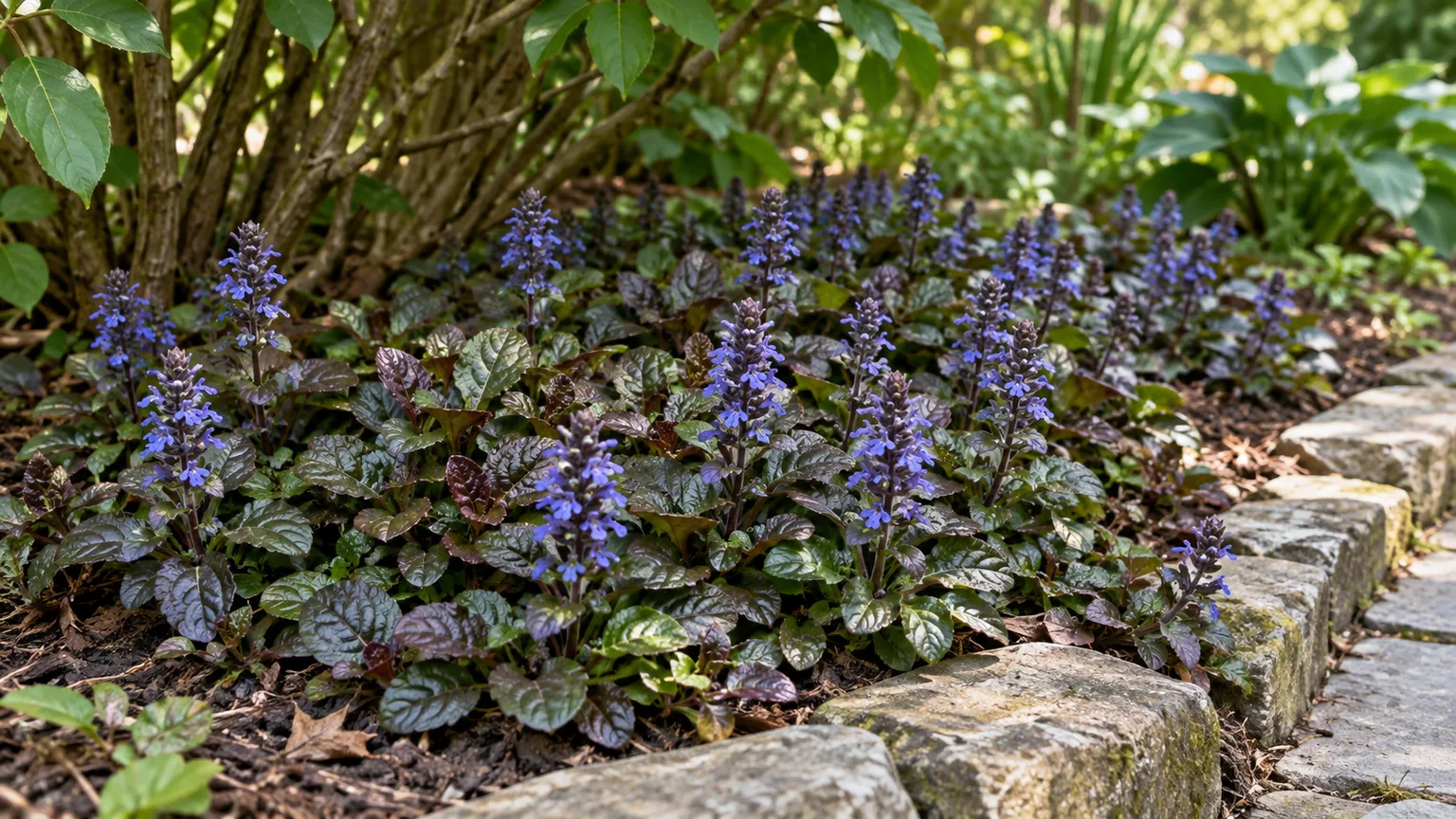
Bugleweed (Ajuga reptans), also called carpet bugle, is a low perennial that fills the ground with glossy rosettes and short blue-violet flower spikes in spring. It is useful where a dense, shade-tolerant cover is welcome, but its runners root as they travel, so the best care plan starts with choosing a place that can handle a spreading plant.
Plant it where you want a living carpet, keep the root zone moist but draining, and check the edges regularly. If you want a plant that stays in a neat little clump without attention, choose a different ground cover.
Bugleweed at a glance
| Feature | What to expect |
|---|---|
| Botanical name | Ajuga reptans |
| Plant type | Low-growing herbaceous perennial ground cover in the mint family, Lamiaceae |
| Foliage | Green, bronze, burgundy, chocolate, or variegated, depending on cultivar; usually 4–12 inches tall |
| Flowers | Upright blue to violet spikes are most common; some cultivars flower pink or white |
| Bloom season | Usually spring into early summer, depending on climate |
| Light | Partial or dappled shade; some sun is tolerated when soil stays evenly moist |
| Soil | Moist, fertile, and well drained; avoid places that remain waterlogged |
| Spread | Surface runners (stolons) root at nodes and make new rosettes |
| Hardiness | Often listed for USDA zones 3–9, but confirm the specific cultivar and local nursery rating |
| Main caution | Can move beyond a bed into lawn or natural areas; check local invasive-plant guidance before planting |
The plant is sometimes evergreen or semi-evergreen in mild climates, but foliage can thin or look tired after a harsh winter. Do not judge its health only by winter color; check for firm crowns and fresh growth once spring conditions return. The Royal Horticultural Society describes bugle as a spreading perennial with spoon-shaped leaves and late-spring to early-summer flowers, while University of Illinois Extension lists it for zones 3–9 and notes its tendency to creep into turf (RHS plant profile, Illinois Extension).
Is ajuga the right ground cover for your site?
Where it earns its space
Ajuga is a strong candidate for a shady, low-traffic patch where turf thins, bare soil needs cover, or a slope needs a planted surface. Its tight foliage can shade the soil and reduce open gaps where weeds establish, though no ground cover eliminates weeding during the first season. On a bank, the spreading mat is useful once it has rooted in; on a narrow strip beneath shrubs, it can cover soil that is awkward to mow.
The plant’s spring spikes add a vertical accent above a short carpet. North Carolina Extension’s plant toolbox lists ajuga as a perennial ground cover and notes that its flowers attract bumblebees and other wildlife. It also makes a useful layer below taller shade plants such as hostas and ferns, where the larger leaves create contrast and the ajuga fills the front edge.
Treat it as a look-at ground cover, not a path surface. Bugleweed’s shallow mat can be flattened by repeated stepping, and gaps from traffic invite weeds back into the bed. It may soften the border beside stepping stones or a patio, but keep the walking line on the stones themselves. Garden Design also recommends it for beds, slopes, and containers rather than relying on it for regular foot traffic (Garden Design).
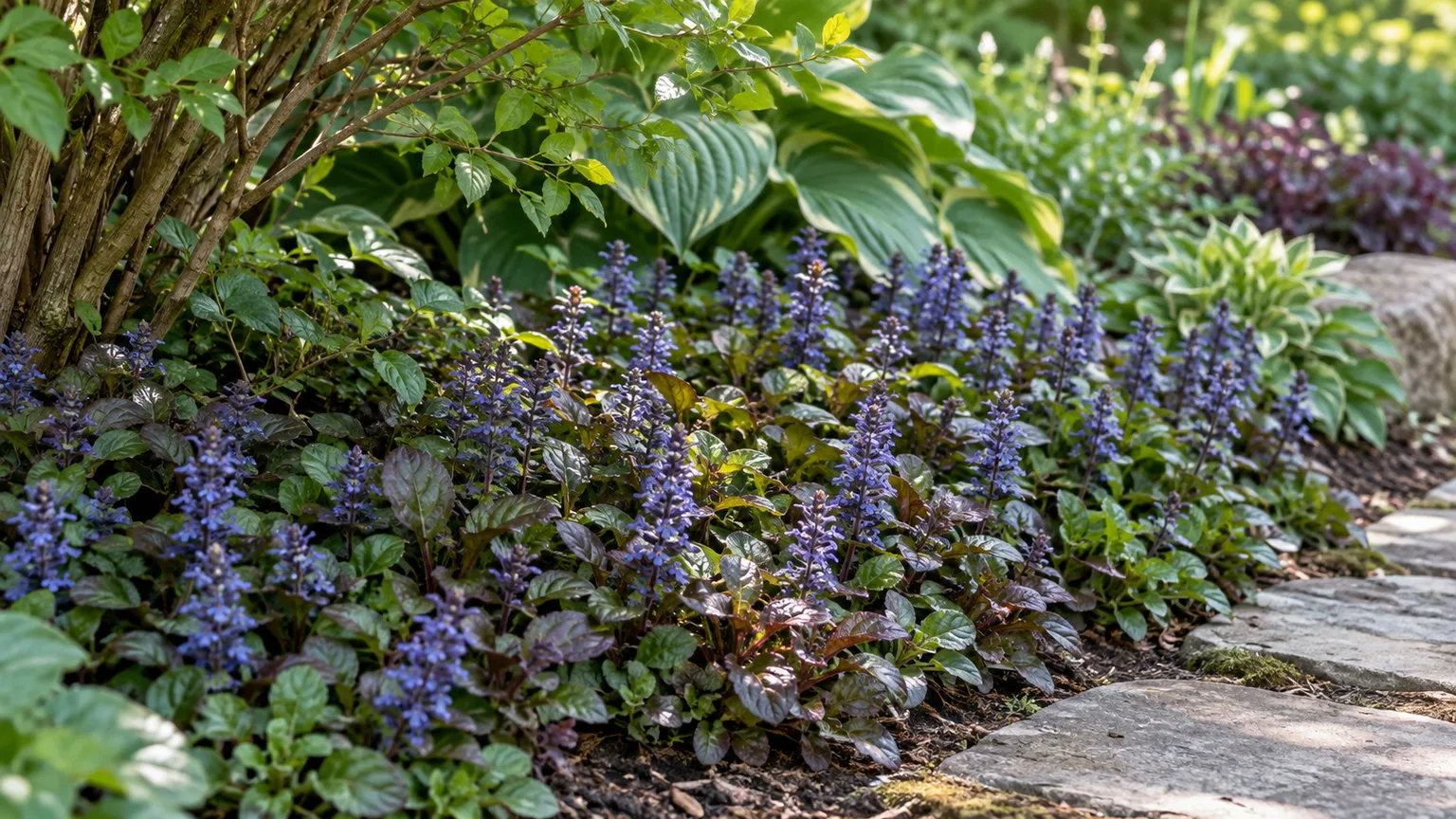
That speed is a benefit only when the site has a clear boundary. Iowa State Extension calls bugleweed a spreading plant and advises against using it as edging next to grass because it can move readily into the lawn (Iowa State Extension on aggressive plants). If the bed touches a lawn, pathway joints, or a natural area, plan a barrier and a regular inspection before buying a flat of plugs.
Where its spread becomes a liability
“Ground cover” does not mean “contained.” Bugleweed sends out slender stolons along the surface; where a runner’s nodes touch suitable soil, they can root and form another rosette. In a small courtyard, mixed perennial border, or finely edged lawn, that means a single escaped runner can become a rooted satellite plant before the original mat looks oversized.
Regional status also matters. The Invasive Plant Atlas of the United States records states that list this species as invasive or regulated, and University of Florida IFAS rates it as an invasive plant not recommended for Florida landscapes. Those assessments do not mean it is legally prohibited everywhere; they mean you should check your state or regional invasive-species list and avoid planting it near wild woodland or stream edges where it is flagged (Invasive Plant Atlas, UF/IFAS plant profile).
If local guidance discourages Ajuga, do not try to solve that concern with more frequent trimming. Choose a locally appropriate native or non-invasive ground cover instead. If Ajuga is acceptable where you garden, use it where expansion is useful and accessible, not where a runner could disappear into an unmanaged neighboring space.
Choose a cultivar for your light and color
Cultivars change the look and sometimes the scale of the planting, but none turns this species into a guaranteed non-spreader. Choose color only after checking the site’s light and moisture. A dark-leaved form may need brighter light to hold its strongest color, while hot afternoon sun can scorch foliage if the soil dries.
Quick cultivar comparison
| Cultivar | Foliage or flower trait | Best use |
|---|---|---|
| ‘Black Scallop’ | Deep burgundy to near-black, scalloped leaves; blue flowers | A dramatic patch with dappled light and room for spread |
| ‘Burgundy Glow’ | Cream, pink, and burgundy variegation | Brightens a shaded bed; inspect for plain-green reverted shoots |
| ‘Chocolate Chip’ | Smaller, narrow leaves with bronze-brown tones | A tighter accent or container where a less vigorous selection is useful |
| ‘Catlin’s Giant’ | Larger bronze-green leaves and taller flower spikes | A bolder texture in a roomy border |
| ‘Alba’ | White flowers rather than the usual blue-violet | A light flower accent among green foliage |
Cultivar names and traits are supported by the NC State Extension Plant Toolbox, which lists selections including ‘Black Scallop,’ ‘Burgundy Glow,’ ‘Chocolate Chip,’ and ‘Catlin’s Giant.’ Garden Design’s cultivar guide describes ‘Chocolate Chip’ as a dwarf, less vigorous form and recommends matching a selection’s foliage and growth habit to the planting space (NC State Extension, Garden Design). Availability and exact performance vary, and labels sometimes use different names or synonyms; read the nursery tag rather than assuming every dark or variegated ajuga is the same cultivar.
For a small bed, start with one or two compact plants and observe them through a growing season before filling the whole border. For a large slope, a faster-spreading selection can make sense if local regulations allow it and maintenance access is safe. Variegated plants can also send out shoots that revert to plain green; remove those shoots at their point of origin if preserving the patterned foliage matters.
Planting bugleweed for an even carpet
Plant in spring or early fall, when the soil is workable and temperatures are moderate. Avoid setting out small divisions immediately before a heat wave or hard freeze. Before planting, remove persistent perennial weeds and loosen compacted soil; weeds that establish inside a dense ajuga mat are much harder to extract without disturbing the runners.
Spacing depends on how quickly you want coverage and how much control matters. UF/IFAS recommends planting on 6- to 12-inch centers for rapid establishment, while Garden Design gives 12 to 18 inches as a general landscape spacing. Use the closer end when fast closure is important and you can manage the edges; use wider spacing when you want to reduce initial density, lower plant cost, or assess the plant before committing to a large carpet.
For a rough shopping estimate, divide the bed area in square feet by the square of the spacing in feet. A 100-square-foot bed planted on a 12-inch grid needs about 100 plugs; at 18-inch spacing, plan on roughly 45 to 50, then adjust for the shape and edges of the bed. This is only a layout estimate, not a promise that the mat will close in a specific number of months. Soil moisture, competing tree roots, cultivar vigor, and growing-season length all change how quickly runners reach one another. If you are unsure about the site, start with a smaller patch and let it show you its pace before filling every gap.
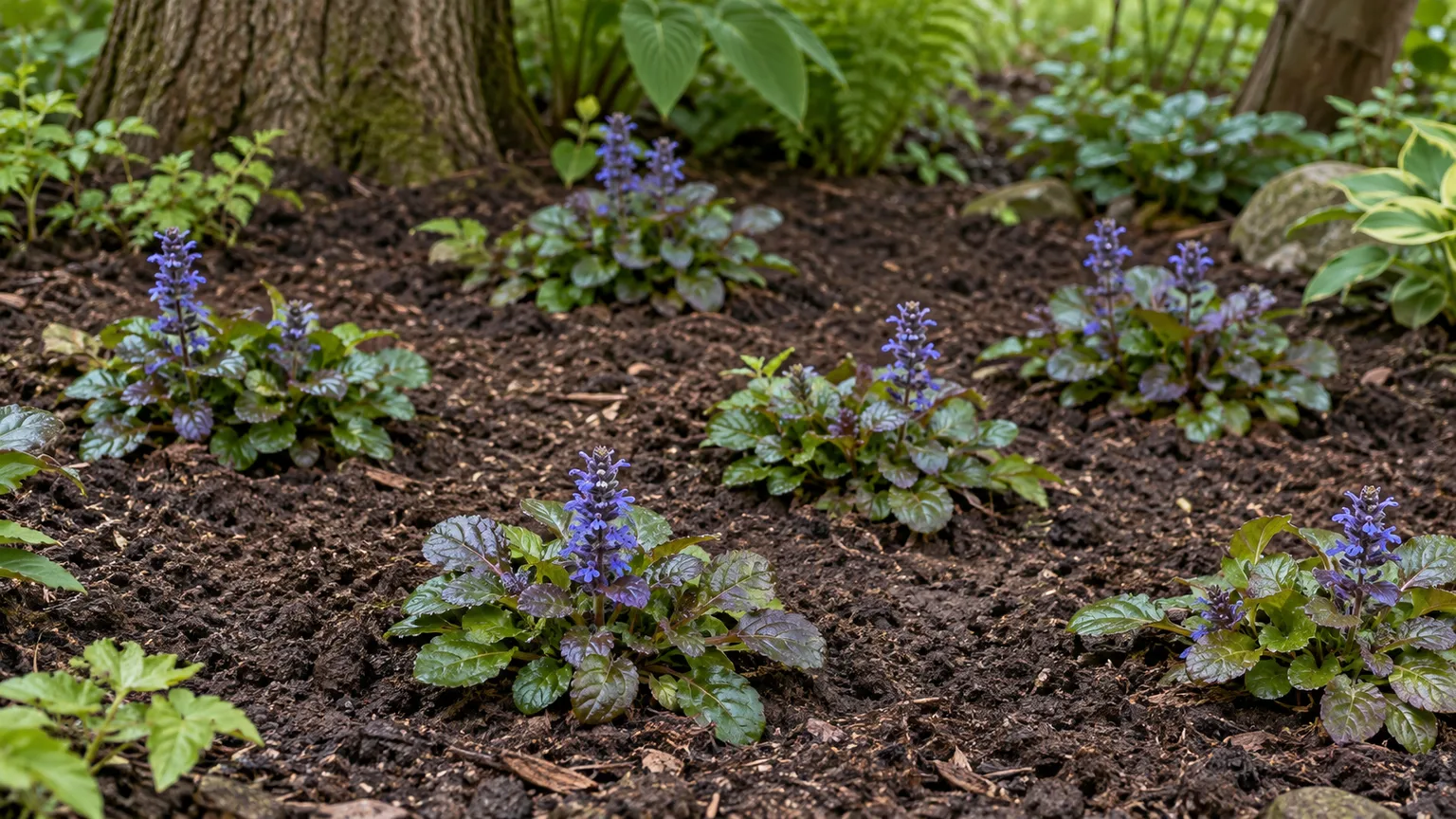
Set each plant at the same depth it grew in its nursery pot. Keep the crown—the point where leaves meet roots—at soil level; burying it in heavy or wet soil raises the risk of rot. Firm soil gently around the roots, water thoroughly, and add a thin layer of leaf mold or compost if the soil is poor. Do not pile mulch over the crowns or runners.
An even row is not essential for a naturalized planting. Staggering plugs gives runners room to meet, while a tight grid is easier to measure in a formal border. Either way, mark the intended boundary visibly and leave enough space to reach the outside edge for inspection.
Match light and soil before watering
Partial shade with reliable moisture is the safest starting point. Ajuga tolerates a range of exposures, but full sun in a hot climate can dry the root zone and scorch leaves. Dense shade may keep the plant alive while reducing flowers or muting the color of purple and variegated cultivars; the RHS notes that purple and patterned leaves can turn greener in deep shade.
Aim for moist, well-drained soil, not a constantly wet pocket. Organic matter helps hold useful moisture in sandy soil, while a compacted or low-lying site needs drainage attention before planting. If water remains on the surface long after rain, choose a different location or improve the site rather than burying the crown and hoping the plant tolerates it. UF/IFAS and NC State Extension both identify crown rot as a risk in soggy or heavy conditions (UF/IFAS, NC State Extension).
Do not assume the soil must be strongly acidic. A healthy, draining bed with moderate fertility is more important than chasing a pH number without a soil test. If other plants show nutrient or pH symptoms too, test the soil before adding amendments; random lime or fertilizer can create a new imbalance.
Water through establishment, then watch the weather
Water new plants thoroughly after planting and check them often during the first several weeks. The goal is to keep the root ball and surrounding soil evenly moist while roots spread into the bed. A light sprinkle that wets only the leaves does little; water at the soil surface long enough to reach the roots, then let excess drain.
As the mat becomes established, lengthen the interval between watering rather than keeping the surface permanently damp. Feel the soil below the mulch: if it is still cool and moist, wait; if the upper layer has dried and the weather is hot, water deeply. Ajuga can handle brief dry spells better once rooted, but a prolonged dry period can thin the carpet and weaken flower display, especially in sun or under thirsty tree roots.
In humid, rainy weather, more water is not better. Check whether the bed drains, lift a small section of foliage to inspect the crown, and reduce irrigation if the soil is staying wet. Overwatering symptoms can look like thirst—yellow leaves and collapse—so diagnose the drainage and crown before increasing the hose schedule.
Feed only when growth shows a need
Bugleweed usually does not need repeated fertilizer in an average garden bed. A modest addition of finished compost before planting is enough for many soils; after establishment, feed only if growth is poor and a soil test or broader garden evidence suggests low fertility. Too much nitrogen can push soft leafy growth without solving shade, drainage, or overcrowding.
If you use a granular product, follow its label and keep granules out of the rosettes. Water it in as directed. Do not apply fertilizer to a drought-stressed or waterlogged patch; first correct the moisture problem.
Contain runners before they escape
Containment is easier when a runner is a few inches long than when it has formed a new rooted rosette inside turf. Walk the edge during active growth and look for thin stems crossing the boundary. Where one has rooted, lift the whole node and its small root system rather than snipping off only the visible leaves.
Edge the boundary
Use a hardscape strip, path, or maintained bed edge to create a line you can inspect. A buried edging can help, but Ajuga runners travel at the soil surface, so an edge that sits flush with the ground may simply be crossed. Keep the border high enough to interrupt surface growth and trim or lift runners that go over it. No barrier removes the need to check the outside edge.
Avoid planting it directly beside turf if you dislike hand-weeding. Iowa State Extension specifically warns that bugleweed tends to move into grass. Where it is already escaping, pull or dig plants when soil is damp, trace runners back to rooted nodes, and repeat checks as new shoots appear. Do not rototill the patch: chopping crowns and runners can leave pieces behind and disturb the lawn.
If you need to shrink an established patch, work from the outside toward the area you want to keep. Loosen and lift small sections so you can follow each runner and remove the rooted rosettes, then inspect the cleared strip again after fresh growth appears. Under a tree or shrub, avoid turning the whole bed deeply; that can damage woody roots and bring buried weed seed to the surface. A few short rounds of careful lifting usually give you more control than one hurried cut that leaves living nodes behind.
For a small or formal space, a pot on a patio is a more dependable boundary than a narrow plastic strip in the ground. Invasive-plant disposal rules differ by location; keep uprooted material from being dumped in a wild area, and follow local green-waste instructions.
Tidy flowers and thin crowded mats
You can leave the flower spikes for their spring display, then shear or snip them off when they fade if you want a neater surface or fewer seeds. Deadheading does not stop the plant’s main route of spread—rooting runners—so keep monitoring the perimeter even after flowers are removed.
When the mat becomes crowded, open it up by lifting sections rather than cutting the entire planting down to the crowns. Better air movement and fewer wet, compressed leaves help reduce disease pressure. The Royal Horticultural Society lists powdery mildew as a possible disease, and Illinois Extension recommends removing old flowers and thinning occasionally to improve airflow and reduce stem disease risk (RHS, Illinois Extension).
Divide ajuga to renew and multiply it
Divide established patches in spring or early fall, when temperatures are mild and the soil is moist enough to work. This is both propagation and maintenance: it lets you reclaim plants from an overgrown edge, open a crowded center, and replant vigorous rooted sections where you want them.
Use a spade or garden fork to lift a small area at the edge of the colony. Pull apart sections that already have leaves and roots; if they are tightly knitted, cut through the mat with a clean knife. Keep divisions that have several healthy leaves and firm roots, and discard brown, mushy, or dead crowns. Replant each division at the original soil depth, water it in, and keep it evenly moist while it re-establishes. The RHS recommends separating rooted stems, and NC State lists division as a propagation method.
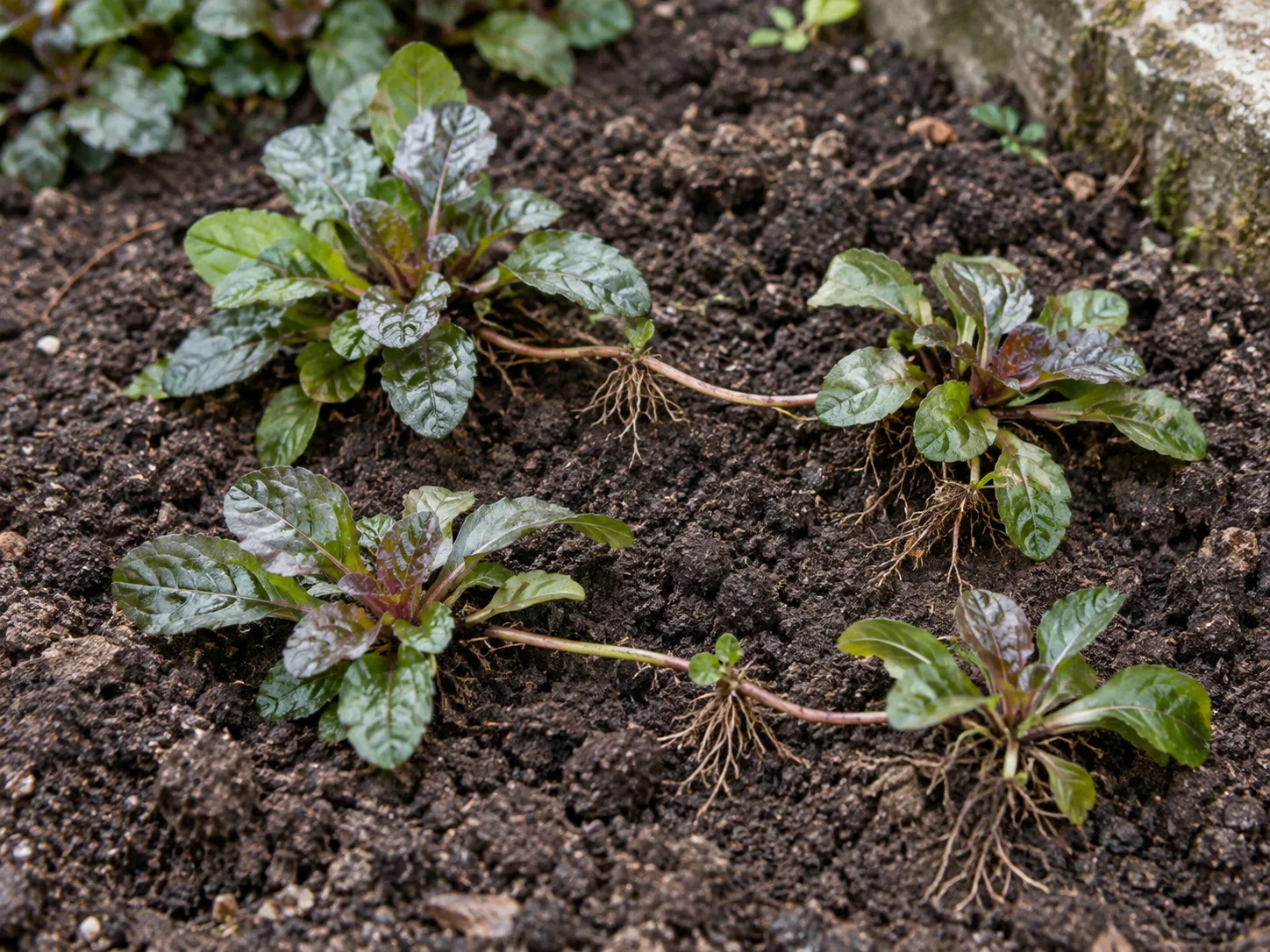
For an aging carpet, replace bare or weak patches with younger edge divisions instead of trying to make the center recover by adding fertilizer. That approach also lets you thin the bed in stages. If you want to reduce the colony, dispose of the surplus responsibly rather than passing it along or tossing rooted pieces where they can establish.
Grow bugleweed in a pot when boundaries matter
A container makes the spread easier to supervise, and the foliage can trail over the rim. Choose a pot with drainage holes and a mix that holds some moisture without staying saturated. Water when the top layer begins to dry, then empty any saucer that remains full after watering.
Check the pot’s drainage holes and nearby ground for roots or runners. If a trailing stem touches damp soil on a patio edge or adjacent planter, it may root there. Trim stems before they anchor, and divide the container when it becomes tightly packed. In cold climates, use a pot rated for outdoor freeze-thaw conditions and protect the root ball more than you would an in-ground planting; container roots experience colder swings than garden soil.
Diagnose yellow leaves, rot, and sparse growth
Yellowing is a symptom, not a watering instruction. If leaves yellow in a wet bed and crowns feel soft or smell sour, suspect excess moisture and crown rot; reduce irrigation, improve drainage, and remove collapsed tissue. If the soil is dry several inches down and leaves are crisping, water deeply and reassess exposure. A plant that stays green but loses the strong bronze or burgundy tone may simply be receiving too little light for that cultivar.
Sparse patches often point to a mismatch between site and plant. Under a mature tree, roots compete for water, so newly planted divisions may need more attentive watering than a nearby bed. In deep shade, flower spikes may be few; move a small trial division to brighter dappled light before relocating the whole mat. Crowded foliage in humid weather can also hide mildew or stem decline, so inspect inside the patch rather than treating the surface only.
Ajuga is generally low in pest problems, but aphids may cluster on tender flower stems. A firm spray of water can dislodge a small colony; avoid broad pesticide use around open flowers and pollinators. If plants repeatedly fail in the same saturated spot, replace them with a species suited to wet soil instead of replanting ajuga into the same conditions.
Conclusion
Bugleweed works best when you treat its spread as part of the planting plan. Give it a moist but well-drained, partly shaded site, choose a cultivar that fits the available light, and keep the crown at soil level. Then inspect the boundary while runners are still easy to lift.
Before planting, check whether Ajuga reptans is recommended where you live. In a permitted, contained bed, its dense foliage and spring flowers can solve a difficult ground-cover problem; in a lawn edge or a region where it is listed as invasive, a better choice is a locally appropriate alternative.