How to Grow and Care for Alocasia 'Dragon Scale' Indoors
Practical Alocasia 'Dragon Scale' care indoors: light, watering, soil, humidity, feeding, winter dormancy, pest control, repotting, and propagation guidance.
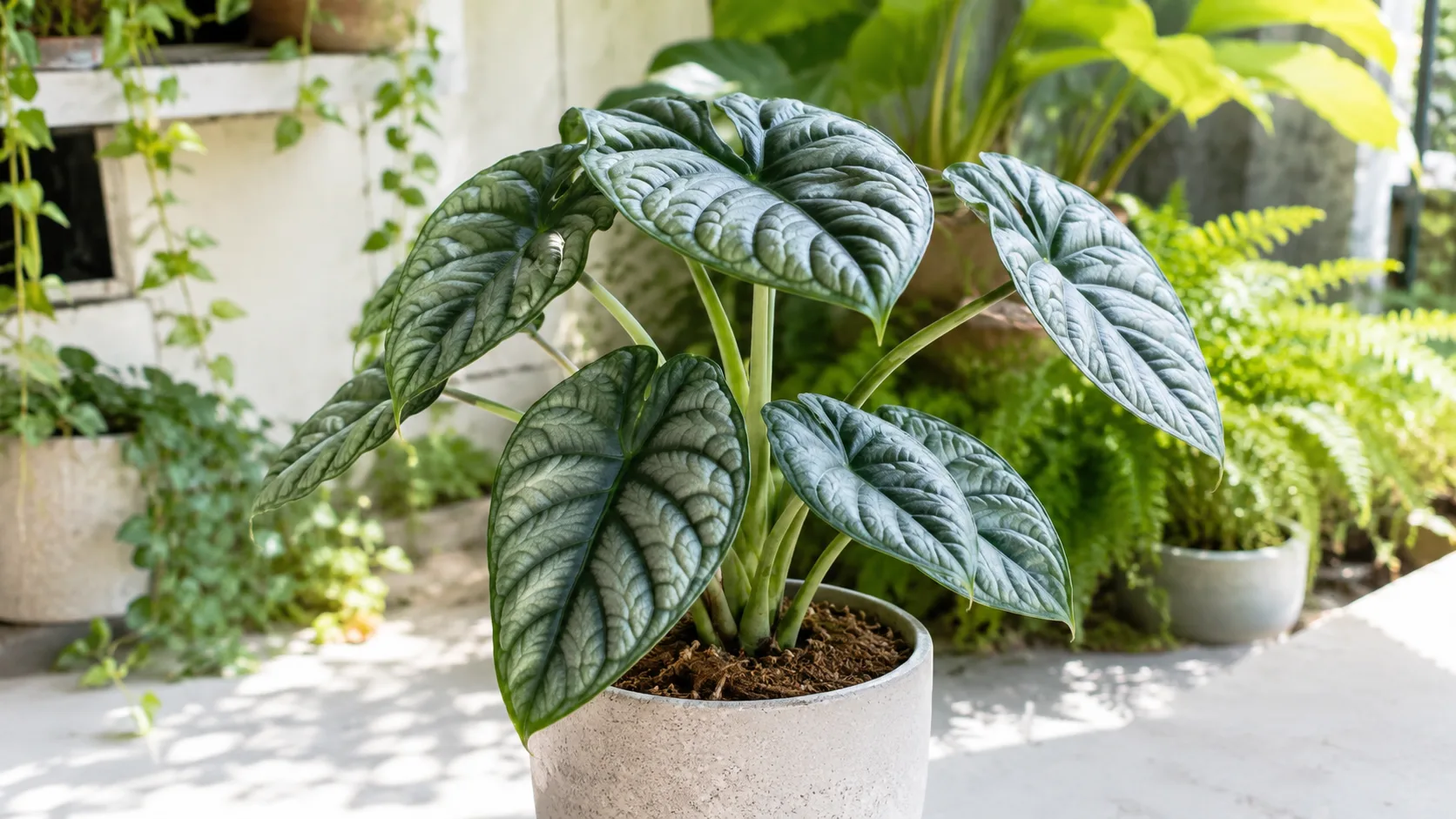
Alocasia ‘Dragon Scale’ (Alocasia baginda ‘Dragon Scale’) is a compact tropical aroid grown for its thick, deeply veined leaves. The texture looks almost embossed, and the plant stays smaller than the large elephant-ear types, but it still needs a warm, bright, carefully watered home to keep producing leaves.
The most reliable routine is simple: give it bright filtered light, use an airy potting mix, and water when the upper layer begins to dry rather than following a weekly schedule. Humidity helps, but wet roots, cold drafts, and sudden changes in care cause more trouble than a room that misses a perfect humidity number.
Quick care snapshot for Alocasia ‘Dragon Scale’
| Need | Practical starting point |
|---|---|
| Light | Bright, indirect light; a few feet back from strong afternoon sun |
| Water | Water when the top inch or two of mix is dry, then drain fully |
| Soil | Moisture-retentive but chunky mix with bark and perlite or pumice |
| Humidity | Aim for roughly 60% or higher if practical; stable air matters most |
| Temperature | A warm room, ideally about 65–80°F (18–27°C), away from drafts |
| Feeding | Diluted balanced fertilizer while new leaves are growing |
| Repotting | Move up only when roots fill the pot or the mix has broken down |
| Safety | Keep away from pets and children; the plant is irritating if chewed |
Treat these as a starting point rather than a rigid scorecard. NC State Extension’s genus-level guidance describes Alocasia as a plant of warm, shaded, moist but well-drained conditions; it also notes that ideal temperatures and mature size vary across the genus. For ‘Dragon Scale’, Ohio Tropics similarly recommends warmth, humidity, drainage, and a mix that does not dry completely, while the detailed growing notes at UK Houseplants emphasize adjusting water as growth slows. Those sources support the broad pattern; your plant’s pot and room determine the exact rhythm.
Identify the plant and understand its growth habit
‘Dragon Scale’ is a named cultivar of Alocasia baginda, a species native to Borneo, as UK Houseplants’ species profile notes. Its rounded, shield-shaped leaves have a dark green surface with raised veins and a lighter, sometimes silvery cast; the undersides can be darker or reddish. The plant grows from a thick underground storage structure and may produce offsets or small corms around the base as it matures.
Those underground parts explain why a healthy plant can recover after losing foliage, but they do not make it immune to rot. The corm and lower stem need oxygen as well as moisture, so a dense pot that stays soaked can destroy the plant even when the leaves look thirsty. A mature indoor plant may reach around 2 feet or more in favorable conditions, though growth and leaf size depend on light, warmth, and pot space.
The name is sometimes used loosely in retail listings, and young specimens can look different from mature plants. Look for the thick, embossed leaves and compact habit rather than expecting every leaf to be identical in color or size.
Choose a bright spot without harsh sun
Place the pot where it receives strong ambient light without long exposure to hot direct sun. An east-facing window is often an easy choice; a bright south or west window can also work if a sheer curtain or a little distance softens the midday and afternoon rays. A dim corner may keep the plant alive, but growth slows and the mix takes longer to dry, raising the risk of overwatering.
Watch the leaves rather than the window label. Pale patches or dry, tan areas on the side facing the glass point to sun scorch, while long petioles that lean toward a single window suggest the plant is reaching for light. Rotate the pot a quarter turn every week or two so newer leaves do not all crowd toward one direction.
If your brightest room is still dim, a grow light can support active growth during short winter days. Keep it far enough away that the leaves do not heat up, and change one condition at a time; moving the plant closer to light can make its pot dry faster, so recheck the soil before the next watering.
Water by checking the mix, not the calendar
Alocasia ‘Dragon Scale’ prefers a mix that stays lightly moist, but its roots should not sit in water. Start by checking the top inch of a small pot or the top inch or two of a larger pot. When that layer feels dry and the pot is noticeably lighter, water slowly until excess drains from the holes, then empty the saucer or cachepot.
A chunky mix may feel dry at the surface while the center still holds moisture. Push a clean finger or wooden skewer a little deeper near the pot edge, or learn the difference in pot weight just after watering and as it dries. If the skewer comes out cool and damp or the pot still feels heavy, wait and check again in a day or two.
The interval can shift from a few days in a warm bright room to much longer in winter, especially in a large plastic pot. Do not compensate for slow winter growth by giving small sips on a calendar; that keeps the center of the root ball wet while the surface dries. Water thoroughly when the plant needs it, then allow drainage and airflow to do their job.
Bottom watering is an option when a very airy mix sheds water before it wets evenly. Set the pot in shallow water for about 10 minutes, then remove it and let it drain completely. Use occasional top watering as well so soluble fertilizer salts do not accumulate in the mix.
Build a loose mix that holds moisture and air
A good mix should take up water, then release the excess quickly while leaving air pockets around the roots. A practical starting blend is two parts peat-free houseplant mix or coco coir, one part medium orchid bark, and one part perlite or pumice. If your room is cool or the pot dries slowly, add a little more bark or perlite; if it dries out in a day in a warm bright spot, keep slightly more fine organic mix.
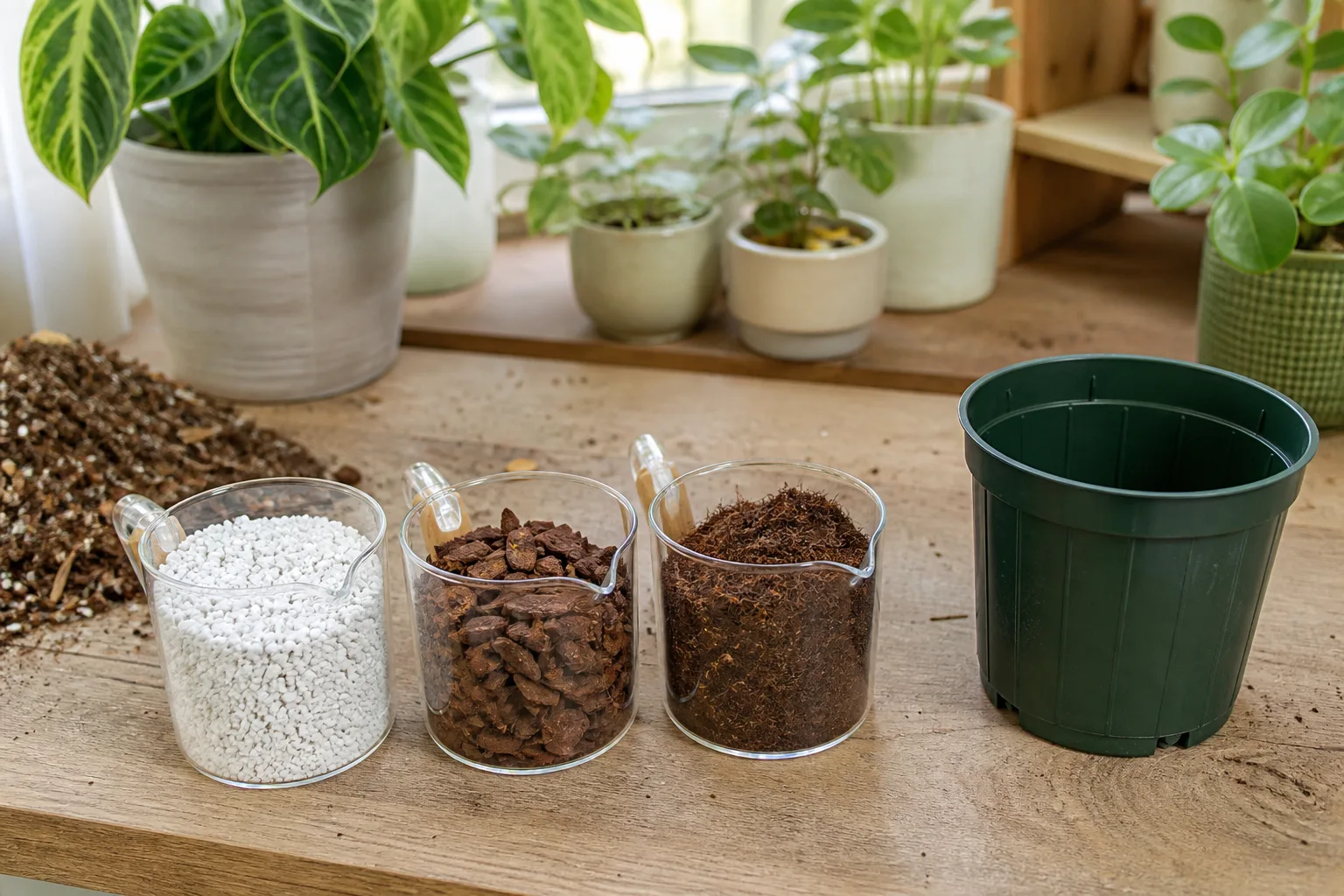
A commercial aroid mix is convenient if it is visibly chunky and does not pack into a dense block when wet. Avoid garden soil and heavy moisture-control mixes by themselves, because they can stay saturated in the lower part of an indoor pot long after the surface looks dry.
Choose a pot with open drainage holes and only a little room around the root ball. Decorative cachepots are fine if you remove the nursery pot for watering or make sure no runoff remains trapped inside. Adding stones to the bottom of a pot does not replace drainage holes and can leave the saturated layer closer to the roots.
There is no need to chase a special calcium-rich pH in a container. NC State Extension’s general Alocasia guidance calls for moist, humus-rich, well-drained soil that is slightly acidic; start with a stable aroid mix and do not add lime, bone meal, or other amendments unless you have a measured reason to do so.
Use humidity and warmth to protect new leaves
Dragon Scale usually produces its best foliage in warm, humid air, especially while a new leaf is unfurling. A practical target is around 60% relative humidity or somewhat higher if you can maintain it comfortably, but do not treat that number as a cliff. Ohio Tropics recommends 60–80% for Alocasia ‘Dragon Scale’; treat that as a useful range rather than a promise of failure below it. A steady room in the 50s with good light, consistent watering, and no hot vent may perform better than a humid room with cold, stagnant, waterlogged soil.
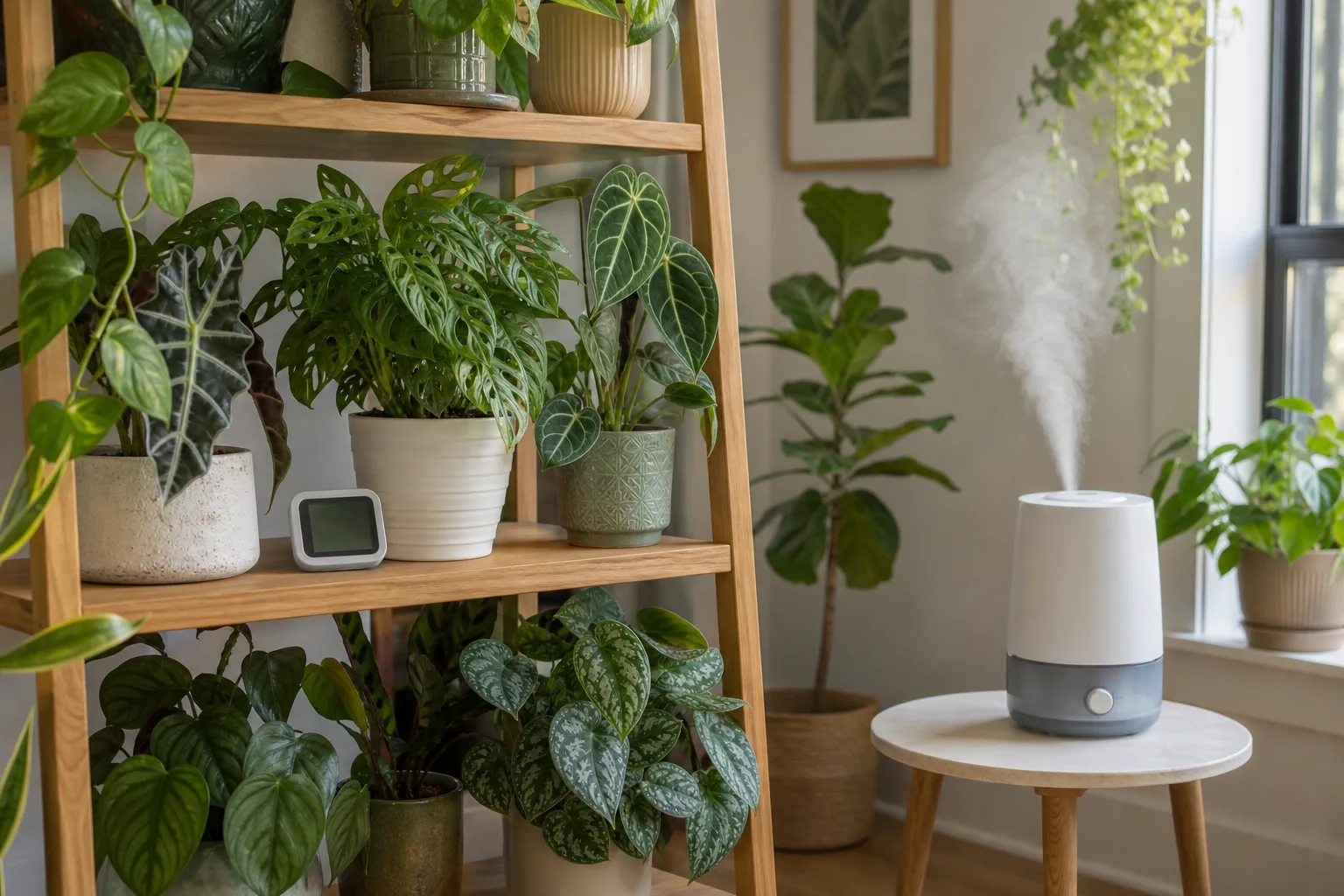
Measure humidity near the leaves with a small hygrometer instead of guessing from the room or placing the sensor in the humidifier’s mist stream. If winter heating drops the reading, a room humidifier nearby is more predictable than misting; mist evaporates quickly and leaves the plant exposed to the same dry air again. Grouping plants can modestly change the local environment, but leave space for air to move between leaves.
Keep the plant in a warm room, roughly 65–80°F (18–27°C), and away from cold window glass, exterior-door drafts, air-conditioning vents, and heat sources that dry one side of the canopy. NC State Extension lists 68–77°F as a favorable daytime range for the Alocasia genus, while indoor growers commonly use a slightly wider range. Avoid abrupt swings more than a single brief cool reading; an overnight draft can stress a tropical plant even when the thermostat looks acceptable.
Feed during active growth without pushing soft growth
Feed only when the plant is actively producing leaves. A balanced liquid houseplant fertilizer diluted to half the label strength every four weeks is a conservative routine in spring and summer; if growth is strong and the mix is frequently watered, follow the product label’s lower end. Pause feeding when the plant stops growing or enters dormancy, because unused fertilizer can build up in a pot that is drying slowly.
Newly purchased plants often arrive with fertilizer already in the nursery mix. Give the plant time to settle and watch for new growth before adding another feed, especially if the roots were recently disturbed. A crust at the soil line or leaf-edge burn can be a sign of salt accumulation; flush the mix with plain water if it drains freely, and do not stack fertilizer, calcium amendments, and pH adjusters in an effort to force larger leaves.
A balanced fertilizer supports steady growth; it will not correct low light, damaged roots, cold stress, or a pot that stays wet. Fix the growing condition first, then resume light feeding when new leaves appear.
Expect slower growth and possible winter dormancy
Growth usually slows when days shorten and indoor light weakens. Some Alocasias shed older leaves or retreat to the corm during a cool or dry period, then resume growth when warmth and light return. This is a possibility, not a seasonal requirement, and one yellowing leaf alone does not prove that a plant is dormant.
If growth pauses, stop fertilizing and reduce watering in response to the slower dry-down. Keep the pot just barely moist enough that the corm does not shrivel, but do not continue summer watering while there are fewer leaves using water. Maintain a warm location and wait for a new shoot before increasing water or feed.
Before assuming dormancy, check the crown and soil. A firm base with a firm corm and no sour smell can wait; a soft, collapsing base or foul-smelling wet mix points to rot and needs attention. Avoid digging up a stable resting plant every week to see whether it has changed.
Repot only when the root ball needs it
Repotting every year is unnecessary if the plant is growing well and water still moves through the mix. Consider a move when roots circle densely, emerge from drainage holes, the plant dries out unusually fast despite a healthy mix, or the medium has broken down and remains wet too long. Spring or early summer is the least disruptive time because active growth can help the plant re-establish.
Move up only one pot size, usually about 1–2 inches wider than the old pot. A much larger container holds a larger volume of damp mix than the roots can use, so it increases the time the center stays wet. Keep the crown at its previous height, loosen only the outside of a tight root ball, and remove roots that are clearly soft or dead with clean snips.
After repotting, water the mix through once and let it drain. Return the plant to the same bright, warm spot for a few weeks rather than changing its light, humidity, and pot at once. A short pause in growth is normal after root disturbance; repeated repotting to chase that pause usually adds stress.
Propagate from offsets or corms
The simplest time to propagate is during spring repotting, when the plant is actively growing and you can see the root system. Division works when a pup has its own roots and a distinct connection to the parent; do not split a single crown just to create more plants. Wear gloves, use a clean blade, and keep sap away from skin, eyes, pets, and children.
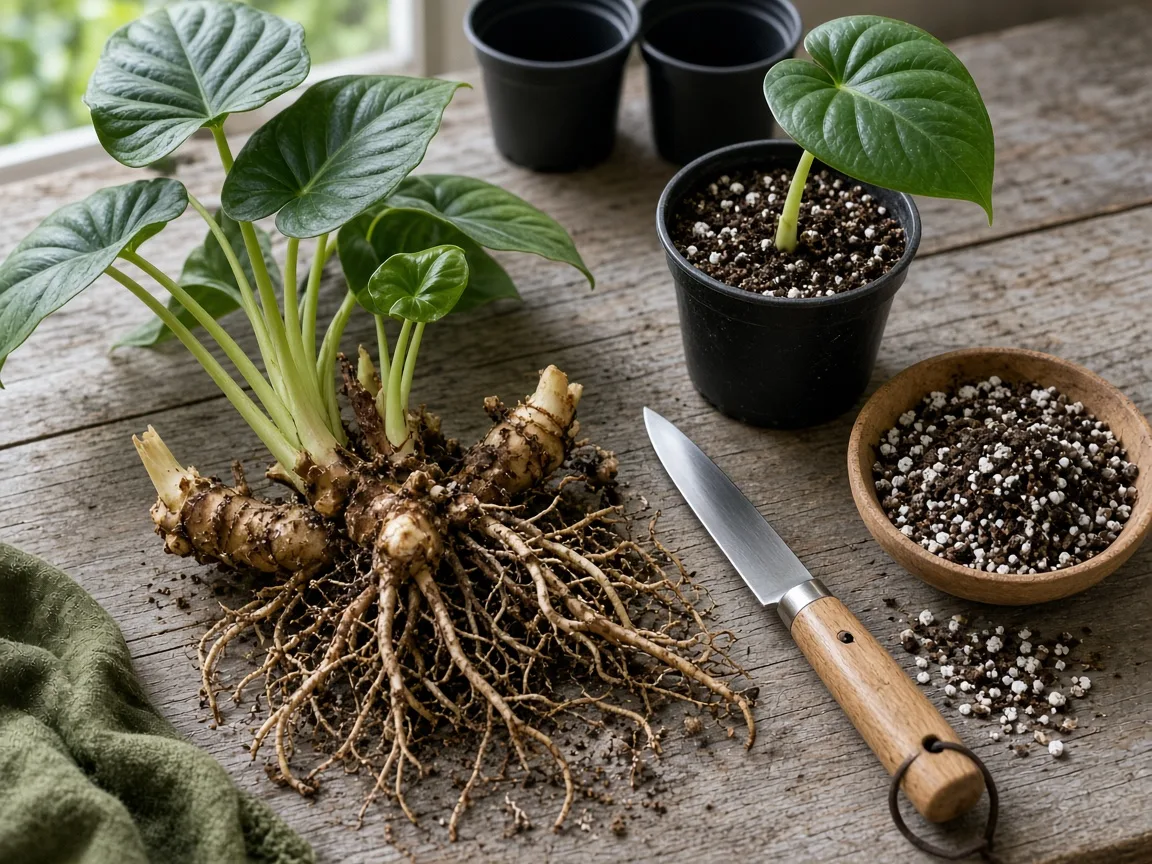
This example shows another Alocasia; the same careful root-ball separation applies to a Dragon Scale offset.
For a rooted offset, ease the soil away from the connection and separate it with as many roots intact as possible. Plant it at the same depth in a small pot of airy mix, water once to settle the medium, and keep it warm in bright indirect light. A small humidity cover can reduce drying while it establishes, but vent it daily and remove it if condensation stays heavy or mold appears.
UK Houseplants describes Alocasia baginda propagation from offsets and corms. Corms are small, firm, rounded structures that may be found among the roots. Save only firm corms; discard soft, hollow, or foul-smelling ones. Set a corm on its side or with its growing tip up in lightly damp sphagnum or a loose propagation mix, leaving the top exposed, then place it in a warm bright location. Keep the medium damp, never waterlogged, and wait patiently for roots and a leaf before moving it into a small pot.
Propagation speed varies with warmth and the corm’s maturity. A corm that has not changed in a few weeks may still be viable, so avoid repeatedly peeling or squeezing it. Once you see active roots and a shoot, pot it shallowly and continue the same careful moisture checks you use for the parent plant.
Prune worn leaves and decide what to do with flowers
Pruning is mostly cleanup. Remove a leaf when it is fully yellow, badly damaged, or diseased; leave a partly green leaf in place because it can still support the corm. Use clean, sharp scissors and cut the petiole near the base without cutting into the crown.
The plant may produce a small spathe and spadix under good conditions, but it is grown for foliage rather than showy flowers. You can leave a healthy bloom or remove it at the base if you prefer the plant’s energy to go toward leaf growth; flowering does not automatically mean the plant is stressed. Wipe dust from leaves with a damp soft cloth and avoid polishing products that can coat the textured surface.
Troubleshoot symptoms before changing several conditions
One symptom rarely identifies one cause. Check the pot, the roots if necessary, recent temperature or location changes, and whether a new leaf is forming before you change the plant’s entire routine. That sequence avoids making an overwatered plant wetter because its leaves happen to droop.
Yellowing: look at the pattern and pot weight
One older bottom leaf yellowing while a new leaf appears can be normal turnover. Several leaves yellowing in quick succession, especially when the pot is heavy and the mix smells sour, is more consistent with overly wet roots; stop watering and inspect the roots if the mix stays wet for days.
If the pot is light and the mix is dry well below the surface, underwatering becomes more likely. If the mix is evenly moist and roots look firm, check light and temperature next instead of immediately fertilizing. Yellow leaves are an outcome, not a diagnosis, so use the surrounding evidence.
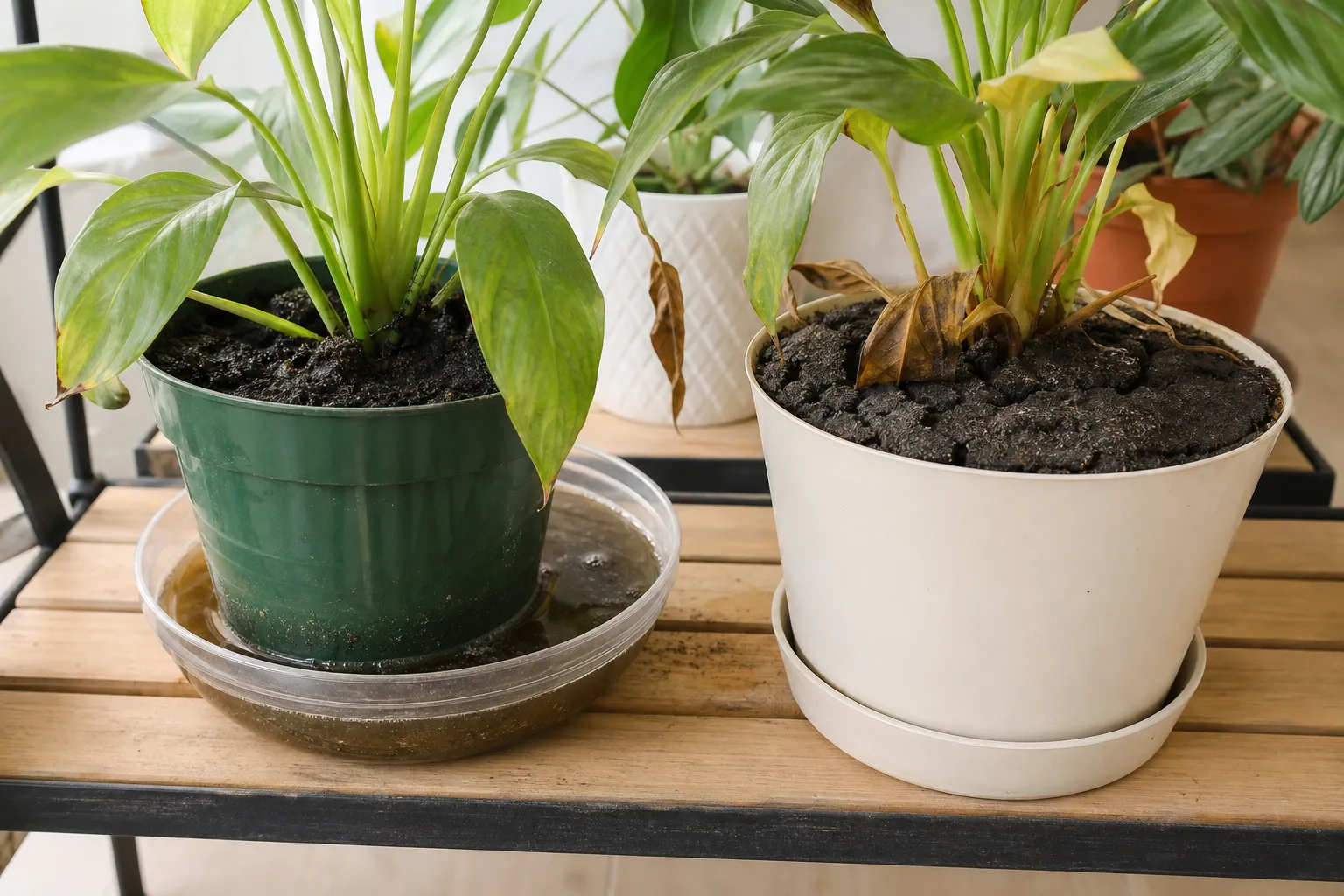
Curling or brown edges: separate dry air from dry roots
Crispy edges can follow low humidity, direct sun, inconsistent watering, or mineral buildup, so first note whether the dry tissue is on the window-facing side or appears evenly around the leaf. If the mix is dry and the pot is light, water thoroughly; if the mix is already wet, adding more water will not fix low humidity and may damage the roots.
Raise humidity gradually with a humidifier if the room is very dry, move the plant away from a hot vent, and avoid repeated misting as the sole solution. If only older leaves have small dry edges while new leaves emerge cleanly, monitor the next leaf before making multiple changes.
Drooping or total leaf loss: check the crown and corm
Drooping can signal thirsty roots, but it can also follow cold exposure or root damage. Feel the mix first; if it is wet, check drainage and temperature before watering. If the petioles have collapsed and the base is soft, unpot and inspect rather than waiting for the foliage to recover on its own.
A leafless plant is not necessarily dead if the corm remains firm and healthy. Remove decaying foliage, keep the corm warm, and water sparingly until new growth resumes. A shriveled corm may be too dry; a soft or mushy one is likely rotting and may not recover.
Check regularly for spider mites and other pests
Spider mites are a common problem on indoor Alocasias, particularly when plants are stressed or the air is warm and dry. Inspect the undersides of leaves, the midrib, and the tight area where petioles meet the crown; fine stippling, pale speckles, or webbing can appear before the infestation is obvious. Thrips, mealybugs, and scale insects can also hitchhike home on a new plant.
Isolate a suspect plant before treating it, then rinse the leaves and wipe the undersides carefully. Recheck every few days because eggs and hidden insects may survive the first cleanup. If you use a pesticide or insecticidal soap, choose a product labeled for indoor ornamentals and follow its label exactly; test a small area first because textured leaves can react differently from smooth foliage.
Keep the plant away from pets and curious children
Alocasias contain insoluble calcium oxalate crystals that can irritate the mouth and digestive tract when plant material is chewed. The ASPCA lists Alocasia as toxic to dogs and cats, and Poison Control explains the irritation caused by Alocasia crystals. Put the pot, fallen leaves, and corms out of reach, and wash hands and tools after pruning or repotting.
If a pet chews the plant, contact a veterinarian or animal poison-control service for case-specific advice. If a person chews or swallows any part, remove visible material from the mouth, rinse, and contact a poison center; seek emergency care for trouble breathing or significant swelling. Do not induce vomiting unless a medical professional instructs you to.
Dragon Scale and Silver Dragon are different cultivars
Both names belong to Alocasia baginda, but they refer to different cultivated forms. ‘Dragon Scale’ usually has deeper green leaves with strongly raised veining, while ‘Silver Dragon’ is generally paler and more silver-green. NC State Extension’s Alocasia entry lists ‘Dragon Scale’ as a compact cultivar with thick, textured foliage, and horticultural descriptions such as Ohio Tropics’ Alocasia variety guide show the visual distinction.
Retail labels and photographs are not always consistent, and juvenile leaves may be less dramatic than mature ones. Choose a plant by the visible leaf texture and overall health rather than paying extra for a label alone. Either cultivar benefits from the same basic priorities: filtered light, warm stable conditions, and roots that stay moist but aerated.
Conclusion
Grow Alocasia ‘Dragon Scale’ in a warm, bright place and give its roots a mix that holds some moisture while draining freely. Water when the upper layer has dried, empty the saucer, and use new growth and pot weight to adjust for seasonal changes rather than following a fixed interval.
When leaves yellow or droop, check the moisture and crown before changing fertilizer or humidity. Repot only when the roots or mix call for it, propagate from a rooted offset or firm corm, and keep all plant parts away from pets and children. Those habits give this textured Alocasia the steady conditions it needs to keep producing healthy leaves.