Sticky Leaves on Monstera Deliciosa: Causes, Checks & Fixes
Quick answer
Sticky Monstera Deliciosa leaves almost always mean sap-feeding pests excreting honeydew. First step: isolate the plant and inspect the crown, leaf undersides, stem joints, and aerial root bases before you spray anything.
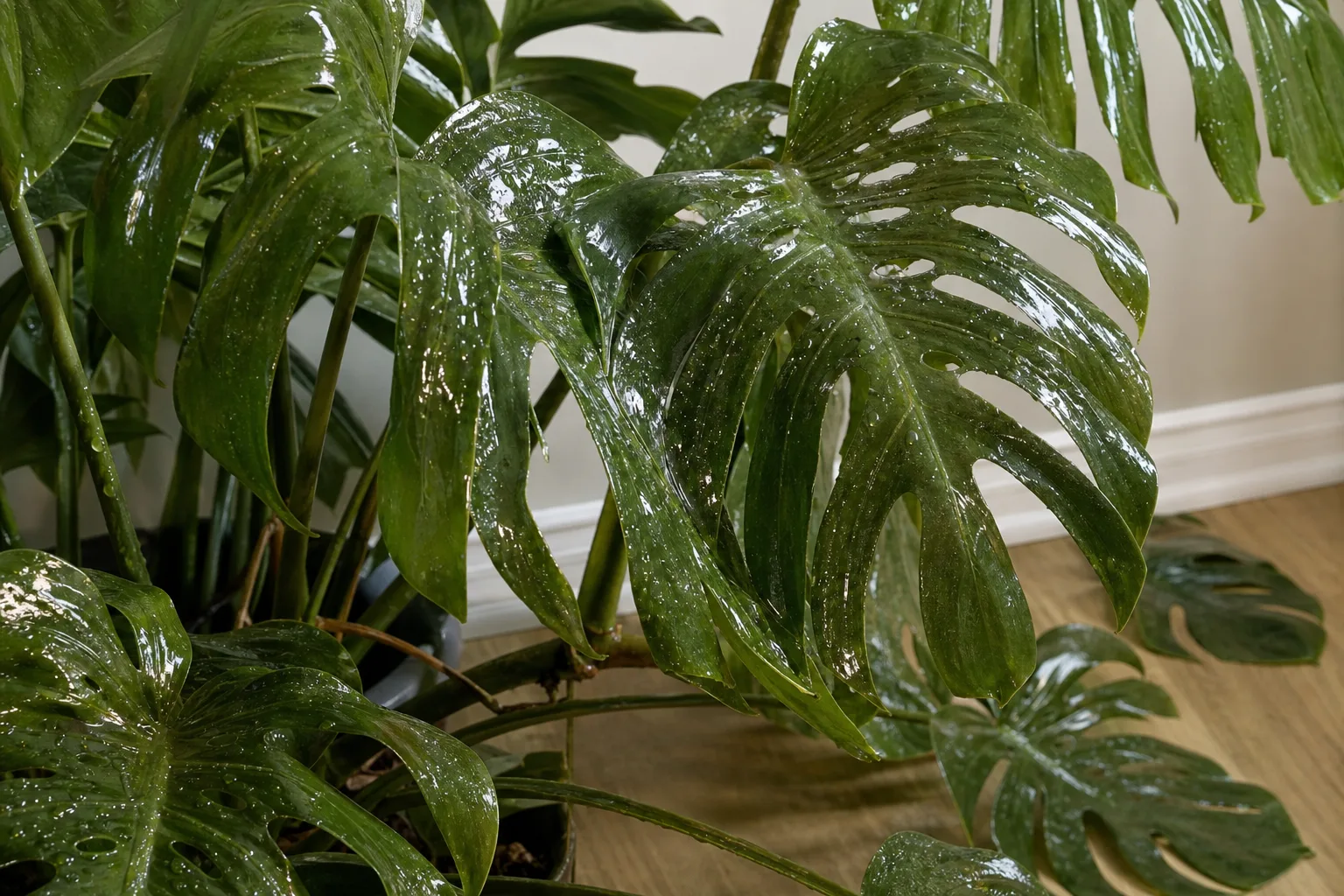
Sticky Leaves on Monstera Deliciosa: Causes, Checks & Fixes
This guide covers sticky leaves on Monstera Deliciosa. See also the general Sticky Leaves guide, watering, and light pages for this plant.
Sticky Leaves on Monstera Deliciosa: Causes, Checks & Fixes
Quick answer
Sticky Monstera Deliciosa leaves are not a humidity or watering mystery. On this large split-leaf floor aroid (Monstera deliciosa), tackiness almost always comes from sap-feeding insects excreting honeydew-a sugary waste that drips from feeding sites onto lower massive blades, petioles, nearby floors, and furniture.
First step: isolate the plant and inspect the crown, leaf undersides, stem joints, and aerial root bases before you spray anything. Mealybugs, scale, aphids, and whiteflies are the usual culprits on Deliciosa. Penn State Extension notes that scale, aphids, mealybugs, spider mites, thrips, and fungus gnats can affect Monstera indoors. If you find cottony wax, bark-colored bumps, soft insect clusters, ants, or black sooty mold that wipes away, you have a pest issue to treat-not a routine care adjustment alone.
Why Monstera Deliciosa gets sticky leaves
Honeydew comes from insects that pierce plant tissue and excrete excess sugar. Iowa State Extension notes that scale, mealybug, and aphids are common houseplant pests that produce honeydew on indoor plants. The stickiness is not coming from the leaf itself-it pools where pests feed, then gravity carries it down broad split blades to lower leaves and the floor below a tall floor plant.
Monstera Deliciosa is especially vulnerable because of how it grows indoors. This architectural climber produces very large leaves on thick petioles climbing a moss pole or trellis. Each leaf axil and the tight crown where new blades unfurl create sheltered crevices where mealybugs cluster on houseplants. Aerial roots gripping a moss pole add more hiding spots at the pole contact line-scale and mealybugs often start there before honeydew coats the glossy upper surface of lower leaves.
Large leaf size accelerates visible mess. A single infested petiole on a mature Deliciosa can drip honeydew across an entire lower split leaf and leave tacky residue on hardwood floors before you notice insects at the top of the pole. Mississippi State Extension notes that sticky leaves are usually the first sign of soft scale on houseplants-often before you spot the flat brown bumps along veins and stems.
New growth at the crown is aphid territory. Clemson HGIC notes that aphids feed on soft new growth and leaf undersides, and Deliciosa pushes periodic flush leaves when light and water are adequate. Aphids on one unfurling tip can coat several lower blades with honeydew while the plant slowly adds replacement foliage.
Ants complicate diagnosis. Ants harvest honeydew and protect pest colonies from predators. Ant trails on pot rims, moss poles, or walls below a tall Deliciosa often appear before you spot the mealybugs feeding in the crown above them.
Indoor conditions that stress Deliciosa can accelerate pest buildup without causing stickiness directly. Plants kept in dim corners with chronically wet mix grow weakly, while those near heat vents in dry winter air may still harbor scale in protected stem crevices. Overwatering alone leaves leaves limp and yellow-not tacky. Sticky residue always points back to live sap feeders or fresh honeydew deposits.
What sticky leaves look like on Monstera Deliciosa
Honeydew stickiness (problem):
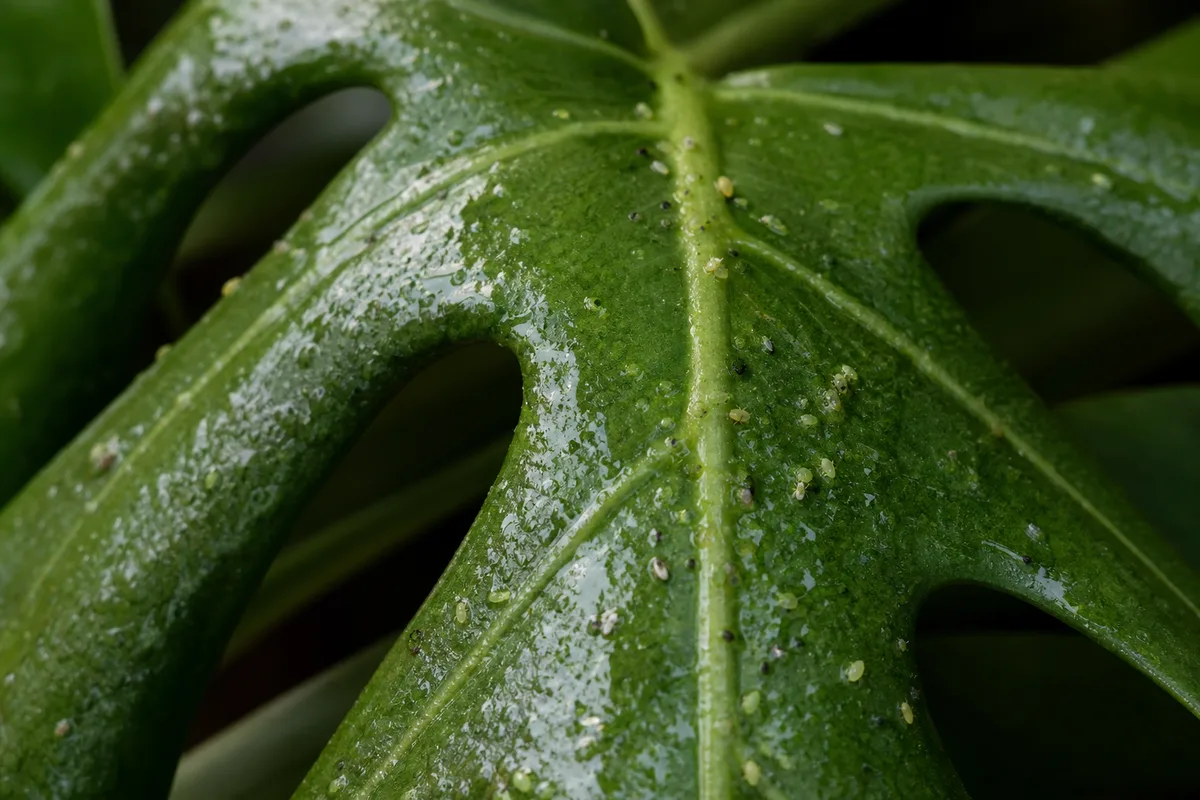
Sticky Leaves symptoms on Monstera Deliciosa - compare with healthy tissue on the same plant.
- Tacky, shiny patches on upper leaf surfaces where drips landed-not uniform across every blade
- Sticky residue on leaf undersides, thick petioles, or stem nodes near feeding sites
- Tackiness collecting along split-leaf edges or dripping onto lower massive blades
- Cottony white masses in the crown center and leaf axils (mealybugs)
- Bark-colored or waxy bumps on stems and petioles that do not wipe off (scale)
- Soft green, black, or whitish aphid clusters on newest unfurling leaves at the moss pole tip
- Black sooty mold that smears and wipes away with a damp cloth
- Ant activity on the pot, moss pole, or floor beneath the plant
- Yellowing, curling, or stunted new split leaves when feeding is heavy
Not pest-related:
- Clear water beads at leaf margins from guttation after heavy watering-watery, not sugary-tacky
- Smooth, glossy mature leaves with no tackiness, insects, or wipe-able black film
- Dry brown tips from low humidity-edges feel crisp, not sticky
Sooty mold is a fungus that grows on honeydew-it does not infect Monstera tissue directly but can block light through large fenestrated blades if the coating is thick. Once insects are controlled, mold stops spreading and can be rinsed off.
How to confirm the cause
Work through these checks in order before treating:
- Pattern first - Widespread tackiness near the crown, axils, or upper leaves below an infested section points to honeydew. Clear water beads at leaf margins after watering suggest guttation instead.
- Crown and axil inspection - Open the center slowly and look where each large petiole meets the main stem. Mealybugs cluster in tight crown tissue; scale hides along green stems disguised as part of the bark.
- Underside check - Lift broad split blades and inspect backs, especially on the newest leaves at the moss pole tip. Aphids stay on tender tissue; scale nymphs look like flat pale dots along veins.
- Aerial root and pole line - Trace where aerial roots grip the moss pole or trellis. Wax and scale often start at contact points before honeydew reaches lower leaves.
- Sooty mold test - Rub a finger on a dark upper patch. Sooty mold smears black and wipes away; healthy glossy leaves do not leave a film.
- Ant trails - Ants marching toward the pot strongly suggest honeydew producers are present on the plant above.
- Wipe-and-watch - Wipe one sticky spot on an upper leaf. Honeydew reappears with new tackiness on lower blades and often fresh pest signs within days.
- Neighbor plants - Inspect philodendron, pothos, and other large aroids nearby. Mealybugs and scale spread on contact before every plant shows stickiness.
If you find pests or fresh honeydew, proceed with isolation and treatment. If only clear guttation beads appear with no insects, ants, or mold after a thorough crown-to-base search, no spray is needed-keep scouting monthly.
First fix for Monstera Deliciosa
Once you confirm pest honeydew-not guttation-isolate the plant and rinse every leaf underside, petiole joint, crown crevice, and aerial root base with lukewarm water.
Move Deliciosa away from your collection the same day you confirm stickiness with pest signs. Delay lets mealybug crawlers and scale spread to neighboring floor plants before a tall specimen is easy to treat.
Once isolated:
- Rinse the entire plant in lukewarm water, directing the stream at leaf undersides, petiole joints, crown crevices, aerial root bases, and moss-pole contact lines where mealybugs hide. Iowa State Extension recommends starting with a good rinse or wipe-down to remove honeydew, sooty mold, and dislodge insects like aphids and mealybug.
- Wrap the pot in a plastic bag during sink or shower rinsing so heavy soil stays in place on a large floor pot.
- After rinsing, physically remove visible mealybugs with a cotton swab dipped in 70% isopropyl alcohol, and gently scrape small scale bumps if the infestation is localized.
- Do not reach for broad-spectrum pesticide on day one if you have not confirmed insects. Do not fertilize a pest-hit Deliciosa-that produces more tender tissue pests prefer.
- Do not spray guttation droplets on an otherwise clean plant-that is normal water release after heavy watering, not an infestation.
Monstera Deliciosa is toxic to cats and dogs via calcium oxalate crystals. Wear gloves when handling treated foliage and keep pets away from freshly rinsed or sprayed plants until leaves dry.
Step-by-step recovery
After the initial rinse and manual removal:
- Repeat water rinses every two to three days until live mealybugs, scale crawlers, or aphid clusters are gone on inspection.
- Apply insecticidal soap labeled for houseplants if colonies persist after several rinses. Cover undersides, crown tissue, and axils thoroughly; repeat applications weekly for four to six weeks may be needed for complete control of mealybug and scale.
- Manage ants if they protect colonies. Ant stakes or barriers on pot legs can help natural enemies reach pests on the moss pole.
- Wash sooty mold off upper leaves with plain water once honeydew production stops. Trim heavily coated split leaves that no longer photosynthesize well through their fenestrations.
- Watch new growth - Deliciosa unfurls new blades more slowly than trailing Monsteras. Clean new split leaves without tackiness mean control is working.
Keep the plant in Monstera Deliciosa light guide with good airflow while recovering-not direct sun on wet large leaves, which can scorch easily. Water when the top 3–5 cm of mix dries, matching Deliciosa’s normal rhythm without letting the pot sit in standing water.
Recovery timeline
Water knockdown shows results within two to three days when colonies are moderate and confined to the crown or one stem section. A full soap course may take four to six weeks with weekly repeats because mealybug crawlers hide in crown crevices and scale has protected adult stages. Sooty mold fades as honeydew dries up; expect cleaner new growth within three to six weeks once insects stay gone-Deliciosa’s slower growth means recovery takes longer than on small-leaved vines.
Sticky upper leaves themselves rarely become glossy again if mold was thick-judge recovery by clean new crown leaves and unsticky unfurling blades, not old coated foliage.
Lookalike symptoms to rule out
Guttation produces clear water beads at leaf margins after heavy watering or high soil moisture-not sugary tackiness with ants or sooty mold.
Spider mites cause fine stippling and webbing, not heavy stickiness. Mites thrive in hot dry air; confirm with a tap test over white paper for moving specks.
Low humidity brown tips feel dry and crisp at leaf edges, not tacky across the blade surface. No honeydew drips onto floors below.
Overwatering yellows lower leaves and softens stems while soil stays wet. Roots may smell sour, but leaves feel limp-not coated in sugary residue.
Fungus gnats indicate moist soil, not sticky foliage. Adults fly when the pot is disturbed; they do not excrete honeydew on leaves.
Mistakes to avoid
Do not assume sticky leaves mean you should mist more or change watering-honeydew is a pest signal, not a humidity deficiency.
Do not only wipe the glossy upper surface of large split leaves. Mealybugs and scale feed at undersides, crown crevices, and aerial root bases you cannot see from across the room.
Do not ignore ants. Controlling mealybugs alone is harder while ants defend colonies and move crawlers to new axils.
Do not compost heavily infested clippings near other houseplants. Discard sealed bag waste if scale or mealybugs were widespread.
Do not increase nitrogen feeding during an active infestation-that fuels soft aphid-friendly growth at the crown.
Do not handle sap-exposed tissue without gloves if pets share the room-Deliciosa sap irritates mouths if chewed.
How to prevent sticky leaves next time
Scout crown crevices and moss-pole contact lines monthly on floor-sized Deliciosa-especially where aerial roots grip support and undersides stay out of sight during quick watering. Quarantine new plants two to three weeks before combining them with an established architectural specimen. Severe infestations may warrant discarding the plant before neighbors are infected; prevention is cheaper than repeated chemical cycles on a heavy pot.
Keep even moisture using your normal rhythm-allow the top 3–5 cm of mix to dry before watering. Avoid excess nitrogen that produces lush soft shoots mealybugs and aphids prefer. Preserve beneficial insects by avoiding broad-spectrum sprays unless needed.
Improve airflow around tall floor displays. Stagnant warm pockets favor scale buildup on stems pressed against walls or furniture.
When to worry
Treat as urgent when honeydew and sooty mold spread across most large leaves within days, new split leaves emerge stunted or distorted, or ants swarm the crown and moss pole. Heavy mealybug and scale infestations can stunt and kill plant parts on houseplants when left unchecked.
Consider replacing a severely coated plant rather than fighting endless reinfestation across every petiole on a mature specimen. Deliciosa is easy to propagate from clean stem cuttings once you have a pest-free section-but only take cuttings after you are confident the source tissue is insect-free.
A single sticky leaf with confirmed mealybugs in one axil is manageable if you isolate and treat immediately. Widespread tackiness across a mixed plant collection needs same-day isolation of every affected pot.
Conclusion
Sticky Monstera Deliciosa leaves usually mean honeydew from sap-feeding pests. Inspect crown crevices, aerial root bases, and broad leaf undersides on your floor plant, confirm the pattern, isolate and rinse before you spray, and repeat until new split growth comes in clean and dry. That path stops mealybugs and scale before they coat your whole specimen and protects the rest of your indoor collection.
When to use this page vs other Monstera Deliciosa guides
- Monstera Deliciosa watering guide - Use for routine moisture checks before assuming sticky leaves is the main issue.
- Monstera Deliciosa problems hub - Browse all 18 common issues on this species.