Not Enough Light on Monstera Deliciosa: Causes, Checks &
Quick answer
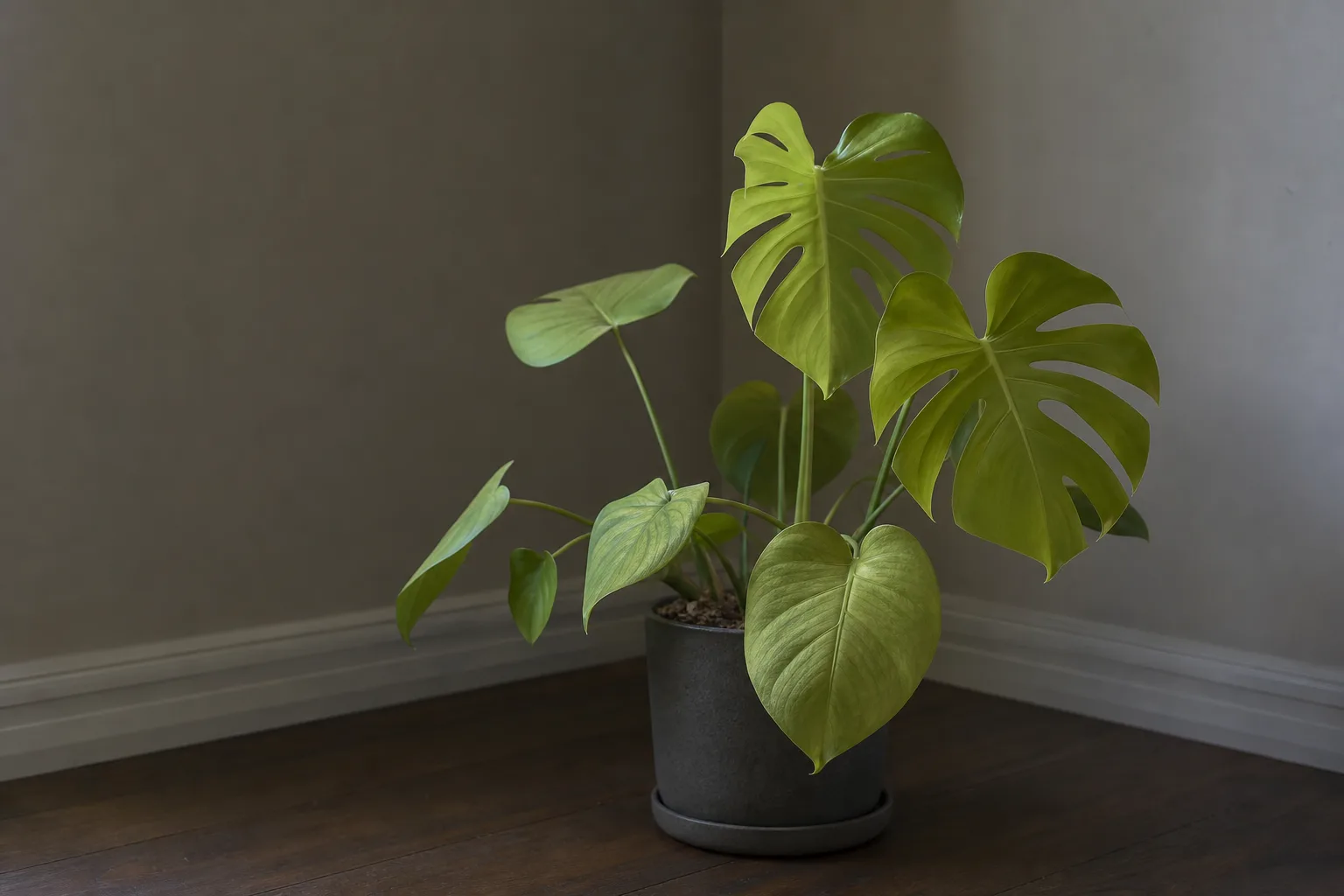
Not enough light on Monstera deliciosa shows as solid new leaves without splits, smaller foliage on long petioles, and vines leaning toward the brightest window. First step: move the plant to bright indirect light within a few feet of an east or filtered south/west window, or add a full-spectrum grow light for 10–12 hours daily.
Not Enough Light on Monstera Deliciosa: Causes, Checks & Fixes
This guide covers not enough light on Monstera Deliciosa. See also the general Not Enough Light guide, watering, and light pages for this plant.
Not Enough Light on Monstera Deliciosa: Causes, Checks & Fixes
Quick answer
Not enough light on Monstera deliciosa (Monstera deliciosa) is the main reason mature vines stop producing split leaves and start reaching toward windows. This hemiepiphytic climbing aroid survives dim corners but will not build the large perforated foliage it is known for without sustained bright indirect exposure.
First step: move the pot to bright indirect light within a few feet of an east-facing window or a south- or west-facing window filtered by sheer curtains-or add a full-spectrum grow light above the canopy for 10–12 hours daily.
The signature Deliciosa pattern is new leaves staying solid and heart-shaped on elongated petioles while the whole vine leans toward the brightest direction. That is different from a young plant’s normal juvenile leaves and different from total growth stall covered on the slow-growth guide.
What not enough light looks like on Monstera deliciosa
Fenestration loss and leaf-size trend
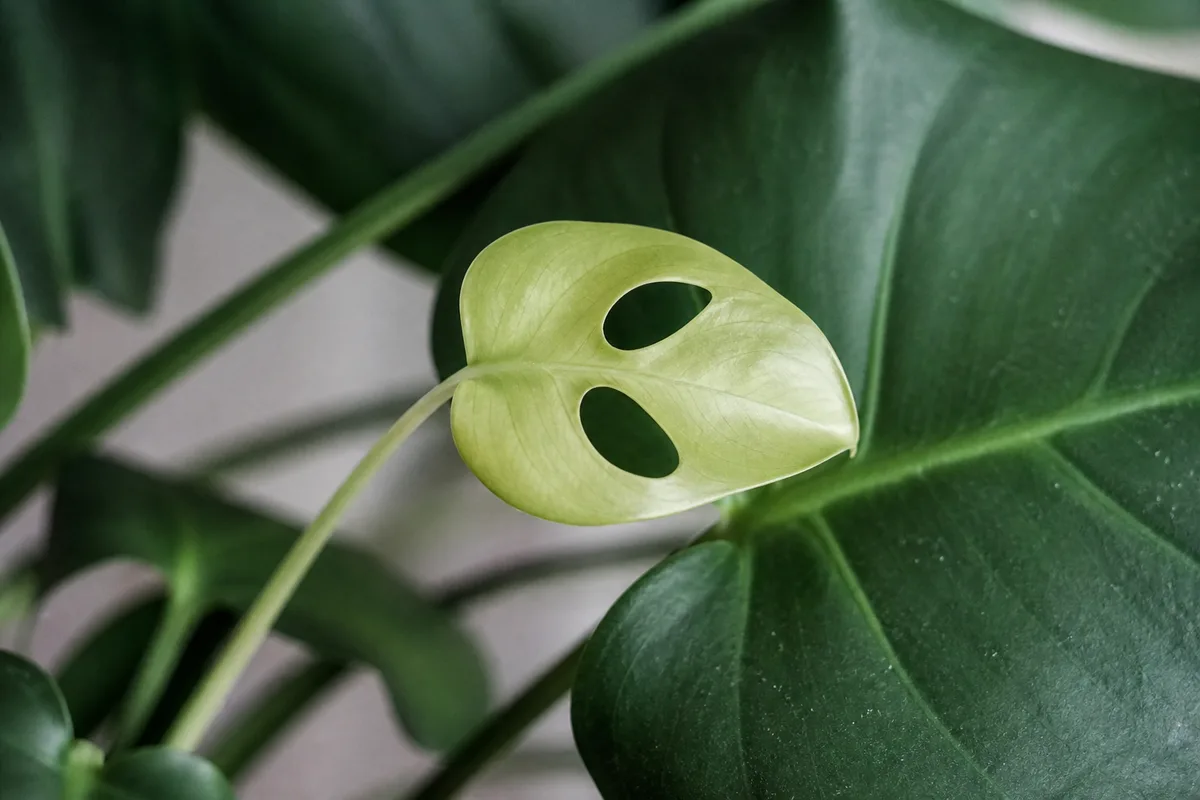
Not Enough Light symptoms on Monstera Deliciosa - compare with healthy tissue on the same plant.
On a vine that already produced split leaves, the newest blades opening without holes or edge splits is the clearest low-light signal. Wisconsin Horticulture Extension states Monstera will not develop leaf perforations when light is inadequate-even under fluorescent lamps if intensity is too weak.
Watch the trend, not a single leaf:
- Smaller new leaves than mature ones farther down the same stem
- Solid cordate hearts on recent nodes while older leaves on that vine already fenestrated
- Longer petioles pushing each new blade farther from the stem toward window light
- Delayed or minimal edge splits on leaves that should be maturing
A small young deliciosa with only solid leaves may simply be immature. Concern starts when a climbing plant with aerial roots and prior fenestrations suddenly pushes plain hearts for several nodes in a row.
Stretch, lean, and moss-pole behavior
- Directional lean toward one window, lamp, or doorway
- Wide gaps between leaves on the newest section of vine-even if leaves still appear
- Aerial roots searching along a moss pole or wall with little upward extension of large foliage
- Upper leaves smaller than lower ones on a tall floor specimen when the canopy sits far below the window line
- Soil staying damp longer than it used to because transpiration slowed
These overlap with leggy growth when the plant is still producing leaves but spacing them out. This page focuses on light as the limiting factor-especially fenestration loss-not every stretch scenario.
Why Monstera deliciosa gets not enough light
Rainforest climber biology indoors
In nature, deliciosa starts as a terrestrial seedling, then climbs toward brighter canopy light using aerial roots. Penn State Extension describes it as an epiphyte that still needs something sturdy to climb indoors-moss poles, trellises, or bark boards. Without adequate photons, the plant economizes: smaller blades, fewer fenestrations, longer internodes.
Common placement mistakes
- Interior rooms more than 6 feet from any window with no supplemental light
- North-facing glass alone in cloudy climates without a grow lamp
- Large floor pots parked in the center of a bright room where the canopy never sees the window
- Bookshelves or corners where furniture blocks half the sky
- Winter day-length drop in the same summer spot-usable light at the leaf surface falls even when you have not moved the pot
Light–water coupling in dim corners
Low light slows water use. Many owners keep the same watering schedule while the top of the mix stays wet for weeks. That pairing mimics overwatering-yellow lower leaves on damp soil-when the root issue is really too little light slowing metabolism.
How to confirm the cause
Work through these checks before repotting, fertilizing, or heavy pruning:
- Fenestration trend - Compare the last three new leaves to a mature perforated leaf on the same vine. Loss of splits on recent growth strongly supports low light. A brand-new small plant with only solid leaves may still be juvenile.
- Window distance and direction - Within 2–4 feet of an east window or filtered south/west glass usually counts as bright indirect for deliciosa. Deep interior placement or north-only exposure typically needs supplementation.
- Shadow test at the canopy - At midday, hold your hand between the top leaves and the window. A soft, defined shadow suggests moderate usable light; a faint or absent shadow means the spot is too dim by extension indoor-light standards.
- Petiole length and lean - Measure spacing between the last two new leaves. Long petioles plus lean toward one side confirm the plant is actively reaching for photons.
- Season and dry-down rhythm - Note calendar month and how many days until the top 3–5 cm of mix feel dry. Winter slowdown is normal; continued solid leaves through spring and summer in the same dim spot is not.
- Rule out lookalikes - Confirm soil is not waterlogged, roots are not mushy, and leaf undersides have no pest clusters before blaming light alone.
Confirmation test: Move the plant to a brighter indirect spot for two weeks without changing fertilizer or pot size. If the next leaf opens with tighter spacing and stronger green color-and eventually splits on a mature vine-light was the limiter.
First fix for Monstera deliciosa
Relocate to bright indirect light-ideally within a few feet of an east-facing window or a south- or west-facing window softened by sheer curtains.
Penn State Extension advises placing Monstera near a sunny window where it receives bright light but not direct sun. NC State Extension lists moderate brightness without direct sunlight as the indoor target.
Do not jump from a dark corner into harsh unfiltered midday sun. Deliciosa leaves are thick and glossy, but tissue formed in deep shade needs gradual acclimation to avoid scorch when light increases.
If a brighter window is unavailable, add a full-spectrum LED grow light 12–18 inches above the canopy for 10–12 hours daily. University of Maryland Extension notes plants stretch when light arrives from one direction-center the lamp over the vine, not off to the side, and rotate the pot weekly.
Make this one change first. Wait two to three weeks before repotting, fertilizing, or pruning heavily so you can read the plant’s response clearly.
Step-by-step recovery
After the light move:
- Monitor the next two to four new leaves - Look for shorter petioles, larger blade size, and returning splits on a mature vine.
- Adjust watering - Brighter light means faster dry-down. Recheck the top 3–5 cm before every drink instead of following an old calendar tied to dim-corner metabolism.
- Confirm moss-pole support - Re-seat aerial roots on a moist pole or trellis. Attached roots help fuel larger architectural leaves once light improves.
- Acclimate gradually if needed - Step closer to the window over one to two weeks, or add sheer curtains before removing them, if leaves were formed in very low light.
- Hold fertilizer - Do not feed to “force” fenestrations. Splits track light, maturity, and climb-not nitrogen alone. Feed lightly only after steady new growth returns in spring or summer.
- Extend grow-light hours in winter - Shorter days reduce window light even when the pot stays in the same place.
Variegated cultivars such as ‘Albo Variegata’ and ‘Thai Constellation’ often need brighter, more stable light than standard green deliciosa to maintain pattern and vigor-NC State notes variegated forms need more sunlight than darker green types.
Recovery timeline
Expect tighter new growth within two to four weeks after light improves. Fenestrations on mature vines typically return on progressively larger new leaves over two to four months, not on the first leaf after a move.
Old stretched petioles and solid leaves do not shorten or re-split-judge success by the next two or three new blades, not by hoping existing tissue reshapes.
Winter corrections may show little until day length and warmth increase-plan on four to eight weeks after conditions improve before deciding the fix failed.
Worsening signs: continued solid small leaves with yellowing on wet soil, soft stems, or sour-smelling mix mean the diagnosis is incomplete-re-check roots and watering rather than only adding light.
Lookalike symptoms to rule out
| Pattern | Key signals | Primary issue |
|---|---|---|
| Low light | Solid new leaves on mature vine, lean, long petioles, slow dry-down | Insufficient bright indirect exposure |
| Normal juvenile stage | Small solid hearts on young plant with few nodes; no prior fenestrations | Age and maturity-not a problem |
| Slow growth stall | No new leaves for months; firm foliage | Light, roots, season, or pests-see slow-growth guide |
| Leggy stretch with leaves still forming | Long internodes but regular new leaves | Light plus support-see leggy-growth page |
| Overwatering in dim corner | Yellow lower leaves, wet soil weeks, soft stem base | Root stress-see overwatering guide |
| Sunburn after sudden move | Bleached or crisp patches on sun-facing leaves | Too much direct sun too fast-not low light |
| Nutrient deficiency | Pale leaves without long petiole stretch | Fix light and watering first; feed only after placement stabilizes |
Mistakes to avoid
Do not assume “houseplant tolerant” means a hallway or bathroom is ideal long term. Deliciosa tolerates lower light briefly; thriving fenestrations need bright indirect exposure sustained across the growing season.
Do not increase fertilizer to force splits in a dim spot. Wisconsin Horticulture Extension links inadequate light to missing perforations-not nutrient shortage.
Do not move instantly from deep shade to unfiltered south glass. Acclimate over one to two weeks to prevent scorch on thick glossy leaves adapted to dim conditions.
Do not ignore wet soil in a dark corner. Slow growth plus damp mix is a common path to root rot on large floor specimens.
Do not confuse natural juvenile solid leaves on a small plant with chronic fenestration loss on a mature climbing vine-the fix for the second is light, not patience alone.
Do not expect a moss pole alone to trigger splits without adequate light. Support helps mature architecture; photons drive fenestrations.
Monstera deliciosa care cross-check
Light interacts with every other variable on a large climbing aroid:
- Watering - Water when the top 3–5 cm of mix are dry. In low light, that takes longer; after a bright move, check more often.
- Temperature - Monstera prefers 60° to 85°F and does not grow below about 50°F. Cold drafts near windows in winter can stall growth even when light looks adequate.
- Humidity - Penn State recommends humidity preferably above 50%. Low light is not fixed by misting alone.
- Support - Provide a moss pole early so aerial roots attach; climbing habit supports larger leaves once light is sufficient.
- Foot-candle target - For reliable fenestrations on mature vines, aim for sustained bright indirect exposure-often roughly 200–400 foot-candles at the canopy-aligned with the Monstera light guide and overview.
How to prevent not enough light next time
Place new deliciosa where the leaf canopy sees the window, not just where the pot fits the room layout. For floor specimens, raise the moss pole or shorten the vine so top leaves sit in the light cone.
Rotate the pot every one to two weeks so vines do not lean permanently toward one side. Clean glass seasonally-sheers, tint, and outdoor foliage block more photons than many owners realize.
Use grow lights in offices, north-facing rooms, and during short winter days. Aim for 10–12 hours of supplemental light when natural levels drop.
Choose placement before buying a heavy ceramic pot you cannot easily move-deliciosa is a vigorous grower that outgrows dim spots within a season.
When to worry
Low light alone rarely kills deliciosa. Investigate promptly when insufficient light pairs with:
- Wet soil for weeks and spreading yellow leaves
- Soft stems at the soil line or sour-smelling mix
- Complete stall in new growth for two months after corrected light and warm temperatures
In those cases, unpot and inspect roots before assuming more light will solve everything.
How this page fits the Monstera cluster
| Your question | Best page |
|---|---|
| Where should I put my Monstera long term? | Light guide |
| No new leaves at all for months | Slow growth |
| Long stems but still producing leaves | Leggy growth |
| Solid new leaves / missing splits | This page |
| Yellow leaves on wet soil in a dim corner | Overwatering |
Related Monstera deliciosa guides
- Monstera deliciosa overview - species hub
- Light needs - window placement and grow lights
- Watering - dry-down rhythm after light changes
- Repotting and moss poles - support for climbing growth
- Slow growth - when the plant stalls entirely
- Holes in leaves - fenestrations vs damage
Not enough light on Monstera deliciosa is a placement problem on a fenestrating climbing aroid-not a mystery disease. Solid new leaves on a mature vine, lean toward the window, and wet soil that never dries in a dim corner are the patterns to catch early. Move to bright indirect exposure first, acclimate gradually, adjust watering to match new dry-down, and judge recovery by the next few leaves-not by hoping old stretched tissue reshapes. When splits return on progressively larger blades, you have corrected the limit that no fertilizer could fix.