Low Humidity on Alocasia Dragon Scale: Causes, Checks &
Quick answer
Dry household air-especially near heating vents in winter-browns the thick scale-like leaf margins on Alocasia Dragon Scale before the rest of the blade yellows. First step: scan for vent and radiator placement, then run a humidifier until a hygrometer at leaf height holds roughly 65–70% RH.
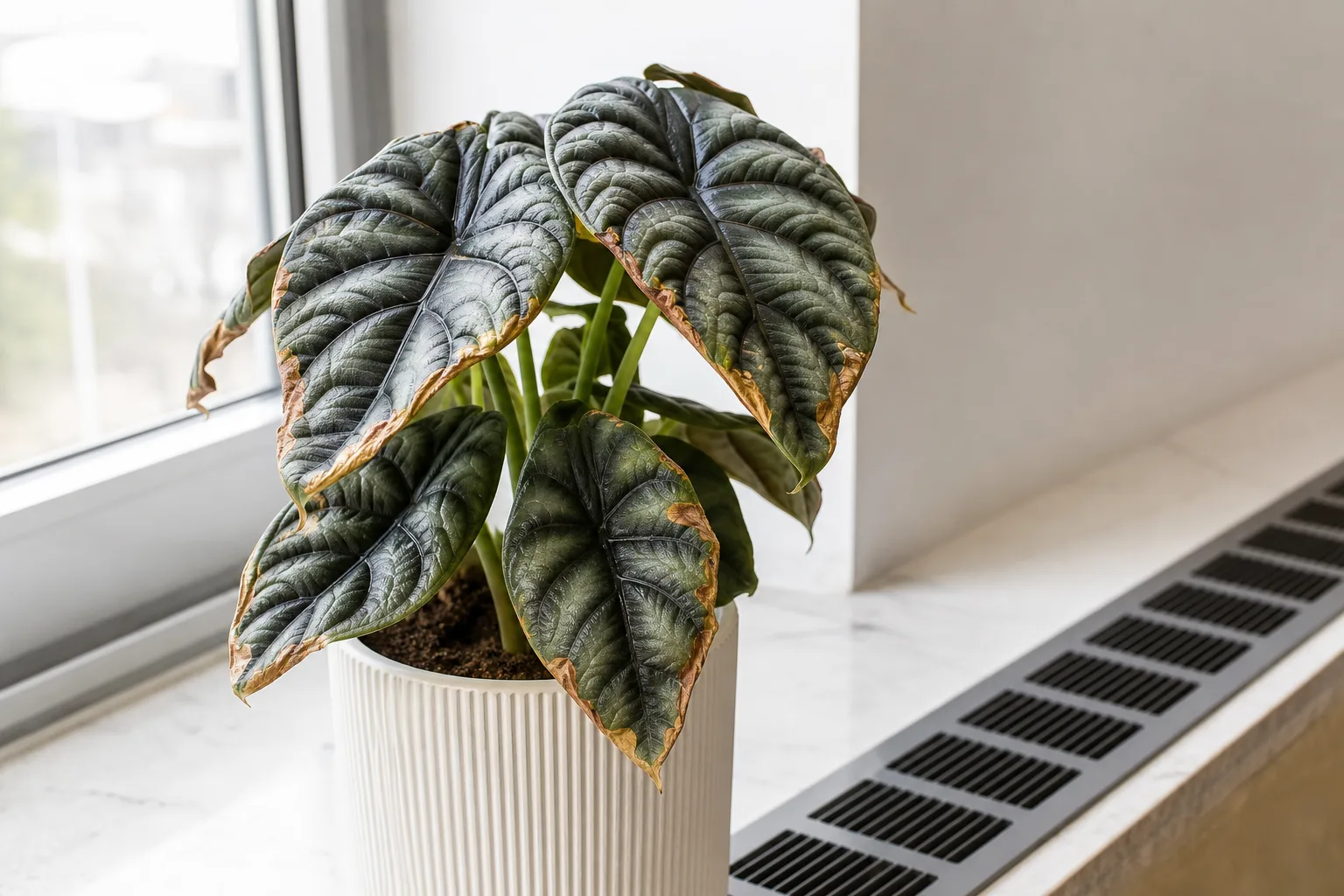
Low Humidity on Alocasia Dragon Scale: Causes, Checks & Fixes
This guide covers low humidity on Alocasia Dragon Scale. See also the general Low Humidity guide, watering, and light pages for this plant.
Low Humidity on Alocasia Dragon Scale: Causes, Checks & Fixes
Quick answer
Alocasia Dragon Scale (Alocasia baginda ‘Dragon Scale’) is a compact jewel alocasia whose thick, scale-textured leaves lose moisture at the margins faster than the rest of the blade when household air is too dry. Winter heating, air conditioning, and placement near vents can push relative humidity well below what this Borneo understory plant tolerates-even while you water correctly.
First step: move the pot off forced-air paths-heat vents, radiators, sunny winter glass, and AC drafts-then place a hygrometer at leaf height and run a humidifier until readings hold roughly 65–70% RH. If papery brown margins appear while the top 2–3 cm of soil dries on your normal watering rhythm, dry air is the likely problem-not thirst. Do not keep soil wet to fix dry air; that invites root rot on Alocasia Dragon Scale on an already stressed corm.
For baseline humidity targets and seasonal setup, see the Alocasia Dragon Scale overview and the humidity section in the watering guide. This page focuses on diagnosing and fixing active dry-air damage on moist soil.
What low humidity looks like on Alocasia Dragon Scale
Dragon Scale has thick, textured blades with silvery-green veining that resemble reptile scales. Those thin leaf margins are the first tissue to desiccate when transpiration outpaces the moisture available in surrounding air.
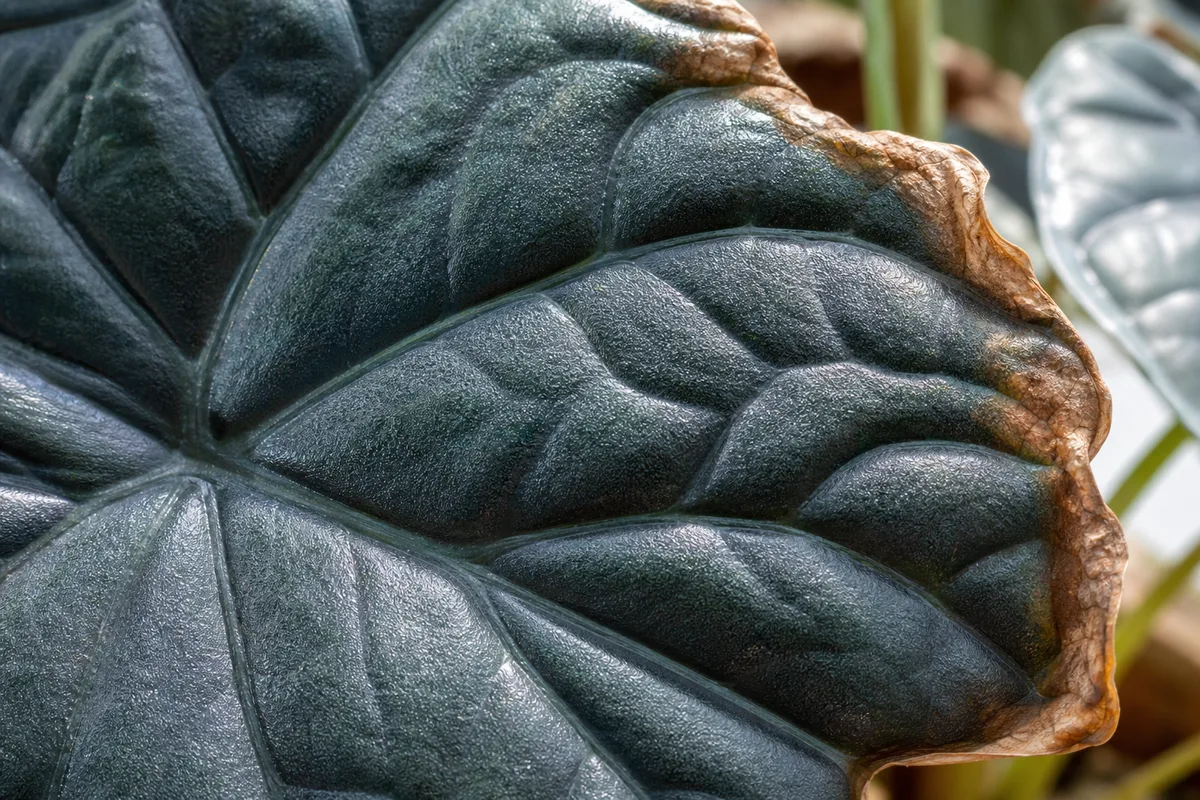
Low Humidity symptoms on Alocasia Dragon Scale - compare with healthy tissue on the same plant.
Typical humidity-stress signs:
- Papery brown or tan crispy edges along leaf margins, often on the newest unfurling spears
- New growth that stalls, curls, or fails to open cleanly while older blades stay mostly green
- Symptoms that worsen after heat season starts or after moving the pot near a vent or radiator
- Damage concentrated on the leaf side facing a heating vent, radiator, or cold window glass
- Wilting or drooping appearance on moist soil-the classic humidity signature that mimics thirst
- Multiple outer leaves developing margin burn while the central crown and corm feel firm
What humidity stress usually is not:
- A dramatically light pot with dusty dry soil pulled from the pot wall-that is underwatering
- Yellow lower leaves with soggy mix, soft petioles, and fungus gnats-that is overwatering
- Uniform brown tips on older leaves with white crust on the pot rim-that is often tap-water fluoride or salt buildup; see brown tips
- Fine stippling with webbing on leaf undersides-that is spider mites, often invited by dry air but a separate treatment
Damaged brown margin tissue on existing leaves will not revert to green. Recovery shows up in the next spears that open after humidity stabilizes-the same expectation noted in the pruning guide for cosmetic edge damage.
Visual pattern check (moist soil + crispy margins)
The humidity signature on Dragon Scale is distinctive enough to recognize without mistaking it for thirst:
- Pot weight: heavy when lifted; mix feels cool and damp at 2–3 cm depth on your normal watering rhythm
- Leaf pattern: tan-brown tissue starts at the thin margin and stops before the thick green scale center; veining stays sharp in the blade interior
- Placement clue: damage concentrates on the leaf side facing a radiator, heat vent, or cold window glass
- New growth: the latest spear from the crown shows crisping before older blades fully brown
Case example: A hygrometer on the desk read 42% in a heated January living room, but at canopy height beside the pot it read 34% RH. Papery margins on the newest spear crisped while soil stayed moist. After moving the pot 1 m from the radiator and running a small cool-mist humidifier on a 65% humidistat for two weeks, canopy readings held 68% RH and the next unfurling leaf opened with intact edges-old brown margins remained, but new growth was clean.
Why Alocasia Dragon Scale is sensitive to dry air
Alocasia baginda ‘Dragon Scale’ evolved in the humid forests of Borneo as an understory perennial. NC State Extension lists Alocasia baginda ‘Dragon Scale’ as a compact variety with textured foliage that shares the high-humidity needs of other alocasias. The Royal Horticultural Society Alocasia growing guide notes that alocasias like medium to high humidity through the growing season, and that low humidity can cause browning on leaf edges and may attract red spider mites.
Indoors, central heating can drop winter air to 10 to 30 percent humidity-far below the 60–80% band the watering guide targets for Dragon Scale. Sustained readings below roughly 50% at leaf height commonly produce margin crisping when other care is average, because high humidity helps slow water loss through transpiration and dry air forces the plant to pull moisture from leaf edges faster than roots can resupply it.
Heat and airflow amplify the problem. A pot beside a forced-air vent, above a radiator, or on drafty winter glass loses humidity within hours. Dragon Scale’s thick leaf surfaces transpire quickly in warm dry air, pulling moisture from the thinnest margins before roots compensate-even when the chunky aroid mix holds adequate water.
Dry air also weakens pest defenses. The RHS links low humidity to red spider mite outbreaks, and dry indoor rooms are a common trigger for mites on alocasias. Raising humidity helps prevention but does not replace treatment on an active spider mite infestation.
Low humidity vs. underwatering vs. fluoride burn vs. spider mites
| Signal | Low humidity | Underwatering | Fluoride / tap-water burn | Spider mites in dry heat |
|---|---|---|---|---|
| Pot weight | Normal to heavy | Noticeably light | Normal to heavy | Normal to heavy |
| Soil at 2–3 cm | Cool, moist on schedule | Dusty dry | Evenly moist | Evenly moist |
| Leaf pattern | Margin crisping; thick blade center stays green | Whole-blade inward curl | Margin burn on older leaves; white pot crust | Fine stippling + webbing on undersides |
| New growth | Spear stalls or edges crisp first | All leaves curl uniformly | Newest leaf tips brown with hard water | Bronzing spreads with webs |
| Timing | Worsens when heat runs | Worsens after skipped watering | Builds slowly over months | Worsens in warm dry air |
| First fix | Move off vent; humidifier to 65–70% RH | Water thoroughly once | Switch to filtered or rainwater | Rinse + treat mites; raise humidity |
If soil is moist and the pot feels heavy but papery margins keep crisping near a radiator in January, treat humidity-not drought. See the underwatering and brown tips guides when the table points away from dry air.
How to confirm low humidity
Work through these checks in order before Alocasia Dragon Scale repotting guide, fertilizing, or watering more:
- Hygrometer reading at leaf height - Room-level gauges on a desk can read 10–15 points higher than air around the foliage. Place the sensor beside the canopy. Below 50% with crisp margins strongly suggests dry air. Log a morning reading at desk height and at canopy height for three days-if canopy RH stays under 50% while edges crisp, dry air is confirmed.
- Vent and draft audit - Note distance from radiators, heat vents, fireplace drafts, cold window glass, and AC outlets. University of Maryland Extension advises protecting indoor plants from drafts and heat from registers, where sudden dry blasts accelerate margin damage.
- Pot weight and soil moisture - Lift the container. If it feels heavy and the top 2–3 cm is cool and damp on your normal watering rhythm, thirst is unlikely. A light pot with dry mix rules out humidity as the primary issue.
- Newest-spear pattern - Humidity damage usually appears on the latest unfurling spear first. Older leaves with isolated tip burn may be fluoride or legacy damage rather than current dry air.
- Water quality cross-check - If humidity is already above 60% and margins still brown on new growth, suspect tap-water fluoride before adding more room moisture. The watering guide covers this overlap.
- Pest check - Tap a suspect leaf over white paper and look for moving specks or fine webbing. Treat mites separately if present.
If humidity reads low, placement is harsh, soil moisture is normal, and new margins crisp, you have enough evidence to treat dry air as the primary issue.
First fix for Alocasia Dragon Scale
Move the pot off heating vents, radiators, sunny winter glass, and AC drafts, then run a humidifier beside the pot until a hygrometer at leaf height reads roughly 65–70% consistently.
This single step addresses the environmental trigger without stacking repotting, fertilizer, or extra watering. Set the humidifier close enough that the canopy benefits-not across a large dry room. A small cool-mist unit placed within 1 m of the foliage is usually adequate for a single Dragon Scale on a shelf or side table.
The RHS recommends standing the pot in a tray of gravel with water below the pot base, grouping plants, or using a humidifier to keep alocasias happy in dry homes. A humidifier with a built-in humidistat is the most reliable option through winter. UF/IFAS Extension notes that humidifiers work well when several humidity-loving plants share a room, while pebble trays and grouping help modestly for a few plants.
Keep your existing watering rhythm from the watering guide: water when the top 2–3 cm of mix begins to dry. Dragon Scale does not need wetter soil to compensate for dry air. Soggy mix in a humidified room still promotes root rot on this rot-sensitive corm.
Do not mist once daily as a substitute. University of Maryland Extension notes it is questionable whether misting really increases humidity, and NC State Richmond County Extension reports misting benefits last only a few minutes. Wet textured leaves in stagnant air can invite fungal spotting. Do not repot or fertilize a plant showing active margin burn-stabilize humidity first.
Step-by-step recovery
After the humidifier is running and placement is corrected:
- Hold humidity steady for two weeks before judging results. Brief spikes from cooking or showers do not count; look for sustained 65–70% at the plant.
- Group other tropical aroids if you have them nearby. Shared transpiration raises local moisture modestly.
- Add a pebble tray if you want a supplemental boost-Mississippi State Extension recommends trays with pots above the water line. Expect only a small local bump; do not rely on trays alone in heated rooms.
- Trim fully brown margin sections with clean scissors if they are unsightly, following the pruning guide guidance on cosmetic edge trim. Leave partially green tissue intact-it still photosynthesizes.
- Inspect weekly for spider mites while air was dry. Wash leaf undersides with lukewarm water if you see stippling; isolate heavily infested plants.
- Maintain Alocasia Dragon Scale light guide so new spears have energy to unfurl cleanly. Dragon Scale is comfortable between 18 and 27 °C (65–80 °F); cold air plus wet substrate while air is dry is a dormancy and rot trigger.
- Resume light feeding only after new leaves open cleanly for several weeks. Fertilizer on stressed tissue can worsen tip burn when salts accumulate.
Hold off on repotting until the plant pushes stable new growth. Root disturbance plus humidity stress slows recovery unnecessarily on a slow-growing jewel alocasia.
Recovery timeline
Humidity corrections show up on the next one or two spears that unfurl, typically within two to four weeks of stable conditions. Old crispy margins remain brown permanently-expect a cleaner look on new foliage, not a full cosmetic reset of existing leaves.
If edges keep browning on successive new spears after four weeks with canopy RH above 65%, revisit light intensity, watering consistency, filtered water use, and pest checks before assuming humidity alone is solved.
Improvement signs: new scale-textured leaves open with intact margins, unfurling speeds up, and the corm stays firm when you press the side of the pot gently. Worsening signs: spreading brown into green tissue on new leaves, soft petioles with wet soil, or mite webbing despite humidification.
Lookalike symptoms to rule out
Underwatering - Whole blades curl inward into a taco shape and feel thin; soil pulls away from the pot and may be dust-dry several centimeters down. Edge crisping is more uniform than margin-only browning on moist soil.
Overwatering and root stress - Yellow lower leaves, soft petioles, sour-smelling soil, and limp foliage despite damp mix. Wet roots cannot move water upward; the plant may look thirsty while soil is wet.
Tap-water fluoride or mineral burn - Brown tips on older leaves with white crust on the pot rim. More common if you feed heavily with hard tap water. Switch to filtered or rainwater rather than only humidifying.
Heat or draft scorch - Uneven crisping on the side facing a vent or hot window glass. Soil may be moist; fix placement before adding more room humidity.
Spider mites - Stippled yellowing with fine webbing on undersides. Dry air invites mites, but raising humidity alone will not eliminate an active colony.
Dormancy - Seasonal leaf drop when light and temperature fall, often with firm corm and much slower watering needs. Do not confuse winter dormancy with humidity failure unless margins crisp on actively growing spears in warm conditions.
What not to do
Do not compensate for dry air by watering more often. Wet roots in a stressed Dragon Scale invite rot faster than crisp margins harm the plant cosmetically.
Do not place the humidifier on the opposite side of a large room and assume the plant benefits. Measure at the canopy.
Do not mist heavily at night or in cold drafts-water sitting on textured leaves can cause spot decay when air circulation is poor.
Do not move the plant daily between rooms hunting humidity. Stability matters more than perfect placement for one afternoon.
Do not prune heavily while humidity is still low. Each cut loses moisture through wounded tissue on a plant already struggling.
Do not ignore spider mites because you raised humidity. Treat active infestations; prevention and cure are different steps.
Do not assume every brown edge is humidity. If you water with hard tap only, rule out fluoride burn on the brown tips page before buying a second humidifier.
Do not combine cold windows, wet substrate, and aggressive humidification without airflow-that can invite fungal issues on crowded foliage while the corm sits cold and damp.
Alocasia Dragon Scale care cross-check
Low humidity rarely exists in isolation. Confirm these basics while you humidify:
- Light - Bright indirect light per the overview. Direct sun increases leaf water loss and bleaches the scale pattern.
- Water - Top 2–3 cm dry before watering; extremely well-draining aroid mix with a drainage hole.
- Water quality - Filtered or rainwater reduces mineral edge burn that overlaps with humidity damage.
- Temperature - Roughly 18–27 °C (65–80 °F) day-to-day; protect from cold window glass and sudden swings.
- Airflow - Gentle circulation is fine; constant hot or cold blasts from vents are not.
Dragon Scale is toxic to pets and humans-keep humidifiers on stable surfaces where pets cannot knock equipment into standing water.
How to prevent low humidity next time
Run a humidifier from early fall through heating season rather than waiting for crisp edges. Set a reminder to check the hygrometer weekly when furnaces cycle.
Place new Dragon Scale purchases away from vents for the first month while you learn how fast the pot dries in your home. Quarantine and observe new spears before clustering with other aroids.
Group tropical foliage to share ambient moisture, but leave space for airflow-crowded wet leaves invite fungal spotting when misting or stagnant humid air keeps surfaces wet too long.
When buying in winter, transport the plant wrapped and avoid leaving it in a cold car. Chilling plus dry air compounds margin burn on thick-textured leaves.
Collectors growing in open rooms may target 65–70% RH; terrarium or grow-cabinet growers often maintain 70–80% during recovery. Match your setup to the plant’s placement rather than chasing one number from a forum.
When to worry
Treat as urgent when every new spear emerges mostly brown despite corrected humidity, growth stops for more than a month in warm weather, or spider mites spread webbing across multiple leaves. Those patterns suggest combined stress or active pests-not cosmetic winter edge burn alone.
You do not need to discard a plant over old crispy margins if the corm is firm and new growth is improving. Judge recovery by clean new spears, not by re-greening damaged edges.
Chronic wet soil combined with aggressive humidification is more dangerous than dry air alone. If you humidify heavily and soil stays soggy, back off watering immediately and check roots before adding more moisture to the room.
Conclusion
Low humidity on Alocasia Dragon Scale is usually an environmental placement problem, not a mystery disease. Confirm whether papery margins appear on moist soil near a vent or radiator, measure RH at leaf height-not desk height-and move the pot off forced-air paths before you water more. Run a humidifier to hold roughly 65–70% RH, rule out fluoride if humidity is already high, and treat spider mites separately if stippling appears. Old margin damage stays brown; success is the next clean spear unfurling after conditions stabilize.
When to use this page vs other Alocasia Dragon Scale guides
- Alocasia Dragon Scale watering guide - Use for routine moisture checks before assuming low humidity is the main issue.
- Alocasia Dragon Scale problems hub - Browse all 16 common issues on this species.
- Brown Tips on Alocasia Dragon Scale - Different entry point when symptoms overlap with low humidity.