How to Grow Wisteria: Planting, Pruning and Care
Learn how to grow wisteria, choose a regionally appropriate species, build a strong support, plant well, and prune for spring flowers without losing control.
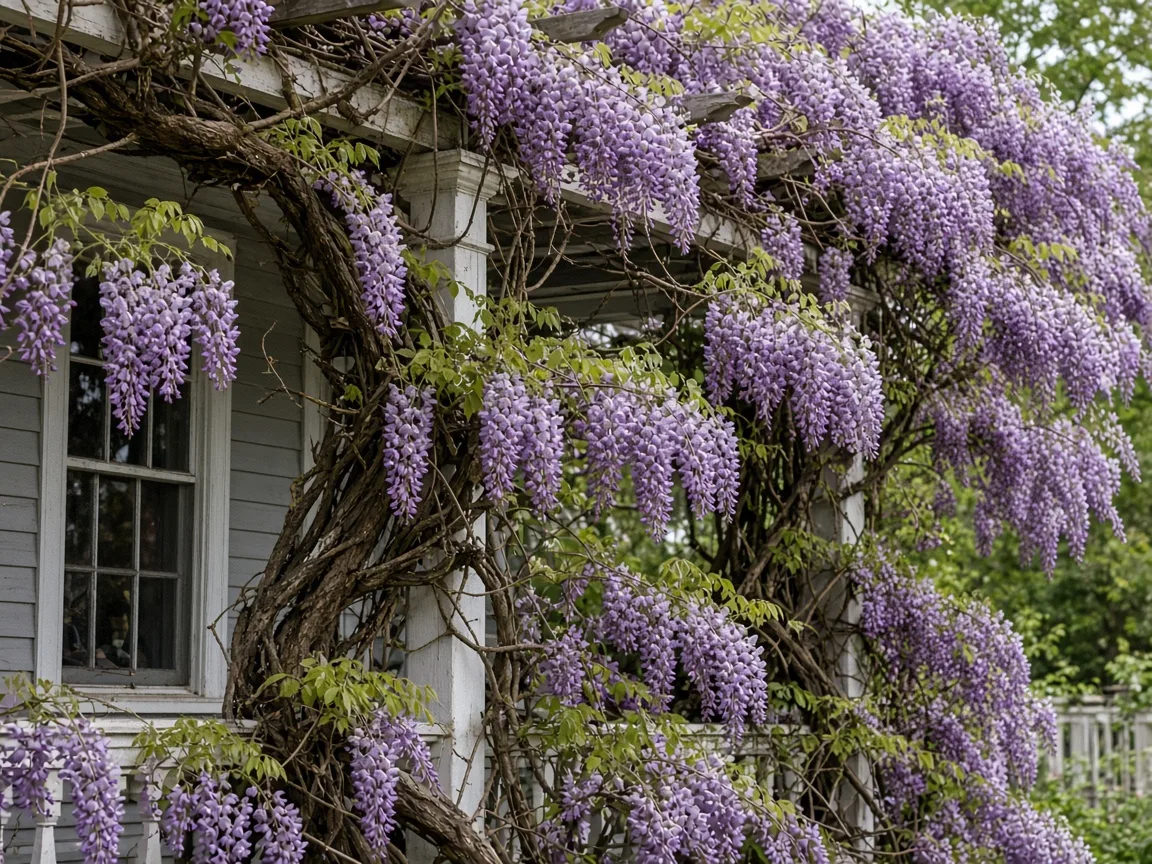
Wisteria can cover a pergola in fragrant spring flowers, but the same fast-growing vine can also bend a light trellis, climb into gutters, and become difficult to remove. Successful wisteria care starts before planting: choose a species suited to your region, decide where its permanent framework will go, and install support strong enough for a mature woody vine.
The three wisterias most North American gardeners encounter are American (Wisteria frutescens), Chinese (W. sinensis), and Japanese (W. floribunda). They do not have the same growth habit or ecological status, and none should be treated as a small, temporary climber. With the right plant, a sound structure, and two purposeful pruning passes each year, wisteria can be a long-lived feature rather than a recurring rescue project.
The short answer: choose carefully, support permanently, prune twice
For many gardens in the eastern United States, start by looking for American wisteria or a regionally appropriate cultivar, then verify that it fits your local conditions. Chinese and Japanese wisteria are invasive in parts of the United States, especially across much of the eastern region; check state and county guidance before buying either. Alabama Cooperative Extension describes how Asian wisteria can escape cultivation, girdle trees, and shade out native vegetation, while NC State Extension lists American wisteria as native across much of the eastern and central United States. (Alabama Cooperative Extension System; NC State Extension Plant Toolbox)
Give the vine full sun for the best flowering, well-drained soil, regular water while it establishes, and a structure you will not need to replace as its stems thicken. Train one or a few permanent leaders, then prune surplus shoots after flowering in summer and again while dormant in winter. Those seasonal cuts keep the vine inside its framework and encourage short flowering spurs instead of a mass of long whips. (Royal Horticultural Society wisteria pruning guidance)
Choose a wisteria species that fits your region
The species decision is not only about flower color or raceme length. It affects how vigorously the vine grows, when it flowers, whether it may spread into natural areas, and how much pruning the structure will need. In the United States, ask for the botanical name on the nursery label; a tag that says only “wisteria” does not give you enough information to make the ecological or maintenance decision.
American wisteria (Wisteria frutescens) is native to much of the eastern United States and is generally less aggressive than the commonly planted Asian species. Its flower clusters are shorter, and flowers tend to appear as foliage emerges rather than on bare stems. NC State Extension describes it as a fast-growing twiner that can still reach substantial size, so native does not mean self-supporting or maintenance-free. Choose it where it is regionally appropriate and where you have room for a sturdy framework. (NC State Extension Plant Toolbox; Fine Gardening’s American wisteria profile)
Chinese wisteria (W. sinensis) and Japanese wisteria (W. floribunda) are prized for striking, fragrant spring displays. Their flower clusters are often longer than those of American wisteria, and many Asian cultivars bloom before or as leaves emerge. But the climbing stems are strong and can overwhelm trees and structures; in regions where they are invasive, the flowers are not a good reason to plant them. In places where local authorities allow them, plan for close containment, pod removal, and regular pruning from the start. (Alabama Cooperative Extension System; Fine Gardening)
American, Chinese, and Japanese wisteria compared
| Garden decision | American wisteria | Chinese or Japanese wisteria |
|---|---|---|
| Native status in the eastern United States | Native across much of the region; confirm local provenance | Asian species; invasive in many eastern landscapes |
| Flower display | Typically shorter clusters; often opens with emerging foliage | Often longer, fragrant clusters; may open before or with leaves |
| Growth and management | Vigorous but generally more manageable | Can become extremely vigorous; containment demands more work |
| Best reason to choose it | A native vine for a permanent, strong support | Only where permitted and where the gardener can maintain and contain it |
This is a quick comparison, not a field-identification key. Hybrids occur, flower timing shifts with climate, and nursery labels may be incomplete. For more detail on identifying and managing an established Asian vine, see the Chinese wisteria identification and removal guide.
Check local invasive-plant guidance before buying
“Invasive” is a regional designation, not a universal description of every garden wisteria. A species may be sold in one state and discouraged or regulated in another. Before ordering, check the current invasive-plant list for your state or county and ask a local extension office whether the species is appropriate where you live. If the answer is unclear, select a locally native alternative rather than relying on a broad online zone chart.
Asian wisteria can escape beyond managed landscapes, where climbing stems may girdle trees and dense growth may shade understory plants. A vine trained neatly across an arbor today can still become difficult to inspect if its growth is not regularly contained. Alabama Cooperative Extension recommends replacing non-native wisteria in residential landscapes with native alternatives where possible. (Alabama Cooperative Extension System)
Build the support before you plant
Wisteria is a twining, woody vine, not a lightweight annual climber. Its stem wraps around whatever it can reach and thickens over time, while the leafy canopy and wet flower clusters add load to the support. A thin decorative trellis, aging fence panel, or loosely attached lattice may be adequate for a young plant but can fail once the vine matures. Choose a permanent structure and verify that its posts, beams, anchors, and wall attachments can carry the weight before planting.
For a wall, attach a dedicated wire system to sound masonry or structural framing rather than asking the vine to grip siding, gutters, or drainpipes. The RHS describes horizontal galvanized wires spaced about one foot apart as a practical framework for wall-trained wisteria; the gap between the wall and wires also gives stems space and airflow. A pergola or arch can display hanging flower clusters beautifully, but it should be built for a mature woody vine, not just for its appearance on installation day. Fine Gardening likewise emphasizes that training requires a firm, permanent stake or structure. (RHS wisteria pruning guidance; Fine Gardening)
Match the structure to the vine you want
A wall-trained wisteria needs a main stem and horizontal arms tied to wires. A pergola-trained vine needs a few leaders guided over the beams, where laterals can hang without being tangled through fragile roof parts. If you want a small standard or “tree” form, begin with a trained plant and use a permanent stake strong enough to support the expanding trunk and crown; Fine Gardening notes that the vine remains structurally flexible even as its stem becomes thick.
Do not train wisteria directly into a mature tree canopy. It can climb out of reach, shade the tree, and make both pruning and eventual removal hazardous. Avoid planting it beside a building simply because the wall is sunny: leave access to windows, gutters, roof edges, and the wire system. A good support plan includes not only where the vine will grow, but also how you will reach and prune it for decades.
Choose a sunny site with room for the framework
For the best flower production, give wisteria at least six hours of direct sun. It can grow in partial shade, but leafy growth may outpace flowering, especially when the flowering laterals sit under a roof, tree canopy, or dense pergola cover. Watch the light at the height where the vine will form spurs, not only at its base. NC State Extension identifies full sun as important for the best bloom on American wisteria. (NC State Extension Plant Toolbox)
Choose soil that drains after rain. Wisteria tolerates a range of garden soils once established, but roots that sit in waterlogged ground are more vulnerable to stress and decline. If water pools at the planting site, improve drainage or choose a different location rather than trying to compensate with fertilizer. A vine placed near a sunny wall may also benefit from protection from strong cold winds in regions where spring flower buds are exposed to late freezes.
Check mature dimensions for the species and cultivar you are buying. Nursery height estimates rarely describe the amount of pruning required to keep a vine on a specific pergola. Leave room to walk around its base, inspect the structure, and reach the main framework; do not position it where its mature shoots will inevitably enter a neighbor’s trees, wires, or roofline.
How to plant a nursery-grown wisteria
Plant in spring or fall when the soil is workable and conditions are mild, avoiding periods of frozen soil, extreme heat, or drought. Water the nursery pot beforehand so the root ball is evenly moist, then dig a hole about as deep as the root ball and wider than it. Loosen circling roots gently, set the vine at the same depth it grew in its pot, backfill with the original soil, and water thoroughly to settle it. Do not bury the stem or add concentrated fertilizer into the planting hole.
Set the plant close enough to the support for easy tying, but not so close that its crown is trapped against a post or wall. If you are using wires, decide where the first leader will travel and tie it loosely with a soft plant tie. The tie should hold the stem in its intended direction without cutting into it as it thickens. Water again if the root zone dries during establishment; young roots need more consistent moisture than a mature vine.
Buy a named, nursery-propagated plant when you want predictable flowers. A seedling can differ from its parent and may take many years to bloom, while a grafted or cutting-grown named cultivar is more likely to flower sooner. BBC Gardeners’ World notes that seed-grown wisteria may take up to 20 years to flower, whereas grafted nursery plants can bloom within several years; actual timing varies by cultivar, climate, age, and care. (BBC Gardeners’ World Magazine)
Planting a wisteria in a container
Wisteria can grow in a large container, but it is not an easy way to keep a vigorous vine permanently small. Container culture is most practical when you deliberately train it as a standard with a single upright stem and a compact crown. Choose a large, stable pot with drainage holes and a strong stake fixed securely in the container, then expect to prune the crown and water more often than an in-ground vine.
Pots dry faster, heat up more quickly, and restrict root growth. Check moisture regularly during warm, windy weather and water deeply when the upper soil begins to dry, allowing excess water to drain. Refresh or replace the potting mix when it compacts and repot gradually as roots fill the container. If you want an arch covered in flowers or a low-maintenance screen, plant in the ground and build the permanent structure; the container route adds ongoing watering, feeding, pruning, and pot-stability work. (BBC Gardeners’ World Magazine)
Water and feed for steady growth, not just leaves
Water a newly planted wisteria deeply whenever the root ball and surrounding soil begin to dry. During the first growing season, check the soil rather than watering on a rigid calendar; sandy soil, hot weather, and wind shorten the interval, while cool or rainy conditions lengthen it. Once established, wisteria is more tolerant of ordinary dry spells, but prolonged drought during active growth can stress the plant and affect flower-bud development for the following season.
Mulch the root zone with a modest layer of organic matter, keeping it away from direct contact with the trunk. Mulch reduces rapid drying and temperature swings, but a deep pile against woody stems can trap moisture and conceal damage. Make sure water reaches the root zone rather than running away from a compacted surface.
Do not routinely feed wisteria with a high-nitrogen fertilizer. As a legume, it can fix nitrogen, and excess nitrogen often produces vigorous leaves and long shoots without solving a flowering problem. If the vine is weak or soil fertility is uncertain, use a soil test before adding fertilizer; then follow the test recommendation rather than applying a “bloom booster” by habit. Do not add phosphorus unless the soil test identifies a need.
Train the first leaders before the vine becomes woody
During the first seasons, decide which stems will become the permanent framework. Keep one main leader for a standard form or a few well-placed leaders for a wall or pergola, and loosely tie them toward the support as they extend. Remove or shorten shoots that head toward gutters, roofs, tree canopies, or unsupported gaps. Early training is easier than untangling a thick stem that has wrapped around the wrong beam.
Allow the selected leader to reach the height or length where you want branching, then manage its side shoots so they form an orderly framework. Inspect ties several times during the growing season; loosen or replace any that begin to constrict the stem. Prune out broken, dead, crossing, and badly placed shoots with clean tools, but do not remove every new stem simply because the plant looks vigorous. The goal is a strong, open structure that you can maintain safely.
If your support is already crowded, remove weak or misplaced growth first and identify the main arms before making large cuts. A vine that has filled a small structure may need a staged renovation; removing all its top growth at once can trigger a mass of replacement shoots and may delay flowering. For a large vine entwined through a building or tree, get help before cutting stems overhead or under tension.
Prune wisteria in summer and during dormancy
Two seasonal pruning passes help contain the vine and build short flowering spurs. The exact months shift with climate: RHS guidance uses July or August for the summer cut and January or February for the dormant cut in its climate. In North America, use those as seasonal cues—after the main bloom for summer, and after leaf fall but before buds swell for winter—rather than copying a calendar date that may not match your local weather. (RHS wisteria pruning guidance; BBC Gardeners’ World Magazine)
First identify the main framework and the shoots you want to extend. Keep a few well-positioned new leaders to replace damaged or aging branches, then shorten the surplus lateral whips. Use sharp bypass pruners for small shoots and a pruning saw for larger wood; avoid pulling or twisting a stem that is wrapped around a support. If you do not know the vine’s species or have never pruned it, make conservative cuts the first year and observe where it flowers before renovating.
Summer pruning after flowering
After the flowers fade and new shoots have lengthened, cut back most long, whippy side shoots to about five or six leaves from their base or from the main framework. Make each cut just above a healthy leaf or bud. This reduces tangles and directs the vine toward shorter spurs, while leaving selected leaders intact to extend the framework. (RHS wisteria pruning guidance)
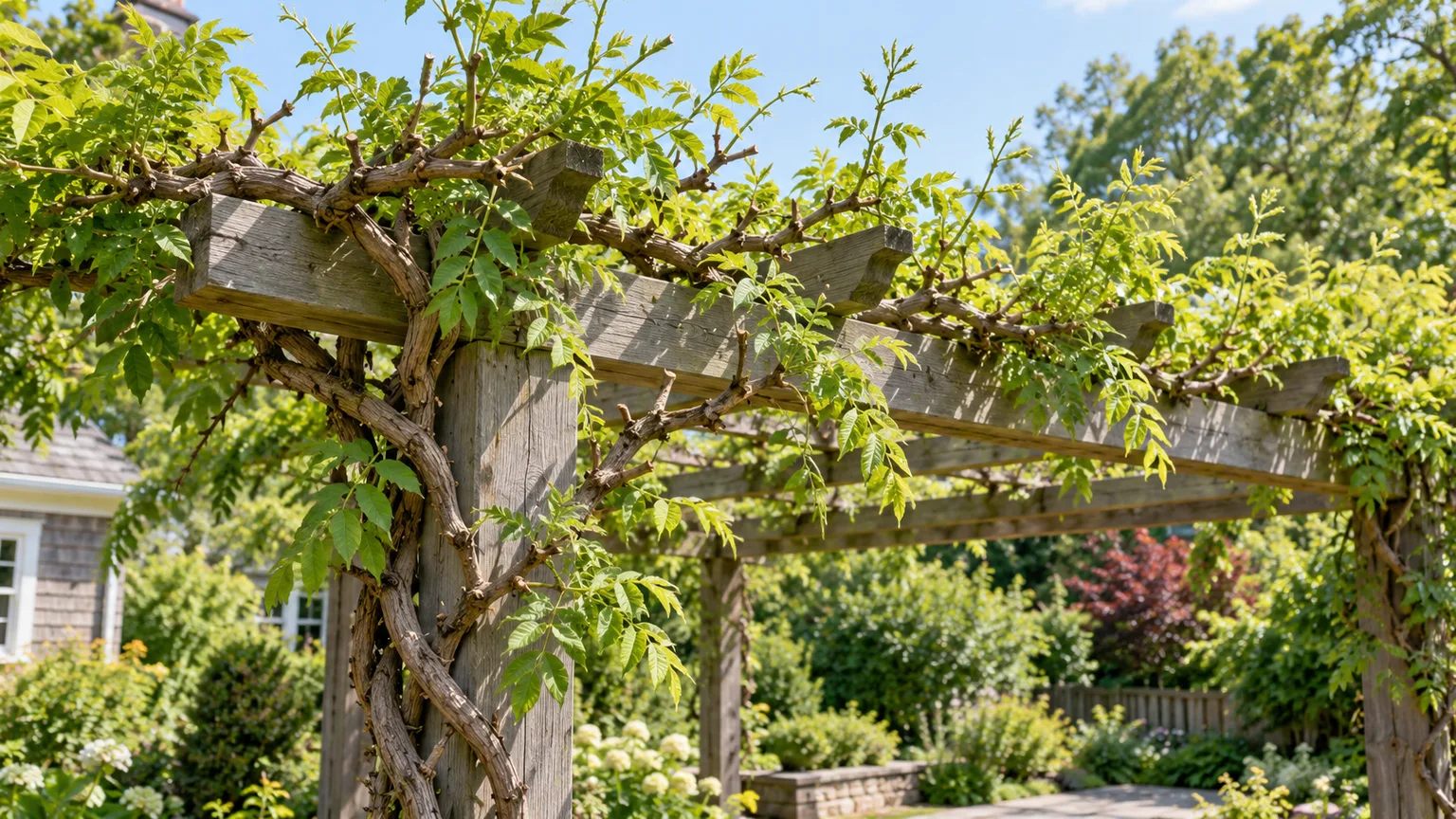
Do not shear the entire vine into a uniform hedge or shorten every stem to the main trunk. Some shoots are needed to fill gaps and carry the framework farther; mark or tie those before you begin. If the vine is young, prioritize structural training over a heavy flowering-spur routine. If it has already produced a good display and stays within its support, remove only the surplus growth that creates a safety or access problem.
Winter pruning that preserves flower spurs
When the vine is leafless and dormant, shorten the side shoots already cut back in summer to roughly two or three buds from their base. Leave the short spurs attached to the permanent framework rather than cutting them flush. On an established Asian wisteria, plump flower buds often sit close to older wood, so inspect before you cut and leave doubtful buds until you can identify them. (RHS wisteria pruning guidance)
Remove dead or broken branches and stems growing into structures, but renovate a neglected vine gradually when the support is sound. Severe pruning can bring a large flush of leafy growth and may cost you one or more flowering seasons while replacement branches develop. If branches must come off to repair a pergola or protect a roof, prioritize safe access and accept that the following bloom may be lighter. For images and a troubleshooting workflow focused on flower buds, see why a wisteria may not bloom.
Why a wisteria vine may not flower
A young wisteria can take years to flower, especially if it was grown from seed. Do not judge a newly planted seedling by the bloom schedule of a mature grafted cultivar. Start by confirming the plant’s age and propagation history; if the nursery label is gone, look for a graft union near the base, but remember that absence of a visible union does not by itself prove how the plant was propagated. (BBC Gardeners’ World Magazine)
For a mature vine, check the likely causes in this order: too little direct sun, pruning at the wrong time, a late frost that damaged flower buds, drought during active growth, or high-nitrogen feeding that favored leaves. Look closely at the structure before pruning. If the vine produced plump buds that later shriveled after a cold snap, frost is more plausible than a lack of fertilizer; if it has never made buds and grows long leafy shoots in shade, first improve the light or correct the pruning pattern.
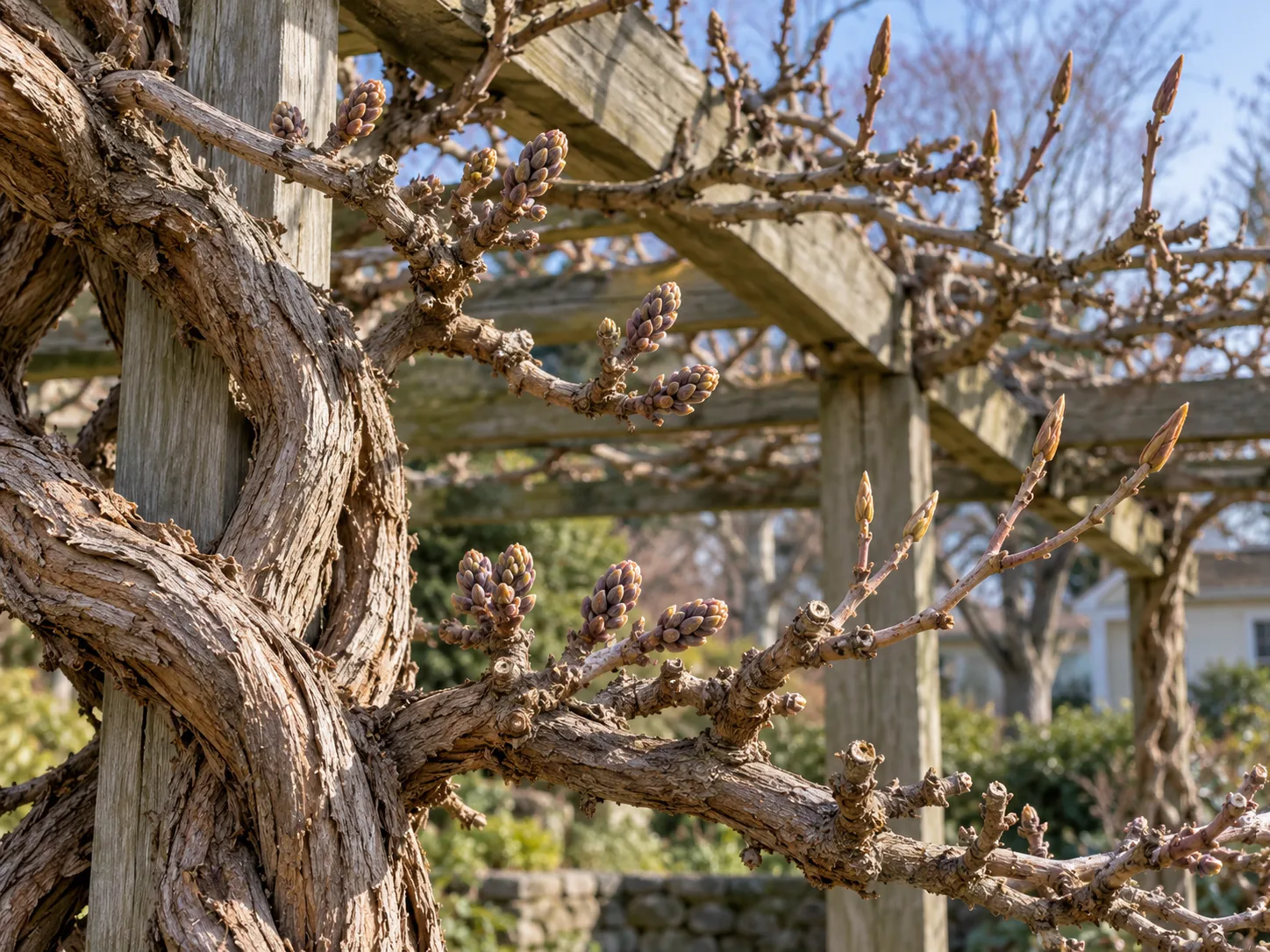
Do not respond to a missing display by immediately root-pruning, transplanting, or applying concentrated phosphorus. These are disruptive steps that do not correct a juvenile plant, lost flower spurs, or frost damage. Keep a simple season record—when it bloomed, when you pruned, whether buds formed, and whether the site stayed dry—so one complete growing cycle can show which change helped. The wisteria bloom troubleshooting guide covers bud identification and a more detailed diagnosis.
Propagate wisteria only if you can wait
Softwood cuttings, layering, and seed can all produce new wisteria plants, but propagation is not the fastest route to a reliable flowering specimen. A cutting or layer preserves the parent cultivar more closely than seed, yet a young plant still needs time to establish and form a mature framework. If fast, predictable flowers are the goal, buy a named, nursery-grown plant and check whether it is grafted or cutting-grown.
If you take a cutting, choose healthy current-season growth and follow a clean propagation method with a sterile medium and steady moisture. Keep the cutting warm in bright indirect light while roots form, then pot it on only after it resists a gentle tug. Rooting success varies, and the new plant may take several seasons before it is ready for a permanent outdoor support. BBC Gardeners’ World likewise notes that wisteria cuttings can take several years to flower. (BBC Gardeners’ World Magazine)
Seeds are slower and may not grow true to the parent cultivar. If you experiment with seed, keep each pod labeled, sow fresh or properly stored seed in a free-draining medium, and expect a long wait before flowering. Keep pods and seeds away from children and animals while handling them. For a named flower color, growth habit, or compact cultivar, vegetative nursery stock is the more dependable choice.
Keep seed pods away from pets and children
Wisteria is toxic if eaten. The ASPCA lists wisteria as toxic to dogs, cats, and horses and describes vomiting, diarrhea, and depression among possible signs. NC State Extension notes that seeds and other plant parts can cause gastrointestinal discomfort when ingested. Keep pets and children away from fallen pods, collect mature pods before they split, and wash your hands after handling plant debris. (ASPCA Animal Poison Control; NC State Extension Plant Toolbox)
If a pet eats a pod or another part of the vine, contact a veterinarian or animal poison-control service promptly; do not wait for signs to worsen or try a home remedy. For suspected human ingestion, contact a local poison-control center or medical professional. Wisteria can still be grown responsibly in many yards, but access to its seeds and pods should be part of the planting and cleanup plan.
Conclusion
Wisteria is easiest to manage when the gardener makes the long-term decisions first. Choose a species appropriate to your region, check local invasive-plant guidance, install a permanent support, and plant where the vine can receive full sun without swallowing a roof, fence, or tree canopy.
Water consistently while the plant establishes, avoid unnecessary nitrogen, and train a small number of leaders before the stems become heavy. Then prune surplus growth after flowering and shorten laterals again during dormancy while preserving the spurs that carry next season’s flowers. If a mature vine does not bloom, diagnose age, light, pruning, frost, and water before making a severe cut. Keep pods away from pets and children, and treat wisteria as a permanent woody feature rather than a temporary flowering accent.



