How to Identify and Remove Chinese Wisteria Vines
Learn how to identify Chinese wisteria, dig out small crowns, cut mature vines safely, dispose of pods and roots, and prevent new shoots from returning.
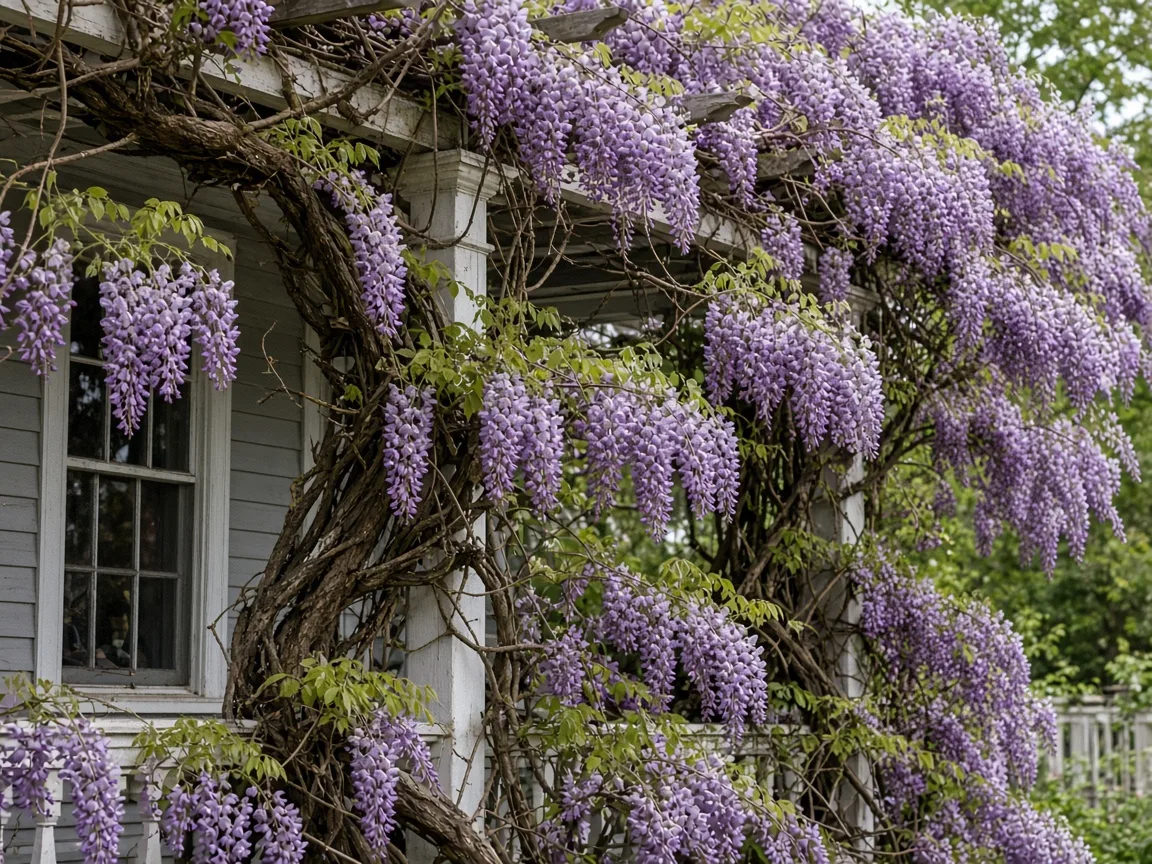
Chinese wisteria (Wisteria sinensis) is a woody, twining vine that can turn from a flowering ornament into a long-term removal project. The durable approach is to confirm what you have, remove or kill the root crown, and return to the site whenever new shoots appear. Cutting the visible vine is a useful first step around trees and buildings, but it does not by itself prove the plant is dead.
A small seedling in open soil is a different job from a decades-old trunk wrapped through a tree canopy. This guide helps you tell the vine from other wisterias, select a removal method that fits the site, handle cut material safely, and avoid the common mistake of treating one clean cut as the end of the work.
The short answer: match the method to the plant
For a seedling or a small plant in open ground, loosen the soil and remove the root crown and as much of the root system as you can. If the roots are tangled with other plants, cut every wisteria stem at ground level and keep cutting the new shoots through the growing season; repeat visits are the price of avoiding herbicide.
For a large, established vine, first sever its climbing stems close to the root crown so the upper growth stops receiving water. Do not yank a heavy vine out of a tree or off siding. Then decide whether the crown can be excavated or whether a locally appropriate, labeled cut-stump treatment is safer and more realistic; either route still requires monitoring for runners and resprouts. UF/IFAS Gardening Solutions describes both repeat cutting and digging as non-herbicide options, and notes that cut vines can resprout if they are not controlled below ground.
Before taking a shovel or herbicide to an uncertain plant, photograph its leaves, flowers, pods, and stem direction and confirm the species with a local extension office or invasive-plant program. Chinese and Japanese wisterias can hybridize, and look-alike vines have different risks and control plans. Regional authorities also differ in which species they list as invasive, so verify the status where the vine is growing.
How to identify Chinese wisteria reliably
Look for a deciduous, woody climber with alternate, pinnately compound leaves: each leaf has a central stalk lined with oval leaflets. NC State Extension describes Chinese wisteria leaves as having 7 to 13 leaflets and its spring flowers as blue-violet, pea-shaped clusters that open before the leaves have fully emerged. After flowering, the vine can carry drooping brown pods with a velvety surface into fall; older stems become thick, twisted, and trunk-like. These features are more useful together than any one clue alone. NC State Extension’s Plant Toolbox provides a detailed species description and quick-identification notes. The Royal Horticultural Society’s Chinese wisteria profile likewise describes a large deciduous climber with drooping, fragrant mauve-to-lilac racemes that open before the leaves.
Chinese wisteria is a twiner, not a clinging vine with suction cups or aerial rootlets. It wraps around a support and may also send lateral stems along the ground, where rooted sections can start new growth. A mature plant can therefore appear to have several separate crowns when the stems are connected underground or by low runners. Follow stems toward their bases before deciding how many plants you are removing.
The direction of the twining stem can help: NC State Extension and the Mississippi Forestry Commission describe Chinese wisteria as twining counterclockwise, while Japanese wisteria is generally clockwise. Use that only as one field clue, not a stand-alone diagnosis. Viewing angle, tangled growth, hybrids, and absent young stem tips can make direction hard to judge; if the plant’s identity changes what you plan to do, have a knowledgeable local source verify it. The Mississippi Forestry Commission’s Chinese and Japanese wisteria profile also warns that overlapping traits and hybrids can make positive identification difficult.
Chinese, Japanese, and American wisteria: key differences
| Clue | Chinese wisteria (W. sinensis) | Japanese wisteria (W. floribunda) | American wisteria (W. frutescens) |
|---|---|---|---|
| Typical twining direction | Counterclockwise | Clockwise | Counterclockwise |
| Leaflets | Usually 7–13 | Often 13–19 | Commonly 9–15, with variation |
| Flowers | Usually open before leaves are fully out | Long clusters, often opening as leaves develop | Shorter clusters, generally after leaves emerge |
| Native range | China | Japan | Eastern and central North America |
| Management note | Invasive in many eastern U.S. landscapes; check local status | Also invasive in many eastern landscapes | Native in parts of the U.S., but still vigorous and needs support |
NC State Extension also describes American wisteria as counterclockwise-twining and less aggressive than Chinese wisteria; its American wisteria profile gives more detail. The Japanese wisteria profile documents the clockwise stems, 15–19 leaflets, and flowers that open as leaves emerge. The table summarizes common tendencies, not a guaranteed key. Flowering time shifts with climate and spring weather, leaflet counts overlap, and garden plants may be hybrids. If the vine is small enough to remove without disturbing protected vegetation, the safest practical choice may be to treat an unidentified Asian wisteria as potentially invasive while you confirm it; if the plant is large or intertwined with a valuable tree, pause and get an expert identification first.
Decide whether removal is needed now
Chinese wisteria is not automatically an ecological threat in every climate or jurisdiction, but it is listed as invasive in some places and can escape from cultivation where conditions suit it. NC State Extension lists W. sinensis as invasive in North Carolina, and UF/IFAS flags it as an invasive plant in Florida natural areas. Check your county, state, or regional invasive-plant list before you decide to retain, move, or dispose of a plant; rules and recommendations can differ across boundaries.
Removal becomes more urgent when the vine is spreading beyond its support, rooting along the ground, producing pods near a natural area, girdling a tree, or pushing into rooflines, gutters, fences, and other structures. The Mississippi Forestry Commission notes that Chinese and Japanese wisterias can form dense thickets and that lateral stems may root along their length. That growth pattern explains why removing only the flowering top or the original trunk may leave viable sections behind.
If it is a single, well-contained vine on a sturdy, detached arbor and local guidance allows it, you may choose containment instead of removal. That means pruning seedpods before they mature, cutting runners before they root, and inspecting the structure and perimeter regularly. It is a continuing maintenance commitment, not proof the vine has become harmless; if you cannot reliably reach the canopy or keep runners off neighboring land, plan for removal or professional help.
Choose a removal method by size and setting
| What you find | Practical first choice | What makes the work harder |
|---|---|---|
| One new seedling in open soil | Pull or dig while soil is damp; remove the crown and roots | Tiny root fragments and nearby seedlings missed during cleanup |
| Several young plants or short runners | Trace stems to crowns, dig accessible roots, then inspect the area | Runners can extend beyond the visible leaf canopy |
| Mature crown in a planting bed | Cut climbing stems low, then excavate if roots can be separated safely | Roots may be large, woody, and interwoven with desirable plants |
| Thick vines in a tree canopy | Cut at the base; let upper growth die in place | Pulling can peel bark or bring down dead branches |
| Vine against a building or fence | Isolate low stems and remove loose material in manageable sections | Pressure, hidden fasteners, brittle dead growth, or fragile siding |
| Sensitive site or restricted herbicide area | Repeated cutting or a professional mechanical plan | Follow-up is essential and can take more than one season |
Think in terms of the root crown and the area the plant has colonized, not just how much vine you can see. A hand-sized seedling may be completely removable in minutes, while a wide patch with linked runners can send up shoots outside the area you cleared. If the plant is near a utility, retaining wall, drainage feature, stream, mature tree roots, or protected habitat, check before digging or applying any chemical.
Prepare the site, tools, and safety plan
Choose a cool, dry work period when you can see the stems and the ground is not slippery. For small plants, use gloves, eye protection, sturdy shoes, hand pruners or loppers, a narrow spade, and a tarp for roots and pods. For woody stems, use a sharp pruning saw or loppers sized for the branch; do not cut a stem that is under tension, above shoulder height, or beyond your stable reach.
Before cutting, trace the vine from the crown up the support and identify every stem that belongs to it. Check where those stems cross shrubs, tree trunks, wires, roof edges, and fences, then clear a landing area for loose material. If a cut could drop a limb, pull down siding, strike a person, or damage a desirable plant, stop and ask an arborist or qualified invasive-plant contractor to make the plan.
Wisteria is harmful if eaten. NC State Extension lists toxic parts that include seeds, pods, leaves, and stems, and the ASPCA’s wisteria listing flags it as toxic to dogs, cats, and horses. Keep children and pets out of the work zone, collect seedpods instead of leaving them on the ground, and wash hands after handling plant debris. If a person or animal eats any part, contact poison control or a veterinarian rather than waiting for symptoms.
If you may use herbicide, add the label’s required protective equipment and site restrictions to the plan before you cut. Keep the product in its original labeled container, prevent drift onto plants you want to keep, and avoid work near water or storm drains unless the product label and local authorities explicitly allow that use. Penn State Extension stresses mixing herbicides according to label directions; the current label is the source for the product-specific site, method, and handling instructions.
Dig out seedlings and small, ground-running plants
Dig when the soil is moist enough to release roots but not so wet that the hole collapses. Start several inches beyond the visible stem, loosen the soil around the crown, and lift the plant while keeping the root mass as intact as you can. Follow lateral stems in both directions; where a section has rooted, cut it back to a connected crown and dig that section too.
Do not assume that pulling the top free has removed the plant. Inspect the hole and the lifted root mass for pale, firm root fragments and woody crown pieces; remove what you can reach without damaging nearby tree roots or buried utilities. Replace the soil only after checking the surrounding ground for additional rooted nodes, then mark the location so you can recheck it during the next flush of growth.
For a patch that is too large to excavate cleanly, cut all stems low and return every few weeks to remove new shoots. The shoots are evidence the root system is still alive, but repeated removal prevents the vine from rebuilding a full canopy and setting seed. This approach is most practical when you can reach the whole patch consistently; it is a poor fit for a slope, inaccessible fence line, or large wooded infestation where skipped shoots can keep feeding the root crown.
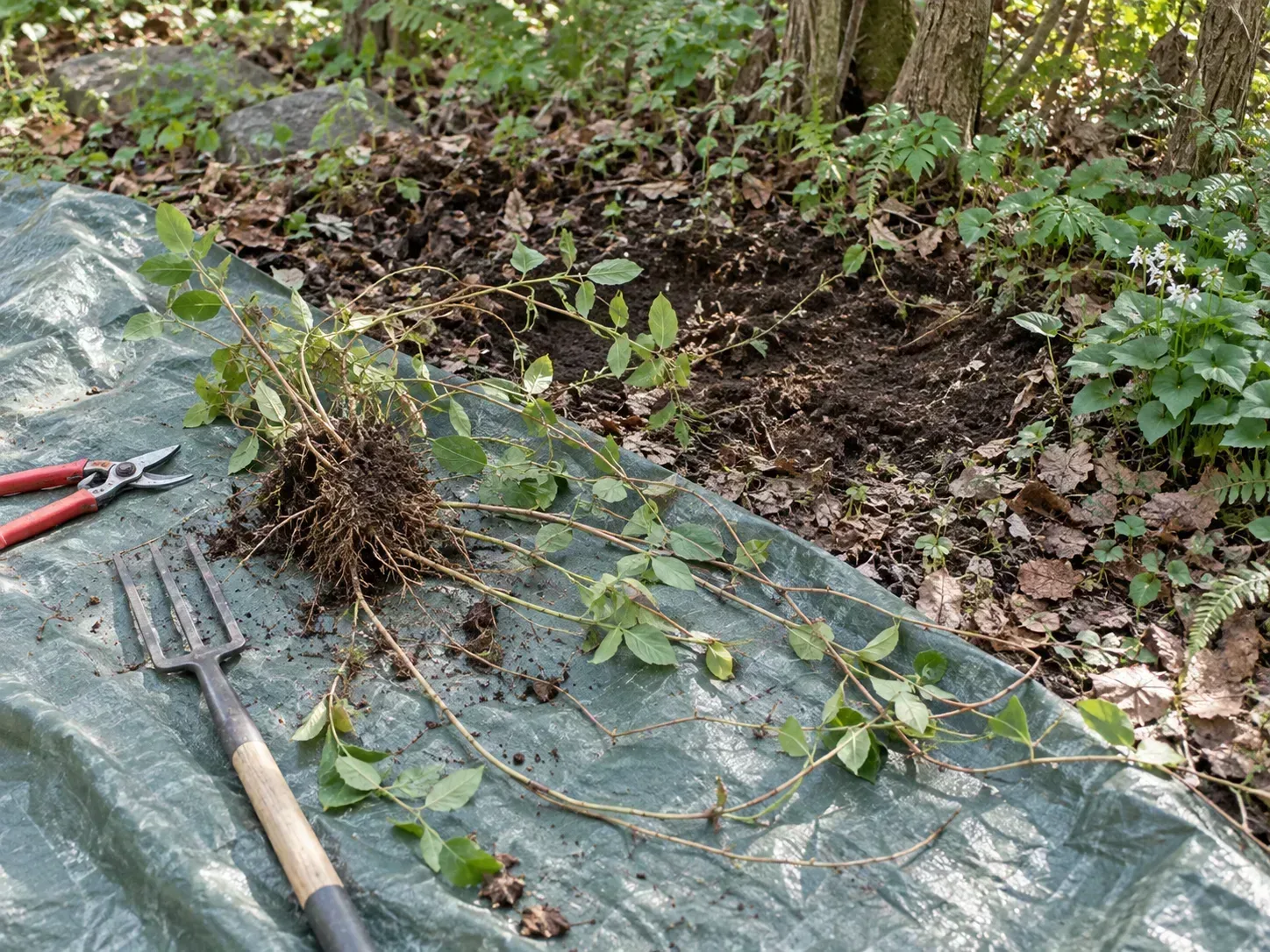
The pictured vine is an example of ground-level manual removal. With wisteria, trace and inspect every runner because a missed rooted section can resprout.
Cut mature vines away from trees and structures
Find the lowest accessible point where the vine emerges from the soil, then sever each climbing stem as close to the root crown as practical. If the plant has several large stems, cut them one at a time and confirm that every live connection from crown to canopy has been interrupted. Remove lower runners that cross the ground, but do not dig aggressively through major tree roots just to make the site look tidy.
Leave the severed upper growth where it is if it is safely supported and can decay without creating a hazard. Pulling a thick, living wisteria stem downward can strip bark, break branches, or damage siding; dead stems can also remain tight around a tree for a long time. A tree with substantial vine weight or a canopy full of tangled growth needs an arborist’s assessment, especially if dead branches could fall over a path, play area, or roof.
Around a building, detach only material that releases without force. Cut it into manageable lengths, protect windows and gutters from falling pieces, and avoid prying roots or stems from masonry. If the vine has entered a wall cavity, lifted roof materials, or grown behind trim, have the structure inspected before you attempt to extract the old wood.
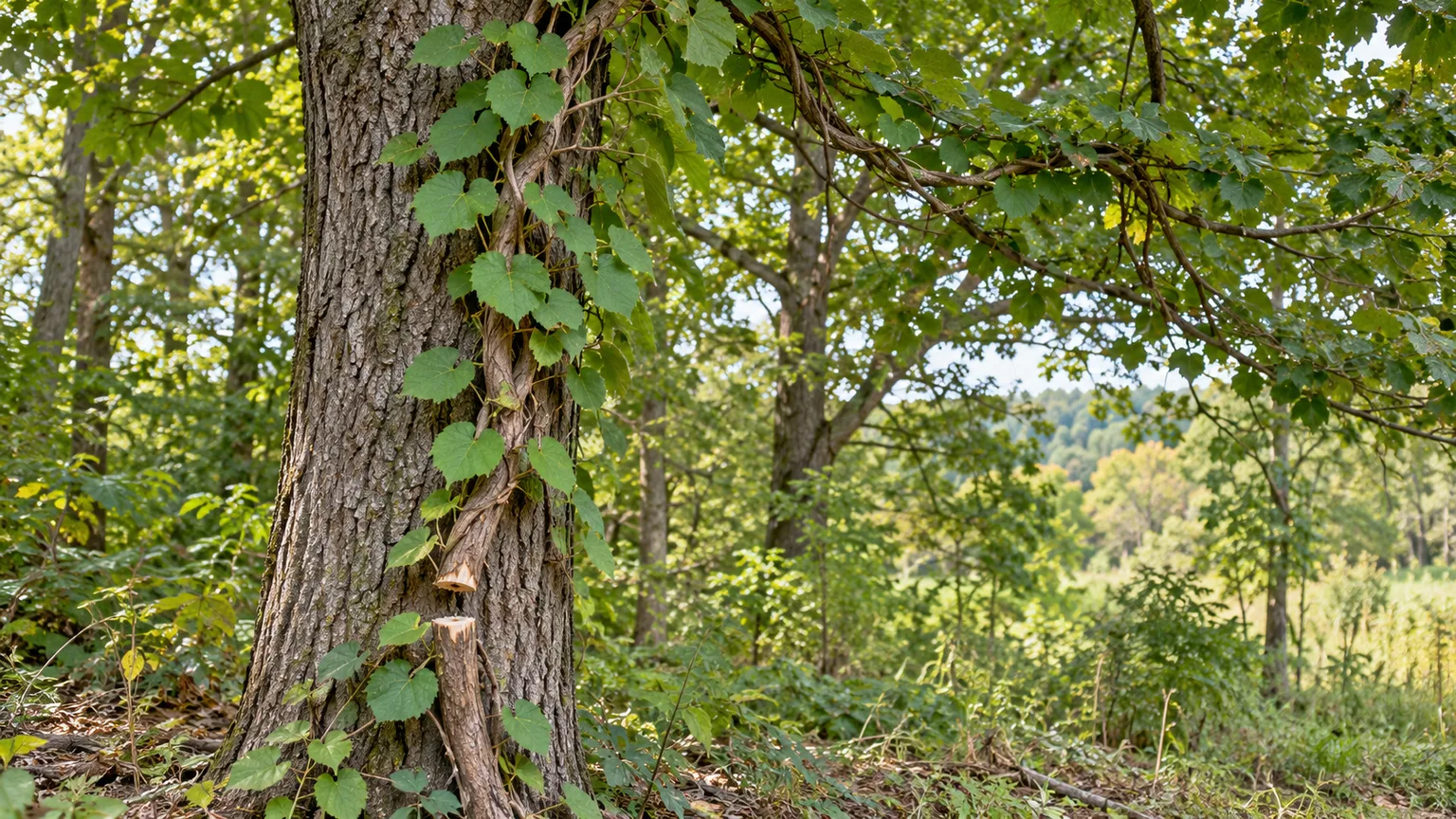
This image illustrates a general tree-vine safety principle: sever at the base rather than pulling an established vine down through the canopy.
Use cut-stump treatment when the crown is too large to dig
A cut-stump method can be more manageable than spraying a canopy because the target is a fresh, low cut surface. UF/IFAS recommends cutting wisteria as close to the root as possible and treating the cut; its guidance also emphasizes repeat control if the plant resprouts. The Mississippi Forestry Commission’s wisteria guidance describes treating the stump just inside the bark after the main stem is severed. The exact product, formulation, target site, and application method matter, so do not copy an old concentration from a web page or substitute a household “weed killer.”
Use a product only when its current label permits the intended cut-stump use at your site and for the target vegetation. If the label does not clearly support that use, ask a local extension educator, licensed pesticide applicator, or land manager before proceeding. Penn State Extension’s cut-stump guidance explains why application differs by stem size and formulation: smaller stems are treated across the cut face, while larger stems require attention to living tissue near the bark. Avoid overspray and runoff; a small paintbrush or labeled applicator may reduce drift compared with spraying, if the label allows it.
Do not apply a soil-active product near desirable tree roots just because the wisteria is in the way. The Mississippi Forestry Commission notes that some herbicides can injure desirable trees through root uptake and that treatment options vary by method. If the crown is intertwined with valuable plants or sits near water, the safest route may be repeated mechanical cutting or a professional who can select a targeted method for that exact site.
Timing and pesticide labels are method-specific
Extension recommendations do not reduce to one universal calendar date. Penn State Extension says late summer and fall are preferred for many cut-stump treatments and cautions that spring sap movement can reduce effectiveness, while UF/IFAS describes active-growth timing for its broader wisteria-control guidance. These recommendations cover different application contexts and should not be blended into a do-it-yourself mixture or assumed to override a product label.
Read the entire label before opening the container, including dilution, treated sites, weather restrictions, protective gear, re-entry interval, and disposal instructions. Mix only what the label allows and use the labeled concentration; never increase a dose to compensate for a missed stump or apply a chemical to foliage when the label permits only a cut-stump use. If you cannot meet the label conditions, choose a nonchemical plan or hire an appropriately licensed professional.
Keep regrowth from reclaiming the site
Inspect the crown and the full footprint of the old runners at least every week or two during the growing season. Look for new shoots at the original base, along buried or exposed stems, and several feet from the main crown; note their locations instead of assuming every shoot begins at the original trunk. Remove a shoot while it is small, then check the same area again rather than waiting for a new canopy to form.
If you chose repeated cutting, keep the schedule through the entire growing season and resume when growth restarts. A single late-season cut can leave enough foliage earlier in the year for the roots to store energy, and one missed runner may continue to spread. If you used an approved cut-stump treatment, inspect anyway: Penn State Extension cautions that initial treatment may reduce a root system without eliminating every resprout, so follow-up and retreatment may be needed when the product label allows.
Use a simple record: map or photograph the original crown, mark the edge of the patch, date each cut, and note where new shoots appear. This makes it easier to spot whether the infestation is shrinking or whether a hidden runner is feeding another section. Keep the surrounding soil covered with a planned replacement planting or mulch only after the wisteria is controlled; neither mulch nor a new plant is a substitute for removing or exhausting the live crown.
Dispose of seedpods, roots, and cut vines
Bag seedpods and root fragments so they cannot be scattered during transport. Do not put viable pods or live root pieces into a home compost pile; a pile that does not heat evenly can leave plant material capable of sprouting. The Buncombe County Extension Master Gardener article on Chinese and Japanese wisteria management specifically recommends bagging fruit and roots rather than composting them.
For long stems, keep the cut material contained on a tarp until you can dispose of it according to local yard-waste rules. UF/IFAS recommends curbside pickup where available, but local programs may have special rules for invasive plants or seed-bearing material. Ask your municipal waste service whether they want it bagged, bundled, or taken to a specific facility; do not dump it in a wooded lot, stream corridor, vacant land, or roadside.
If the vines have already dried without pods or viable root sections, the disposal route may be different from fresh seed-bearing material, but the local waste program still has the final say. Keep the pile away from soil contact until it is collected, and do one last sweep for pods hidden in leaf litter. This small cleanup step prevents the removal site from becoming a seed source for the next season.
Avoid removal mistakes that create new problems
Cutting once and walking away: Cutting blocks the visible vine but leaves the root crown and runners alive. Either remove accessible roots or schedule repeated shoot removal until the plant stops returning. Put follow-up visits on your calendar before the first cut, not after the canopy comes back.
Pulling a mature vine off a tree: A thick stem can tear bark and branches. Sever it near the ground and let the high growth die in place unless an arborist directs another approach. Reassess dead growth later if it creates a falling-limb or access hazard.
Digging blindly through a mature landscape: A wisteria root system can be large and mixed with tree roots, cables, irrigation, or drainage lines. Trace first, call utility-marking services before substantial excavation, and use selective cutting where digging would do more harm than the vine. A cleaner-looking hole is not worth injuring a desirable tree or buried service.
Spraying the whole canopy: A broad foliar spray can drift onto desirable plants and may not be permitted by the product label for that location. A targeted cut-stump method can limit the target area, but only if a labeled product and safe site conditions are available. Never rely on a windy-day workaround or improvised shield to make an unsuitable product safe.
Using salt, household vinegar, or boiling water: These are not reliable ways to kill a large woody root system and can damage soil, nearby plants, or hardscape. They also distract from the two methods that address the actual problem: remove the crown or keep cutting regrowth, with targeted labeled treatment as a conditional option. A scorched leaf or damaged surface root does not show that the underground crown is dead.
Composting pods or root fragments: Wisteria can spread by seed and rooted stems. Contain the material and follow local invasive-plant disposal rules. If your local program has a separate collection for invasive plants, use it.
Know when to hire a professional
Call an arborist when the vine is high in a mature tree, has added substantial weight to a canopy, has grown across a roof, or would require ladder or chainsaw work. Ask for an arborist’s assessment before anyone pulls dead growth out of a tree; decay and weather may eventually loosen the stems, and the safest removal timing depends on the condition of the host tree and the risk to people and structures.
A licensed pesticide applicator or invasive-plant contractor is a better choice when the root crown is too large to excavate, repeated cutting is impractical, the vine is in a natural area, or desirable plants and water are close to the target. Give the contractor photographs and the site history, including any previous products used, and ask what follow-up visits are included. A quote that promises instant, permanent eradication without inspecting the crown, runners, nearby trees, and site restrictions is not a strong plan.
If the wisteria belongs to a neighbor or has crossed a property line, talk with them before removing shared growth or applying anything that could cross the boundary. Local invasive-species offices, county extension services, and land-management agencies can help identify the species and confirm whether local rules apply. The goal is to control the plant without creating a property, habitat, or chemical problem of your own.
Replant the cleared space thoughtfully
After control, cover the site with plants suited to its light, soil, moisture, and room to grow. In parts of the eastern United States, American wisteria (Wisteria frutescens) may be a native alternative, but it is still a vigorous twining vine that needs strong, accessible support and regular management. Do not assume that choosing a native species makes it suitable for a small trellis or a tree trunk.
If you want a different flowering vine, ask your local extension office or native-plant society for options that are native to your region and will not escape into nearby natural areas. Coral honeysuckle (Lonicera sempervirens) is one native option in much of the eastern United States, but even an appropriate native can need pruning and a correctly sized support. UF/IFAS discusses American wisteria and other alternatives for Florida gardeners; its recommendations are regional, so choose replacements for your own climate rather than copying a Florida planting list.
Keep the former wisteria area visible while you establish replacement plants. Avoid planting a dense screen over the exact crown until you have completed a full growing-season check for shoots; otherwise, new growth can hide until it is woody again. Replanting is the final step in a control plan, not a substitute for confirming that the old vine has stopped resprouting.
Conclusion
Identify Chinese wisteria from a combination of its compound leaves, spring flowers, woody twining stems, and velvety pods, then verify the species if the plant is large or the decision is consequential. Dig out a small crown when you can reach it without damaging nearby roots; for mature vines, sever the climbing stems low, avoid pulling growth from trees or buildings, and choose repeated cutting or a label-approved cut-stump treatment based on the site.
The job is complete only after the old root crown and runners stop sending up shoots. Contain pods and root pieces, keep people and pets away from debris, and inspect the site through later growing seasons. With a removal method matched to the plant and steady follow-up, you can clear the vine without trading it for preventable damage to a tree, building, soil, or neighboring planting.



