How to Grow and Care for Chinese Fringe Flower
Grow loropetalum in the right light and acidic, well-drained soil. Get cultivar sizes, planting steps, pruning timing, container care, and fixes for common problems.
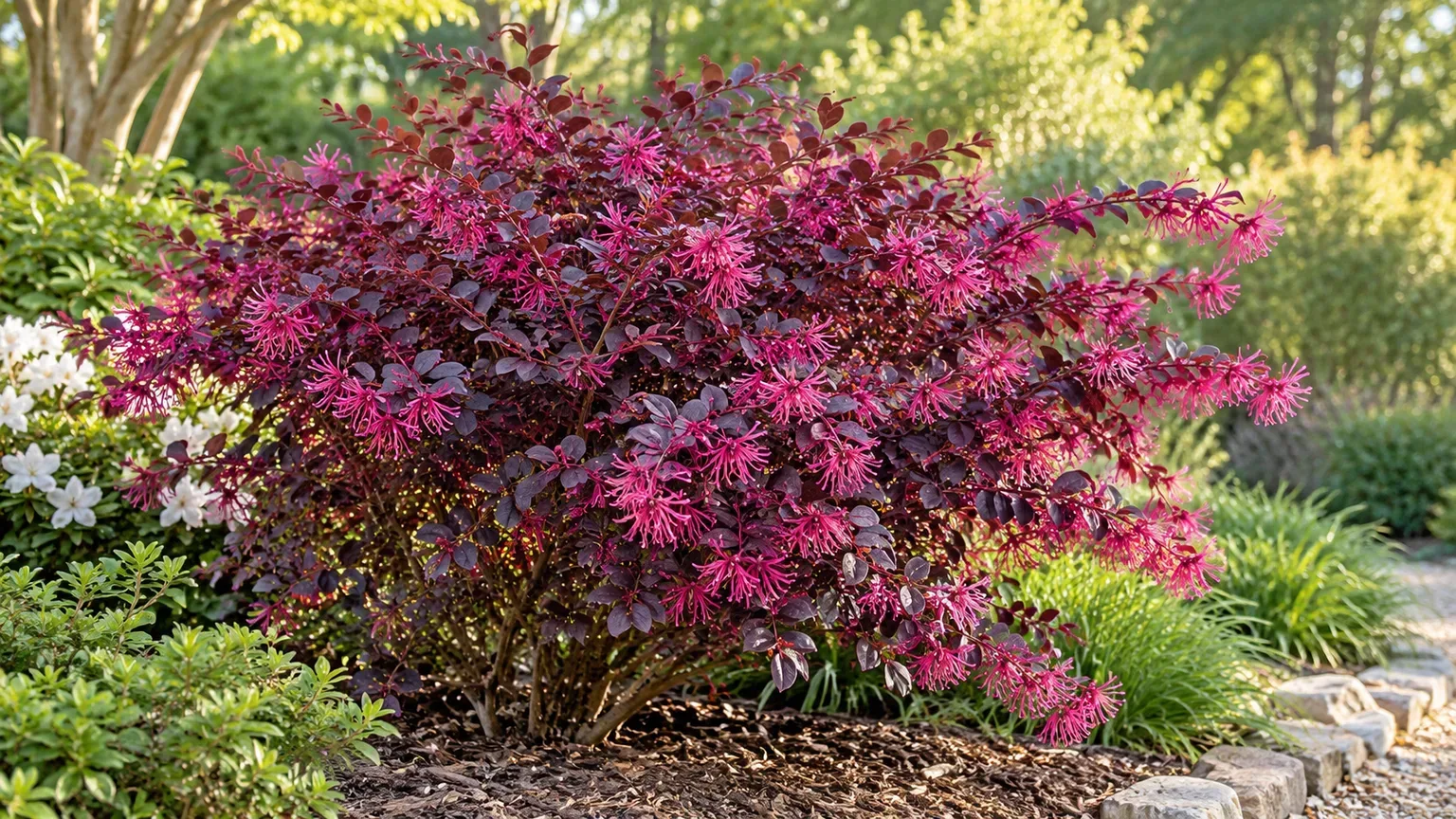
Chinese fringe flower (Loropetalum chinense) is a broadleaf shrub grown for arching branches, small oval leaves, and spring clusters of narrow, ribbon-like flowers. The familiar burgundy-leaved selections bloom pink to red, while the species form has green leaves and white flowers. The name can suggest one tidy shrub, but loropetalums range from low mounds to large screening plants, so choosing a cultivar that fits the site is the first step toward easy care.
Most established plants need little routine attention when they have acidic, well-drained soil and enough light. The problems that deserve attention are persistent wetness, alkaline soil, winter exposure at the cold edge of the plant’s range, and pruning that removes developing flower buds.
| Care point | What to provide |
|---|---|
| Light | Full sun to partial shade; protect from harsh afternoon sun in hot climates |
| Soil | Moisture-retentive but well-drained, fertile soil; ideally acidic, around pH 4.5–6.5 |
| Water | Water deeply while establishing; after that, water during prolonged dry spells and avoid saturated roots |
| Mature size | Highly cultivar-dependent: dwarf mounds may be about 1–3 feet tall, while larger shrubs can exceed 10 feet |
| Flowering | Main flush usually arrives in late winter or spring; some cultivars rebloom lightly |
| Pruning | Usually optional; if shaping is needed, prune after the main bloom |
| Hardiness | Commonly grown in USDA Zones 7–10, but cultivar, exposure, and container roots affect winter survival |
What is Chinese fringe flower?
Chinese fringe flower is an evergreen or semi-evergreen shrub in the witch-hazel family, Hamamelidaceae. It is native to parts of eastern Asia and has a rounded to vase-shaped habit with layered, arching stems. The flowers have slender petals that look like small tassels, which explains the common name and the botanical name: loron and petalon are Greek roots meaning strap and petal. North Carolina State Extension
In warm regions the leaves usually stay on through winter. In colder or exposed sites, a plant can lose some foliage or suffer tip damage without behaving like a fully deciduous shrub. The best-known selections have burgundy or purple foliage and pink flowers, but green-leaved forms with white flowers are also available. Some cultivars show red or bronze new growth that matures to greener or deeper purple leaves, so a seasonal color change is not automatically a sign of poor health.
Do not confuse loropetalum with Chinese fringe tree (Chionanthus retusus), a different woody plant with much larger leaves and flower panicles. At a nursery, check the botanical name on the tag if you are buying by common name alone.
Choose a cultivar that fits your space
Cultivar choice matters more than a generic “mature size” listing. Some Chinese fringe flowers remain low and wide, while others become substantial shrubs that can crowd paths, windows, and neighboring plants if placed as though they were compact foundation bushes. Ask for the cultivar name, then plan around its expected width as well as its height.
| Example selection | Approximate mature size | Common use |
|---|---|---|
| ‘Purple Pixie’ | About 1–2 feet tall and 4–5 feet wide | Low, spreading groundcover or slope |
| ‘Snow Muffin’ | About 1–3 feet tall and 2–3 feet wide | Compact mound with white flowers |
| ‘Emerald Snow’ | About 4 feet tall and wide | Medium compact shrub with green foliage and white flowers |
| ‘Sizzlin’ Pink’ | About 4–6 feet tall and 4–5 feet wide | Mid-size hedge, border, or accent |
| ‘Plum Delight’ or ‘Pizzazz’ | Often about 6–8 feet tall and wide | Larger accent or informal screen |
These are approximate landscape figures, not promises: local climate, pruning, age, and growing conditions change the result. UF/IFAS Extension’s cultivar descriptions show how sharply heights and spreads can differ even among commonly sold plants; North Carolina State Extension notes that species plants can grow taller still. Check the nursery label and leave room for the full stated spread instead of planning to shear a naturally arching plant into a permanently smaller shape. UF/IFAS Extension North Carolina State Extension
Match mature height and spread to the planting site
For a foundation bed, use a compact cultivar if you need a low plant beneath windows or beside a narrow walkway. A taller selection can work as a screen or background shrub, but measure the available space from the center of the planting hole to paths, walls, utility equipment, and neighboring plants. As a simple starting point, reserve at least half the cultivar’s listed mature width on each side of the trunk; add more room where you want an open, layered form rather than a clipped hedge.
Low, spreading types can soften a retaining wall or cover a slope, but their width may be several times their height. A container can control the root area and make a compact cultivar easier to place, yet it does not turn a large cultivar into a permanently small plant. If you need a plant that stays below a specific height without frequent pruning, buy one bred for that size rather than relying on repeated shearing.
Where Chinese fringe flower grows best
Choose a site with good drainage, some shelter from cold wind, and enough light for the chosen foliage color and flower display. North Carolina State Extension recommends full sun with some afternoon shade for strong bloom and foliage, while the RHS advises afternoon shade and shelter from cold winds in its cooler climate context. In practice, morning sun with light afternoon protection is a useful starting point in hot regions; in cooler summers, more direct sun can improve flowering and color. North Carolina State Extension Royal Horticultural Society
Avoid a low pocket where rainwater stands or a dense shade bed where the shrub receives little direct light. A loropetalum may survive less-than-ideal conditions for a time, but chronic shade reduces flowering and soggy soil can damage roots. If the only available site is heavy clay, consider a raised bed or broad mound so the root zone drains instead of making a deep, amended planting hole that stays wet inside the surrounding clay.

Balance light, bloom, and foliage color
Most loropetalums tolerate partial shade, but “tolerates” does not mean the shrub will look the same in every exposure. More sun generally supports a fuller flower display and richer foliage color in burgundy selections. Strong, dry afternoon sun can scorch leaves in hot climates, especially on a recently planted shrub with a small root system. When both problems are possible, give the plant morning sun and late-day shade rather than deep shade all day.
Light can also help explain weak flowering. Before adding fertilizer to a shrub that makes leaves but few flowers, check whether nearby trees or a fence have reduced the light since planting. If the site is shaded, selective pruning of an overhanging plant or moving a young loropetalum may help more than feeding it.
Use hardiness zones as a guide, not a guarantee
Chinese fringe flower is commonly grown in USDA Zones 7–10, but listed hardiness is not a guarantee that every cultivar will thrive throughout those zones. North Carolina State Extension advises protecting plants in cooler areas from winter winds and notes that spring planting gives them more time to establish before winter. Gardeners’ World gives a more conservative cold tolerance for the UK climate it covers, which illustrates why local guidance and the exact cultivar matter. North Carolina State Extension Gardeners’ World
In a borderline zone, select a cold-hardy cultivar, plant it in spring, mulch the root zone after the soil cools, and choose a site protected from wind. Do not feed heavily late in the growing season to encourage soft new growth before frost. A potted shrub has less insulation around its roots than one planted in the ground, so it may need a sheltered, unheated winter location even when an in-ground plant survives nearby.
Plant loropetalum without creating root stress
Plant in spring or fall when temperatures are moderate and the soil is workable; spring is a safer choice in colder regions because roots have the growing season to settle before winter. Water the nursery container before planting so the root ball is evenly damp. Check the plant’s tag for the cultivar, spread, and any protected variety name before buying or propagating it.
Planting in a garden bed
First, test the site after rain. If water remains around the planting area for hours, fix drainage or choose another location before setting the shrub in the ground. A hole that is much deeper than the root ball does not solve poor drainage; it can become a basin that collects water around the roots.
Dig a hole roughly two to three times as wide as the root ball but no deeper than the root ball’s height. Slide the plant from its container and loosen only circling or tightly matted outer roots. Set the top of the root ball level with, or just slightly above, the surrounding soil; deep planting can bury the stem base and leave the shrub chronically stressed. Backfill with the native soil, firm gently to remove large air pockets, and water thoroughly. Garden Design Gardeners’ World
Space plants according to their mature width, not the size of the nursery pot. If a cultivar is expected to spread six feet, planting its center only three feet from a wall leaves no room for its mature canopy and airflow. For a hedge, you can plant closer than the full individual spread, but expect the shrubs to overlap and plan to prune them after flowering if you want a uniform edge.
Apply a two- to three-inch layer of organic mulch over the root zone, keeping it a few inches away from stems. Mulch reduces moisture swings and protects roots, but a mound piled against the trunk stays damp and hides the base of the plant. Garden Design
Growing Chinese fringe flower in a container
Choose a dwarf or compact cultivar and a sturdy pot with several open drainage holes. The container should be only a little wider than the current root ball; a pot that is dramatically oversized holds extra wet mix around a small root system. Use a high-quality, well-draining container mix suited to acid-loving shrubs, and place the pot where it gets bright light and good air circulation.

Water a container when the upper layer of mix begins to dry, then let excess drain completely. Containers warm and dry faster than garden beds, so check them more often during hot, windy weather; do not leave the pot standing in a saucer of water. Repot when roots circle densely or emerge from the drainage holes, moving up one pot size and refreshing some of the mix.
Container roots experience colder temperatures than roots in the ground. Before a prolonged hard freeze, move the pot beside a sheltered wall or into a cool, unheated protected space, or insulate the container and group it with other pots. Avoid bringing an outdoor shrub into a heated room for the winter; a warm indoor environment is not a substitute for the plant’s seasonal outdoor conditions. Gardeners’ World
Water by establishment and soil condition
Water a newly planted loropetalum deeply after planting, then keep the root ball and nearby soil evenly moist while roots establish. During a dry spell in the first growing season, a deep soak once or twice a week may be a useful starting point, but rainfall, soil texture, temperature, and drainage determine the actual interval. Gardeners’ World recommends watering one to two times weekly during dry spells in the first season; use that as a check-in prompt, not an automatic calendar. Gardeners’ World
To decide whether to water, feel the soil a few inches below the surface near the root ball. If it is still cool and damp, wait; if it is dry at root depth, water slowly enough to soak the full root zone. Frequent shallow sprinkling can wet the surface while leaving deeper roots dry. After establishment, loropetalum is somewhat drought tolerant, but prolonged heat or drought can still cause leaf scorch, leaf drop, or reduced flowering, so water during extended dry spells rather than waiting for severe wilting. North Carolina State Extension Garden Design
Container plants need more frequent checks because the limited soil volume dries quickly. If a container mix repeatedly dries out in a day or two, move the plant out of intense afternoon exposure or use a larger pot at the next repotting. If the mix stays wet for several days, verify drainage holes and reduce watering; adding more water to a wet pot can worsen root decline.
Manage soil, mulch, and fertilizer
Loropetalum performs best in rich, moisture-retentive but well-drained soil that is acidic. A soil pH around 4.5–6.5 is commonly recommended; in alkaline soil, leaves may develop chlorosis as the plant struggles to access nutrients. The first step for recurring yellow foliage is a soil test, not an improvised dose of fertilizer or acidifier. Garden Design North Carolina State Extension
Mix compost into a broad planting bed if the soil is low in organic matter, but do not fill only the planting hole with rich, loose material in heavy clay. The sharp transition can hold water around the root ball. In a poorly drained site, raising the bed or planting on a mound is usually more reliable than trying to fix one small pocket. Keep mulch two to three inches deep and pulled away from the stems.
Established shrubs in suitable soil usually need little or no supplemental fertilizer. If growth is weak, first check light, drainage, pH, and whether the shrub is still establishing. If a soil test indicates a nutrient need, use a fertilizer labeled for landscape shrubs and follow its rate and timing directions. Applying extra nitrogen when leaves are yellow can produce soft foliage without correcting high-pH chlorosis or root damage.
Prune after the main bloom
A loropetalum can keep its naturally arching shape with little pruning. Remove dead, damaged, or crossing stems as needed, then wait until the main spring flower flush fades before shaping the live canopy. Pruning in late winter or before flowering may remove buds formed on the previous season’s growth; late-spring pruning gives the shrub more time to grow before winter and may leave room for light later blooms on cultivars that rebloom. North Carolina State Extension Gardeners’ World
Use hand pruners or loppers to thin selected branches back to a side branch or the main stem instead of shearing every surface into a tight shell. Selective cuts open the shrub while preserving its layered habit and light inside the canopy. If it is used as a formal hedge, trim lightly after bloom and accept that repeated shearing can reduce flowers and create a dense outer layer with bare interior stems.
Work carefully: loropetalum branches can be brittle, and leaning into the canopy or pulling branches aside can snap them. Remove a few stems at a time, step back to assess the outline, and avoid taking off more than needed in one session. A badly overgrown shrub can be reduced gradually over two or three post-bloom seasons; a severe cutback may sacrifice the next bloom and leave an uneven plant while it regrows. UC Marin Master Gardeners
Propagate from cuttings or by layering
Softwood or semi-ripe cuttings taken in late spring through midsummer are a practical way to make a clone of a plant, while layering is slower but leaves the shoot attached to the parent as it roots. Seed is a poor choice when you want the same flower color and habit as a named cultivar because seedlings can vary from the parent. GardenersPath
For a cutting, choose a healthy, non-flowering shoot that is beginning to firm up rather than a very soft, wilting tip. Cut a four- to six-inch section with clean pruners, remove leaves from the lower half, and insert the bare portion into a small pot of moist, airy propagation mix. A rooting hormone is optional; if you use one, follow its label and keep it off foliage and skin.
Cover the pot with a clear dome or bag to maintain humidity, but keep the cover from touching the leaves. Place it in bright, indirect light away from hot sun, and keep the medium lightly moist rather than waterlogged. Vent the cover if heavy condensation persists. Rooting may take several weeks; once a cutting resists a gentle tug and begins new growth, remove the cover gradually and let it establish in its pot before planting outdoors. GardenersPath Gardeners’ World
Layering is another option if a low branch can reach the soil. Pin a section of stem under a shallow layer of soil while leaving its tip above ground, then keep the area moist and check for roots after several months; it can take about a year for roots to form. Once rooted, sever the new plant from the parent and grow it in a pot before transplanting. If the mother plant is a named patented cultivar, check its tag and patent status first: in the United States, a plant patent can give its owner the right to exclude others from asexual reproduction of that specific plant. United States Patent and Trademark Office
Follow the seasons and set bloom expectations
The main flower display usually arrives in late winter or spring, with the exact timing varying by climate and cultivar. Some selections produce a smaller, scattered rebloom later in the year, but the shrub should not be treated as a continuous bloomer. The strongest floral show is tied to the branches and buds already present before the spring flush, which is why timing a major prune after that display matters. North Carolina State Extension Garden Design
New foliage may open red, bronze, or purple, then shift toward green or a deeper shade as it matures. The color depends on cultivar, light, and seasonal conditions. A green-leaved, white-flowered selection is not a failed burgundy variety; it is a different form. Likewise, a red-leaved cultivar may look less vivid in shade without being diseased.
In spring, refresh mulch and remove winter-damaged tips after you can see where living growth resumes. During summer, water young plants through dry spells and monitor container moisture. In autumn, stop routine shaping so the plant can hold its buds and harden its growth before winter. In colder areas, keep the root zone mulched and the shrub sheltered from drying winds; in warm climates, routine winter protection is usually unnecessary for an in-ground plant.
Troubleshoot yellow leaves, scorch, and dieback
Start with the pattern of damage and the condition of the soil. Yellow leaves across a whole shrub may point to root stress, while distorted new leaves, discrete spots, or swollen stems suggest different problems. Do not apply a pesticide or trace-element spray until you have a plausible diagnosis; some loropetalum problems are uncommon, and treatment can be ineffective or add more stress.
Separate soil and water problems from disease
Yellowing between green veins on newer foliage can be chlorosis associated with alkaline soil. Check soil pH and drainage before changing the soil; high pH is a known issue for loropetalum, and the right correction depends on a test and local soil conditions. A yellowing shrub in soggy ground may instead have root damage. If the root zone is wet, correct drainage and watering first rather than adding iron or fertilizer. North Carolina State Extension Garden Design
Small, distorted, crumpled new leaves and stunted shoots can indicate copper deficiency, which UF/IFAS reports is more common in the ‘Ruby’ cultivar and may be associated with high soil pH. Because that symptom can be confused with other stress, confirm the issue with a soil test or local extension office before using copper. If any treatment is recommended, follow the product label exactly; do not borrow a commercial nursery mixture for a home landscape. UF/IFAS Extension
Brown margins on the side facing intense sun or cold wind may be scorch. Improve the site’s afternoon protection, keep the root ball from drying completely, and wait for healthy new growth before pruning back living branches. Few pests are usually serious, but inspect for mites or aphids if leaves stipple, curl, or look unusually dull. A strong spray of water may be enough for a small aphid population; identify the pest before choosing any control. Dull purple spots are an uncommon leaf disease reported by UF/IFAS; cool, moist weather can encourage it, so avoid keeping foliage wet and ask a local extension office for help if spotting spreads. [UF/IFAS Extension]
Rough, dark swellings on stems, followed by branch dieback, can be a sign of bacterial gall. Do not take or share cuttings from a suspicious plant. UF/IFAS says sanitation is the current control: disinfect tools after each cut, and understand that removing galled branches may slow spread but does not eradicate the bacterium from an infected shrub. Ask a county extension office whether a plant with widespread galls should be removed; routine fungicide is not a cure for this bacterial problem. [UF/IFAS Extension]
Conclusion
The most reliable Chinese fringe flower care starts before planting: choose a cultivar whose full spread fits the space, give it light for good flowering, and set it in acidic soil that drains well. Water consistently while it establishes, then let the soil condition—not a fixed schedule—guide supplemental watering. In suitable ground, a loropetalum needs little feeding and usually little pruning.
If the shrub looks wrong, diagnose the site before reaching for fertilizer: check moisture, drainage, light, and soil pH, then look for a distinct pest or disease symptom. Prune after the main bloom, protect plants exposed to severe cold, and choose a compact cultivar for pots or small gardens. Those choices let the shrub keep its natural shape and seasonal color with less corrective work.



